22-37
22-31 (40 min.) Multinational transfer pricing, global tax minimization.
Supergrow, Inc., based in Des Moines, Iowa, sells high-end fertilizers. Supergrow has two
divisions:
▪ North Italy mining division, which mines potash in northern Italy
▪ U.S. processing division, which uses potash in manufacturing top-grade fertilizer
The processing division’s yield is 50%: It takes 2 tons of raw potash to produce 1 ton of top-
grade fertilizer. Although all of the mining division’s output of 12,000 tons of potash is sent for
processing in the United States, there is also an active market for potash in Italy. The foreign
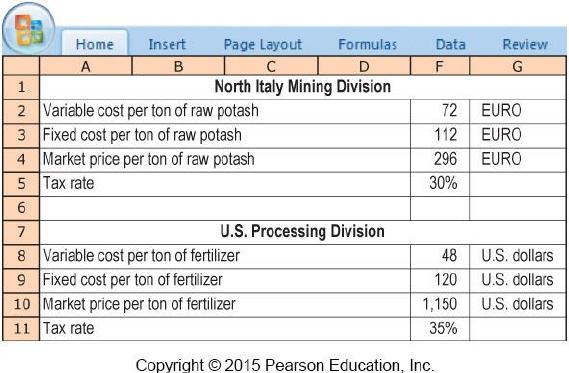
exchange rate is 0.80 Euro = $1 U.S. The following information is known about the two
divisions:
Required:
1. Compute the annual pretax operating income, in U.S. dollars, of each division under the
following transfer-pricing methods: (a) 150% of full cost and (b) market price.
2. Compute the after-tax operating income, in U.S. dollars, for each division under the transfer-
pricing methods in requirement 1. (Income taxes are not included in the computation of cost–
based transfer price, and Supergrow does not pay U.S. income tax on income already taxed in
Italy.)
3. If the two division managers are compensated based on after-tax division operating income,
which transfer-pricing method will each prefer? Which transfer-pricing method will
maximize the total after-tax operating income of Supergrow?
4. In addition to tax minimization, what other factors might Supergrow consider in choosing a
transfer-pricing method?
22-38
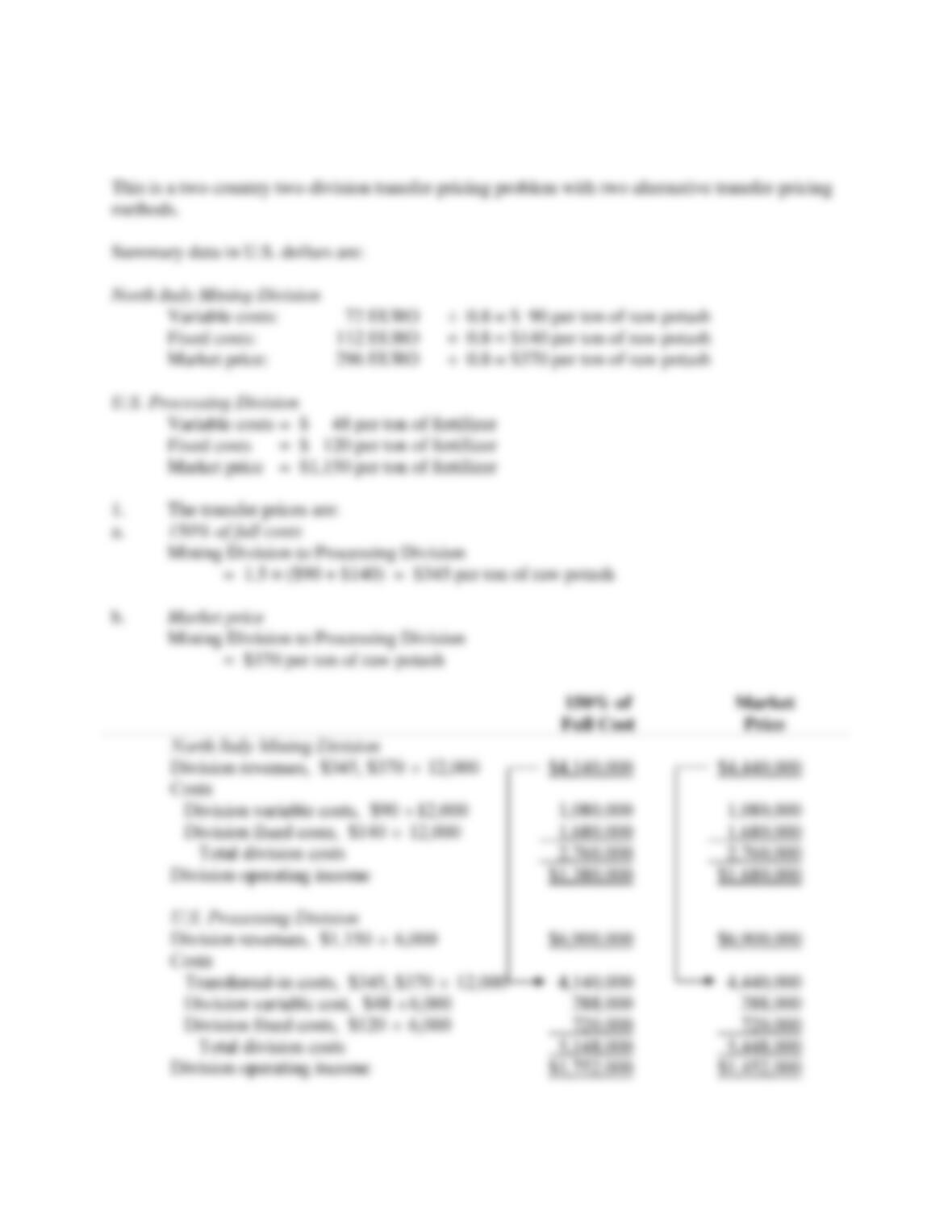
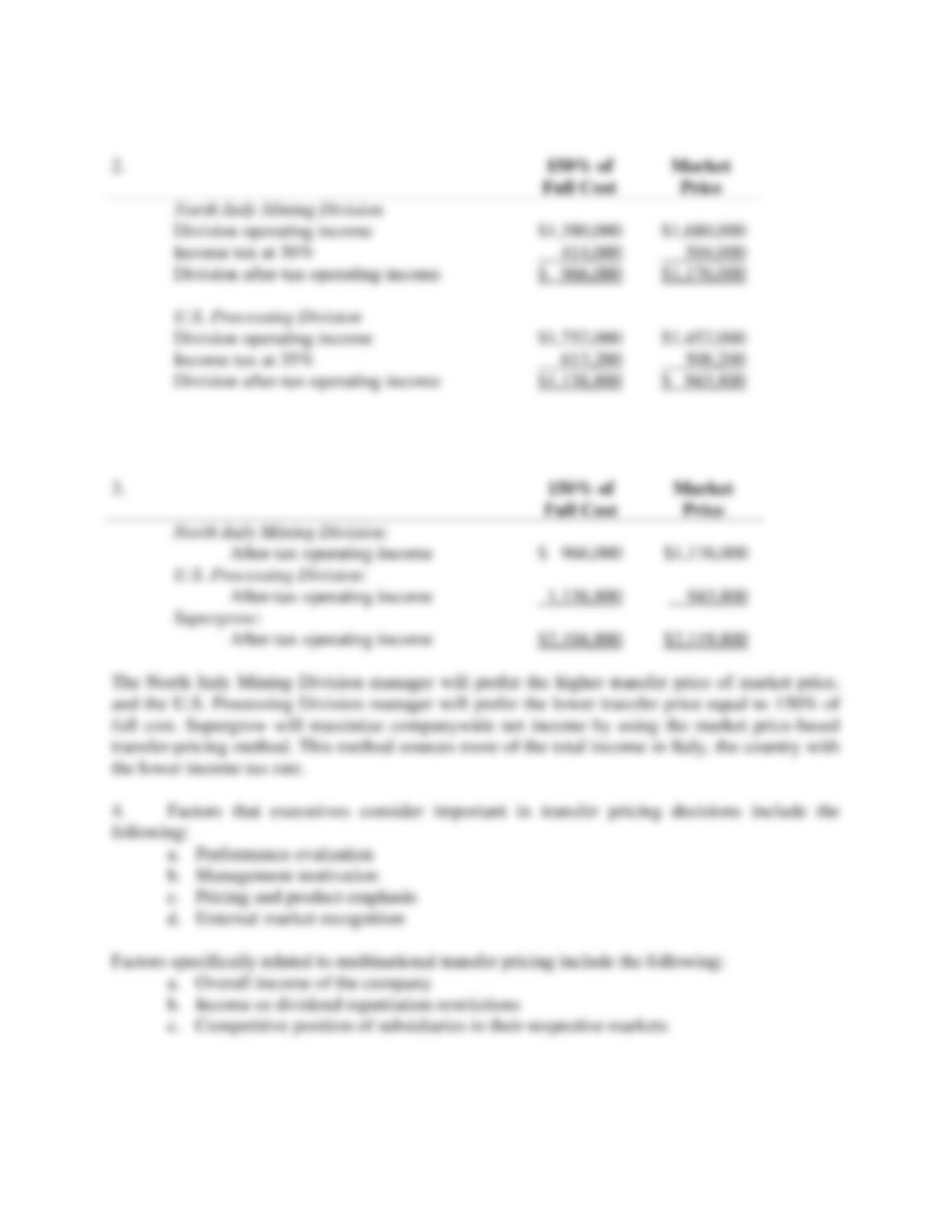
SOLUTION
22-39
22-40
22-32 (30–40 min.) Transfer pricing, external market, goal congruence.
Baldenius Corp. produces and sells high- quality scissors made of stainless steel. The firm
consists of two divisions, UP and DOWN. The UP division manufactures 30,000 pairs of
scissors per year. It incurs variable manufacturing costs of $9 per unit and total annual fixed
manufacturing costs of $60,000. The UP division sells 10,000 units externally at a price of $16
each, mostly to office supplies stores. It transfers the remaining 20,000 units internally to the
DOWN division, which modifies the units, adds a titanium plasma coating, and sells them for
use by salon professionals in the United States.
Baldenius Corp. has adopted a market-based transfer pricing policy. For each pair of scissors
it receives from the UP division, the DOWN division pays the weighted-average external price
the UP division charges its customers outside the company. The current transfer price is
accordingly set at $16.
Kathleen Bono, the manager of the UP division, receives an offer from Jean-Georges, an
international hair salon supplier. Jean-Georges offers to buy 4,000 pairs of scissors at a price of
$12.50 each, knowing that the entire scissors industry (including Baldenius Corp.) has excess
capacity at this time. The variable manufacturing cost to UP for the units Jean-Georges is
requesting is $9, and there are no additional costs associated with this offer. Accepting Jean–
Georges’ offer would not affect the current price of $16 charged to existing external customers.
Required:
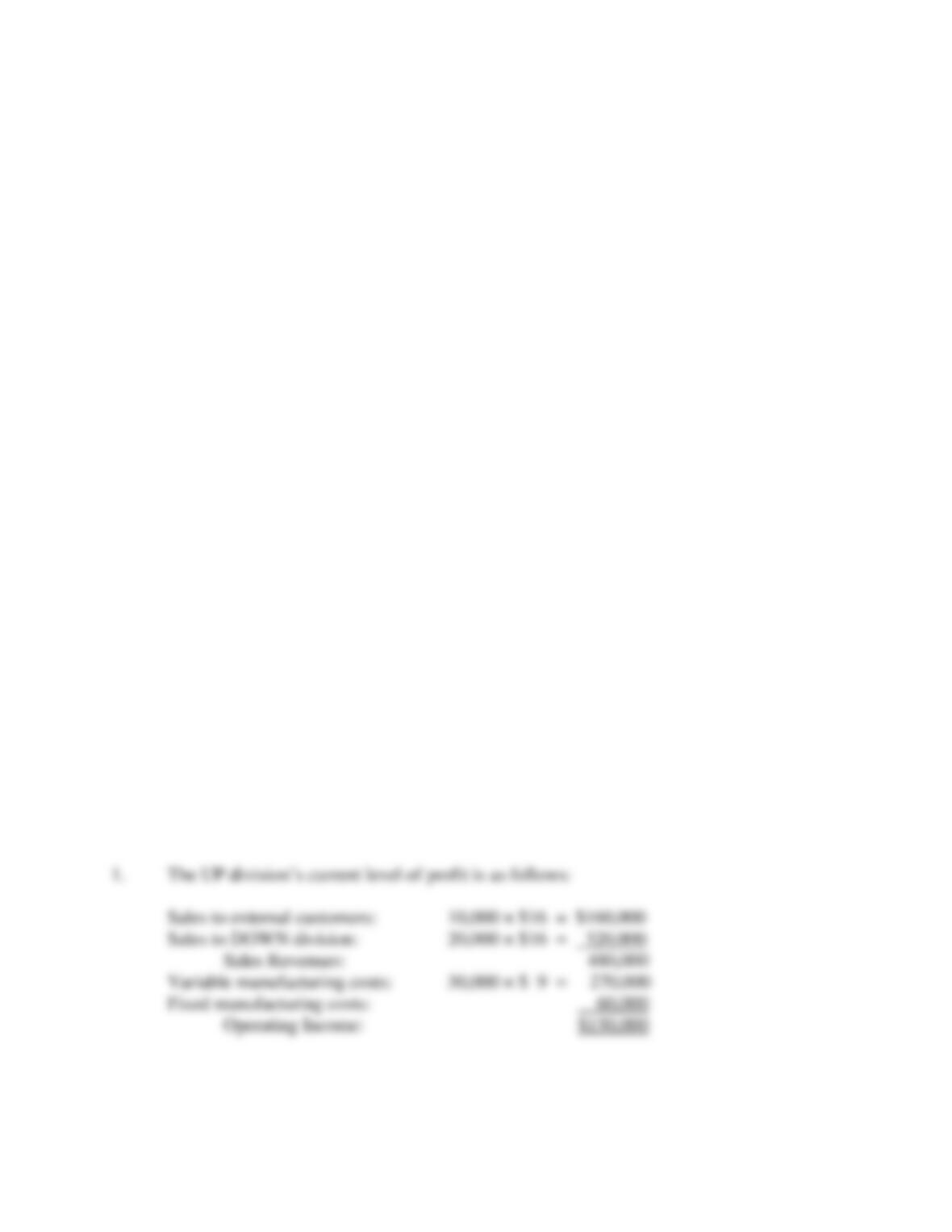
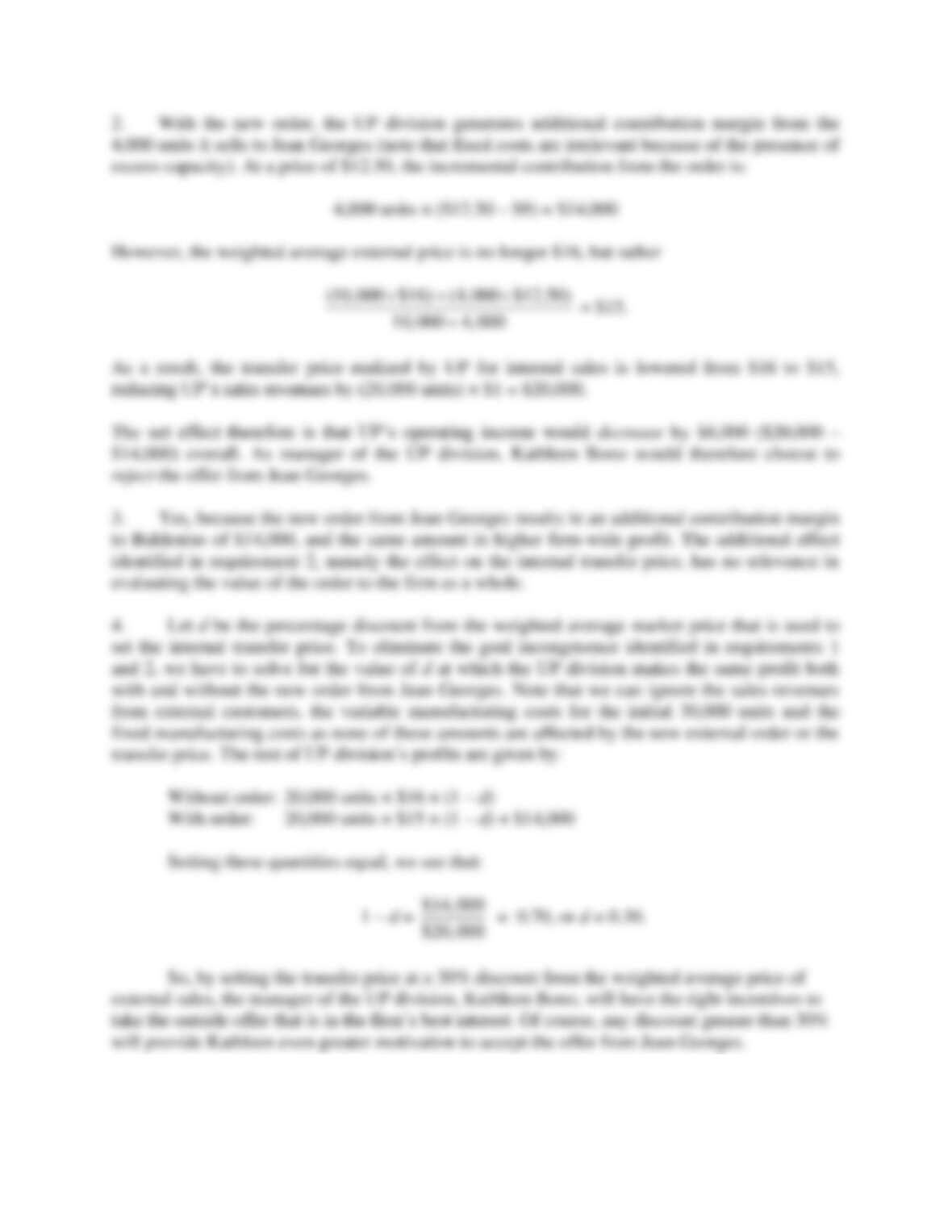
1. Calculate the UP division’s current annual level of profit (without the new order).
2. Compute the change in the UP division’s profit if it accepts Jean–Georges’ offer. Will
Kathleen Bono accept this offer if her aim is to maximize the UP division’s profit?
3. Would the top management of Baldenius Corp. want the UP division to accept the offer?
Compute the change in firmwide profit associated with Jean-Georges’ offer.
4. Baldenius Corp. is considering changing its policy. Henceforth, the transfer price will be set
at a fixed percentage discount from the weighted-average price charged by UP on external
sales. At what percentage discount would the goal incongruence identified in your answer to
requirements 2 and 3 no longer be a problem?
SOLUTION
22-41
22-33 (30–40 min.) International transfer pricing, taxes, goal congruence.
22-42
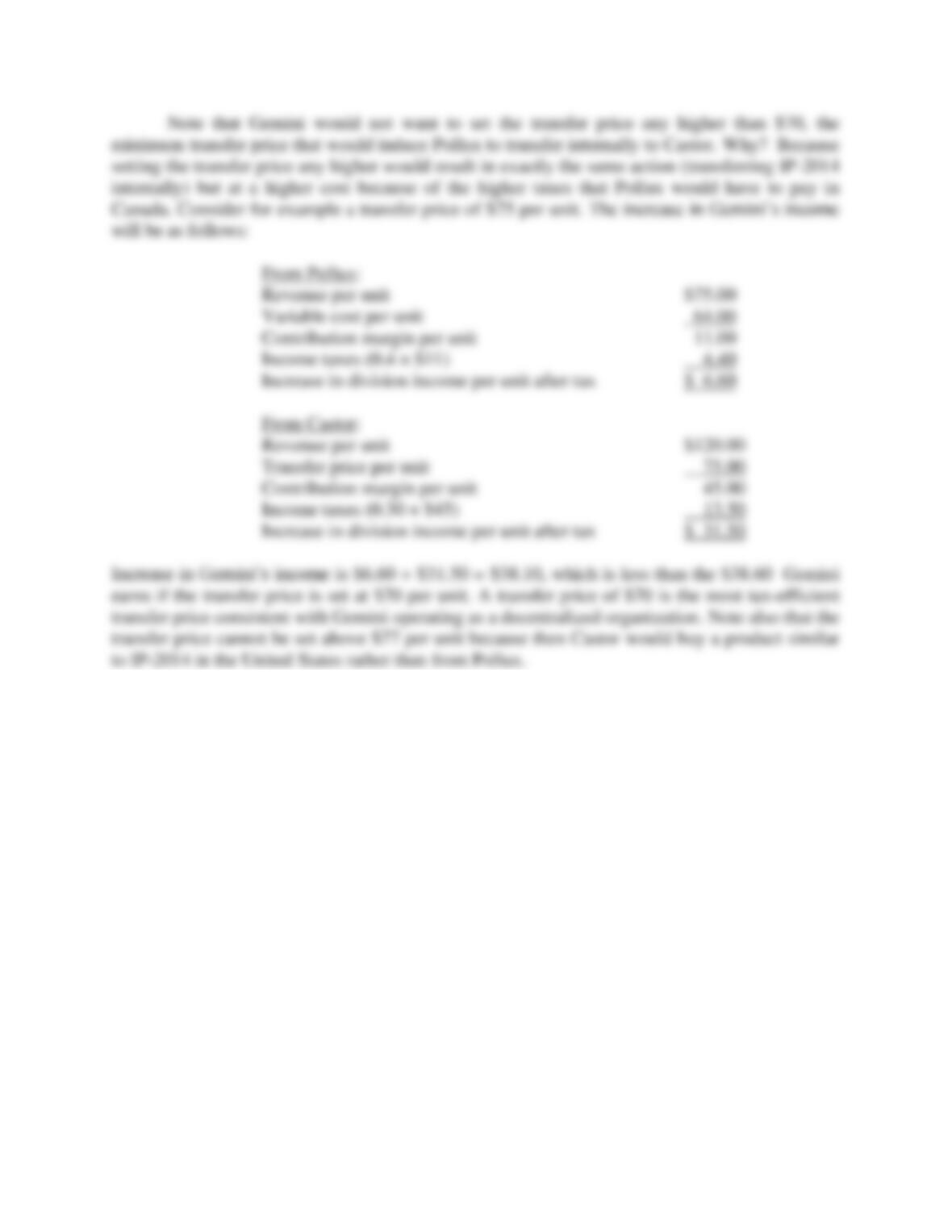
Castor, a division of Gemini Corporation, is located in the United States. Its effective income tax
rate is 30%. Another division of Gemini, Pollux, is located in Canada, where the income tax rate
is 40%. Pollux manufactures, among other things, an intermediate product for Castor called IP–
2014. Pollux operates at capacity and makes 15,000 units of IP-2014 for Castor each period, at a
variable cost of $56 per unit. Assume that there are no outside customers for IP-2014. Because
the IP-2014 must be shipped from Canada to the United States, it costs Pollux an additional $8
per unit to ship the IP-2014 to Castor. There are no direct fixed costs for IP-2014. Pollux also
manufactures other products.
A product similar to IP-2014 that Castor could use as a substitute is available in the United
States for $77 per unit.
Required:
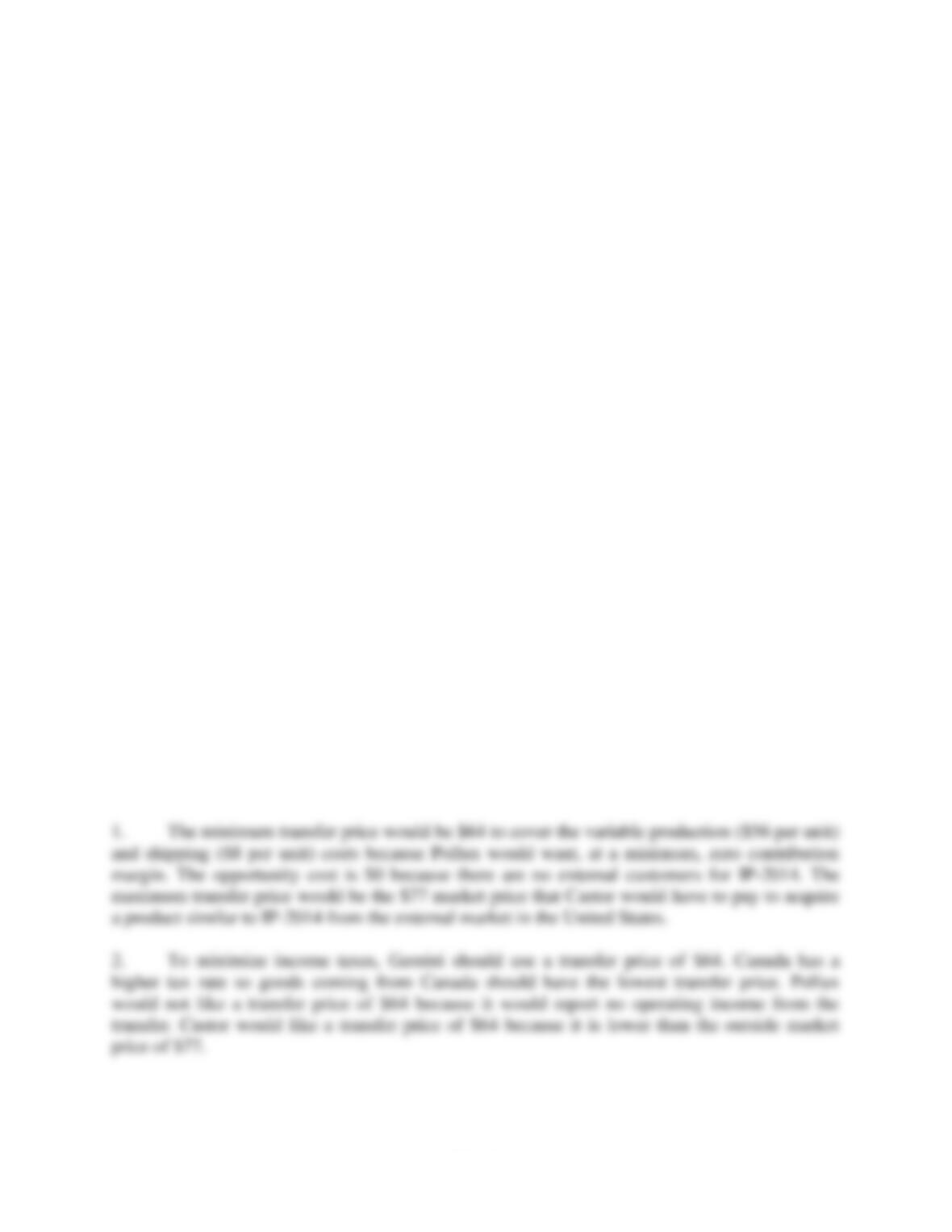
1. What is the minimum and maximum transfer price that would be acceptable to Castor and
Pollux for IP-2014, and why?
2. What transfer price would minimize income taxes for Gemini Corporation as a whole?
Would Castor and Pollux want to be evaluated on operating income using this transfer price?
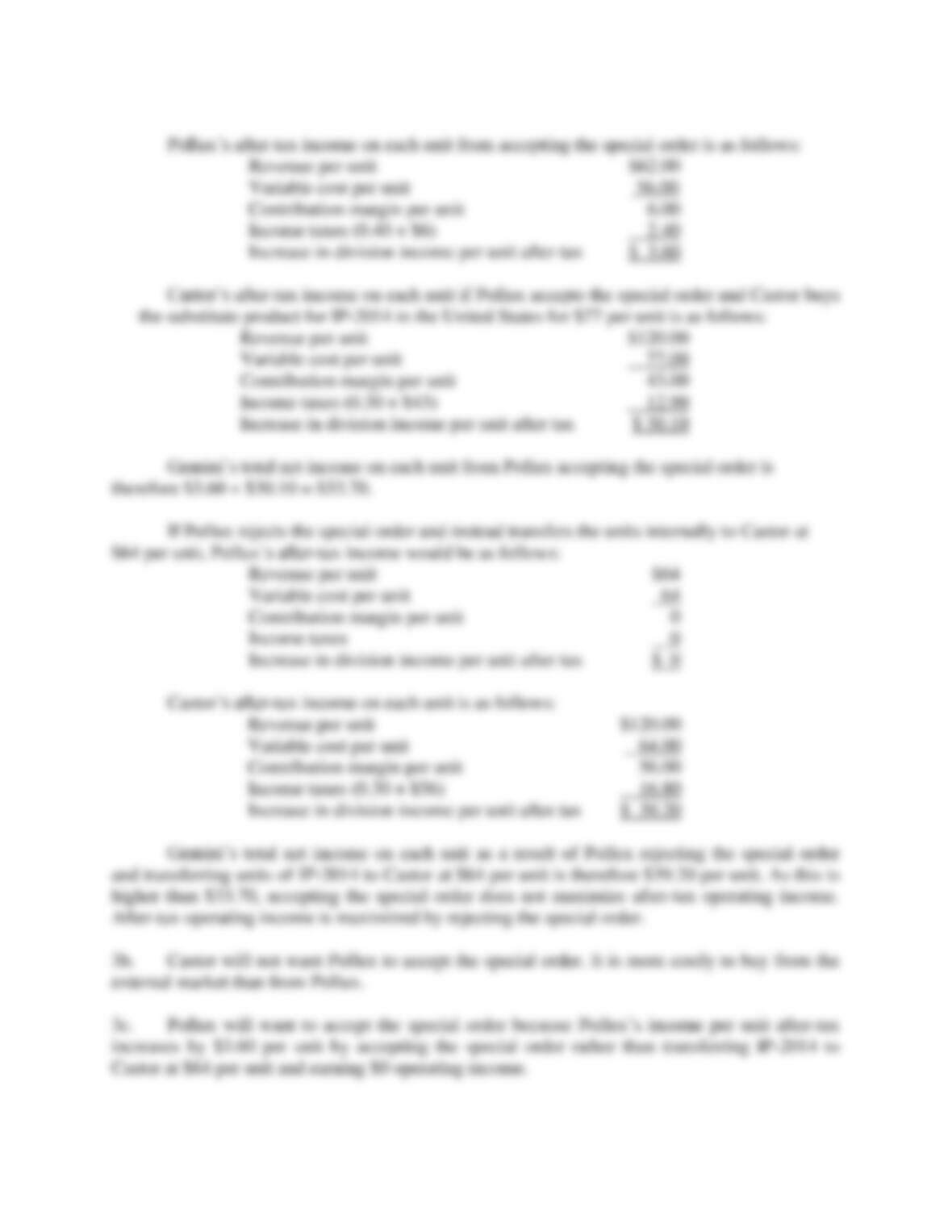
3. Suppose Gemini uses the transfer price from requirement 2 and each division is evaluated on
its own after-tax division operating income. Now suppose Pollux has an opportunity to sell
8,000 units of IP-2014 to an outside customer for $62 each. Pollux will not incur shipping
costs because the customer is nearby and offers to pay for shipping. Assume that if Pollux
accepts the special order, Castor will have to buy 8,000 units of the substitute product in the
United States at $77 per unit.
a. Will accepting the special order maximize after-tax operating income for Gemini
Corporation as a whole?
b. Will Castor want Pollux to accept this special order? Why or why not?
c. Will Pollux want to accept this special order? Explain.
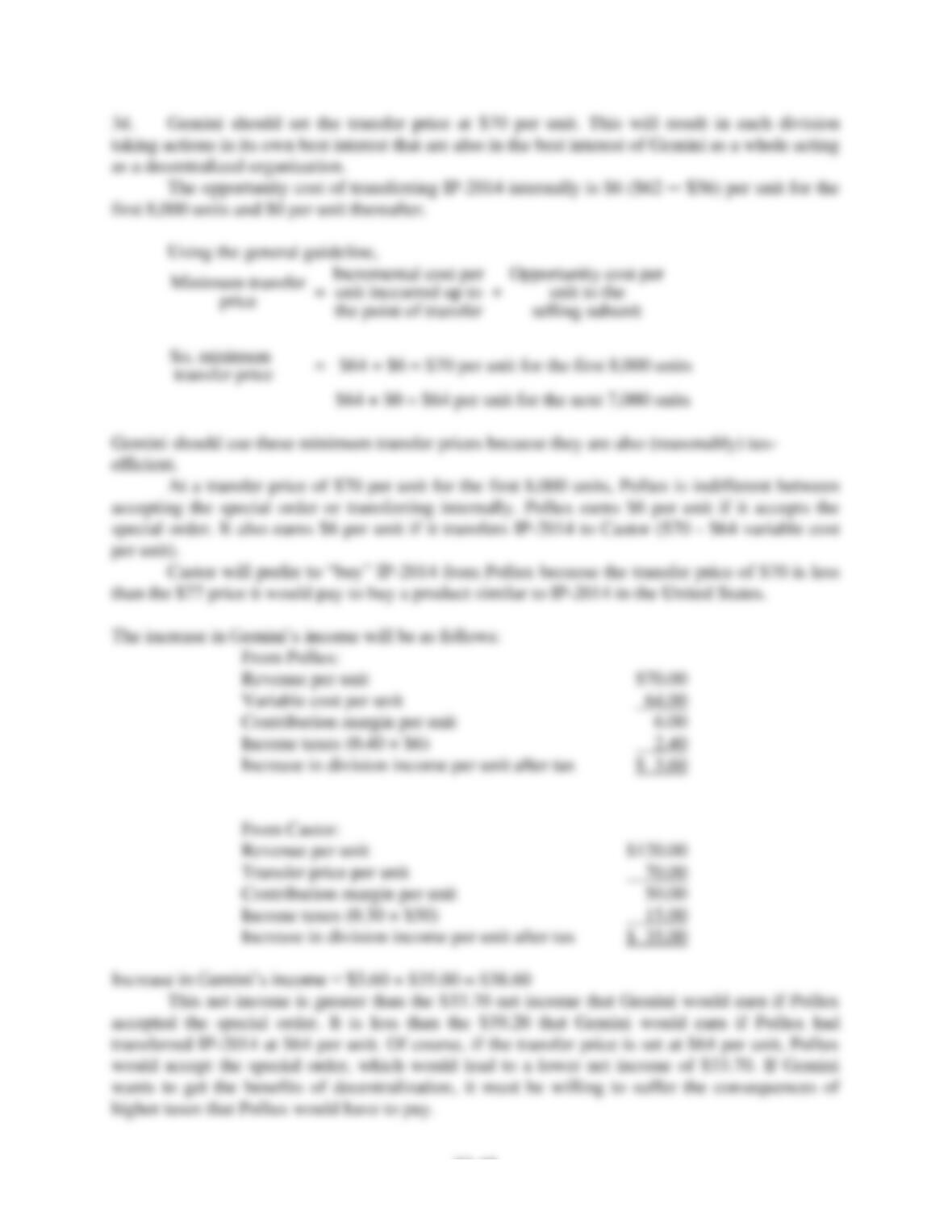
d. Suppose Gemini Corporation wants to operate in a decentralized manner. What transfer
price should Gemini set for IP-2014 so that each division acting in its own best interest
takes actions with respect to the special order that are in the best interests of Gemini
Corporation as a whole?
SOLUTION

22-43
22-44
22-45
22-46
22-34 (20 min.) Transfer pricing, goal congruence, ethics.
Sustainable Industries manufactures cardboard containers (boxes) made from recycled paper
products. The company operates two divisions, paper recycling and box manufacturing, as
decentralized entities. The recycling division is free to sell recycled paper to outside buyers, and
the box manufacturing division is free to purchase recycled paper from other sources. Currently,
however, the recycling division sells all of its output to the manufacturing division, and the
manufacturing division does not purchase materials from outside suppliers.
The recycled paper is transferred from the recycling division to the manufacturing division at
110% of full cost. The recycling division purchases recyclable paper products for $0.075 per
pound. The recycling division uses 100 pounds of recyclable paper products to produce one roll
of recycled paper. The division’s other variable costs equal $6.35 per roll, and fixed costs at a
monthly production level of 10,000 rolls are $2.15 per roll. During the most recent month,
10,000 rolls of recycled paper were transferred between the two divisions. The recycling
division’s capacity is 15,000 rolls.
With the increase in demand for sustainably made products, the manufacturing division
expects to use 12,000 rolls of paper next month. Ecofree Corporation has offered to sell 2,000
rolls of recycled paper next month to the manufacturing division for $17.00 per roll.
22-47
Required:
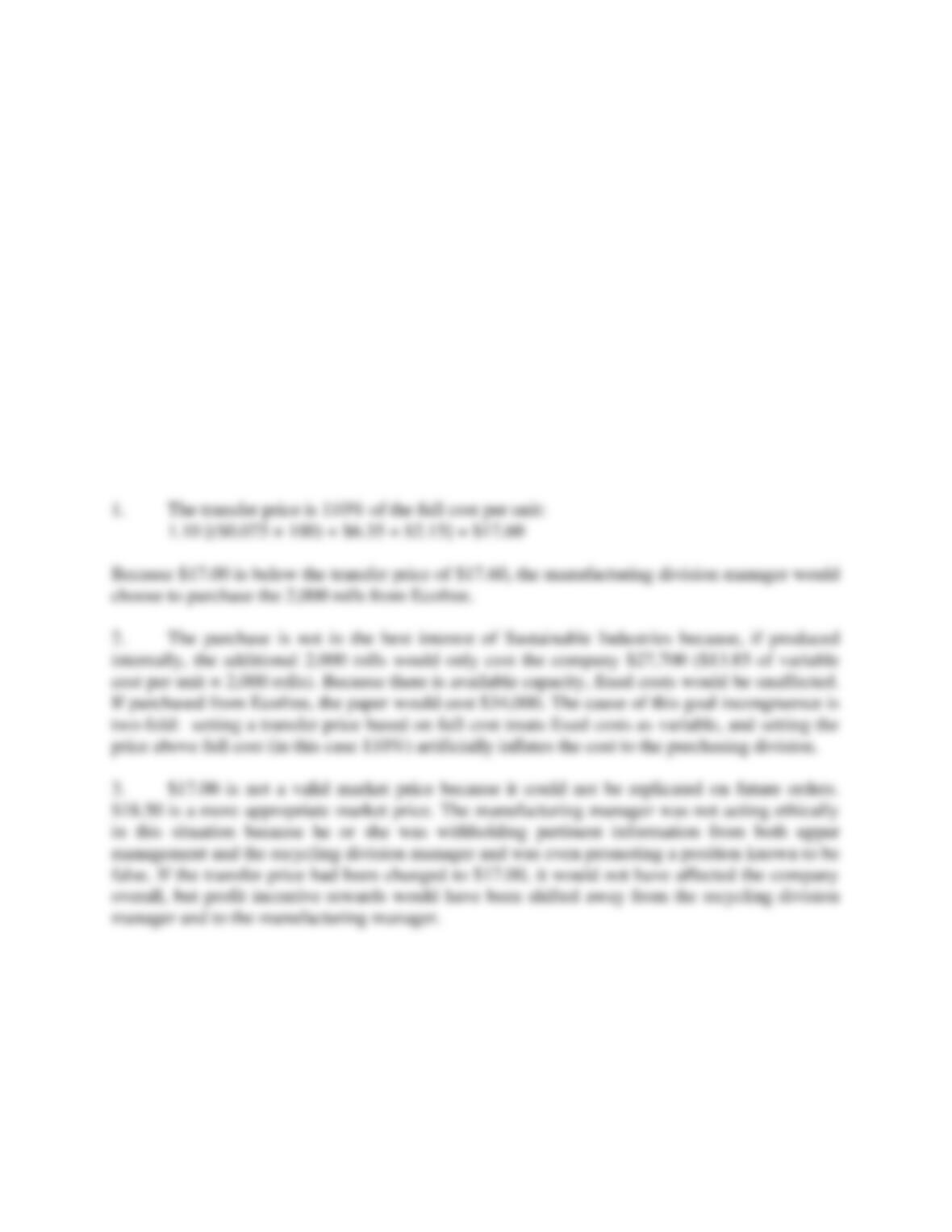
1. Compute the transfer price per roll of recycled paper. If each division is considered a profit
center, would the manufacturing manager choose to purchase 2,000 rolls next month from
Ecofree Corporation?
2. Is the purchase in the best interest of Sustainable Industries? Show your calculations. What is
the cause of this goal incongruence?
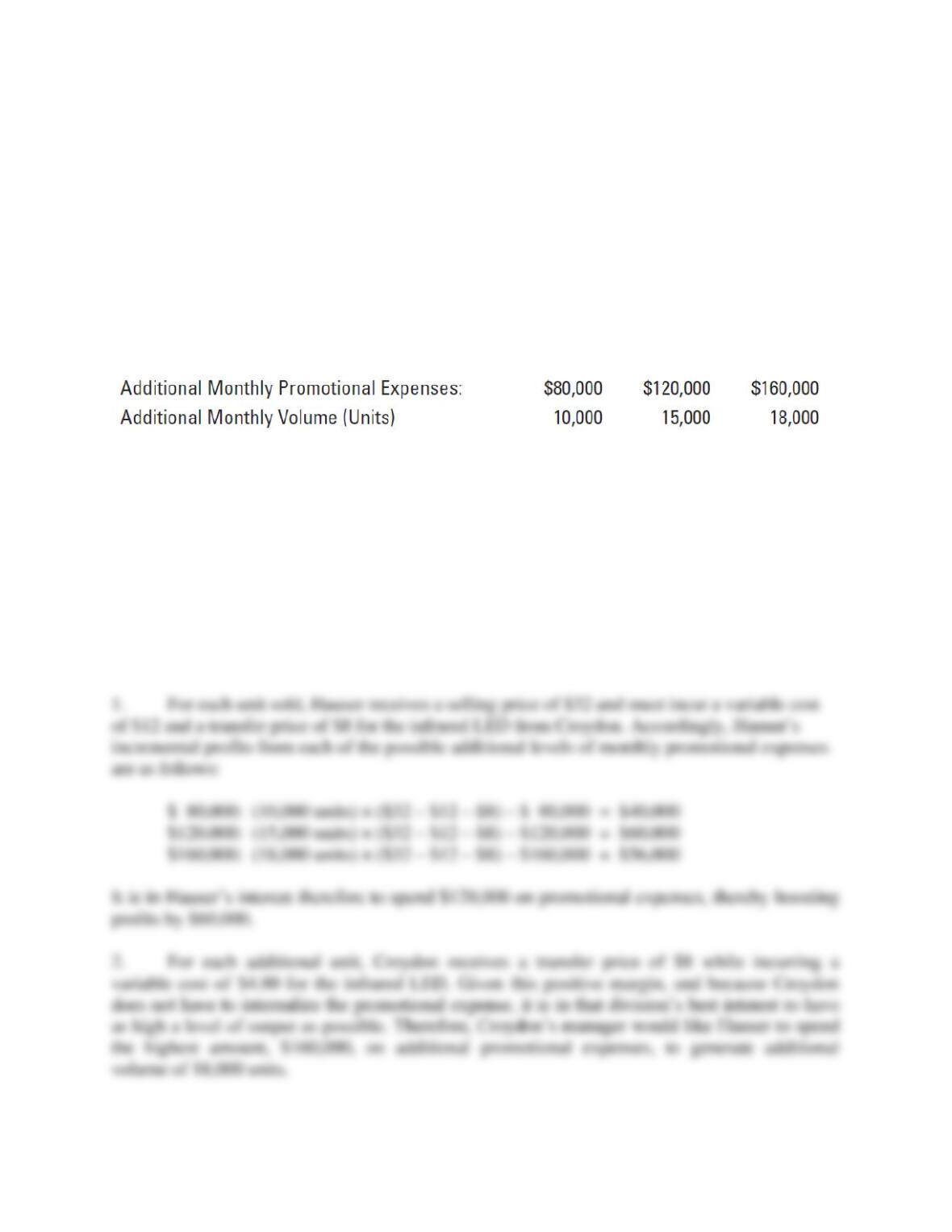
3. The manufacturing division manager suggests that $17.00 is now the market price for
recycled paper rolls and that this should be the new transfer price. Sustainable’s corporate
management tends to agree. The paper recycling manager is suspicious. Ecofree’s prices
have always been much higher than $17.00 per roll. Why the sudden price cut? After further
investigation by the recycling division manager, it is revealed that the $17.00 per roll price
was a one-time-only offer made to the manufacturing division due to excess inventory at
Ecofree. Future orders would be priced at $18.50 per roll. Comment on the validity of the
$17.00 per roll market price and the ethics of the manufacturing manager. Would changing
the transfer price to $17.00 matter to Sustainable Industries?
SOLUTION
22-48
22-35 (25 min.) Transfer pricing, goal congruence.
The Croydon Division of CC Industries supplies the Hauser Division with 100,000 units per
month of an infrared LED that Hauser uses in a remote control device it sells. The transfer price
of the LED is $8, which is the market price. However, Croydon does not operate at or near
capacity. The variable cost to Croydon of the LED is $4.80, while Hauser incurs variable costs
(excluding the transfer price) of $12 for each remote control. Hauser’s selling price is $32.
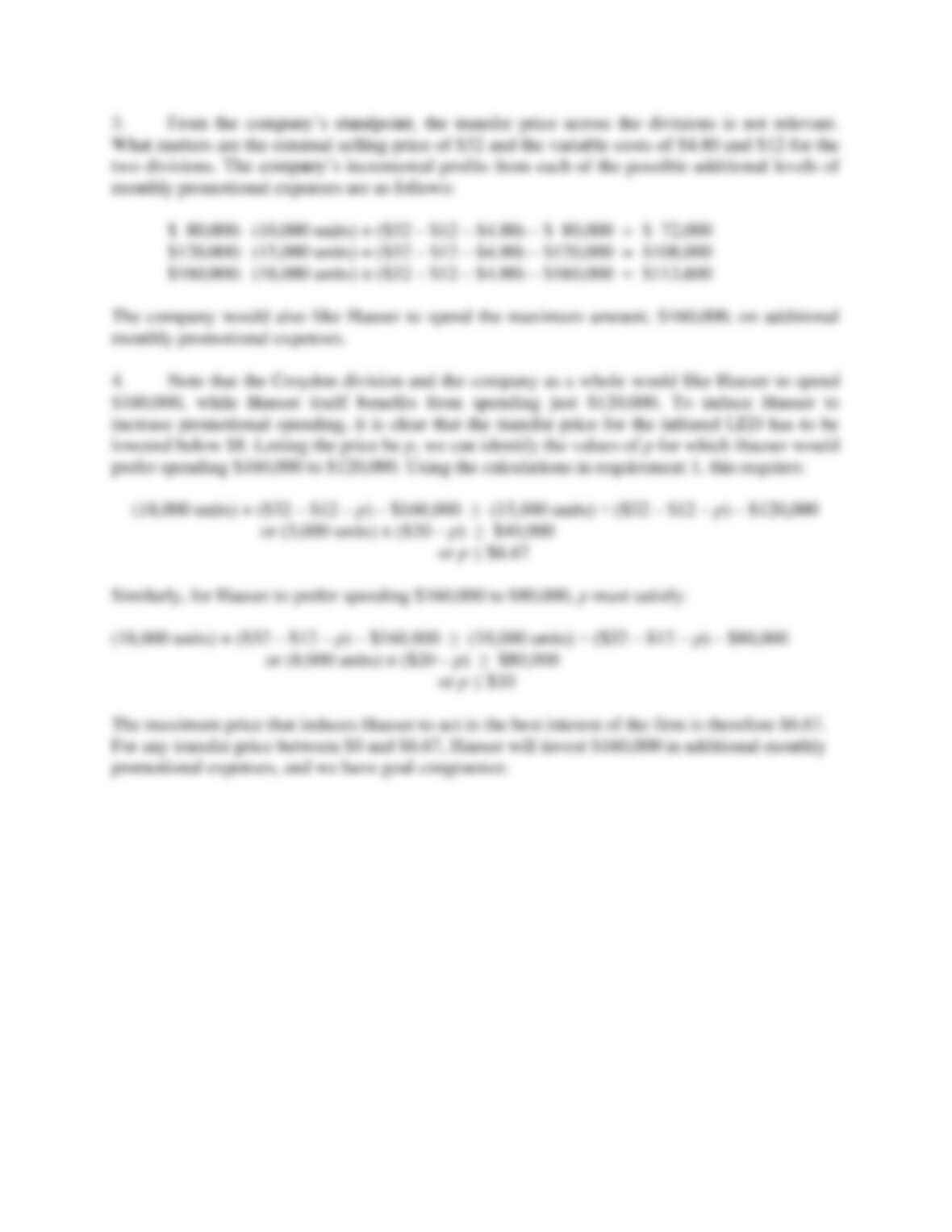
Hauser’s manager is considering a promotional campaign. The market research department of
Hauser has developed the following estimates of additional monthly volume associated with
additional monthly promotional expenses.
Required:
1. What level of additional promotional expenses would the Hauser division manager choose?
2. As the manager of the Croydon division, what level of additional promotional expenses
would you like to see the Hauser division manager select?
3. As the president of CC Industries, what level of spending would you like the Hauser division
manager to select?
4. What is the maximum transfer price that would induce the Hauser division to spend the
optimal additional promotional expense from the standpoint of the firm as a whole?
SOLUTION
22-49
22-36 (30-35 min.) Transfer pricing, perfect and imperfect markets.
Letang Company has three divisions (R, S, and T), organized as decentralized profit centers.
Division R produces the basic chemical Ranbax (in multiples of 1,000 pounds) and transfers it to
Divisions S and T. Division S processes Ranbax into the final product Syntex, and Division T
processes Ranbax into the final product Termix. No material is lost during processing.
Division R has no fixed costs. The variable cost per pound of Ranbax is $0.18. Division R has
a capacity limit of 10,000 pounds. Divisions S and T have capacity limits of 4,000 and 6,000
pounds, respectively. Divisions S and T sell their final product in separate markets. The company
keeps no inventories of any kind.
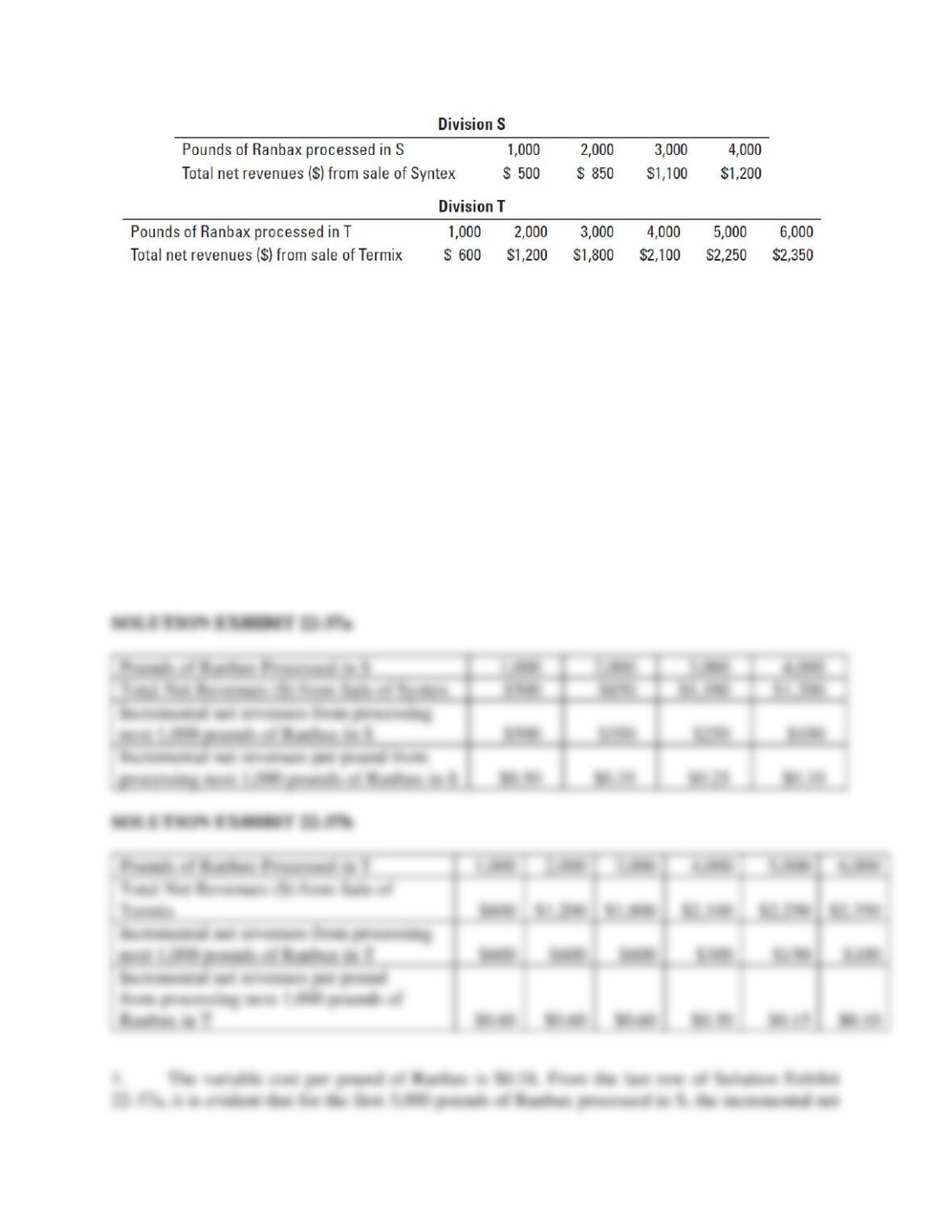
The cumulative net revenues (i.e., total revenues – total processing costs) for divisions S and
T at various output levels are summarized below.
22-50
Required:
1. Suppose there is no external market for Ranbax. What quantity of Ranbax should the Letang
Company produce to maximize overall income? How should this quantity be allocated
between the two processing divisions?
2. What range of transfer prices will motivate Divisions S and T to demand the quantities that
maximize overall income (as determined in requirement 1), as well as motivate Division R to
produce the sum of those quantities?
3. Suppose that Division R can sell any quantity of Ranbax in a perfectly competitive market
for $0.33 a pound. To maximize Letang’s income, how many pounds of Ranbax should
Division R transfer to Divisions S and T, and how much should it sell in the external market?
4. What range of transfer prices will result in Divisions R, S, and T taking the actions
determined as optimal in requirement 3? Explain your answer.
SOLUTION
22-51