CHAPTER 22
Accounting Changes and Error Analysis
ASSIGNMENT CLASSIFICATION TABLE (BY TOPIC)
Topics
Questions
Brief
Exercises
Exercises
Problems
Concepts
for Analysis
1. Differences between change in
principle, change in estimate,
change in entity, errors.
2, 4, 6, 7,
8, 9, 12, 13,
15, 21
8, 10
3, 5
1, 2, 3, 4
2. Accounting changes:
a. Comprehensive.
1, 3
10
3, 6
1, 2, 4, 5
for long-term construction
2, 10
1, 2, 10
1, 6
3
1, 2
4, 7
3
e. Change from FIFO to LIFO.
2, 11
1, 2
f. Change from LIFO.
8
3
2, 3, 5, 7
3
1, 3, 4, 5,
6, 7, 8, 10
8, 9, 10
1, 5
b. Changes in estimate,
changes in depreciation
2, 3, 8, 18
4, 5, 9
8, 9, 11,
12, 13, 14
1, 2, 3, 4,
6, 7
1, 2, 3,
4, 5, 6
3. Correction of an error.
a. Comprehensive.
8, 14, 15,
17, 19
8, 9, 10
10, 15, 16,
18, 19,
20, 21
3, 4, 6, 7,
8, 9, 10
2, 3, 4
2, 18, 21
6, 7
17, 18
2, 6, 8
9, 16, 20
9, 17, 18
8, 10
1, 2
ASSIGNMENT CLASSIFICATION TABLE (BY LEARNING OBJECTIVE)
Learning Objectives
Questions
Brief
Exercises
Exercises
Problems
Concepts
for
Analysis
1. Discuss the types of
accounting changes and
understand the accounting for
changes in accounting
principles.
1, 2, 3, 4,
5, 6, 7, 8, 9,
10, 11
1, 2, 3, 4
9, 10
1, 2, 3, 4,
5, 6, 7, 10
1, 2, 3, 4,
5, 6
1, 2, 3, 4, 5
changes in estimates and
changes in the reporting entity.
correction of errors.
to record a change from or to
the equity method of
accounting.
*5. Make the computations and
prepare the entries necessary
11, 12
22, 23
11, 12
ASSIGNMENT CHARACTERISTICS TABLE
Item
Description
Level of
Difficulty
Time
(minutes)
E22.1
Change in principle—long-term contracts.
Moderate
10–15
E22.2
Change in principle—inventory methods.
Moderate
10–15
E22.3
Accounting change.
Difficult
25–30
E22.4
Accounting change.
Difficult
25–30
E22.5
Accounting change.
Difficult
30–35
E22.6
Change in principle—long-term contracts.
Simple
10–15
E22.7
Various changes in principle—inventory methods.
Moderate
20–25
E22.8
Accounting changes—depreciation.
Difficult
30–35
E22.9
Change in estimate and error; financial statements.
Moderate
25–30
E22.10
Accounting for accounting changes and errors.
Simple
E22.11
Error and change in estimate—depreciation.
Simple
15–20
E22.12
Depreciation changes.
Moderate
20–25
E22.13
Change in estimate—depreciation.
Simple
10–15
E22.14
Change in estimate—depreciation.
Simple
20–25
E22.15
Error correction entries.
Simple
15–20
E22.16
Error analysis and correcting entry.
Simple
10–15
E22.17
Error analysis and correcting entry.
Simple
10–15
E22.18
Error analysis.
Moderate
25–30
E22.19
Error analysis and correcting entries.
Simple
20–25
E22.20
Error analysis.
Moderate
20–25
E22.21
Error analysis.
Moderate
10–15
Change from fair value to equity.
Complex
25–30
Change from equity to fair value.
Moderate
15–20
P22.1
Change in principle—inventory—periodic.
Moderate
30–35
P22.2
Change in estimate and error correction.
Moderate
30–35
P22.3
Comprehensive accounting change and error analysis problem.
Complex
30–40
P22.4
Error corrections and accounting changes.
Complex
30–40
P22.5
Accounting changes.
Moderate
40–50
P22.6
Accounting change and error analysis.
Moderate
25–30
P22.7
Error corrections.
Moderate
25–30
P22.8
Comprehensive error analysis.
Difficult
30–35
P22.9
Error analysis.
Moderate
20–25
P22.10
Error analysis and correcting entries.
Complex
50–60
Fair value to equity method with goodwill.
Moderate
20–25
Change from fair value to equity method.
Moderate
20–25
CA22.1
Analysis of various accounting changes and errors.
Moderate
25–35
CA22.2
Analysis of various accounting changes and errors.
Moderate
20–30
CA22.3
Analysis of three accounting changes and errors.
Moderate
30–35
CA22.4
Analysis of various accounting changes and errors.
Moderate
20–30
CA22.5
Change in principle, estimate.
Moderate
20–30
CA22.6
Change in estimate, ethics.
Moderate
20–30
ANSWERS TO QUESTIONS
1. The major reasons why companies change accounting methods are:
(a) Desire to show better profit picture.
2. (a) Change in accounting principle; retrospective application is generally not made because it is
impracticable to determine the effect of the change on prior years. The FIFO inventory amount
is therefore generally the beginning inventory in the current period.
3. The three approaches suggested for reporting changes in accounting principles are:
(a) Currently—the cumulative effect of the change is reported in the current year’s income as
a special item.
4. The FASB believes that the retrospective approach provides financial statement users the most
useful information. Under this approach, the prior statements are changed on a basis consistent
5. The indirect effect of a change in accounting principle reflects any changes in current or future
cash flows resulting from a change in accounting principle that is applied retrospectively. An
6. A change in an estimate is simply a change in the way an individual perceives the realizability of
an asset or liability. Examples of changes in estimate are: (1) change in the realizability of trade
receivables, (2) revisions of estimated lives, (3) changes in estimates of warranty costs, and
Questions Chapter 22 (Continued)
7. This is an example of a situation in which it is difficult to differentiate between a change in account-
ing principle and a change in estimate. In such a situation, the change should be considered a
8. (a) Charge to expense—possibly separately disclosed.
(b) Change in estimate that is effected by a change in accounting principle—currently and
prospectively.
9. This change is to be handled as a correction of an error. As such, the portion of the change
attributable to prior periods ($23,000 = $52,000 − $29,000) should be reported as an adjustment
10. Preferability is a difficult concept to apply. The problem is that there are no basic objectives to
indicate which is the most preferable method, assuming a selection between two generally accepted
11. When a company changes to the LIFO method, the base-year inventory for all subsequent LIFO
calculations is the beginning inventory in the year the method is adopted. This assumes that prior
12. Where individual company statements were reported in prior years and consolidated financial
statements are to be prepared this year, the following reporting and disclosure practices should
be implemented:
(1) The financial statements of all prior periods presented should be restated to show the
Questions Chapter 22 (Continued)
13. This change represents a change in reporting entity. This type of change should be reported by
restating the financial statements of all prior periods presented to show the financial information
14. Counterbalancing errors are errors that will be offset or corrected over two periods. Non–
counterbalancing errors are errors that are not offset in the next accounting period. An example
15. A correction of an error in previously issued financial statements should be handled as a prior–
period adjustment. Thus, such an error should be reported in the year that it is discovered as an
adjustment to the beginning balance of retained earnings. In addition, if comparative statements
are presented, the prior periods affected by the error should be restated. The disclosures need
16. This change represents a change from an accounting principle that is not generally accepted to
an accounting principle that is acceptable. As such, this change should be handled as a
17. Retained earnings is correctly stated at December 31, 2022. Failure to accrue salaries in earlier
years is a counterbalancing error that has no effect on 2022 ending retained earnings.
LO: 3, Bloom: AP, Difficulty: Moderate, Time: 3-5, AACSB: Analytic, AICPA BB: None, AICPA FC: Reporting, AICPA PC: None
18. December 31, 2021
Machinery …………………………………………………………………………………….. 6,000
Accumulated Depreciation—Equipment ($6,000 ÷ 10) ………………….. 600
Questions Chapter 22 (Continued)
19. The amortization error decreases net income by $2,700 in 2020. Interest expense related to the
discount should have been charged for $300 ($3,000 ÷ 10), but was charged for $3,000. The
entry to correct for this error is as follows:
20. This error has no effect on net income because both purchases and inventory were understated.
The entry to correct for this error, assuming a periodic inventory system, is:
21. This error increases net income by $2,400 in 2020. Depreciation should have been charged to
net income. The entry to correct for this error is as follows:
SOLUTIONS TO BRIEF EXERCISES
BRIEF EXERCISE 22.1
Construction in Process ($120,000 – $80,000) ……… 40,000
BRIEF EXERCISE 22.2
Difference in profit-sharing expense—prior years
Pre-tax income—percentage-of-completion …………. $120,000
BRIEF EXERCISE 22.3
Inventory ……………………………………………………….….. 1,200,000
Deferred Tax Liability ($1,200,000 X 20%) ……… 240,000
BRIEF EXERCISE 22.4
This is a change in estimate effected by a change in accounting principle.
Cost of depreciable assets ………………………………….. $250,000
Accumulated depreciation …………………………………… (90,000)
Carrying value at January 1, 2020 ………………………… 160,000
BRIEF EXERCISE 22.5
Depreciation Expense ………………………………………………. 24,000
Accumulated Depreciation—Equipment ……………… 24,000
BRIEF EXERCISE 22.6
Equipment……………………………………………………………….. 50,000
Accumulated Depreciation—Equipment ……………… 20,000
Retained Earnings …………………………………………….. 21,000
BRIEF EXERCISE 22.7
BEIDLER COMPANY
Retained Earnings Statement
For the Year Ended December 31, 2020
Retained earnings, January 1, as previously reported ……. $2,000,000
Less: Correction of depreciation error, net of tax ……… 320,000*
Retained earnings, January 1, as adjusted ………………… 1,680,000
BRIEF EXERCISE 22.8
2020
2021
a.
Overstated
Overstated
Overstated
Understated
BRIEF EXERCISE 22.9
1. The change to a three-year remaining life for the purpose of computing
depreciation on production equipment is a change in estimate due to a
BRIEF EXERCISE 22.10
1. Both FIFO and LIFO are generally accepted accounting principles;
thus, this item is a change in accounting principle.
*BRIEF EXERCISE 22.11
Cash ($95,000 X 10%) …………………………………………….. 9,500
Equity Investments …………………………………………. 1,500
*BRIEF EXERCISE 22.12
January 1, 2021
Equity Investments (Conrad Corporation) ……………… 475,000
Cash ………………………………………………………………. 475,000
SOLUTIONS TO EXERCISES
EXERCISE 22.1 (10–15 minutes)
(a) The net income to be reported in 2021, using the retrospective approach,
would be computed as follows:
EXERCISE 22.2 (10–15 minutes)
(a) Inventory …………………………………………………………. 14,000*
Retained Earnings ……………………………………… 14,000
EXERCISE 22.3 (25–30 minutes)
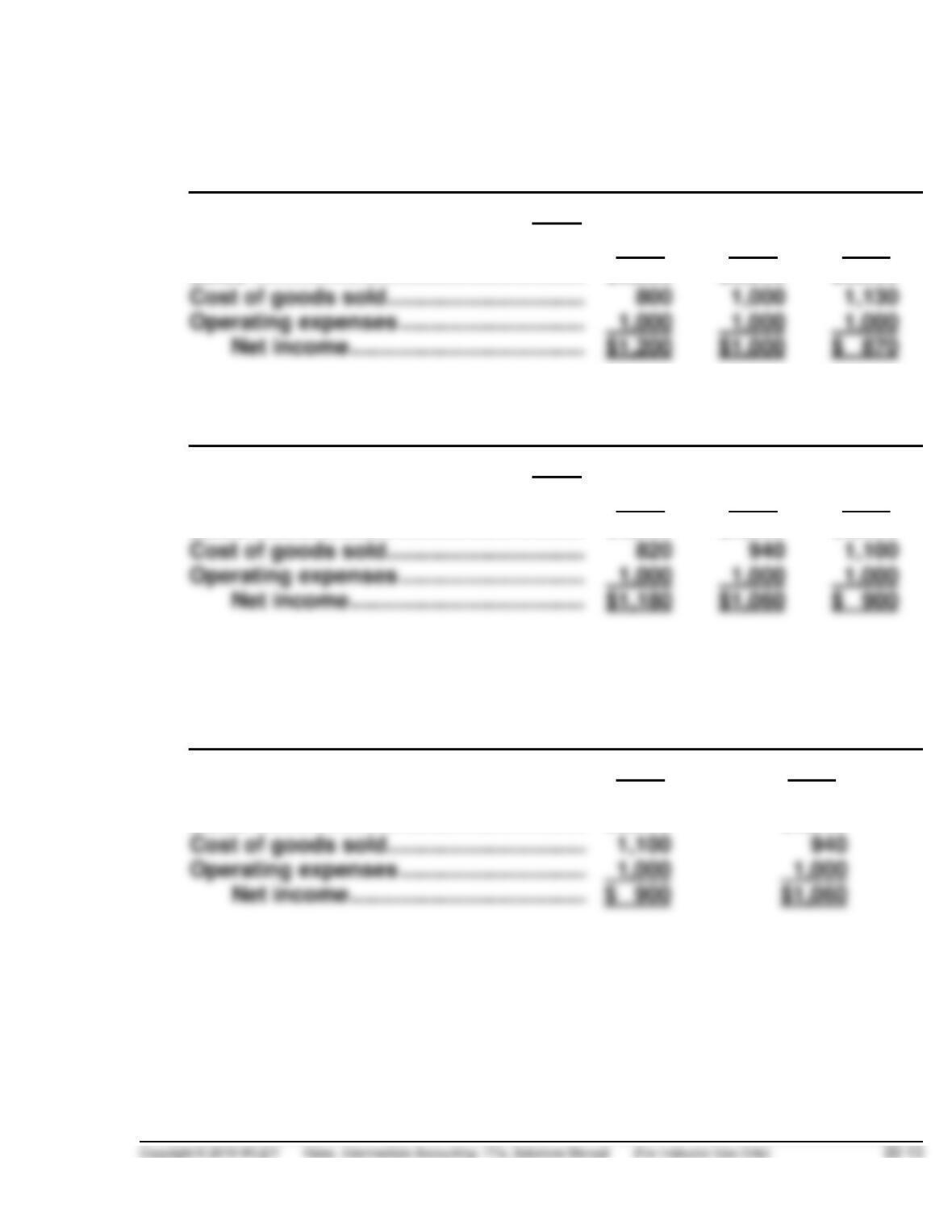
(a) TAVERAS CO.
Income Statement
For the Year Ended December 31
LIFO
2018
2019
2020
Sales ………………………………………………..
$3,000
$3,000
$3,000
Cost of goods sold …………………………….
Operating expenses …………………………..
Net income ………………………………….
$1,200
$1,000
$ 870
Income Statement
For the Year Ended December 31
FIFO
2018
2019
2020
Sales ………………………………………………..
$3,000
$3,000
$3,000
Cost of goods sold …………………………….
Operating expenses …………………………..
Net income ………………………………….
$1,180
$1,060
$ 900
(b) TAVERAS CO.
Income Statement
For the Year Ended December 31
2020
2019
As adjusted (Note A)
Sales …………………………..……………………
$3,000
$3,000
Cost of goods sold …………………………….
Operating expenses …………………………..
EXERCISE 22.3 (Continued)
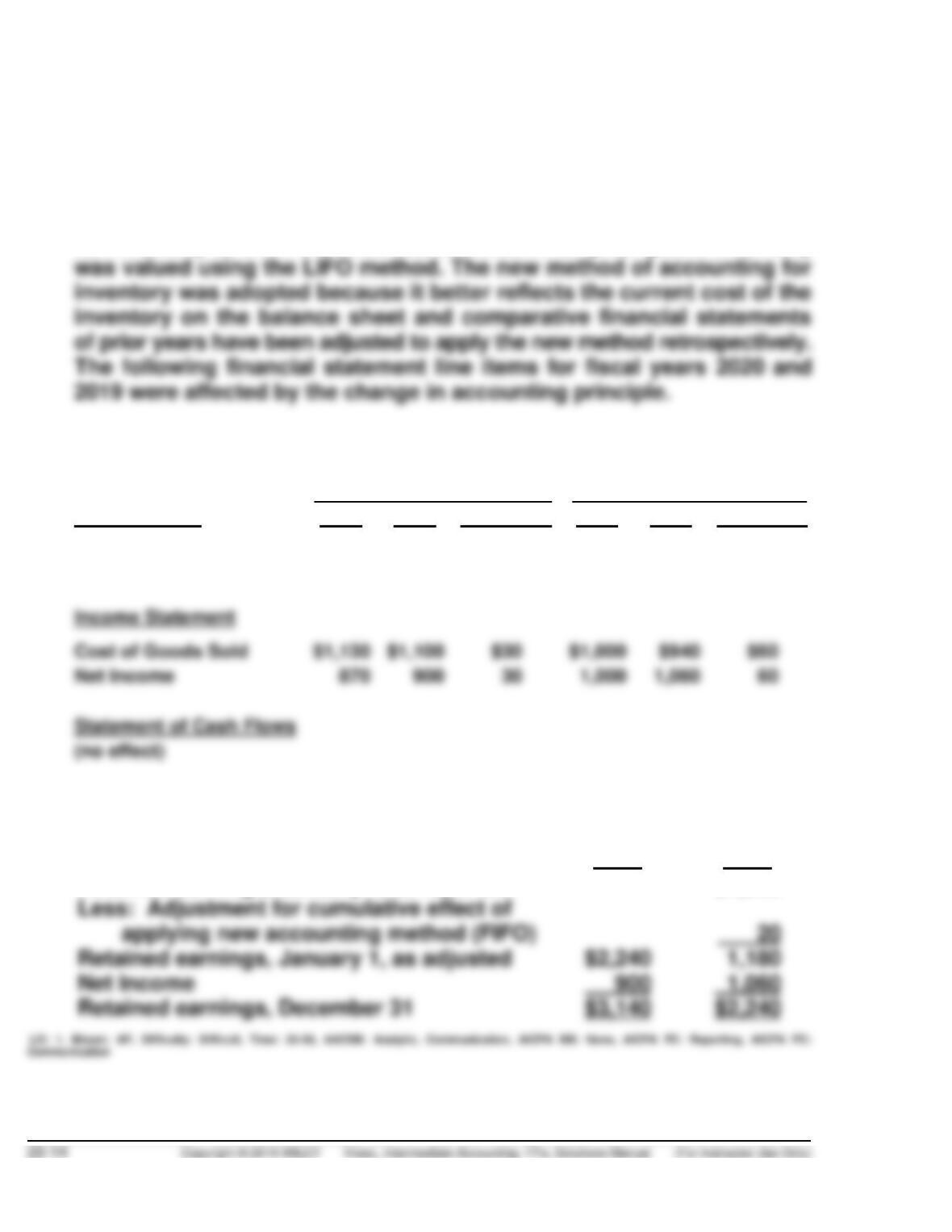
(c) Note A:
Change in Method of Accounting for Inventory Valuation
On January 1, 2020, Taveras elected to change its method of valuing
its inventory to the FIFO method, whereas in all prior years inventory
2020
2019
Balance Sheet
LIFO
FIFO
Difference
LIFO
FIFO
Difference
Inventory
$ 320
$ 390
$70
$ 200
$ 240
$40
Retained Earnings
3,070
3,140
70
2,200
2,240
40
Income Statement
Cost of Goods Sold
$1,130
$1,100
$1,000
Net Income
30
1,000
1,060
60
(no effect)
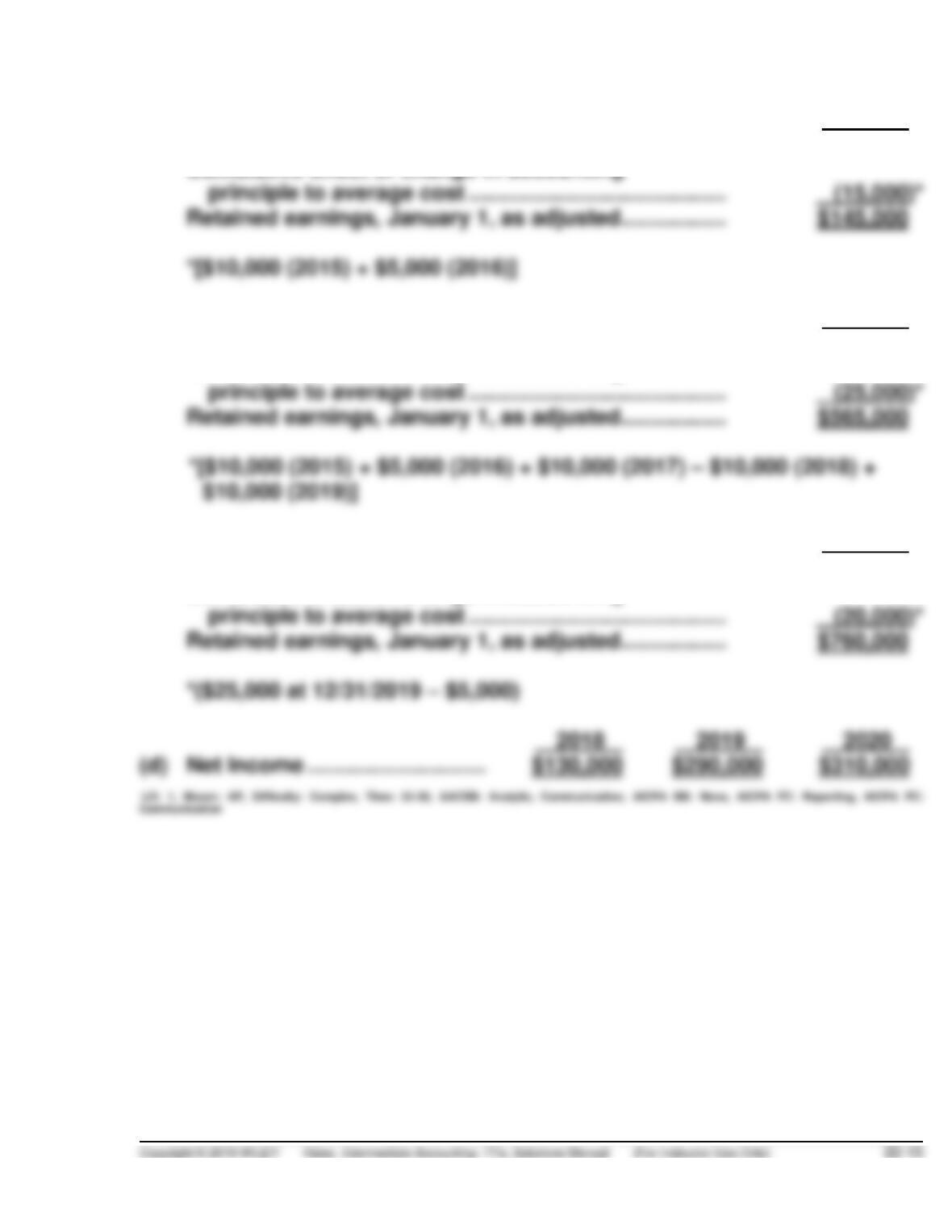
(d) Retained earnings statements after retrospective application.
2020
2019
Retained earnings, January 1, as reported
$1,200
Retained earnings, January 1, as adjusted
$2,240
Net Income
900
EXERCISE 22.4 (25–30 minutes)
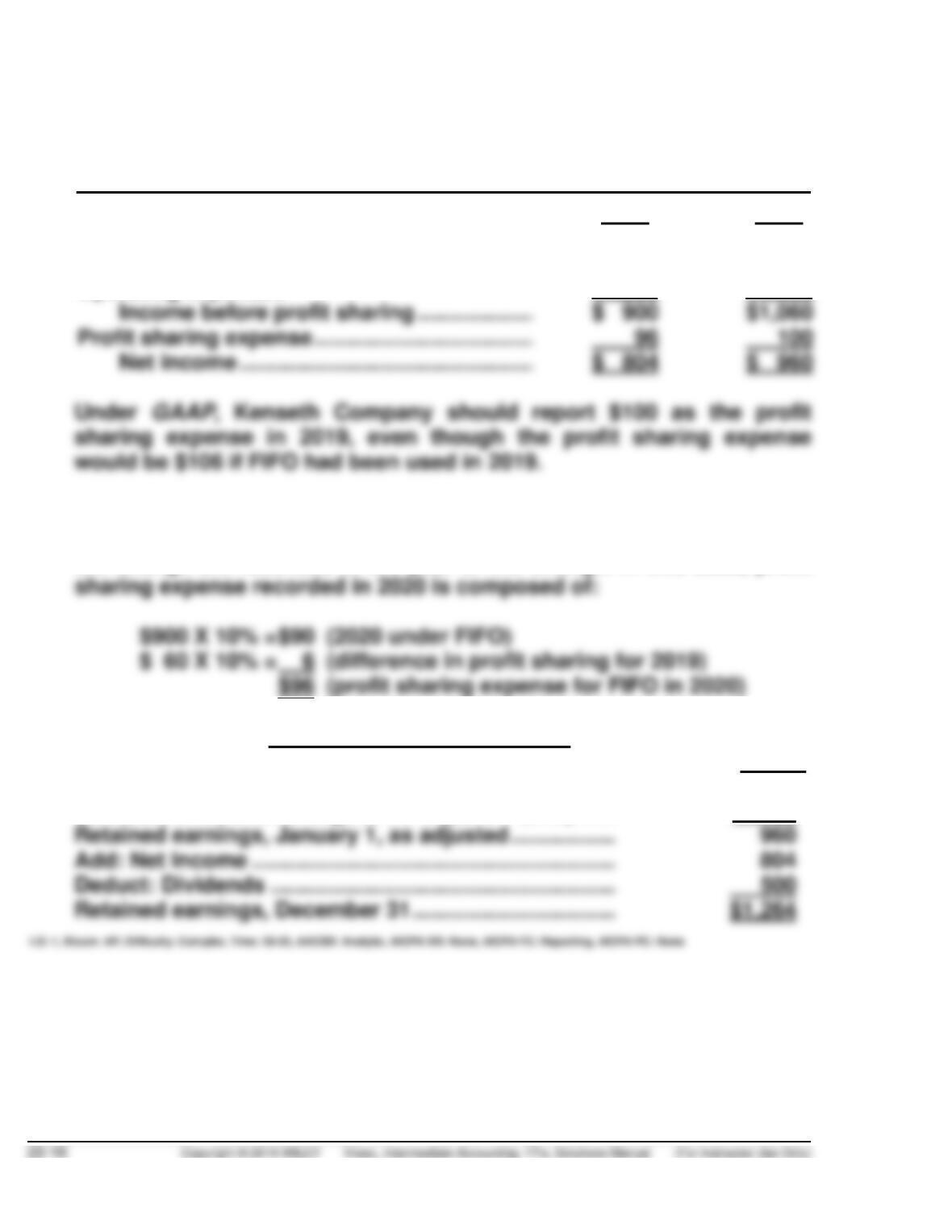
2017
(a) Retained earnings, January 1, as reported …………….. $160,000
Cumulative effect of change in accounting
2020
(b) Retained earnings, January 1, as reported …………….. $590,000
Cumulative effect of change in accounting
2021
(c) Retained earnings, January 1, as reported …………….. $780,000
Cumulative effect of change in accounting
EXERCISE 22.5 (30–35 minutes)
(a) KENSETH COMPANY
Income Statement
For the Year Ended
2020
2019
Sales ………………………………………………………..
$3,000
$3,000
Cost of goods sold ……………………………………
1,100
940
Operating expenses
1,000
1,000
Income before profit sharing ……………….
$ 900
$1,060
Profit sharing expense ………………………………
Net income …………………………………………
(b) The profit sharing expense reflects an indirect effect of the change in
accounting principle. Under GAAP, indirect effects from periods before
the change are recorded in the year of the change. In this case, profit
(c) Retained Earnings Statement
2020
Retained earnings, January 1, as reported …………….. $900
Cumulative effect of change to FIFO ($960 – $900) …… 60
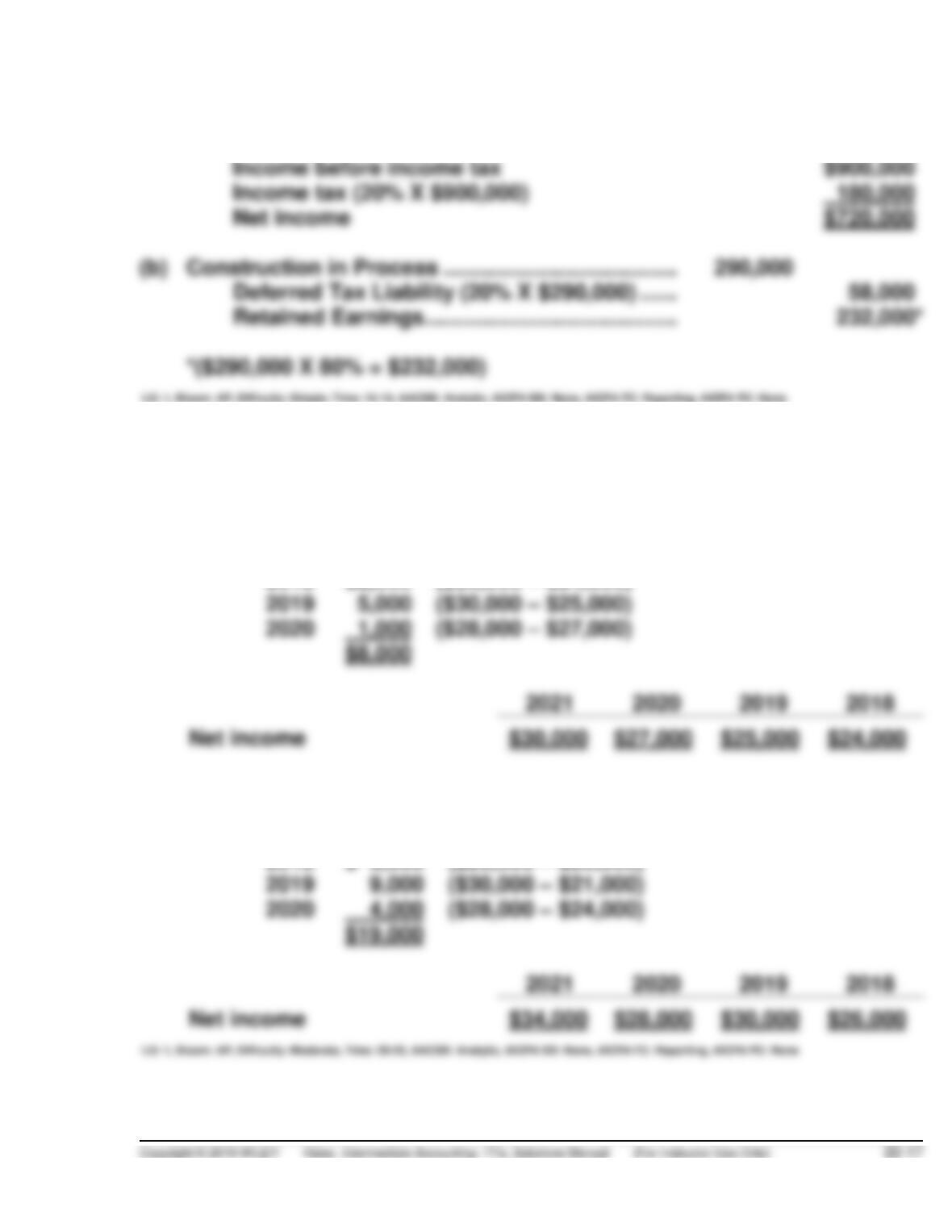
EXERCISE 22.6 (10–15 minutes)
(a) The net income to be reported in 2021, using the retrospective approach,
would be computed as follows:
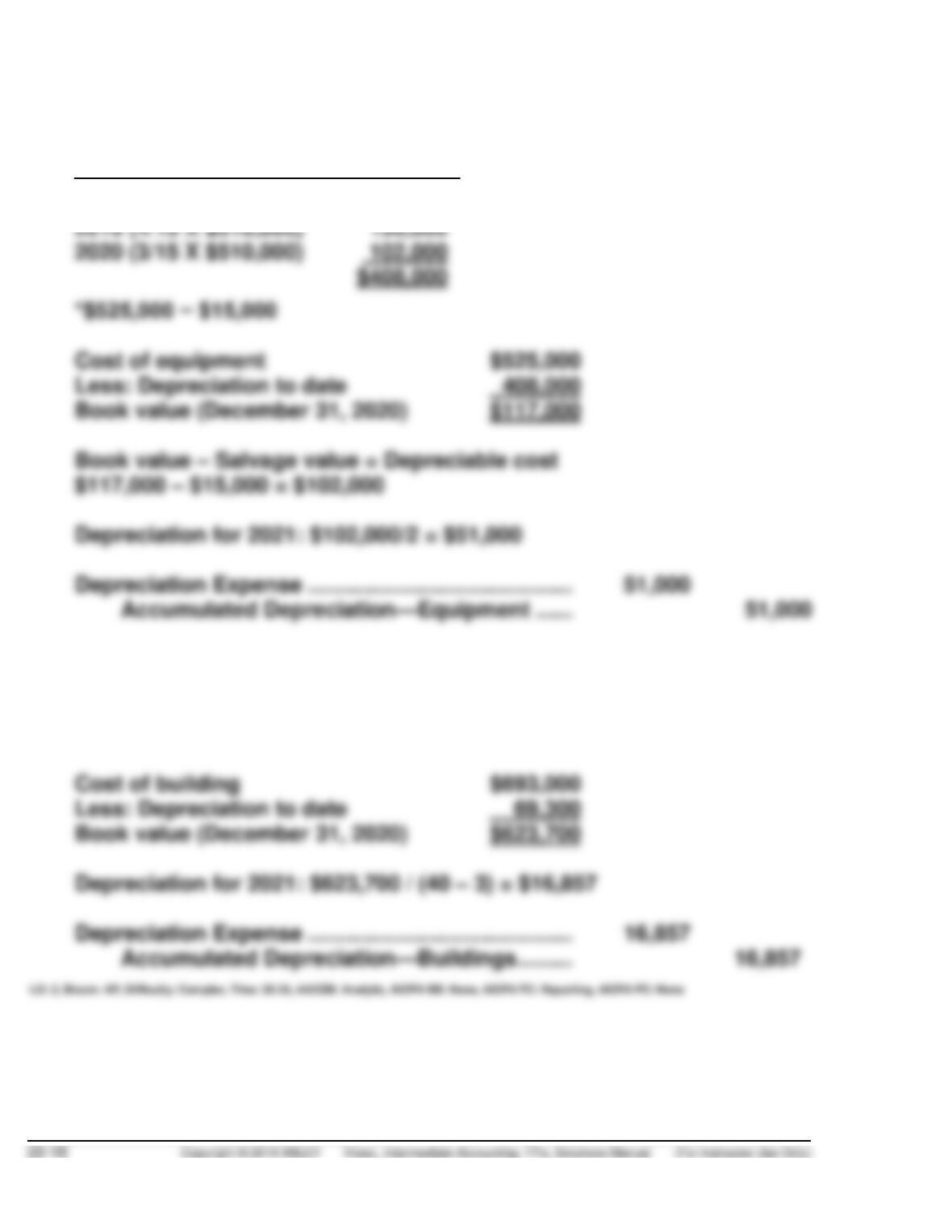
EXERCISE 22.7 (20–25 minutes)
(a) Retained Earnings …………………………………………….. 8,000
Inventory ……………………………………………………. 8,000*
*2018 $2,000 ($26,000 – $24,000)
(b) Inventory ………………………………………………………….. 19,000
Retained Earnings ………………………………………. 19,000*
*2018 $ 6,000 ($26,000 – $20,000)
EXERCISE 22.8 (30–35 minutes)
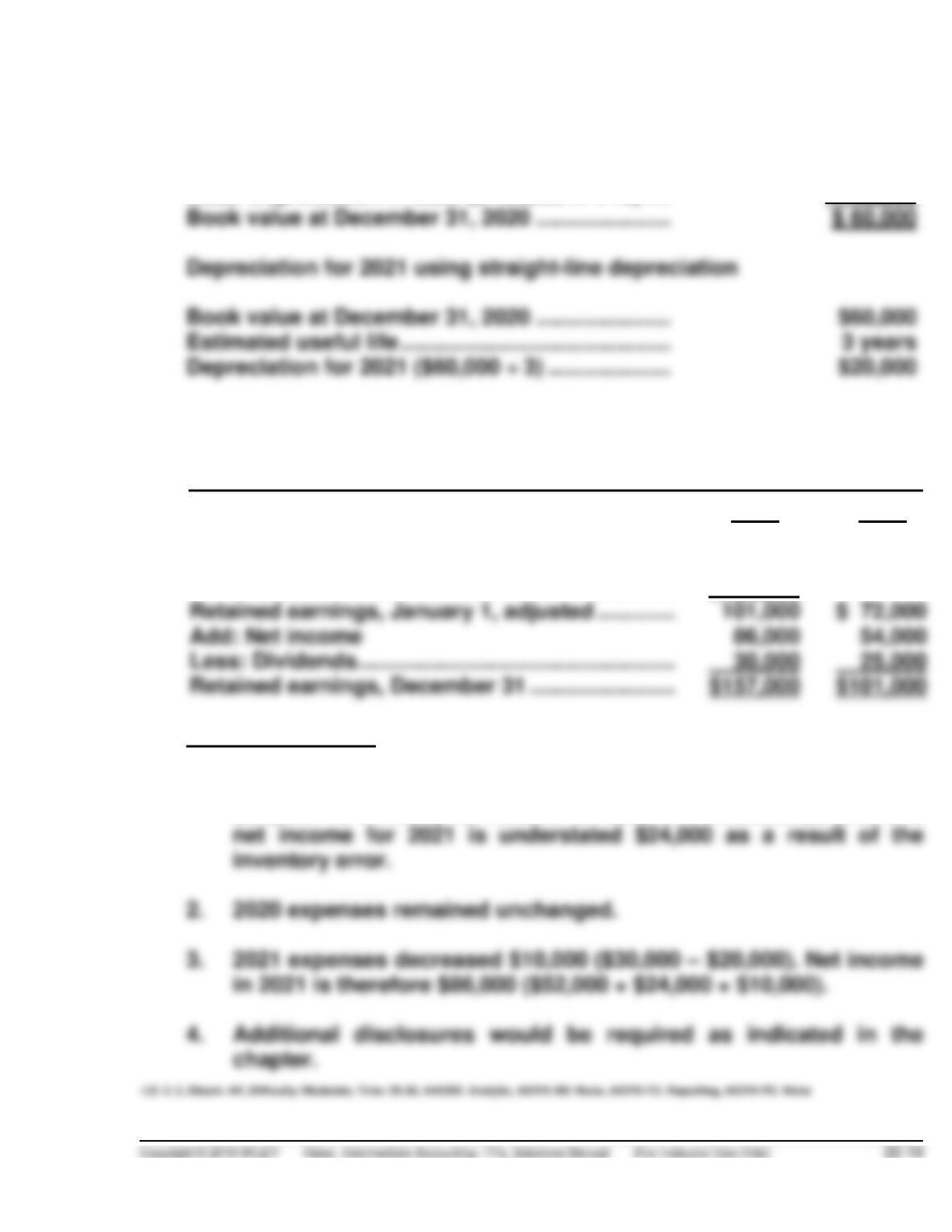
(a) Depreciation to date on equipment
Sum-of-the–years’-digits depreciation
2018 (5/15 X $510,000*) $170,000
(b) Depreciation to date on building
$693,000/30 years = $23,100 per year
$23,100 X 3 = $69,300 depreciation to date
EXERCISE 22.9 (25–30 minutes)
Change from sum-of-the-years digit to straight-line
Cost of depreciable assets …………………………... $100,000
Less: Depreciation in 2020 ($100,000 X 4/10) …. 40,000
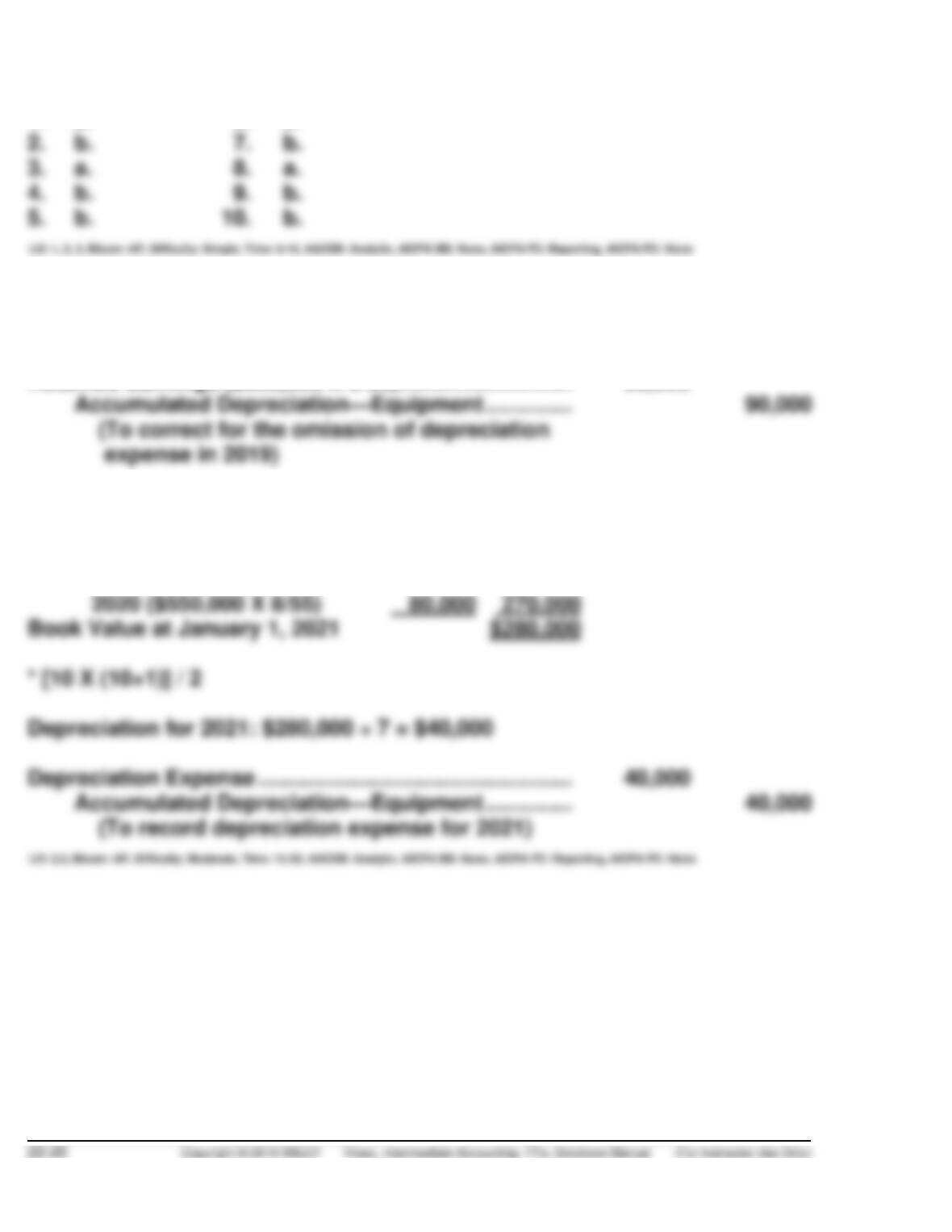
DENISE HABBE INC.
Retained Earnings Statement
For the Year Ended
2021
2020
Retained earnings, January 1, unadjusted ………..
$125,000
Less: Correction of error for inventory
overstatement …………………………………………..
24,000
Retained earnings, January 1, adjusted ……………
Retained earnings, December 31 ……………………..
$157,000
Note to instructor:
1. 2020 cost of sales increased $24,000; 2021 cost of sales decreased
$24,000. As a result, net income for 2020 is overstated $24,000 and
EXERCISE 22.10 (5–10 minutes)
1. a. 6. a.
EXERCISE 22.11 (15–20 minutes)
December 31, 2021
Retained Earnings ($550,000 X 9/55) ………………………. 90,000
Cost of Machine $550,000
Less: Depreciation prior to 2021
2018 ($550,000 X 10/55*) $100,000
2019 ($550,000 X 9/55) 90,000