ACCOUNTING, ANALYSIS, AND PRINCIPLES (Continued)
Analysis
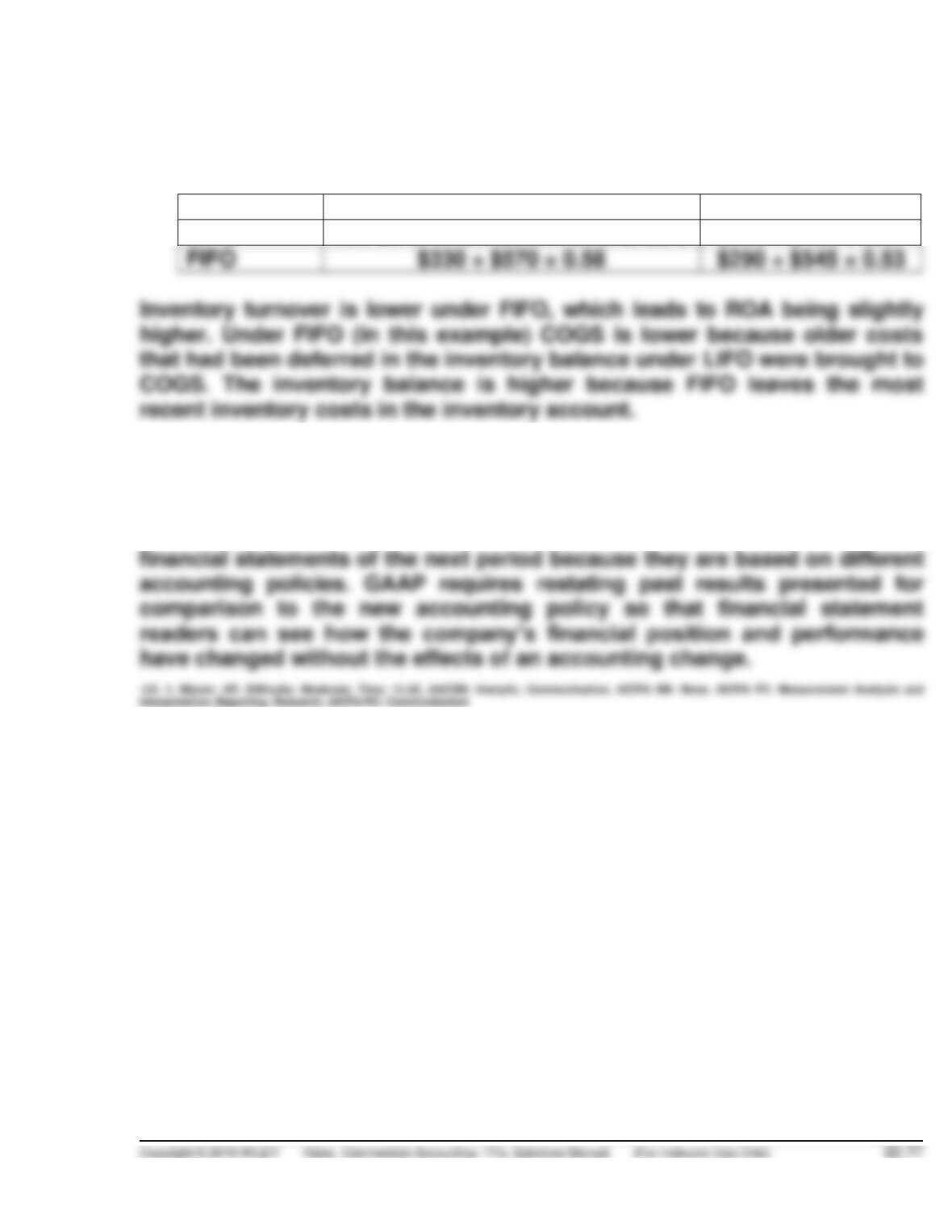
Inventory turnover:
2020
2019
LIFO
N/A LIFO information not available
$300 ÷ $490 = 0.61
FIFO
Principles
The issue is consistency across time. When a company changes accounting
policies, financial statements from one period are not comparable to the
CE22.1
Master Glossary
(a) A change that has the effect of adjusting the carrying amount of an existing asset or liability or
altering the subsequent accounting for existing or future assets or liabilities. A change in accounting
estimate is a necessary consequence of the assessment, in conjunction with the periodic presen-
tation of financial statements, of the present status and expected future benefits and obligations
(c) The process of revising previously issued financial statements to reflect the correction of an error
in those financial statements.
CE22.2
According to FASB ASC 250-10–50-7 (Accounting Changes and Error Corrections—Disclosure):
When financial statements are restated to correct an error, the entity shall disclose that its previously
CE22.3
According to FASB ASC 250–10–45-5 (Accounting Changes and Error Corrections—Other Presentation
Matters):
An entity shall report a change in accounting principle through retrospective application of the new
CE22.4
According to FASB ASC 250-10-S99-4 (Accounting Changes and Error Corrections—SEC Materials):
If a registrant justified a change in accounting method as preferable under the circumstances, and the
circumstances change, may the registrant revert to the method of accounting used before the change?
CODIFICATION RESEARCH CASE
(a) According to FASB ASC 250-10-20 (Glossary), a change in accounting
estimate that is inseparable from the effect of a related change in
Under FASB ASC 250-10–45
45–17, A change in accounting estimate shall be accounted for in the
period of change if the change affects that period only or in the
45–19 Like other changes in accounting principle, a change in
accounting estimate that is affected by a change in accounting
principle may be made only if the new accounting principle is
(b) According to FASB ASC 250-10–45-18, distinguishing between a change
in an accounting principle and a change in an accounting estimate is
sometimes difficult. In some cases, a change in accounting estimate is
CODIFICATION RESEARCH CASE (Continued)
(c) According to FASB ASC 250–10–S50—Disclosure of the Impact that
Recently Issued Accounting Standards Will Have on the Financial
Statements of the Registrant when Adopted in a Future Period
S50-1 See paragraph 250-10–S99-5, SAB Topic 11.M, for SEC Staff
views regarding disclosure of the impact of recently issued
S99-5 The following is the text of SAB Topic 11.M, Disclosure of the
Impact that Recently Issued Accounting Standards Will Have on
the Financial Statements of the Registrant when Adopted in a
Future Period.
Question 1: Does the staff believe that these filings should
include disclosure of the impact that the recently issued
accounting standard will have on the financial position and
results of operations of the registrant when such standard is
adopted in a future period?
CODIFICATION RESEARCH CASE (Continued)
Interpretive Response: Yes. The commission addressed a
similar issue with respect to Statement 52 and concluded that
“The Commission also believes that registrants that have not yet
that have had or that the registrant reasonably expects will have
a material impact on future sales, revenues or income from
continuing operations. The staff believes that disclosure of
impending accounting changes is necessary to inform the
reader about expected impacts on financial information to be
reported in the future and, therefore, should be disclosed in
accordance with the existing MD&A requirements. With respect to
financial statement disclosure, GAAS9 specifically address the
need for the auditor to consider the adequacy of the disclosure
of impending changes in accounting principles if (a) the financial
CODIFICATION RESEARCH CASE (Continued)
– 6FRR 6, Section 2.
– 7In those instances where a recently issued standard will
Question 2: Does the staff have a view on the types of
disclosure that would be meaningful and appropriate when a
new accounting standard has been issued but not yet adopted
by the registrant?
Interpretive Response: The staff believes that the registrant
should evaluate each new accounting standard to determine the
The following disclosures should generally be considered by the
registrant:
– A brief description of the new standard, the date that
adoption is required and the date that the registrant plans to
CODIFICATION RESEARCH CASE (Continued)
– A discussion of the impact that adoption of the standard is
expected to have on the financial statements of the
IFRS CONCEPTS AND APPLICATION
IFRS22.1
The IFRS standard addressing accounting and reporting for changes in
IFRS22.2
FASB has issued guidance on changes in accounting principles, changes
in estimates, and corrections of errors, which essentially converges U.S.
GAAP to IAS 8. Key remaining differences are as follows.
• One area in which IFRS and U.S. GAAP differ is the reporting of
error corrections in previously issued financial statements. While
both GAAPs require restatement, U.S. GAAP is an absolute
standard—that is, there is no exception to this rule.
IFRS22.3
Currently, under U.S. GAAP, when a company prepares financial
statements on a new basis, comparative information must be provided for a
IFRS22.4
The indirect effect of a change in accounting policy reflects any changes in
current or future cash flows resulting from a change in accounting policy
IFRS22.5
The company prospectively applies the new accounting policy as of the
IFRS22.6
2. Depreciation.
a. This is a change in accounting estimate. Restatement of
IFRS22.6 (Continued)
3. Mathematical Error. This is a correction of an error and prior
period adjustment treatment would be in order.
4. Preproduction Costs—Furniture Division. This should probably
be construed as an inseparability situation in that the change in
5. FIFO to Average-Cost Change. This is a change in accounting
policy. Restatement of December 31, 2019 retained earnings is
6. Percentage–of–Completion. This is a change in accounting policy.
Retained earnings should be adjusted.
(b) The adjustment to the December 31, 2019 retained earnings balance
IFRS22.7
(a) The guidelines for reporting a change in accounting principle related to
(1) is required by an IFRS; or
IFRS22.7 (Continued)
(2) results in the financial statements providing reliable and more
relevant information about the effects of transactions, other events
IFRS22-8
(a) The following IFRS, IFRS IC interpretations and amendments are
effective for the first time in this financial year:
There have been no significant changes to accounting under IFRS which
The following IFRS have been issued but are not yet effective:
IFRS 9 ‘Financial Instruments’ replaces all phases of the financial
instruments project and IAS 39 ‘Financial Instruments:
Recognition and Measurement’. The standard is effective from periods
beginning on or after 1 January 2018 and introduces:
IFRS 15 ‘Revenue from Contracts with Customers’ is effective for periods
beginning on or after 1 January 2018. The standard establishes a principles
based approach for revenue recognition and is based on the concept of
recognizing revenue for obligations only when they are satisfied and the
> IFRS 16 ‘Leases’ was issued on 13 January 2016 and is effective for
periods beginning on or after 1 January 2019. Early adoption is permitted if
IFRS 15 ‘Revenue from Contracts with Customers’ has also been applied.
IFRS 16 is not yet endorsed by the EU. The standard represents a
significant change in the accounting and reporting of leases for lessees as
The Group has established a working group to assess the impact of the
new standard. Work performed includes assessing the accounting impacts
of the change, the process of collecting the required data from across the
IFRS22.8 (Continued)
(b) Critical accounting judgements and sources of estimation Uncertainty
The preparation of consolidated financial statements requires the Group to
make estimates and judgements that affect the application of policies and
reported amounts. Critical judgements represent key decisions made by
management in the application of the Group accounting policies. Where a
Critical accounting judgements
Adjusted items The directors believe that the adjusted profit and earnings
per share measures provide additional useful information for shareholders
on the performance of the business. These measures are consistent with
IFRS22.8 (Continued)
Sources of estimation uncertainty
Useful lives and residual values of property, plant and equipment
Depreciation is provided to write down the cost of property, plant and
equipment to their estimated residual values over their estimated useful
Impairment of property, plant and equipment Property, plant and
equipment are reviewed for impairment if events or changes in
circumstances indicate that the carrying amount may not be recoverable.
When a review for impairment is conducted, the recoverable amount is
determined based on value in use calculations. This method requires the
Group to determine the appropriate period over which to assess future
cash flows and discount rate assumptions. See notes 14 and 15 for further
details on the Group’s assumptions and associated sensitivities.
IFRS22.8 (Continued)
Revenue recognition Accruals for sales returns, deferred income in
relation to loyalty scheme redemptions and gift card and credit voucher
redemptions are estimated on the basis of historical returns and
redemptions. These are recorded so as to be allocated against revenue in
Inventory provisioning Inventory provisions are recognised where the net
realisable value from the sale of inventory is estimated to be lower than its
carrying value, requiring estimation of the expected future sale price. The