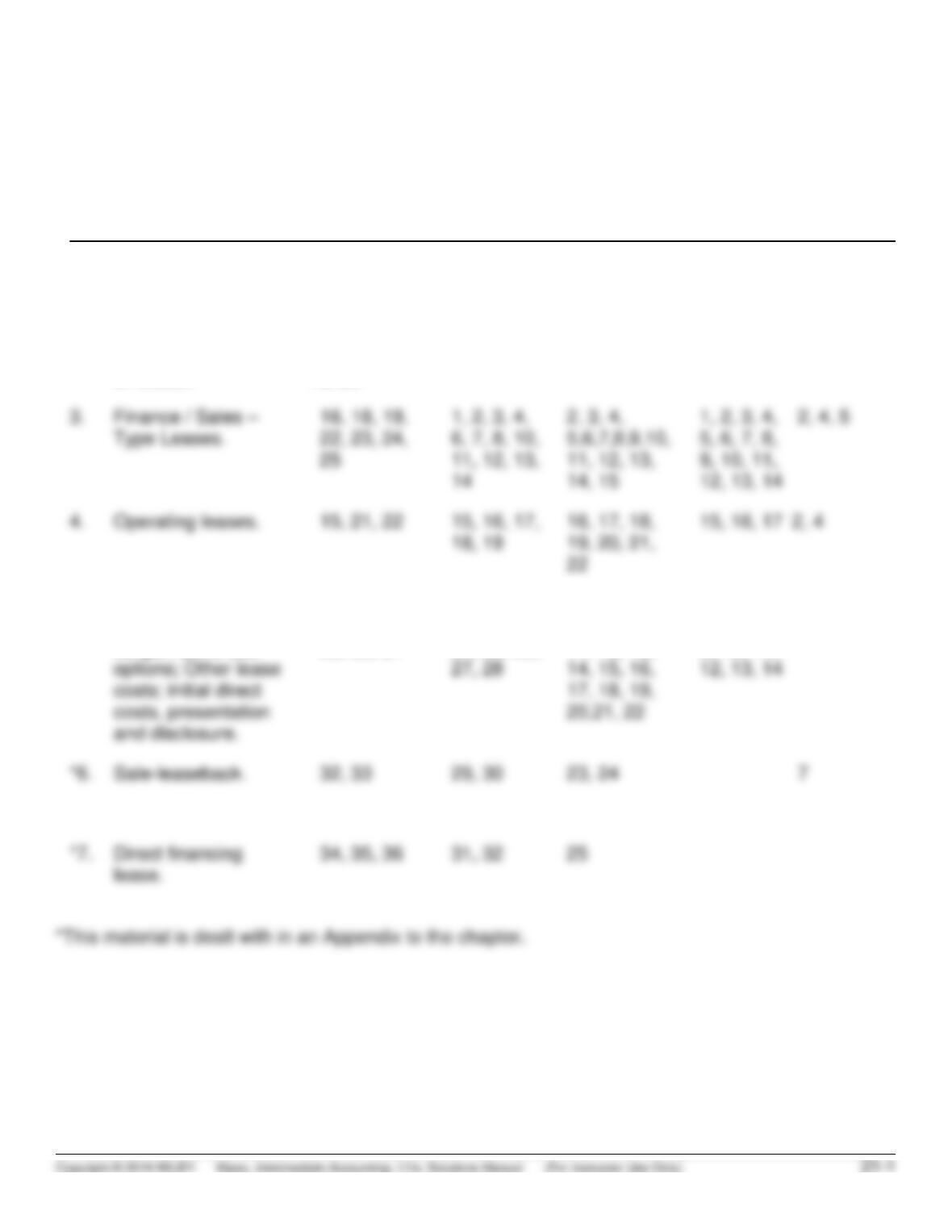
CHAPTER 21
Accounting for Leases
ASSIGNMENT CLASSIFICATION TABLE (BY TOPIC)
Topics
Questions
Brief
Exercises
Exercises
Problems
Concepts
for Analysis
1. Rationale for leasing.
1, 2, 3
2. Concepts,
classification, and
measurement
of leases.
4, 5, 6, 7, 8,
10, 11, 12,
13, 14, 17,
19, 20
5, 9
1
1
14, 15
12, 13, 14
5. Special Issues
Residual values;
bargain-purchase
9, 10, 12,
17, 26, 27,
28, 30, 31
4, 8, 9, 20,
21, 22, 23,
24, 25, 26,
1, 2, 3, 4,5,
6,7,8, 9, 10,
11, 12, 13,
1, 2, 3, 4,
5, 6, 7, 8,
9, 10, 11,
1, 2, 3, 4,
5, 6
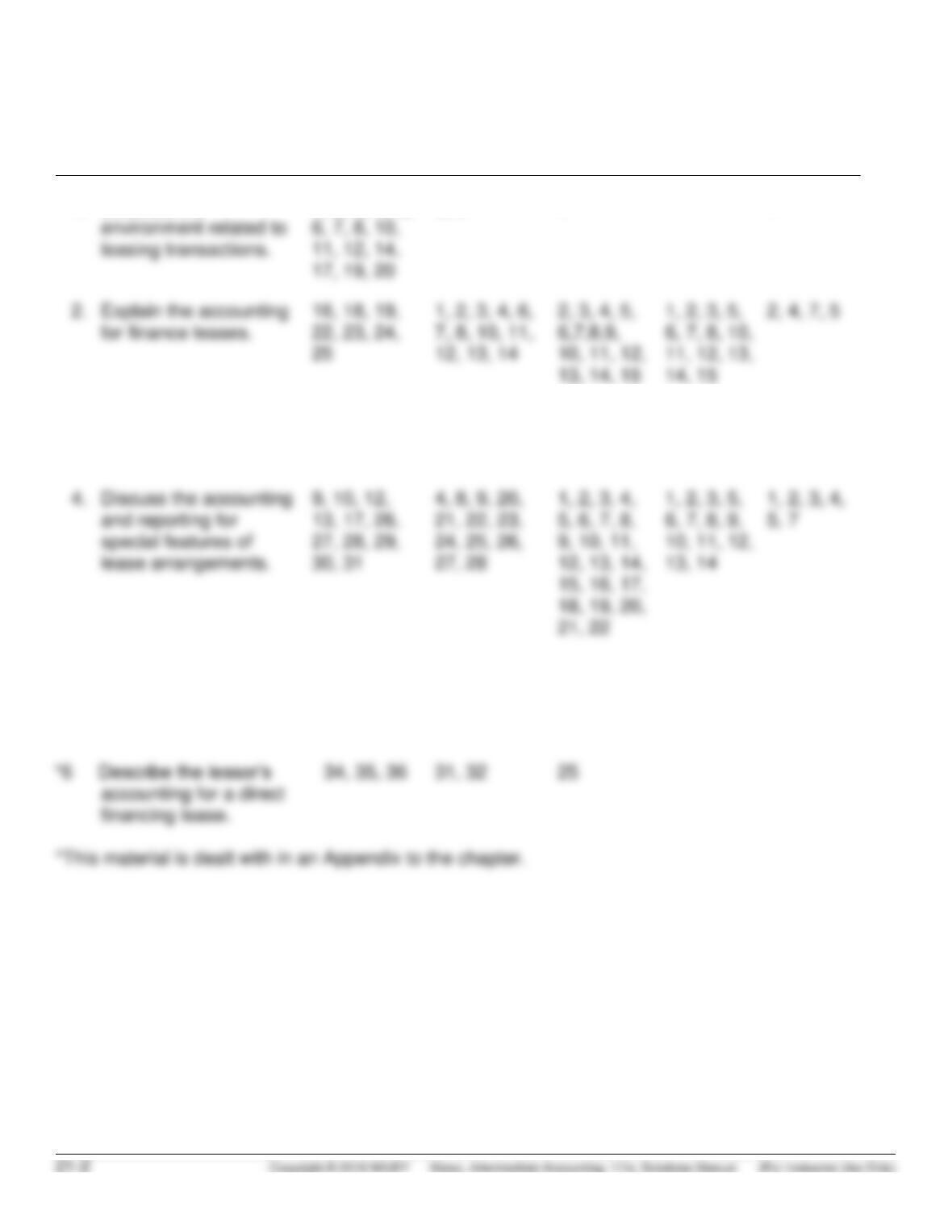
ASSIGNMENT CLASSIFICATION TABLE (BY LEARNING OBJECTIVE)
Learning Objectives
Questions
Brief
Exercises
Exercises
Problems
Concepts
for
Analysis
environment related to
leasing transactions.
6, 7, 8, 10,
11, 12, 14,
1. Describe the
1, 2, 3, 4, 5,
5, 9
1
1
3. Explain the accounting
for operating leases.
15, 21, 22
15, 16, 17,
18, 19
16, 17, 18,
19, 20, 21,
22
9, 15, 16,
17
2, 4
30, 31
27, 28
12, 13, 14,
15, 16, 17,
18, 19, 20,
*5. Describe the lessee’s
accounting for sale-
leaseback
transactions.
32, 33
29, 30
23, 24
7
accounting for a direct
financing lease.
31, 32
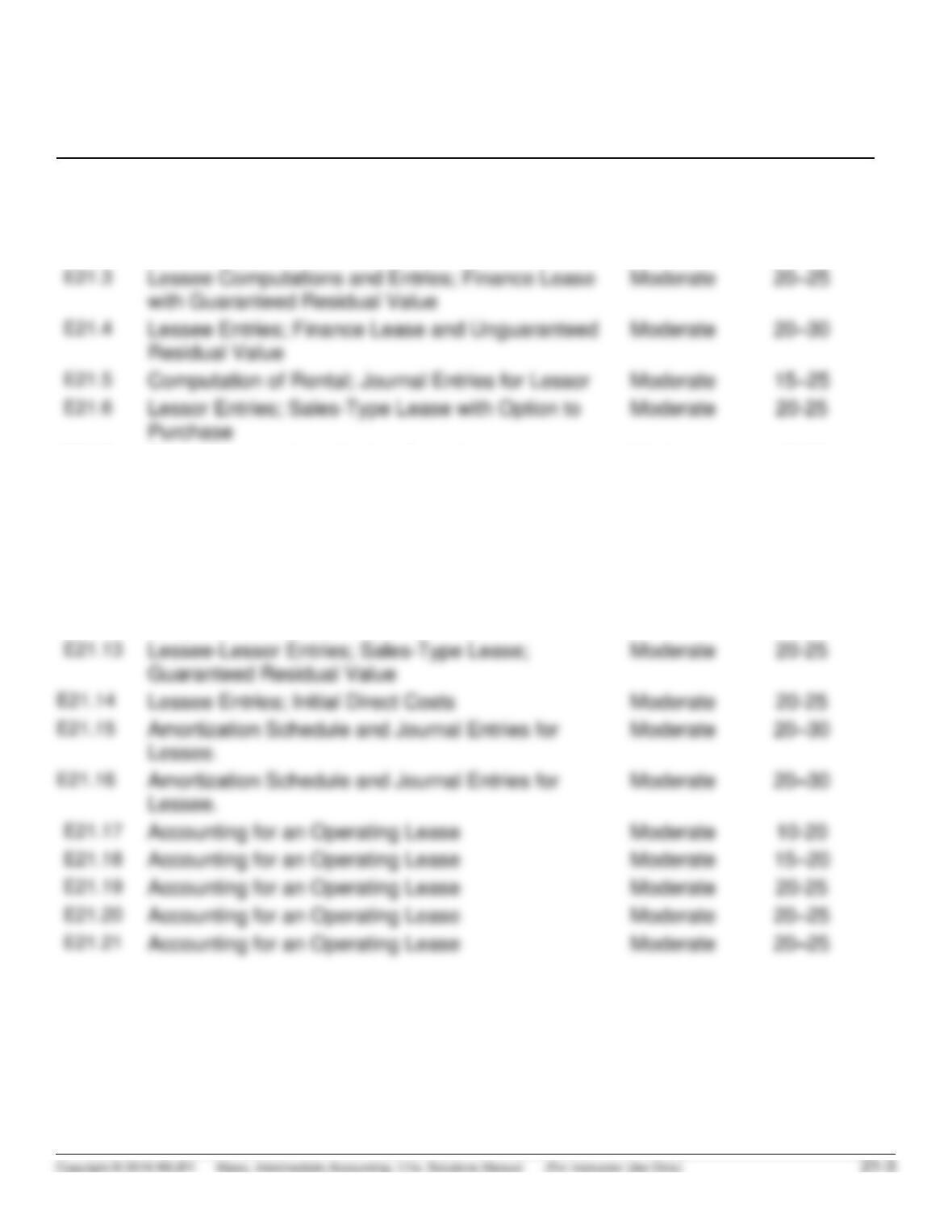
ASSIGNMENT CHARACTERISTICS TABLE
Item
Description
Level of
Difficulty
Time
(minutes)
E21.1
Lessee Entries; Finance Lease with No Residual
Value
Moderate
15–20
E21.2
Lessee Entries; Finance Lease with Unguaranteed
Residual Value
Moderate
15–20
E21.3
E21.4
E21.5
Computation of Rental; Journal Entries for Lessor
Moderate
15–25
E21.6
Lessor Entries; Sales-Type Lease with Option to
Purchase
Moderate
20–25
E21.7
Type of Lease; Amortization Schedule
Moderate
15–20
E21.8
Lessor Entries; Sales-Type Lease
Moderate
15–20
E21.9
Lessee Entries; Initial Direct Costs
Moderate
20–25
E21.10
Lessee Entries with Bargain-Purchase Option
Moderate
20–30
E21.11
Lessor Entries with Bargain-Purchase Option
Moderate
20–30
E21.12
Lessee-Lessor Entries; Sales-Type Lease with a
Bargain Purchase Option
Moderate
20–25
E21.13
Lessee Entries; Initial Direct Costs
Moderate
20–25
Moderate
20–30
Moderate
20–30
E21.17
Accounting for an Operating Lease
Moderate
10–20
E21.18
Accounting for an Operating Lease
Moderate
15–20
E21.19
Accounting for an Operating Lease
Moderate
20-25
E21.20
Accounting for an Operating Lease
Moderate
20–25
E21.21
Accounting for an Operating Lease
Moderate
20–25
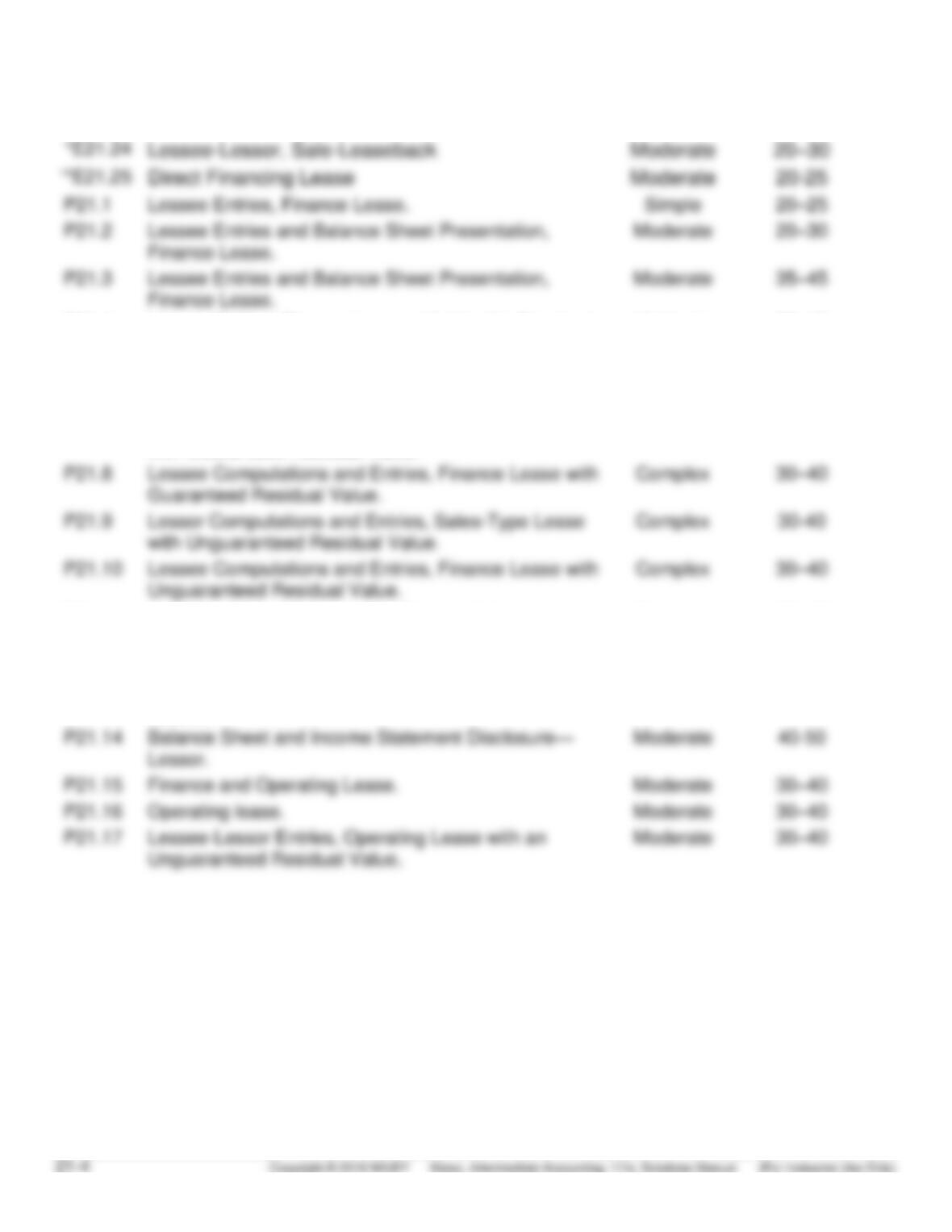
E21.22
Accounting for an Operating Lease
Moderate
25-30
*E21.23
Sale-Leaseback
Moderate
20–30
Moderate
Moderate
20–25
P21.1
Lessee Entries, Finance Lease.
20–25
P21.2
Lessee Entries and Balance Sheet Presentation,
Moderate
20–30
P21.3
Lessee Entries and Balance Sheet Presentation,
Finance Lease.
Moderate
35–45
P21.4
Lessee Entries, Finance Lease with Monthly Payments.
Moderate
30–40
P21.5
Basic Lessee Accounting with Difficult PV Calculation
Moderate
40–50
P21.6
Lessee-Lessor Entries, Finance Lease with a
Guaranteed Residual Value.
Moderate
25–35
P21.7
Lessor Computations and Entries, Sales-Type Lease
with Guaranteed Residual Value.
Complex
30–40
P21.8
Lessee Computations and Entries, Finance Lease with
Guaranteed Residual Value.
Complex
30–40
P21.9
Lessor Computations and Entries, Sales-Type Lease
with Unguaranteed Residual Value.
Complex
30–40
P21.10
Lessee Computations and Entries, Finance Lease with
Unguaranteed Residual Value.
Complex
30–40
P21.11
Lessee-Lessor Accounting for Residual Values.
Complex
30–40
P21.12
Lessee-Lessor Entries, Balance Sheet Presentation,
Finance and Sales-Type Lease.
Moderate
35–45
P21.13
Balance Sheet and Income Statement Disclosure—
Lessee.
Moderate
35–45
P21.14
Balance Sheet and Income Statement Disclosure—
Lessor.
Moderate
40–50
P21.15
Finance and Operating Lease.
Moderate
30–40
P21.16
Operating lease.
Moderate
30–40
P21.17
Lessee-Lessor Entries, Operating Lease with an
Unguaranteed Residual Value.
Moderate
30–40
Item
Description
Level of
Difficulty
Time
(minutes)
CA21.1
Lessee accounting and reporting.
Moderate
15–25
CA21.2
Lessor and lessee accounting and disclosure.
Moderate
25–35
CA21.3
Lessee capitalization tests.
Moderate
20–30
and lessor.
CA21.5
Lease capitalization, bargain-purchase option.
Moderate
20–25
Sale-Leaseback.
Moderate
15–25
ANSWERS TO QUESTIONS
1. The major lessor groups in the United States are banks, captives, and independents. Banks are the
largest players in the leasing business. Captives are subsidiaries whose primary business is to perform
leasing operations for the parent company. They have the point of sale advantage in finding leasing
2. (a) Possible advantages of leasing for the lessee:
1. Leasing may be more flexible in that the lease agreement may contain less restrictive
provisions than the bond indenture.
2. Leasing permits 100% financing of assets, as the lease is often signed without requiring any
(c) Given the new reporting standard on leasing the financial statement effects of a long-term
noncancelable lease versus the purchase of the asset are somewhat similar. That is assets under a long
3. Possible advantages of leasing for a lessor:
1. It often provides profitable interest margins.
2. It can stimulate sales of a lessor’s product whether it be from a dealer (lessor) or a
4. Lessees generally have two possible lease accounting methods: (a) the finance method and (b) the
operating method. Under both methods, the lessee records a right-of-use asset and a related lease
liability. However, the subsequent treatment of the right-of-use asset and lease liability differs under
5. The five classification tests are the following:
1. Transfer of Ownership Test: if the lease transfers ownership of the asset to the lessee at the
end of the lease term, it is a finance lease.
2. Lease Purchase Option Test: if it is reasonably certain that the lessee will exercise the option
(i.e. it is a bargain purchase option), it is a finance lease.
6. The discount rate used by the lessee in the present value test and for valuing the lease liability is the
implicit interest rate used by the lessor. This rate is defined as the discount rate that, at the
commencement of the lease, causes the aggregate present value of the lease payments and
7. (a) If a lease is for a major part of the economic life of the lease, the lease is classified as a finance
lease. In practice, 75% of the economic life of the asset is generally used to meet this classification test.
That is, if the lease term is 75% or greater of the economic life of the asset, the lease is classified as a
8. Paul Singer is for the most part correct. As long as the lease has a lease term of over 12 months, Paul is
correct that the lease must be recognized on the balance sheet of the lessee. However, the new lease
9. (a) Residual value is the expected value of the leased asset at the end of the lease term.
(b) A guaranteed residual value is a guarantee made to a lessor that the value of the leased asset
10. (a) A bargain purchase option is a lease purchase option in which the lessee can buy the asset for a
price that is significantly lower than the underlying asset’s expected fair value at the date the option
becomes exercisable, thus making the exercise of the option reasonably certain. A bargain renewal
option is essentially the same conceptually as a bargain purchase option, except the option is to renew
11. The lease liability is recorded at the present value of the lease payments. This includes the periodic
rental payments made by the lessee, bargain-purchase option if any, and amounts probable to be owed
12. Wonda Stone is correct in her interpretation. For purposes of lease classification, the present value of
the guaranteed residual value is used in determining whether the present value (90%) test is met.
13. The right–of-use asset is initially measured as the same amount as the lease liability (i.e. present value of
lease payments), adjusted for initial direct costs, prepayments and lease incentives. Initial direct costs
paid by the lessee will increase the initial value of the right-of-use asset. Similarly, prepaid rent paid by
14. Variable lease payments should be included at the level of the index/rate at the commencement date.
Increases or decreases in the index should not be assumed when valuing the lease liability. Thus, for the
15. The lessee records a right-of-use asset and lease liability at commencement of the lease. The lessee
records the same amount for lease expense each period over the lease term (often referred to as the
straight-line method). The straight-line amount to be recognized each period is computed by finding the
total cost of the lease to the lessee and dividing the total cost by the number of periods in the lease term.
16. For a finance lease, the lessee records a right-of-use asset and lease liability at commencement of the
lease. The lessee then recognizes interest expense on the lease liability over the life of the lease using
the effective interest method and records amortization expense on the right–of-use asset generally on a
straight line basis. A lessee therefore reports both interest expense and amortization of the right to use
17. The income statement presentation differs between the operating and finance lease methods of
accounting for the lessee. While both methods amortize the right-of–use asset and reduce the lease
liability over the course of the lease, the accounts used and amounts recognized are different. Under the
operating method, a lessee records the same amount for lease expense each period over the lease
18. The lease agreement between Alice Foyle, M.D. and Brownback Realty, Inc. is in substance a purchase
of property. Because the lease has a bargain-purchase option which transfers ownership of the property
19. From the standpoint of the lessor, leases will (with few exceptions) be classified for accounting purposes as
either (a) operating leases or (b) sales-type leases.
A sales-type lease meets one or more of the following five tests:
1. The lease transfers ownership,
2. The lease contains a bargain-purchase option,
20. A lease receivable is defined as the present value of the periodic rental payments plus any guaranteed
residual value. A net investment in the lease includes not only the components of the lease receivable but
21. Under the operating method, each rental receipt of the lessor is recorded as lease revenue. The
underlying leased asset is still recognized on the balance sheet of the lessor and depreciated in the
22. Under a sales-type lease, lessors report in the income statement Sales Revenue and Cost of Goods
Sold (and resultant gross profit) at commencement of the lease. During the lease term, Interest Revenue
23. Walker Company can use the sales-type lease method if the lease meets one or more of the following five
tests:
(1) The lease transfers ownership of the property to the lessee,
(2) The lease contains a bargain-purchase option,
24. Metheny Corporation should recognize the present value of the lease payments (normal sales price) as
sales revenue, and the carrying amount (book value) of the asset as cost of goods sold. Thus, the gross
25. Although not part of the classification tests, the lessor must also determine whether the collectibility of
payments from the lessee is probable, as it has implications for the subsequent accounting of the lease.
26. (a) (1) The lessee’s accounting for a lease with an unguaranteed residual value is the same as the
accounting for a lease with no residual value. That is, unguaranteed residual values are not
included in the lessee’s lease payments, either for classification or measurement purposes.
(2) A guaranteed residual value has significance for the lessee in two ways. First, for classification
27. The amount to be recovered by the lessor is the same whether the residual value is guaranteed or
28. If a bargain-purchase option exists, the lessee must increase the present value of the lease payments by
the present value of the option price. This is the case for both classification and initial measurement of
29. Initial direct costs are the incremental costs of a lease that would not have been incurred had the lease not
been executed. For the lessee, some costs that are included in the right–of-use asset are commissions,
legal fees from the execution of the lease, lease documentation preparation costs incurred after the
30. A short-term lease is a lease that, at the commencement date, has a lease term of 12 months or less.
31. Lessees and lessors must provide additional qualitative and quantitative disclosures to help financial
statement users to assess the amount, timing, and uncertainty of future cash flows. Qualitative lease
disclosures include the nature of the leases, how variable lease payments are determined, the existence
*32. In a sale-leaseback arrangement, a company (the seller-lessee) transfers an asset to another company
(the buyer-lessor) and then leases that asset back from the buyer-lessor. In order to qualify for sale-
leaseback treatment, the initial transfer of the asset must be such that the seller-lessee gives up control
*33. The sale and subsequent lease will receive sale-leaseback accounting treatment. The initial transfer of
the asset was a sale, and the seller-lessee gave control of the asset to the buyer-lessor. In addition, the
subsequent leaseback is classified as an operating lease, and thus Sanchez never takes control of the
*34. Lessors account for a lease as a sales-type lease if the lease transfers control of the underlying asset to
the lessee, based on meeting one of the five lease classification tests. If none of the classification tests
*35. In a sales-type lease, the lessor recognizes the gross profit immediately at the commencement of the
lease, and interest revenue each period on the lease receivable. In a direct-financing lease, the lessor
*36. Under a direct financing lease, the profit on the lease is deferred and recognized over the life of the
lease (instead of at the lease commencement as would be the case in a sales-type lease). The deferred
gross profit reduces the receivable in the lease, and subsequent accounting for the direct-financing
lease is based on a discount rate that will amortize the net lease receivable over the life of the lease to
zero. That is, in a direct-financing lease the rate used to amortize the lower net lease receivable (lease
SOLUTIONS TO BRIEF EXERCISES
BRIEF EXERCISE 21.1
The lease does not meet the transfer of ownership test, the bargain purchase test,
the economic life test [(5 years ÷ 8 years) < 75%], or the specialized asset test.
BRIEF EXERCISE 21.2
The lease does not meet the transfer of ownership test, the bargain purchase test,
or the specialized asset test. While the initial five year lease term and rental
payments would result in the lease failing the economic life test and the present
Economic Life Test
6 years (5 years initial + 1 year for renewal option) ÷ 7 years = 85.7% > 75%
Present Value Test
PV of initial rental payments (4.54595* X $15,000): $68,189
BRIEF EXERCISE 21.3
The lease payments in the lease arrangement will include both the annual fixed
BRIEF EXERCISE 21.4
The lease payments for years 1 and 2 will be $1,700 ($2,000 annual rental minus
BRIEF EXERCISE 21.5
Variable payments in a lease are not considered in determining the initial value
of the lease liability and right-of-use asset. Because the lease payments are
BRIEF EXERCISE 21.6
12/31/19
Right-of–Use Asset ($41,933 X 3.57710*) …………………. 150,000**
Lease Liability ……………………………………………….. 150,000
BRIEF EXERCISE 21.6 (Continued)
12/31/20
Interest Expense [($150,001 – $41,933) X .08] ………….. 8,645
Lease Liability ………………………………………………………. 33,288
BRIEF EXERCISE 21.7
12/31/20
Interest Expense [($300,000 – $48,337) X .08] ………….. 20,133
BRIEF EXERCISE 21.8
Fair value of leased asset $70,000
Less: Present value of guaranteed residual value
($5,000 X .50025*) 2,501
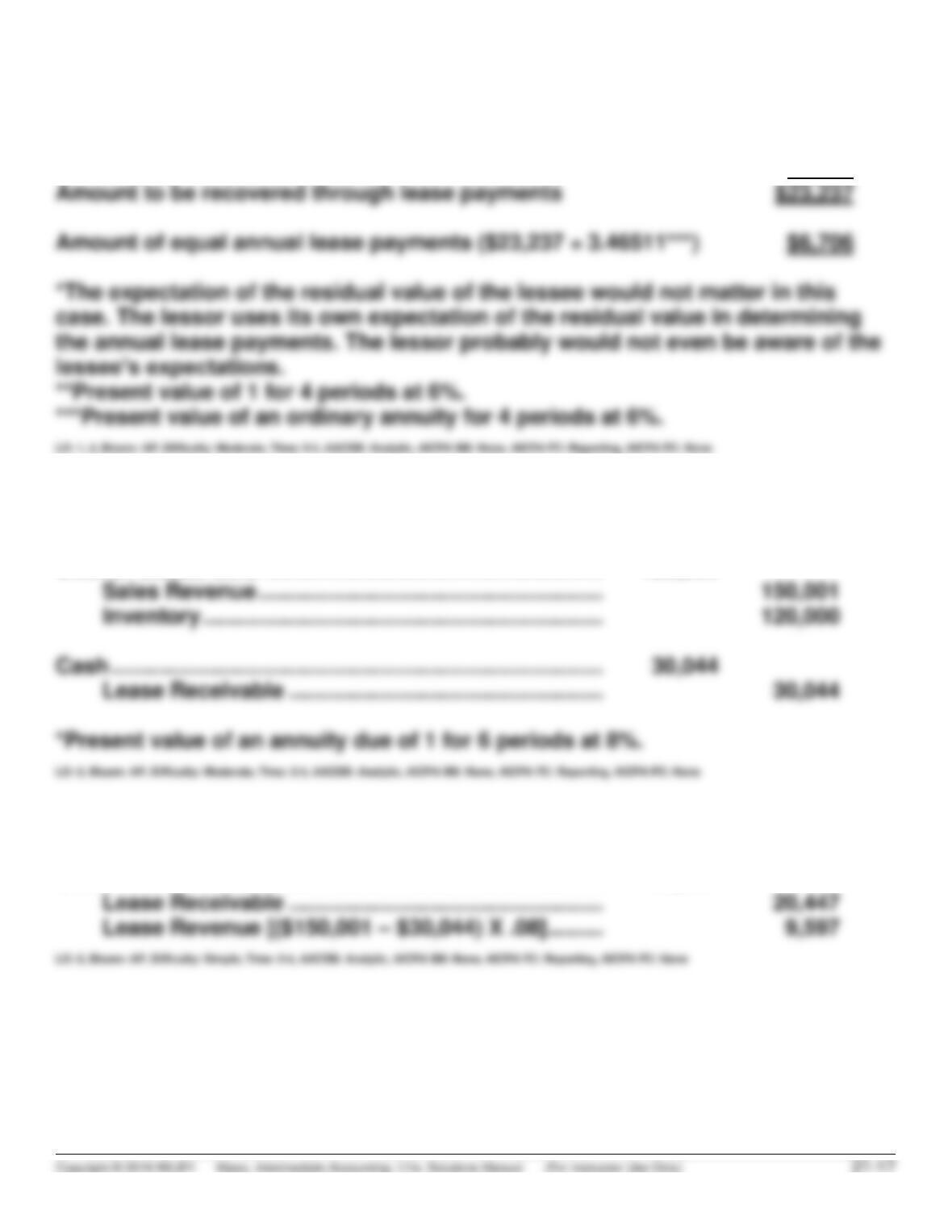
BRIEF EXERCISE 21.9
Fair value of leased asset $47,000
Less: Present value of lessor’s expected residual value*
($30,000 X .79209**) 23,763
BRIEF EXERCISE 21.10
Lease Receivable (4.99271* X $30,044) …………………… 150,001
Cost of Goods Sold ………………………………………………. 120,000
BRIEF EXERCISE 21.11
Cash …………………………………………………………………….. 30,044
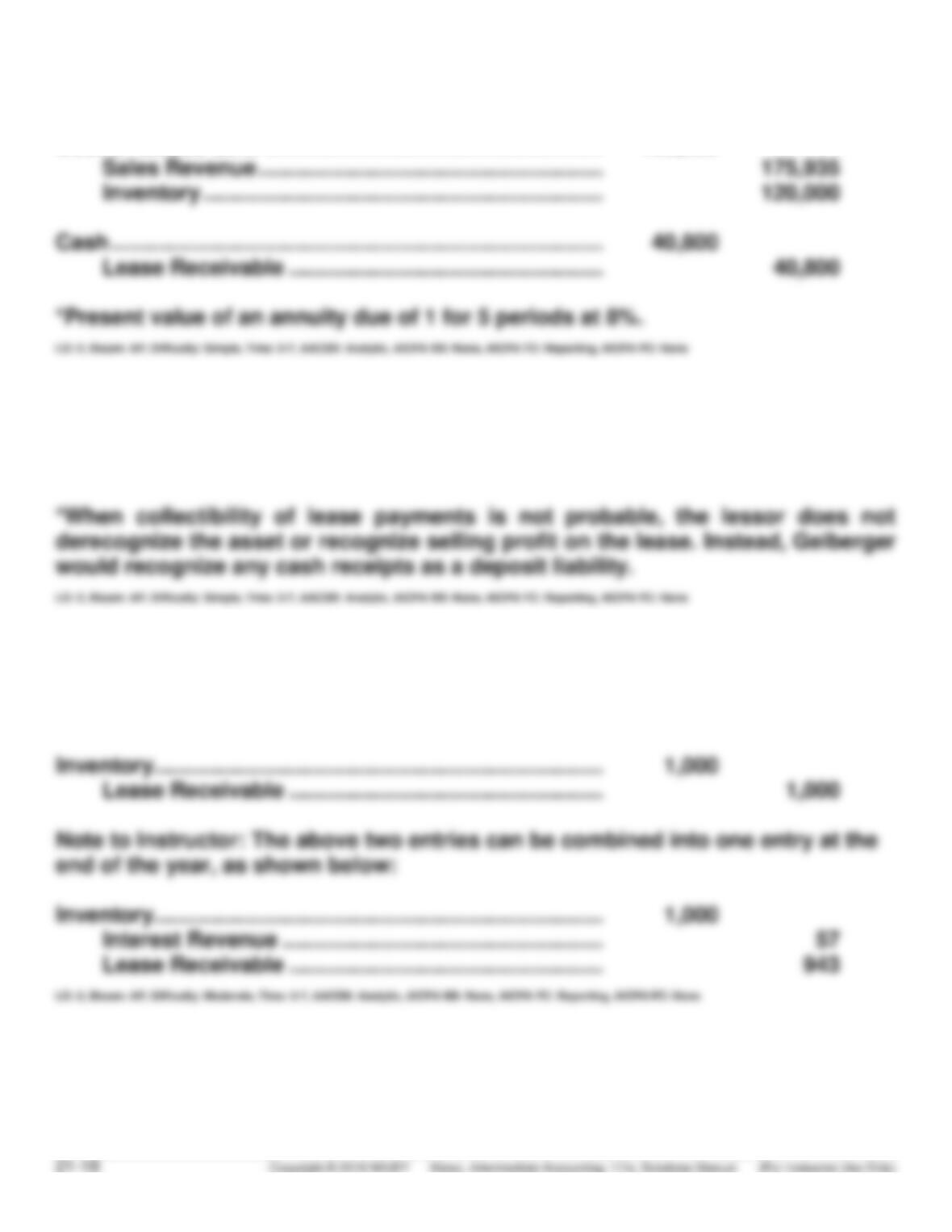
BRIEF EXERCISE 21.12
Lease Receivable ($40,800 X 4.31213*) …………………… 175,935
Cost of Goods Sold ………………………………………………. 120,000
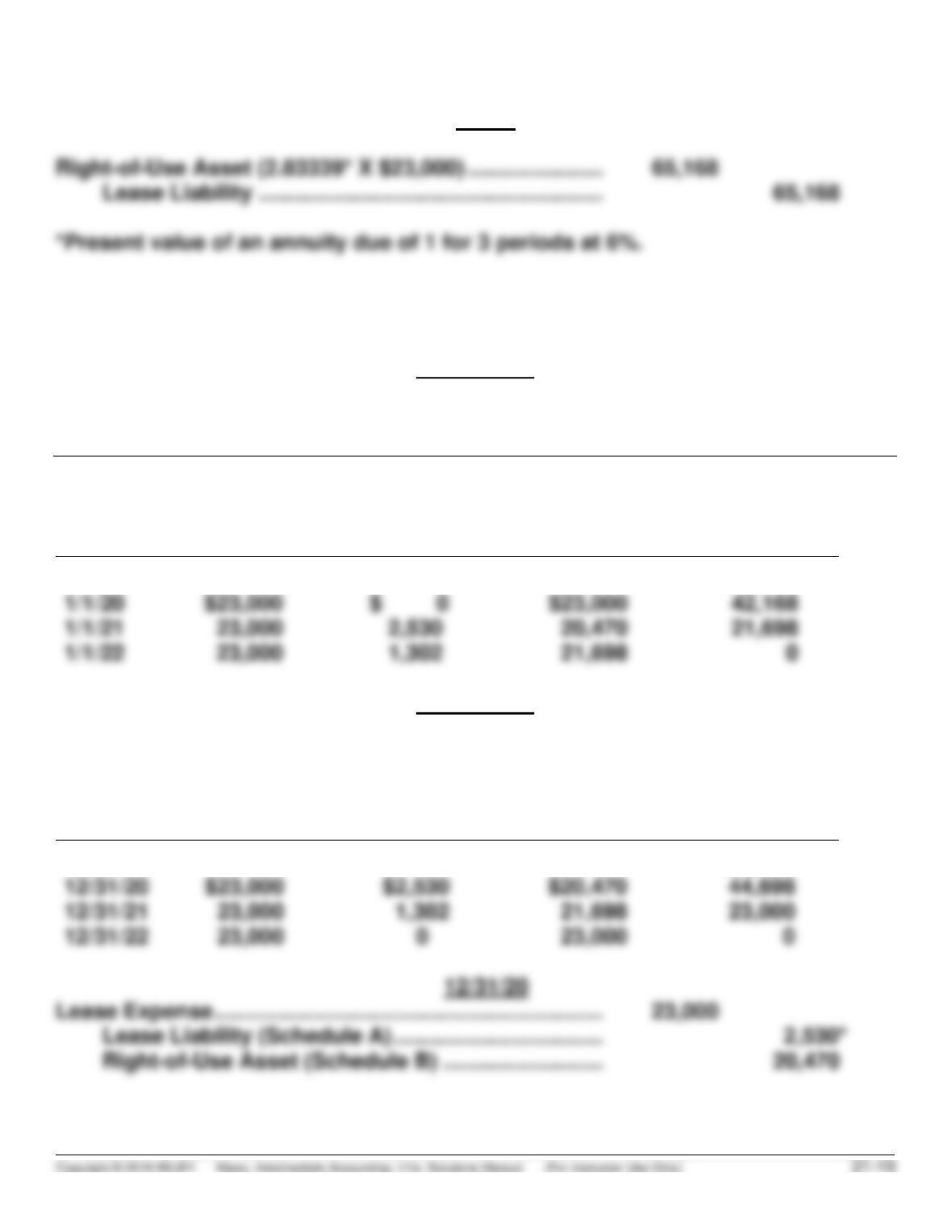
BRIEF EXERCISE 21.13
Cash …………………………………………………………………….. 40,800
Deposit Liability* ……………………………………………. 40,800
BRIEF EXERCISE 21.14
Lease Receivable …………………………..……………………… 57
Interest Revenue ……………………………………………. 57
BRIEF EXERCISE 21.15
1/1/20
Lease Liability ………………………………………………………. 23,000
Cash ……………………………………………………………… 23,000
Schedule A
LEBRON JAMES CORPORATION
Lease Amortization Schedule
Annuity-Due Basis
Date
Annual
Payment
Interest (6%) on
Liability
Reduction
of Lease
Liability
Lease Liability
1/1/20
$65,168
1/1/22
Schedule B
Lease Expense Schedule
Date
(A)
Lease Expense
(Straight-Line)
(B)
Interest (6%) on
Lease Liability
(C)
Amortization
of ROU Asset
(A–B)
Carrying Value
of ROU Asset
1/1/20
$65,168
$23,000
$20,470
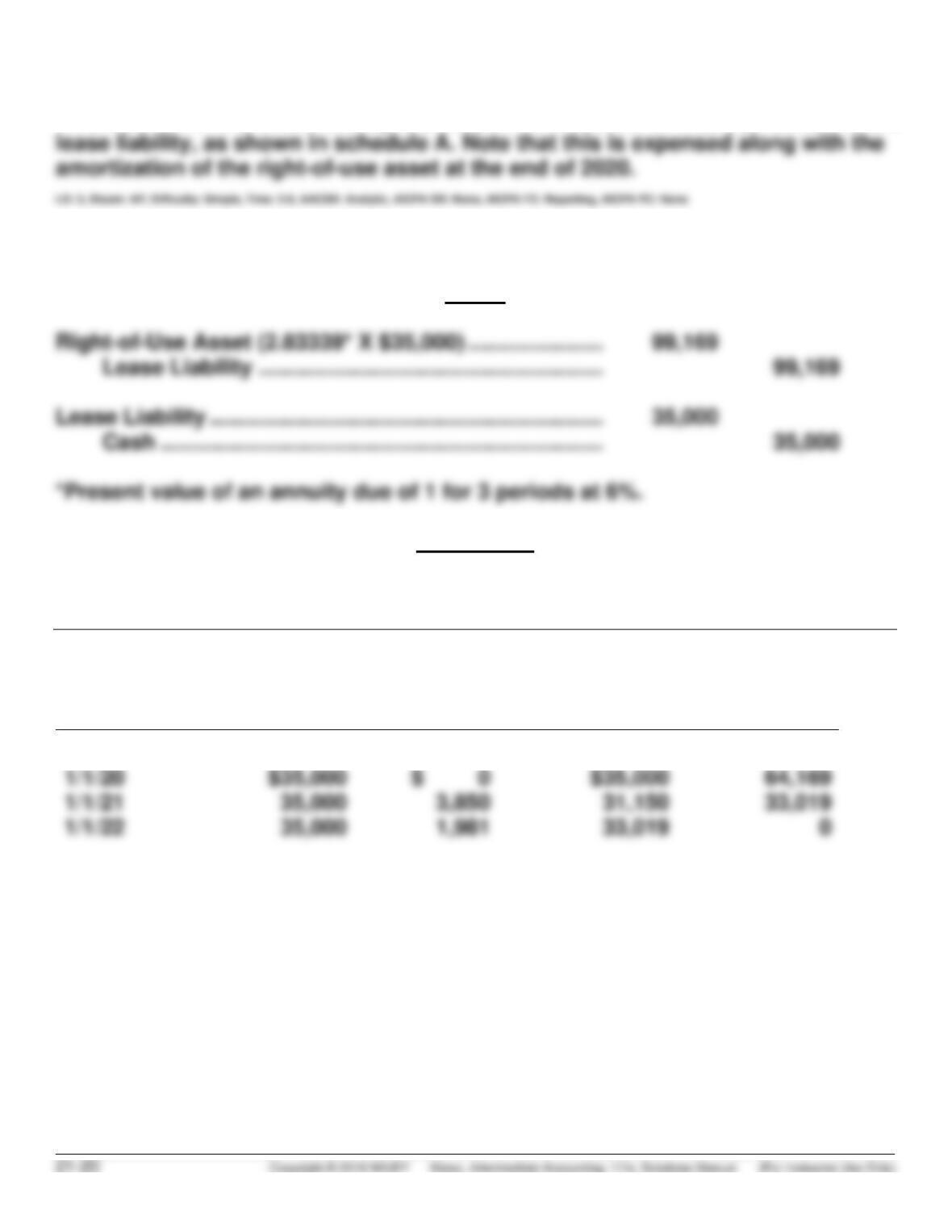
BRIEF EXERCISE 21.15 (Continued)
*The accrual of the lease liability is a result of the accrual of interest related to the
BRIEF EXERCISE 21.16
1/1/20
Schedule A
KINGSTON CORPORATION
Lease Amortization Schedule
Annuity-Due Basis
Date
Annual Payment
Interest (6%)
on Liability
Reduction
of Lease
Liability
Lease Liability
1/1/20
$99,169