Financial and Managerial Accounting, 8th Edition
21-1
CHAPTER 21
FLEXIBLE BUDGETS AND STANDARD COSTS
Related Assignment Materials
Student Learning Objectives
Discussion
Questions
Quick
Studies*
Exercises*
Problems*
AA and
BTN
Conceptual objectives:
Procedural objectives:
P1. Prepare a flexible budget and
interpret a flexible budget
performance report.
1, 2, 3, 4, 5,
14
21-11, 21–12
21-13, 21-15,
21-1, 21-2,
21-3, 21-4,
21-22
21-2, 21-3,
21-4, 21-5,
21-6
21-1, 21-2,
21-3, SP
21-16
P4. Compute overhead controllable
and volume variances.
9, 10, 12, 13,
16
21-13, 21-14,
21-15, 21-16
21-17, 21-19,
21-20, 21-21,
21-22
21-3, 21-4
*See additional information on next page that pertains to these quick studies, exercises, and problems.
SP refers to the Serial Problem
AA refers to Accounting Analysis
Analyze changes in sales from expected amounts.
Sales Variances
1:53
1:11
2:36
1:26
0:44
Flow of Events in Variance Analysis
0:23
Cost Variance Computation
1:17
Financial and Managerial Accounting, 8th Edition
prior written consent of McGraw-Hill Education.
21-2
Additional Information on Related Assignment Material
See Chapter 1 of the Instructor’s Resource Manual for more information on materials for this text available in
Connect.
Connect
Available on the instructor’s course-specific website, Connect:
Hints/Guided Examples
Please note that the Guided Examples are labeled as “Hints” in Connect assignments. The animated PowerPoints without
Need-to-Know Videos
LO
Need–to-Know
Title
Time
P1
21-1
Flexible Budget
2:27
P2
21-2
Cost Variances
1:10
P3
21-3
Direct Materials Price and Quantity Variances
2:48
P3
21-4
Direct Labor Rate and Efficiency Variances
2:45
P4
21-5
Overhead Variances
2:46
P6
21-7
Recording Variances
0:47
Concept Overview Videos
LO
Title
Time
C1
Define standard costs and explain how standard cost information is useful for
management by exception.
Standard Costs
1:00
Setting Standard Costs
1:28
Management by Exception
0:47
Financial and Managerial Accounting, 8th Edition
21-3
Materials and Labor Variances
1:02
Materials and Labor Variances Model
1:25
P3
Compute materials and labor variances.
Materials Variances
2:40
Evaluating Materials Variances
0:52
Labor Variances
2:19
Evaluating Labor Variances
1:08
P4
Compute overhead controllable and volume variances.
Flexible Overhead Budgets & Overhead Standards
3:54
Computing Overhead Cost Variances
2:17
Overhead Controllable and Volume Variances
2:41
Overhead Variance Report
0:43
P5
Compute overhead spending and efficiency variances. (Appendix 21A)
Expanded Overhead Variances
3:07
2:02
1:44
Direct Material Journal Entries
1:12
0:41
1:11
Direct Labor Journal Entries – Illustration
0:35
Factory Overhead Journal Entries
1:46
1:32
Synopsis of Chapter Revision
NEW opener—Away and entrepreneurial assignment.
Added graph to flexible budget exhibit.
Revised discussion of flexible budget.
New exhibit and discussion of computing total cost variance.
Edited discussion of direct materials cost variance.
Edited discussion of evaluating labor variances.
Financial and Managerial Accounting, 8th Edition
21-4
Chapter Outline
I. Budgetary Process
1. Budgetary Control and Reporting
a. Budgetary control⎯managers use budgets to control operations and see that planned
objectives are met.
b. Budget reports
6. Flexible budgeting: a flexible budget (also called a variable budget) is based on several different
amounts of sales or activity levels.
7. A flexible budget is more useful when actual results are different from predicted.
8. Fixed Budget Performance Report
a. A fixed budget performance report compares actual results with results expected under the
fixed budget (that predicted a certain sales volume or other activity level). (Exhibit 21.2)
b. Differences between budgeted and actual results are designated as variances.
II. Flexible Budget Reports –Superior alternative to fixed budget reports.
A. Purpose of Flexible Budgets
1. Flexible budget (also called variable budget) is based on predicted amounts of revenues and
expenses corresponding to actual level of output.
2. Useful both before and after the period’s activities are complete
Financial and Managerial Accounting, 8th Edition
21-5
B. Preparation of Flexible Budgets
1. To prepare a flexible budget, follow these steps:
2. Must classify costs as variable and fixed within a relevant range.
a. Variable cost per unit of activity remains constant; total amount of variable cost changes in
3. When numbers making up a flexible budget are created:
a. Each variable cost is expressed as either a constant amount per unit of sales or as a percent of
4. Layout follows a contribution margin format (Exhibit 21.3)
a. Sales are followed by variable costs (per unit), and then by fixed costs⎯difference between
sales and variable costs equals contribution margin.
C. Flexible Budget Performance Report
1. Compares actual performance and budgeted performance based on actual sales volume (or other
level of activity).
Financial and Managerial Accounting, 8th Edition
III. Standard Costing⎯Actual costs are amounts paid in past transactions; a measure of comparison is
usually needed to decide whether actual cost amounts are reasonable or excessive, and standard costs
offer one basis for comparison.
A. Standard costs are preset costs for delivering a product or service expected under normal conditions.
1. Used by management to assess the reasonableness of actual costs incurred for producing the
product or service.
IV. Setting Standard Costs
A. Identifying Standard Costs
1. Managerial accountants, engineers, personnel administrators, purchasing managers, and
production managers work together to set standard costs.
2. Regardless, actual costs frequently differ from standard costs; differences often due to more than
one factor.
a. Actual quantity used (of direct labor hours or direct materials) may differ from standard.
.
V. Cost Variances⎯Cost variance (or simply variance) is difference between actual and standard costs; can
be favorable (if actual cost is less than standard cost) or unfavorable (if actual cost is more than standard
cost). Note that short-term favorable variances can lead to long-term unfavorable variances.
A. Cost Variance Analysis
1. Variances are commonly identified in performance reports.
Financial and Managerial Accounting, 8th Edition
3. Results of efforts should allow assignment of responsibility for the variance; actions can then be
taken to correct problems.
4. Four steps involved in proper management of variance analysis.
a. Preparation of standard cost performance report.
B. Cost Variance Computation⎯Cost variance (CV) equals difference between actual cost (AC) and
standard cost (SC).
1. Actual quantity (AQ ) Standard quantity (SQ)
x Actual price (AP) x Standard price (SP)
Actual Cost (AC) Standard Cost (SC)
5. Price variance and quantity variance can be determined by formulas.
Actual Cost Standard
6. Alternative price variance and quantity variance formulas can also be used.
a. Price variance = (Actual price – Standard price) x Actual quantity.
C. Computing Materials and Labor Variances
1. Material cost variances may be due to price and/or quantity factors.
a. A materials price variance results when company pays different amount per unit than
21-8
2. Labor cost variances may be due to rate (price) and/or efficiency (quantity) factors.
a. Labor rate (price) variance results when wage rate paid to employees differs from standard
VI. Overhead Standards and Variances⎯A predetermined overhead rate is used to assign standard
overhead costs to products or services produced; predetermined rate is often based on relation between
standard overhead and standard labor cost, standard labor hours, standard machine hours, or another
measure of production.
A. Standard Overhead Rate
1. Standard overhead costs are amounts expected to occur at a certain level of activity.
4. To allocate overhead costs to products or services, management establishes standard overhead
cost rate using a 3-step process:
a. Step 1: determine an allocation base: a measure of input management believes is related to
overhead costs, such as direct labor hours or machine hours.
VII. Computing Overhead Cost Variances
1. Cost accounting system applies overhead using predetermined overhead rate when standard costs
are used as described in Step 3.
2. The standard overhead applied is based on the predetermined overhead rate and the standard
Financial and Managerial Accounting, 8th Edition
3. To help identify factors causing the total overhead cost variance managers will analyze the
variance separately for volume and controllable variances.
a. The controllable variance is the difference between the actual total overhead costs incurred
4. Analyzing overhead controllable and volume variances
a. An unfavorable volume means the company did not reach its expected operating level – a
5. Overhead Variance Reports
a. Help managers isolate the reasons for a controllable variance.
b. Shows specific overhead costs and how they differ from budgeted amounts
VIII. Decision Analysis⎯Sales Variances⎯Similar to computation and analysis of cost variances.
A. Sales price variance and sales volume variance can be computed. Managers use sales variances for
planning and control purposes.
1. Sales price variance measures the impact of the actual sales price differing from the expected
IX. Expanded Overhead Variances
A. Computing Overhead Cost Variances⎯assume predetermined rate is based on relation between
standard overhead and standard labor hours.
1. Framework uses classifications of overhead costs as either variable or fixed
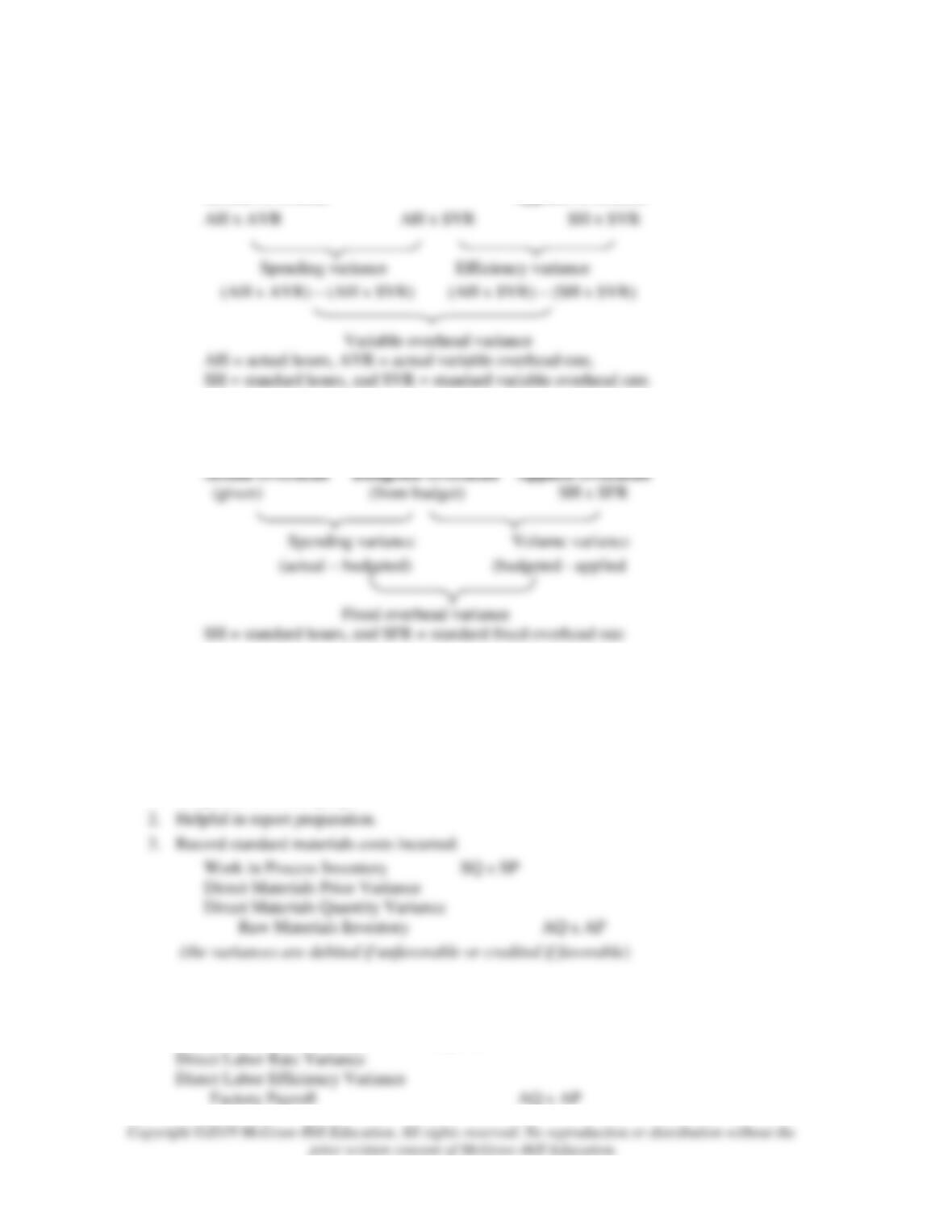
2. Exhibit 21A.1 shows that the variable overhead spending and efficiency variances and the fixed
overhead spending variance are combined to get the controllable variance.
Financial and Managerial Accounting, 8th Edition
21-10
B. Variable overhead cost variances can be determined by formulas.
Formulas:
Actual Overhead Applied Overhead
C. Fixed overhead cost variances can be determined by formulas that include only the fixed portion of
overhead.
Formulas:
1. Fixed overhead volume variance results when actual volume of production differs from standard
68157323volume of production.
2. Budgeted fixed overhead amount remains same regardless of expected volume, and is computed
based on standard direct labor hours allowed for the expected production volume.
X. Standard Cost Accounting Systems
Standard cost systems also record standard costs and variances in most accounts.
1. Simplifies recordkeeping
4. Record standard labor cost of goods manufactured:
Work in Process Inventory SQ x SP
Financial and Managerial Accounting, 8th Edition
21-11
(the variances are debited if unfavorable or credited if favorable)
5. Assign standard predetermined overhead to Work in Process:
Work in Process Inventory SQ x SPR
6. An alternative is to combine the spending and efficiency variances into one account called
“Controllable Variances”.
7. Accumulate balances in the different variance accounts until end of accounting period; to close,
8. Can use a standard costing income statement to summarize a company’s performance. The
Financial and Managerial Accounting, 8th Edition
21-12
Chapter 21 Alternate Demo Problem #1
Problem #1
XYZ Company manufactures tables. A standard cost card for the manufacture of one
table shows the following:
Standard Cost per Table:
Required:
Calculate the price and quantity variances for direct material and direct labor.
Financial and Managerial Accounting, 8th Edition
21-13
Chapter 21 Alternate Demo Problem #2
Atlantic Company has the following monthly flexible budget information based on an
expectation of operating at 80% of the factory’s capacity or 10,000 units produced:
Operating Levels
70%
80%
90%
Budgeted output in units
8,000
10,000
12,000
Budgeted labor (standard hours)
16,000
20,000
24,000
Budgeted overhead
Required:
1. Compute the predetermined overhead rate per direct labor hour for variable
overhead, fixed overhead, and total overhead.
Financial and Managerial Accounting, 8th Edition
21-14
Chapter 21 Alternate Demo Problem #1: Solution
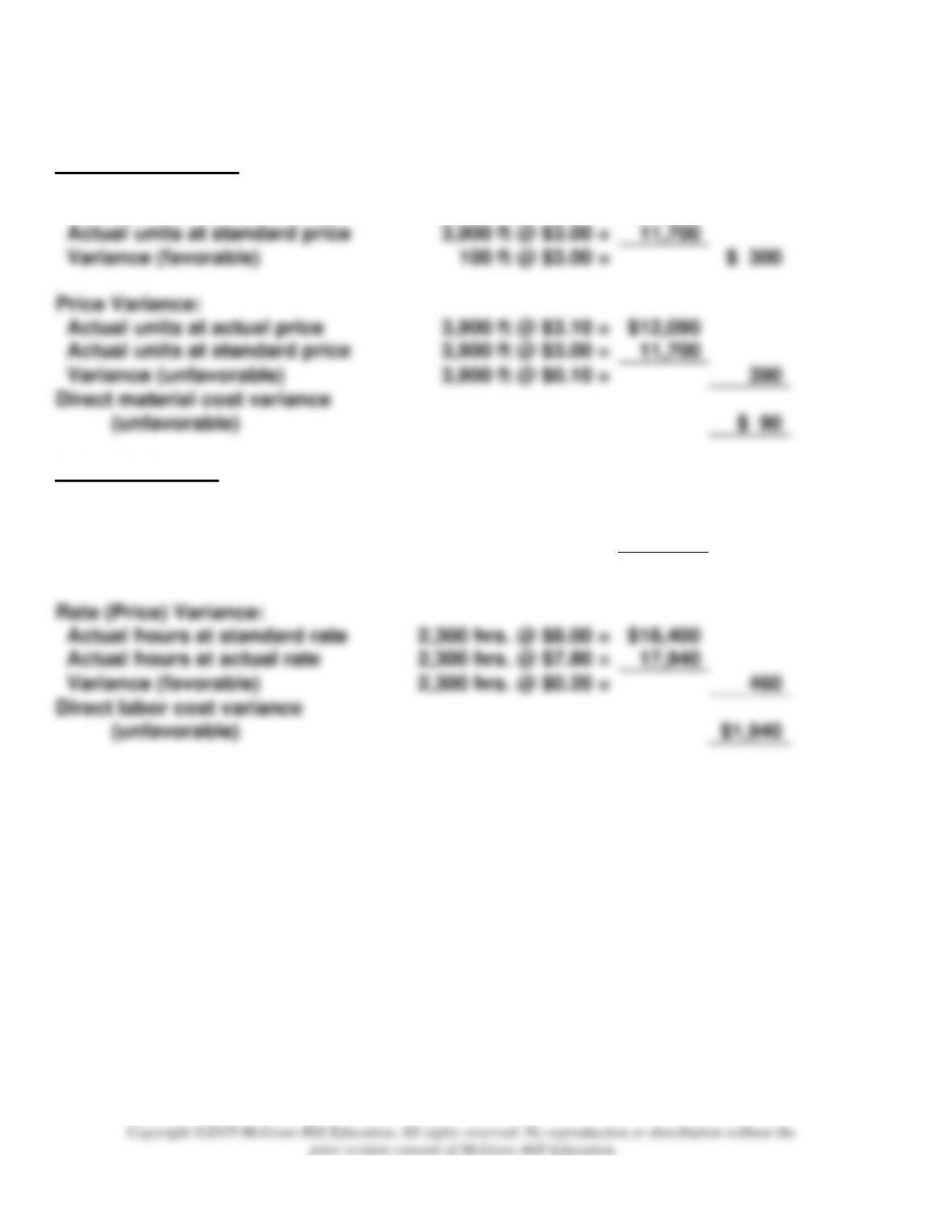
Materials Variances
Units produced……………………………………..
tables
Standard quantity of materials for 1,000 tables
Sq ft
AQ
3,900
Sq ft.
AQ
3,900
Sq ft.
SQ
4,000
Sq ft.
X AP
X $3.10
X SP
X 3.00
X SP
X 3.00
$12,000
Labor Variances
Units produced……………………………………..
1,000
tables
Standard quantity of hours for 1,000 tables
2,000
hours
AQ
2,300
Hrs.
AQ
2,300
Hrs.
SQ
2,000
Hrs.
X AP
X $7.80
X SP
X 8.00
X SP
X 8.00
$16,000
Financial and Managerial Accounting, 8th Edition
21-15
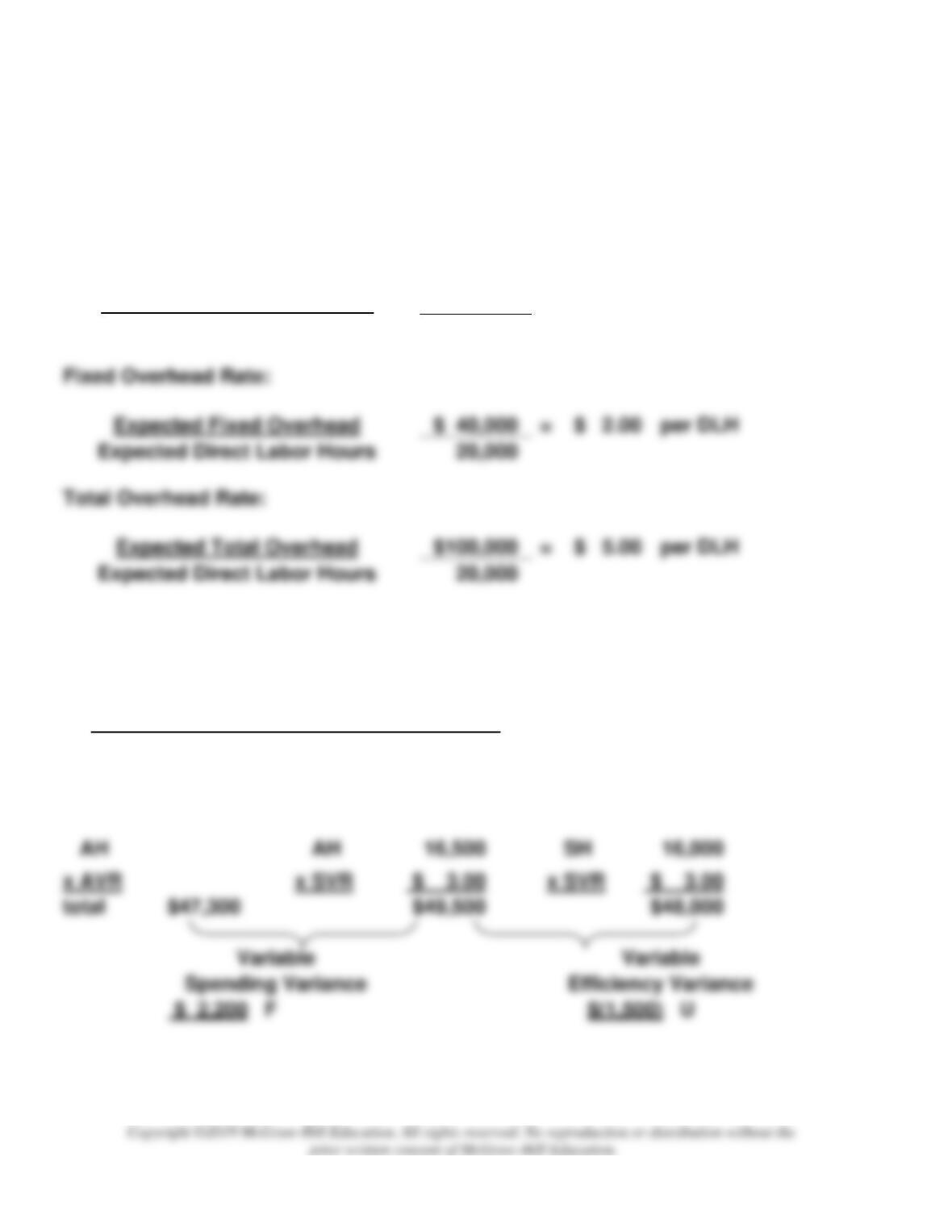
Material Variances:
Quantity Variance:
Standard units at standard price
4,000 ft @ $3.00 =
$12,000
Actual units at standard price
3,900 ft @ $3.00 =
11,700
Variance (favorable)
Price Variance:
Actual units at actual price
3,900 ft @ $3.10 =
$12,090
Actual units at standard price
3,900 ft @ $3.00 =
11,700
(unfavorable)
Labor Variances:
Efficiency (Quantity) Variance
Actual hours at standard rate
2,300 hrs. @ $8.00 =
$18,400
Standard hours at standard rate
2,000 hrs. @ $8.00 =
16,000
Variance (unfavorable)
300 hrs. @ $8.00 =
$2,400
Actual hours at actual rate
2,300 hrs. @ $7.80 =
17,940
Variance (favorable)
2,300 hrs. @ $0.20 =
(unfavorable)
$1,940
Financial and Managerial Accounting, 8th Edition
21-16
Chapter 21 Alternate Demo Problem #2: Solution
1. Compute the predetermined overhead rates
Overhead at operating level expected (80%) or 10,000 units
Variable Overhead Rate:
Expected Variable Overhead
$ 60,000
=
$ 3.00
per DLH
Expected Direct Labor Hours
20,000
Fixed Overhead Rate:
$ 40,000
=
$ 2.00
per DLH
Expected Direct Labor Hours
20,000
Total Overhead Rate:
$100,000
=
$ 5.00
per DLH
Expected Direct Labor Hours
20,000
2. Variable Overhead Variance Computations
Actual Variable
Applied Variable
Overhead
Overhead
AH
AH
16,500
SH
16,000
$ 3.00
$ 3.00
total
$47,300
$49,500
$48,000
F
$(1,500)
U
Financial and Managerial Accounting, 8th Edition
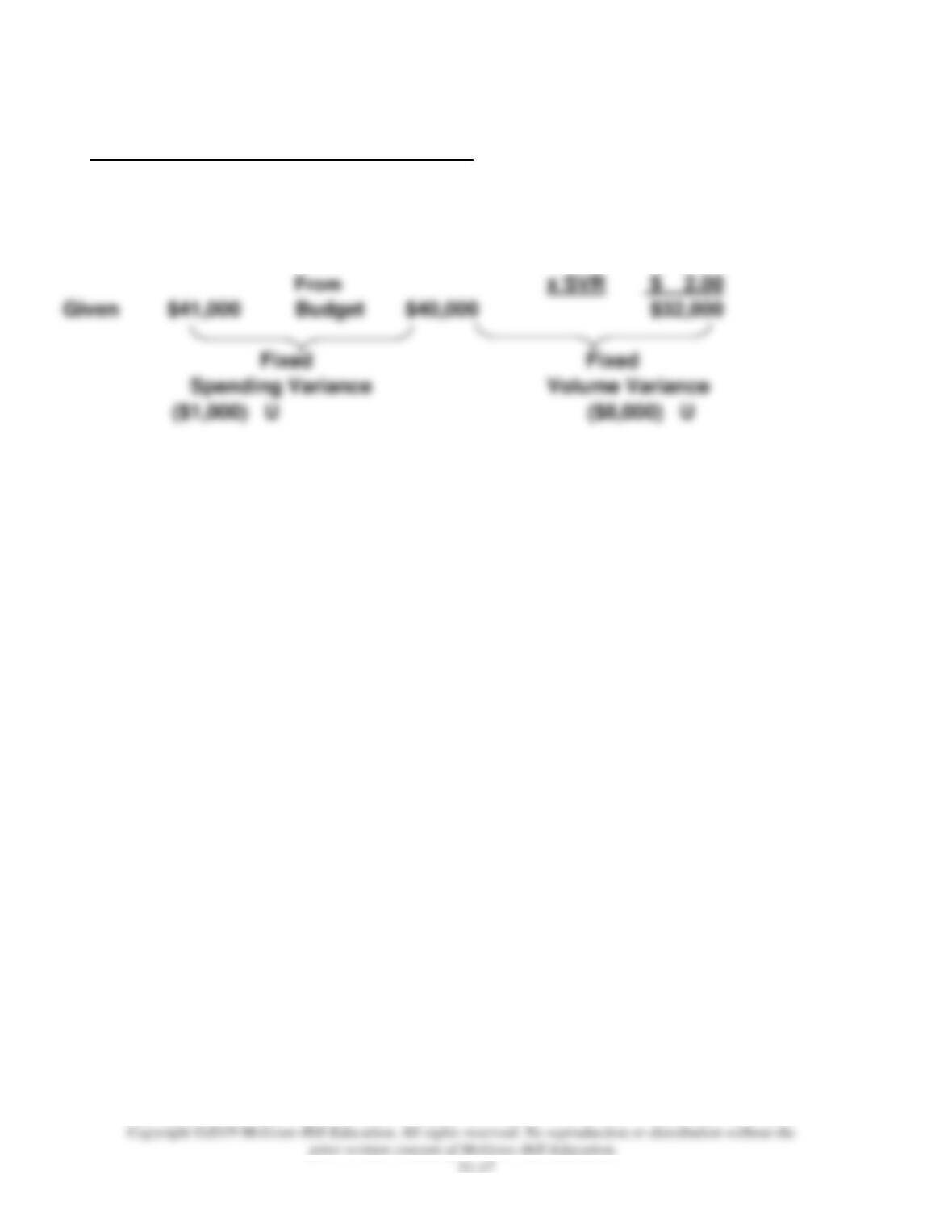
3. Fixed Overhead Variance Computations
Actual Fixed
Applied Fixed
Overhead
Overhead
SH
16,000
$ 2.00
$41,000
$40,000
$32,000
Fixed
Spending Variance
U
U