21-41
21-31 (20 min.) DCF, sensitivity analysis, no income taxes.
(CMA, adapted) Invigor Corporation is an international manufacturer of fragrances for women.
Management at Invigor is considering expanding the product line to men’s fragrances. From the
best estimates of the marketing and production managers, annual sales (all for cash) for this new
line are 1,200,000 units at $50 per unit; cash variable cost is $20 per unit; and cash fixed costs
are $8,000,000 per year. The investment project requires $70,000,000 of cash outflow and has a
project life of 8 years.
At the end of the 8-year useful life, there will be no terminal disposal value. Assume all cash
flows occur at year-end except for initial investment amounts.
Men’s fragrance is a new market for Invigor, and management is concerned about the
reliability of the estimates. The controller has proposed applying sensitivity analysis to selected
factors. Ignore income taxes in your computations. Invigor’s required rate of return on this
project is 12%.
Required:
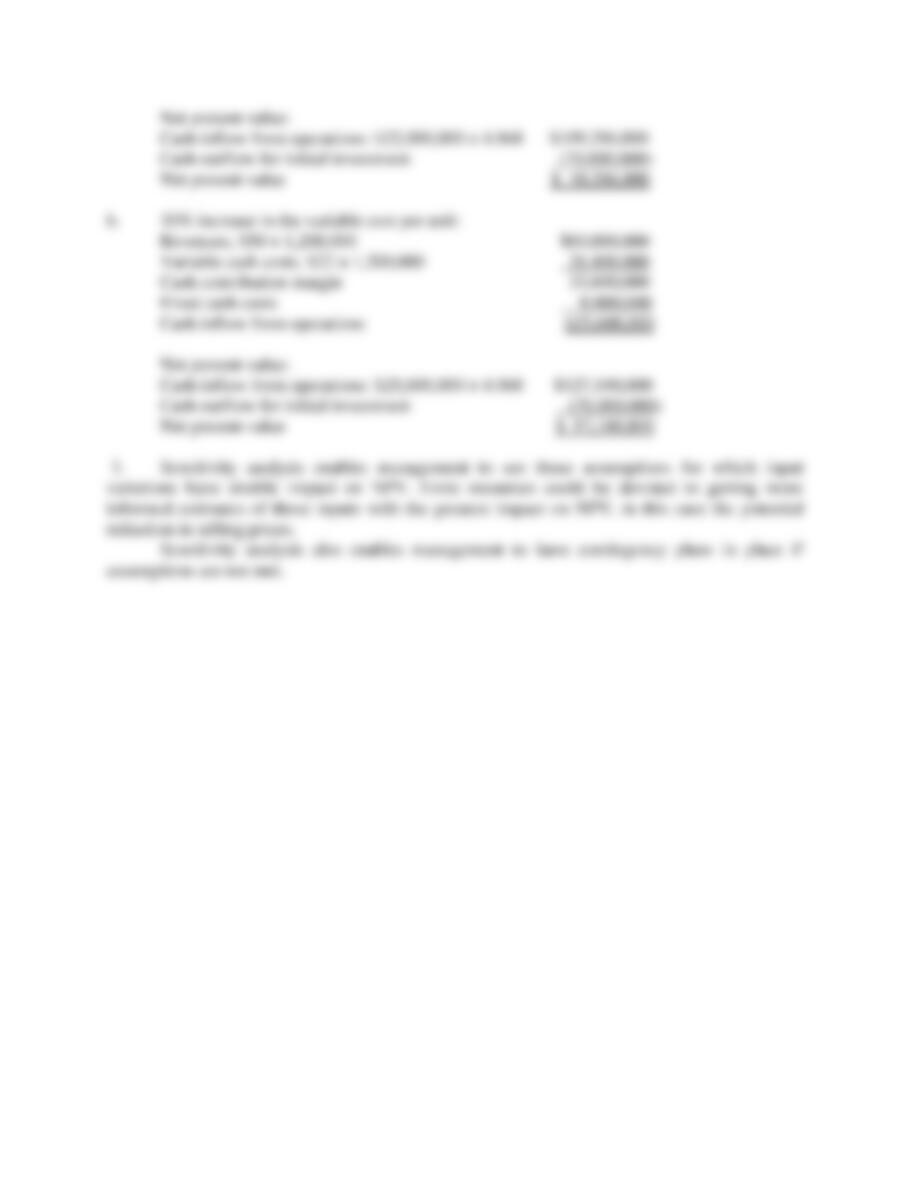
1. Calculate the net present value of this investment proposal.
2. Calculate the effect on the net present value of the following two changes in assumptions.
(Treat each item independently of the other.)
a. 10% reduction in the selling price
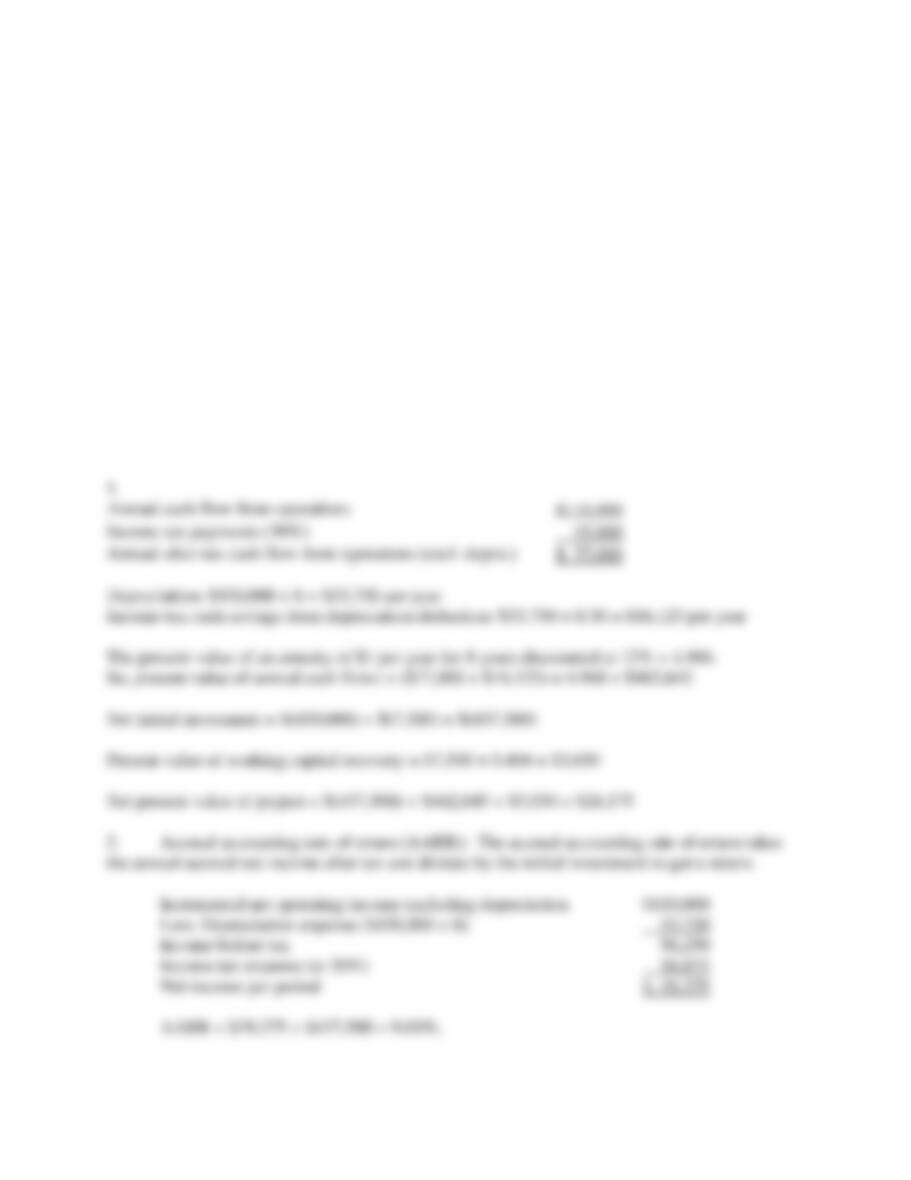
b. 10% increase in the variable cost per unit
3. Discuss how management would use the data developed in requirements 1 and 2 in its
consideration of the proposed capital investment.
SOLUTION
21-42
21-43
21-32 (30–35 min.) NPV and AARR, goal-congruence issues.
Eric Ishton, a manager of the Plate Division for the Stone Ware Manufacturing company, has the
opportunity to expand the division by investing in additional machinery costing $430,000. He
would depreciate the equipment using the straight-line method and expects it to have no residual
value. It has a useful life of 8 years. The firm mandates a required after-tax rate of return of 12%
on investments. Eric estimates annual net cash inflows for this investment of $110,000 before
taxes and an investment in working capital of $7,500. The tax rate is 30%.
Required:
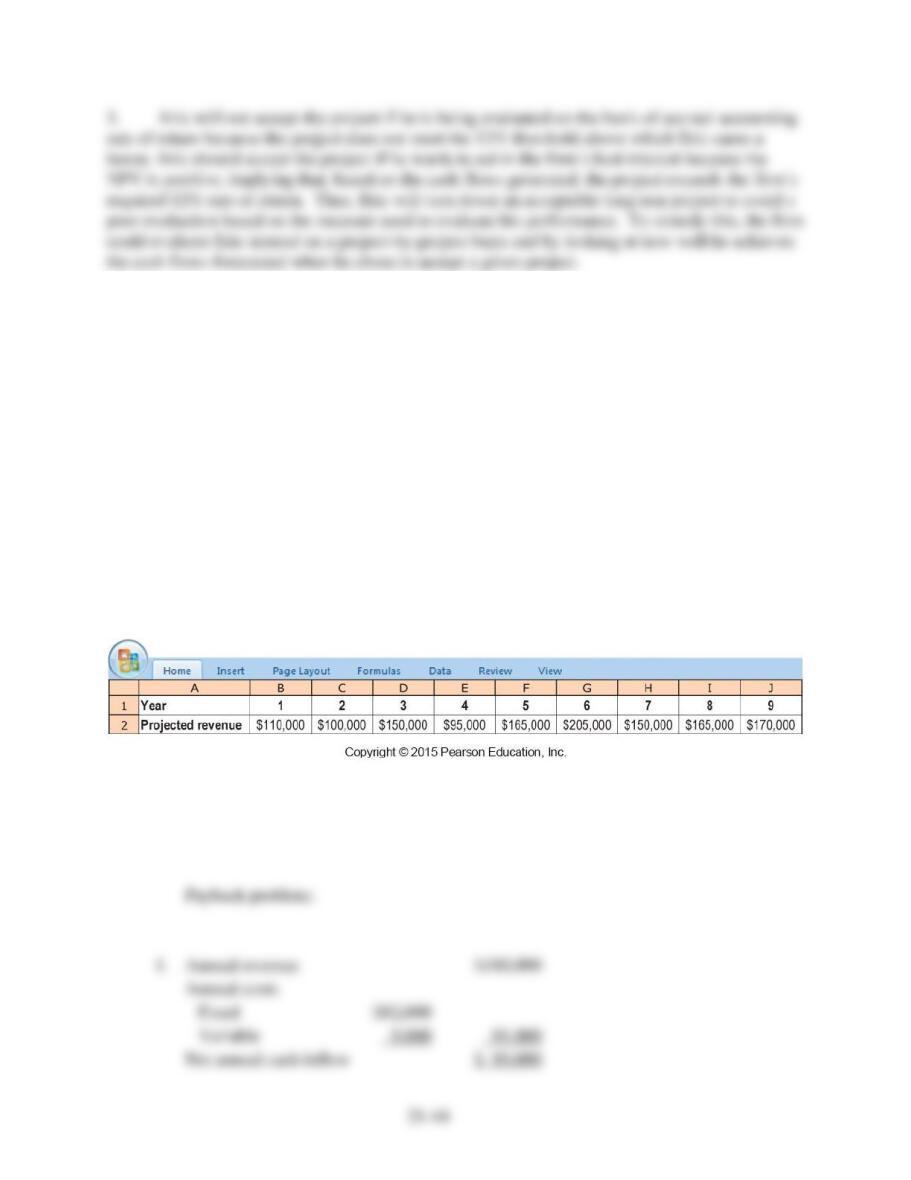
1. Calculate the net present value of this investment.
2. Calculate the accrual accounting rate of return based on net initial investment for this project.
3. Should Eric accept the project? Will Eric accept the project if his bonus depends on
achieving an accrual accounting rate of return of 12%? How can this conflict be resolved?
SOLUTION
21-33 (30 min.) Payback methods, even and uneven cash flows.
Cardinal Laundromat is trying to enhance the services it provides to customers, mostly college
students. It is looking into the purchase of new high– efficiency washing machines that will allow
for the laundry’s status to be checked via smartphone.
Cardinal estimates the cost of the new equipment at $186,000. The equipment has a useful life
of 9 years. Cardinal expects cash fixed costs of $82,000 per year to operate the new machines, as
well as cash variable costs in the amount of 5% of revenues. Cardinal evaluates investments
using a cost of capital of 6%.
Required:
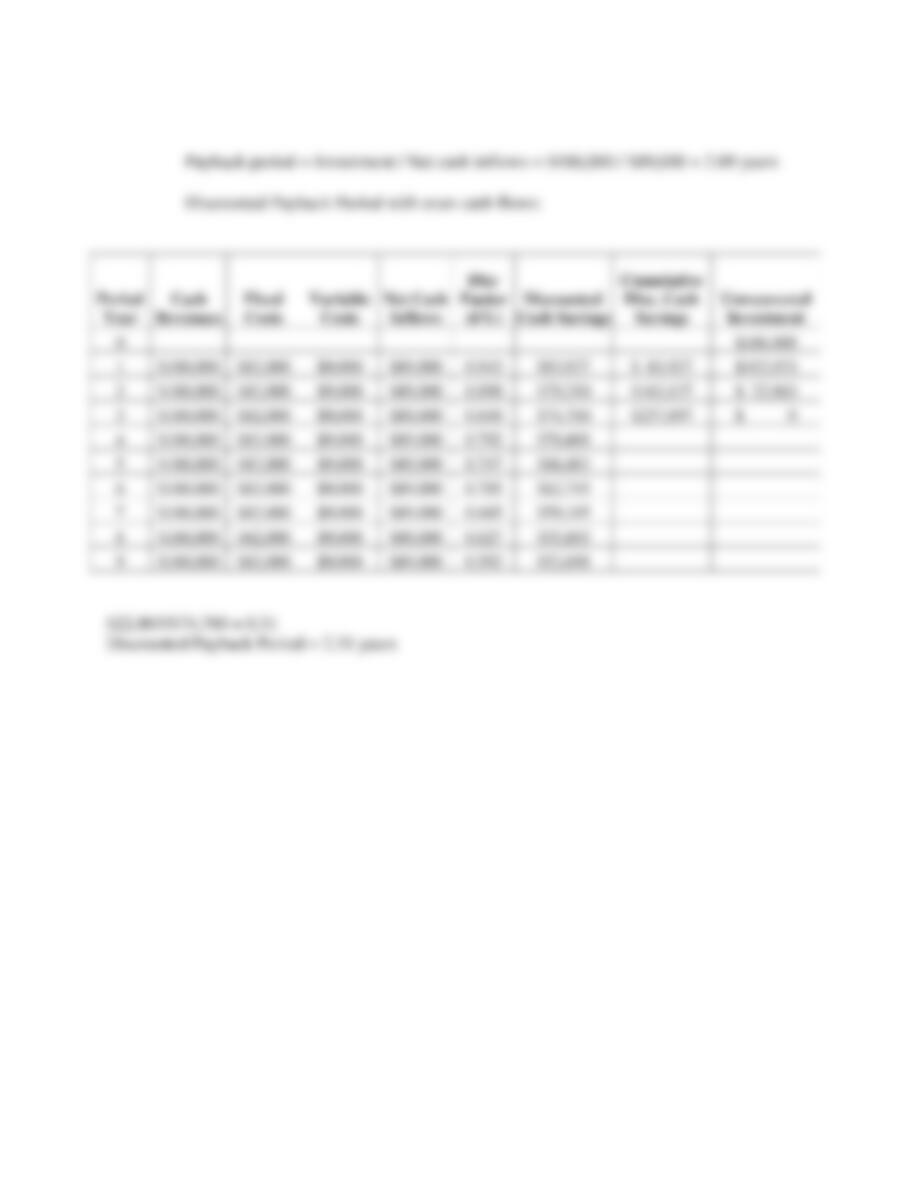
1. Calculate the payback period and the discounted payback period for this investment,
assuming Cardinal expects to generate $180,000 in revenues every year from the new
machines.
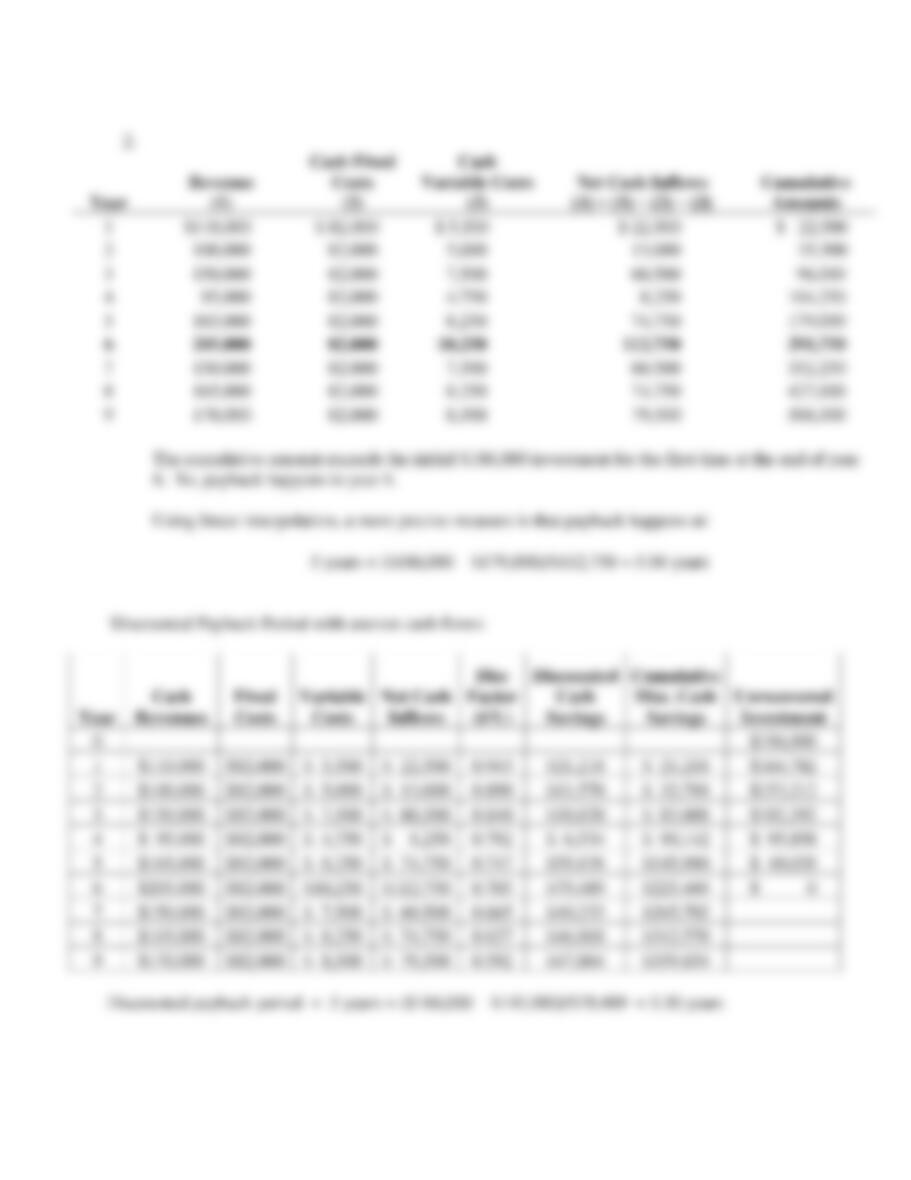
2. Assume instead that Cardinal expects the following uneven stream of cash revenues from
installing the new washing machines:
Based on this estimated revenue stream, what are the payback and discounted payback periods
for the investment?
SOLUTION
21-45
21-46
21-47
21-34 (40 min.) Replacement of a machine, income taxes, sensitivity.
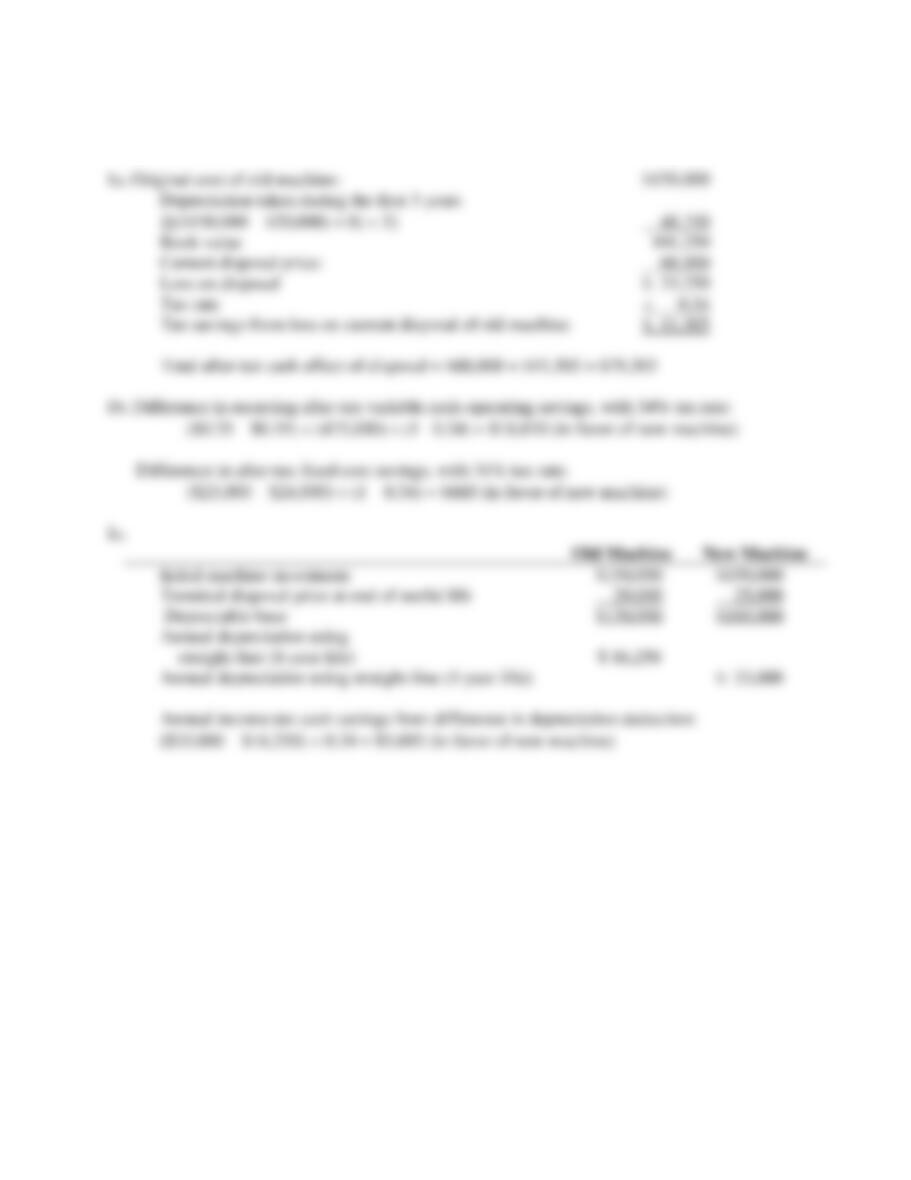
(CMA, adapted) The Frooty Company is a family-owned business that produces fruit jam. The
company has a grinding machine that has been in use for 3 years. On January 1, 2014, Frooty is
considering the purchase of a new grinding machine. Frooty has two options: (1) continue using
the old machine or (2) sell the old machine and purchase a new machine. The seller of the new
machine isn’t offering a trade-in. The following information has been obtained:
A
Frooty is subject to a 34% income tax rate. Assume that any gain or loss on the sale of machines
is treated as an ordinary tax item and will affect the taxes paid by Frooty in the year in which it
occurs. Frooty’s after-tax required rate of return is 12%. Assume all cash flows occur at year-end
except for initial investment amounts.
Required:
1. A manager at Frooty asks you whether it should buy the new machine. To help in your
analysis, calculate the following:
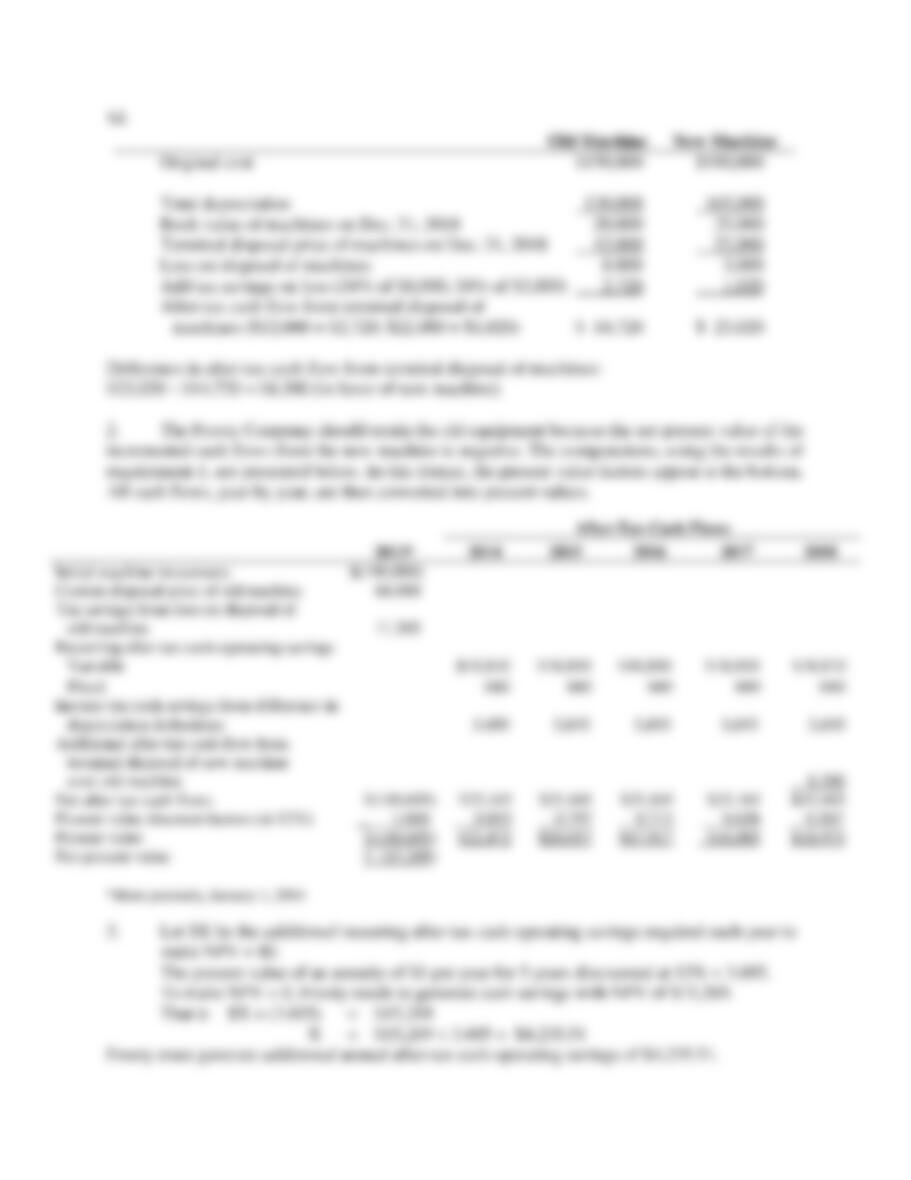
a. One-time after-tax cash effect of disposing of the old machine on January 1, 2014
b. Annual recurring after-tax cash operating savings from using the new machine (variable
and fixed)
c. Cash tax savings due to differences in annual depreciation of the old machine and the
new machine
d. Difference in after-tax cash flow from terminal disposal of new machine and old machine
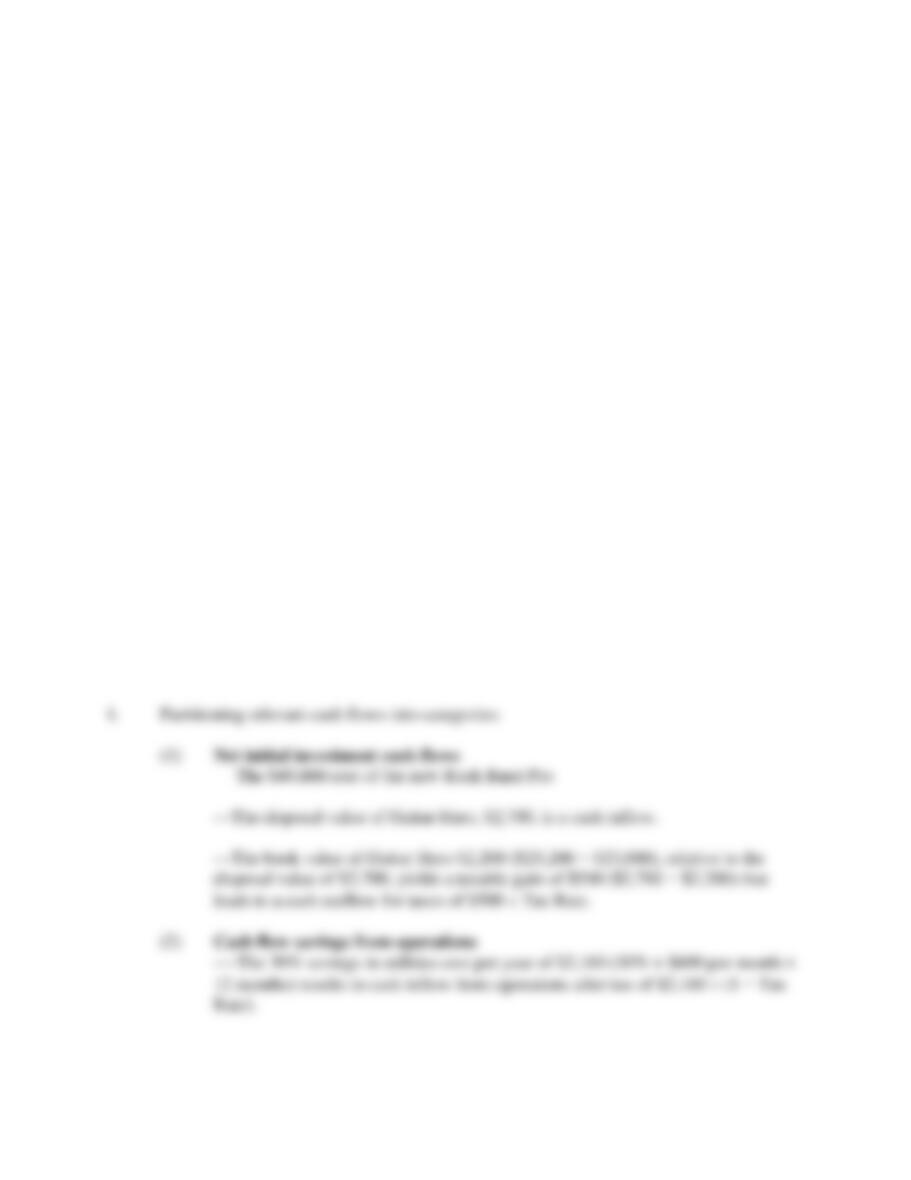
2. Use your calculations in requirement 1 and the net present value method to determine
whether Frooty should use the old machine or acquire the new machine.
3. How much more or less would the recurring after-tax cash operating savings of the new
machine need to be for Frooty to earn exactly the 12% after-tax required rate of return?
Assume that all other data about the investment do not change.
21-48
SOLUTION
21-49
21-50
21-35 (35 min.) Recognizing cash flows for capital investment projects.
Johnny Buster owns Entertainment World, a place that combines fast food, innovative beverages,
and arcade games. Worried about the shifting tastes of younger audiences, Johnny contemplates
bringing in new simulators and virtual reality games to maintain customer interest.
As part of this overhaul, Johnny is also looking at replacing his old Guitar Hero equipment
with a Rock Band Pro machine. The Guitar Hero setup was purchased for $25,200 and has
accumulated depreciation of $23,000, with a current trade-in value of $2,700. It currently costs
Johnny $600 per month in utilities and another $5,000 a year in maintenance to run the Guitar
Hero equipment. Johnny feels that the equipment could be kept in service for another 11 years,
after which it would have no salvage value.
The Rock Band Pro machine is more energy-efficient and durable. It would reduce the
utilities costs by 30% and cut the maintenance cost in half. The Rock Band Pro costs $49,000
and has an expected disposal value of $5,000 at the end of its useful life of 11 years.
Johnny charges an entrance fee of $5 per hour for customers to play an unlimited number of
games. He does not believe that replacing Guitar Hero with Rock Band Pro will have an impact
on this charge or materially change the number of customers who will visit Entertainment World.
Required:
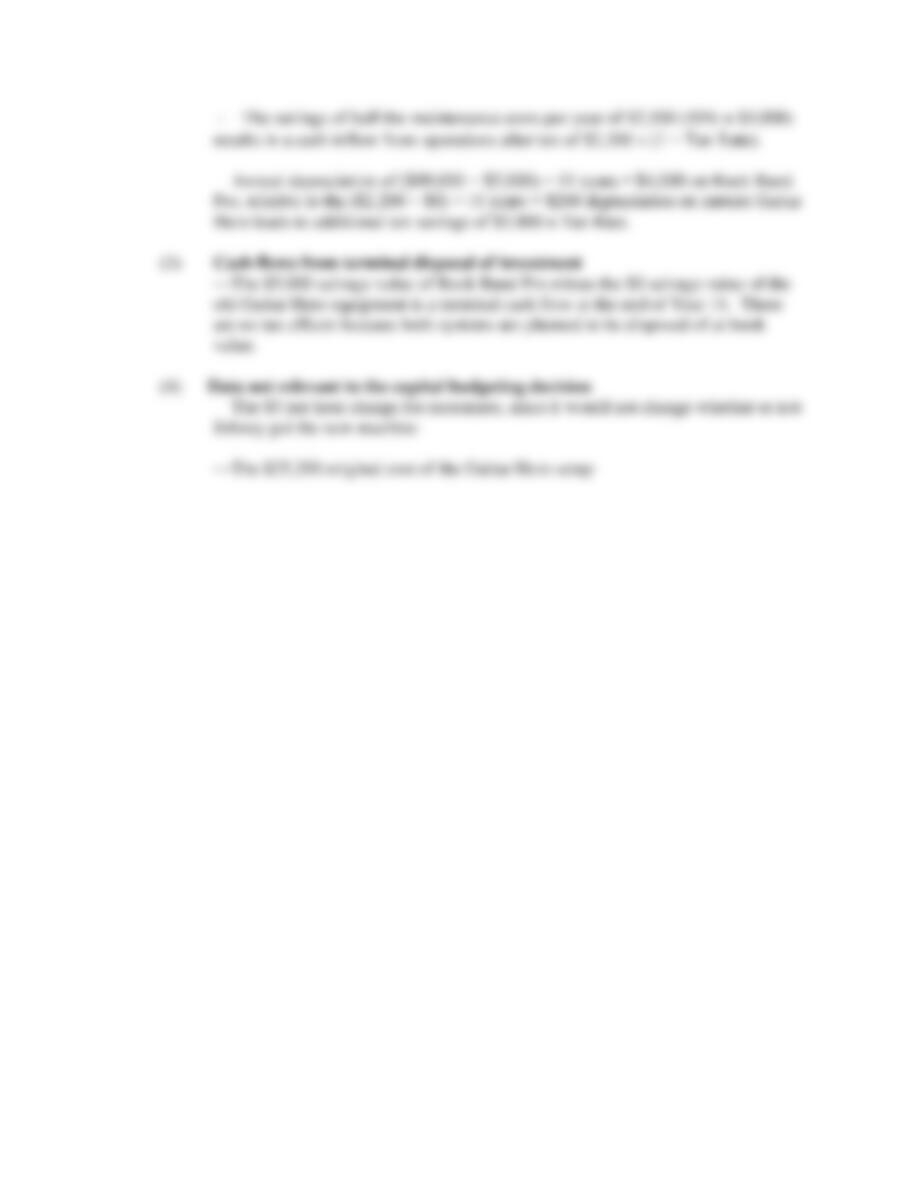
1. Johnny wants to evaluate the Rock Band Pro project using capital budgeting techniques. To
help him, read through the problem and separate the cash flows into four groups: (1) net
initial investment cash flows, (2) cash flow savings from operations, (3) cash flows from
terminal disposal of investment, and (4) cash flows not relevant to the capital budgeting
problem.
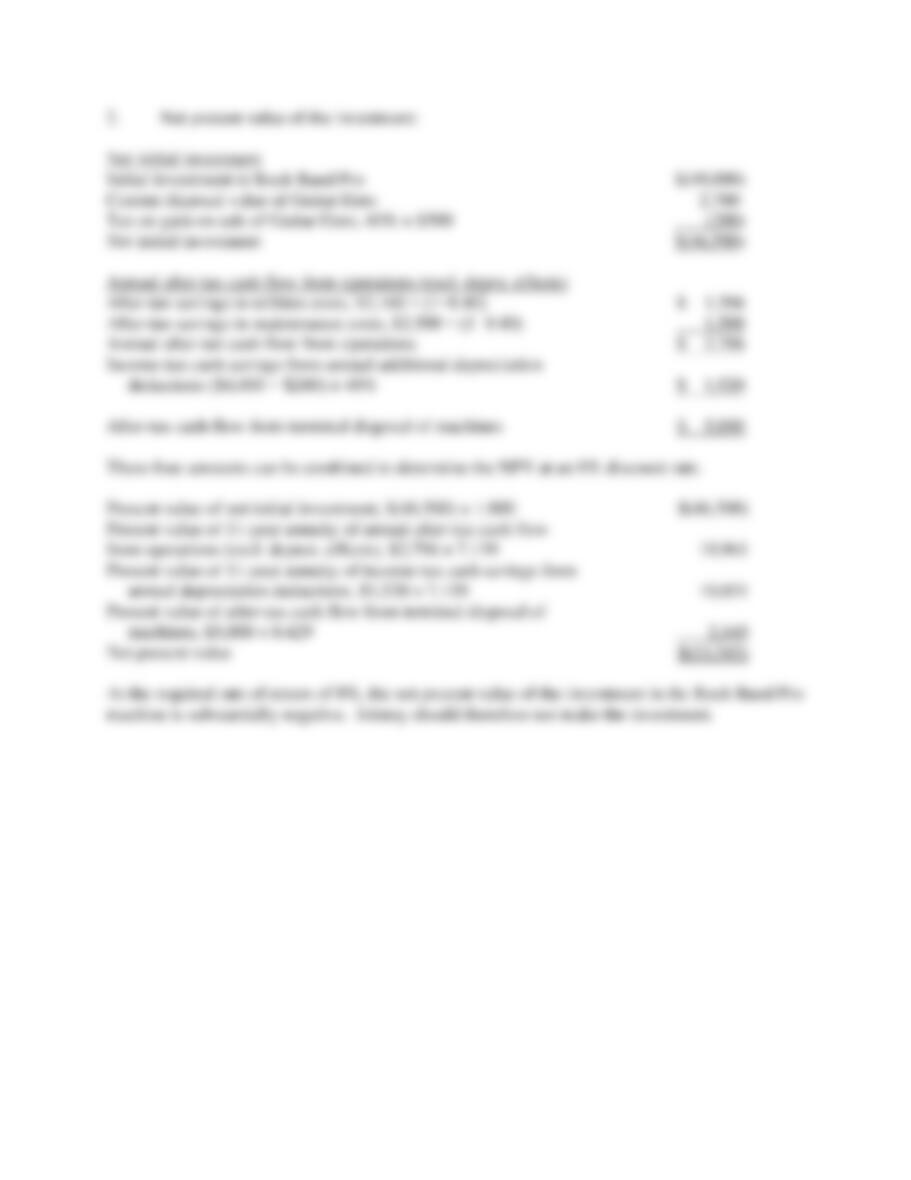
2. Assuming a tax rate of 40%, a required rate of return of 8%, and straight-line depreciation
over the remaining useful life of equipment, should Johnny purchase Rock Band Pro?
SOLUTION
21-51
21-52
21-53
21-54
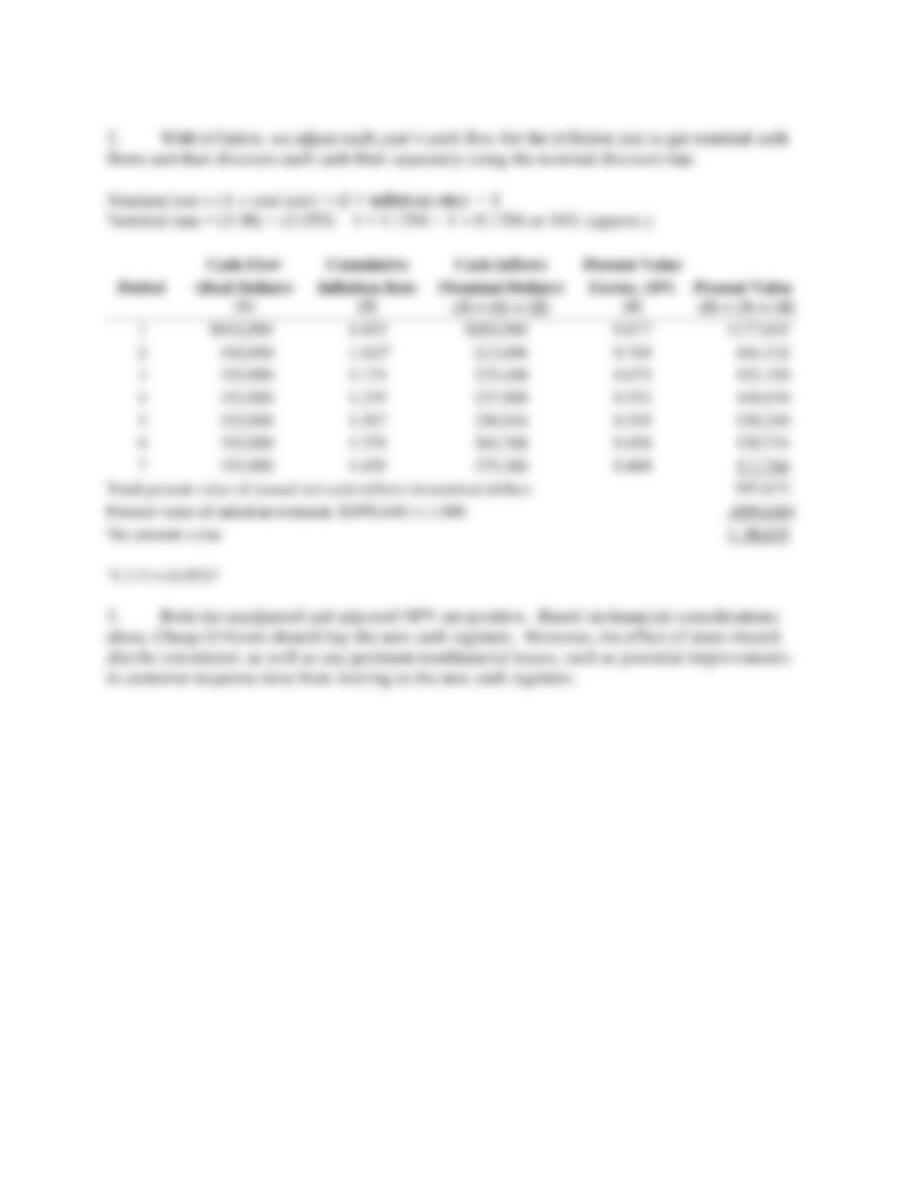
21-36 (25 min.) NPV, inflation and taxes.
Cheap-O Foods is considering replacing all 10 of its old cash registers with new ones. The old
registers are fully depreciated and have no disposal value. The new registers cost $899,640 (in
total). Because the new registers are more efficient than the old registers, Cheap-O will have
annual incremental cash savings from using the new registers in the amount of $192,000 per
year. The registers have a 7-year useful life and no terminal disposal value and are depreciated
using the straight-line method. Cheap-O requires an 8% real rate of return.
Required:
1. Given the preceding information, what is the net present value of the project? Ignore taxes.
2. Assume the $192,000 cost savings are in current real dollars and the inflation rate is 5.5%.
Recalculate the NPV of the project.
3. Based on your answers to requirements 1 and 2, should Cheap-O buy the new cash registers?
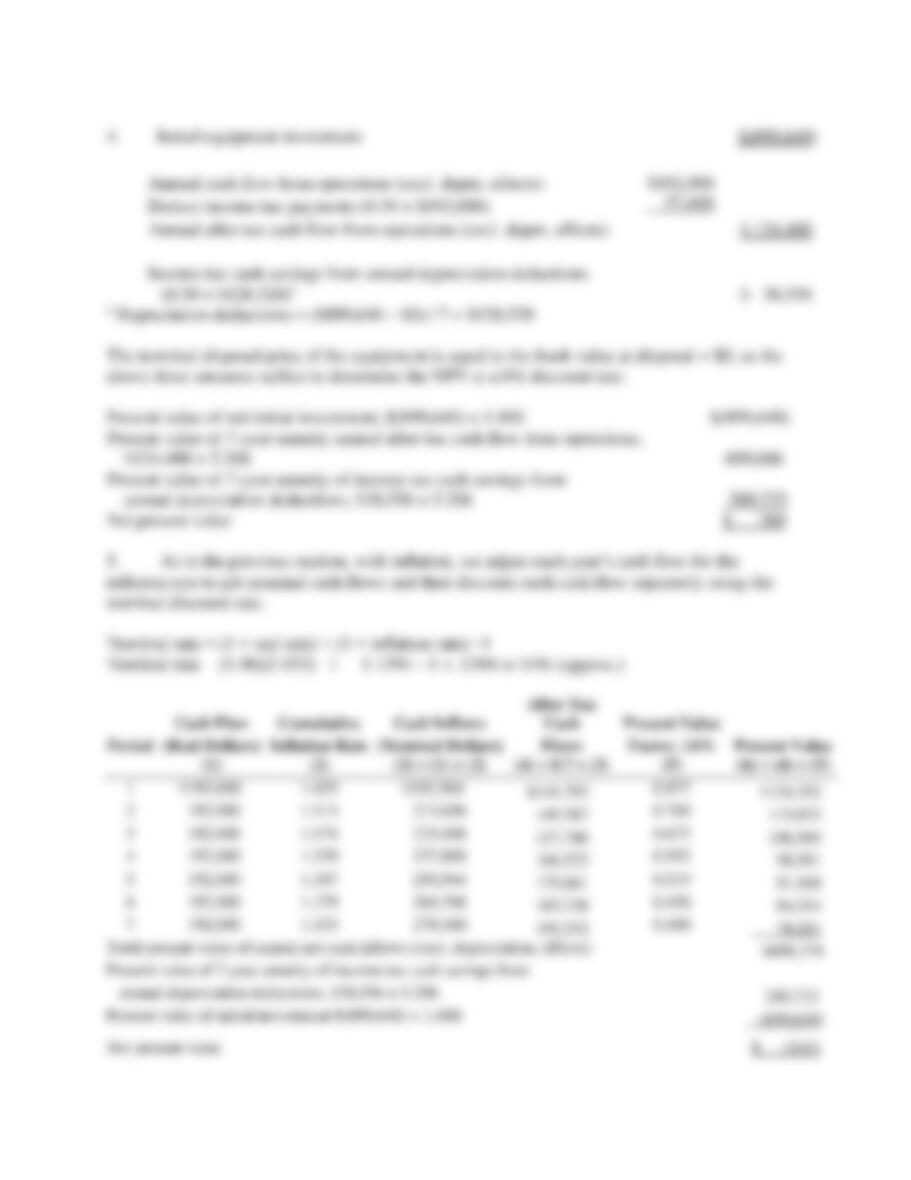
4. Now assume that the company’s tax rate is 30%. Calculate the NPV of the project assuming
no inflation.
5. Again assuming that the company faces a 30% tax rate, calculate the NPV of the project
under an inflation rate of 5.5%.
6. Based on your answers to requirements 4 and 5, should Cheap-O buy the new cash registers?
SOLUTION
21-55
21-56

21-57
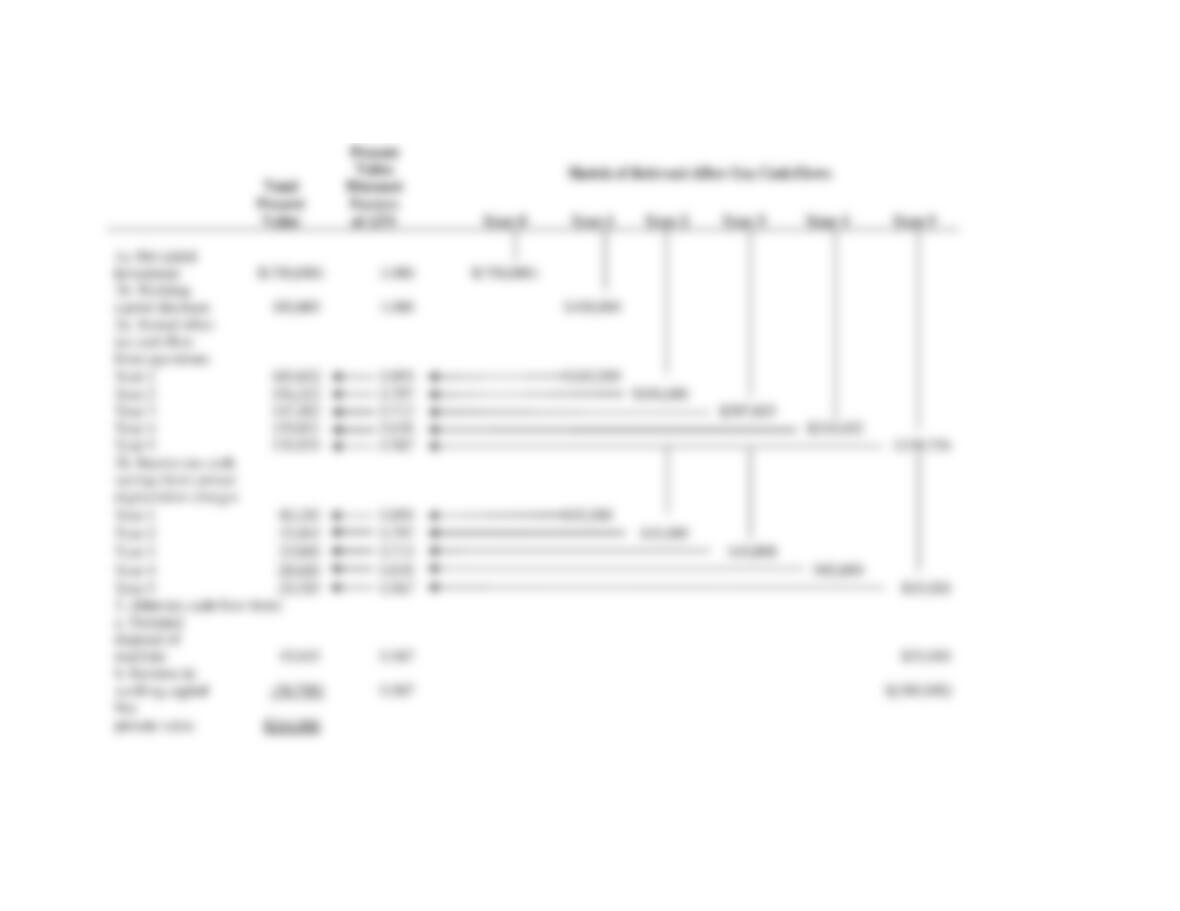
21-37 (60 min.) NPV of information system, income taxes.
Saina Supplies leases and sells materials, tools, and equipment and also provides add-on services
such as ground maintenance and waterproofing to construction and mining sites. The company
has grown rapidly over the past few years. The owner, Saina Torrance, feels that for the
company to continue to scale, it needs to install a professional information system rather than
relying on intuition and Excel analyses. After some research, Saina’s CFO reports back with the
following data about a data warehousing and analytics system that she views as promising:
▪ The system will cost $750,000. For tax purposes, it can be depreciated straight-line to a
zero terminal value over a 5-year useful life. However, the CFO expects that the system
will still be worth $50,000 at that time.
▪ There is an additional $75,000 annual fee for software upgrades and technical support from
the vendor.
▪ The ability to provide better services and to target and reach more clients as a result of the
new system will directly result in a $500,000 increase in revenues for Saina in the first year
after installation. Revenues will grow by 5% each year thereafter. Saina’s contribution
margin is 60%.
▪ Due to greater efficiency in ordering and dispatching supplies, as well as in collecting
receivables, the firm’s working-capital requirements will decrease by $100,000.
▪ Saina will also be able to reduce the amount of warehouse space it currently leases, saving
$40,000 annually in the process.
▪ Saina Supplies pays an income tax of 30% and requires an after-tax rate of return of 12%.
Assume that all cash flows occur at year-end except for initial investment amounts.
Required:
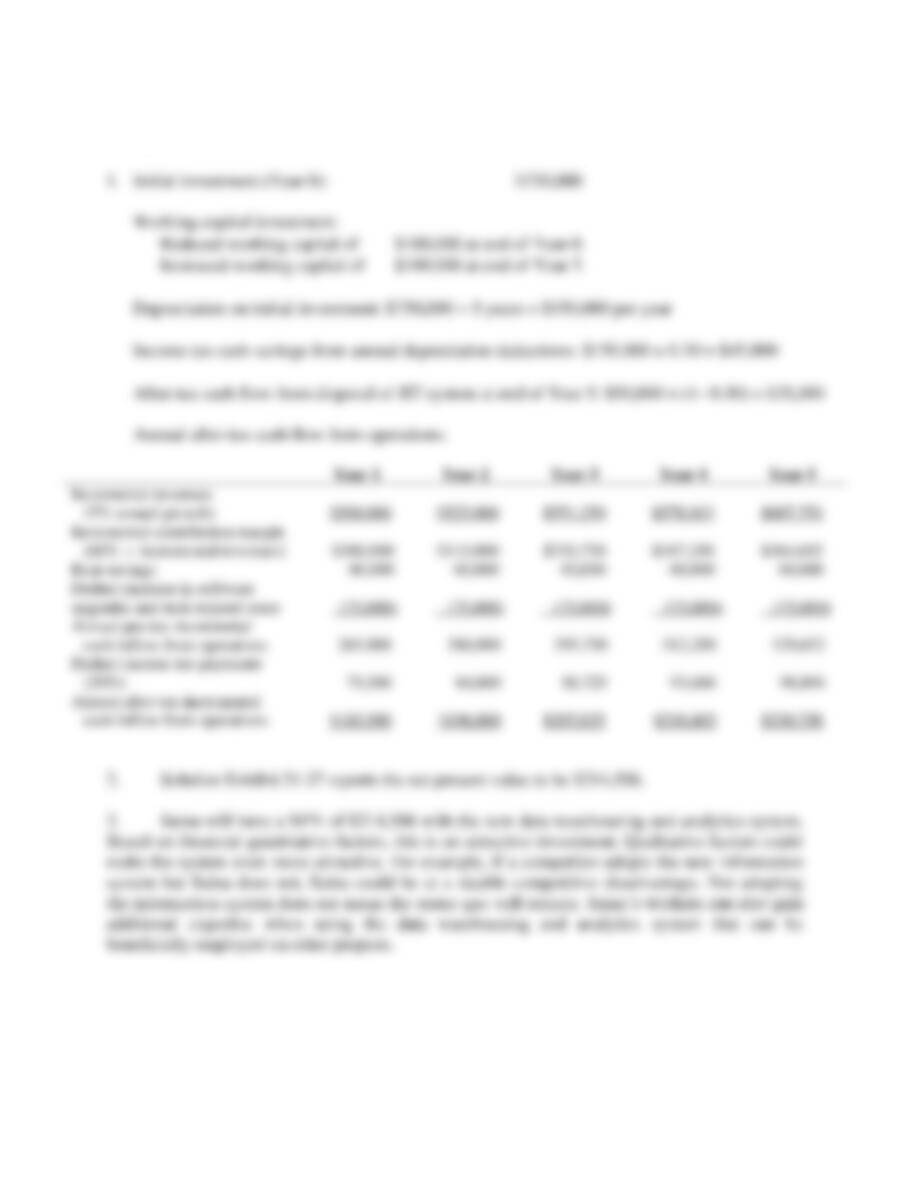
1. If Saina decides to purchase and install the new information system, what is the expected
incremental after-tax cash flow from operations during each of the 5 years?
2. Compute the net present value of installing the information system at Saina Supplies.
3. In addition to the analysis in requirement 2, what nonfinancial factors you would consider in
making the decision about the information system?
21-58
SOLUTION
21-59
SOLUTION EXHIBIT 21-37
21-60