EXERCISE 21.4 (Continued)
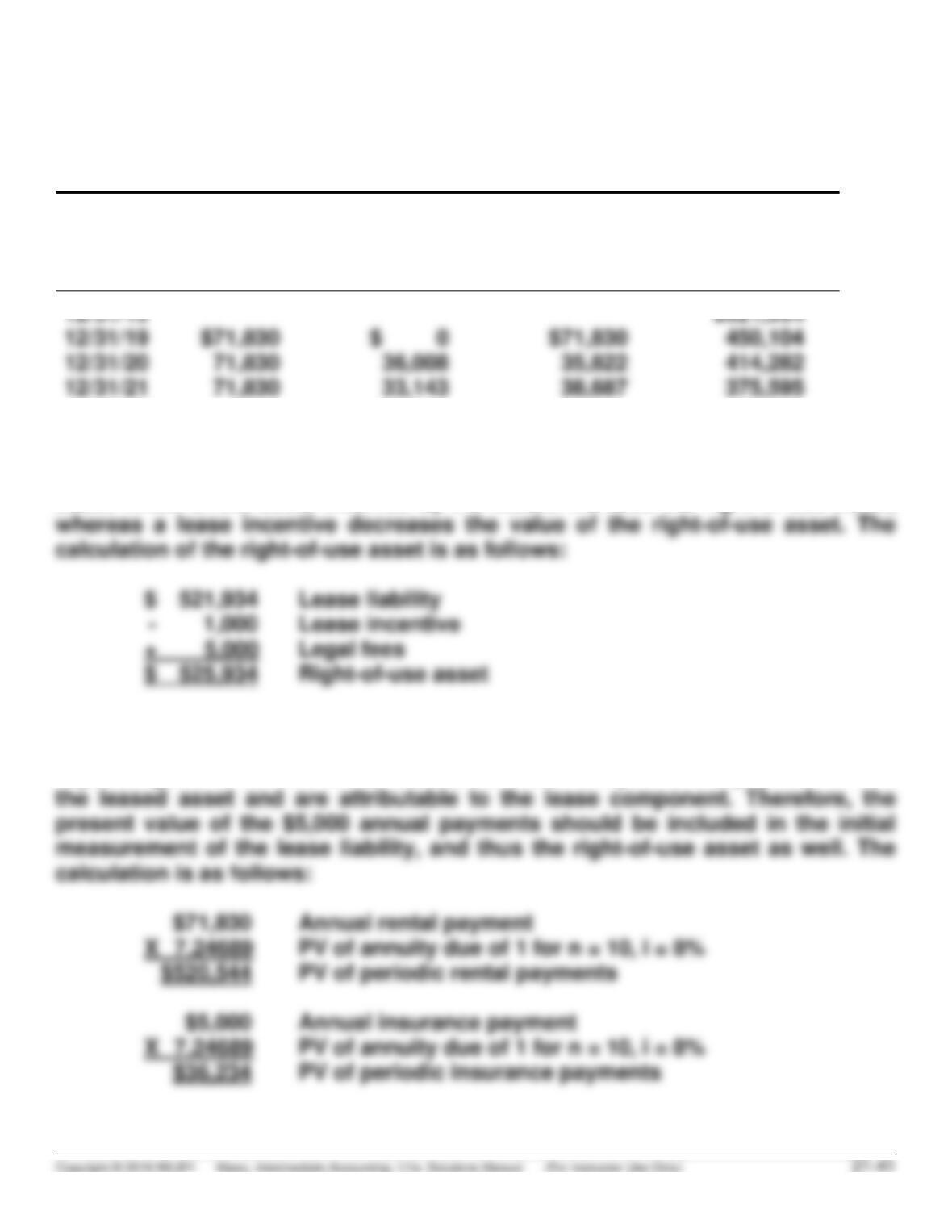
Schedule 1 KIMBERLY-CLARK CORP.
Lease Amortization Schedule (partial)
(Lessee)
Date
Annual Lease
Payment
Interest (8%) on
Liability
Reduction
of Lease
Liability
Lease Liability
(b) Initial direct costs and lease incentives do not affect the initial measurement
of the lease liability. Instead, they only affect the measurement of the right-of-use
asset. Initial direct costs incurred by the lessee increase the right–of–use asset,
(c) The annual insurance payments of $5,000 are considered part of the annual
payments to the lessor similar to the rental payments, as they do not transfer a
separate good or service to the lessee, but rather are part of the payment to use
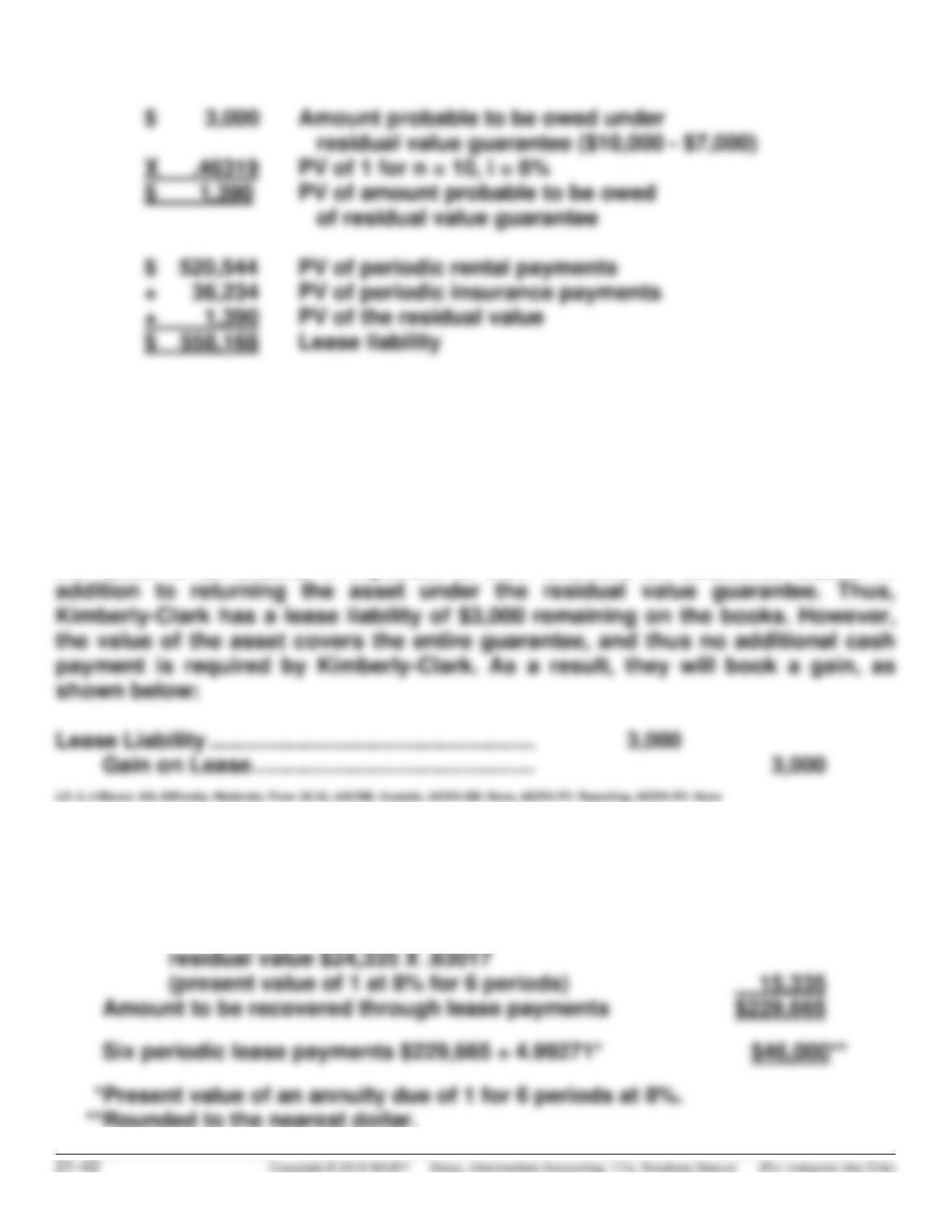
EXERCISE 21.4 (Continued)
Note how the inclusion of the executory costs leads to an inflated lease liability
and related right-of–use asset. Additionally, note that had the insurance
payments been variable, they would not have been included at all in the
measurement of the lease liability, which would have led to a very different initial
measurement of the liability and asset.
(d) Because Kimberly-Clark expected the residual value of the asset at the end of
the lease to be $7,000, it expected to owe Sheffield an additional $3,000 in
EXERCISE 21.5 (15–25 minutes)
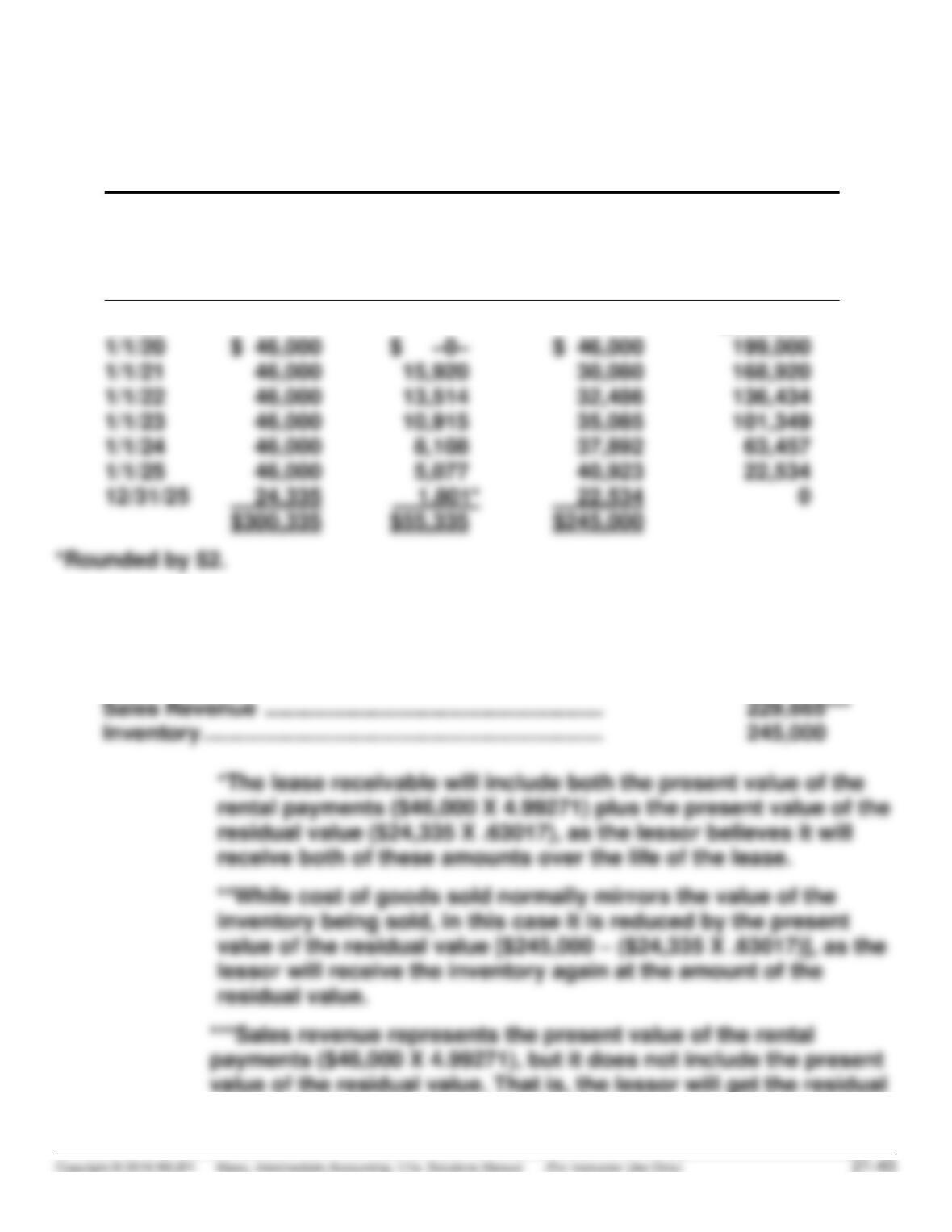
(a) Fair value of leased asset to lessor $245,000
Less: Present value of unguaranteed
EXERCISE 21.5 (Continued)
(b) MORGAN LEASING COMPANY (Lessor)
Lease Amortization Schedule
Date
Annual
Lease
Payment
Plus URV
Interest (8%) on
Lease
Receivable
Recovery
of Lease
Receivable
Lease
Receivable
1/1/20
$245,000
(c) 1/1/20
Lease Receivable ………………………………………………. 245,000*
Cost of Goods Sold 229,665**
EXERCISE 21.5 (Continued)
value back at the end of the lease, and thus has not “sold” that
portion of the asset.
1/1/20
EXERCISE 21.6 (20–25 minutes)
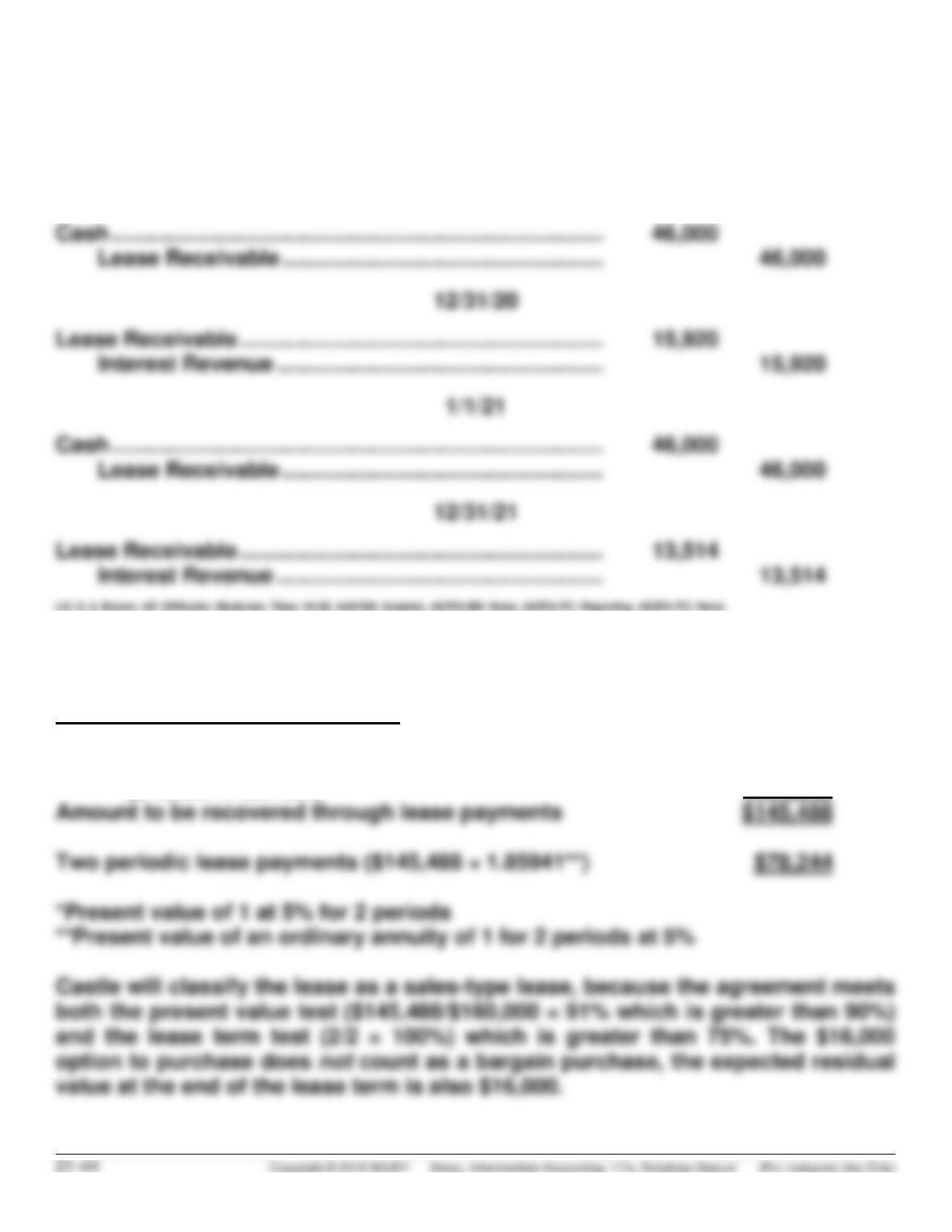
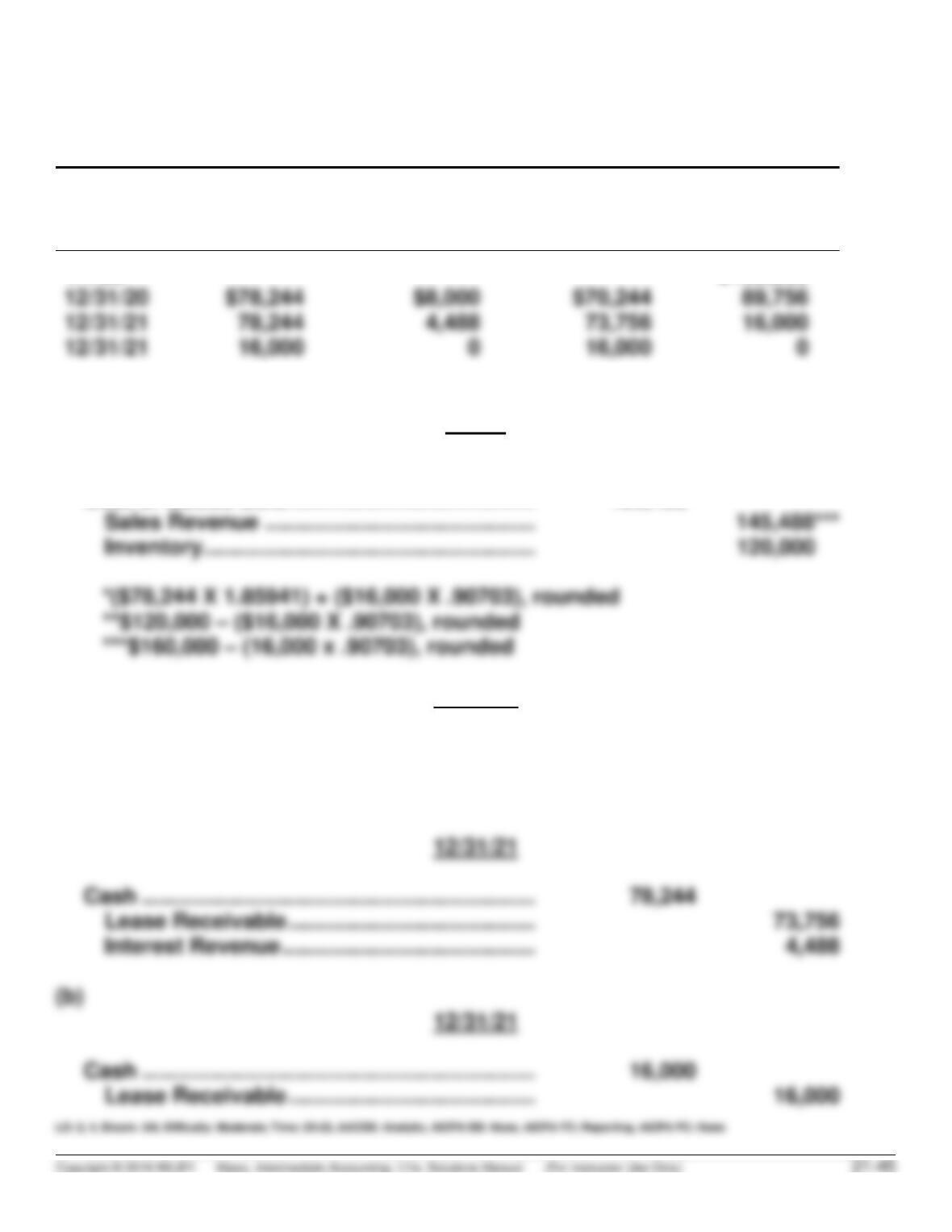
Computation of annual payments
Fair value of leased asset to lessor $160,000
Less: Present value of residual value
($16,000 X .90703*) 14,512
EXERCISE 21.6 (Continued)
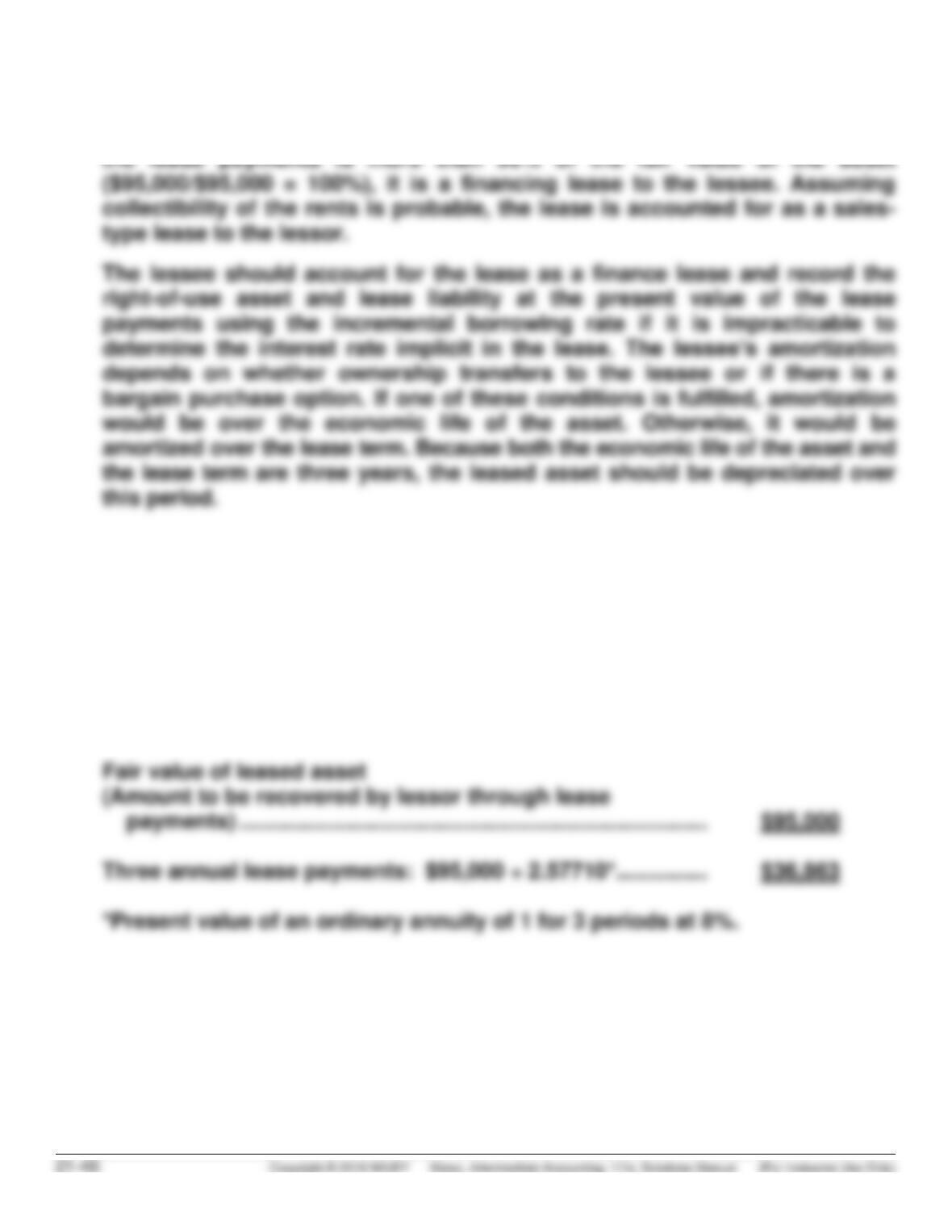
CASTLE LEASING COMPANY (Lessor)
Lease Amortization Schedule
Date
Annual Lease
Payment
Interest (5%)
on Lease
Receivable
Recovery
of Lease
Receivable
Lease
Receivable
1/1/20
$160,000
12/31/21
(a)
1/1/20
Lease Receivable ……………………………………. 160,000*
Cost of Goods Sold …………………………………. 105,488**
12/31/20
Cash ………………………………………………………. 78,244
Lease Receivable …………………………………. 70,244
Interest Revenue ………………………………….. 8,000
EXERCISE 21.7 (15–20 minutes)
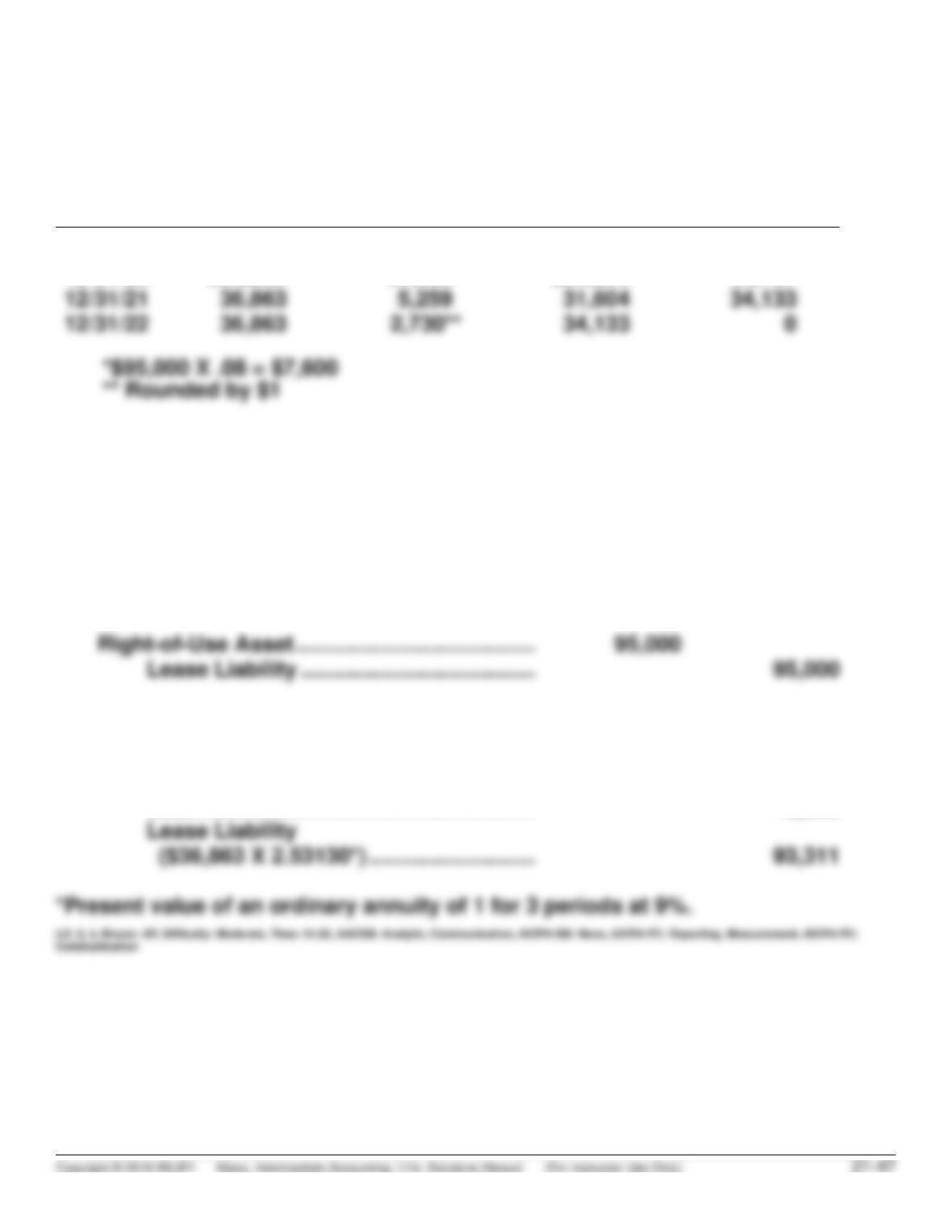
(a) Because title to the asset passes to the lessee, the lease term is longer than
75% of the economic life of the asset (3/3 = 100%), and the present value of
The lessor should account for the lease as a sales-type lease. The lessor
should record a lease receivable and sales revenue equal to the present
value of the lease payments of $95,000. In addition, the lessor should
remove the asset (inventory) from its books at $70,000, and the related cost
of goods sold $70,000. Interest is recognized annually at a constant rate
relative to the unrecovered lease receivable (See lease amortization
schedule).
EXERCISE 21.7 (Continued)
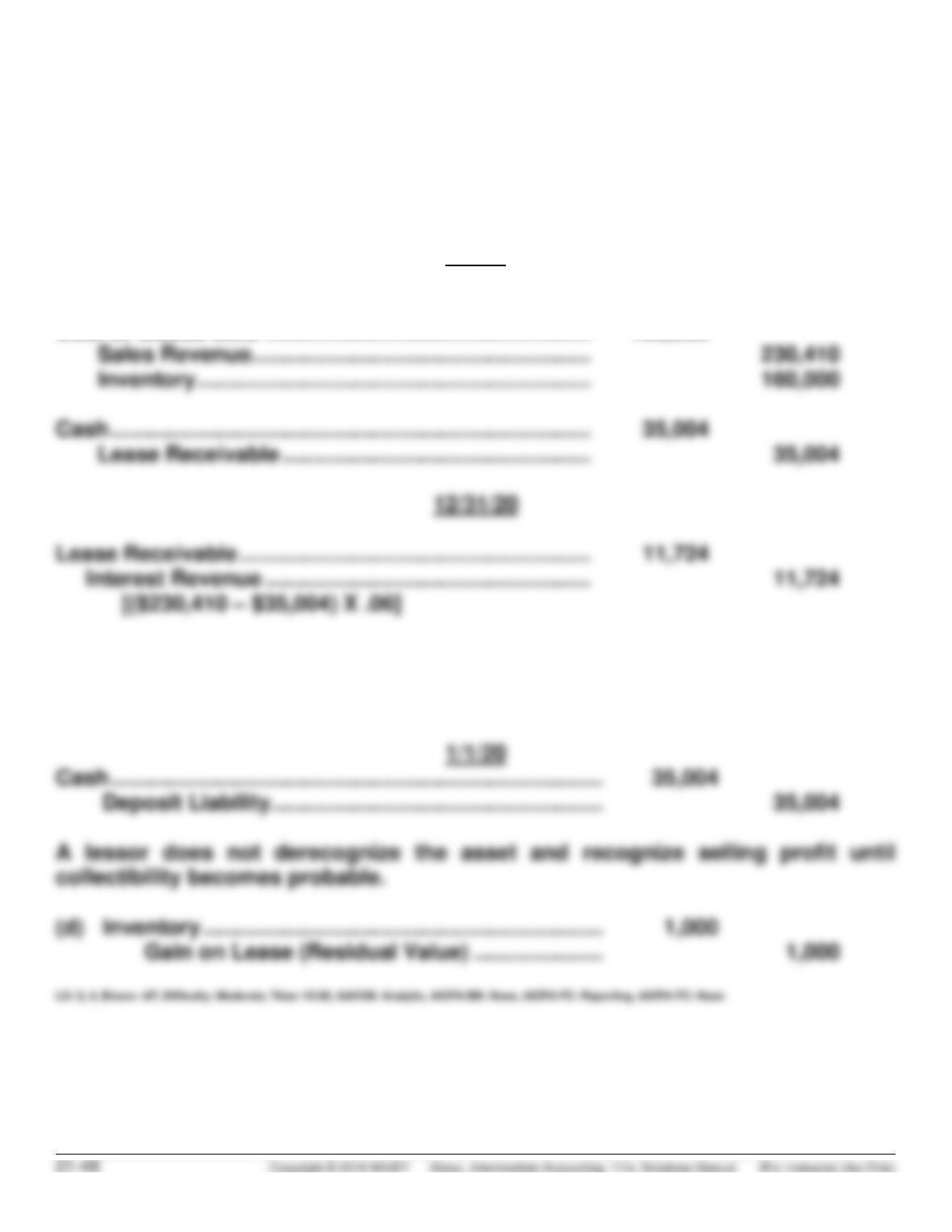
(b) Amortization Schedule
Rent Receipt/
Payment
Interest (8%)
Revenue/
Expense
Reduction of
Principal
Receivable/
Liability
1/1/20
—
—
—
$95,000
12/31/20
$36,863
$7,600*
$29,263
65,737
12/31/21
12/31/22
(c) 1/1/20
Lease Receivable ………………………………….. 95,000
Cost of Goods Sold ……………………………….. 70,000
Sales Revenue ……………………………….. 95,000
Inventory ……………………………………….. 70,000
(d) 1/1/20
(e) 1/1/20
Right-of–Use Asset ………………………………… 103,311
Cash ……………………………………………… 10,000
EXERCISE 21.8 (15–20 minutes)
(a) $35,004 X 6.58238* = $230,410
*Present value of an annuity due of 1 for 8 periods at 6%.
(b) Because the lease term test is met (8/10 = 80% > 75%), the lease is classified
as a sales-type lease.
1/1/20
Lease Receivable …………………………..……………………. 230,410
Cost of Goods Sold …………………………………………….. 160,000
(c) If the collectibility of lease payments is not probable for the lessor, the
lessor does not derecognize the asset or recognize selling profit on the lease.
Instead, Crosley would recognize any cash receipts as a deposit liability.
EXERCISE 21.9 (20-25 minutes)
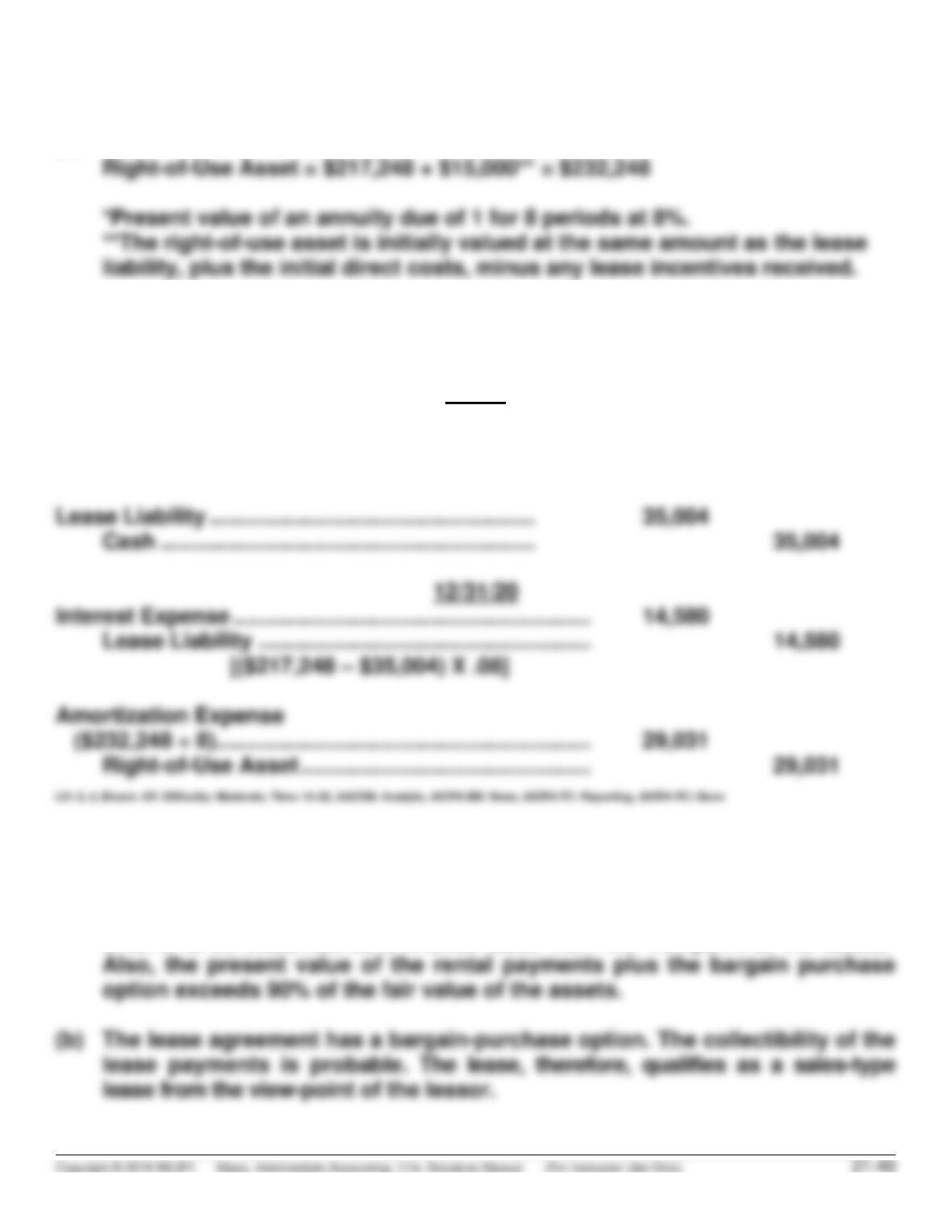
(a) Lease Liability = $35,004 x 6.20637* = $217,248
(b) The lease is classified as a finance lease, since the lease term is 80% of the
economic life of the asset (8/10), which is more than 75% of the economic life.
1/1/20
Right-of–Use Asset ………………………………………. 232,248
Cash ……………………………………………………. 15,000
Lease Liability ……………………………………… 217,248
EXERCISE 21.10 (20–30 minutes)
(a) The lease agreement has a bargain-purchase option and thus meets the
criteria to be classified as a finance lease from the viewpoint of the lessee.
EXERCISE 21.10 (Continued)
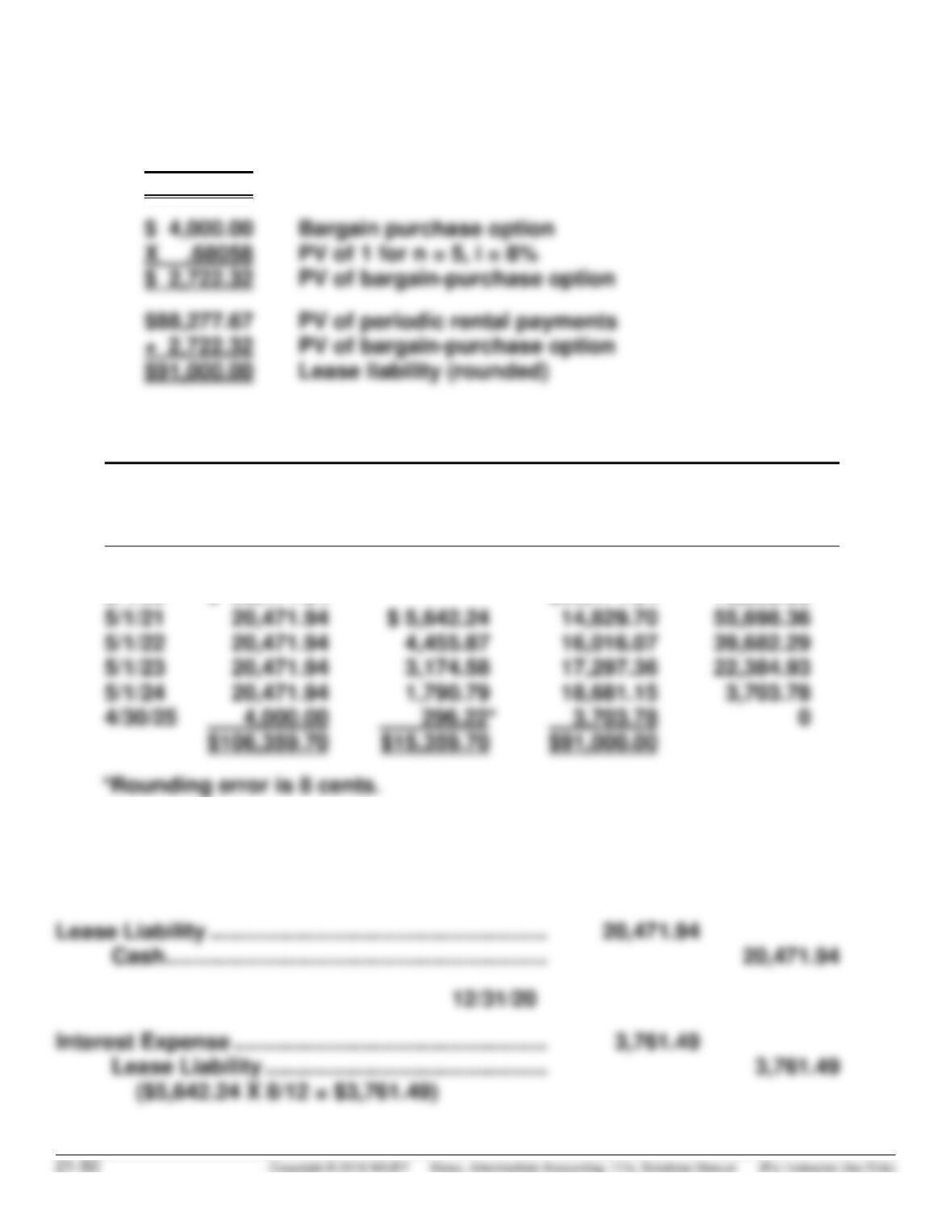
(c) Computation of lease liability:
$20,471.94 Annual rental payment
X 4.31213 PV of annuity due of 1 for n = 5, i = 8%
$88,277.67 PV of periodic rental payments
RODE COMPANY (Lessee)
Lease Amortization Schedule
Date
Annual Lease
Payment Plus
BPO
Interest
(8%) on
Liability
Reduction
of Lease
Liability
Lease
Liability
5/1/20
$91,000.00
5/1/20
$ 20,471.94
$20,471.94
70,528.06
5/1/23
$106,359.70
$91,000.00
(d) 5/1/20
Right-of–Use Asset ………………………………………… 91,000.00
Lease Liability ………………………………………. 91,000.00
EXERCISE 21.10 (Continued)
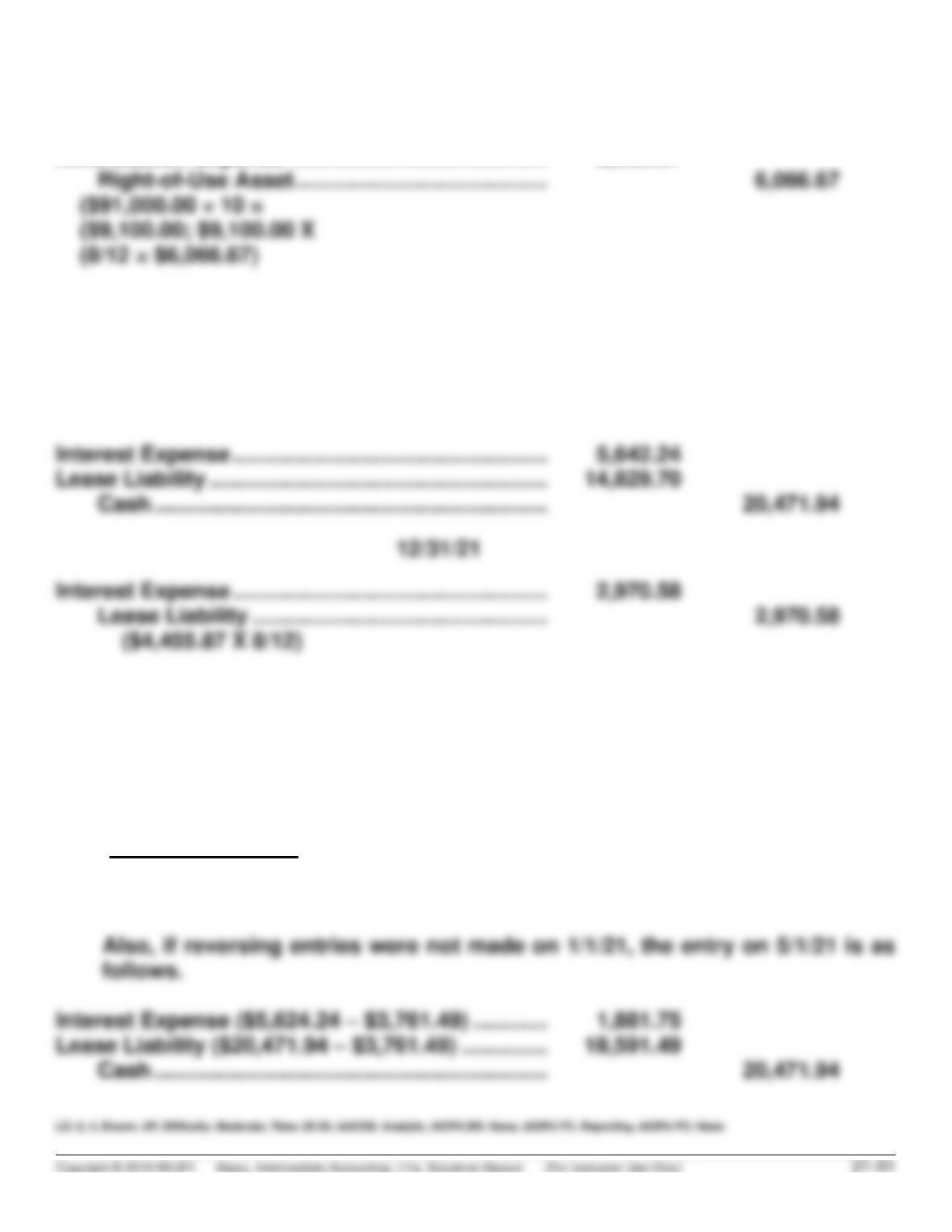
12/31/20
Amortization Expense …………………………………… 6,066.67
1/1/21
Lease Liability ………………………………………………. 3,761.49
Interest Expense …………………………………….. 3,761.49
5/1/21
12/31/21
Amortization Expense …………………………………… 9,100.00
Right-of–Use Asset ………………………………….. 9,100.00
($91,000.00 ÷ 10 years =
($9,100.00)
(Note to instructor: Because a bargain-purchase option was involved, the
leased asset is depreciated over its economic life rather than over the lease
term).
EXERCISE 21.11 (20–30 minutes)
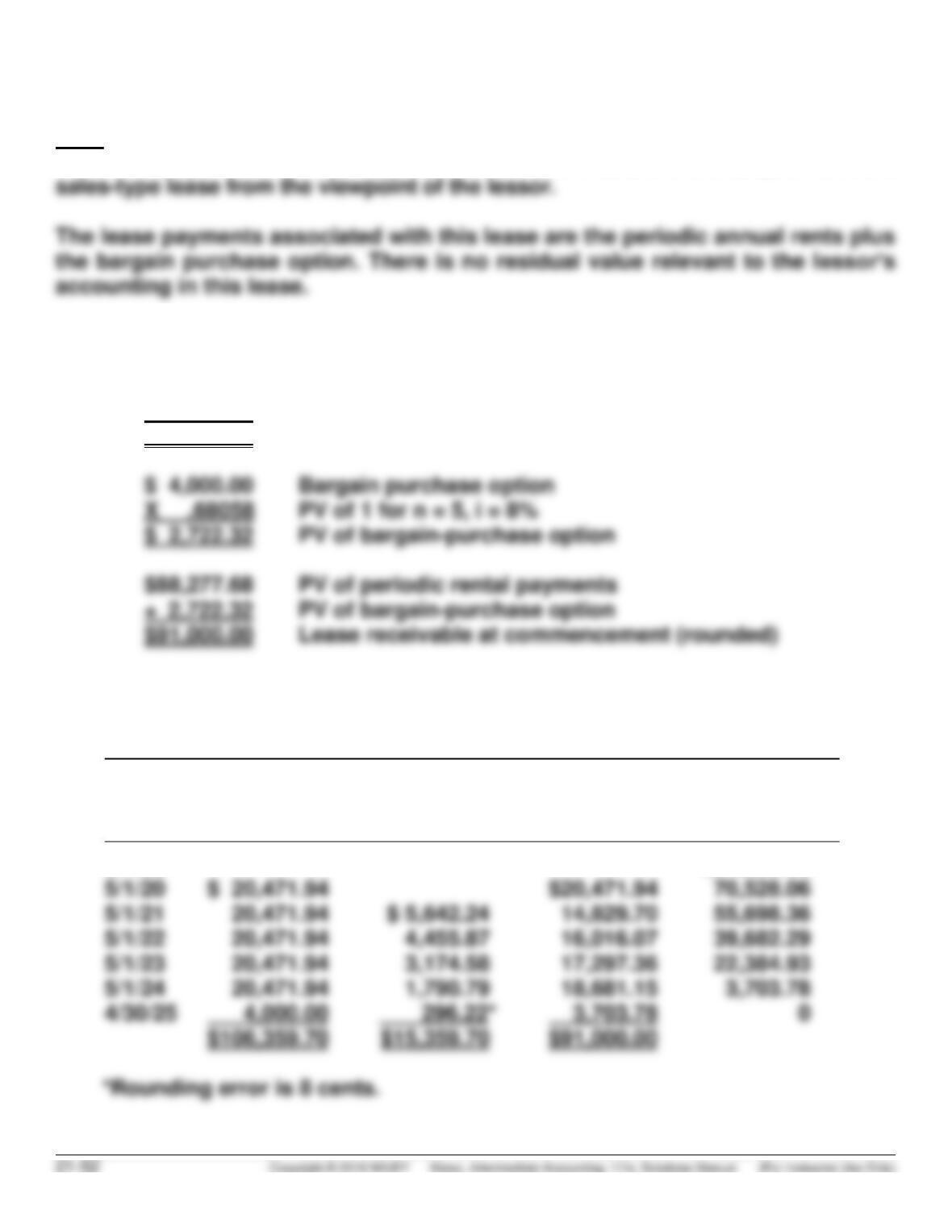
Note: The lease agreement has a bargain-purchase option. The collectibility of
the lease payments by Mooney is probable. The lease, therefore, qualifies as a
(a) The lease receivable is computed as follows:
$20,471.94 Annual rental payment
X 4.31213 PV of an annuity due of 1 for n = 5, i = 8%
$88,277.67 PV of periodic rental payments
(b) MOONEY LEASING COMPANY (Lessor)
Lease Amortization Schedule
Date
Annual Lease
Payment Plus
BPO
Interest (8%)
on Lease
Receivable
Recovery
of Lease
Receivable
Lease
Receivable
5/1/20
$91,000.00
EXERCISE 21.11 (Continued)
(c)
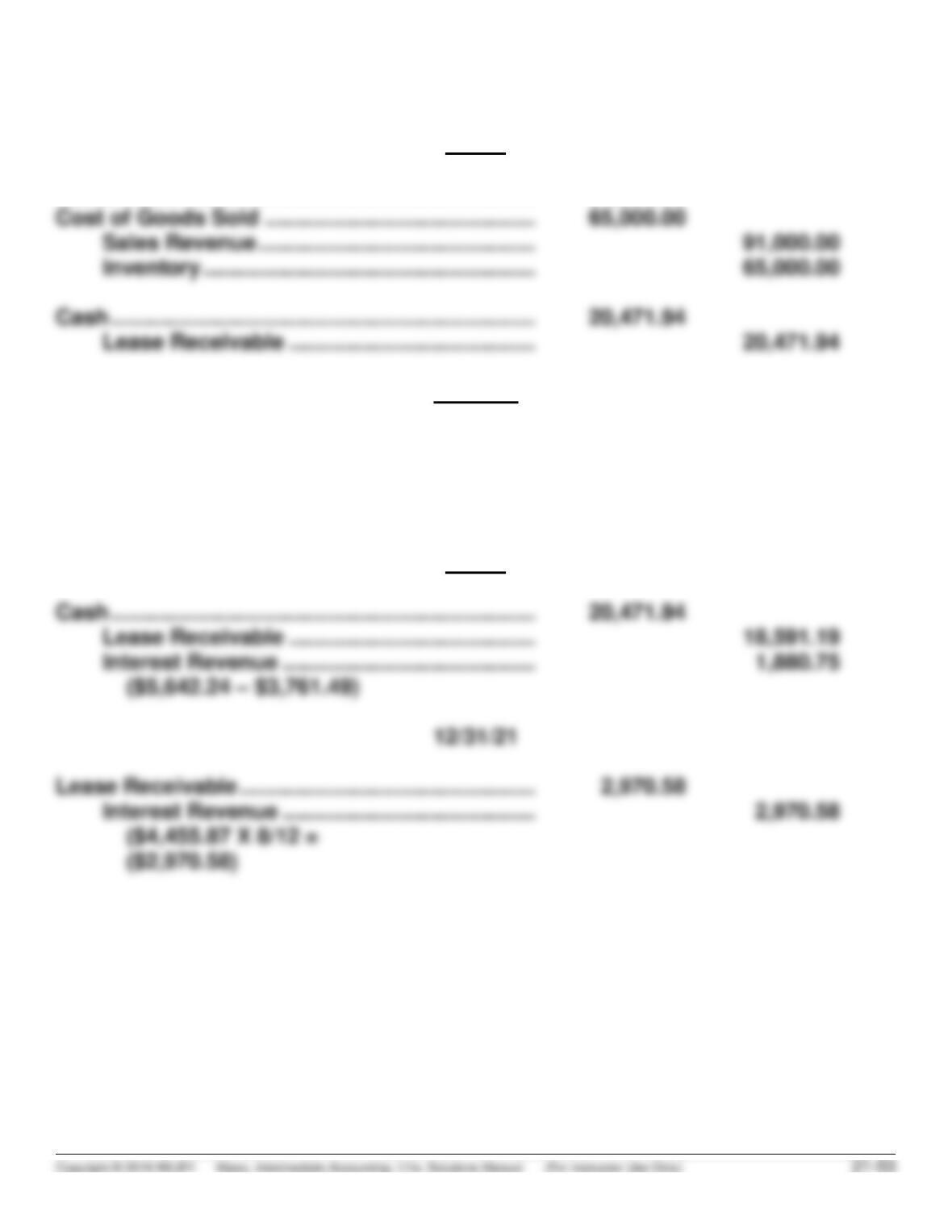
5/1/20
Lease Receivable …………………………..……………. 91,000.00
12/31/20
Lease Receivable …………………………………….. 3,761.49
Interest Revenue ………………………………….. 3,761.49
($5,642.24 X 8/12 =
$3,761.49)
5/1/21
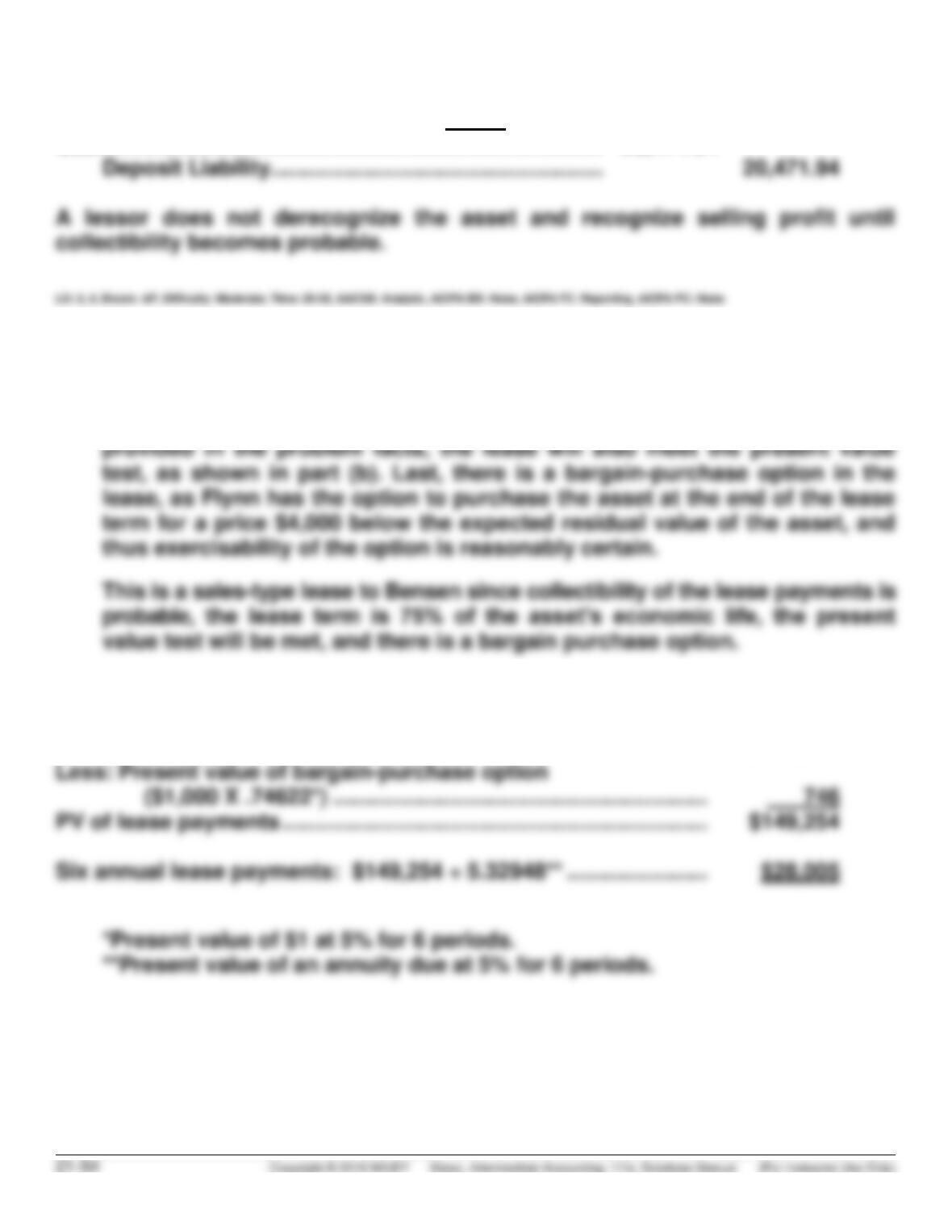
(d) If the collectibility of lease payments is not probable for the lessor, the
lessor does not derecognize the asset or recognize selling profit on the lease.
Instead, Mooney would recognize any cash receipts as a deposit liability.
EXERCISE 21.11 (Continued)
5/1/20
Cash …………………………………………………………………….. 20,471.94
EXERCISE 21.12 (20–25 minutes)
(a) This is a finance lease to Flynn since the lease term is 75% (6 ÷ 8) of the
asset’s economic life. In addition, although the lease payments are not
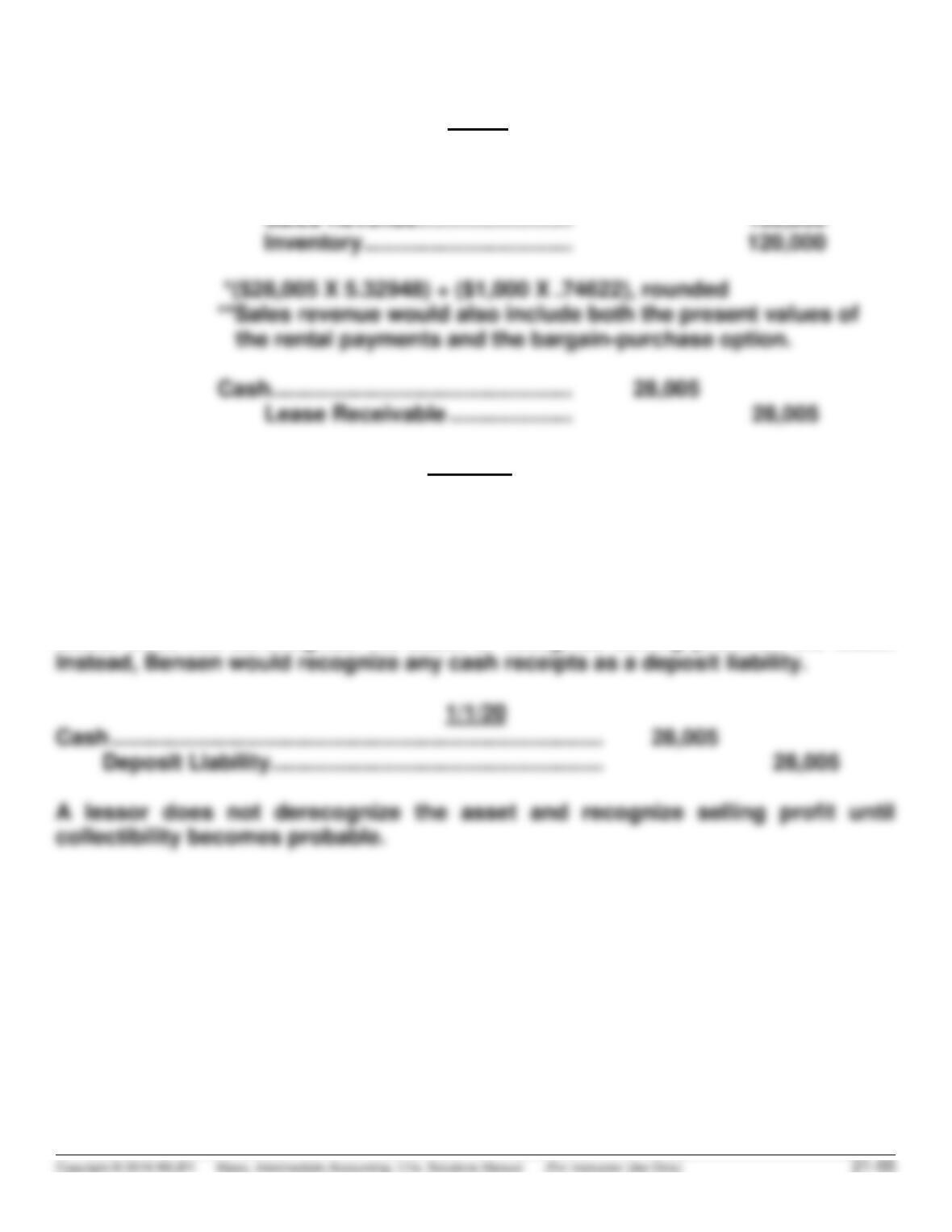
(b) Computation of annual rental payment (by the lessor):
Fair value of leased asset ……………………………………………………… $150,000
EXERCISE 21.12 (Continued)
1/1/20
(c) Lease Receivable ………………………. 150,000*
Cost of Goods Sold …………………… 120,000
12/31/20
Lease Receivable ………………………. 6,100
Interest Revenue ………………… 6,100
[($150,000 – $28,005) X .05]
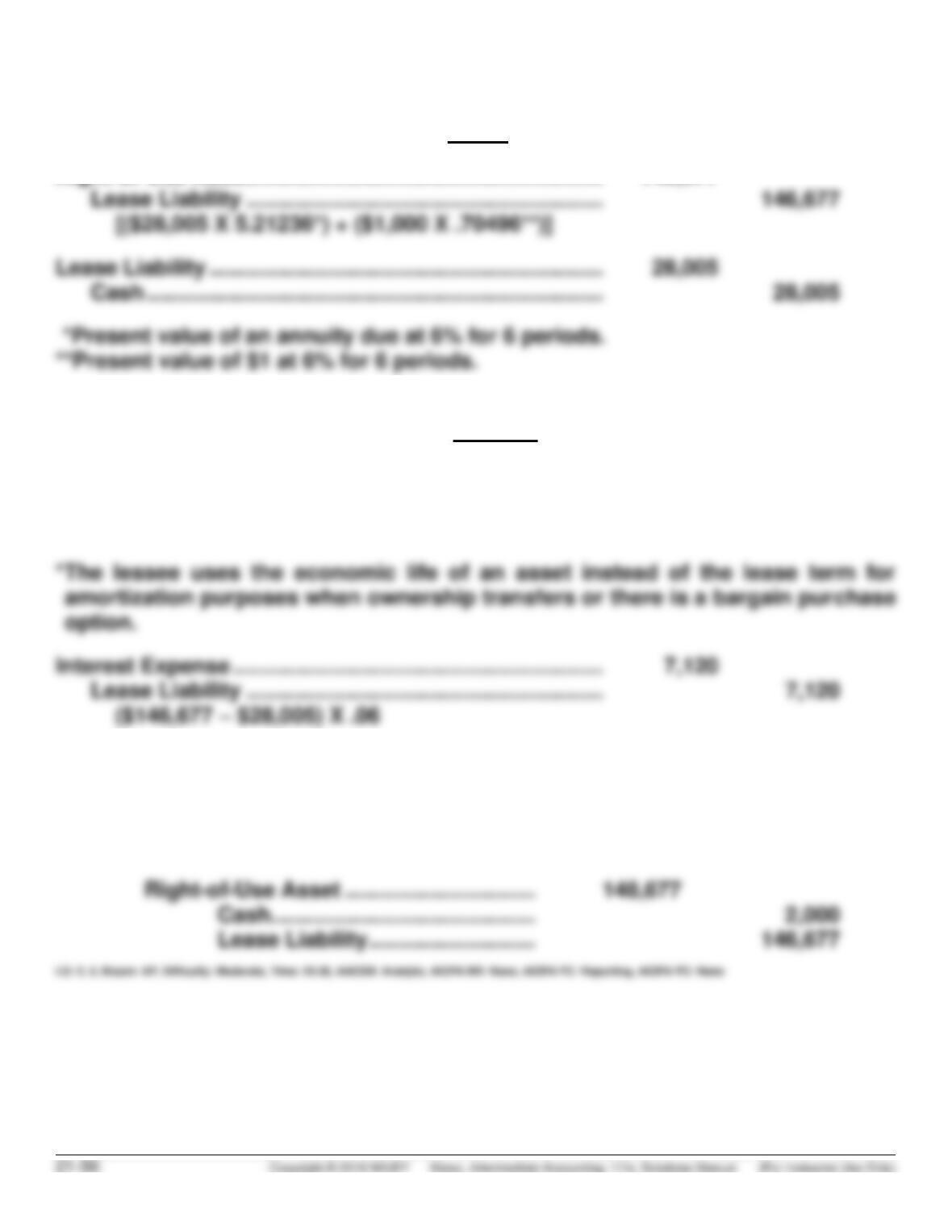
(d) If the collectibility of lease payments is not probable for the lessor, the
lessor does not derecognize the asset or recognize selling profit on the lease.
EXERCISE 21.12 (Continued)
(e)
1/1/20
Right-of–Use Asset ………………………………………………… 146,677
12/31/20
Amortization Expense …………………………………………… 18,335
Right-of-Use Asset …………………………………………… 18,335
($146,677 ÷ 8* years)
(f) The value of the lease liability for the lessee is unaffected by any initial
direct costs incurred. However, the initial measurement of the right–of-use
asset must be adjusted for initial direct costs incurred. Thus, the initial
right-of–use asset should be measured at $148,677 ($146,677 + $2,000)
EXERCISE 21.13 (20-25 minutes)
(a) The lease will be classified as a sales-type lease for Phelps and a finance
lease for Walsh. While ownership does not transfer at the end of the lease, there
is no bargain purchase option, the asset is not specialized, and the present value
test is not met (see calculation of lease liability for PV of lease payments), the
lease term is greater than 75% of the useful life of the asset (5 ÷ 6 = 83%).
*This value should be used in performing the present value test. The lease fails
the present value test because $20,280 ÷ $23,000 = 88.2%, which is less than
90%.
*Rounded by $2.
The initial lease liability and right-of–use asset, from Walsh’s (lessee’s) point of
EXERCISE 21.13 (Continued)
(b)
Phelps’ Journal Entries
1/1/20
Lease Receivable …………………………..……………. 23,000*
Cost of Goods Sold ……………………………………. 13,280**
12/31/20
Lease Receivable …………………………..…………………. 1,464
Interest Revenue
[(23,000 – $4,703) x .08] ……………………………… 1,464
Walsh’s Journal Entries
1/1/20
Right-of–Use Asset ……………………………………………. 20,280
Lease Liability …………………………………………….. 20,280
(c) If the residual value is guaranteed, Walsh must consider this guarantee in
determining whether the present value test for classification purposes, is met.
However, the lease term test was already met, so this will not change the
classification of the lease from either party’s perspective.
EXERCISE 21.13 (Continued)
(d) Walsh would need to include the present value of the amount probable to be
owed under the residual value guarantee in its initial measurement of the lease
liability. Because the expected residual value is less than the guaranteed
residual value, Walsh must include the present value of the difference, or the
EXERCISE 21.14 (20-25 minutes)
If the lessee is unaware of the rate implicit in the lease, it should use its
incremental borrowing rate to calculate the present value the lease payments
EXERCISE 21.14 (Continued)
EXERCISE 21.15 (20–30 minutes)
Note: This lease is a finance lease to the lessee because the present value
(a) PLOTE COMPANY (Lessee)
Lease Amortization Schedule
Date
Annual Lease
Payment
Interest (5%) on
Liability
Reduction
of Lease
Liability
Lease
Liability
(b)
1/1/20
Right-of–Use Asset …………………………………………. 73,094.98
Lease Liability ………………………………………….. 73,094.98
1/1/20