Financial and Managerial Accounting, 9th Edition
21-1
CHAPTER 21
FLEXIBLE BUDGETS AND STANDARD COSTS
Related Assignment Materials
Student Learning Objectives
Discussion
Questions
Quick
Studies*
Exercises*
Problems*
AA, DA and
BTN
Conceptual objectives:
Analytical objectives:
expected amounts.
C1. Define standard costs and
8, 13, 16
21–5, 21–25
21-1
21-6
BTN 21–1, BTN 21-3,
Procedural objectives:
P1. Prepare a flexible budget and
interpret a flexible budget
performance report.
1, 2, 3, 4, 5,
12
21-1, 21–2,
21-3, 21–4,
21–23
21-2, 21-3,
21–4, 21-5,
21-6
21-1, 21–2,
21-3, SP
P2. Compute the total cost
variance.
11,15
21-5, 21-6
21-7, 21-8
21-3
DA 21-1
21-3, 21-4
P5 Compute overhead spending and
21–19, 21–20
21-27, 21–28
21-5
DA 21-3
*See additional information on next page that pertains to these quick studies, exercises and problems.
SP refers to the Serial Problem
AA refers to Accounting Analysis
Financial and Managerial Accounting, 9th Edition
21-2
Questions with Guided Example videos
Additional Information on Related Assignment Material
Connect
Available on the instructor’s course-specific website, Connect repeats all numerical Quick Studies, all Exercises and
Problems Set A. Connect also provides algorithmic versions for Quick Study, Exercises, and Problems. It allows
instructors to monitor, promote, and assess student learning. It can be used in practice, homework, or exam mode.
Prebuilt Assignments and Turnkey courses are available.
Hints/Guided Examples
Please note that the Guided Examples are labeled as “Hints” in Connect assignments. The animated PowerPoints without
Need-to-Know Videos
LO
Need–to-Know
Title
Time
P1
21-1
Flexible Budget Performance Report
5:39
P2
21-2
Cost Variances
1:48
P3
21-3
Direct Materials Price and Quantity Variances
2:48
P3
21-4
Direct Labor Rate and Efficiency Variances
2:45
P4
21-5
Overhead Variances
2:38
Variance Analysis
P5
21-7
Part A: Expanded Overhead Variances
5:16
Costing
Concept Overview Videos
LO
Title
Time
C1
Define standard costs and explain how standard cost information is useful.
Standard Costs
0:36
Setting Standard Costs
1:30
Analyze changes in sales from expected amounts.
Sales Variances
1:32
0:50
1:16
1:18
Financial and Managerial Accounting, 9th Edition
21-3
Flexible Budget Performance Report
1:00
P2
Compute the total cost variance.
Cost Variance
0:44
Flow of Events in Variance Analysis
0:23
Cost Variance Computation
1:17
Compute direct materials and direct labor variances.
Materials and Labor Variances
0:45
Direct Materials Variances
1:26
Evaluating Direct Materials Variances
0:48
Direct Labor Variances
1:08
Evaluating Direct Labor Variances
2:08
P4
Compute overhead controllable and volume variances.
Flexible Overhead Budgets & Overhead Standards
2:08
Computing Overhead Cost Variances
1:44
Volume Variance and Controllable Variance
1:44
Overhead Variance Report
0:59
P5
Compute overhead spending and efficiency variances. (Appendix 21A)
Expanded Overhead Variances
3:13
Expanded Variable Overhead Variances
1:49
Expanded Fixed Overhead Variance
1:39
Direct Material Journal Entries
1:12
Direct Material Journal Entries – Illustration
0:41
Direct Labor Journal Entries
1:11
Direct Labor Journal Entries – Illustration
0:35
Factory Overhead Journal Entries
1:05
Factory Overhead Journal Entries — Illustration
1:01
Synopsis of Chapter Revision
NEW opener – True Fit and entrepreneurial assignment.
Revised Exhibit 21.1 to better show fixed vs flexible budgets.
Simplified Exhibit 21.2 on a fixed budget performance report.
Simplified Exhibit 21.3 and 21.4 for learning.
Added Part B to Need-to-Know 21–1.
Modernized Exhibit 21.5.
NEW numbers and exhibits in Appendix 21A.

Financial and Managerial Accounting, 9th Edition
21-4
Financial and Managerial Accounting, 9th Edition
21-5
Chapter Outline
I. Fixed and Flexible Budgets
1. Managers use budgets to control operations and see that planned objectives are met.
2. Budget reports – compare budgeted results to actual results.
3. Common periods for budget reports are for a month, a quarter and for a year.
a. Master budget is based on a predicted level of activity, such as sales volume, for the budget
7. Fixed Budget Performance Report
a. Compares actual results with planned activities (that predicted a certain sales volume or
other activity level). (Exhibit 21.2)
b. Shows budgeted amounts, actual amounts and variances.
8. Favorable variance (F)⎯actual income is higher than budgeted income, when actual revenue is
II. Flexible Budget Reports –Superior alternative to fixed budget reports.
A. Purpose of Flexible Budgets
1. Flexible budget prepared before the period begins, is often based on several levels of activity.
Provide different “what–if” scenarios. Includes both best-case and worst-case activity levels.
2. Flexible budget prepared after the period ends helps managers evaluate performance.
B. Preparation of Flexible Budgets
1. To prepare a flexible budget, follow these steps:
a. Identify activity levels, such as units produced or sold.
Financial and Managerial Accounting, 9th Edition
21-6
2. Flexible Budget Equation for Total Budgeted Costs
a. Flexible budgets can be prepared at any level of activity.
C. Flexible Budget Performance Report
1. Compares actual performance and budgeted performance based on actual sales activity level.
A. Standard Costing⎯ Standard costs are preset costs for delivering a product or service under normal
conditions.
1. Manufacturing companies use standard costing for direct materials, direct labor and overhead
costs.
2. When actual costs vary from standard costs, management identifies the reason and takes
corrective action.
III. Setting Standard Costs
A. Identifying Standard Costs
1. Standards for direct labor costs set by time and motion studies that show the direct labor hours
required under normal operations.
IV. Cost Variance Analysis⎯Cost variance (or simply variance) is difference between actual and standard
cost; can be favorable (if actual cost is less than standard cost) or unfavorable (if actual cost is more than
standard cost).
A. Flow of events in variance analysis
1. Prepare a standard cost performance report.
Financial and Managerial Accounting, 9th Edition
21-7
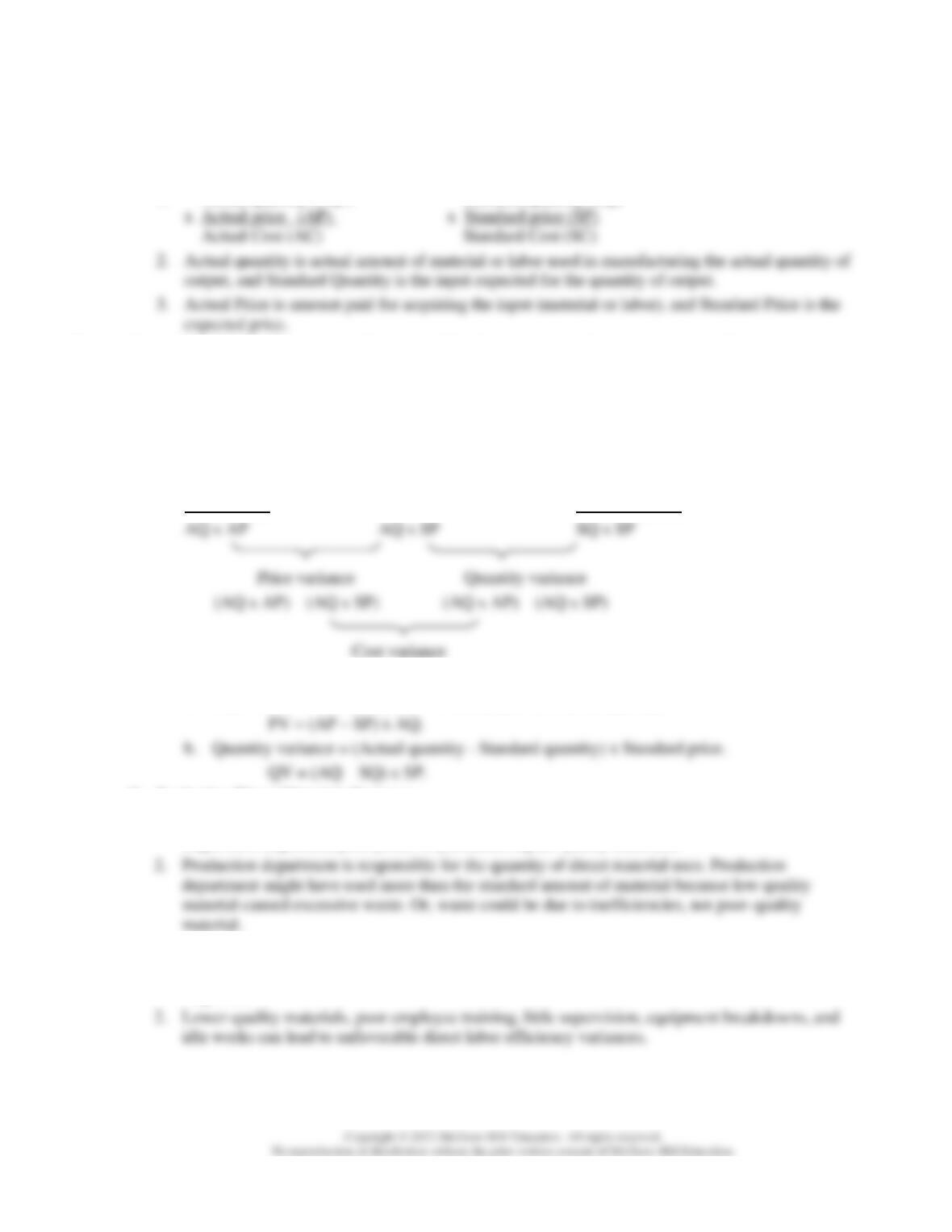
B. Cost Variance Computation⎯Cost variance (CV) equals actual cost (AC) minus standard cost (SC).
1. Actual quantity (AQ ) Standard quantity (SQ)
V. Direct Materials and Direct Labor Variances. Two factors explain direct materials and direct labor
variances:
A. Price (or rate) variance – difference between actual price per unit of input and standard price per unit
of input.
B. Quantity (or efficiency) variance – difference between actual quantity of input used and standard
quantity of input that should have been used.
1. Price variance and quantity variance formulas:
Actual Cost Standard Cost
6. Alternative price variance and quantity variance formulas:
a. Price variance = (Actual price – Standard price) x Actual quantity.
C. Evaluating Direct Materials Variances
1. Purchasing department is responsible for the price paid for materials. Purchasing department
might have negotiated poor prices or purchased higher-quality materials.
D. Computing Direct Labor Variances
1. Higher-skilled workers might finish the same number of units in fewer hours, but have a higher
wage rate.
Financial and Managerial Accounting, 9th Edition
21-8
VI. Overhead Standards and Variances⎯managers apply overhead costs to products and services using a
standard overhead rate resulting in overhead amounts expected to occur at a specific activity level.
A. Flexible Overhead Budgets – show budgeted variable costs per unit and fixed costs for the period.
B. Standard Overhead Rate – follow three step process:
Step 1: determine an allocation base: a measure of input related to overhead costs, such as direct
C. Computing Overhead Cost Variances
1. Standard overhead is applied is based on actual production times standard amount of allocation
1. Volume Variance – difference between budgeted fixed overhead and standard fixed overhead
applied for the actual units produced.
E. Controllable Variance – difference between actual overhead and the flexible budget of total overhead
for actual units produced.
1. Computed as actual total overhead minus flexible budget of total overhead for actual units
produced.
a. An unfavorable volume means the company did not reach its expected operating level – a
VII. Decision Analysis⎯Sales Variances⎯Similar to computation and analysis of cost variances.
A. Sales price variance and sales volume variance can be computed. Managers use sales variances for
planning and control purposes.
1. Sales price variance measures the impact of the actual sales price differing from the expected
price.
Financial and Managerial Accounting, 9th Edition
21-9
IX. Expanded Overhead Variances and Standard Cost Accounting System
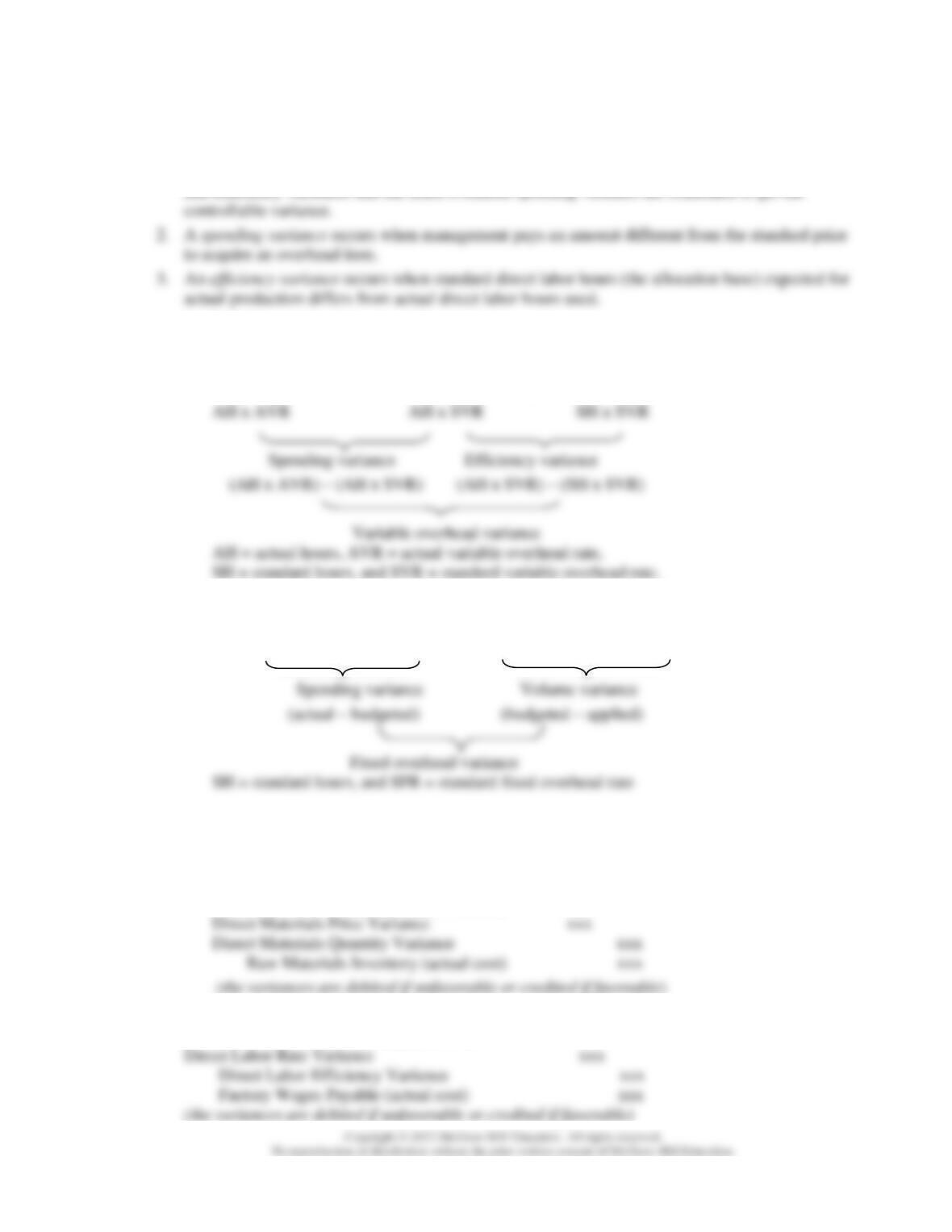
1. Computing Overhead Cost Variances — Exhibit 21A.1 shows that the variable overhead spending
and efficiency variances and the fixed overhead spending variance are combined to get the
A. Computing Variable and Fixed Overhead Variances
1. Variable Variance Formulas:
Actual Variable Overhead Applied Variable Overhead
2. Fixed Overhead Variance Formulas:
Actual Fixed Overhead Budgeted Fixed Overhead Applied Fixed Overhead
(given) (flexible budget) SH x SFR
X. Standard Cost Accounting Systems
Standard cost systems also record standard costs and variances in most accounts.
1. Direct materials:
Work in Process Inventory (standard cost) xxx
2. Direct labor:
Work in Process Inventory (standard cost) xxx
Financial and Managerial Accounting, 9th Edition
3. Overhead:
Work in Process Inventory (standard cost) xxx
4. Accumulate balances in the different variance accounts until end of accounting period; to close,
add to or subtract from the manufacturing costs recorded in the period.
5. Can use a standard costing income statement to summarize a company’s performance. The
Income Statement reports sales and cost of goods sold at standard amounts and then lists the
Financial and Managerial Accounting, 9th Edition
Chapter 21 Alternate Demo Problem #1
Problem #1
XYZ Company manufactures tables. A standard cost card for the manufacture of one
table shows the following:
Standard Cost per Table:
Direct material: 4 sq. ft. @ $3/sq. ft.
$12
Total prime costs
$28
Direct material: 3,900 sq. ft. @ $3.10/sq. ft.
$12
Required:
Calculate the price and quantity variances for direct material and direct labor.
Financial and Managerial Accounting, 9th Edition
21–12
Chapter 21 Alternate Demo Problem #2
Atlantic Company has the following monthly flexible budget information based on an
expectation of operating at 80% of the factory’s capacity or 10,000 units produced:
Operating Levels
70%
80%
90%
Budgeted output in units
8,000
10,000
12,000
Budgeted labor (standard hours)
16,000
Budgeted overhead
During the current month, the company operated at 70% of capacity and employees
worked 16,500 hours and the flowing actual overhead costs were incurred:
Required:
1. Compute the predetermined overhead rate per direct labor hour for variable
overhead, fixed overhead, and total overhead.
Financial and Managerial Accounting, 9th Edition
21–13
Chapter 21 Alternate Demo Problem #1: Solution
Materials Variances
Units produced……………………………………..
1,000
tables
X std. quantity of materials per unit…………..
Sq. ft per table
Standard quantity of materials for 1,000 tables
4,000
Sq ft
AQ
3,900
Sq ft.
AQ
3,900
Sq ft.
SQ
4,000
Sq ft.
X AP
X $3.10
X SP
X 3.00
X SP
X 3.00
$12,090
$11,700
$12,000
Labor Variances
Units produced……………………………………..
1,000
tables
X standard direct labor hrs per unit…………..
X 2
hours
Standard quantity of hours for 1,000 tables
2,000
hours
AQ
2,300
Hrs.
AQ
2,300
Hrs.
2,000
Hrs.
X AP
X $7.80
X SP
X 8.00
X SP
X 8.00
$17,940
$18,400
$16,000
U
Financial and Managerial Accounting, 9th Edition
21–14
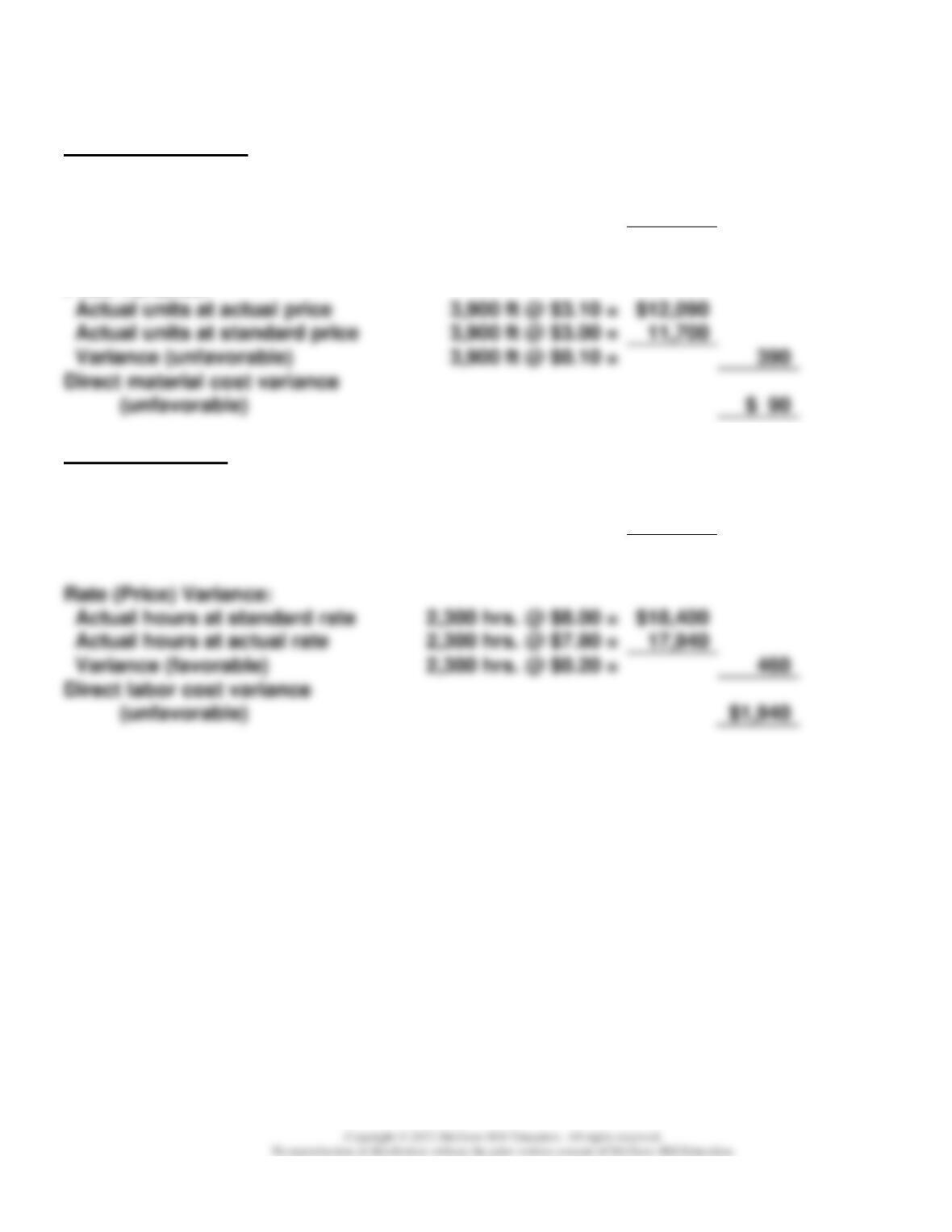
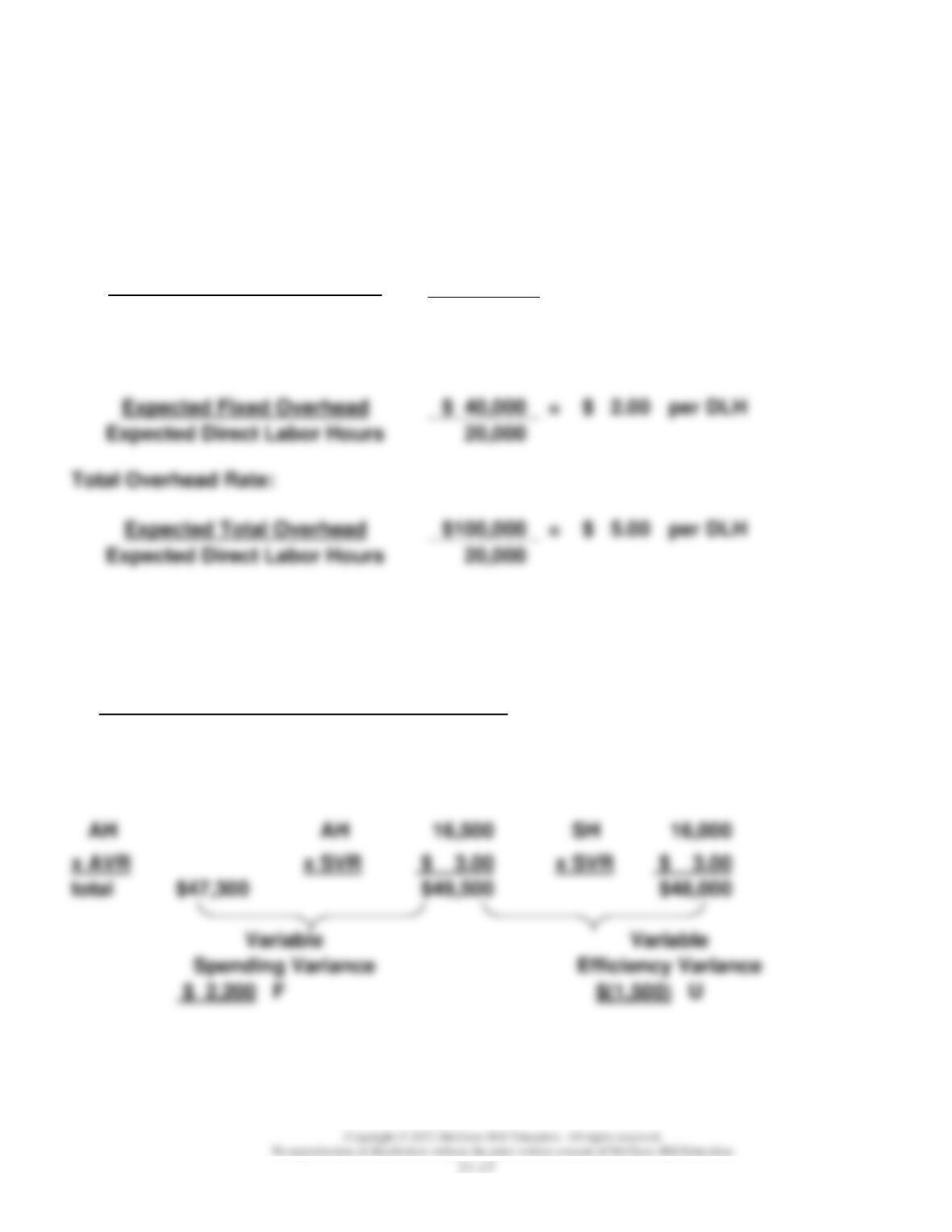
Material Variances:
Quantity Variance:
Standard units at standard price
4,000 ft @ $3.00 =
$12,000
Actual units at standard price
3,900 ft @ $3.00 =
11,700
Variance (favorable)
100 ft @ $3.00 =
$ 300
Price Variance:
Actual units at actual price
3,900 ft @ $3.10 =
$12,090
Actual units at standard price
3,900 ft @ $3.00 =
11,700
Variance (unfavorable)
3,900 ft @ $0.10 =
(unfavorable)
Labor Variances:
Efficiency (Quantity) Variance
Actual hours at standard rate
2,300 hrs. @ $8.00 =
$18,400
Standard hours at standard rate
2,000 hrs. @ $8.00 =
16,000
Variance (unfavorable)
300 hrs. @ $8.00 =
$2,400
Actual hours at standard rate
2,300 hrs. @ $8.00 =
$18,400
Actual hours at actual rate
2,300 hrs. @ $7.80 =
17,940
Variance (favorable)
2,300 hrs. @ $0.20 =
(unfavorable)
$1,940
Financial and Managerial Accounting, 9th Edition
Chapter 21 Alternate Demo Problem #2: Solution
1. Compute the predetermined overhead rates
Overhead at operating level expected (80%) or 10,000 units
Variable Overhead Rate:
Expected Variable Overhead
$ 60,000
=
$ 3.00
per DLH
Expected Direct Labor Hours
20,000
$ 40,000
=
$ 2.00
per DLH
Expected Direct Labor Hours
20,000
Total Overhead Rate:
$100,000
=
$ 5.00
per DLH
Expected Direct Labor Hours
20,000
Fixed Overhead Rate:
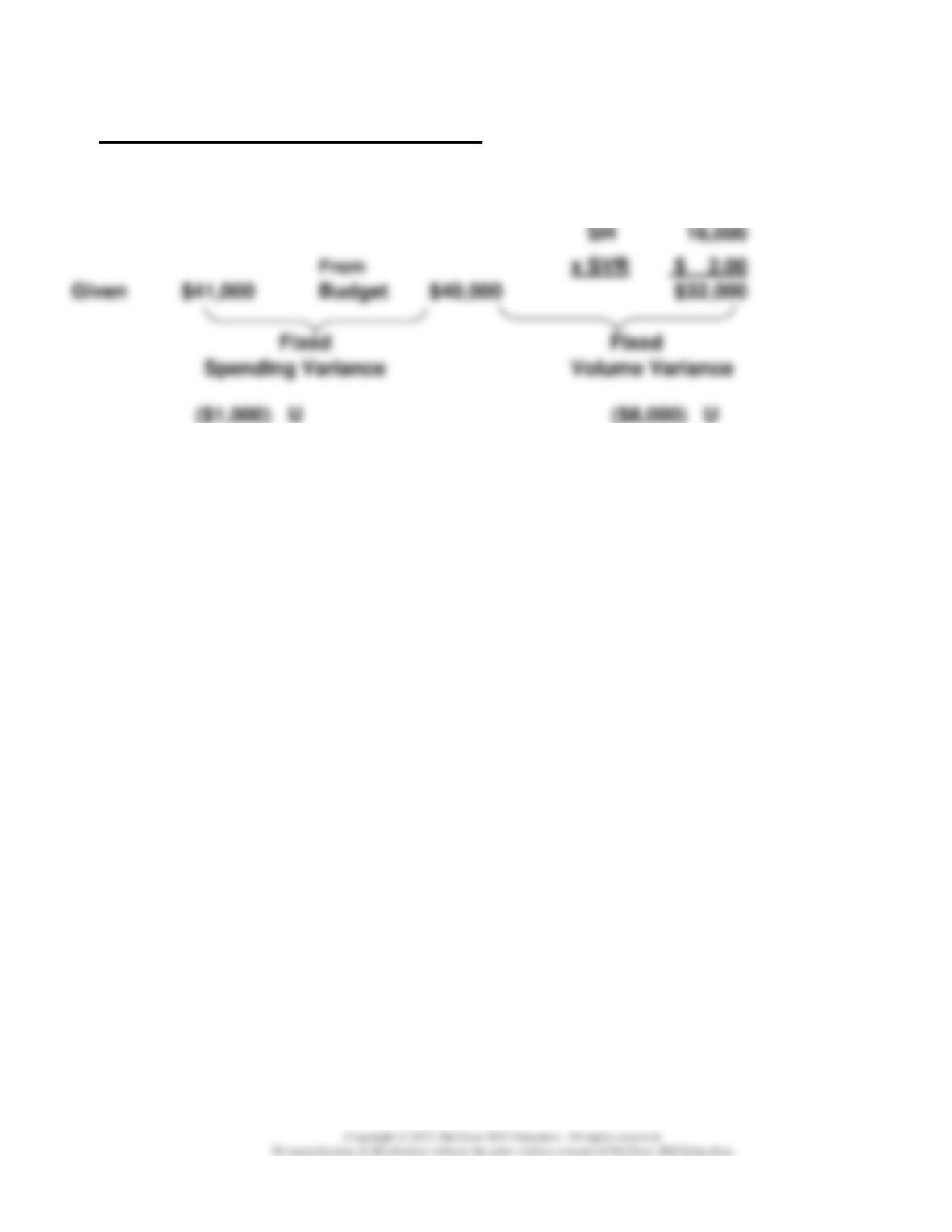
2. Variable Overhead Variance Computations
Actual Variable
Applied Variable
Overhead
Overhead
AH
AH
16,500
SH
16,000
$ 3.00
$ 3.00
total
$47,300
$49,500
$48,000
F
$(1,500)
U
Financial and Managerial Accounting, 9th Edition
21–16
3. Fixed Overhead Variance Computations
Actual Fixed
Applied Fixed
Overhead
Overhead
$ 2.00
$41,000
$40,000
$32,000
U
U