Financial and Managerial Accounting, 9th Edition
20–1
CHAPTER 20
MASTER BUDGETS AND PLANNING
Related Assignment Materials
Student Learning Objectives
Discussion
Questions
Quick
Studies*
Exercises*
Problems*
AA, DA and
BTN
Conceptual objectives:
Analytical objectives:
C1. Describe the benefits of budgeting
1, 2, 3, 4, 5, 6,
20-1, 20-2
20-1
BTN 20-1, BTN 20-2,
Analytical objectives:
P1. Prepare the operating budget of a
master budget for a manufacturing
company.
7, 8, 11, 15
20-3, 20-4,
20-5, 20-6
20-7, 20-8,
20-9, 20-10,
20–11, 20-12,
20-13, 20–14,
20-15, 20–16
20-1, 20–3,
20-4, 20–5,
20-6, 20–7,
20-8, 20–9,
20-10, 20–11,
20-12, 20–13,
20-14, 20–15,
20–16
20-1, 20-4
DA 20-1, DA 20-2,
DA 20-3, AA 20-2
20-23, 20–24
20–23
*See additional information on next page that pertains to these quick studies, exercises and problems.
SP refers to the Serial Problem
AA refers to Accounting Analysis
Financial and Managerial Accounting, 9th Edition
20–2
Additional Information on Related Assignment Material
See Chapter 1 of the Instructor’s Resource Manual for more information on materials for this text available in
Connect.
Connect
Available on the instructor’s course-specific website, Connect:
• All numerical Quick Studies, all Exercises and Problems Set A.
Hints/Guided Examples
Presentations. These are indicated in the Related Assignment Materials grid on page 1 in blue bold font.
Need-to-Know Videos
LO
Need–to-Know
Title
Time
C1
20-1
Budgeting Benefits
0:32
P1
20-2
Production Budget
0:47
P1
20-3
Direct Materials and Direct Labor Budgets
2:07
P1
20-4
Selling and General and Administrative Expense Budgets
1:25
P2
20-5
Schedule of Cash Receipts; Cash Budget
2:41
20-6
COMPREHENSIVE 1 – Master Budget — Manufacturer
Merchandiser
P4
20-8
Merchandise Purchases Budget
1:06
Concept Overview Videos
LO
Title
Time
C1
Describe the benefits of budgeting and the process of budget administration.
Budgeting Process
1:54
Budgeting and Human Behavior
1:25
Budget Reporting and Timing
1:20
Direct Labor Budget and Revenue per employee
1:03
Prepare the operating budget of a master budget — for a manufacturing company.
Master Budget Components
0:58
Sales Budget
1:03
Production Budget
1:52
Direct Materials Budget
1:38
Direct Labor Budget
0:49
Financial and Managerial Accounting, 9th Edition
20–3
Factory Overhead Budget
1:10
Budgeted Product Cost Per Unit
0:48
Selling Expense Budget
1:09
General and Admin. Expense Budget
0:42
P2
Prepare a cash budget—for a manufacturing company.
Capital Expenditures Budget
0:35
Cash Budget
0:50
Cash Receipts from Sales
1:53
Cash Payments for Direct Materials
1:00
Preparing the Cash Budget
1:33
Interest Payments and Loan Activity
1:58
P3
Prepare budgeted financial statements.
Budgeted Income Statement
1:33
Budgeted Balance Sheet
0:27
Merchandise Purchases Budget
2:02
Synopsis of Chapter Revision
NEW opener—Ellis Island Tropical Tea and entrepreneurial assignment.
NEW LO on direct labor budget for a service firm and revenue per employee.
Simplified Production Budget in Exhibit 20.6.
Slightly revised direct materials budget in Exhibit 20.7.
Slightly revised direct labor budget in Exhibit 20.8.
Revised analysis assignments: Company Analysis, Comparative Analysis, and Extended Analysis.
Financial and Managerial Accounting, 9th Edition
20–4
Chapter Outline
I. Budget Process and Administration—ensures that activities of employees and departments contribute
to meeting the company’s overall goals. Budgeting is the process of planning future business actions
and expressing them as formal plans.
A. Budget Process
1. Budget⎯formal statement of a company’s plans, expressed in dollars.
2. Cover short periods such as a month, quarter, or year.
B. Benefits of Budgeting—benefit key managerial functions of planning and controlling.
1. Plan: focuses on future opportunities and threats to the organization. Forces management to
plan for the future.
C. Budgeting and Human Behavior
1. Budgeting can affect the attitudes of employees evaluated by them.
2. Three guidelines to ensure positive motivating force.
D. Potential Negative Outcomes of Budgeting
1. Managers must be aware of negative outcomes.
a. Employees may understate the sales budget and/or overstate the expense budget to allow a
E. Budget Reporting and Timing
1. Usually coincides with the company’s fiscal year.
Financial and Managerial Accounting, 9th Edition
20–5
II. Operating Budgets
A. Master Budget Components
1. Contains several interconnected.
B. Sales Budget
1. First step in preparing master budget – shows planned unit sales and budgeted dollars from those
sales
b. To develop sales budget, companies must estimate both unit sales and selling price per unit.
C. Production Budget – shows number of units to be produced each period to meet budgeted sales and
a desired inventory level.
1. Companies will keep enough inventory on hand to protect against lost sales caused by
unfulfilled demands from customers or delays in shipments from suppliers (called safety stock).
D. Direct Materials Budget — shows budgeted costs for direct materials that must be purchased to meet
the budgeted production.
Units to produce
x Materials required per unit
E. Direct Labor Budget — shows budgeted costs for direct labor that will be needed for the budgeted
production for the period.
Financial and Managerial Accounting, 9th Edition
20–6
Cost of direct labor
F. Factory Overhead Budget — shows budgeted costs for factory overhead needed to complete the
budgeted production for the period.
Direct labor hours needed
G. Budgeted Cost of Goods Sold
Once we have completed the three manufacturing budgets, we can compute the budgeted cost per
unit and cost of goods sold budget.
1. Budgeted cost per unit is computed as the cost of direct materials (Exhibit 20.10), plus cost of
H. Selling Expense Budget
1. Based on sales volume.
I. General and Administrative Expense Budget:
III. Investing and Financing Budget
A. Capital Expenditures Budget (Investing Budget)
1. Reports expected cash receipts and cash payments related to the sale and purchase of plant
B. Cash Budget (Financing Budget)
1. Cash Budget⎯shows budgeted cash receipts and payments during budget period. Managing
Financial and Managerial Accounting, 9th Edition
20–7
Beginning cash balance
+ Budgeted cash receipts
a. Cash Receipts from Sales
i. Expected cash sales – from sales budget.
ii. Expected cash collections of accounts receivable.
IV. Budgeted Financial Statements
1. Budgeted Income Statement
2. Budgeted Balance Sheet
3. Using the Master Budget
a. Planning – at any stage in the master budget process, might show results that require new
4. Budgeting for Service Companies – service providers also use master budgets but typically need
Financial and Managerial Accounting, 9th Edition
20–8
V. Decision Analysis—Direct Labor Budget and Revenue per Employee — Direct labor budget is
key for a service firm.
A. Budgeted direct labor cost is computed as budgeted direct labor hours times direct labor cost per
hour.
1. Business can assess effectiveness of their workforce using revenue per employee ratio computed
as total revenue divided by total employees.
VI. Appendix 20A – Merchandise Purchases Budget
A. Merchandisers⎯Sales budget used as basis for merchandise purchases budget.
Financial and Managerial Accounting, 9th Edition
20–9
Chapter 20 Alternate Demo Problem
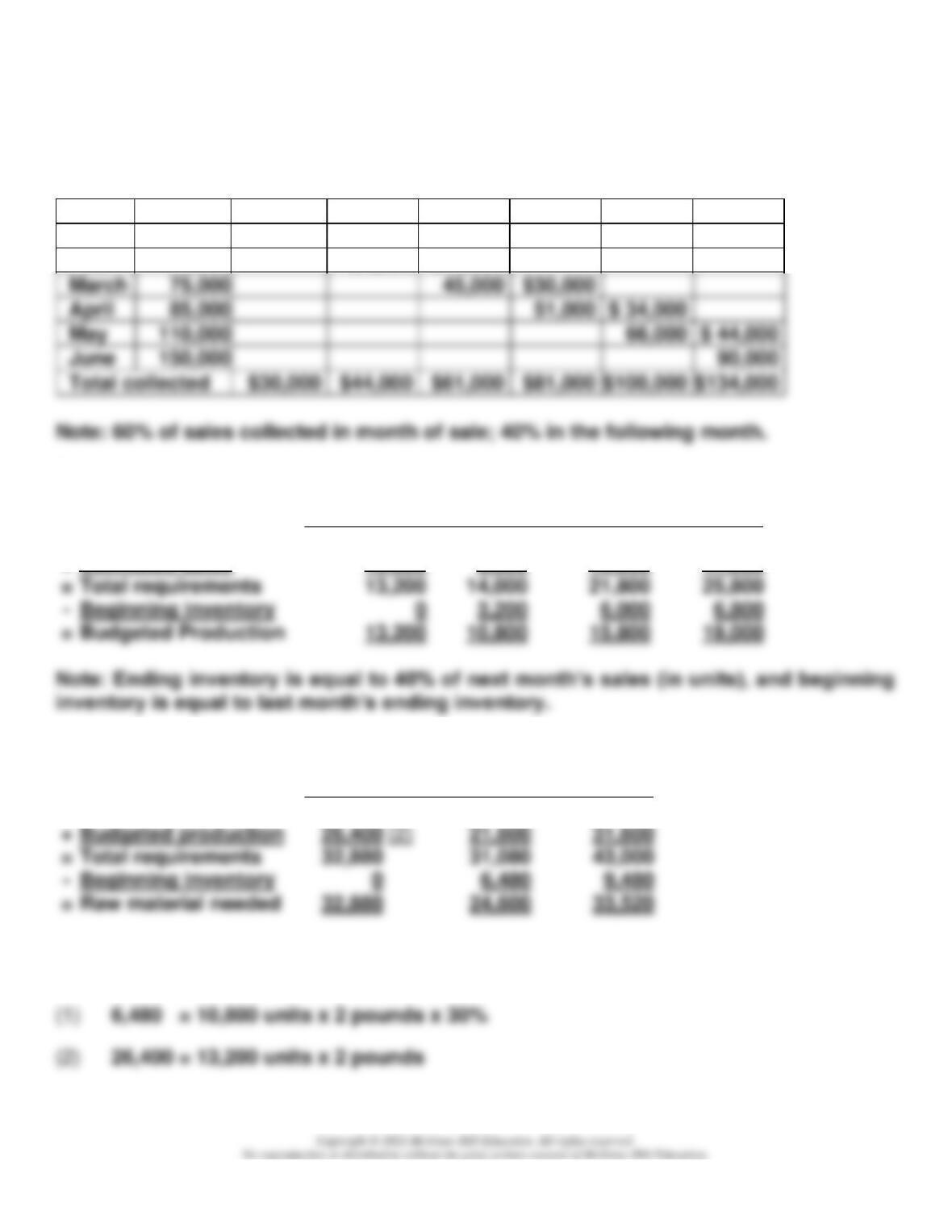
ABC Company started business on January 1, 2021. The company estimated that sales
for the first six months would be as follows:
Month
Units
Dollars
January
10,000
$ 50,000
February
March
15,000
17,000
30,000
The company sells all items on account and expects collections of accounts receivable
to be as follows: 60% in the month of the sale, and the remaining 40% in the month after
the sale.
Required:
(a) Compute the expected cash collections during the months of January, February,
March, April, May and June.
(b) The company has decided that finished goods inventory at the end of each month
should ideally be equal to 40% of next month’s sales. What should budgeted
production be for each of the first four months?
Financial and Managerial Accounting, 9th Edition
20–10
Chapter 20 Solution: Alternate Demo Problem
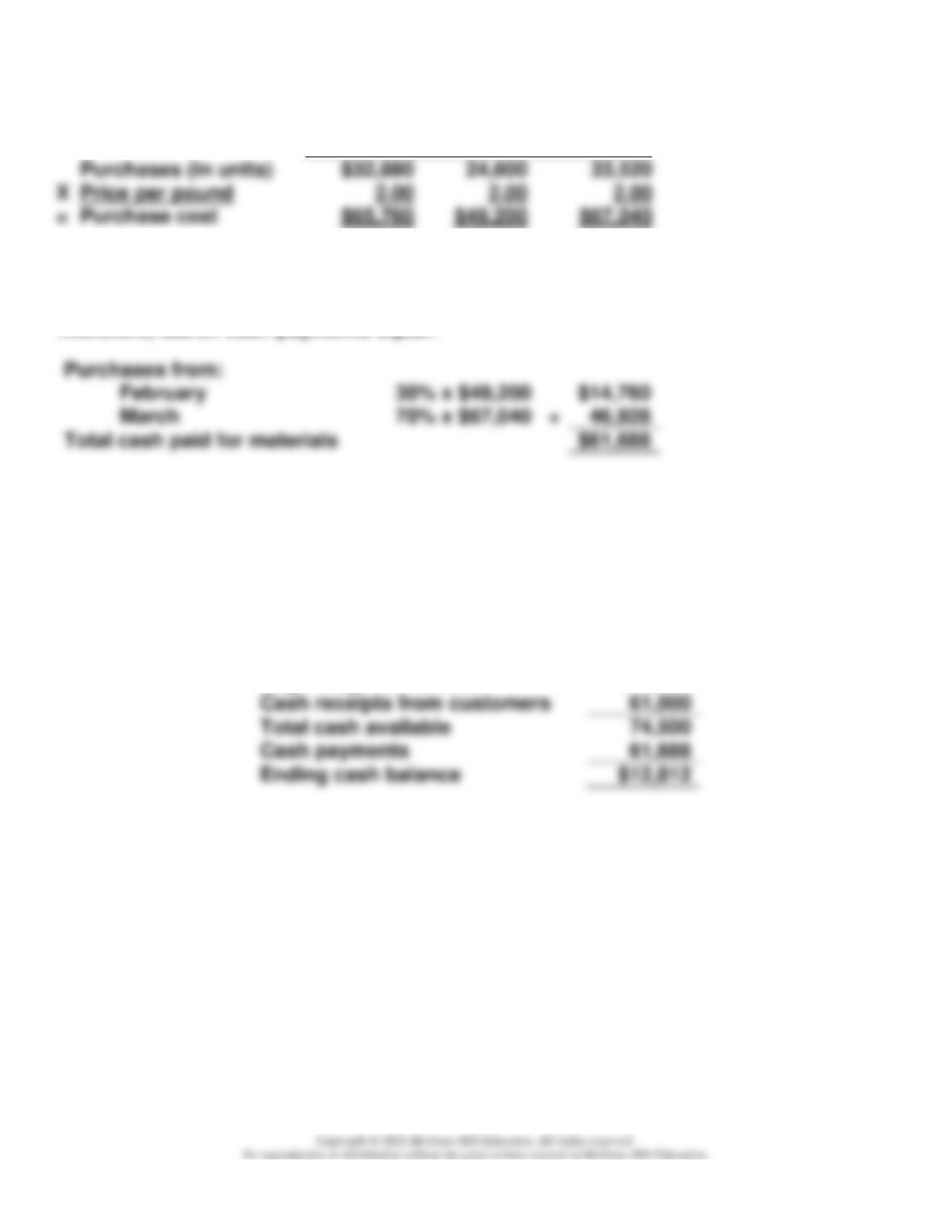
(a)
Collections
Month
Sales
Jan.
Feb.
March
April
May
June
Jan.
$ 50,000
$30,000
$20,000
Feb.
40,000
24,000
$16,000
March
75,000
45,000
$30,000
85,000
51,000
May
66,000
June
90,000
Total collected
$30,000
$44,000
$61,000
$81,000
$100,000
$134,000
(b)
Jan.
Feb.
March
April
Ending inventory
3,200
6,000
6,800
8,800
+
Estimated sales
10,000
8,000
15,000
17,000
=
Total requirements
13,200
21,800
25,800
3,200
6,000
6,800
(c)
Jan.
Feb.
March
Ending inventory
6,480
(1)
9,480
11,400
+
Budgeted production
(2)
21,600
31,600
=
Total requirements
31,080
43,000
6,480
9,480
=
Raw material needed
24,600
33,520
Note: It takes two pounds of raw material to make one unit of product and ending
inventory should equal 30% of next month’s production.
Financial and Managerial Accounting, 9th Edition
20–11
(d)
Jan.
Feb.
March
Purchases (in units)
X
Price per pound
=
Purchase cost
March cash payments equals 70% of March purchases plus 30% of February purchases.
Therefore, March cash payments equal:
Purchases from:
+
Total cash paid for materials
(e)
ABC COMPANY
Cash Budget
For the Month of March 2021
Beginning cash balance
$13,500
Cash receipts from customers
Total cash available
Cash payments
$12,812