20-21
20-26 (30 min.) EOQ, uncertainty, safety stock, reorder point.
Stewart Corporation is a major automobile manufacturer. It purchases steering wheels from
Coase Corporation. Annual demand is 10,400 steering wheels per year or 200 steering wheels
per week. The ordering cost is $100 per order. The annual carrying cost is $13 per steering
wheel. It currently takes 1.5 weeks to supply an order to the assembly plant.
Required:
1. What is the optimal number of steering wheels that Stewart’s managers should order
according to the EOQ model?
2. At what point should managers reorder the steering wheels, assuming that both demand and
purchase-order lead time are known with certainty?
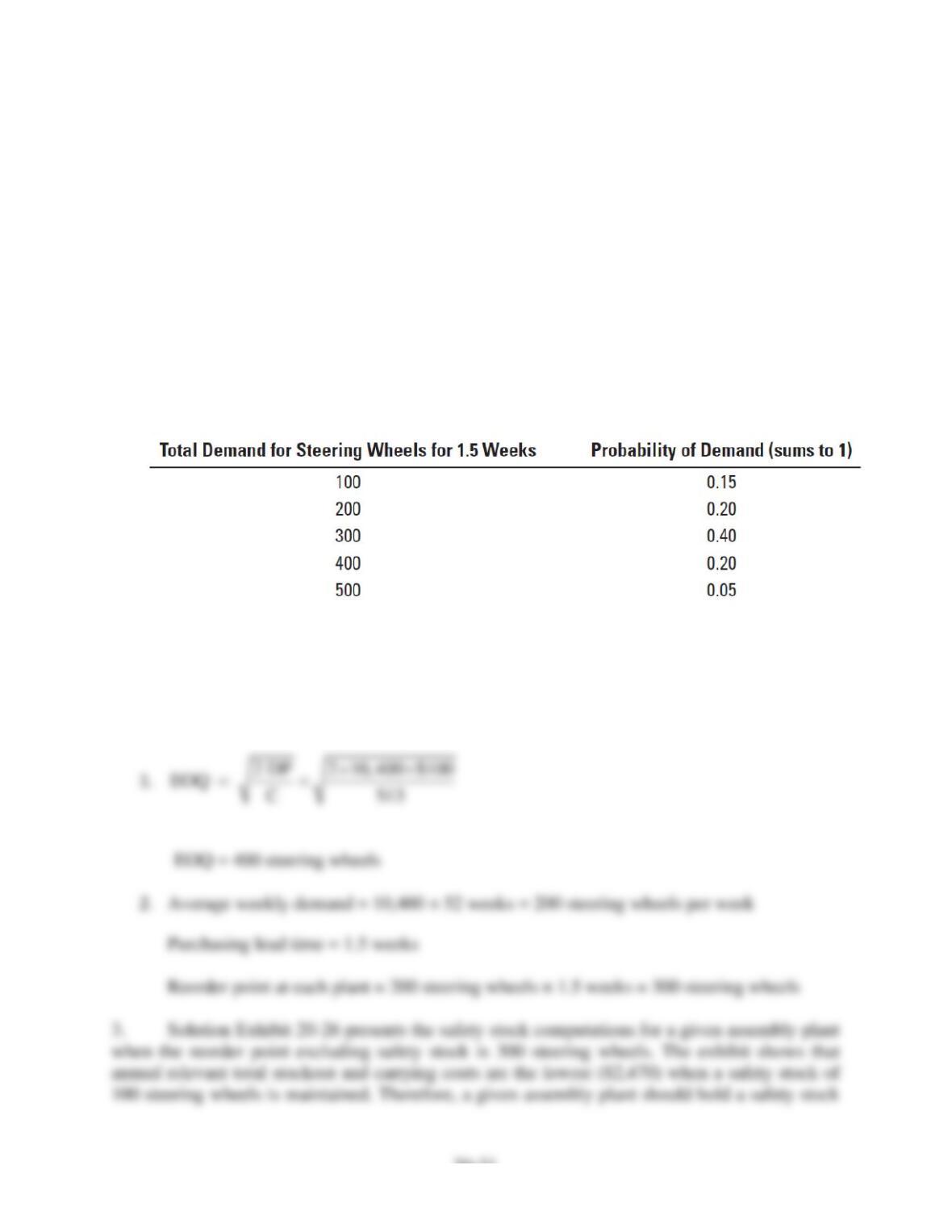
3. Now assume that demand can vary during the 1.5-week purchase-order lead time. The
following table shows the probability distribution of various demand levels:
If Stewart runs out of stock, it would have to rush order the steering wheels at an additional
cost of $9 per steering wheel. How much safety stock should the assembly plant hold? How
will this affect the reorder point and reorder quantity.
SOLUTION
20-22
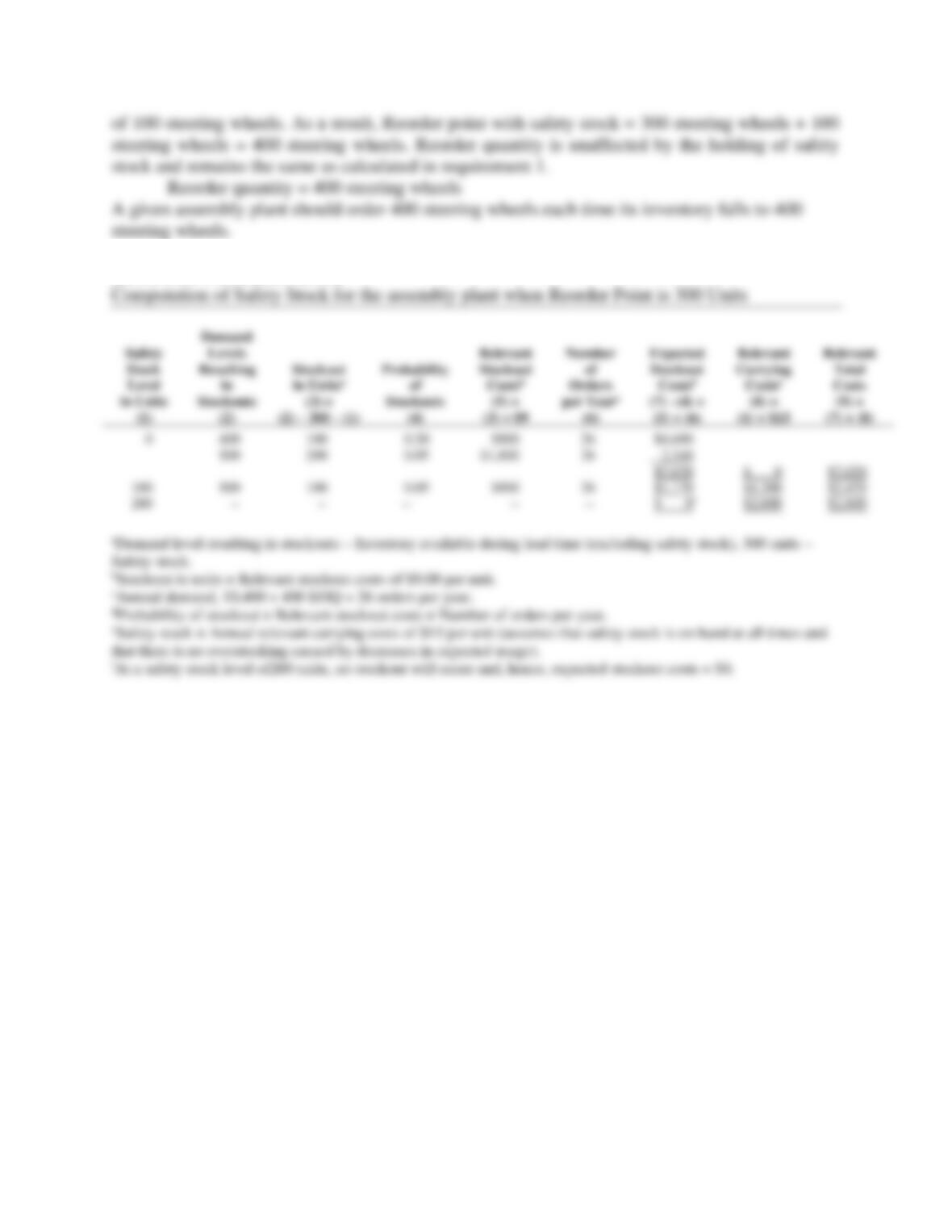
SOLUTION EXHIBIT 20-26
20-23
20-27 (25 min.) MRP, EOQ, and JIT.
Tech Works Corp. produces J-Pods, music players that can download thousands of songs. Tech
Works forecasts that demand in 2014 will be 48,000 J-Pods. The variable production cost of each
J-Pod is $54. In its MRP system, due to the large $10,000 cost per setup, Tech Works plans to
produce J-Pods once a month in batches of 4,000 each. The carrying cost of a unit in inventory is
$17 per year.
Required:
1. Using the MRP system, what is the annual cost of producing and carrying J-Pods in
inventory? (Assume that, on average, half of the units produced in a month are in inventory.)
2. A new manager at Tech Works has suggested that the company use the EOQ model to
determine the optimal batch size to produce. (To use the EOQ model, Tech Works needs to
treat the setup cost in the same way it would treat ordering cost in a traditional EOQ model.)
Determine the optimal batch size and number of batches. Round up the number of batches to
the nearest whole number. What would be the annual cost of producing and carrying J-Pods
in inventory if it uses the optimal batch size? Compare this cost to the cost calculated in
requirement 1. Comment briefly.
3. Tech Works is also considering switching from its MRP system to a JIT system. This will
result in producing J-Pods in batch sizes of 600 J-Pods and will reduce obsolescence,
improve quality, and result in a higher selling price. The frequency of production batches will
force Tech Works to reduce setup time and will result in a reduction in setup cost. The new
setup cost will be $500 per setup. What is the annual cost of producing and carrying J-Pods
in inventory under the JIT system?
4. Compare the models analyzed in the previous parts of the problem. What are the advantages
and disadvantages of each?
SOLUTION
20-24
20-25
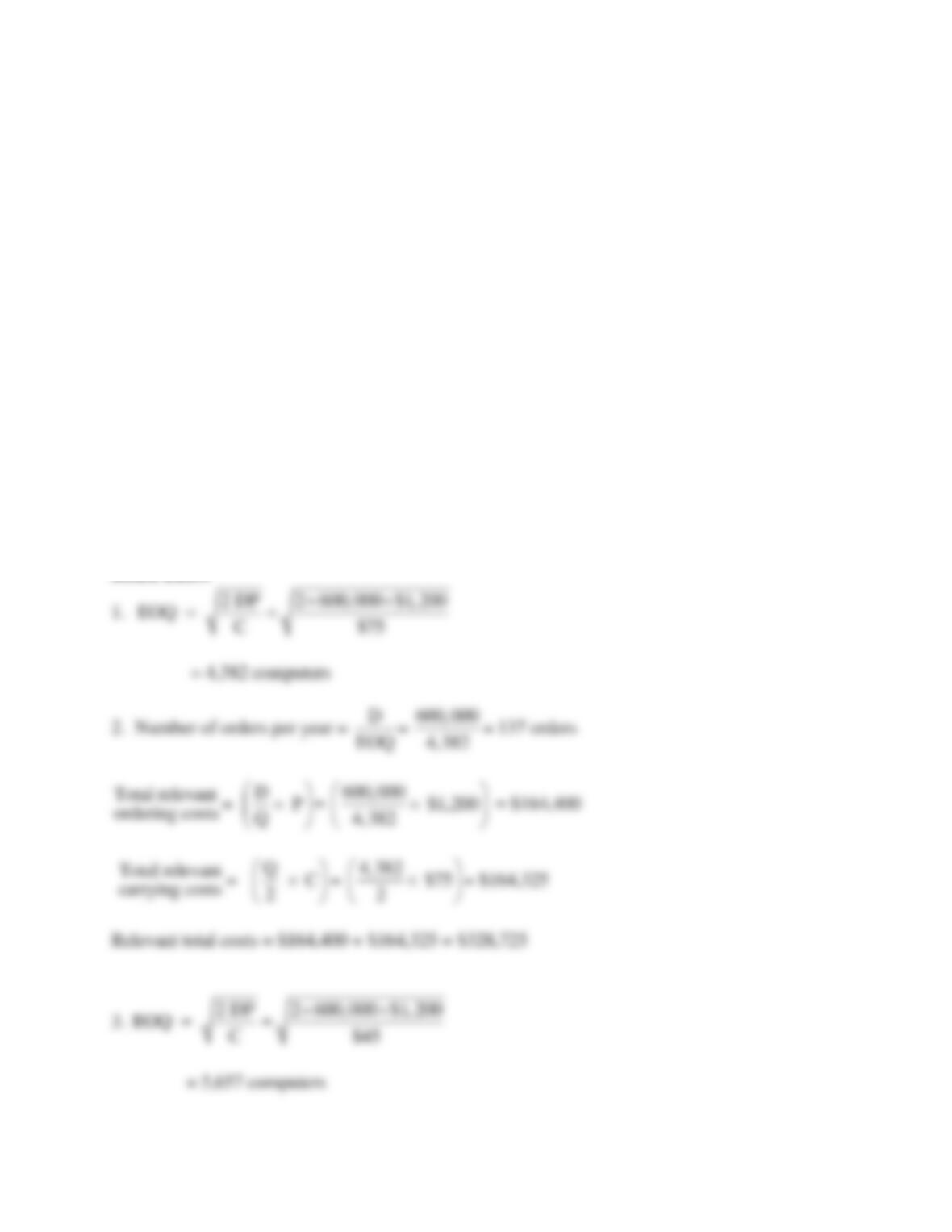
20-28 (30 min.) Effect of management evaluation criteria on EOQ model.
Computer Depot purchases one model of computer at a wholesale cost of $300 per unit and
resells it to end consumers. The annual demand for the company’s product is 600,000 units.
Ordering costs are $1,200 per order and carrying costs are $75 per computer, including $30 in
the opportunity cost of holding inventory.
Required:
1. Compute the optimal order quantity using the EOQ model.
2. Compute (a) the number of orders per year and (b) the annual relevant total cost of ordering
and carrying inventory.
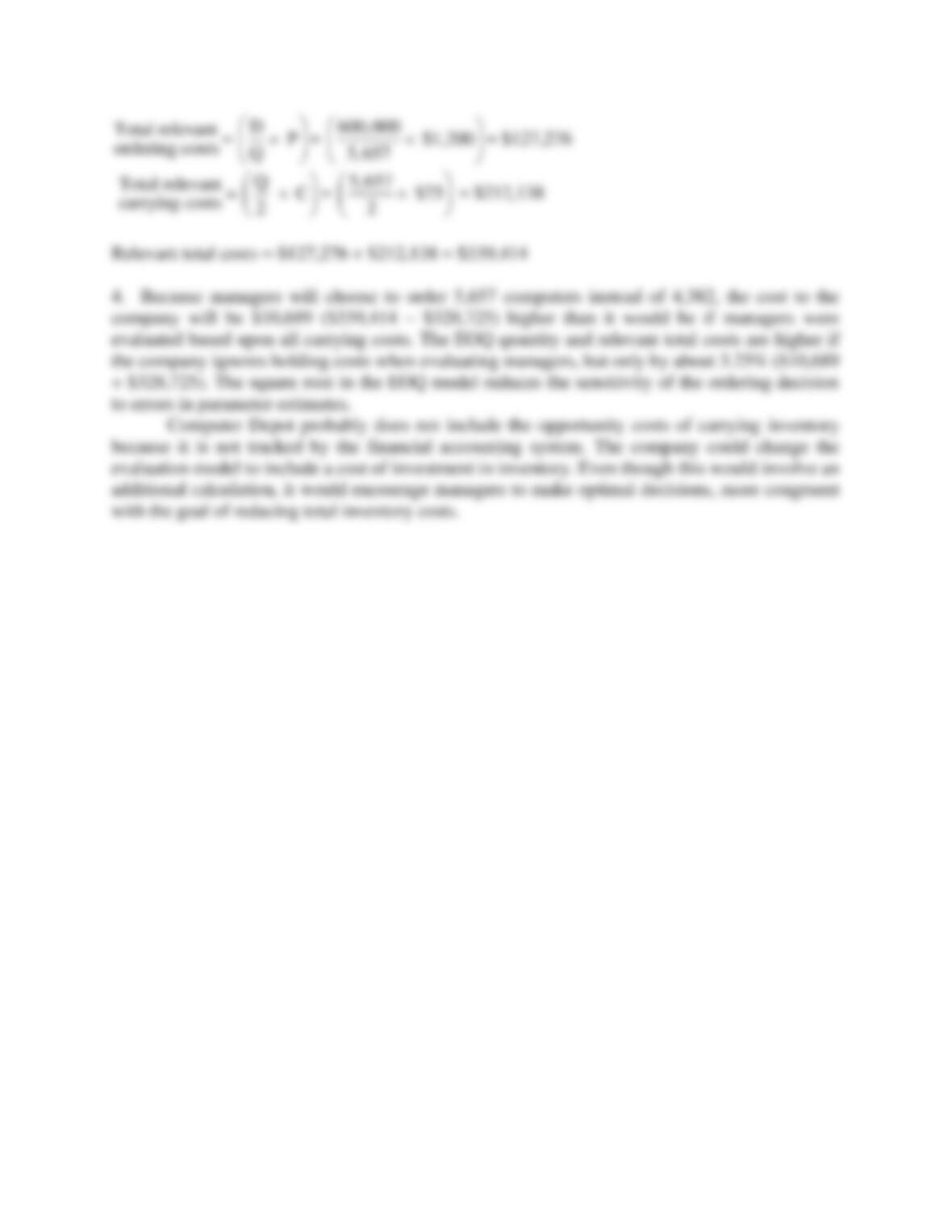
3. Assume that when evaluating the manager, the company excludes the opportunity cost of
carrying inventory. If the manager makes the EOQ decision excluding the opportunity cost of
carrying inventory, the relevant carrying cost would be $45, not $75. How would this affect
the EOQ amount and the actual annual relevant cost of ordering and carrying inventory?
4. What is the cost impact on the company of excluding the opportunity cost of carrying
inventory when making EOQ decisions? Why do you think the company currently excludes
the opportunity costs of carrying inventory when evaluating the manager’s performance?
What could the company do to encourage the manager to make decisions more congruent
with the goal of reducing total inventory costs?
SOLUTION
20-26
20-29 (30 min.) JIT purchasing, relevant benefits, relevant costs.
(CMA, adapted) The Greene Corporation is an automotive supplier that uses automatic turning
machines to manufacture precision parts from steel bars. Greene’s inventory of raw steel
averages $300,000. John Oates, president of Greene, and Helen Gorman, Greene’s controller, are
concerned about the costs of carrying inventory. The steel supplier is willing to supply steel in
smaller lots at no additional charge. Gorman identifies the following effects of adopting a JIT
inventory program to virtually eliminate steel inventory:
▪ Without scheduling any overtime, lost sales due to stockouts would increase by 35,000 units
per year. However, by incurring overtime premiums of $20,000 per year, the increase in lost
sales could be reduced to 20,000 units per year. This would be the maximum amount of
overtime that would be feasible for Greene.
▪ Two warehouses currently used for steel bar storage would no longer be needed. Greene
rents one warehouse from another company under a cancelable leasing arrangement at an
annual cost of $45,000. The other warehouse is owned by Greene and contains 12,000 square
feet. Three-fourths of the space in the owned warehouse could be rented for $1.25 per square
foot per year. Insurance and property tax costs totaling $7,000 per year would be eliminated.
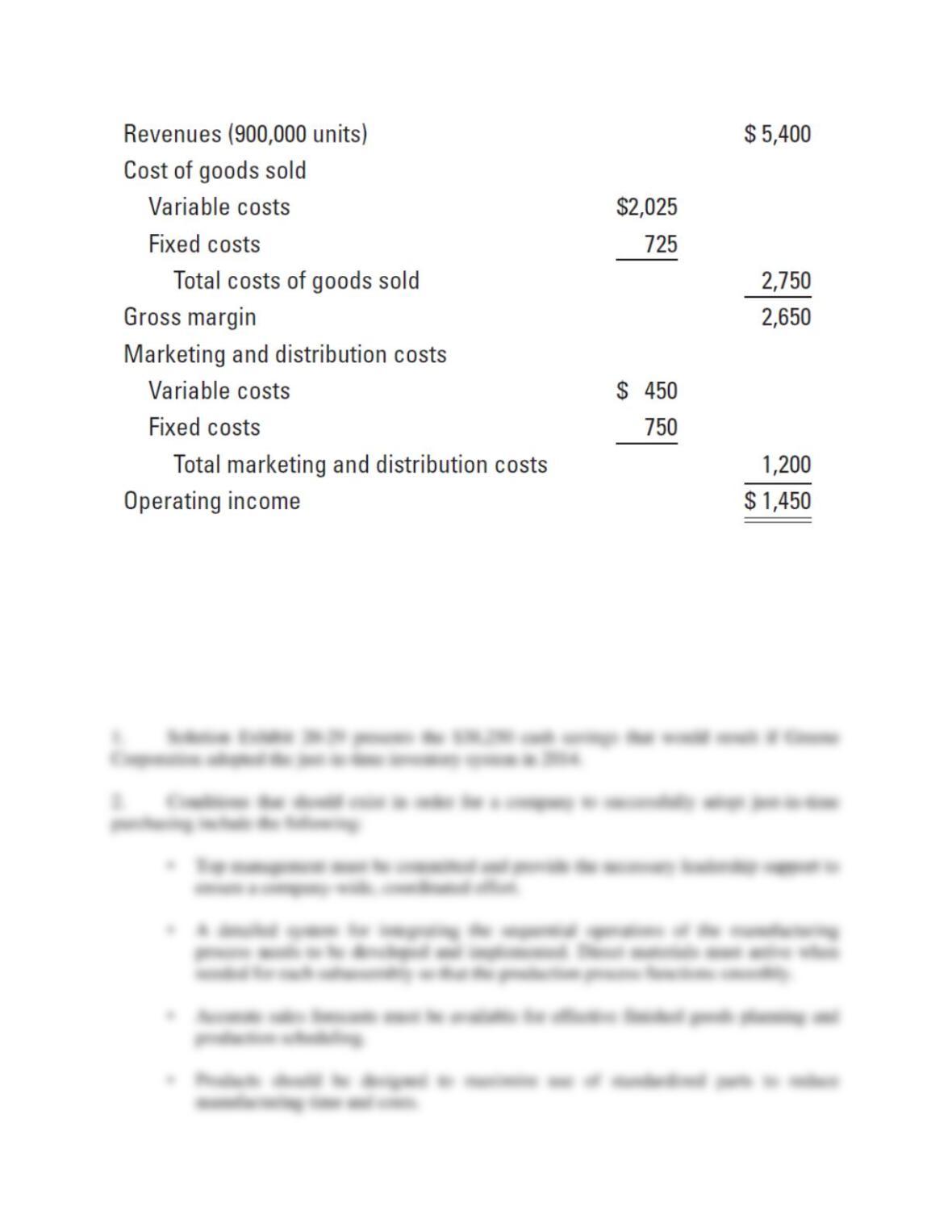
Greene’s required rate of return on investment is 20% per year. Greene’s budgeted income
statement for the year ending December 31, 2014, (in thousands) is:
20-27
Required:
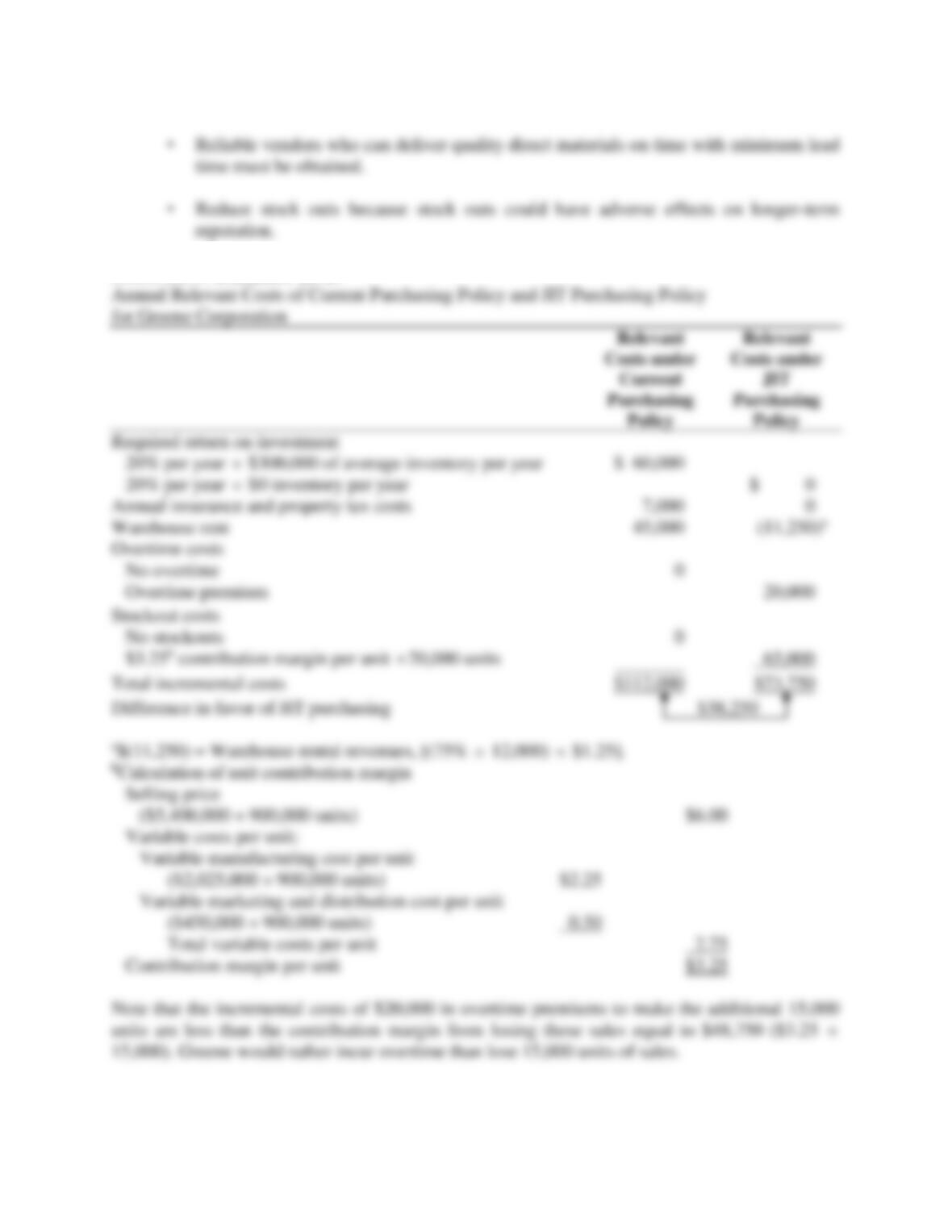
1. Calculate the estimated dollar savings (loss) for the Greene Corporation that would result in
2014 from the adoption of JIT purchasing.
2. Identify and explain other factors that Greene should consider before deciding whether to
adopt JIT purchasing.
SOLUTION
20-28
SOLUTION EXHIBIT 20-29
20-29
20-30 (25 min.) Supply chain effects on total relevant inventory costs.
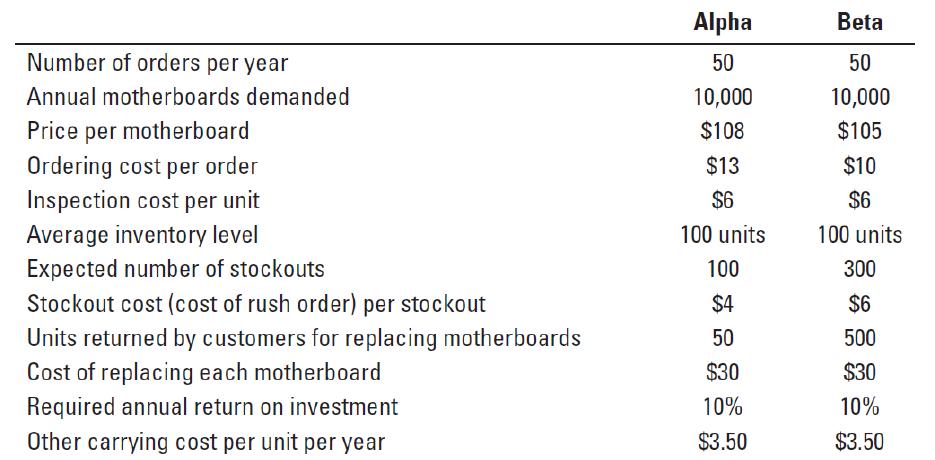
Peach Computer Co. outsources the production of motherboards for its computers. It is currently
deciding which of two suppliers to use: Alpha or Beta. Due to differences in the product failure
rates in the two companies, 5% of motherboards purchased from Alpha will be inspected and
25% of motherboards purchased from Beta will be inspected. The following data refer to costs
associated with Alpha and Beta:
Required:
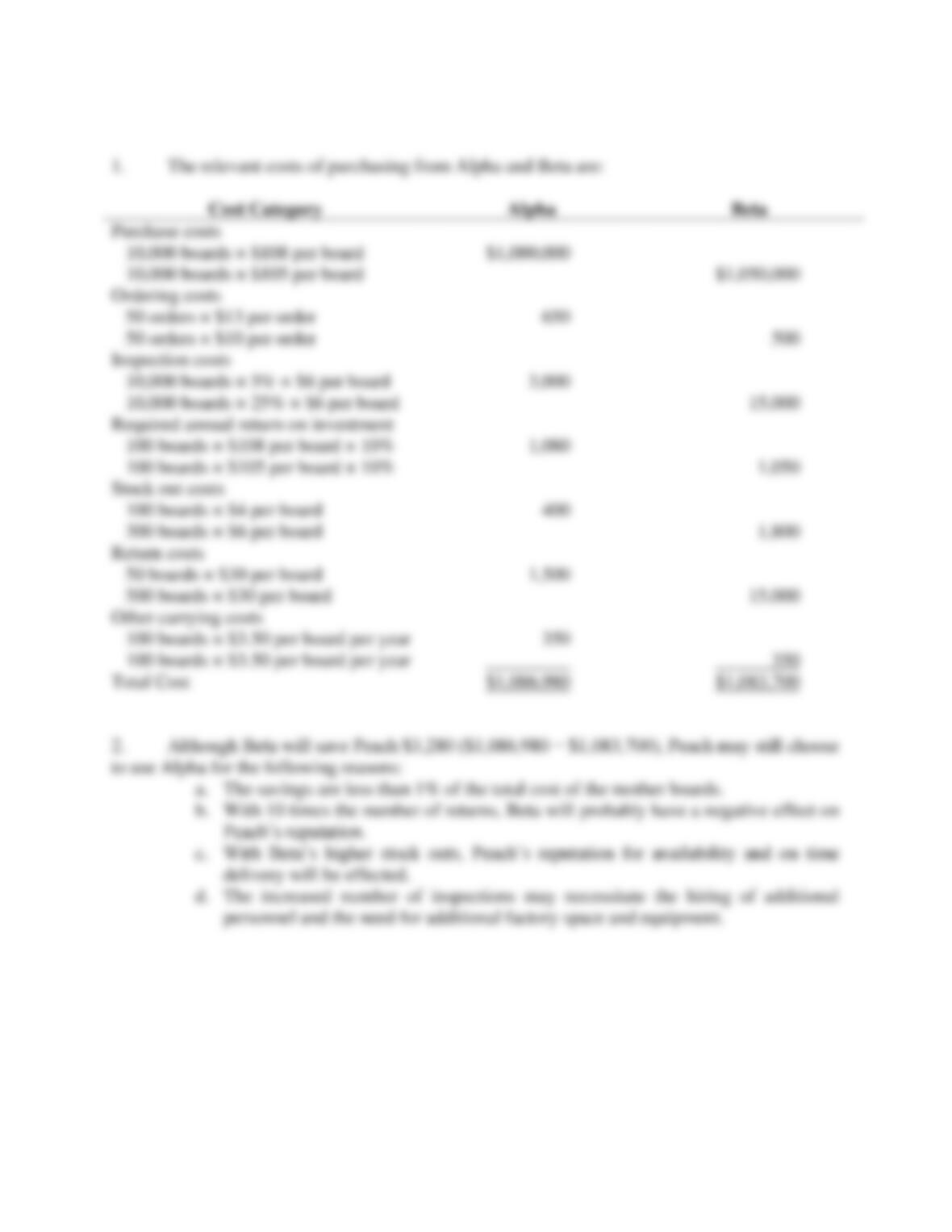
1. What is the relevant cost of purchasing from Alpha and Beta?
2. What factors other than cost should Peach consider?
20-30
SOLUTION
20-31
20-31 (25 min.) Supply chain effects on total relevant inventory costs.
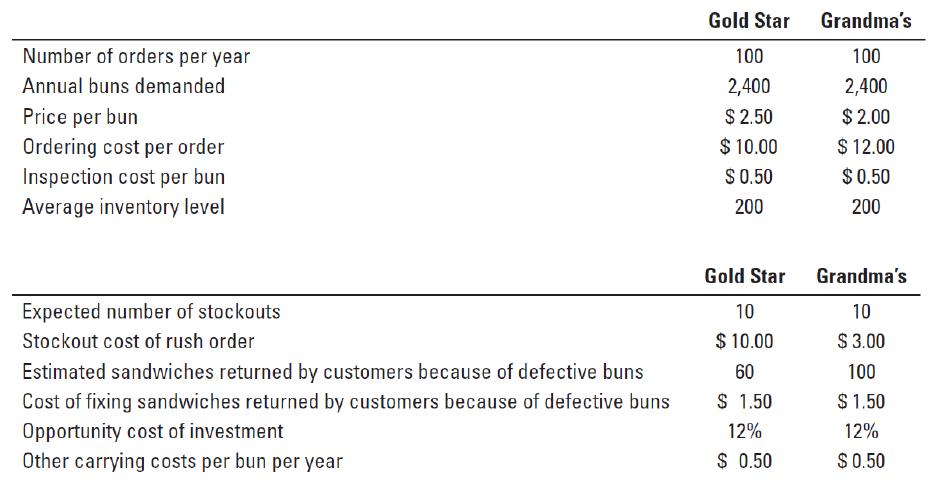
Joe’s Deli orders specially-made sandwich buns from two different suppliers: Gold Star Breads
and Grandma’s Bakery. Joe’s Deli would like to use only one of the suppliers in the future. Due
to variations in quality, Joe’s would need to inspect 30% of Gold Star’s buns and 60% of
Grandma’s. The following data refer to costs associated with the two suppliers.
Required:
1. What is the relevant cost of purchasing from Gold Star and Grandma’s?
2. What factors other than cost should Joe’s Deli consider?