Problem 20-5B (60 minutes)
Part 1
H2O SPORTS
Merchandise Purchases Budgets
For April, May, and June
April
May
June
WATER SKIS
Budgeted sales for next month ………………………
90,000
130,000
100,000
Ratio of ending inventory to future sales ………..
10%
10%
10%
Budgeted ending inventory …………………………..
9,000
13,000
10,000
Add budgeted sales ……………………………………….
70,000
90,000
130,000
Required units of available merchandise ………..
79,000
103,000
140,000
Less actual (or budgeted) beginning inventory …….
(9,000)
(13,000)
Budgeted purchases ……………………………………..
94,000
127,000
Budgeted sales for next month ………………………
90,000
110,000
100,000
Ratio of ending inventory to future sales ………..
10%
10%
Add budgeted sales ……………………………………….
100,000
110,000
Required units of available merchandise ………..
109,000
101,000
120,000
Less actual (or budgeted) beginning inventory …….
(90,000)
(9,000)
(11,000)
Budgeted purchases ……………………………………..
19,000
92,000
109,000
LIFE JACKETS
Budgeted sales for next month ………………………
190,000
200,000
120,000
Ratio of ending inventory to future sales ………..
10%
10%
10%
Budgeted ending inventory …………………………..
19,000
20,000
12,000
Add budgeted sales ……………………………………….
160,000
190,000
200,000
Required units of available merchandise ………..
179,000
210,000
212,000
Less actual (or budgeted) beginning inventory …….
Problem 20-5B (Concluded)
Part 2. Analysis Component
Inventory levels might become too high for a number of reasons, including:
• Management may have simply lost sight of inventory levels, thereby
allowing them to reach inappropriately high levels.
• The company’s suppliers may have only recently become more
dependable than they were in the past.
• A supplier may have recently located a new distribution facility nearby,
with the result that the merchandise can be delivered more promptly.
Problem 20-6B (50 minutes)
SONY STEREO
Cash Budgets
For April, May, and June
April
May
June
Beginning balance ……………………………………
$ 3,000
$ 53,000
$ 44,000
Cash receipts
Collection on accounts receivable* …………
136,000
210,000
290,200
Receipts from bank loan …………………………
80,000
_______
_______
Total cash available ………………………………….
219,000
263,000
334,200
Payroll ……………………………………………………
Other expenses ………………………………………
Interest on bank loan* …………………………..
* Interest at 12% on $80,000 for 90 days is $2,400.
Supporting calculations
Collections of credit sales*
March
April
May
June
March sales ($180,000)—[25%: 45%: 20%: 9%] …………..
$ 45,000
$ 81,000
$ 36,000
$ 16,200
April sales ($220,000)—[25%: 45%: 20%] …………………..
–
55,000
99,000
44,000
May sales ($300,000)—[25%: 45%] …………………………..
–
–
75,000
135,000
June sales ($380,000)—[25%] …………………………..
–
–
–
95,000
Total ……………………………………………………………………….
$ 45,000
$136,000
$210,000
$290,200
Payments on credit purchases**
March
April
May
June
March purchases ($100,000)—(0%: 80%: 20%) …………………………..
$ 80,000
$ 20,000
April purchases ($210,000)—(0%: 80%: 20%) …………………………..
–
42,000
May purchases ($180,000)—(0%: 80%) …………………………..
–
–
–
–
Problem 20-7B (70 minutes)
Part 1
Cash collections of credit sales (accounts receivable)
From sales in
Total
% Collected
March
April
January ……………………………….
$396,000
23%
$ 91,080
February ………………………………
495,000
35
173,250
…………………………..
23
$113,850
March ………………………………….
418,000
40
167,200
…………………………………..
35
146,300
April …………………………………….
412,500
40
_______
165,000
Total collected ……………………..
$431,530
$425,150
Part 2
Budgeted ending inventories (in units)
February
Budgeted ending inventory units ……………
3,850
Part 3
CONNICK COMPANY
Merchandise Purchases Budgets
For February, March, and April
February
March
April
Problem 20-7B (Continued)
Part 4
Cash payments on product purchases (for March and April)
From purchases in
Total
% Paid
March
April
February …………………………………
$261,600
70%
$183,120
March …………………………………….
227,400
30
68,220
……………………………………..
70
$159,180
April ……………………………………….
230,400
30
_______
69,120
Total paid ……………………………….
$251,340
$228,300
Part 5
CONNICK COMPANY
Cash Budget
March
April
Beginning cash balance ………………………………………………….
$ 50,000
$ 58,070
Cash receipts from customers ………………………………………..
431,530
425,150
Total available cash ……………………………………………………….
481,530
483,220
Cash payments for:
Purchases ……………………………………………………………………
251,340
228,300
160,000
160,000
120
0
Total payments ……………………………………………………….
411,460
388,300
Additional loan ……………………………………………………….
Repayment of loan ……………………………………………………….
$ 58,070
$ 94,920
Part 6
Analysis Component: Information about the supply of cash in the near future
would be helpful to the management of Connick Company. A good cash
budget would be likely to be helpful to management in negotiating the terms
of the loan. If the bank knows, for example, that the full borrowed amount is
likely to be repaid in the following month, the interest rate could be
substantially lower.
Problem 20-8B (130 minutes)
Part 1
ISLE CORPORATION
Sales Budgets
January, February, and March 2020
Budgeted
Units
Budgeted
Unit Price
Budgeted
Total Dollars
January 2020 ……………………………………………….
6,000
$45
$ 270,000
February 2020………………………………………………
8,000
45
360,000
March 2020 ………………………………………………….
10,000
45
450,000
Total for the first quarter ………………………………
24,000
$1,080,000
Part 2
ISLE CORPORATION
Merchandise Purchases Budgets
January, February, and March 2020
January
February
March
Total
Next month’s budgeted sales units …..
8,000
10,000
9,000
Ratio of inventory to future sales ………
x 25%
x 25%
x 25%
Add budgeted sales units …………………
Deduct beginning inventory units ……..
(5,000)
Units to be purchased ………………………
Budgeted cost per unit ……………………..
Part 3
ISLE CORPORATION
Selling Expense Budgets
January, February, and March 2020
January
February
March
Total
Problem 20-8B (Continued)
Part 4
ISLE CORPORATION
General and Administrative Expense Budgets
January, February, and March 2020
January
February
March
Total
Salaries ……………………………………………….
$12,000
$12,000
$12,000
$36,000
Maintenance ………………………………………..
3,000
3,000
3,000
9,000
Depreciation* ……………………………………….
6,375
7,375
7,675
21,425
Total expenses …………………………………….
$21,375
$22,375
$22,675
$66,425
* Depreciation expense calculations
Annual
2,250
Part 5
ISLE CORPORATION
Capital Expenditures Budgets
January, February, and March 2020
January
February
March
Equipment purchases …………………………………..
$72,000
$96,000
$ 28,800
Land purchase ……………………………………………..
_______
_______
150,000
Total ……………………………………………………….
$72,000
$96,000
$178,800
Problem 20-8B (Continued)
Part 6
ISLE CORPORATION
Cash Budgets
January, February, and March 2020
January
February
March
Beginning cash balance ………………………………..
$ 36,000
$182,850
$ 107,850
Cash receipts from customers (note A)…………….
382,500
421,500
355,500
Total cash available ………………………………………
418,500
604,350
463,350
Cash payments for:
Merchandise (note B) …………………………………….
72,000
306,000
123,000
Sales commissions …………………………………….
54,000
72,000
90,000
Sales salaries ……………………………………………..
7,500
7,500
7,500
General & administrative salaries ………………..
12,000
12,000
12,000
Maintenance expense …………………………………
3,000
3,000
3,000
Taxes payable …………………………………………….
90,000
Purchases of equipment …………………………..
72,000
96,000
28,800
Purchase of land …………………………………………
Repayment of loan to bank …………………………..
Additional loan from bank …………………………..
________
76,950
$182,850
$107,850
$ 36,000
Supporting calculations
January
February
March
Total
Note A: Cash receipts from customers
Total sales …………………………………………………
$270,000
$360,000
$450,000
$1,080,000
Cash sales (25%) …………………………..…………..
$ 67,500
$ 90,000
$112,500
$ 270,000
Credit sales (75%) ……………………………………..
$202,500
$270,000
$337,500
$ 810,000
Cash collections
Receivables at 12/31/2019 (60%; 40%) ………..
$315,000
$210,000
$ 525,000
January credit sales (60%; 40%) ………………..
121,500
$ 81,000
202,500
February credit sales (60%; 40%) ……………….
_______
_______
162,000
162,000
Total from credit customers ……………………….
$315,000
331,500
243,000
889,500
Cash sales…………………………………………………
67,500
90,000
112,500
270,000
Total cash received ……………………………………
$382,500
$421,500
$355,500
$1,159,500
Credit purchases ……………………………………….
$90,000
$255,000
$292,500
$637,500
Accounts payable at 12/31/2019 (20%; 80%) .
$72,000
$288,000
$360,000
January purchases (20%; 80%) ………………….
18,000
$72,000
February purchases (20%) …………………………
_______
_______
51,000
51,000
Total paid on purchases …………………………….
$72,000
$306,000
$123,000
$501,000
Problem 20-8B (Continued)
Part 7
ISLE CORPORATION
Budgeted Income Statement
For Three Months Ended March 31, 2020
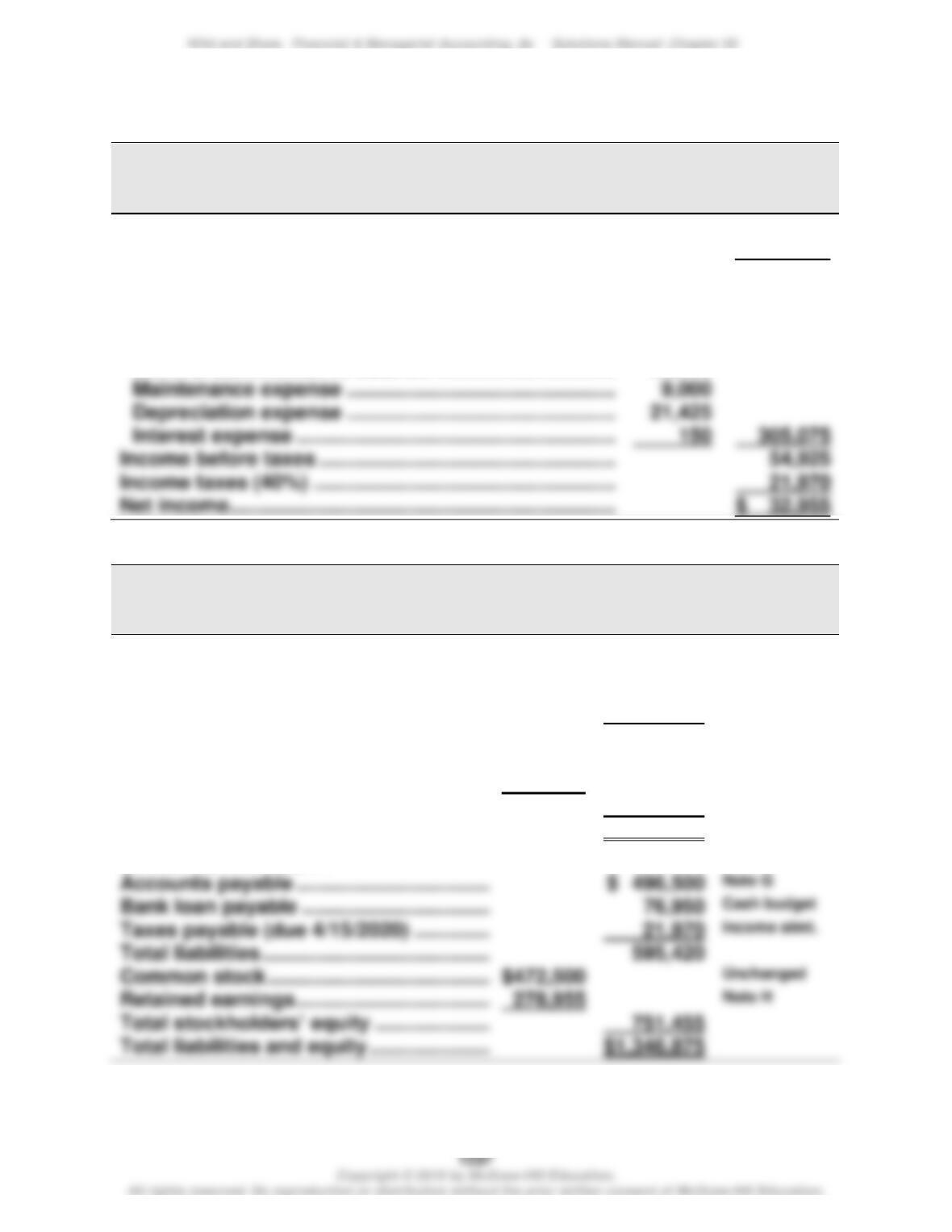
Sales ……………………………………………………………………..
$1,080,000
Cost of goods sold (24,000 units @ $30) …………………
720,000
Gross profit …………………………………………………………..
360,000
Operating expenses
Sales commissions ……………………………………………..
$216,000
Sales salaries ………………………………………………………
22,500
General administrative salaries …………………………..
36,000
Maintenance expense ………………………………………….
Depreciation expense ………………………………………….
21,425
305,075
Income before taxes ………………………………………………
Income taxes (40%) ……………………………………………….
21,970
Part 8
ISLE CORPORATION
Budgeted Balance Sheet
March 31, 2020
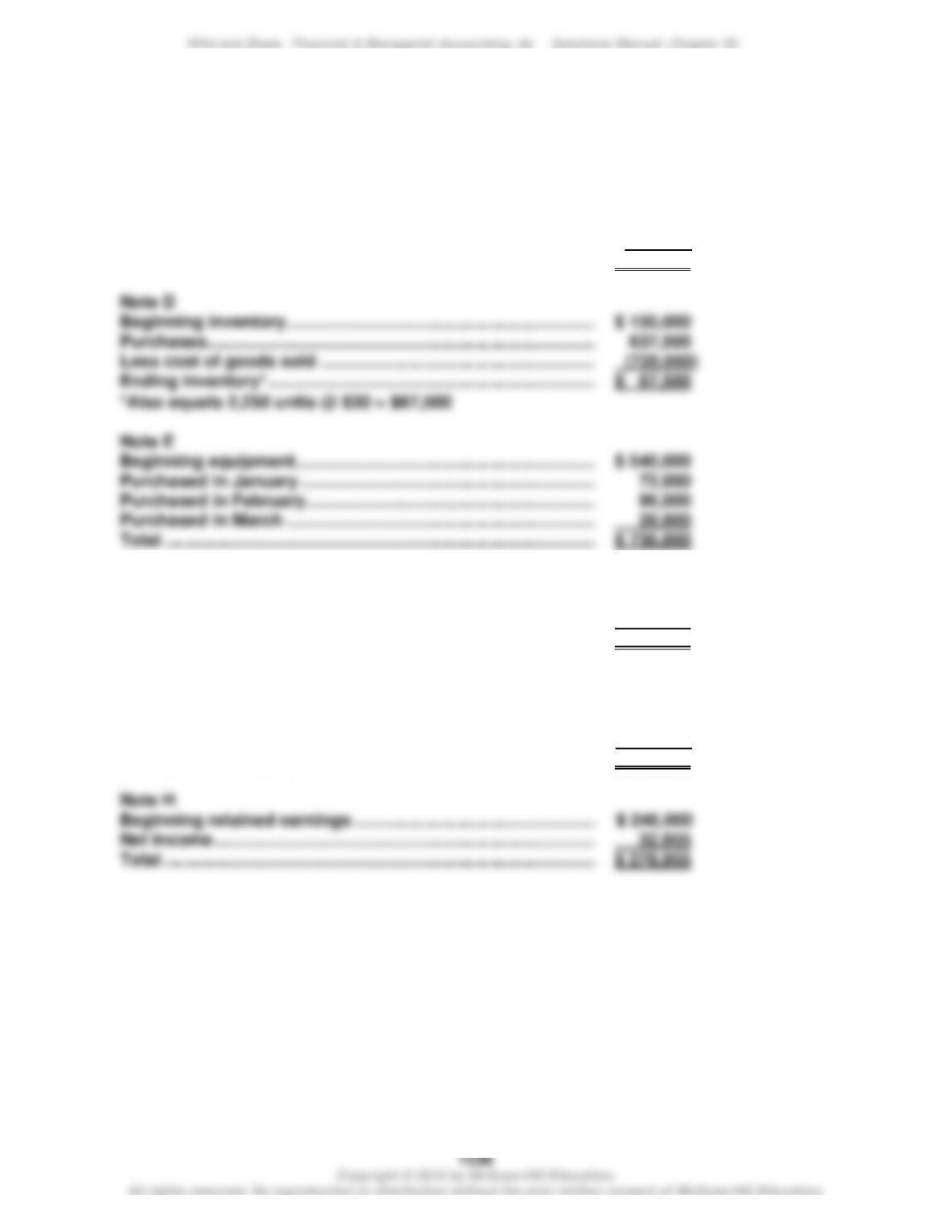
ASSETS
Cash ……………………………………………………
$ 36,000
Cash budget
Accounts receivable …………………………..
445,500
Note C
Inventory ……………………………………………..
67,500
Note D
Total current assets …………………………..
549,000
Equipment …………………………………………..
$736,800
Note E
Less accumulated depreciation ……………
88,925
647,875
Note F
Land ……………………………………………………
150,000
Capital budget
Total assets …………………………………………
$1,346,875
LIABILITIES AND EQUITY
Accounts payable ………………………………..
Note G
Bank loan payable ……………………………….
Taxes payable (due 4/15/2020) ……………..
21,970
Income stmt.
Total liabilities ……………………………………..
595,420
Common stock …………………………………….
$472,500
Unchanged
Retained earnings ………………………………..
278,955
Note H
Total stockholders’ equity ……………………
751,455
Total liabilities and equity …………………….
$1,346,875
Problem 20-8B (Concluded)
Supporting Footnotes
Note C
Beginning receivables ……………………………………………………….
$ 525,000
Credit sales ………………………………………………………………………..
810,000
Less collections ……………………………………………………….………..
(889,500)
Ending receivables ……………………………………………………………..
$ 445,500
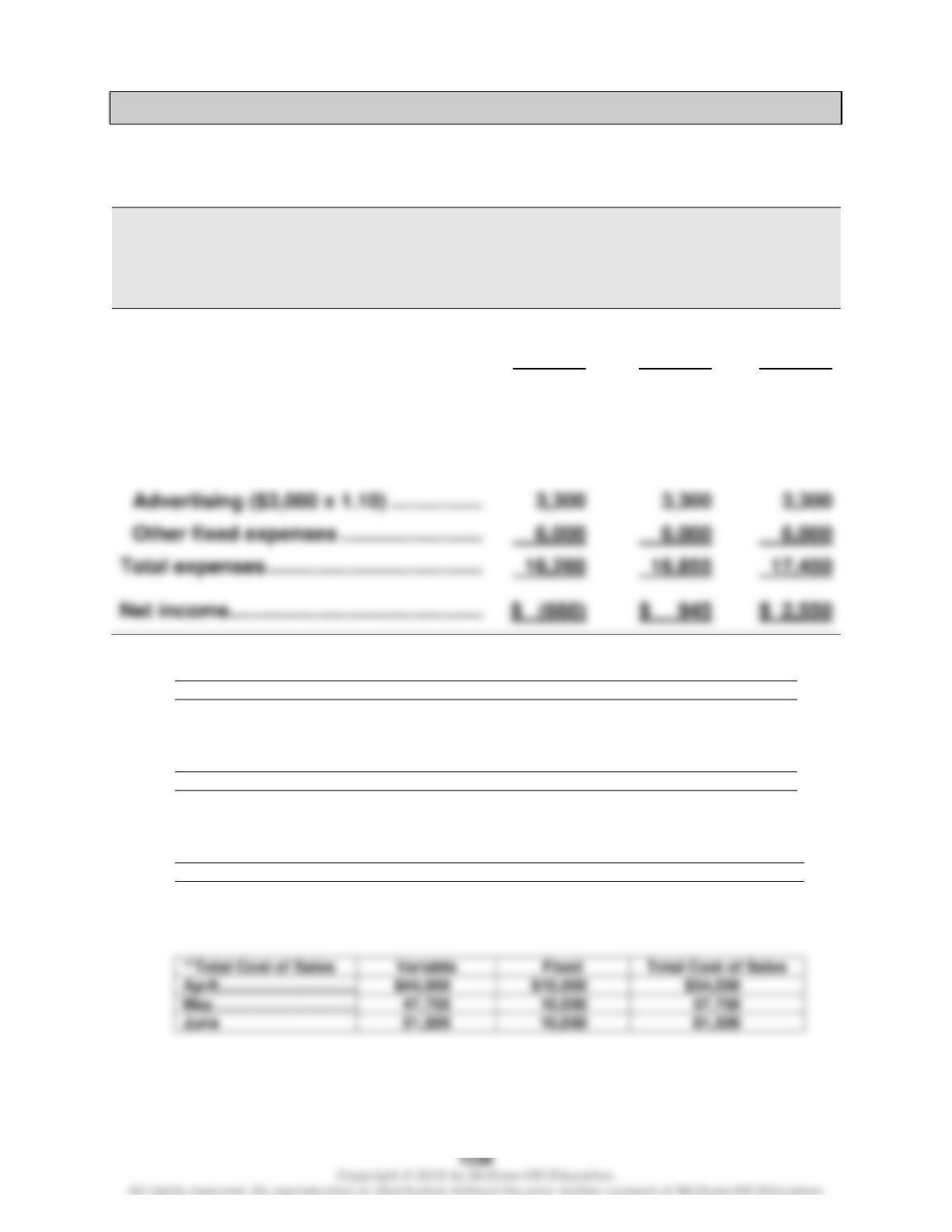
Note D
Beginning inventory ……………………………………………………….
$ 150,000
Purchases ………………………………………………………………………….
637,500
Less cost of goods sold ……………………………………………………..
(720,000)
*Also equals 2,250 units @ $30 = $67,500
Note E
Beginning equipment ……………………………………………………….
$ 540,000
Purchased in January …………………………..…………………………..
Purchased in February……………………………………………………….
Purchased in March ……………………………………………………….
28,800
Total ………………………………………………………………………………….
$ 736,800
Note F
Beginning accumulated depreciation …………………………………..
$ 67,500
Depreciation expense ……………………………………………………….
21,425
Total ………………………………………………………………………………….
$ 88,925
Note G
Beginning accounts payable ……………………………………………….
$ 360,000
Purchases ………………………………………………………………………….
637,500
Payments …………………………………………………………………………..
(501,000)
Ending accounts payable ……………………………………………………
$ 496,500
Note H
Beginning retained earnings ……………………………………………….
Net income …………………………………………………………………………
32,955
Total ………………………………………………………………………………….
Wild and Shaw, Financial & Managerial Accounting, 8e Solutions Manual: Chapter 20
Serial Problem — SP 20
Serial Problem, Business Solutions (50 minutes)
Part 1
BUSINESS SOLUTIONS—Computer Furniture Segment
Budgeted Income Statements
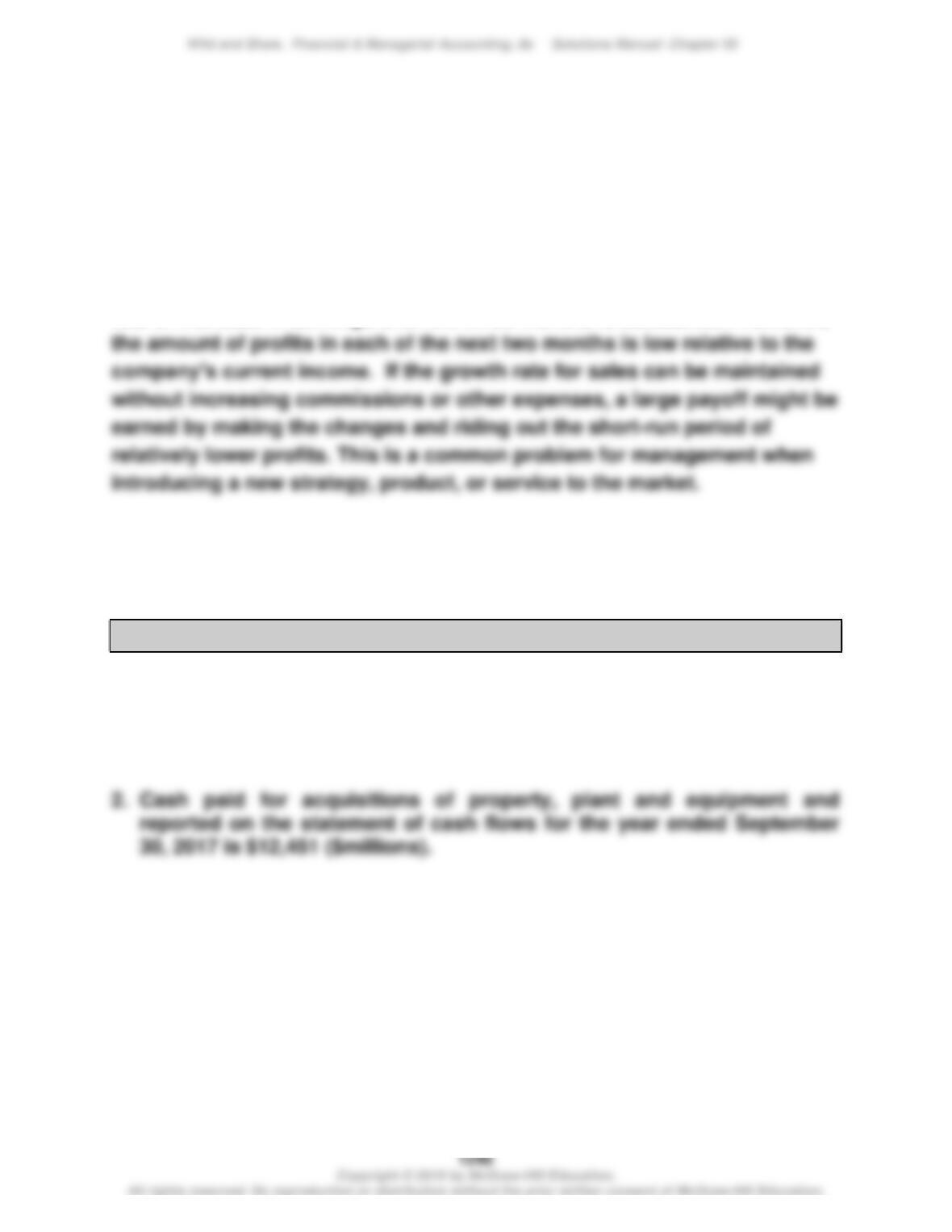
For Months of April, May, and June
April
May
June
Sales* …………………………………………………
$69,600
$75,550
$81,500
Cost of goods sold**…………………………..
54,000
57,750
61,500
Gross profit ………………………………………..
15,600
17,800
20,000
Expenses
Sales commissions (10%) ………………….
6,960
7,555
8,150
*Results from per month volume increases for the next 3 months
Desks
Units
Sales (@ $1,150)
Variable Cost of Sales (@ $750)
April …………………………..
48
$55,200
$36,000
May …………………………..
52
59,800
39,000
June …………………………..
56
64,400
42,000
Chairs
Units
Sales (@ $450)
Variable Cost of Sales (@ $250)
April …………………………..
32
$14,400
$8,000
May …………………………..
35
15,750
8,750
June …………………………..
38
17,100
9,500
Total Desk & Chairs
Sales
Variable Cost of Sales
April …………………………..
$69,600 = $55,200 + $14,400
$44,000 = $36,000 + $8,000
May …………………………..
$75,550 = $59,800 + $15,750
$47,750 = $39,000 + $8,750
June …………………………..
$81,500 = $64,400 + $17,100
$51,500 = $42,000 + $9,500
April …………………………..
$10,000
May ……………………………………………………….
June
Serial Problem, Business Solutions (Concluded)
Part 2
The plan for increasing sales volume by reducing the price and increasing
advertising would cause the company to generate a loss in the first month
of the next quarter. This result is not encouraging. However, the company
would expect profits in each of the next two months of the quarter, and the
rate of increase in earnings over the three months is substantial. However,
Company Analysis — AA 20-1
1. Apple’s statement of cash flows would report cash paid for acquisitions
of property, plant and equipment among the activities disclosed in its
cash flows from investing activities section.
Comparative Analysis — AA 20-2
1. and 2.
Apple and Google figures for fiscal years 2017 and 2016—data
available from Appendix A—are shown below ($ millions):
Apple
2017
2016
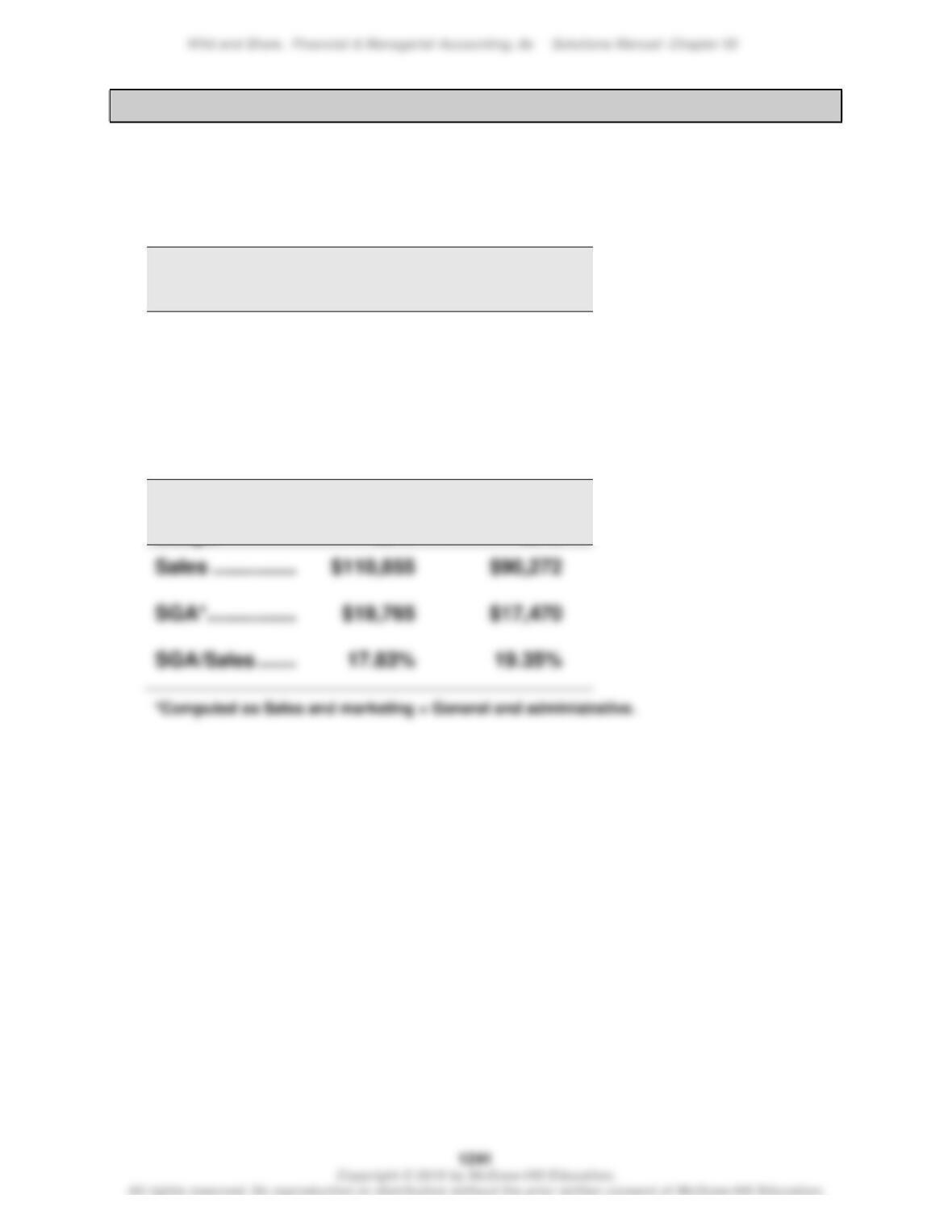
Sales ……………
$229,234
$215,639
SGA ……………..
$15,261
$14,194
SGA/Sales ……..
6.66%
6.58%
Google
2017
2016
Sales ……………
$110,855
3. Google spends more (as a percent of sales on selling, general, and
administrative expenses.
Global Analysis — AA 20-3
(Samsung financial statement amounts in millions of Korean won; Apple financial
statement amounts in millions of U.S. dollars)
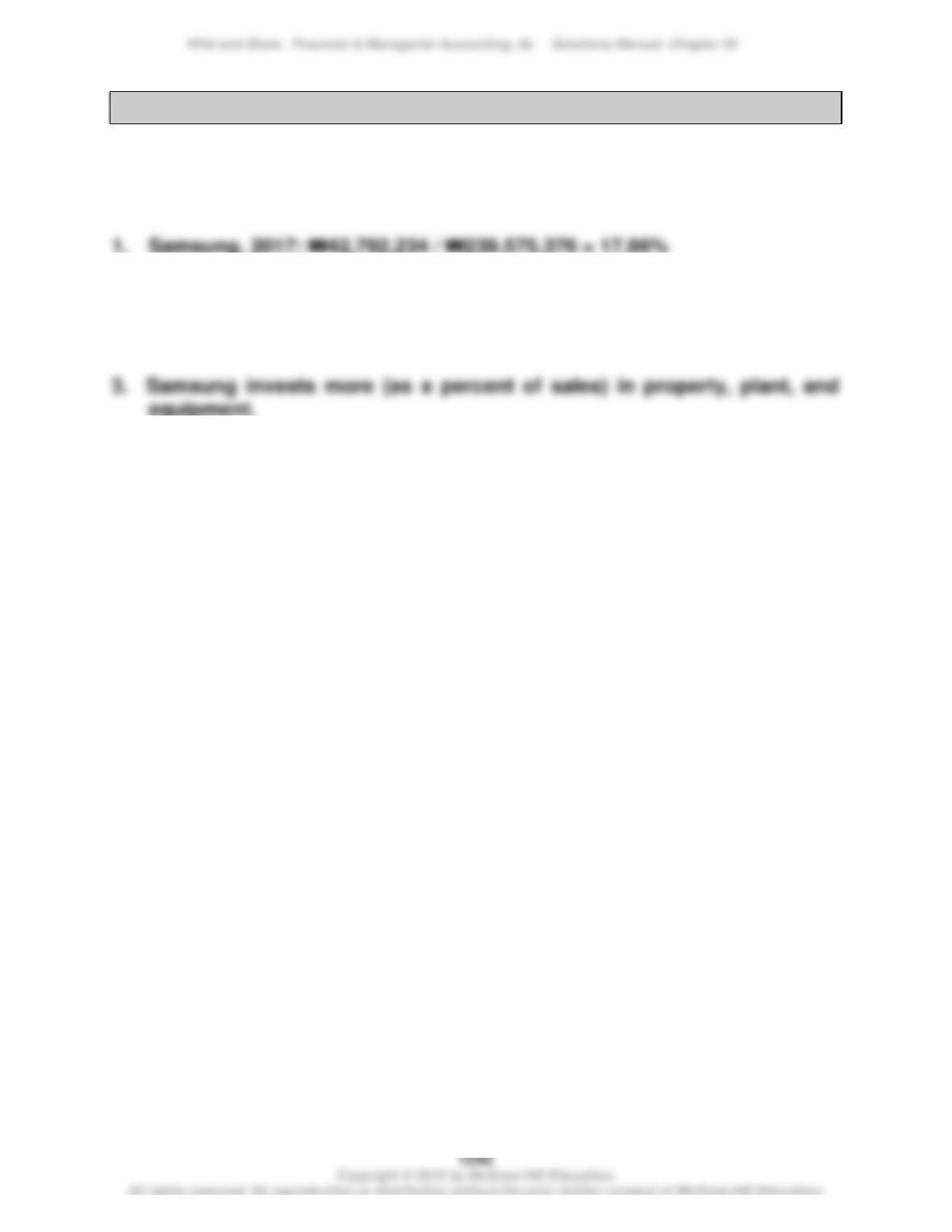
2. Apple, 2017: $12,451 / $229,234 = 5.43%
4. If Samsung budgets total sales of 240,000,000 million Korean won for
2018, and plans to invest 18% of 2018 sales in property, plant, and
equipment, it will budget 43,200,000 million Korean won.
Ethics Challenge — BTN 20-1
Report on “Use It or Lose It” Budgeting
Instructor note: There is no widely accepted solution to this problem. The key is for the student to
think about the problem and work to at least modify the negative behavioral consequences of this
practice.
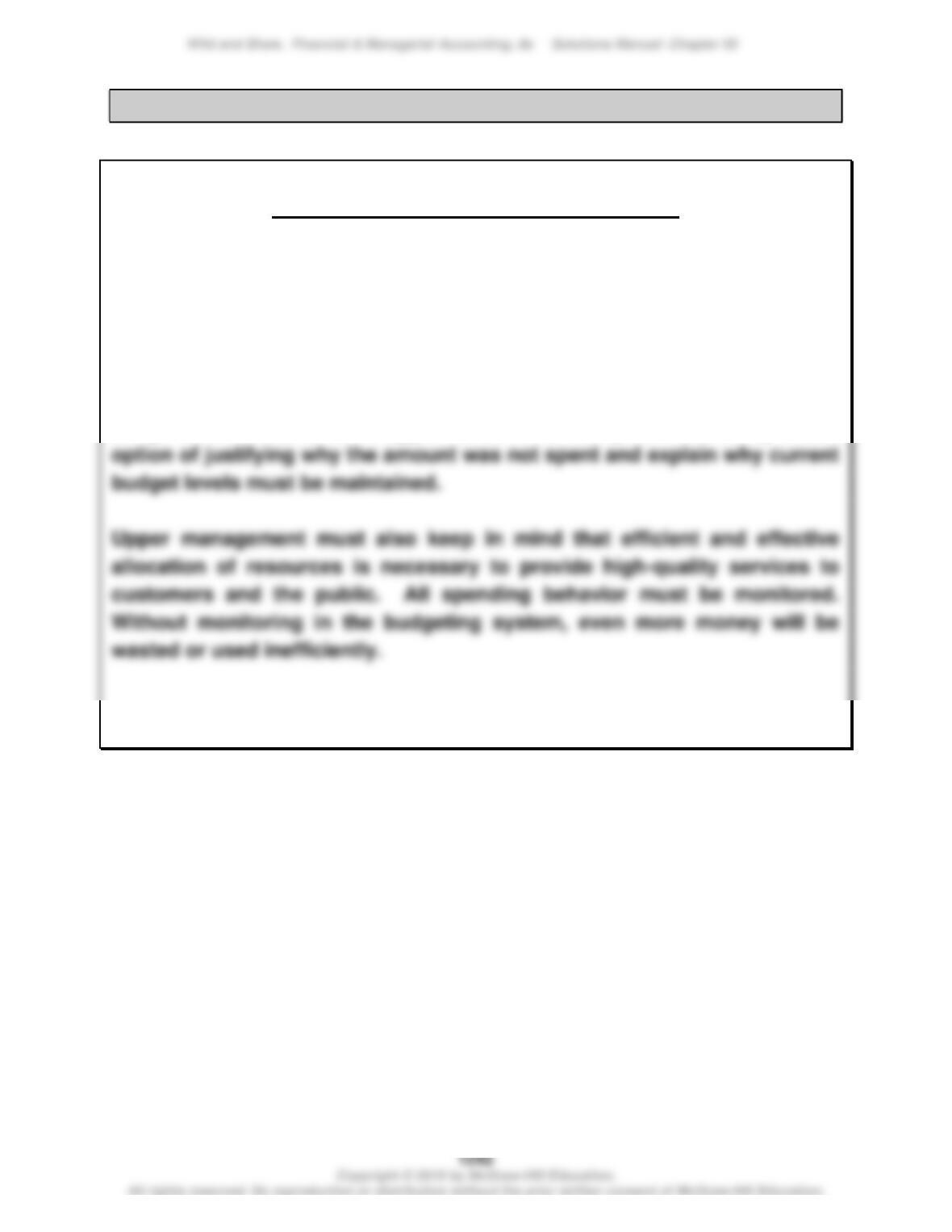
Any plan offered as a solution must better align upper management’s
expectations with department managers’ behavior. For example, upper
management might only cut by one-half the amount not spent according to
budget. Another potential suggestion is to allow department managers the
Communicating in Practice — BTN 20-2
MEMORANDUM
TO: ____________________
FROM: ____________________
DATE: ____________________
SUBJECT: ____________________
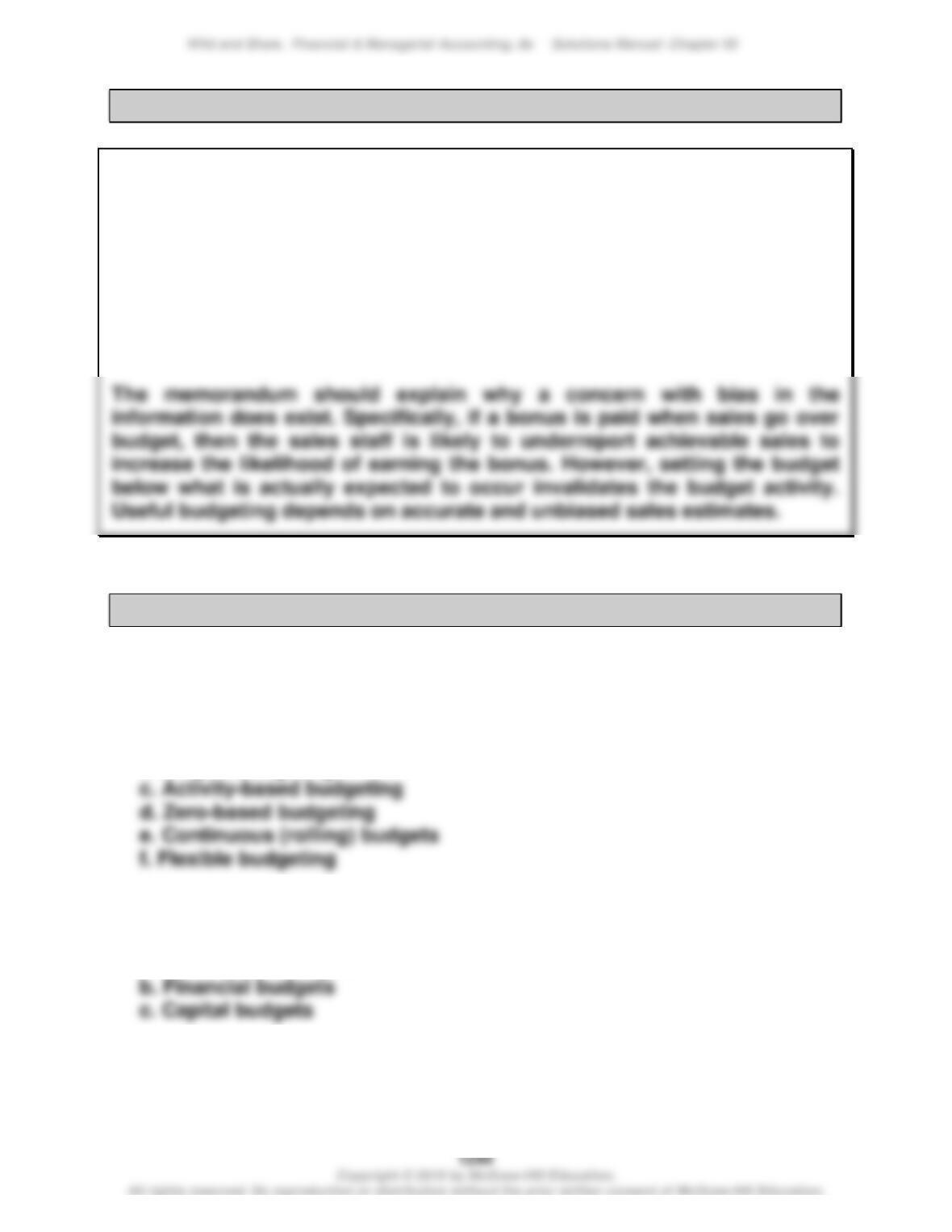
The content of this memorandum will vary among students. The student
must emphasize the need to know the compensation structure of the sales
staff to understand any potential bias in the information provided to the
budget process.
Taking It to the Net — BTN 20-3
1. The budgeting methodologies listed as being covered on the CMA exam
include:
a. Annual business plans (master budgets)
b. Project budgeting
2. The types of budgets (“annual profit plans”) listed as being covered on
the CMA exam include:
a. Operational budgets
Teamwork in Action — BTN 20–4
There is no specific solution to this assignment. The instructor should
watch for proper development and identification of all reasonable costs.
Entrepreneurial Decision — BTN 20-5
1. Budgeting allows an organization to plan its activities better by
allocating financial resources to the different activities. A budget
provides a plan for Anna and Phil to assess how well the company is
doing, and whether changes are necessary.
Hitting the Road — BTN 20-6
Instructor note: This problem is designed to (1) show that external factors are important
in determining price and volume and (2) develop awareness of external factors when
preparing a sales budget.
1. & 2.
The types of external factors identified by the student for consideration in
part (1), or selected as an explanatory factor for part (2), might include the
following:
• Location, such as near a convenient or busy traffic area.
• Competitors’ responses to price and quality.
• Climatic conditions.