20-1
CHAPTER 20
INVENTORY MANAGEMENT, JUST-IN-TIME,
AND SIMPLIFIED COSTING METHODS
20-1 Cost of goods sold (in retail organizations) or direct materials costs (in organizations with
a manufacturing function) as a percentage of sales frequently exceeds net income as a percentage
of sales by many orders of magnitude. In the Kroger grocery store example cited in the text, cost
20-2 Six cost categories important in managing goods for sale in a retail organization are the
following:
1. purchasing costs
2. ordering costs
3. carrying costs
20-3 Five assumptions made when using the simplest version of the EOQ model are the
following:
1. The same quantity is ordered at each reorder point.
2. Demand, ordering costs, carrying costs, and the purchase-order lead time are certain.
20-4 Costs included in the carrying costs of inventory are incremental costs for such items as
insurance, rent, and obsolescence plus the opportunity cost of capital (or required return on
investment).
20-5 Examples of opportunity costs relevant to the EOQ decision model but typically not
recorded in accounting systems are the following:
1. the return forgone by investing capital in inventory
2. lost contribution margin on existing sales when a stockout occurs;
3. lost contribution margin on potential future sales that will not be made to disgruntled
customers
20-2
Step 3: Compute the difference between the monetary outcomes from Steps 1 and 2.
20-7 Goal congruence issues arise when there is an inconsistency between the EOQ decision
model and the model used for evaluating the performance of the person implementing the model.
For example, if opportunity costs are ignored in performance evaluation, the manager may be
induced to purchase in a quantity larger than the EOQ model indicates is optimal.
production (or sales).
20-9 Factors causing reductions in the cost to place purchase orders of materials are the
following:
• Companies are establishing long-run purchasing agreements that define price and
quality terms over an extended period.
• Companies are using electronic links, such as the Internet, to place purchase orders.
• Companies are increasing the use of purchase-order cards.
20-11 Supply-chain analysis describes the flow of goods, services, and information from the
initial sources of materials and services to the delivery of products to consumers, regardless of
whether those activities occur in the same company or in other companies. Sharing of
information across companies benefits manufacturers and retailers because it enables a reduction
in inventory levels at all stages of the supply chain, fewer stockouts at the retail level, reduced
manufacture of product not subsequently demanded by retailers, and a reduction in expedited
manufacturing orders.
20-12 Just-in–time (JIT) production is a “demand–pull” manufacturing system that manufactures
each component in a production line as soon as, and only when, needed by the next step in the
production line. It has the following features:
• Organize production in manufacturing cells.
20-3
• Carefully select suppliers who are capable of delivering quality materials in a timely
manner.
The benefits of JIT production include lower costs and higher margins from better flow of
information, higher quality, and faster delivery, as well as simpler accounting systems. The cost
of JIT production is the risk of stockouts—a production problem in any step of the
manufacturing process will result in materials (goods) not being produced in time.
20-13 Traditional normal and standard costing systems use sequential tracking, in which journal
entries are recorded in the same order as actual purchases and progress in production, typically at
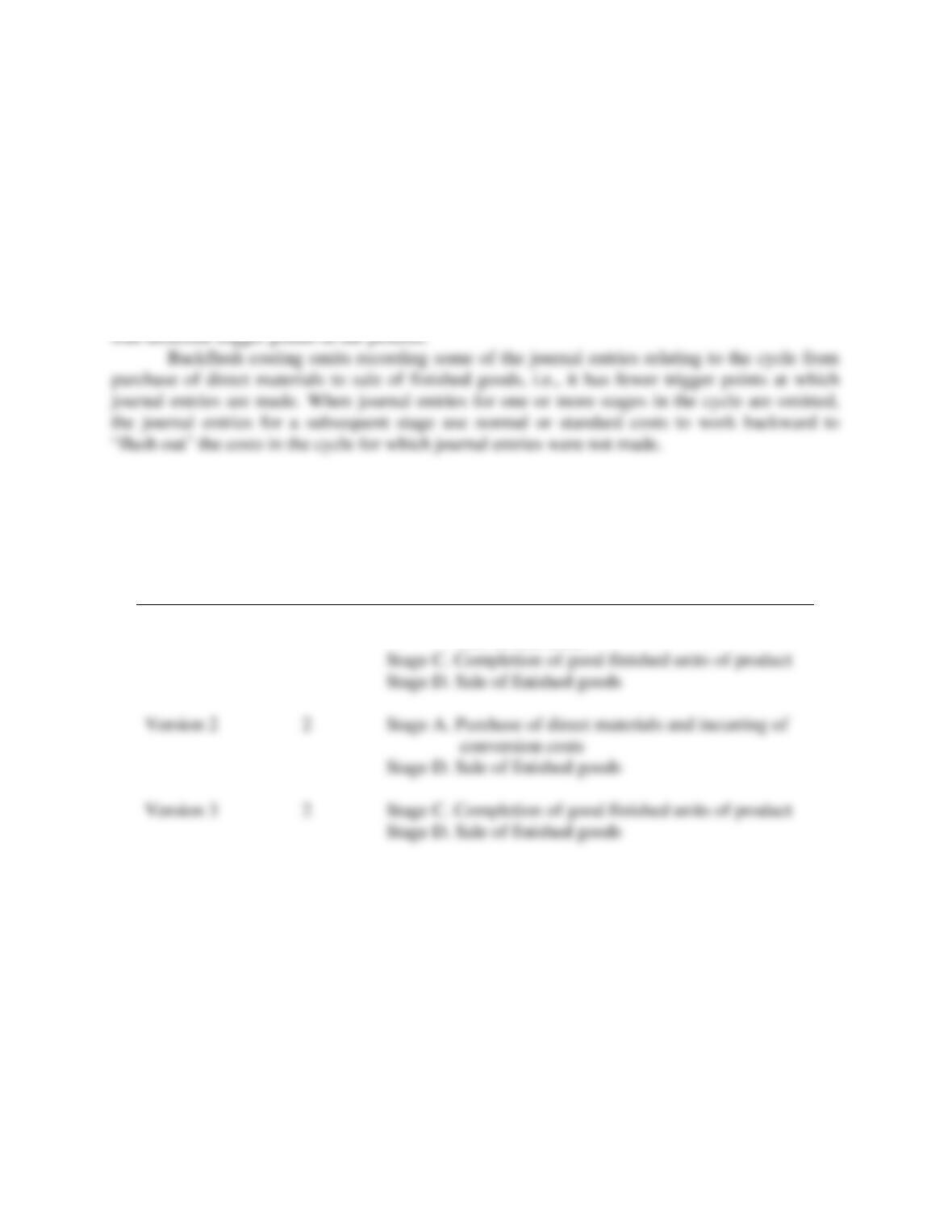
20-14 Versions of backflush costing differ in the number and placement of trigger points at
which journal entries are made in the accounting system:
Number of
Journal Entry
Trigger Points
Location in Cycle Where
Journal Entries Made
Version 1
3
Stage A. Purchase of direct materials and incurring of
conversion costs
Version 2
2
Stage A. Purchase of direct materials and incurring of
conversion costs
20-15 Traditional accounting systems cost individual products and separate product costs from
selling, general, and administrative costs. Lean accounting costs the entire value stream instead
of individual products. Rework costs, unused capacity costs, and common costs that cannot be
reasonably assigned to value streams are excluded from value stream costs. In addition, many
lean accounting systems expense material costs in the period they are purchased, rather than
storing them on the balance sheet until the products using the material are sold.
20-4
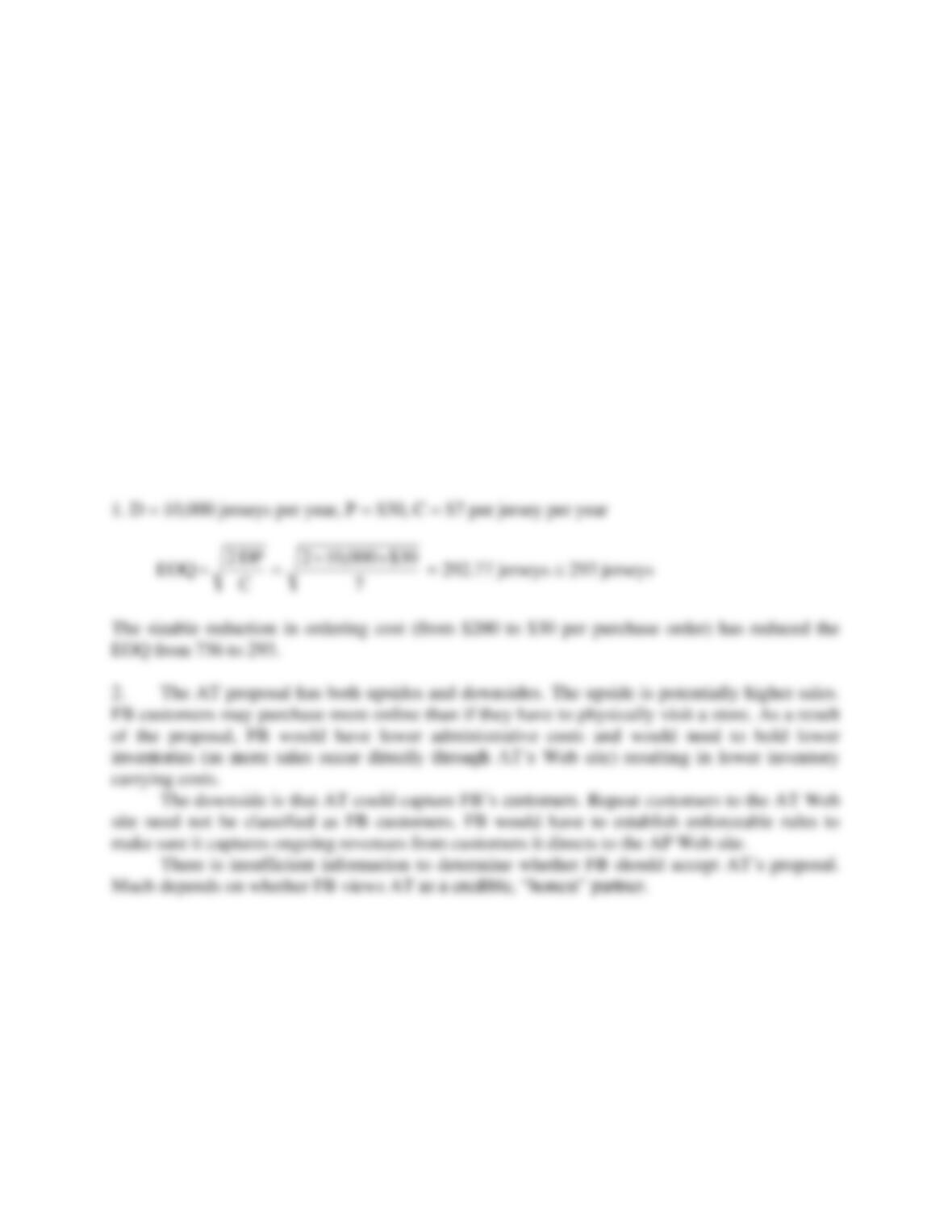
20-16 (20 min.) Economic order quantity for retailer.
Fan Base (FB) operates a megastore featuring sports merchandise. It uses an EOQ decision
model to make inventory decisions. It is now considering inventory decisions for its Los Angeles
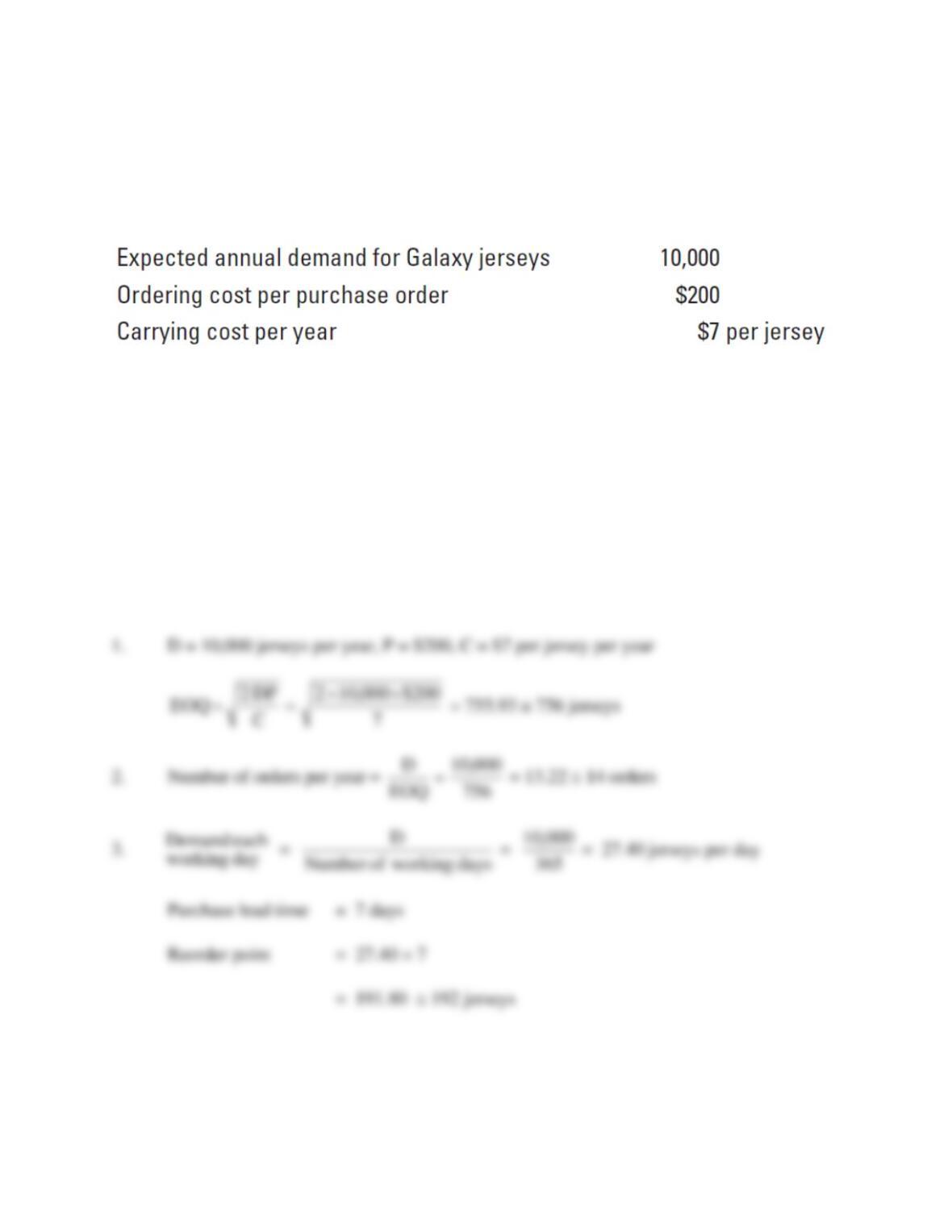
Galaxy soccer jerseys product line. This is a highly popular item. Data for 2013 are as follows:
Each jersey costs FB $40 and sells for $80. The $7 carrying cost per jersey per year consists of
the required return on investment of $4.80 (12% × $40 purchase price) plus $2.20 in relevant
insurance, handling, and storage costs. The purchasing lead time is 7 days. FB is open 365 days a
year.
Required:
1. Calculate the EOQ.
2. Calculate the number of orders that will be placed each year.
3. Calculate the reorder point.
SOLUTION
20-5
20-17 (20 min.) Economic order quantity, effect of parameter changes (continuation of 20-16).
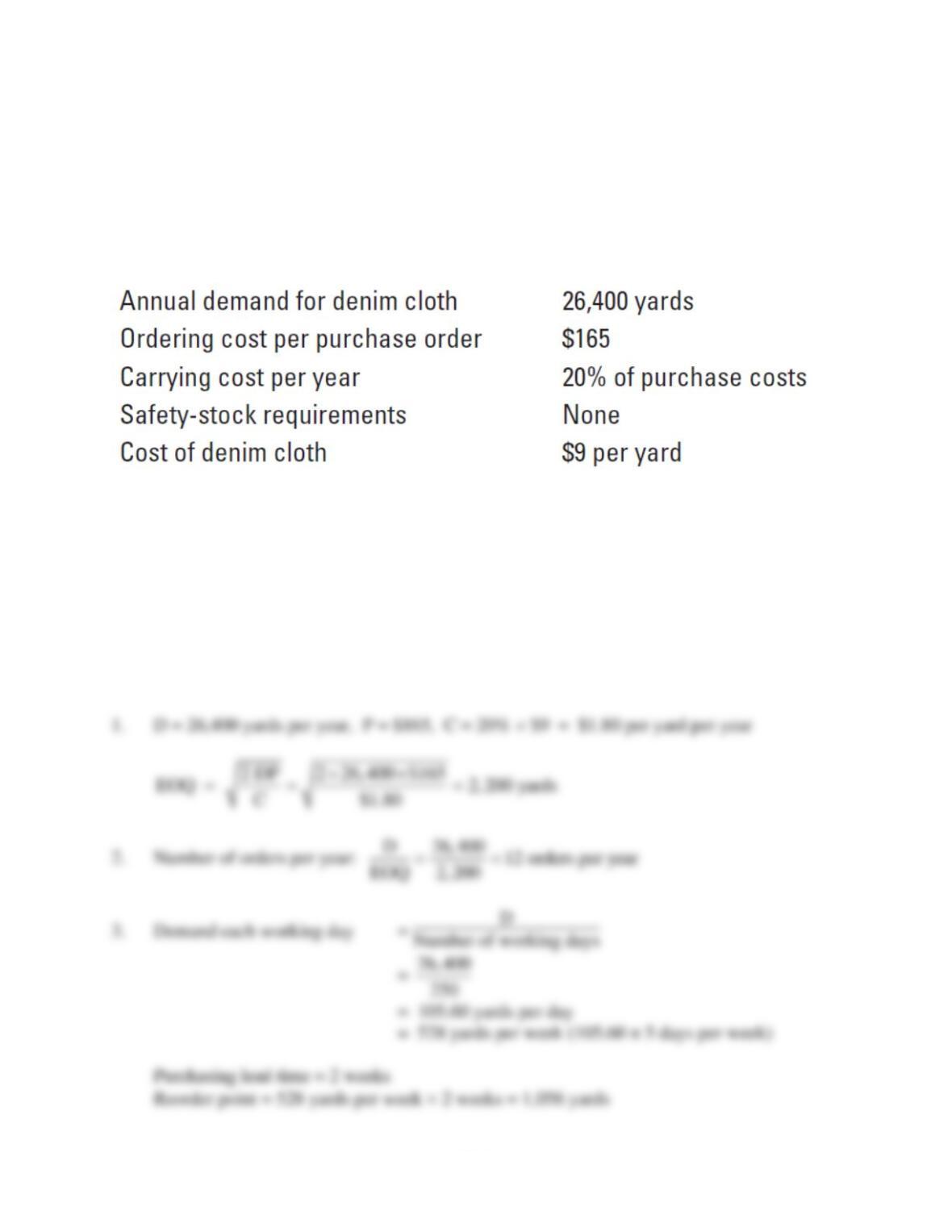
Athletic Textiles (AT) manufactures the Galaxy jerseys that Fan Base (FB) sells to its customers.
AT has recently installed computer software that enables its customers to conduct “one–stop”
purchasing using state-of-the-art Web site technology. FB’s ordering cost per purchase order will
be $30 using this new technology.
Required:
1. Calculate the EOQ for the Galaxy jerseys using the revised ordering cost of $30 per purchase
order. Assume all other data from Exercise 20-16 are the same. Comment on the result.
2. Suppose AT proposes to “assist” FB. AT will allow FB customers to order directly from the
AT Web site. AT would ship directly to these customers. AT would pay $10 to FB for every
Galaxy jersey purchased by one of FB’s customers. Comment qualitatively on how this offer
would affect inventory management at FB. What factors should FB consider in deciding
whether to accept AT’s proposal?
SOLUTION
20-6
20-18 (15 min.) EOQ for a retailer.
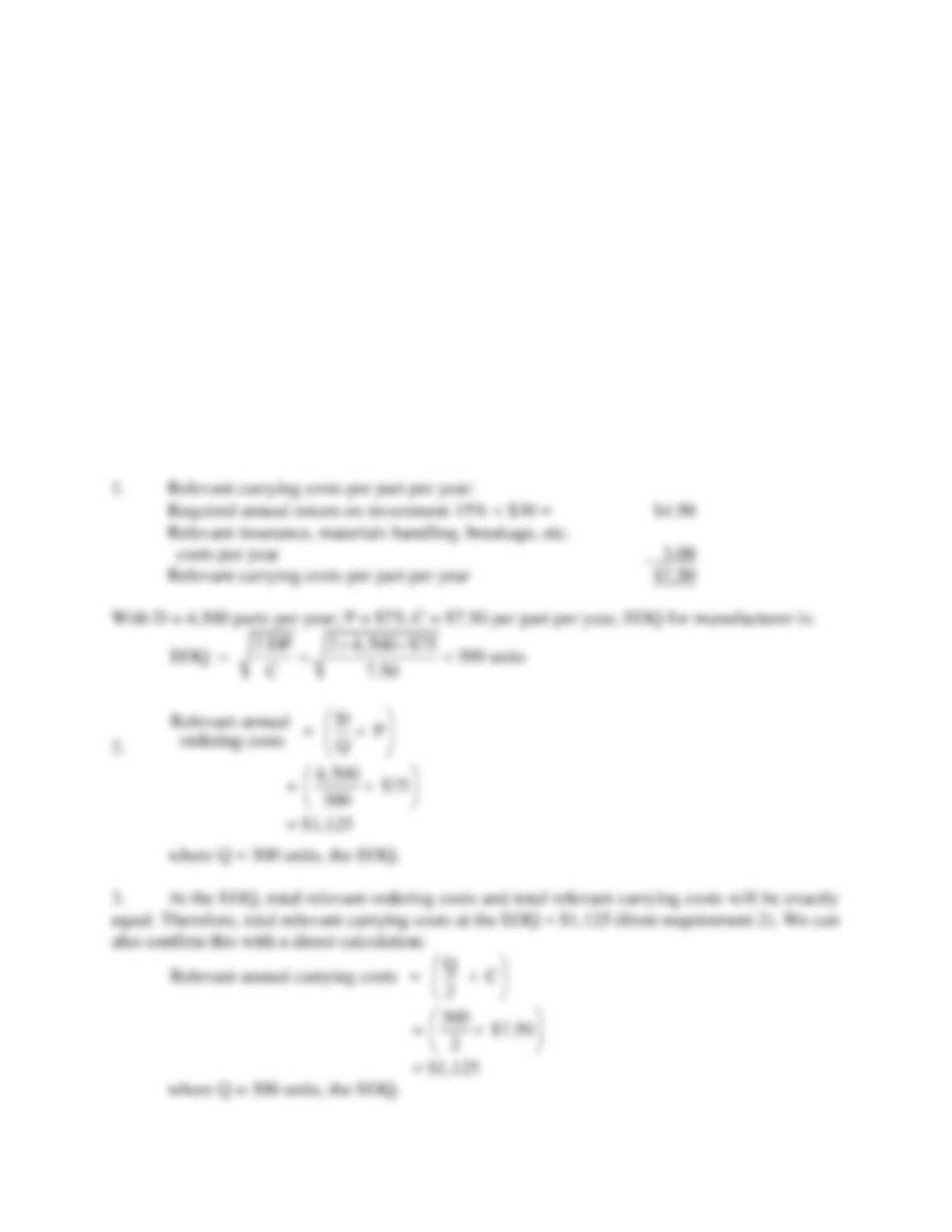
The Denim World sells fabrics to a wide range of industrial and consumer users. One of the
products it carries is denim cloth, used in the manufacture of jeans and carrying bags. The
supplier for the denim cloth pays all incoming freight. No incoming inspection of the denim is
necessary because the supplier has a track record of delivering high-quality merchandise. The
purchasing officer of the Denim World has collected the following information:
The purchasing lead time is 2 weeks. The Denim World is open 250 days a year (50 weeks for 5
days a week).
Required:
1. Calculate the EOQ for denim cloth.
2. Calculate the number of orders that will be placed each year.
3. Calculate the reorder point for denim cloth.
SOLUTION
20-7
20-19 (20 min.) EOQ for manufacturer.
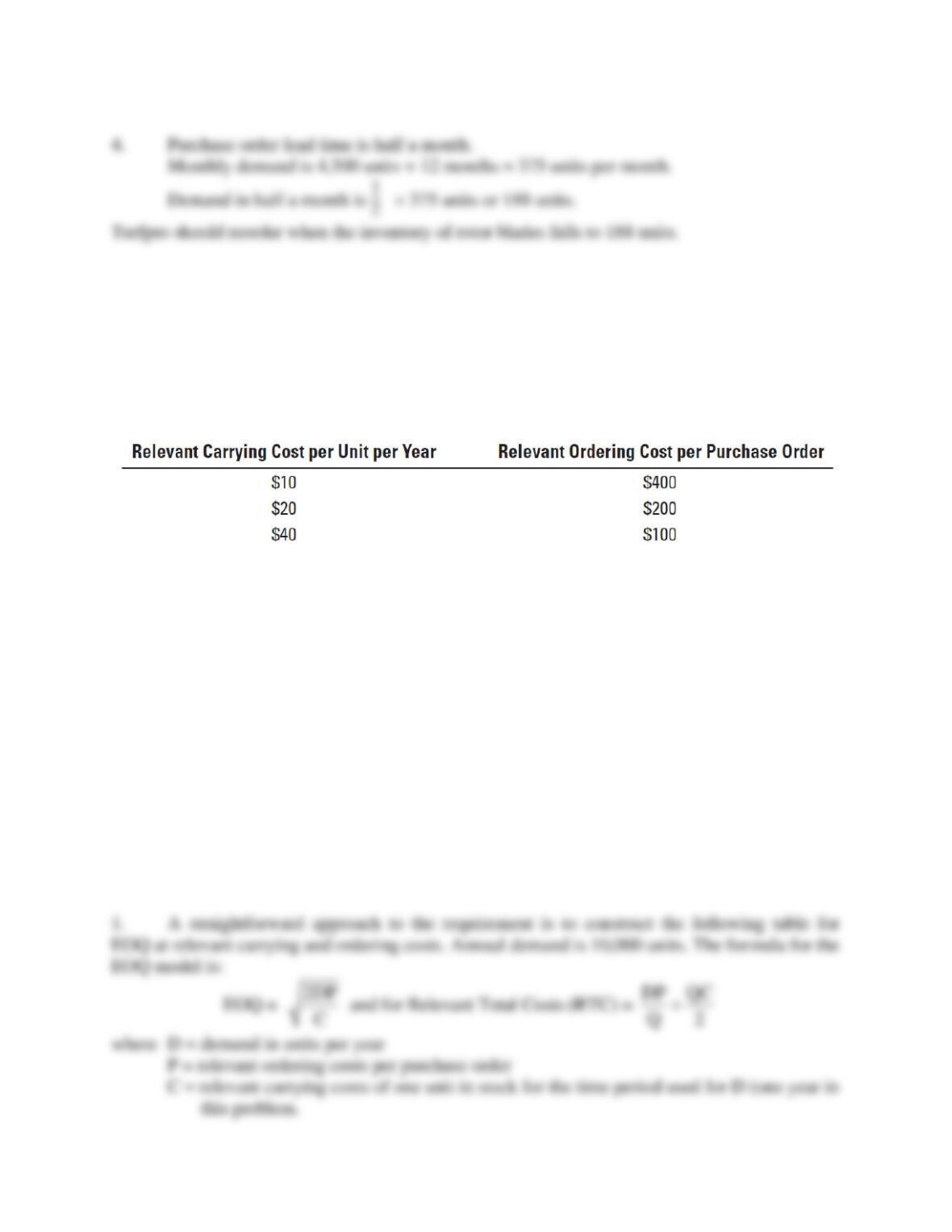
Turfpro Company produces lawn mowers and purchases 4,500 units of a rotor blade part each
year at a cost of $30 per unit. Turfpro requires a 15% annual rate of return on investment. In
addition, the relevant carrying cost (for insurance, materials handling, breakage, etc.) is $3 per
unit per year. The relevant ordering cost per purchase order is $75.
Required:
1. Calculate Turfpro’s EOQ for the rotor blade part.
2. Calculate Turfpro’s annual relevant ordering costs for the EOQ calculated in requirement 1.
3. Calculate Turfpro’s annual relevant carrying costs for the EOQ calculated in requirement 1.
4. Assume that demand is uniform throughout the year and known with certainty so there is no
need for safety stocks. The purchase-order lead time is half a month. Calculate Turfpro’s
reorder point for the rotor blade part.
SOLUTION
20-8
20-20 (20 min.) Sensitivity of EOQ to changes in relevant ordering and carrying costs.
Alpha Company’s annual demand for its only product, XT-590, is 10,000 units. Alpha is
currently analyzing possible combinations of relevant carrying cost per unit per year and relevant
ordering cost per purchase order, depending on the company’s choice of supplier and average
levels of inventory. This table presents three possible combinations of carrying and ordering
costs.
Required:
1. For each of the relevant ordering and carrying-cost alternatives, determine (a) EOQ and (b)
annual relevant total costs.
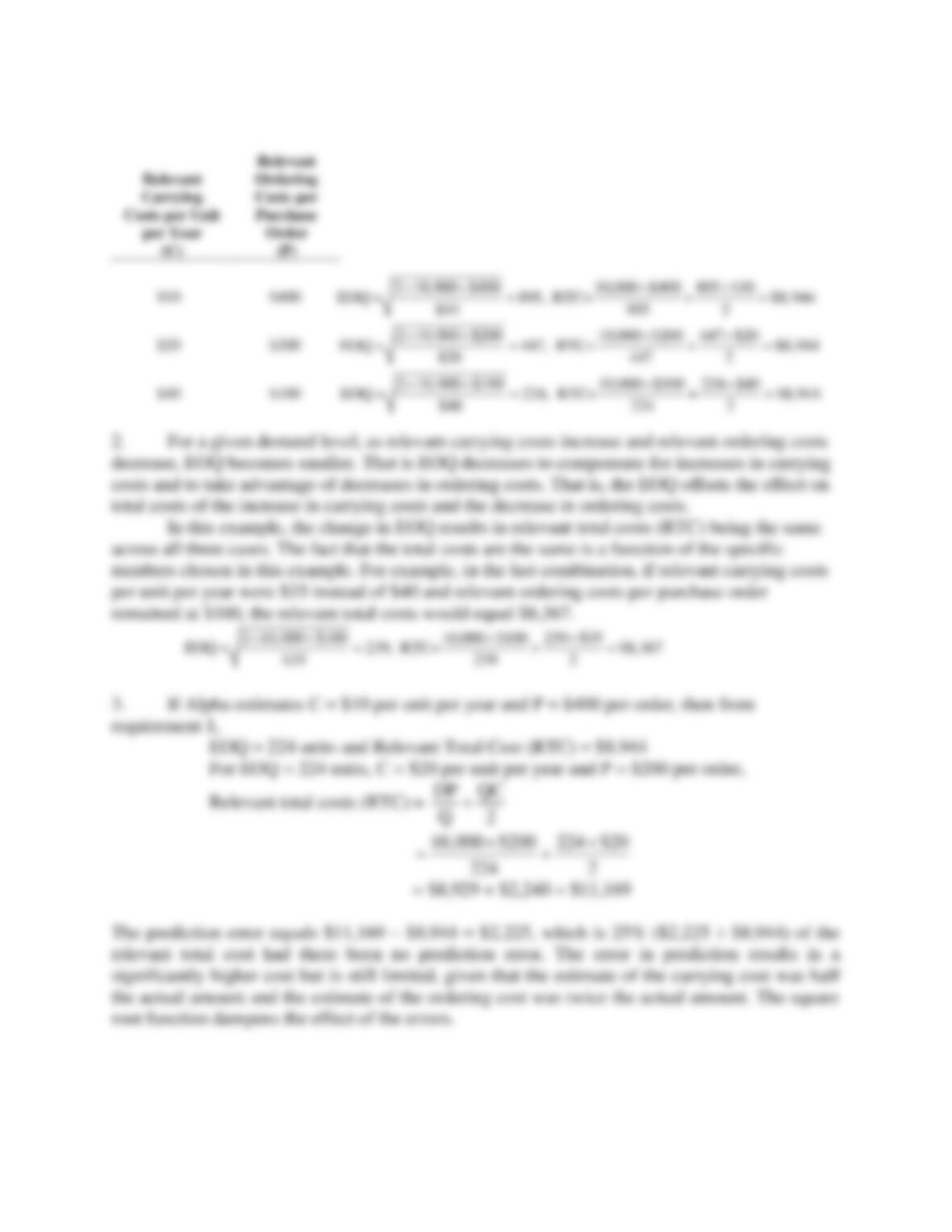
2. How does your answer to requirement 1 give insight into the impact of changes in relevant
ordering and carrying costs on EOQ and annual relevant total costs? Explain briefly.
3. Suppose the relevant carrying cost per unit per year was $20 and the relevant ordering cost
per purchase order was $200. Suppose further that Alpha calculates EOQ after incorrectly
estimating relevant carrying cost per unit per year to be $10 and relevant ordering cost per
purchase order to be $400. Calculate the actual annual relevant total costs of Alpha’s EOQ
decision. Compare this cost to the annual relevant total costs that Alpha would have incurred
if it had correctly estimated the relevant carrying cost per unit per year of $20 and the
relevant ordering cost per purchase order of $200 that you have already calculated in
requirement 1. Calculate and comment on the cost of the prediction error.
SOLUTION
20-9
20-21 (20 min.) JIT production, relevant benefits, relevant costs.
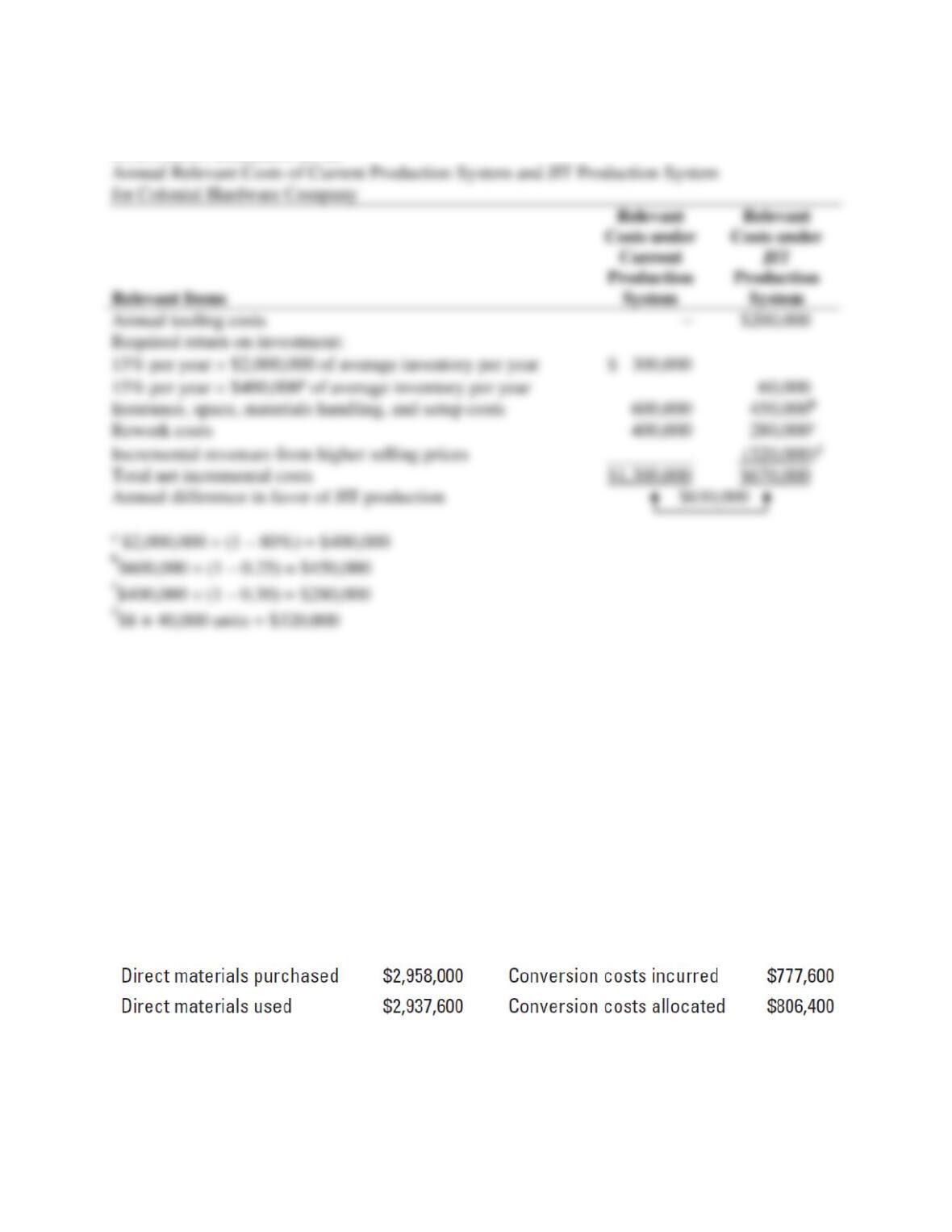
The Colonial Hardware Company manufactures specialty brass door handles at its Lynchburg
plant. Colonial is considering implementing a JIT production system. The following are the
estimated costs and benefits of JIT production:
a. Annual additional tooling costs would be $200,000.
b. Average inventory would decline by 80% from the current level of $2,000,000.
c. Insurance, space, materials-handling, and setup costs, which currently total $600,000
annually, would de- cline by 25%.
d. The emphasis on quality inherent in JIT production would reduce rework costs by 30%.
Colonial currently incurs $400,000 in annual rework costs.
e. Improved product quality under JIT production would enable Colonial to raise the price of its
product by $8 per unit. Colonial sells 40,000 units each year.
Colonial’s required rate of return on inventory investment is 15% per year.
Required:
1. Calculate the net benefit or cost to Colonial if it adopts JIT production at the Lynchburg
plant.
2. What nonfinancial and qualitative factors should Colonial consider when making the
decision to adopt JIT production?
3. Suppose Colonial implements JIT production at its Lynchburg plant. Give examples of
performance measures Colonial could use to evaluate and control JIT production. What
would be the benefit of Colonial implementing an enterprise resource planning (ERP)
system?
SOLUTION
20-11
20-12
SOLUTION EXHIBIT 20-21
20-22 (30 min.) Backflush costing and JIT production.
Grand Devices Corporation assembles handheld computers that have scaled-down capabilities of
laptop computers. Each handheld computer takes 6 hours to assemble. Grand Devices uses a JIT
production system and a backflush costing system with three trigger points:
▪ Purchase of direct materials and incurring of conversion costs
▪ Completion of good finished units of product
▪ Sale of finished goods
There are no beginning inventories of materials or finished goods and no beginning or ending
work-in– process inventories. The following data are for August 2013:
Grand Devices records direct materials purchased and conversion costs incurred at actual costs.
It has no direct materials variances. When finished goods are sold, the backflush costing system
“pulls through” standard direct material cost ($102 per unit) and standard conversion cost ($28
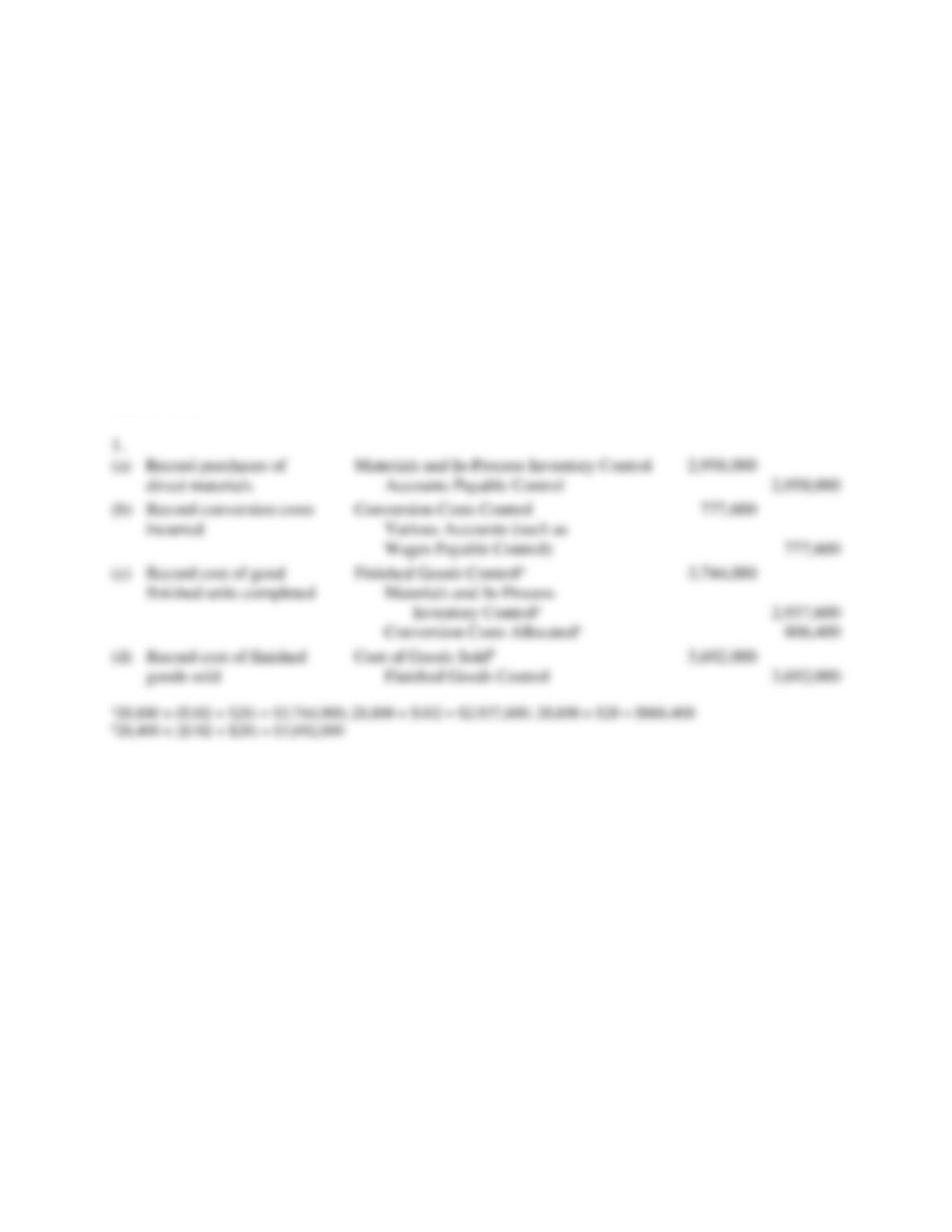
20-13
per unit). Grand Devices produced 28,800 finished units in August 2013 and sold 28,400 units.
The actual direct material cost per unit in August 2013 was $102, and the actual conversion cost
per unit was $27.
Required:
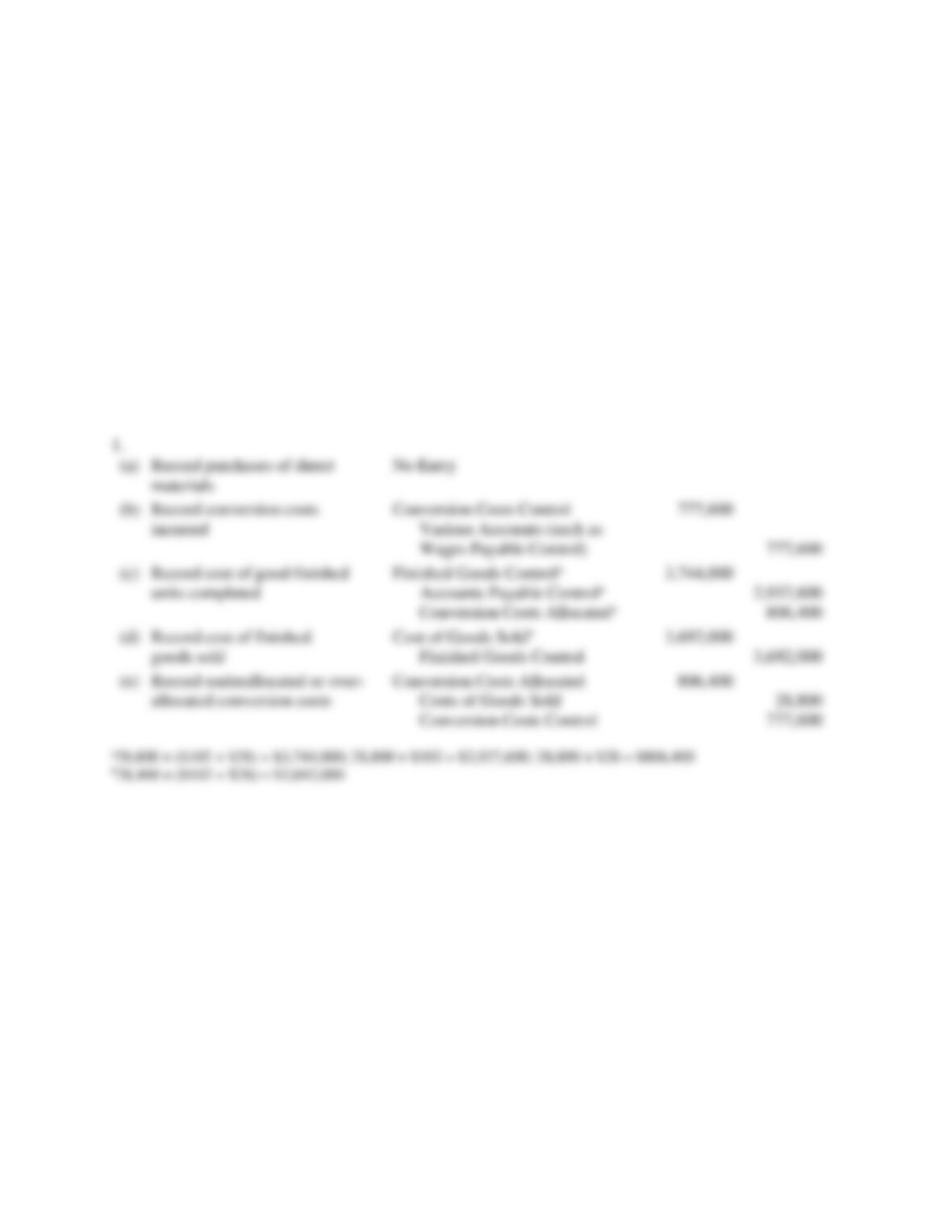
1. Prepare summary journal entries for August 2013 (without disposing of under- or
overallocated conversion costs).
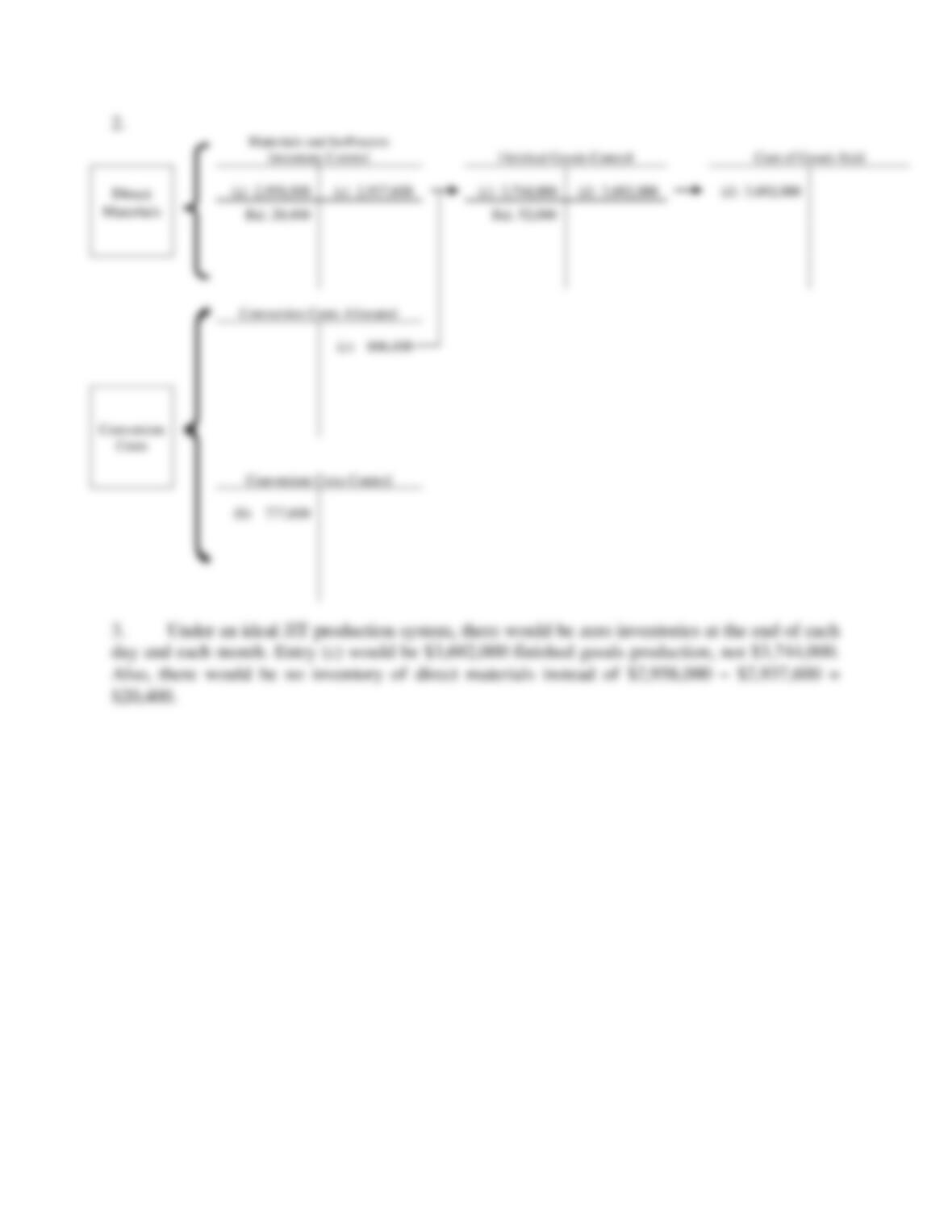
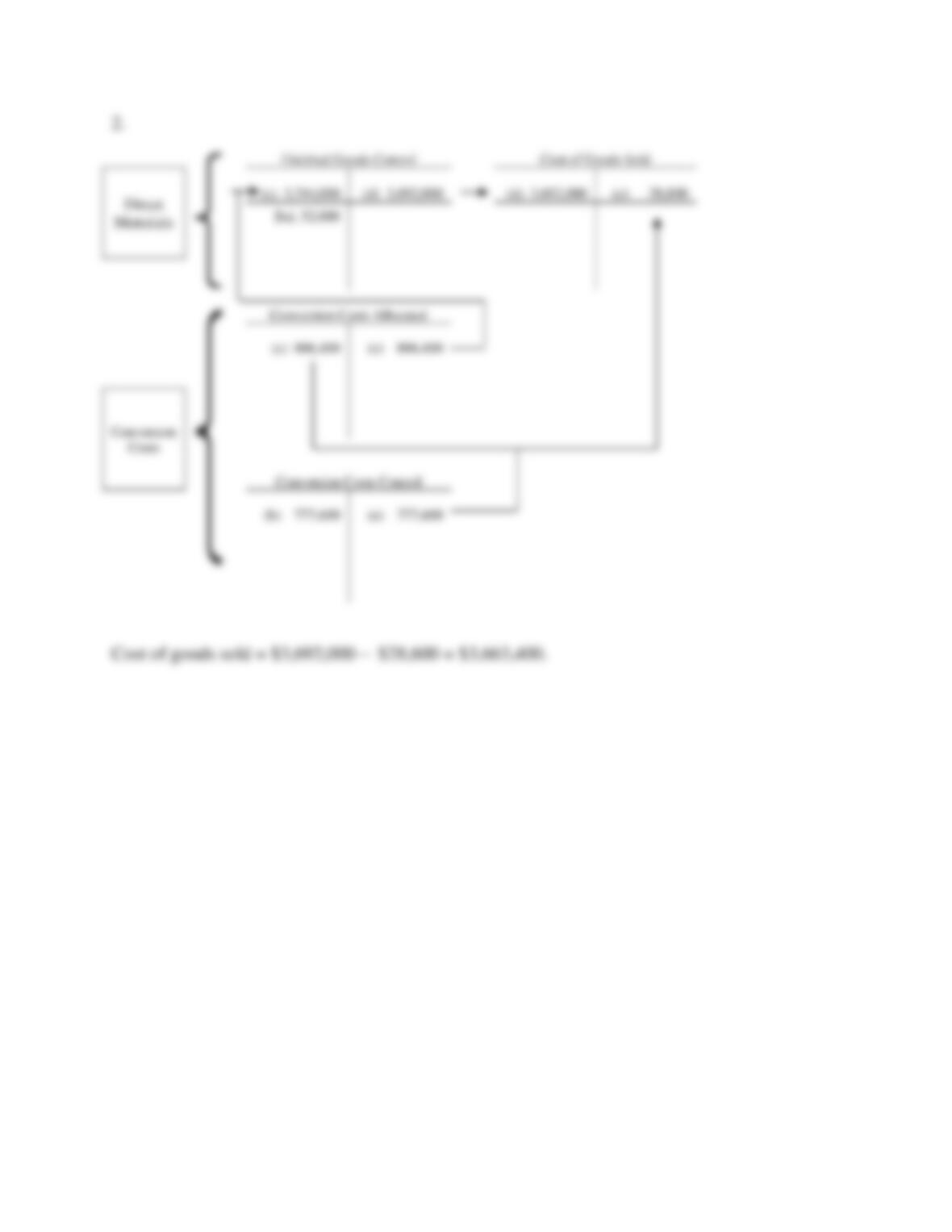
2. Post the entries in requirement 1 to T-accounts for applicable Materials and In-Process
Inventory Control, Finished Goods Control, Conversion Costs Control, Conversion Costs
Allocated, and Cost of Goods Sold.
3. Under an ideal JIT production system, how would the amounts in your journal entries differ
from those in requirement 1?
SOLUTION
20-14
20-15
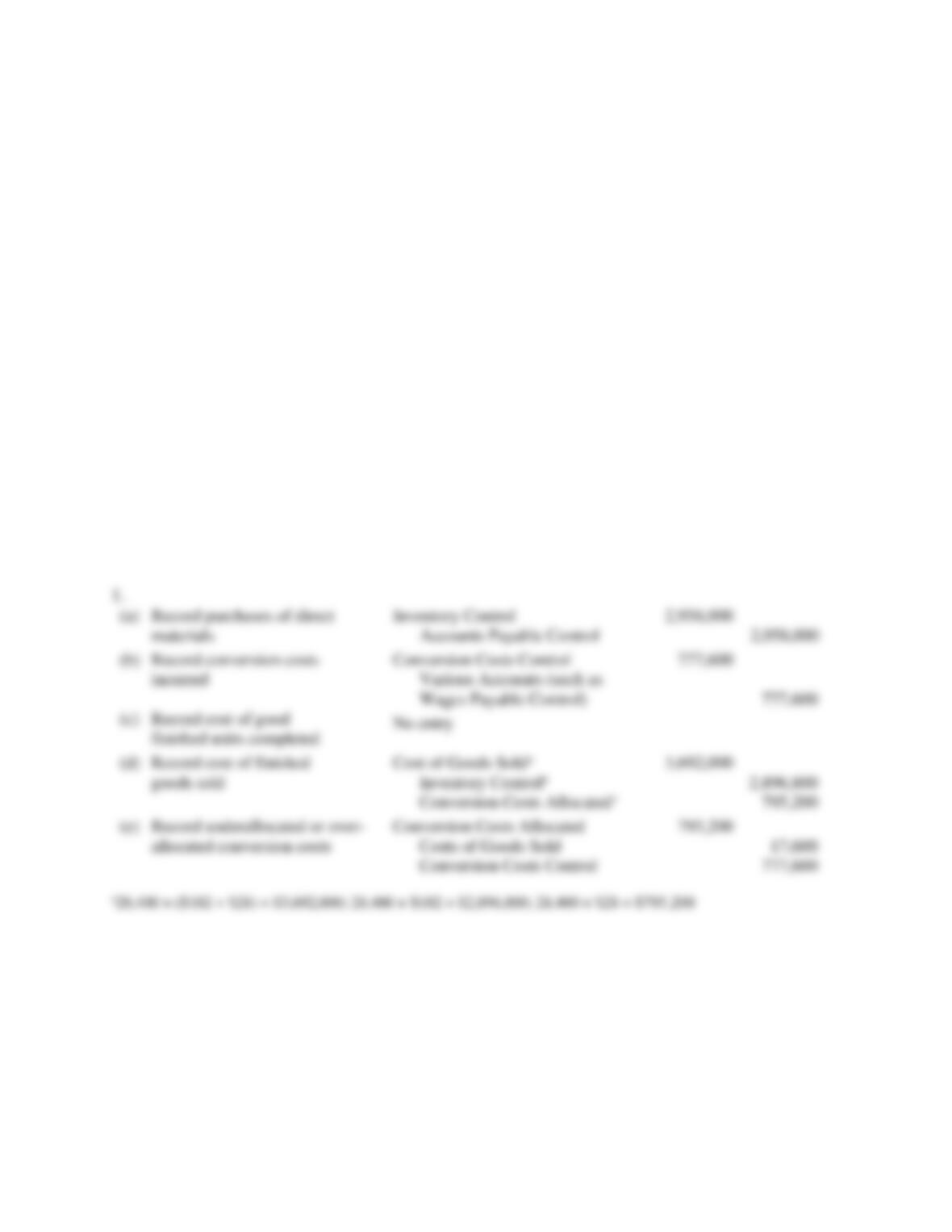
20-23 (20 min.) Backflush costing, two trigger points, materials purchase and sale
(continuation of 20-22).
Assume the same facts as in Exercise 20-22, except that Grand Devices now uses a backflush
costing system with the following two trigger points:
▪ Purchase of direct materials and incurring of conversion costs
▪ Sale of finished goods
The Inventory Control account will include direct materials purchased but not yet in production,
materials in work in process, and materials in finished goods but not sold. No conversion costs
are inventoried. Any under- or overallocated conversion costs are written off monthly to Cost of
Goods Sold.
Required:
1. Prepare summary journal entries for August, including the disposition of under- or
overallocated conversion costs.
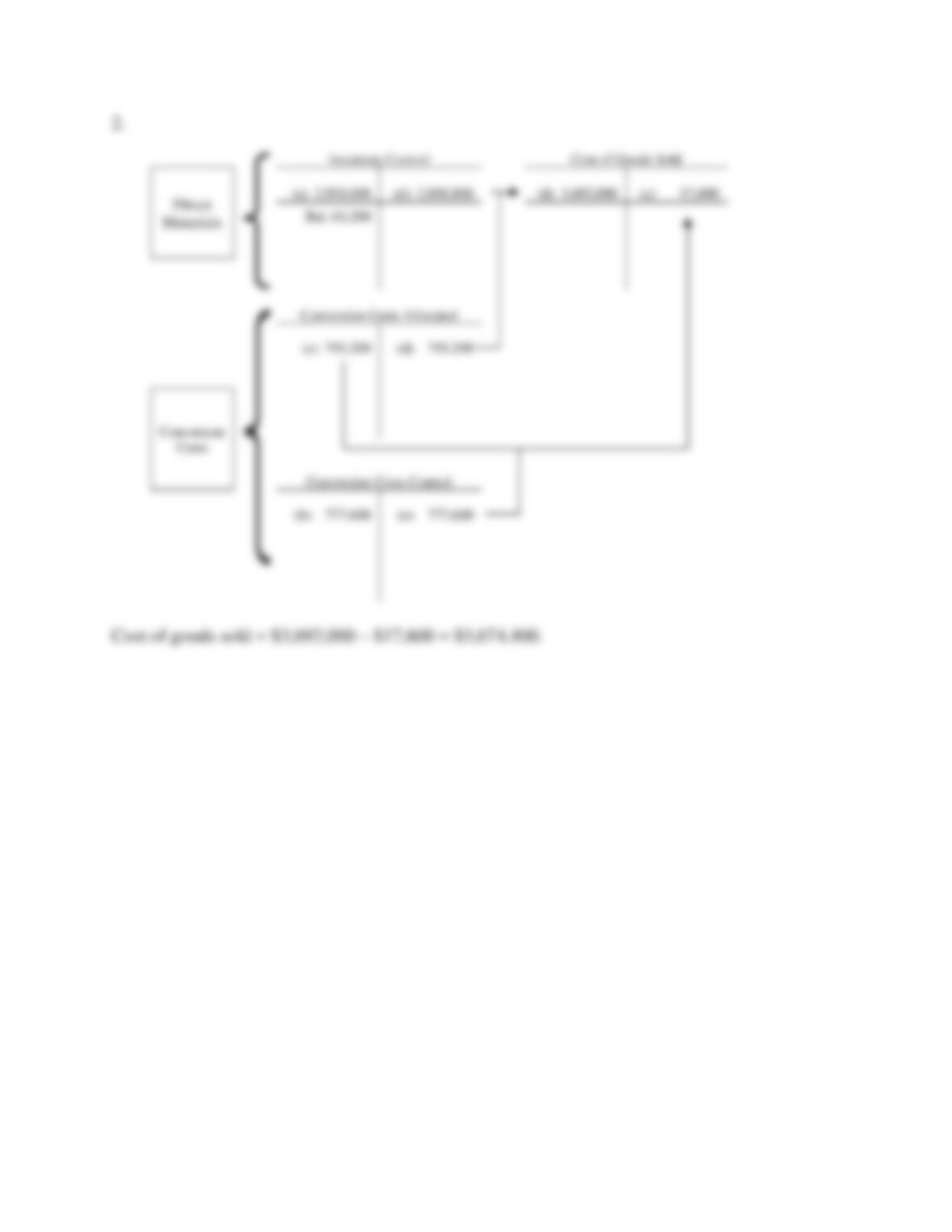
2. Post the entries in requirement 1 to T-accounts for Inventory Control, Conversion Costs
Control, Conversion Costs Allocated, and Cost of Goods Sold.
SOLUTION
20-16
20-17
20-24 (20 min.) Backflush costing, two trigger points, completion of production and
sale (continuation of 20-22).
Assume the same facts as in Exercise 20-22, except now Grand Devices uses only two trigger
points, Completion of good finished units of product and Sale of finished goods. Any under- or
overallocated conversion costs are written off monthly to Cost of Goods Sold.
Required:
1. Prepare summary journal entries for August, including the disposition of under- or
overallocated conversion costs.
2. Post the entries in requirement 1 to T-accounts for Finished Goods Control, Conversion
Costs Control, Conversion Costs Allocated, and Cost of Goods Sold.
SOLUTION
20-18
20-25 (30 min.) EOQ, uncertainty, safety stock, reorder point.
Chadwick Shoe Co. produces and sells an excellent-quality walking shoe. After production, the
shoes are distributed to 20 warehouses around the country. Each warehouse services
approximately 100 stores in its region. Chadwick uses an EOQ model to determine the number
of pairs of shoes to order for each warehouse from the factory. Annual demand for Warehouse
OR2 is approximately 120,000 pairs of shoes. The ordering cost is $250 per order. The annual
carrying cost of a pair of shoes is $2.40 per pair.
Required:
1. Use the EOQ model to determine the optimal number of pairs of shoes per order.
2. Assume each month consists of approximately 4 weeks. If it takes 1 week to receive an order,
at what point should warehouse OR2 reorder shoes?
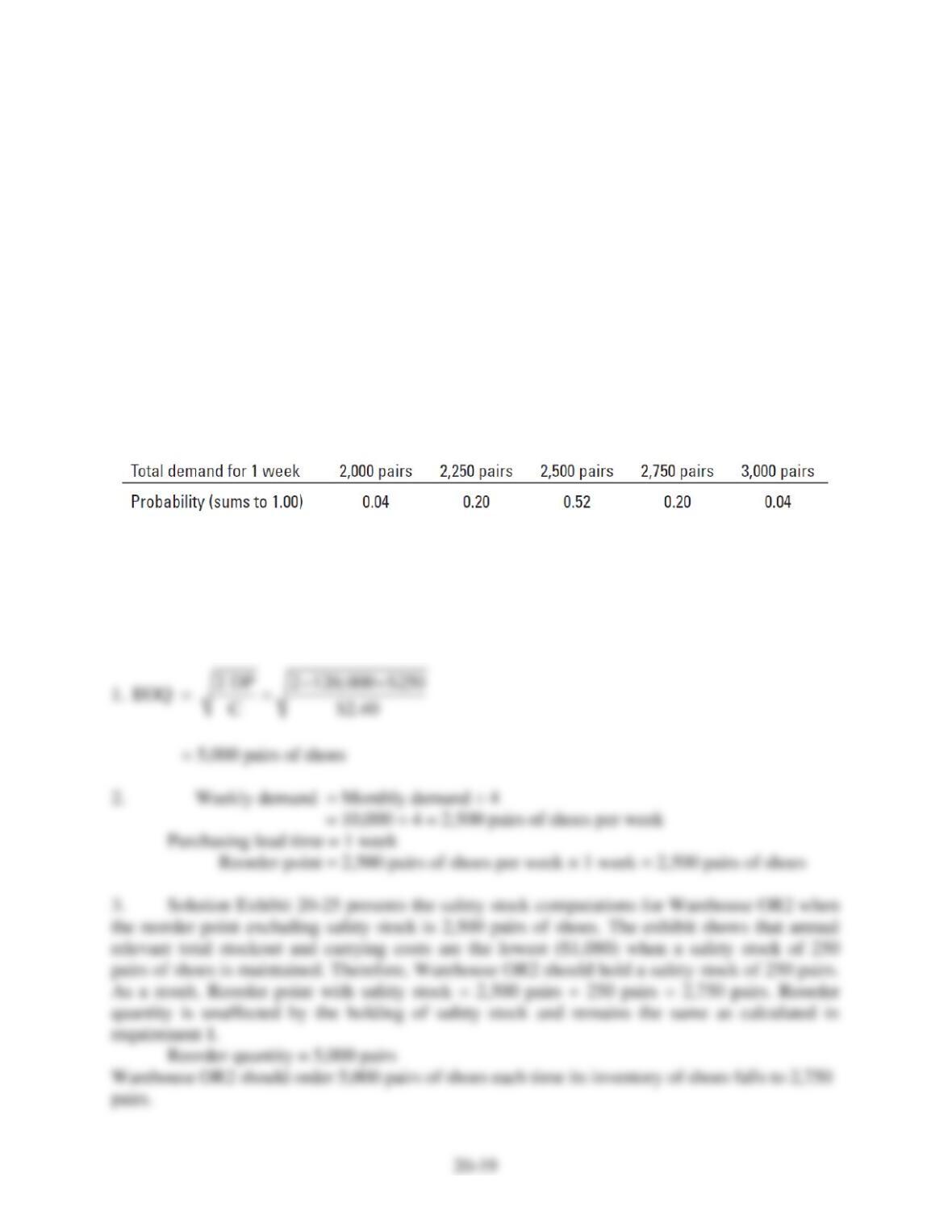
3. Although OR2’s average weekly demand is 2,500 pairs of shoes (120,000 ÷ 12 months ÷ 4
weeks), demand each week may vary with the following probability distribution:
If a store wants shoes and OR2 has none in stock, OR2 can “rush” them to the store at an
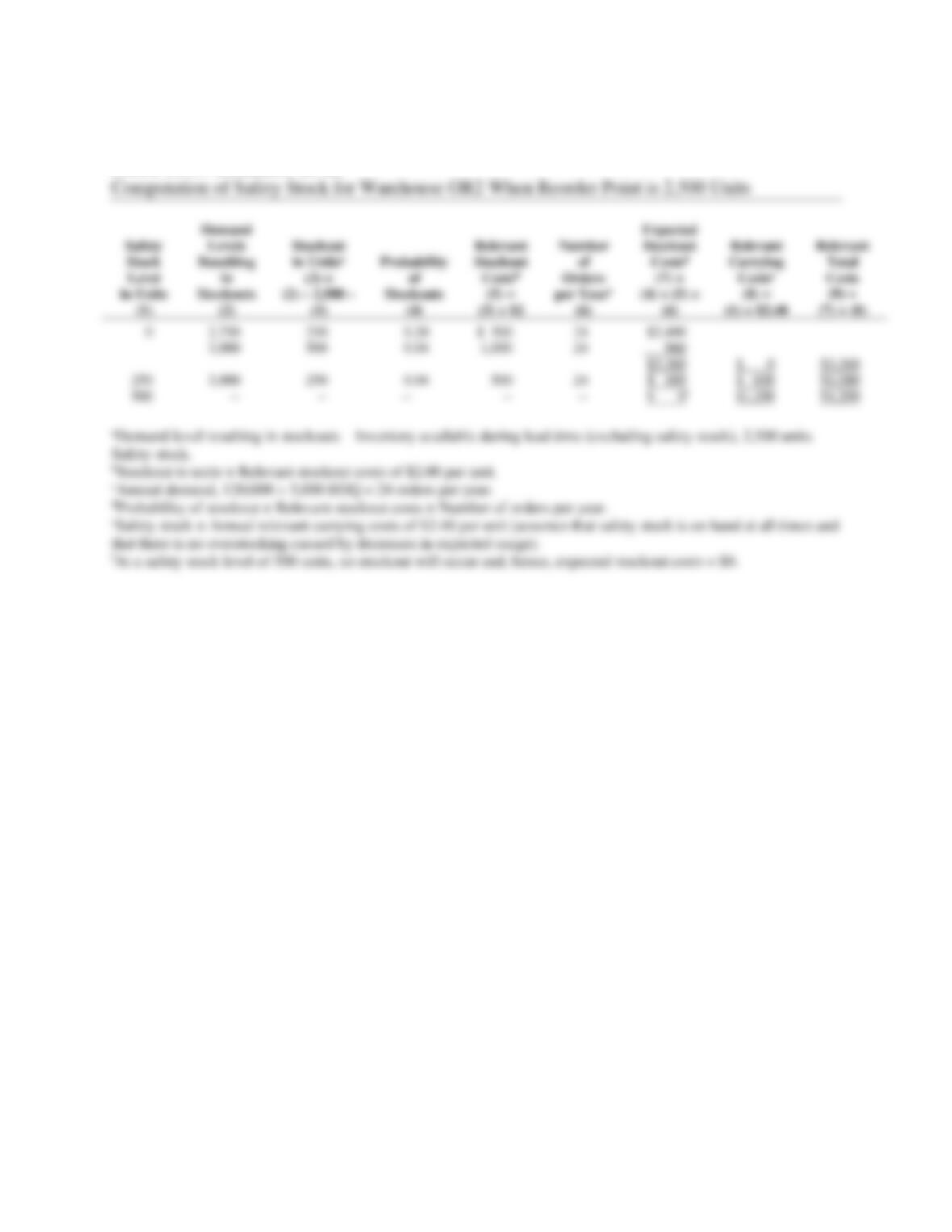
additional cost of $2 per pair. How much safety stock should Warehouse OR2 hold? How will
this affect the reorder point and reorder quantity?
SOLUTION
20-20
SOLUTION EXHIBIT 20-25