Wild, Shaw, Chiappetta, FAP 23e Solutions Manual: Chapter 20
Chapter 20
Process Costing
QUESTIONS
1. The main deciding factor in choosing between a job order costing system or a
process costing system is the type of product or service. Examples where a
3. Yes, services can be delivered by processes. For example, Federal Express delivers
4. The journal entries to match cost flows with product flows are primarily the same
for both process costing and job order costing. In process costing, the materials
6. The computation of equivalent units of production focuses on converting partially
completed units to a measure in terms of completed units. We need to use EUP
7. The two main methods of process costing are the weighted-average and the first-in,
first-out (FIFO) methods. The weighted-average method considers “average flow”
8. A process cost accounting system treats labor that is used entirely within one
9. Direct labor costs flow to the Work in Process Inventory account. Then the direct
10. At the end of the accounting period the Factory Overhead account should have a
11. Yes, it is possible to have either underapplied or overapplied overhead in a process
12. Equivalent units for direct materials differ from that for direct labor (and overhead) if
direct materials and direct labor (and overhead) are added at different stages in the
13. The four steps in accounting for production activity (for process operations) are: 1)
14. The process cost summary serves at least three purposes: (a) to help department
managers control their departments; (b) to help factory managers evaluate
15. Yes. Google might use process costing to determine the cost of manufacturing its
16. Likely processing steps for digital televisions include making the frame and
17. General Mills, like most food processors, faces risks due to water scarcity and
climate change that could disrupt its supply and lower profits. The company also
Wild, Shaw, Chiappetta, FAP 23e Solutions Manual: Chapter 20
QUICK STUDIES
Quick Study 20-1 (5 minutes)
Quick Study 20-2 (5 minutes)
Quick Study 20-3 (10 minutes)
Quick Study 20-4 (10 minutes)
Units
Units in beginning inventory
150,000
Units started
310,000
Total units to account for
460,000
Units completed and transferred out
340,000
Units in ending inventory
120,000
Total units accounted for
460,000
1064
Quick Study 20-5 (10 minutes)
Equivalent units under the weighted-average method
Equivalent
EUP for conversion—Weighted average
Units
Equivalent units of production …………………………………………………….
Quick Study 20-6 (10 minutes)
Equivalent units under the FIFO method
Equivalent
EUP for conversion—FIFO
Units
Equivalent units to complete beginning WIP (150,000 x 20%) ……….
Equivalent units started and completed* ……………………………………..
Equivalent units of production …………………………………………………….
Quick Study 20-7 (5 minutes)
Cost per equivalent unit of production—weighted-average method
Quick Study 20-8 (10 minutes)
Equivalent units under the weighted-average method
Equivalent
EUP for conversion—Weighted average
Units
Equivalent units of production …………………………………………………….
1065
Quick Study 20-9 (15 minutes)
Equivalent units under the FIFO method
Equivalent
EUP for conversion—FIFO
Units
Equivalent units to complete beginning WIP (320,000 x 75%) ……….
Equivalent units started and completed* ……………………………………..
Quick Study 20-10 (15 minutes)
Equivalent units of production—Weighted
average
Direct
Materials
Conversion
Units of ending work in process
Quick Study 20-11 (25 minutes)
Cost per equivalent unit—Weighted average
Direct
Materials
Conversion
Costs of beginning work in process………………
$ 996
$ 585
Costs incurred this period…………………………..
Total costs……………………………………………..
÷ Equivalent units of production (from QS 20–10)…
Units of ending work in process
Quick Study 20-12 (10 minutes)
Cost assignment—Weighted average
Direct
Materials
Conversion
Costs of units transferred out
Quick Study 20-13 (5 minutes)
Work in Process Inventory—Painting …………………….
Quick Study 20-14 (15 minutes)
Equivalent units of production—FIFO
Direct
Materials
Conversion
1067
Quick Study 20-15 (5 minutes)
Cost per equivalent unit – FIFO
Direct
Materials
Conversion
Costs incurred this period …………………………………
÷ Equivalent units of production (from QS 20–14)
Quick Study 20-16 (20 minutes)
Assignment of costs to output of department—FIFO
Costs of ending work in process
Quick Study 20-17 (5 minutes)
Quick Study 20-18 (10 minutes)
a)
Equivalent units of production—Weighted average
Direct
Materials
Units completed & transferred out (17,000 x 100%)
Units of ending work in process
b)
Cost per equivalent unit—Weighted average
Direct
Materials
Costs of beginning work in process ………………….
Costs incurred this period …………………………………
Quick Study 20-19 (10 minutes)
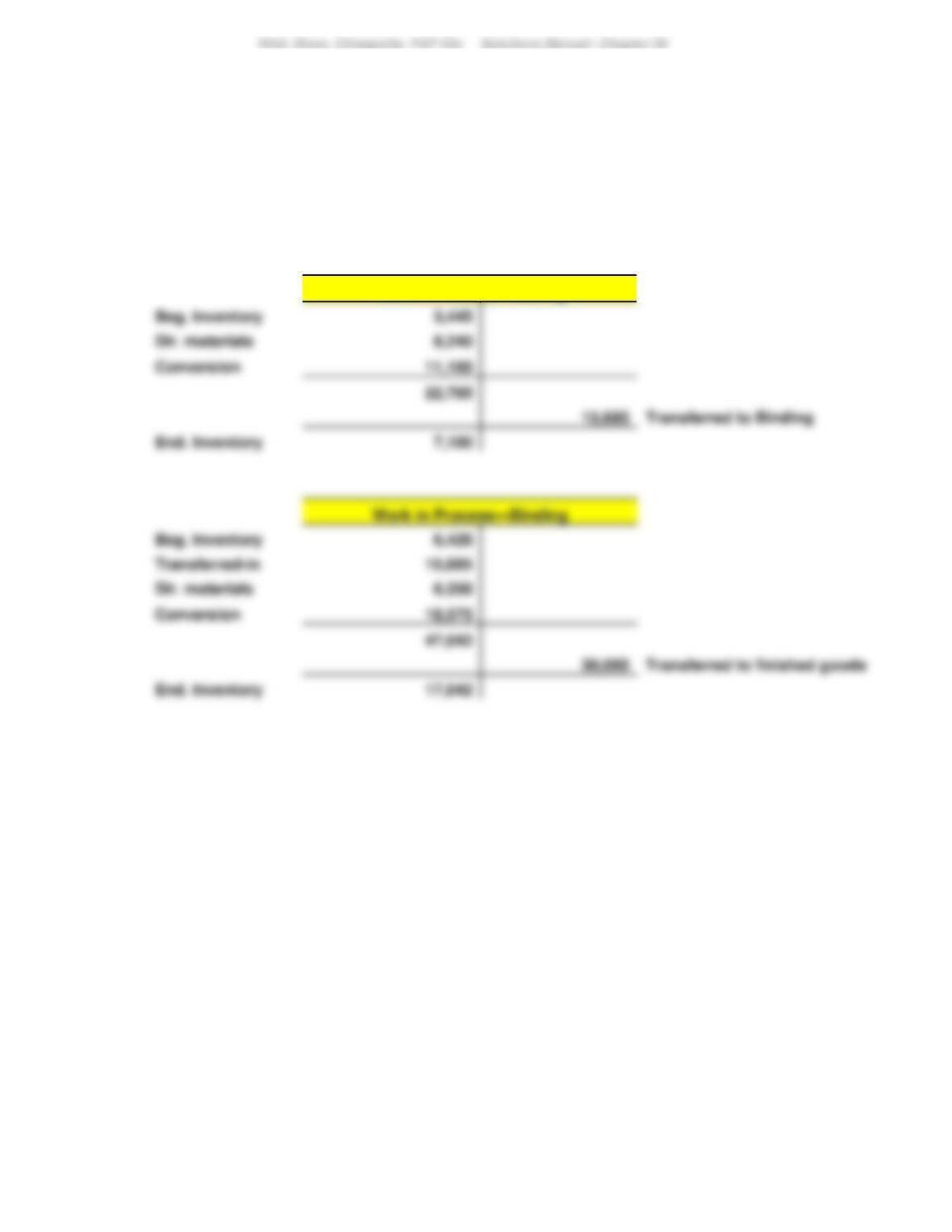
Cost assignment—Weighted average
Direct
Materials
1069
Quick Study 20-20 (10 minutes)
The ending balance in Work in Process Inventory—Cutting is $7,100 and
the ending balance in Work in Process Inventory—Binding is $17,042, as
computed below.
Work in Process—Cutting
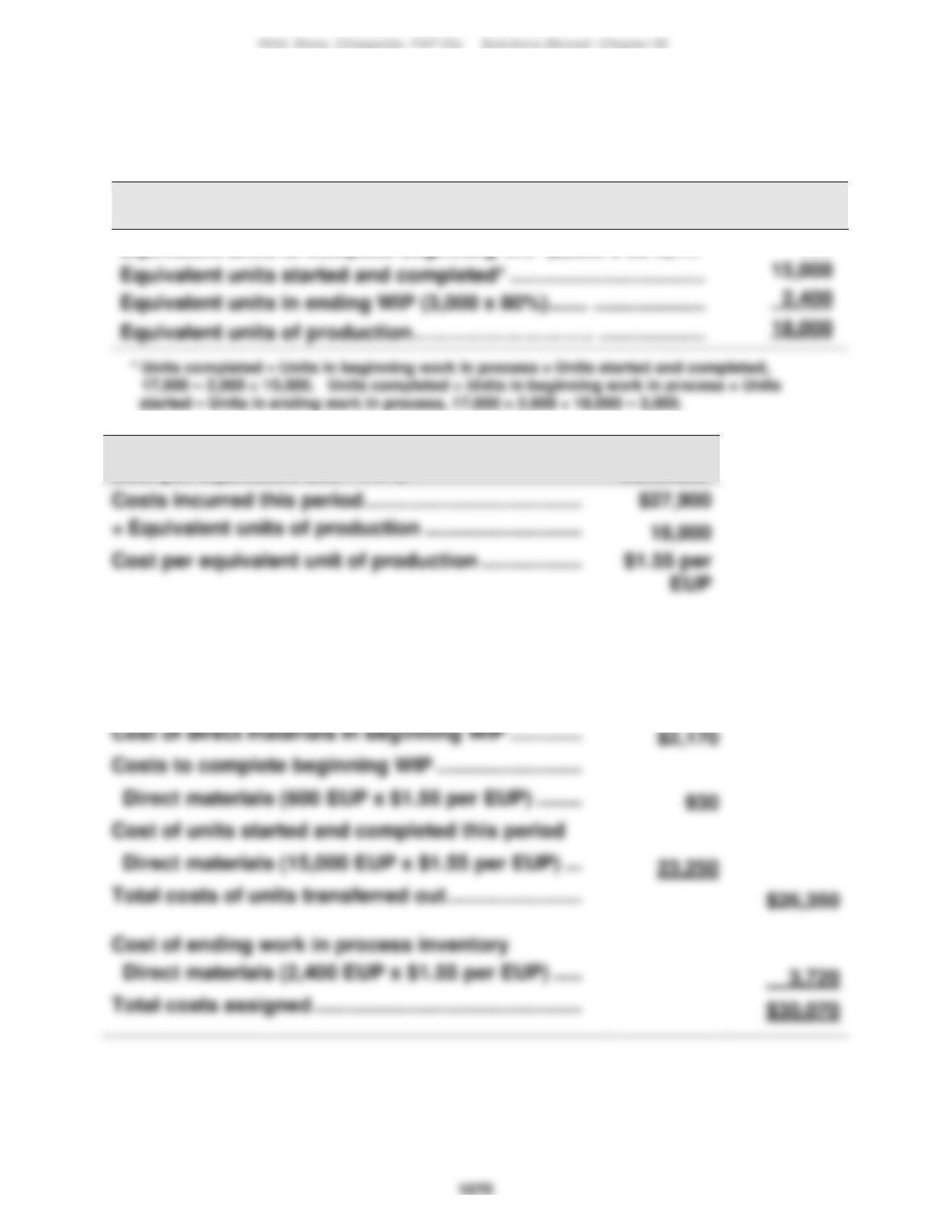
Cost of ending work in process inventory
Quick Study 20-21 (15 minutes)
Equivalent units under the FIFO method
Equivalent
EUP for materials—FIFO
Units
Equivalent units to complete beginning WIP (2,000 x 30%)….
600
Equivalent units started and completed* ……………………………..
Cost per equivalent unit—FIFO
Direct
Materials
Costs incurred this period …………………………………
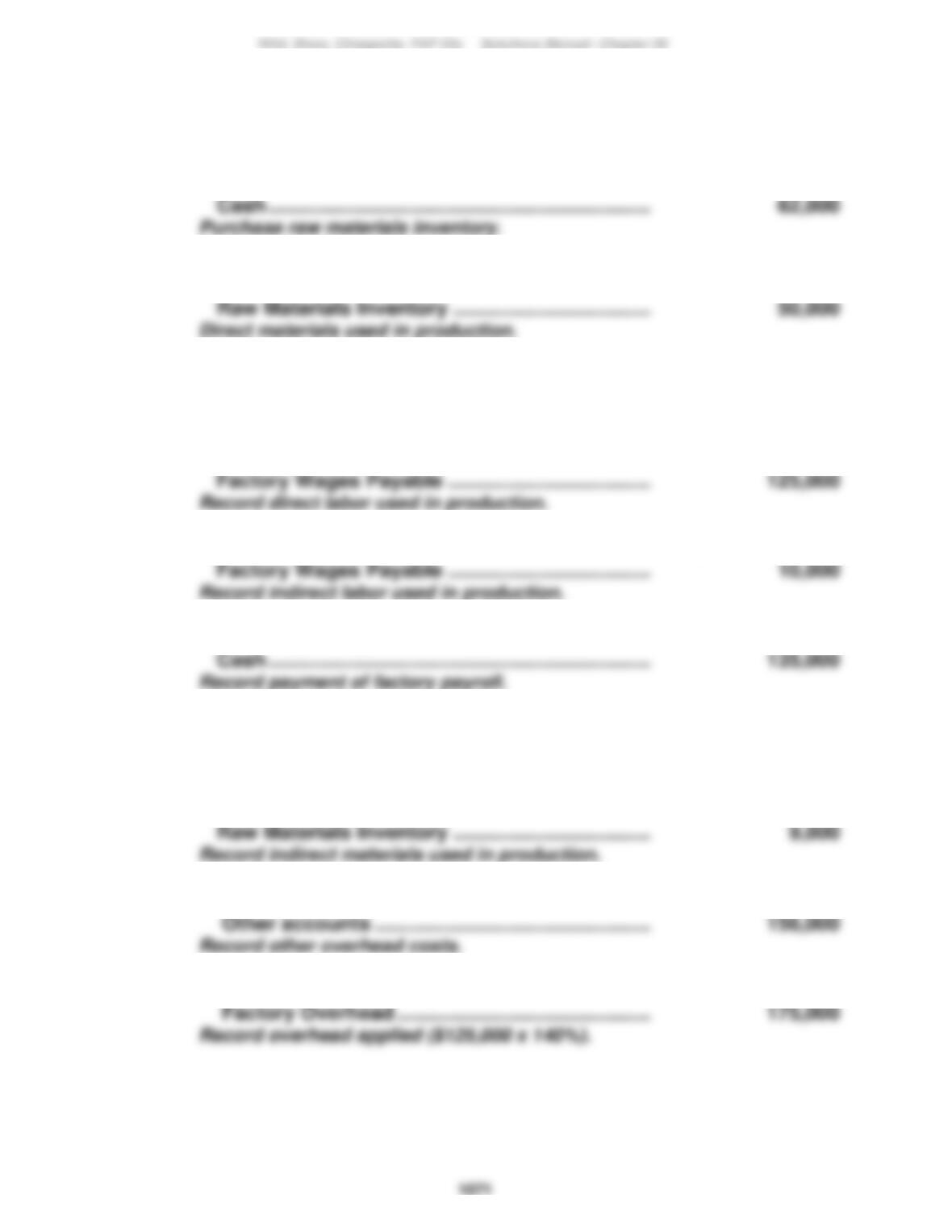
Quick Study 20-22 (15 minutes)
Assignment of direct materials costs to output of department—FIFO
Costs transferred out
Quick Study 20-23 (10 minutes)
1.
Raw Materials Inventory ………………………………………..
62,000
2.
Work in Process Inventory …………………………………….
50,000
Quick Study 20-24 (10 minutes)
1.
Work in Process Inventory …………………………………….
125,000
2.
Factory Overhead ………………………………………………….
10,000
3.
Factory Wages Payable …………………………………………
135,000
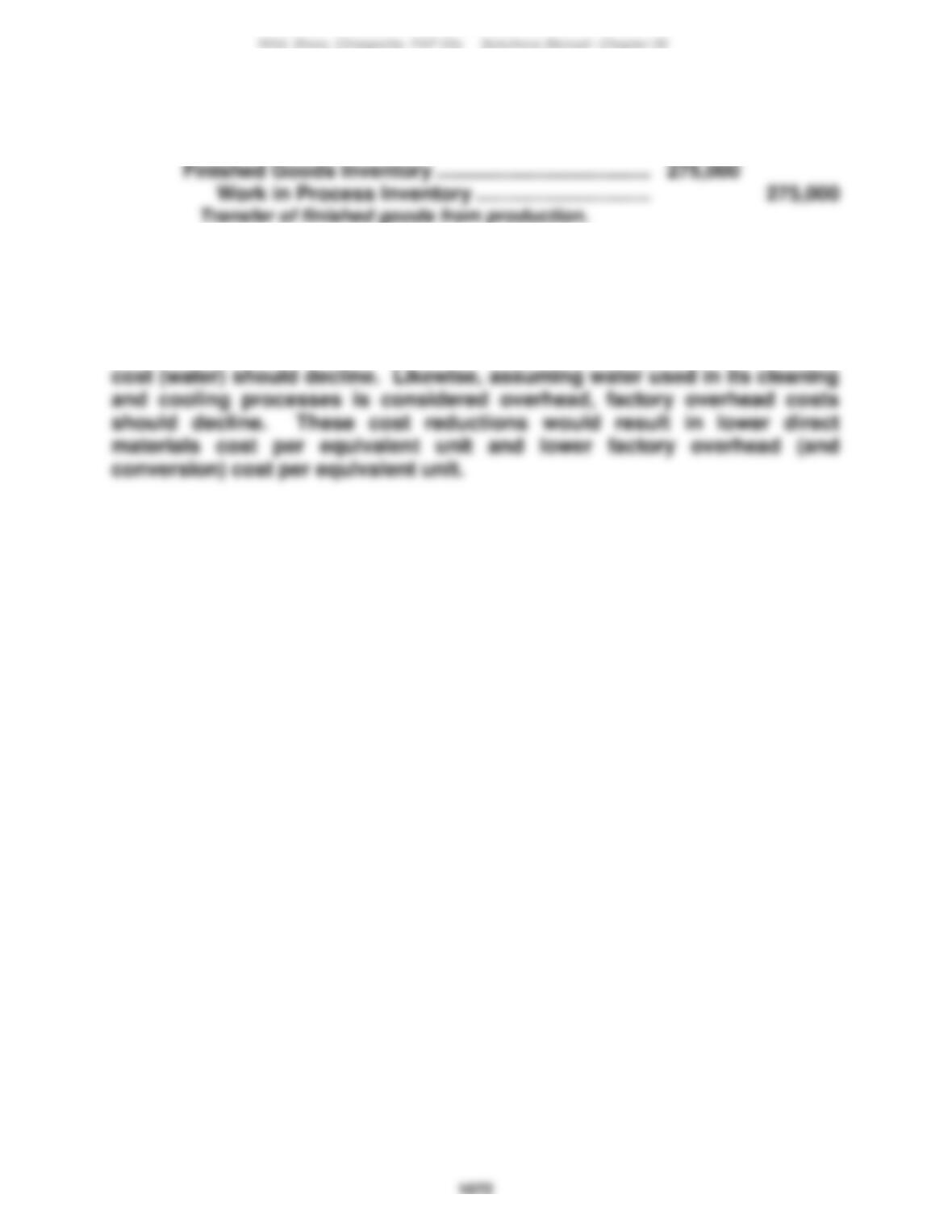
Quick Study 20-25 (15 minutes)
1.
Factory Overhead ………………………………………………….
9,000
2.
Factory Overhead ………………………………………………….
156,000
3.
Work in Process Inventory …………………………………….
175,000
Quick Study 20-26 (10 minutes)
Quick Study 20-27 (5 minutes)
If the company is successful in reducing water usage, its raw materials
Wild, Shaw, Chiappetta, FAP 23e Solutions Manual: Chapter 20
1073
EXERCISES
Exercise 20-1 (10 minutes)
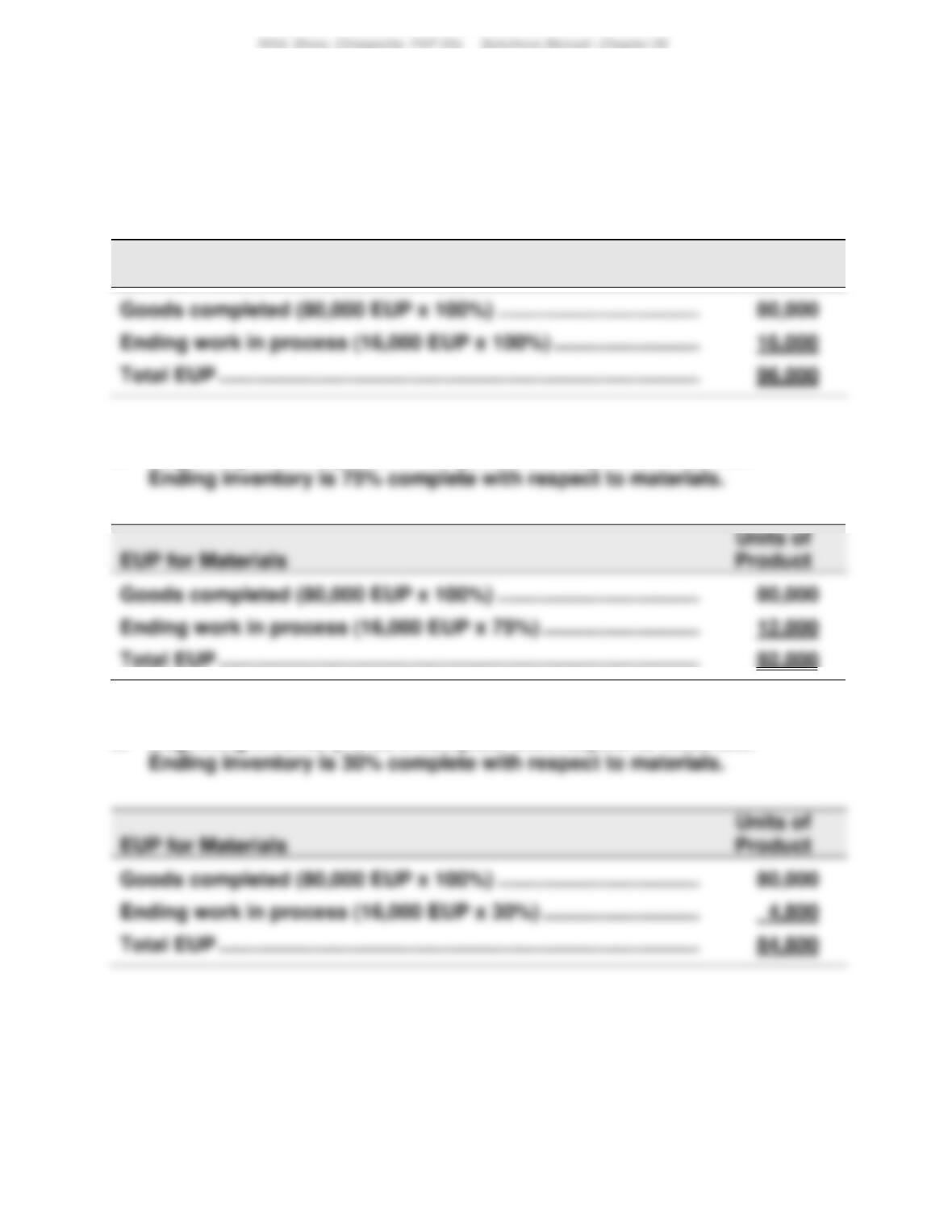
1. Process operation 7. Job order operation
Exercise 20-2 (10 minutes)
a. Job order operation e. Job order operation
Exercise 20-3 (10 minutes)
1074
Exercise 20-4 (30 minutes)
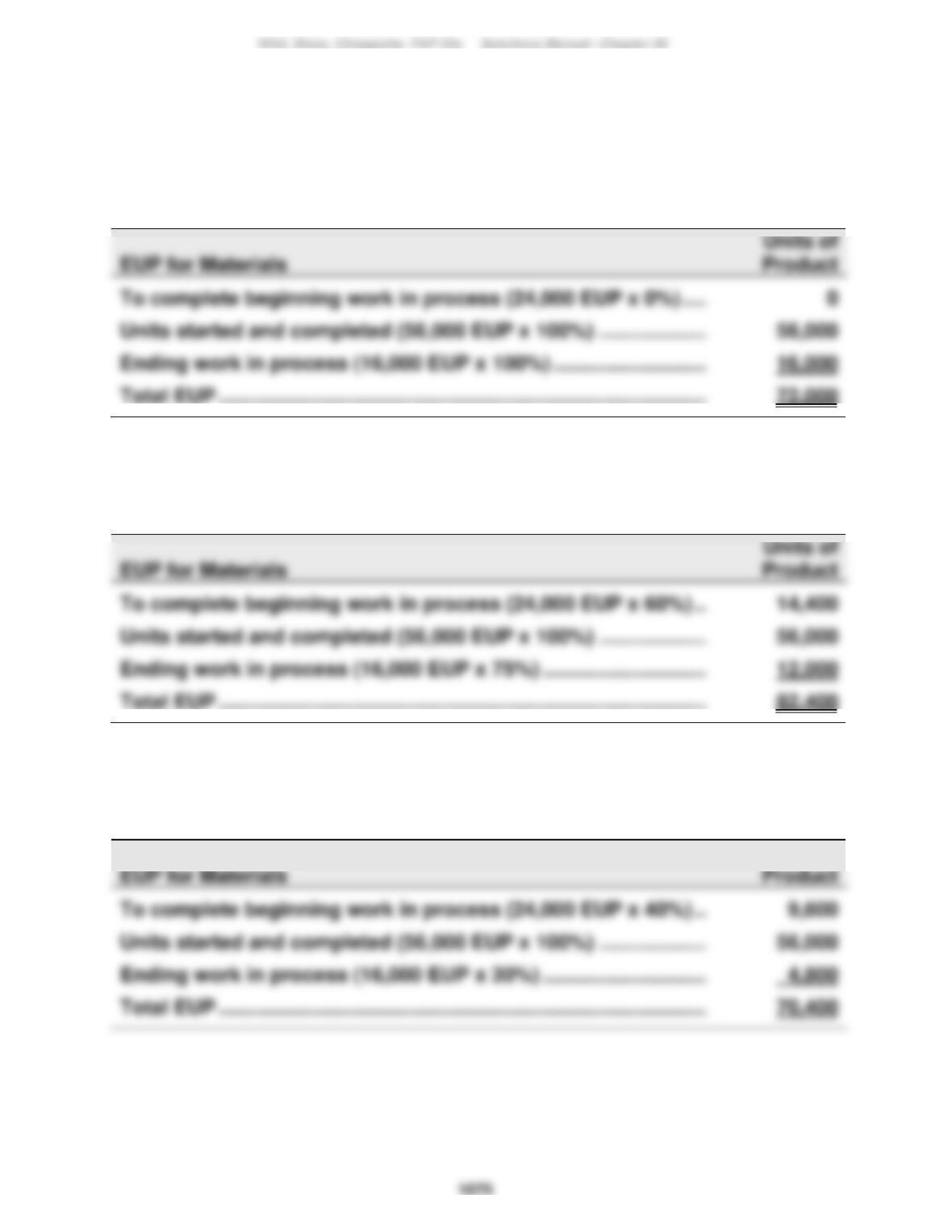
1. Beginning inventory is 100% complete with respect to materials.
Ending inventory is 100% complete with respect to materials.
EUP for Materials
Units of
Product
Ending work in process (16,000 EUP x 100%) ……………………..
2. Beginning inventory is 40% complete with respect to materials.
EUP for Materials
Product
Ending work in process (16,000 EUP x 75%) ……………………….
3. Beginning inventory is 60% complete with respect to materials.
EUP for Materials
Product
Ending work in process (16,000 EUP x 30%) ……………………….
To complete beginning work in process (24,000 EUP x 40%) …….
Exercise 20-5 (30 minutes)
1. Beginning inventory is 100% complete with respect to materials.
Ending inventory is 100% complete with respect to materials.
To complete beginning work in process (24,000 EUP x 0%) ………
2. Beginning inventory is 40% complete with respect to materials.
Ending inventory is 75% complete with respect to materials.
Units of
To complete beginning work in process (24,000 EUP x 60%) …….
3. Beginning inventory is 60% complete with respect to materials.
Ending inventory is 30% complete with respect to materials.
Units of
Conversion (295,000 EUP x $3.00 per EUP) …………………………..
885,000
Total costs transferred out ………………………………………………………
Costs of ending work in process
Direct materials (24,000 EUP x $4.00 per EUP) ………………………
96,000
Conversion (9,000 EUP x $3.00 per EUP) …………………………..
27,000
Total costs of ending work in process …………………………..
Total costs assigned* ……………………………………………………….
Exercise 20-6 (30 minutes)
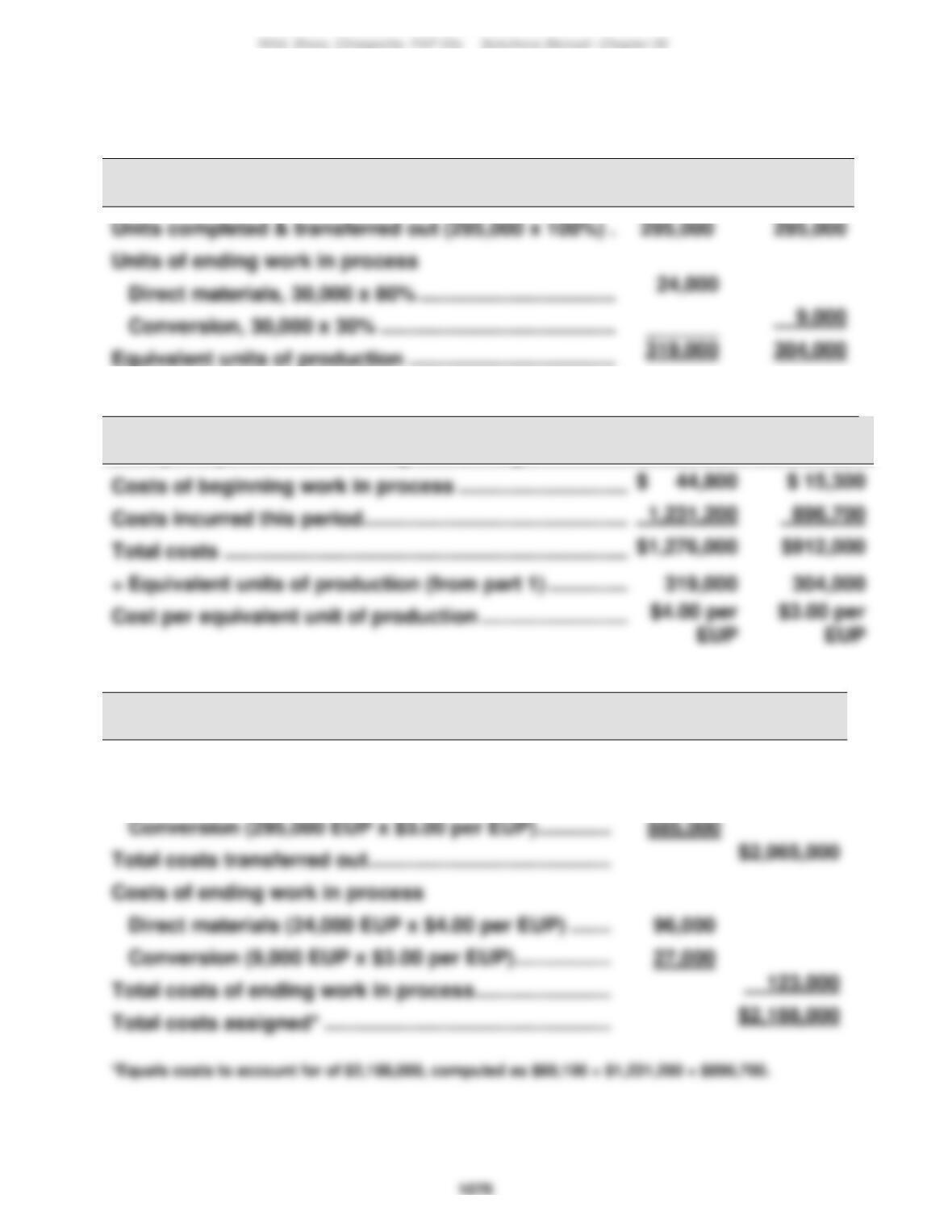
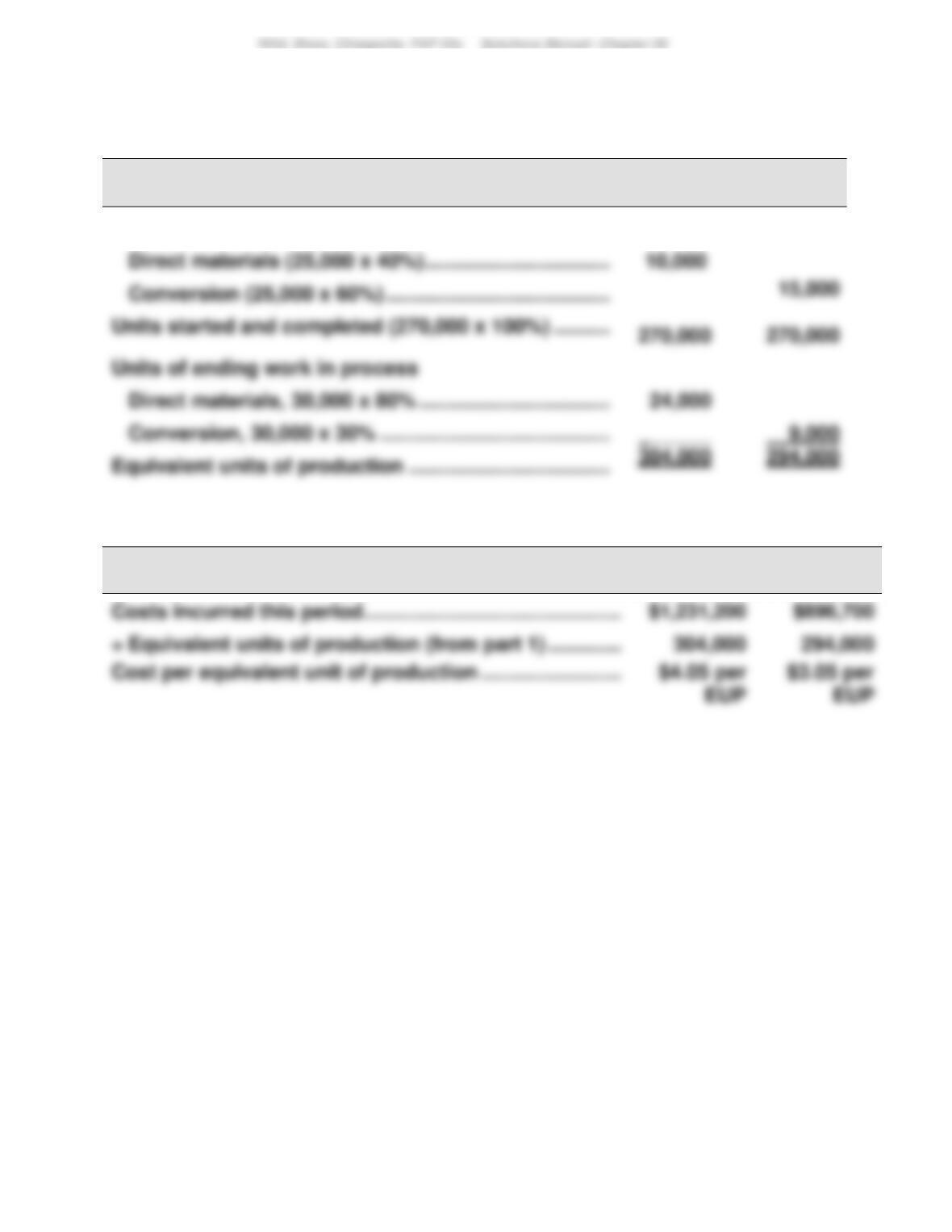
1.
Equivalent units of production—Weighted average
Direct
Materials
Conversion
Units completed & transferred out (295,000 x 100%) ………………..
295,000
Units of ending work in process
Direct materials, 30,000 x 80% ………………………………………………
Conversion, 30,000 x 30% …………………………………………………….
Equivalent units of production ………………………………………………..
2.
Cost per equivalent unit—Weighted average
Direct
Materials
Conversion
Costs of beginning work in process …………………………..
Costs incurred this period ……………………………………………………….
Total costs ……………………………………………………………………………..
÷ Equivalent units of production (from part 1) ………………………….
3.
Cost assignment—Weighted average
Costs of units transferred out
Direct materials (295,000 EUP x $4.00 per EUP) …………………….
$1,180,000
1077
Exercise 20-7 (30 minutes)
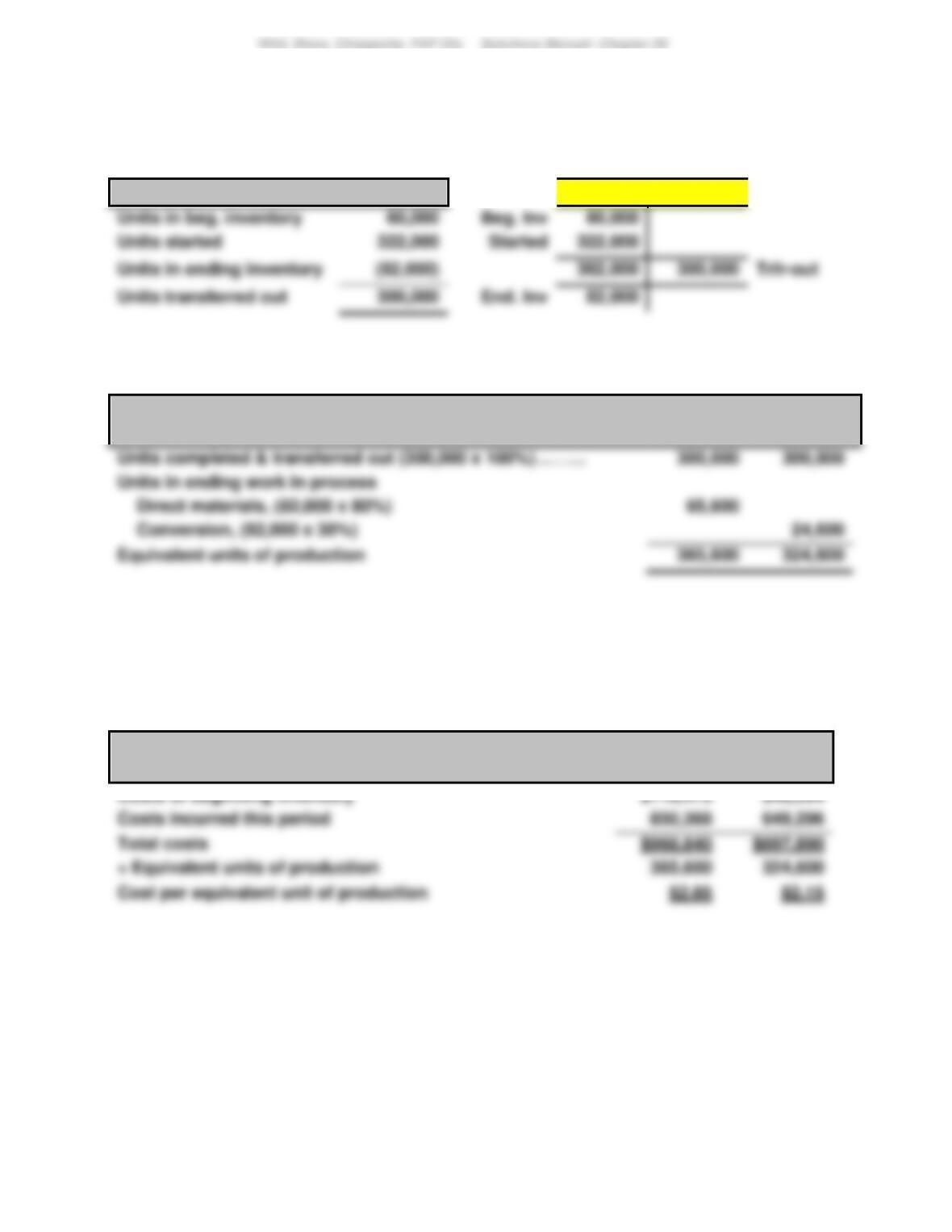
1.
Equivalent units of production—FIFO
Direct
Materials
Conversion
Units of ending work in process
Equivalent units of production ………………………………………………..
Units to complete beginning work in process
2.
Cost per equivalent unit—FIFO
Direct
Materials
Conversion
Costs incurred this period ……………………………………….
÷ Equivalent units of production (from part 1) ………….
1078
Exercise 20-8 (20 minutes)
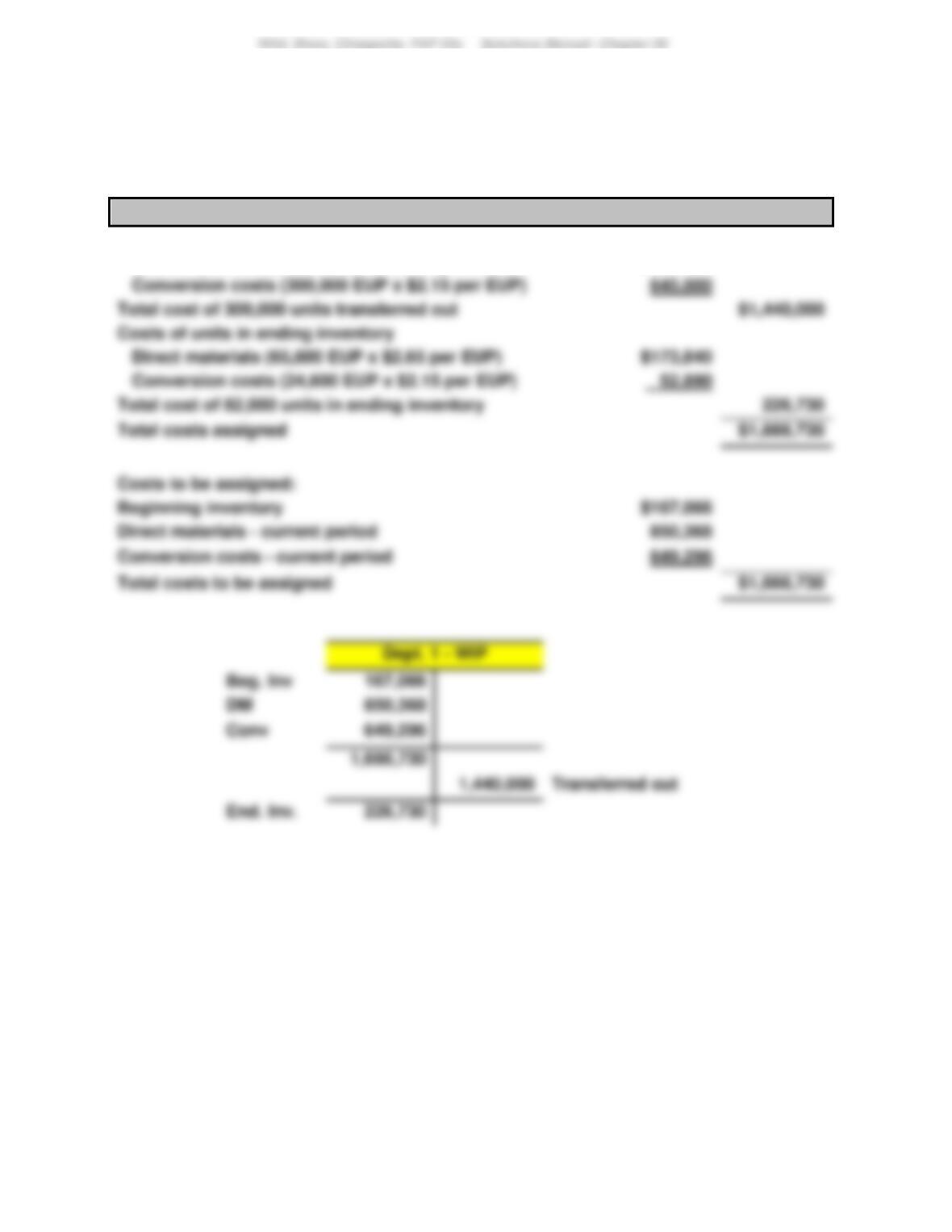
1. Units transferred out
Units
Dept. 1 – units
Units started
322,000
Units in ending inventory
Units transferred out
300,000
End. Inv
2. EUP
Equivalent units of production – weighted-average
Direct
Materials
Conversion
Equivalent units of production
Exercise 20-9 (20 minutes)
1. Cost per EUP
Cost per equivalent unit – weighted-average
Direct
Materials
Conversion
Cost per equivalent unit of production
1079
Exercise 20-9 (continued)
2.
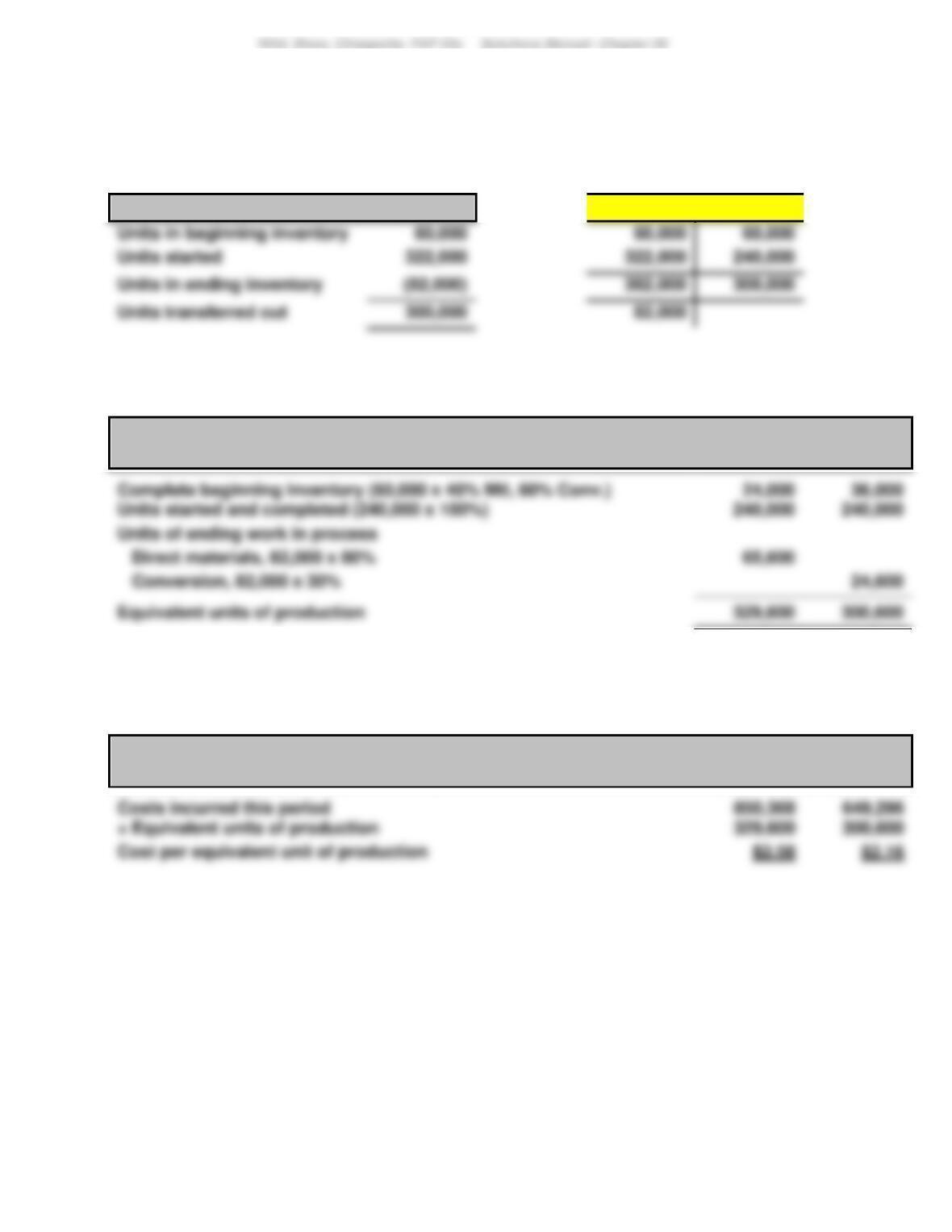
Cost assignment and reconciliation – weighted-average
Costs of units transferred out
Direct materials (300,000 EUP x $2.65 per EUP)
$795,000
Conversion costs (300,000 EUP x $2.15 per EUP)
Total cost of 300,000 units transferred out
Costs of units in ending inventory
Total cost of 82,000 units in ending inventory
Costs to be assigned:
Beginning inventory
$167,066
Beg. Inv
End. Inv.
1080
Exercise 20-10 (20 minutes)
1.
Units
Units
2.
Equivalent units of production – FIFO
Direct
Materials
Conversion
Exercise 20-11 (20 minutes)
1.
Cost per equivalent unit – FIFO
Direct
Materials
Conversion