20-1
CHAPTER 20
MASTER BUDGETS AND PERFORMANCE PLANNING
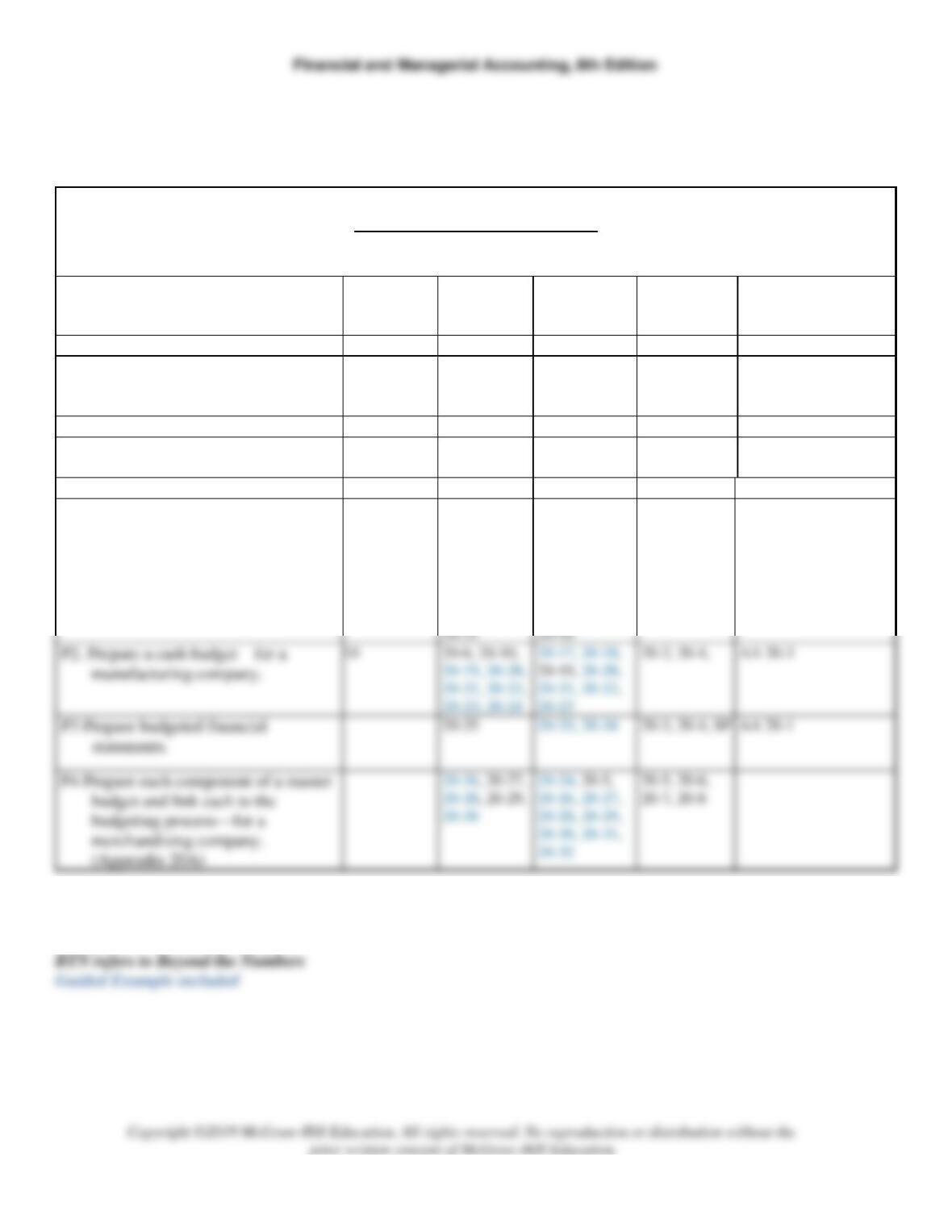
Related Assignment Materials
Student Learning Objectives
Discussion
Questions
Quick
Studies*
Exercises*
Problems*
AA and
BTN
Conceptual objectives:
C1. Describe the benefits of budgeting
and the process of budget
administration.
1, 2, 3, 4, 5, 6,
9, 12, 13, 14
20-1, 20-2
20-2
BTN 20-1, BTN 20-2,
BTN 20-3, BTN 20-5
Analytical objectives:
A1. Analyze expense planning using
activity-based budgeting.
16
20-35
BTN 20-4
Analytical objectives:
P1. Prepare the operating budget of a
master budget — for a
manufacturing company.
7, 8, 11, 15
20-3, 20-4,
20-5, 20-7,
20-8, 20-9,
20-11, 20-12,
20-13, 20-14,
20-15, 20-16,
20-17, 20-18,
20-6, 20-10,
20-2, 20-4,
AA 20-3
merchandising company.
(Appendix 20A)
20-1, 20-3,
20-4, 20-5,
20-6, 20-7,
20-8, 20-9,
20-10, 20-11,
20-12, 20-13,
20-14, 20-15,
20-1, 20-4,
AA 20-2, BTN 20-6
*See additional information on next page that pertains to these quick studies, exercises and problems.
SP refers to the Serial Problem
AA refers to Accounting Analysis
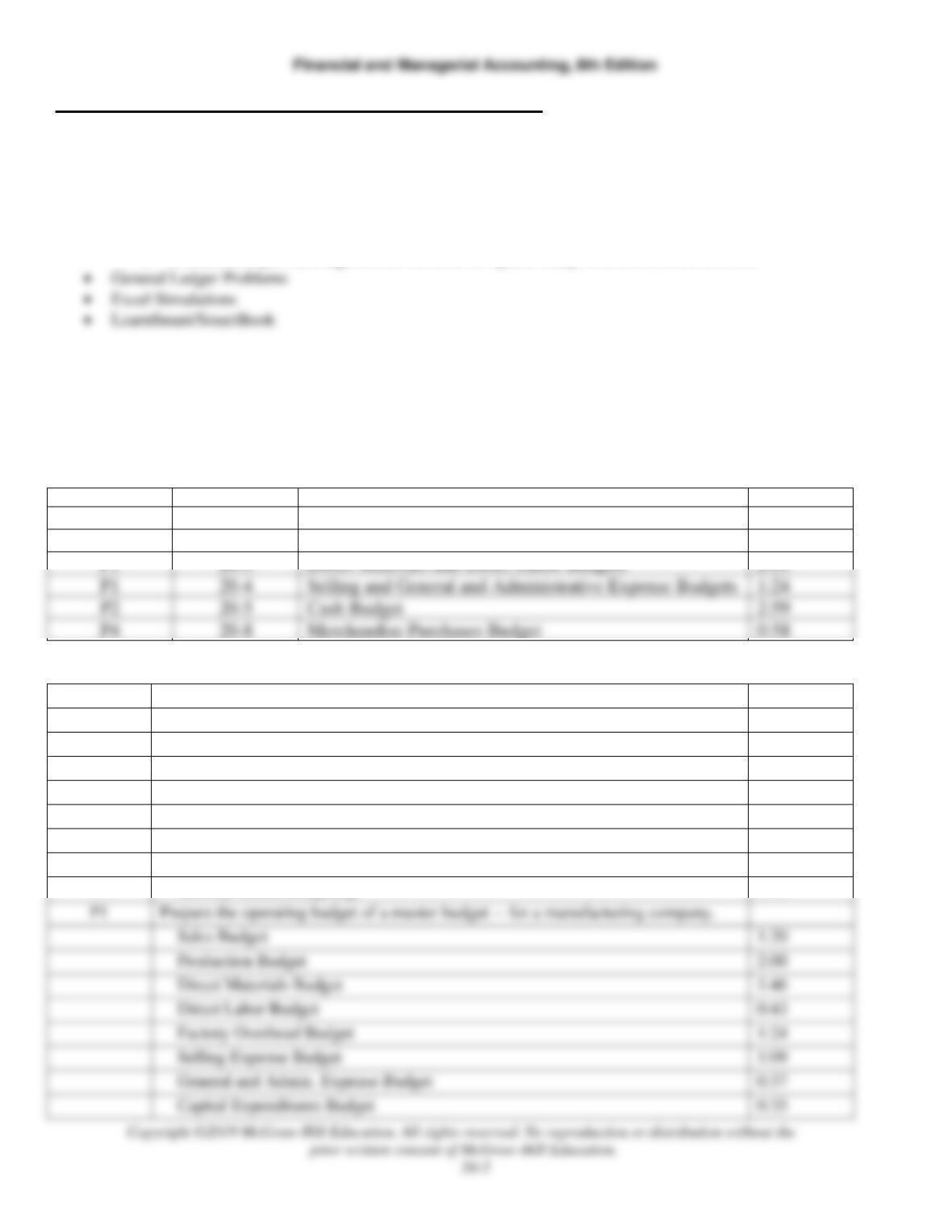
Prepare the operating budget of a master budget — for a manufacturing company.
Sales Budget
Production Budget
Direct Materials Budget
Direct Labor Budget
Factory Overhead Budget
Selling Expense Budget
General and Admin. Expense Budget
Capital Expenditures Budget
Additional Information on Related Assignment Material
See Chapter 1 of the Instructor’s Resource Manual for more information on materials for this text available in
Connect.
Connect
Available on the instructor’s course-specific website, Connect:
• All numerical Quick Studies, all Exercises and Problems Set A.
o Connect also provides algorithmic versions for Quick Study, Exercises, and Problems.
Hints/Guided Examples
Please note that the Guided Examples are labeled as “Hints” in Connect assignments. The animated PowerPoints without
the video and audio functions for the Guided Examples are also available in the Connect Instructor Library and Exercise
Presentations. These are indicated in the Related Assignment Materials grid on page 1 in blue bold font.
Need-to-Know Videos
LO
Need–to-Know
Title
Time
C1
20-1
Budgeting Benefits
0:32
P1
20-2
Production Budget
0:53
P1
20-3
Direct Materials and Direct Labor Budgets
2:03
P1
20-4
Selling and General and Administrative Expense Budgets
1:24
P2
20-5
Cash Budget
2:59
P4
20-8
Merchandise Purchases Budget
0:58
Concept Overview Videos
LO
Title
Time
C1
Describe the benefits of budgeting and the process of budget administration.
Budgeting Process
2:22
Budgeting and Human Behavior
1:31
Budget Reporting and Timing
1:38
Master Budget Components
0:58
Master Budget Sequence
1:07
A1
Analyze expense planning using activity-based budgeting.
Activity-Based Budgeting
1:56
Financial and Managerial Accounting, 8th Edition
20-3
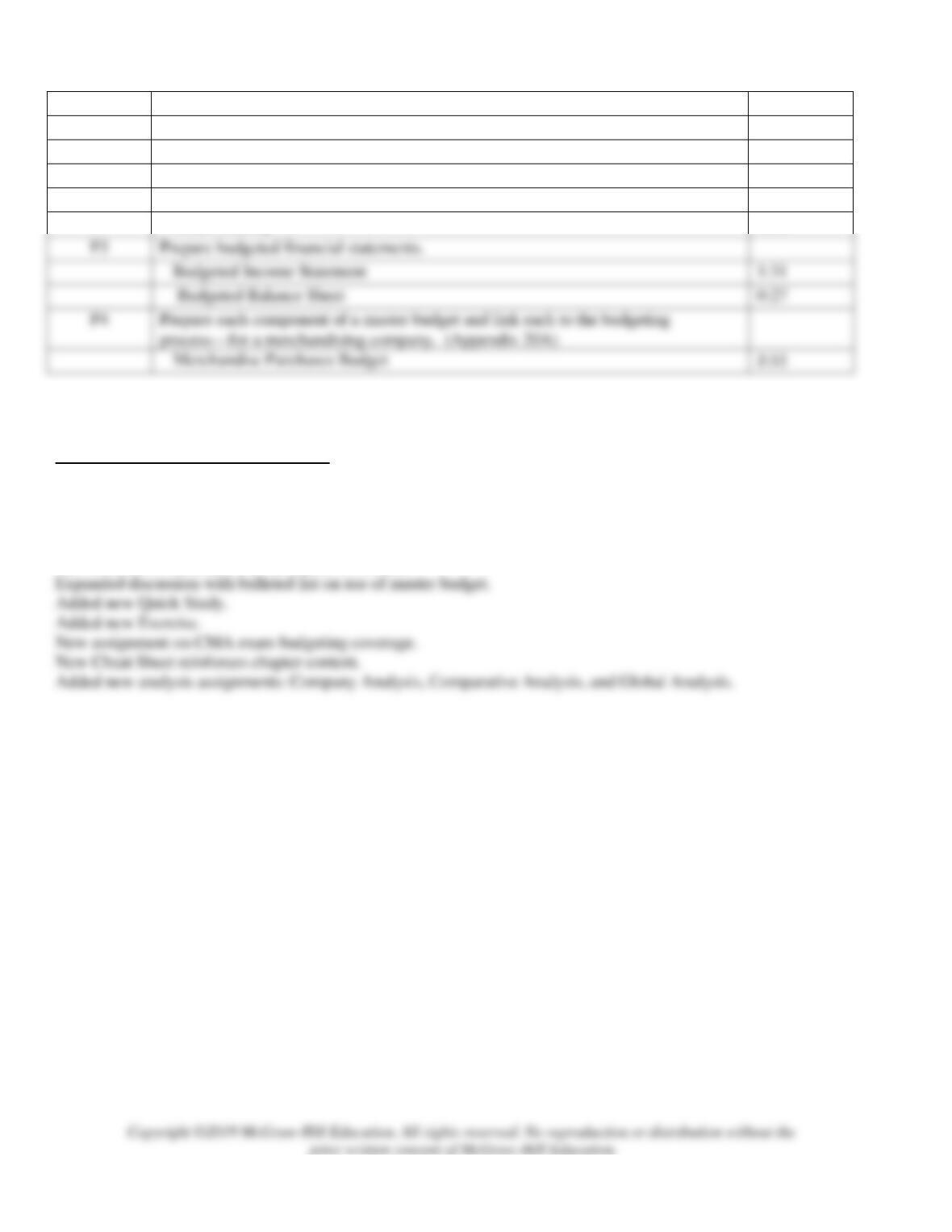
P2
Prepare a cash budget—for a manufacturing company.
Cash Budget
1:40
Cash Receipts from Sales
1:53
Cash Payments for Materials
1:00
Preparing the Cash Budget
1:33
Loan Activity
1:58
P3
Prepare budgeted financial statements.
Budgeted Income Statement
1:31
Budgeted Balance Sheet
0:27
Merchandise Purchases Budget
Synopsis of Chapter Revisions
NEW opener—Misfit Juicery and entrepreneurial assignment.
Added T-accounts and steps to exhibit margins.
Added numbered steps to several exhibits.
Expanded discussion of cost of goods sold budgeting.
New exhibit for calculation of cash paid for interest
20-4
Chapter Outline
I. Budging as a Management Tool—ensures that activities of employees and departments contribute to
meeting the company’s overall goals. Budgeting is the process of planning future business actions and
expressing them as formal plans.
A. Budget Process⎯process of planning future business activities.
1. Budget⎯Formal statement of a company’s plans, expressed in monetary terms.
B. Benefits of Budgeting—benefit key managerial functions of planning and controlling.
1. Planning: focuses on future opportunities and threats to the organization. Makes management
devote time to plan for the future.
C. Budgeting and Human Behavior
1. Budgeting provides standards for evaluating performance and can affect the attitudes of
employees evaluated by them.
2. Three guidelines to ensure positive effect on employees’ attitudes.
D. Potential Negative Outcomes of Budgeting
1. Managers must be aware of negative outcomes.
a. Employees may understate the sales budget and/or overstate the expense budget to allow a
budgetary slack in meeting targets.
b. Pressure to meet budgeted results may lead to unethical or fraudulent behavior.
c. Some employees may spend budgeted amounts even on unnecessary times to make sure
their budgets are not reduced in the next period
E. Budget Reporting and Timing
1. Usually coincides with the company’s fiscal year.
20-5
5. Budget Timing – Many companies apply continuous budgeting by preparing rolling budgets. In
continuous budgeting:
a. Company continually revises its budgets as time passes.
b. Entire set of budgets added each quarter to replace quarter that just elapsed.
c. Management is continuously planning ahead.
II. Master Budget ⎯Formal, comprehensive plan for a company’s future.
A. Master Budget Components
1. Contains several individual budgets that are linked with each other to provide a coordinated plan
B. Operating Budgets⎯Four major types.
1. Sales budget
a. First step in preparing master budget – shows planned unit sales and expected dollars from
those sales
2. Production Budget – shows number of units to be produced in a period. Is based on the budgeted
unit sales in the sales budget and inventory considerations.
a. Whether company manufacturers or purchases the products it sells, budgeted future sales
volume is primary factor in inventory management decisions.
b. Companies will keep enough inventory on hand to reduce risk of running short (called
safety stock); provides protection against lost sales caused by unfulfilled customer demands
or delays in shipments from suppliers.
20-6
f. Use these three steps to complete the production budget:
i. Compute budgeted ending inventory, based on the company’s inventory policy.
ii. Add budgeted sales, from the sales budget.
iii. Subtract beginning inventory.
The result is the required units to be produced for the period.
g. The production budgeted is used as basis for three manufacturing budgets.
3. Direct Materials Budget:
shows budgeted costs for direct materials that will be needed to be purchased to satisfy the
estimated production for the period.
4. Direct Labor Budget:
shows budgeted costs for direct labor that will be needed to satisfy the period’s estimated
production.
Budgeted production units to be produced
x Direct Labor requirement per unit (hours)
Total direct labor hours needed
x Direct Labor cost per hour
Total cost of direct labor
6. Product cost per unit:
With the three manufacturing budgets, the product cost per unit can be computed. This
amount is used to prepare the:
Cost of goods sold budget – total manufacturing costs for the period.
Budgeted income statement – expected income from budgeted activities.
7. Selling Expense Budget:
a. Based on sales volume (either dollars or units depending how rate is given).
b. Plan listing the type and amounts of selling expenses expected during budget period.
c. Created to provide sufficient selling expenses to meet sales goals reflected in sales budget.
8. General and Administrative Expense Budget:
a. Plan showing predicted operating expenses not included in selling expenses budget.
b. Consists of items variable or fixed in terms of sales volume (expected units or sales dollars).
c. Interest expense and income tax expense cannot be planned at this stage of budgeting
C. Financing Budgets
1. Cash Budget⎯shows expected cash inflows and outflows during budget period. Managing cash
is vital for the firm’s success. Helps company meet cash balance goal.
Beginning cash balance
+ Budgeted cash receipts
Total available cash
– Budgeted cash payments
Preliminary Cash balance
+ or – Loan activity
Ending Cash Balance
20-8
c. Budgeted cash payments include:
i. Budgeted cash payments from selling expense budget and general and administrative
expense budget.
ii. Expected cash payments for interest expense and income taxes.
iii. Expected cash purchases for a merchandiser.
iv. Expected direct materials, direct labor and overhead payments (excluding depreciation)
for a manufacturer.
v. Expected cash payments on accounts payable.
vi. Other expected cash payments such as owner’s withdrawals or dividends, repayment of
notes, etc.
d. Loan Activity: if company has agreement with bank to keep a minimum cash balance,
company will need to borrow if preliminary balance is less than this minimum amount.
They will need to repay any loan balance when preliminary balance is greater than the
minimum amount.
2. Budgeted Income Statement
3. Budgeted Balance Sheet
1. Planning: the master budget is clearly a plan for future activities
Controlling: managers typically compare actual results to budgeted results. The differences
are called variances. They examine theses variances, especially the large ones, to identify
areas for improvement and take corrective action.
III. Budgeting for Service Companies – service providers also use master budgets. Master budgets for
service provider includes:
B. Service providers do not prepare production or direct materials budgets.
IV. Decision Analysis—Activity-Based Budgeting (ABB)-––budget system based on expected activities.
A. Traditional budgets are based on figures from previous year, adjusted for changes in operating
conditions.
B. Activity-based budgeting requires management to list activities and to understand the resources
required to perform these activities.
1. Helps management assess how much expenses will increase with increases in activity levels.
2. Helps management reduce costs by eliminating non-value-added activities.
Financial and Managerial Accounting, 8th Edition
20-9
V. Appendix 20A – Merchandise Purchases Budget
A. Merchandisers⎯Sales budget used as basis for merchandise purchases budget.
B. Preparing the merchandise purchases budget: expressed in both units and dollars.
Next month’s budgeted unit sales
x Ratio of inventory to future sales
= Budgeted ending inventory units
20-10
Chapter 20 Alternate Demo Problem
ABC Company started business on January 1, 2019. The company estimated that sales
for the first six months would be as follows:
Month
Units
Dollars
January
10,000
$ 50,000
February
8,000
40,000
March
15,000
75,000
April
17,000
85,000
May
22,000
110,000
June
30,000
150,000
The company sells all items on account and expects collections of accounts receivable
to be as follows: 60% in the month of the sale, and the remaining 40% in the month
after the sale.
Required:
(a) Compute the expected cash collections during the months of January, February,
March, April, May and June.
(b) The company has decided that finished goods inventory at the end of each month
should ideally be equal to 40% of next month’s sales. What should budgeted
production be for each of the first four months?
Chapter 20 Solution: Alternate Demo Problem
(a)
Collections
Month
Sales
Jan.
Feb.
March
April
May
June
Jan.
$ 50,000
$30,000
$20,000
Feb.
40,000
24,000
$16,000
March
75,000
45,000
$30,000
April
85,000
51,000
$ 34,000
May
110,000
66,000
$ 44,000
June
150,000
90,000
Total collected
$30,000
$44,000
$61,000
$81,000
$100,000
$134,000
Note: 60% of sales collected in month of sale; 40% in the following month.
(b)
March
Ending inventory
6,000
6,800
8,800
+
Estimated sales
8,000
15,000
17,000
=
Total requirements
21,800
25,800
–
Beginning inventory
3,200
6,000
6,800
=
Budgeted Production
15,800
19,000
(c)
Jan.
Feb.
March
Ending inventory
6,480
(1)
9,480
11,400
+
Budgeted production
26,400
(2)
21,600
31,600
=
Total requirements
32,880
31,080
43,000
–
Beginning inventory
0
6,480
9,480
=
Raw material needed
32,880
24,600
33,520
Financial and Managerial Accounting, 8th Edition
(d)
Jan.
Feb.
March
Purchases (in units)
$32,880
24,600
33,520
X
Price per pound
2.00
2.00
2.00
=
Purchase cost
$65,760
$49,200
$67,040
March cash payments equals 70% of March purchases plus 30% of February
purchases.
Therefore, March cash payments equal:
Purchases from:
February
March
+
Total cash paid for materials
(e)
ABC COMPANY
Cash Budget
For the Month of March 2019
Beginning cash balance
$13,500
Cash receipts from customers
61,000
Total cash available
74,500
Cash payments
61,688
Ending cash balance
$12,812