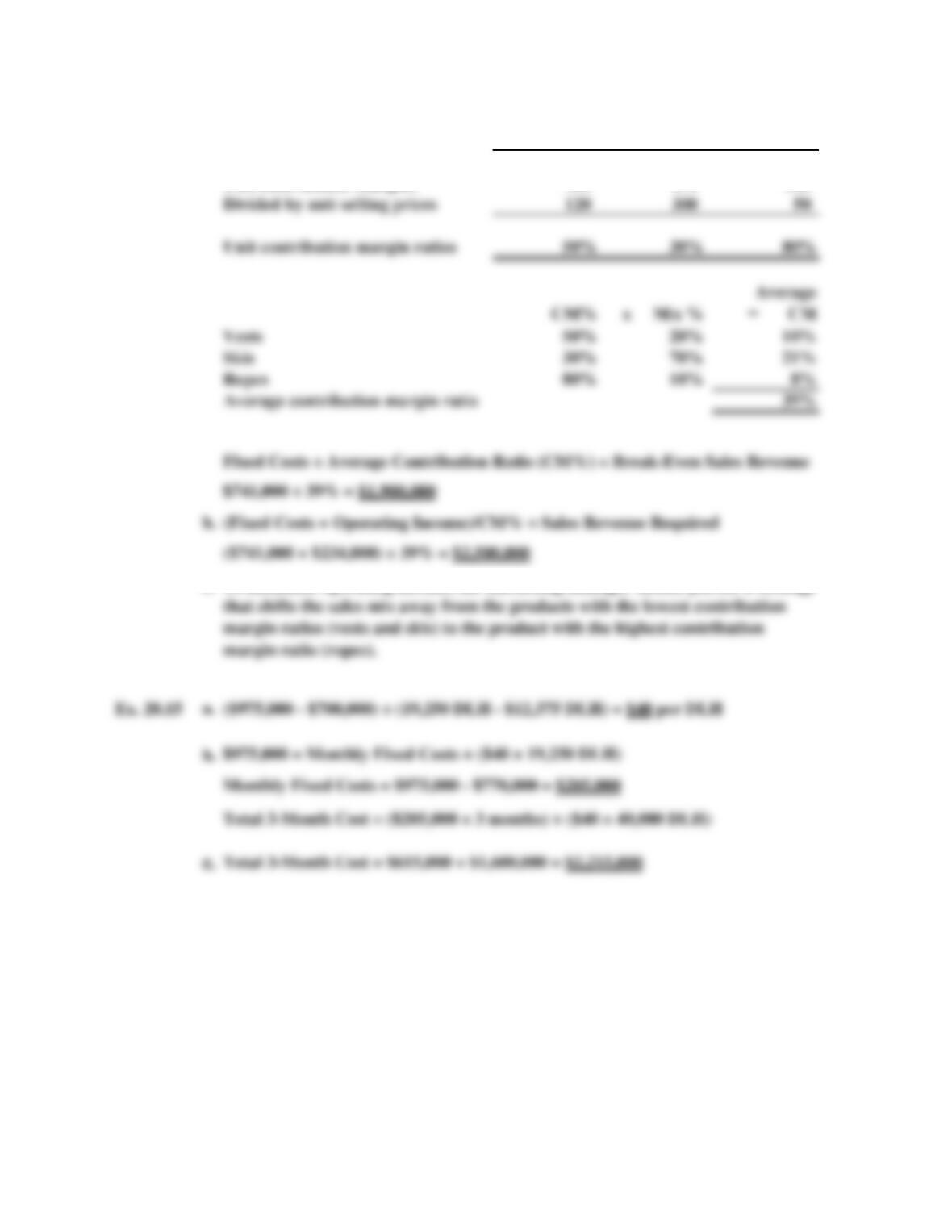
Ex. 20.14 a. Vests Skis Ropes
Unit selling prices $120 $300 $50
Unit variable costs (60) (210) (10)
Unit contribution margins $60 $90 $40
c.
To maximize operating income, the marketing manager should pursue a strategy
SOLUTIONS TO PROBLEMS SET A
25 Minutes, Easy
PROBLEM 20.1A
IONIC CHARGE
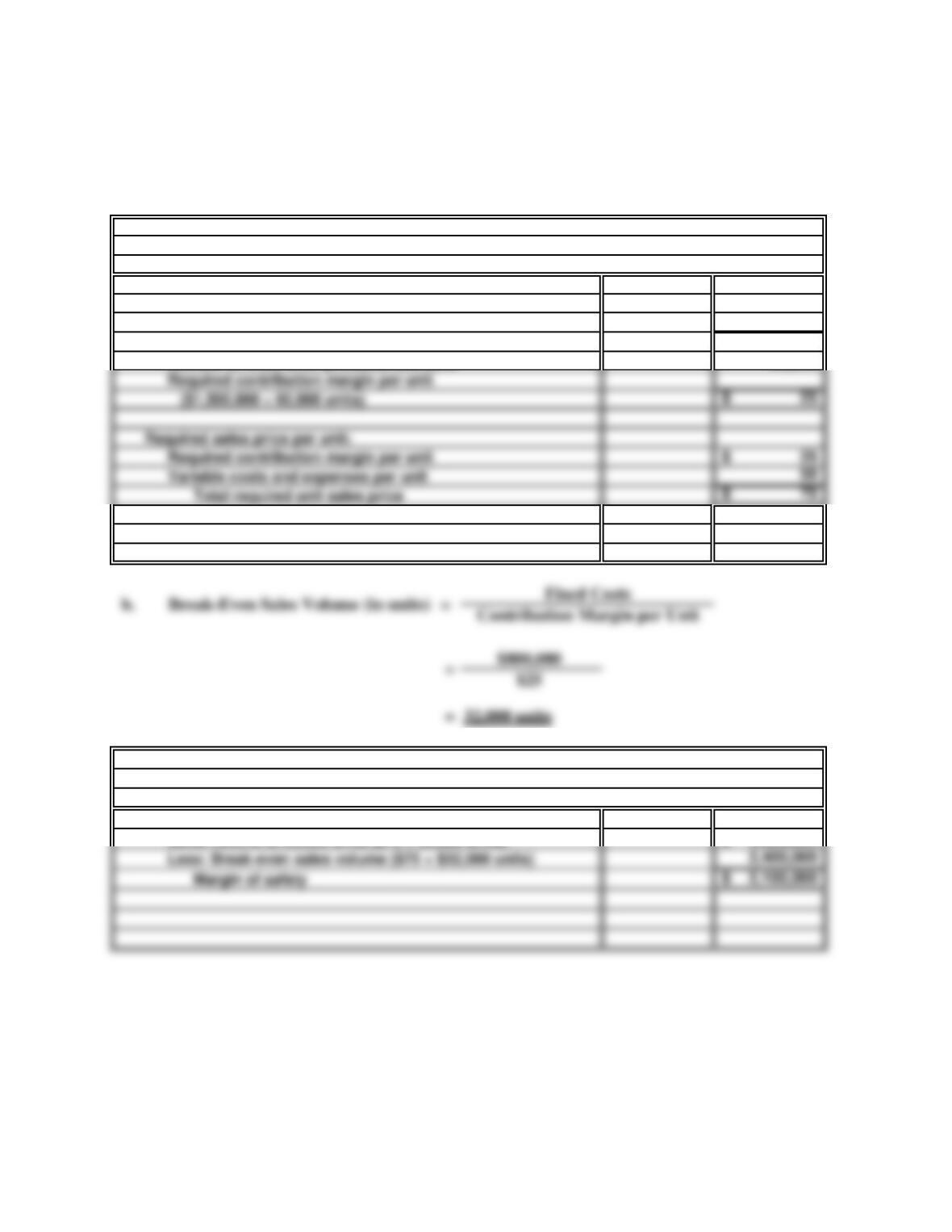
a. Required contribution margin per unit
Budgeted operating Income
700,000$
Fixed costs 800,000
Total required contribution margin 1,500,000$
Number of units to be produced and sold 60,000
c. Margin of safety at 60,000 units:
Sales volume at 60,000 units ($75 × 60,000 units)
4,500,000$
Variable costs and expenses per unit 50
PROBLEM 20.1A
IONIC CHARGE (concluded)
d.
No. With a unit sales price of $60, the break-even sales volume is 80,000 units:
25 Minutes, Medium PROBLEM 20.2A
BLASTER CORPORATION
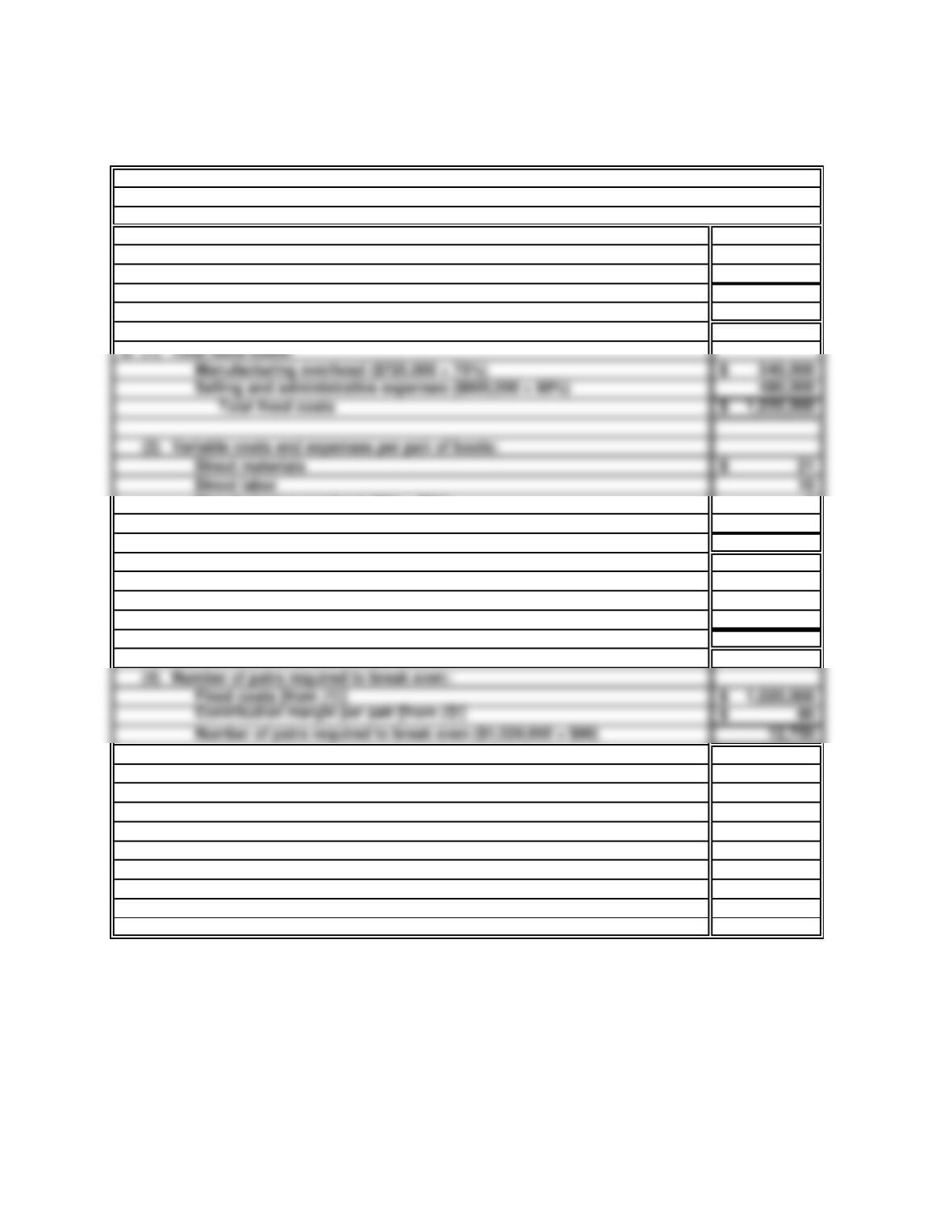
a. Sales price per unit:
Budgeted costs
2,250,000$
Add: Budgeted operating income 900,000
Budgeted sales revenue 3,150,000$
Sales price per pair ($3,150,000 ÷ 30,000 pairs) 105$
Manufacturing overhead ($24 × 25%) 6
Selling and administrative expense ($20 × 20%) 4
Total variable costs per pair 41$
(3) Contribution margin per pair of boots:
Sales price per pair
121$
Less: Variable costs per pair [from (2) ]41
Contribution margin per pair 80$
(4) Number of pairs required to break even:
Contribution margin per pair [from (3) ]80$
Number of pairs required to break even ($1,020,000 ÷ $80) 12,750
Selling and administrative expenses ($600,000 × 80%) 480,000
Total fixed costs 1,020,000$
(2) Variable costs and expenses per pair of boots:
Direct labor 10
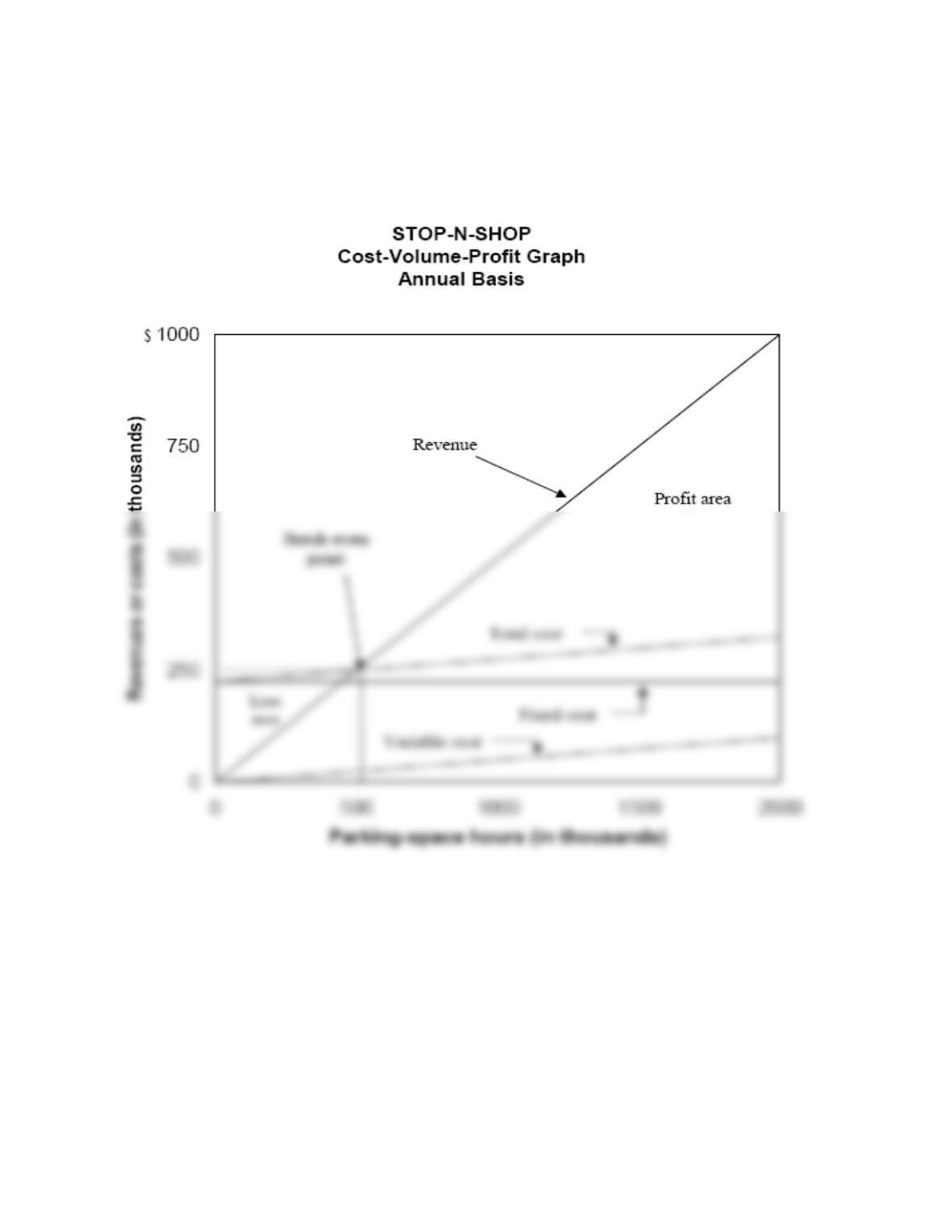
PROBLEM 20.3A
STOP-N-SHOP
a.
30 Minutes, Medium
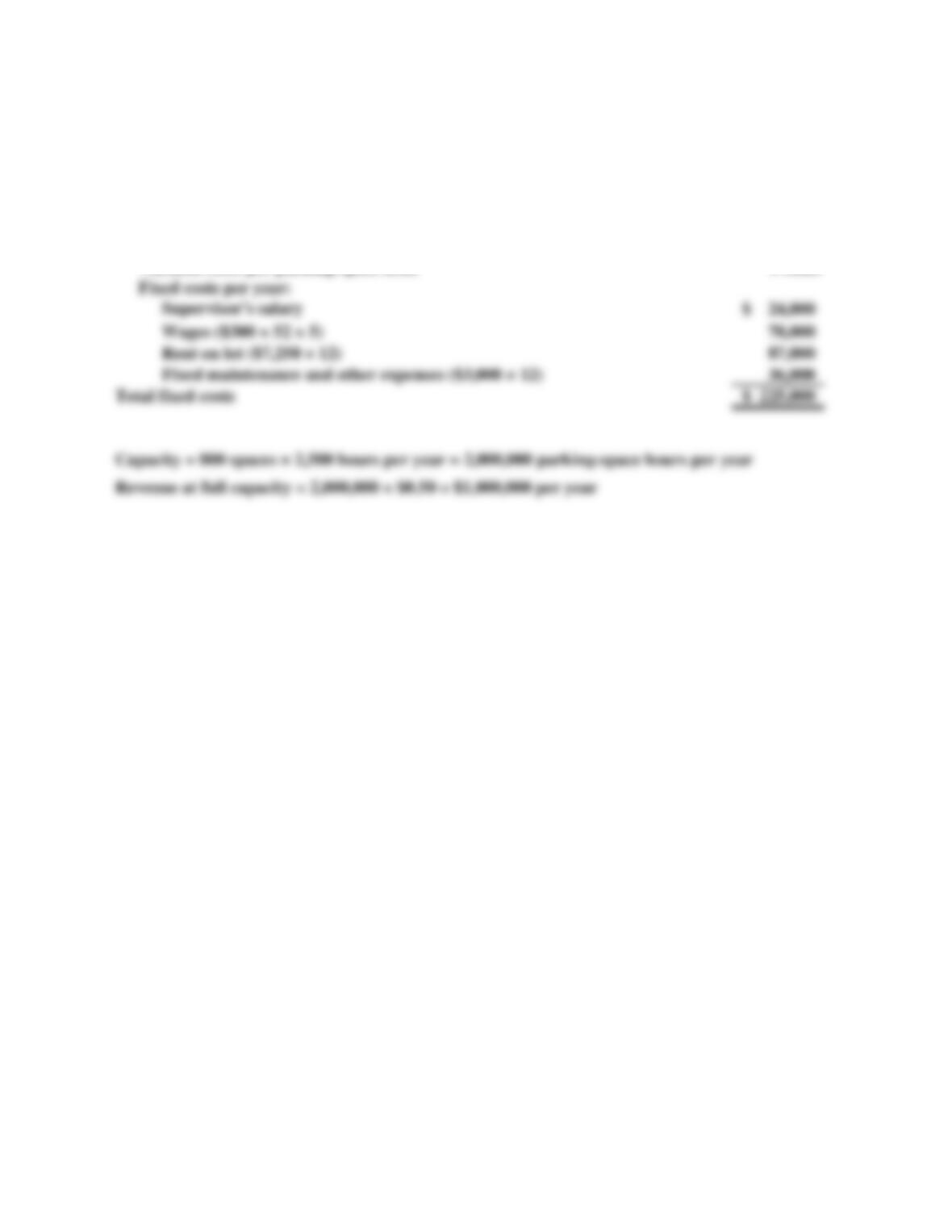
PROBLEM 20.3A
STOP-N-SHOP (continued)
The following information is used for parts b. and c. of this problem.
Operating data:
Revenue per parking-space hour 50 cents
Variable costs per parking-space hour 5 cents
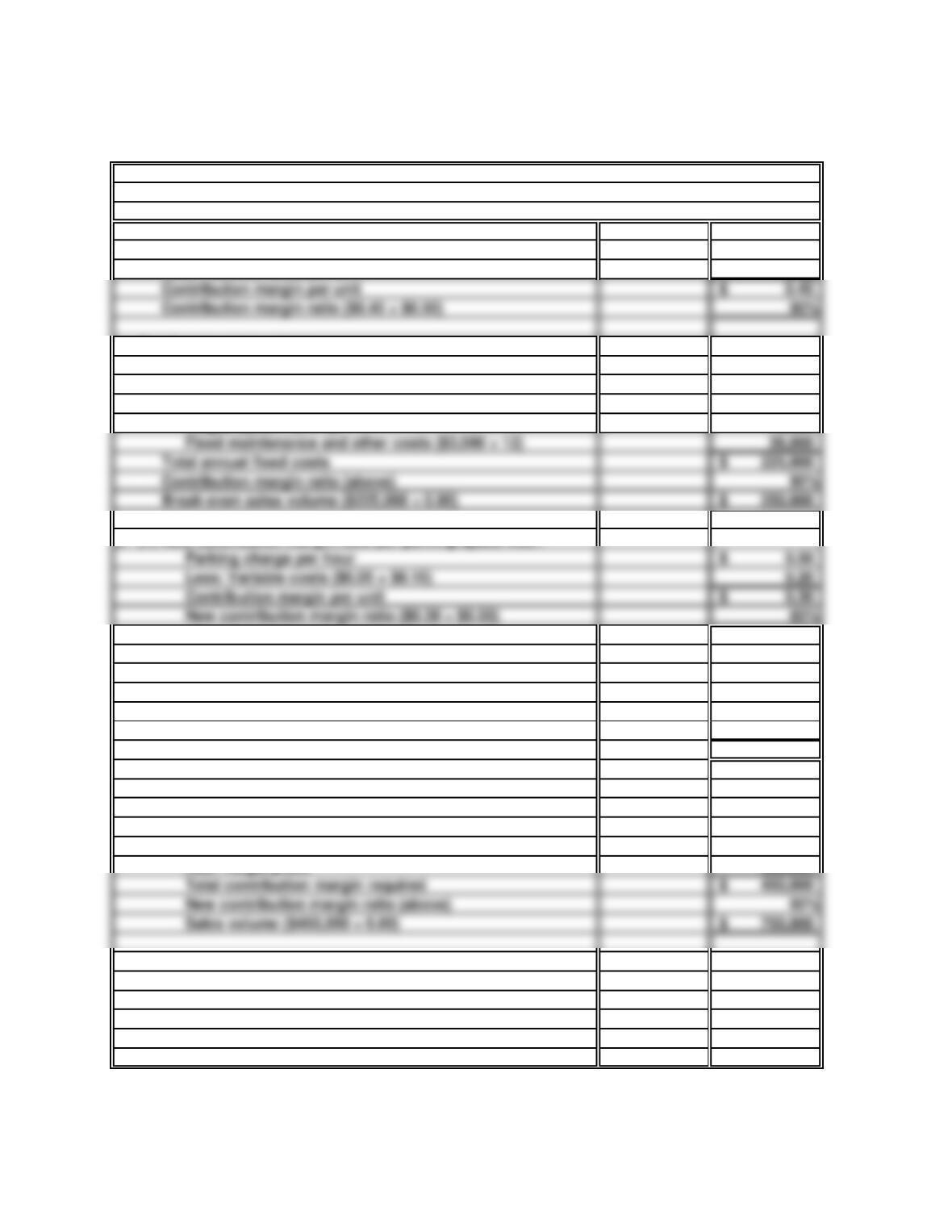
PROBLEM 20.3A
STOP-N-SHOP (concluded)
b. Contribution margin ratio:
Parking charge per hour 0.50$
Less: Variable costs per unit 0.05
Break-even sales volume:
Fixed costs:
Rent on lot ($7,250 × 12) 87,000$
Supervisor’s salary 24,000
Wages ($300 × 52 × 5) 78,000
Fixed maintenance and other costs ($3,000 × 12) 36,000
Break-even sales volume ($225,000 ÷ 0.90) 250,000$
Less: Variable costs ($0.05 + $0.15) 0.20
New contribution margin ratio ($0.30 ÷ $0.50) 60%
c. (1) New contribution margin ratio per parking-space hour:
New level of fixed costs:
Rent on lot ($7,250 × 12) 87,000$
Supervisor’s salary 24,000
Vacation pay ($300 × 2 × 5) 3,000
Fixed maintenance and other costs ($3,000 × 12) 36,000
Total fixed costs under new arrangement 150,000$
(2) Required sales revenue to produce desired operating
income:
Total fixed costs under new arrangement (above) 150,000$
Add: Target profit 300,000
Sales volume ($450,000 ÷ 0.60) 750,000$
Contribution margin ratio ($0.45 ÷ $0.50) 90%
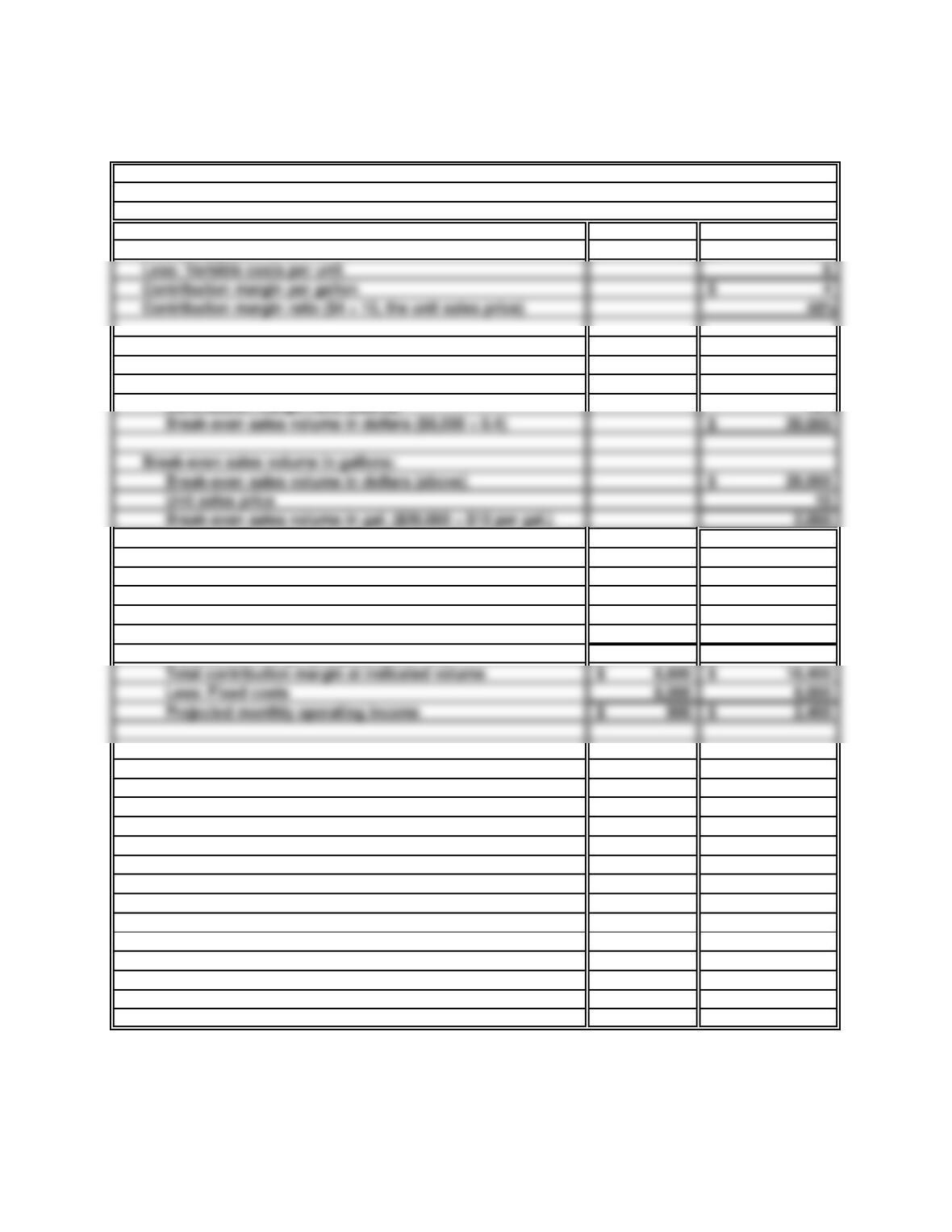
PROBLEM 20.4A
RAINBOW PAINTS
a. Contribution margin ratio:
Unit sales price 10$
Break-even sales volume in dollars:
Fixed costs ($3,160 + $3,640 + $1,200) 8,000$
Contribution margin ratio (above) 40%
b. On the following page.
c. Projected operating income at various levels:
2,200 Gallons 2,600 Gallons
Contribution margin per gallon ($10 – $6) 4$ 4$
30 Minutes, Medium
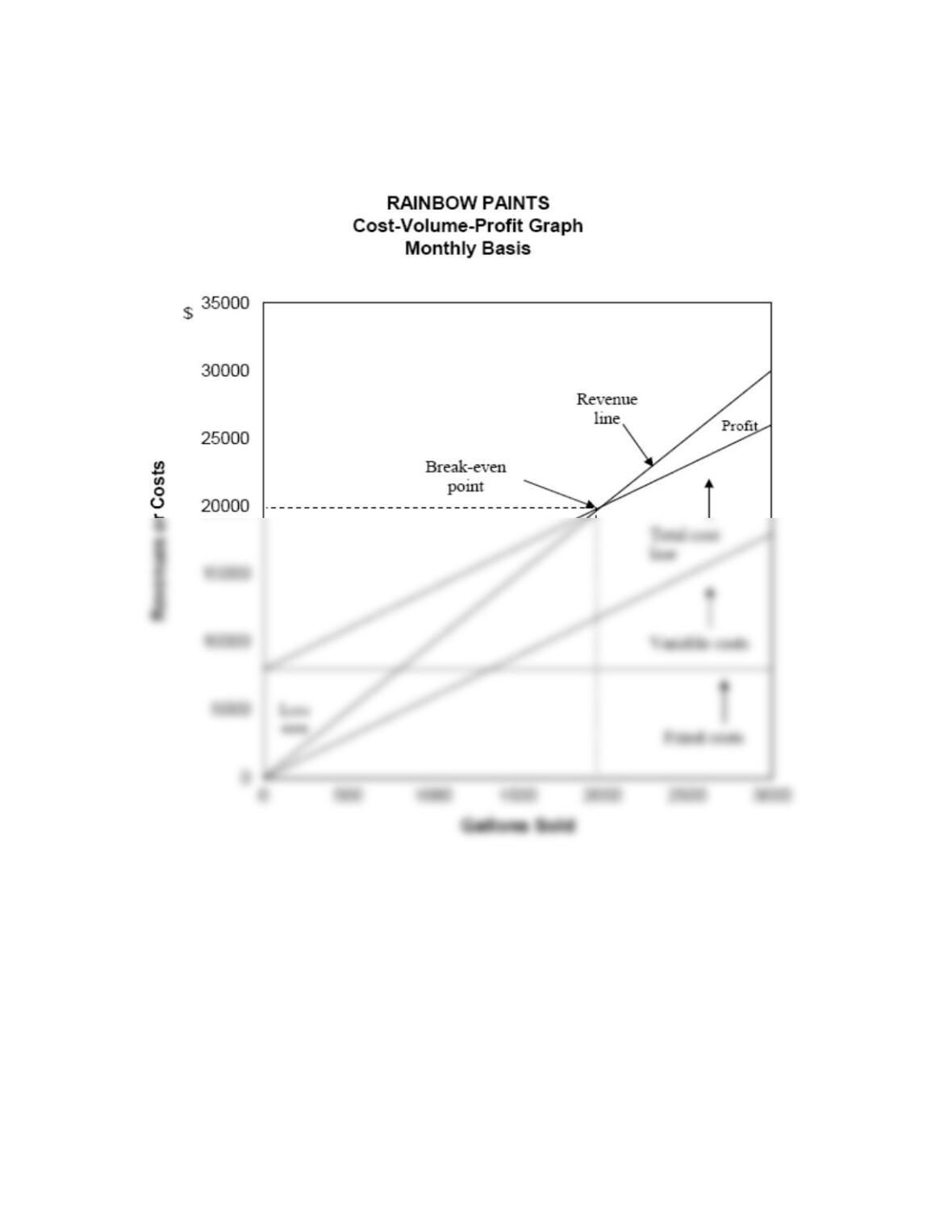
PROBLEM 20.4A
RAINBOW PAINTS (concluded)
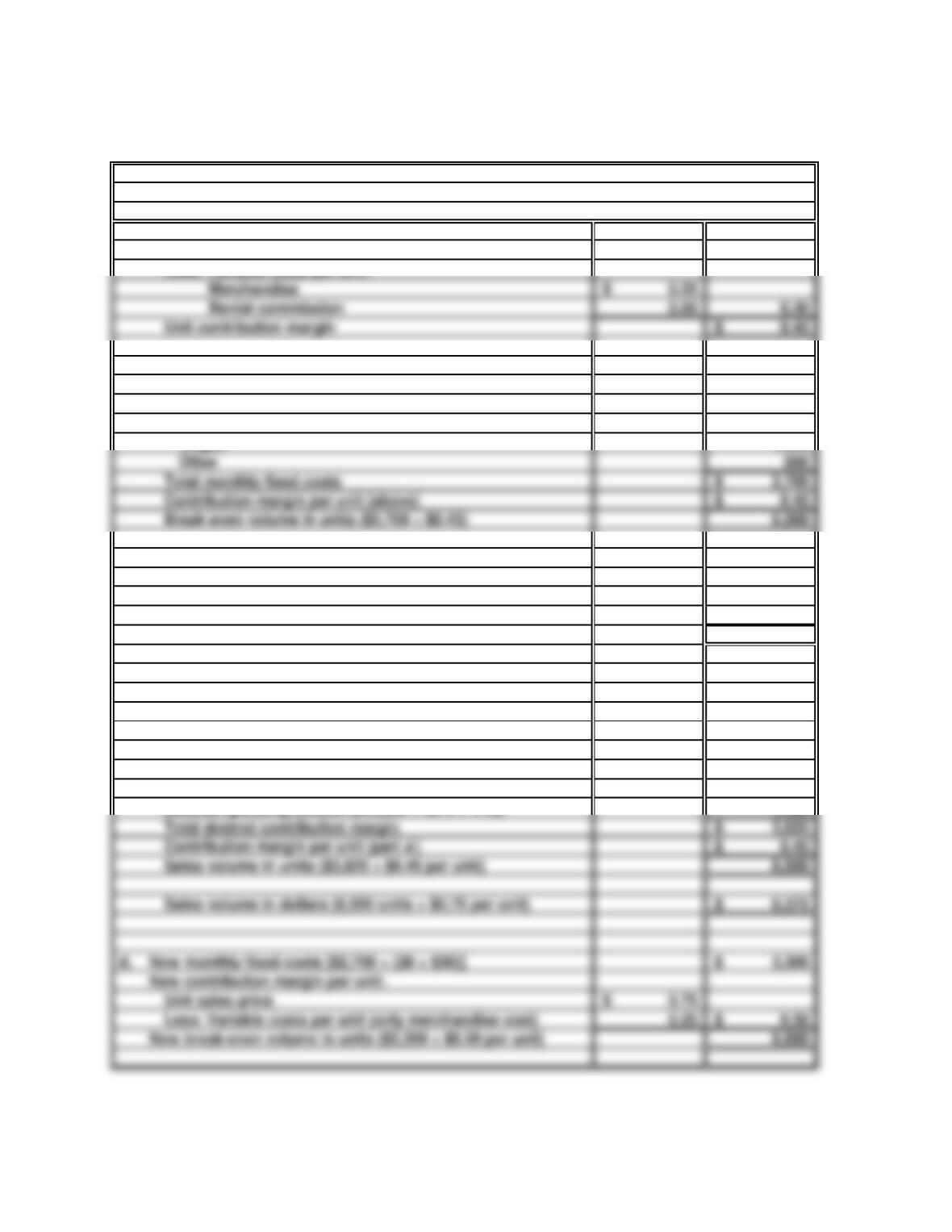
b.
40 Minutes, Strong
PROBLEM 20.5A
SIMON TEGUH
a. Unit contribution margin:
Sales price per unit 0.75$
Less: Variable costs per unit:
Break-even volume in units:
Monthly fixed costs:
Depreciation ($36,000 × 0.20 × 1/12) 600$
Wages 1,500
Contribution margin per unit (above) 0.45$
Break-even volume in units ($2,700 ÷ $0.45) 6,000
Break-even volume in dollars:
Break-even volume in units (above) 6,000
Unit sales price 0.75$
Break-even volume in dollars (6,000 units × $0.75) 4,500$
b. See following page.
c. Sales volume to produce operating income equal to 30%
return on investment:
Total monthly fixed costs (part a)2,700$
Desired operating income ($45,000 × 30% × 1/12) 1,125
Contribution margin per unit (part a)0.45$
Sales volume in units ($3,825 ÷ $0.45 per unit) 8,500
Less: Variable costs per unit (only merchandise cost) 0.25 0.50$
Unit contribution margin 0.45$
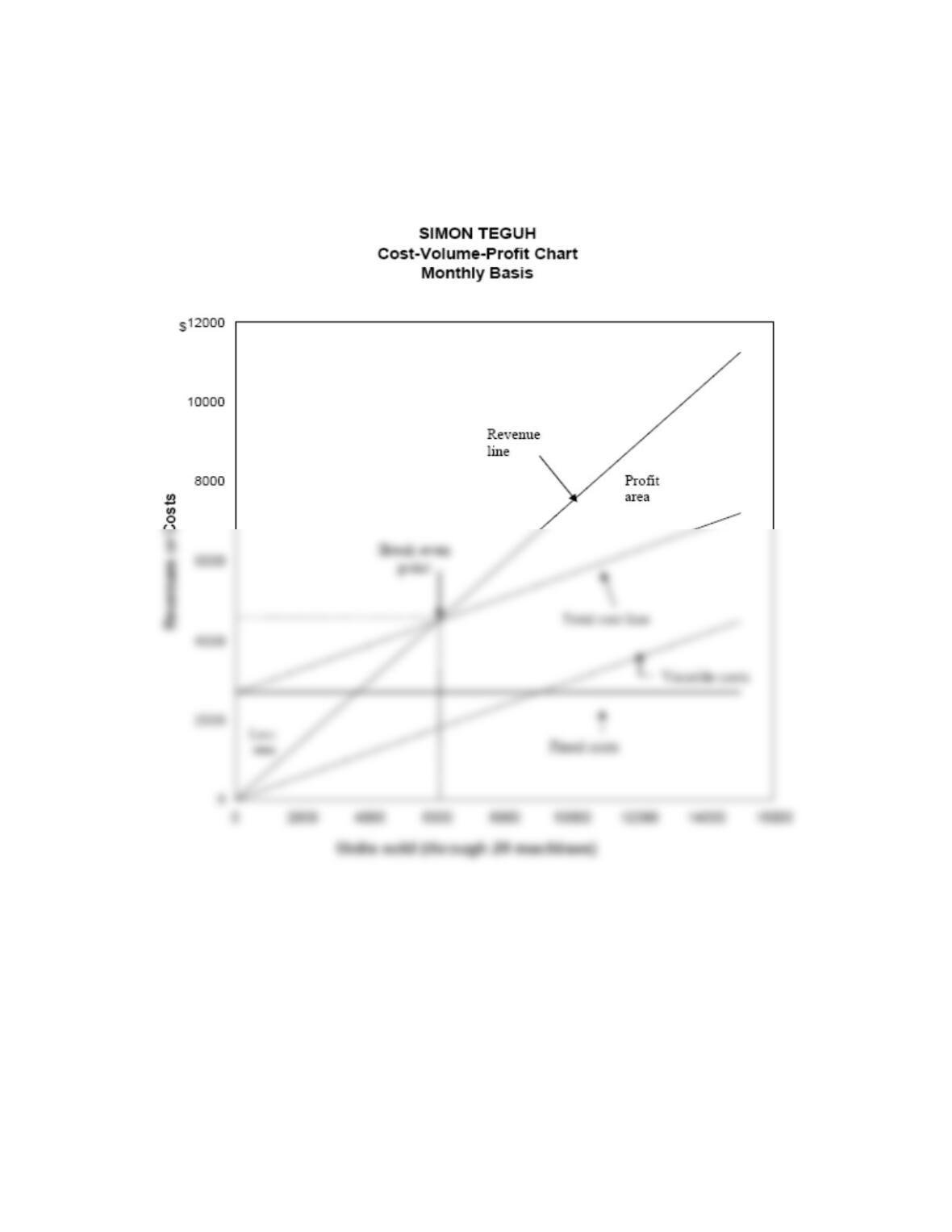
PROBLEM 20.5A
SIMON TEGUH (concluded)
b.
30 Minutes, Strong PROBLEM 20.6A
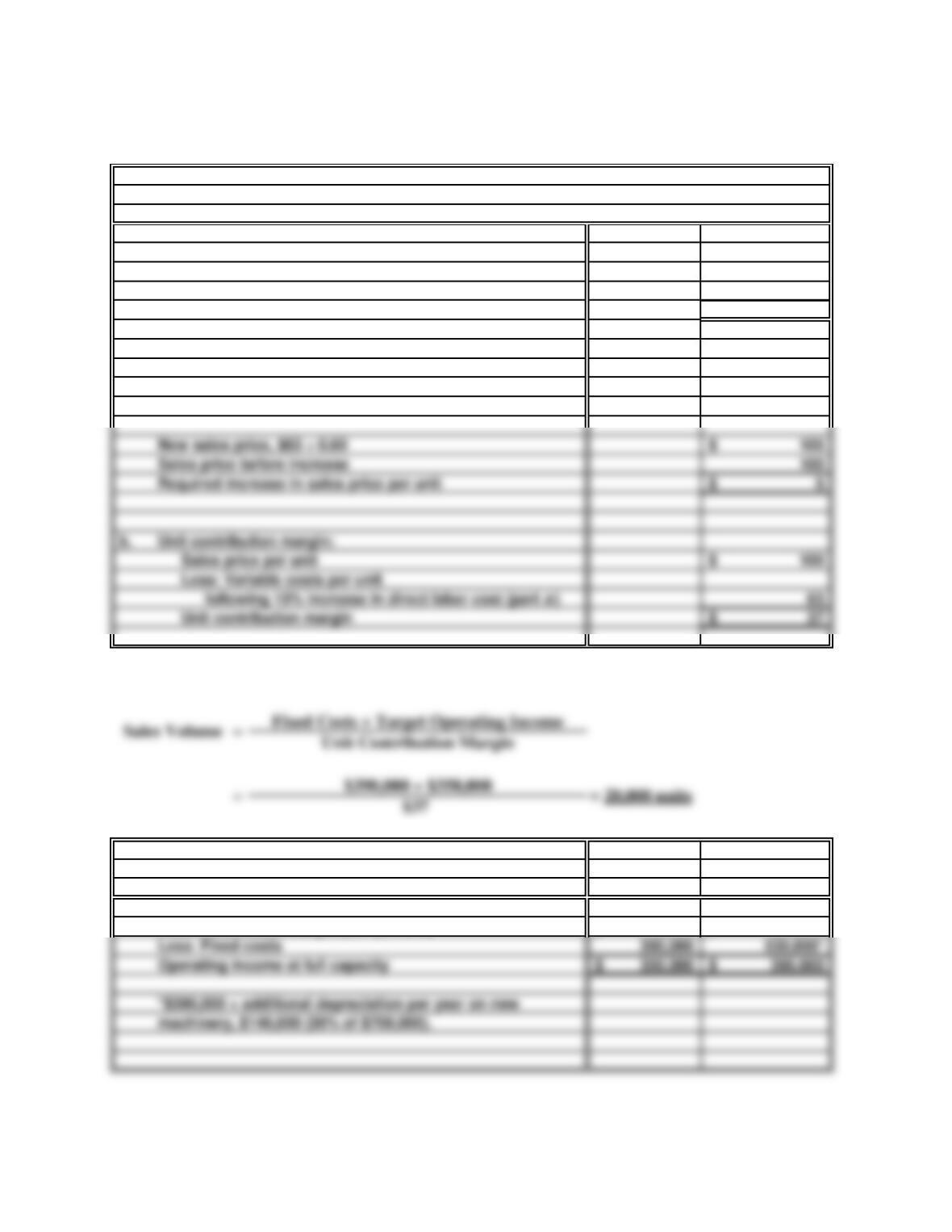
PRECISION SYSTEMS
a. Variable costs per unit before 15% increase in the cost of
direct labor 60$
Increase in cost of direct labor, 15% of $20 3
Variable costs and expenses per unit
after 15% increase in the cost of direct labor 63$
Because the contribution margin ratio of 40% is required,
the variable costs of $63 per unit must equal 60%
of sales price after the wage increase.
c. Current After
Capacity Expansion
(20,000 Units) (25,000 Units)
Total contribution margin ($37 per unit) 740,000$ 925,000$
Less: Fixed costs 390,000 530,000*
Operating income at full capacity 350,000$ 395,000$
Sales volume required to maintain current operating income:
Sales price before increase 100
Required increase in sales price per unit 5$
Unit contribution margin 37$
35 Minutes, Strong PROBLEM 20.7A
PERCULA FARMS
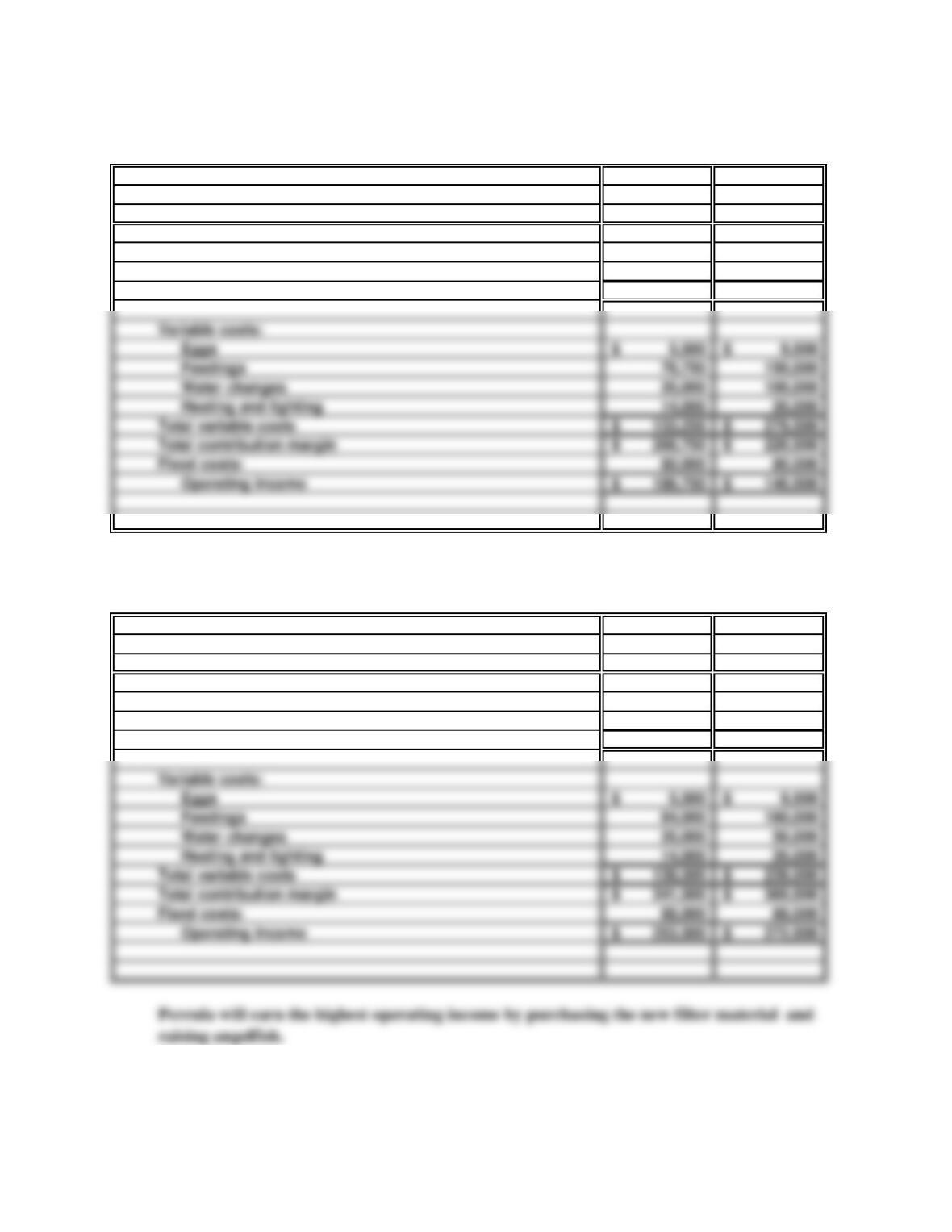
a. Raising clownfish will result in the highest
operating income.
Clownfish Angelfish
Number of salable fish 100,000 50,000
× sale price 4$ 10$
Total revenue 400,000$ 500,000$
b.
c. and d.
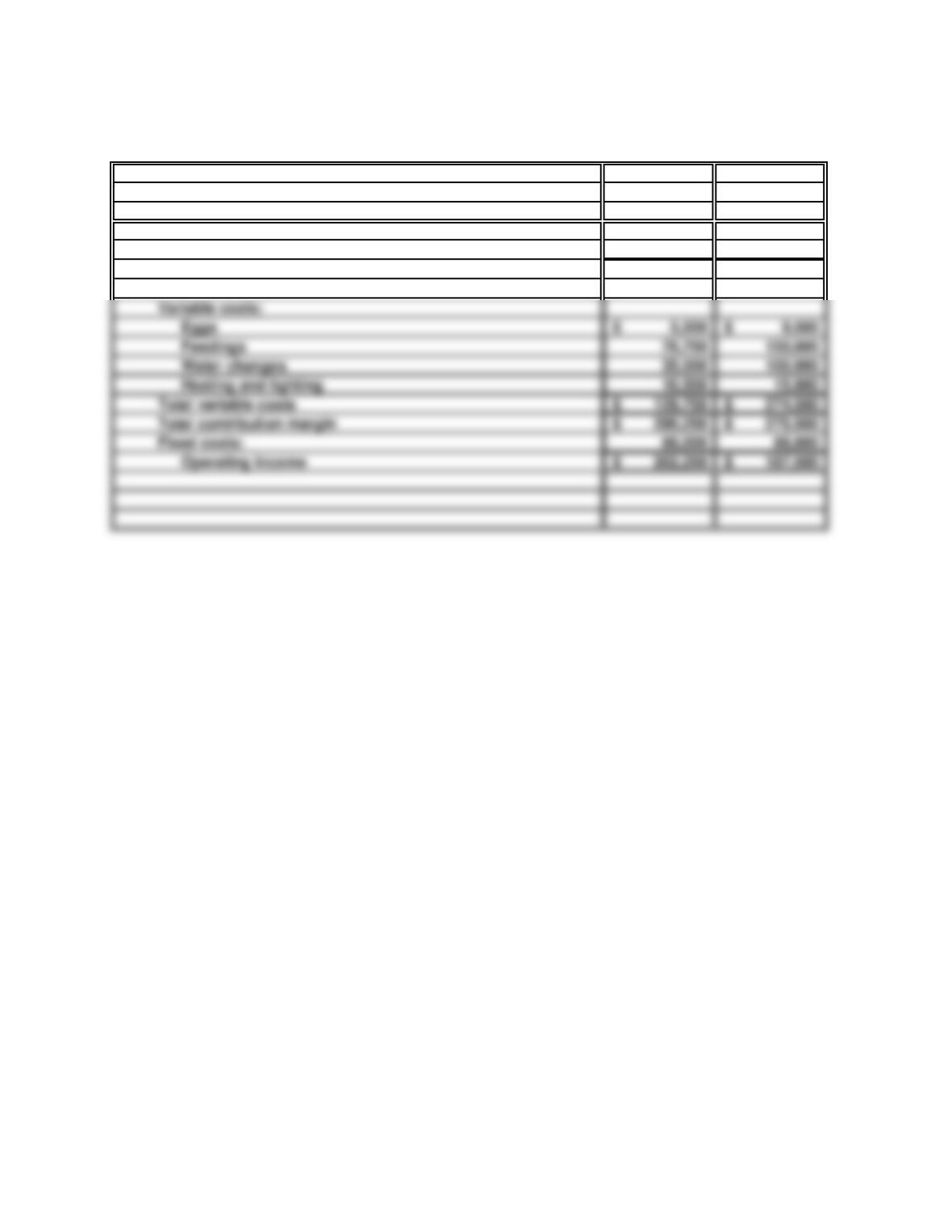
Operating income with new filter material:
Clownfish Angelfish
Number of salable fish 120,000 60,000
× sale price 4$ 10$
Total revenue 480,000$ 600,000$
Heating and lighting 14,000 20,000
Total variable costs 138,500$ 239,500$
Fixed costs: 88,000 88,000
Operating income 253,500$ 272,500$
The most important factors in determining operating income are survival rates, and the
costs of feeding and water changes.
Heating and lighting 14,000 20,000
Total variable costs 133,250$ 279,500$
Fixed costs: 80,000 80,000
Operating income 186,750$ 140,500$
PROBLEM 20.7A
PERCULA FARMS (concluded)
c. and d.
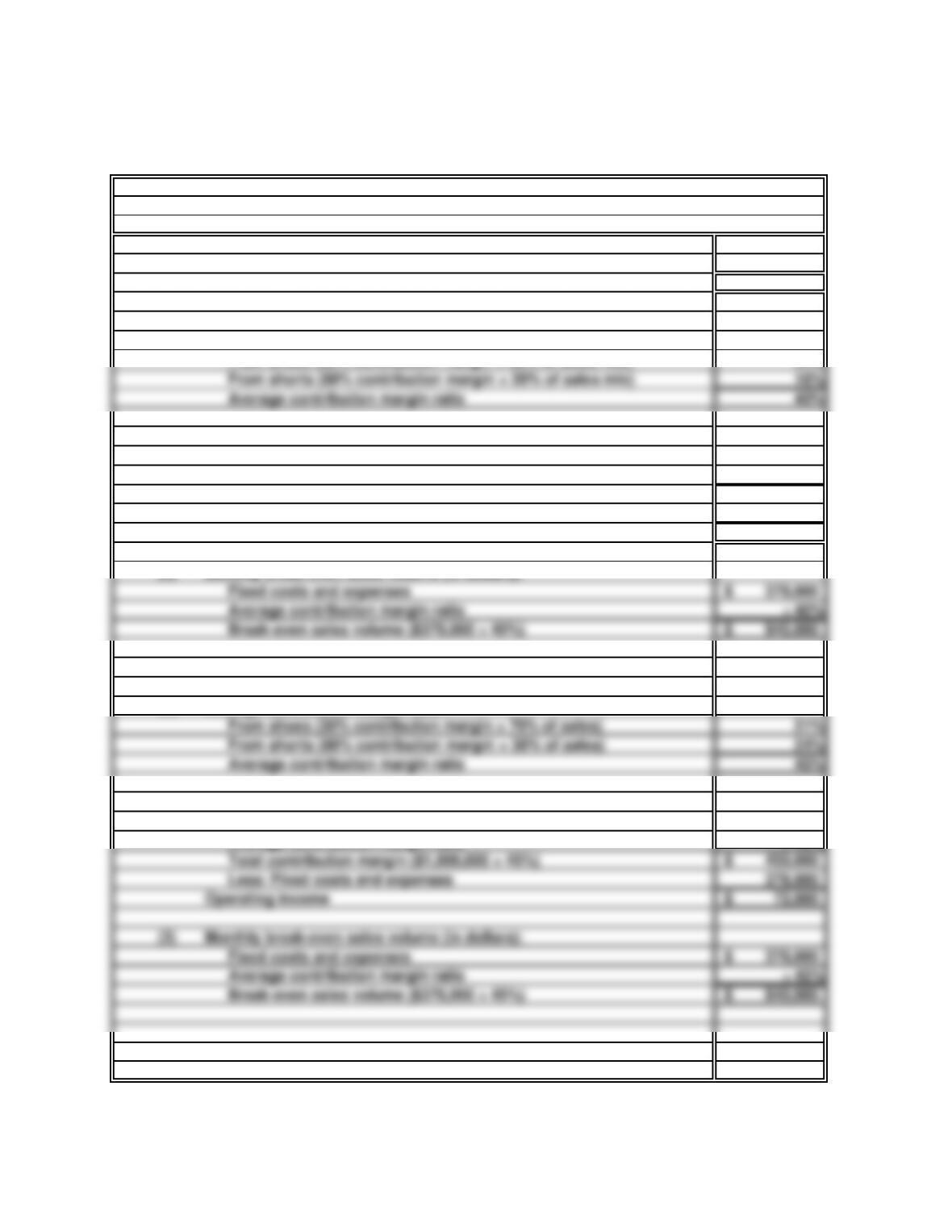
Operating income with new heating and lighting
equipment: Clownfish Angelfish
Number of salable fish 105,000 55,000
× sale price 4$ 10$
Total revenue 420,000$ 550,000$
Operating income 202,250$ 187,500$
PROBLEM 20.8A
LIFEFIT PRODUCTS
a. Contribution margins of product lines:
Shoes ($15 contribution margin ÷ $50 sales price) 30%
Shorts ($4 contribution margin ÷ $5 sales price) 80%
b. (1) Average contribution margin ratio:
From shoes (30% contribution margin × 80% of sales mix) 24%
(2) Monthly operating income:
Total sales 1,000,000$
Average contribution margin ratio × 40%
Total contribution margin ($1,000,000 × 40%) 400,000$
Less: Fixed costs and expenses 378,000
Operating income 22,000$
Average contribution margin ratio ÷ 40%
Break-even sales volume ($378,000 ÷ 40%) 945,000$
(3) Monthly break-even sales volume (in dollars):
From shorts (80% contribution margin × 30% of sales) 24%
Average contribution margin ratio 45%
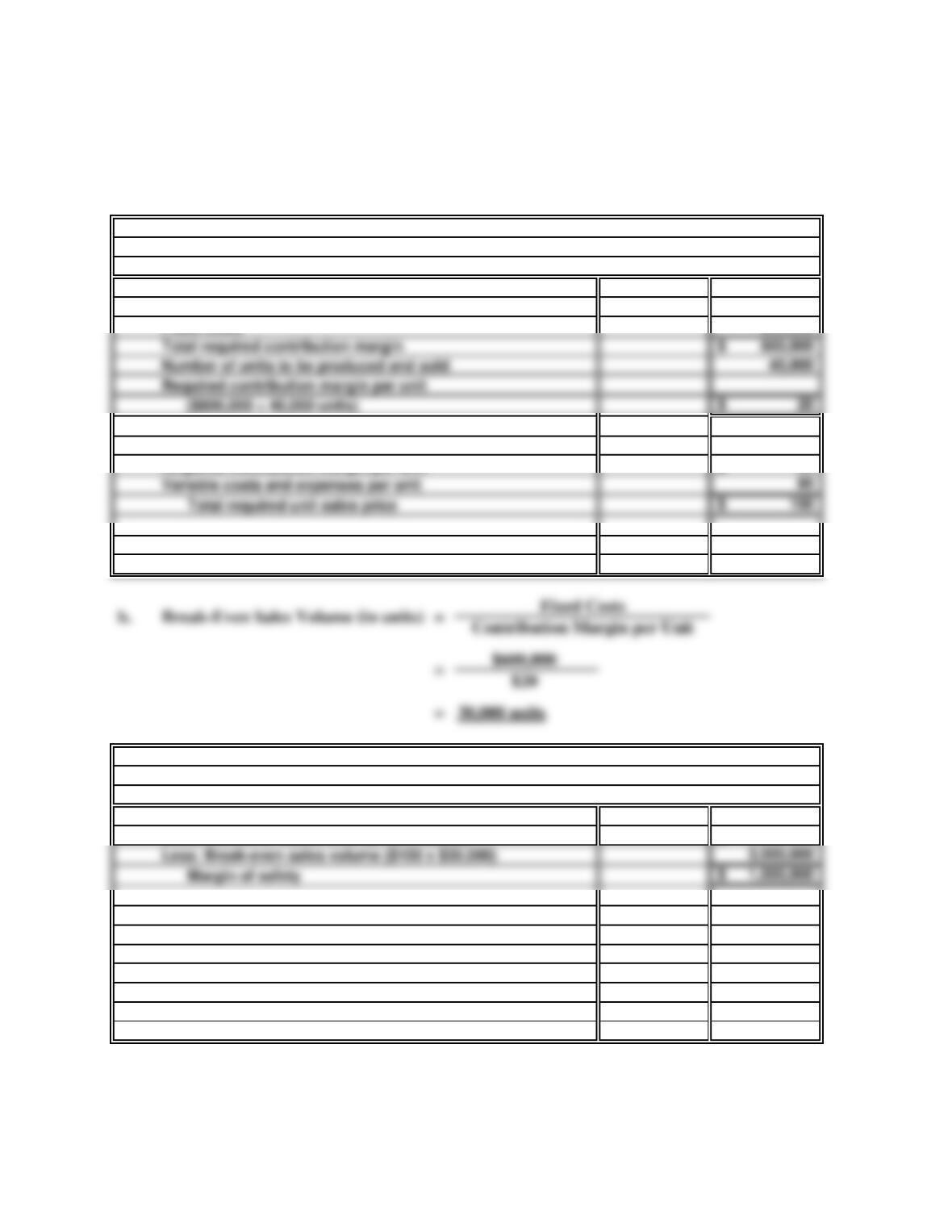
c. Assuming new sales mix (shoes, 70%; shorts, 30%)
(1) Average contribution margin ratio:
(2) Monthly operating income:
Total sales 1,000,000$
Average contribution margin ratio × 45%
Less: Fixed costs and expenses 378,000
Average contribution margin ratio ÷ 45%
Break-even sales volume ($378,000 ÷ 45%) 840,000$
35 Minutes, Strong
From shorts (80% contribution margin × 20% of sales mix) 16%
Average contribution margin ratio 40%

PROBLEM 20.8A
LIFELIFT PRODUCTS (concluded)
d.
In the new sales mix, increased sales of shorts have replaced some sales of shoes. Shorts
SOLUTIONS TO PROBLEMS SET B
25 Minutes, Medium
PROBLEM 20.1B
NATHE, INC.
a. Required contribution margin per unit
Budgeted operating Income 200,000$
Fixed costs 600,000
Required sales price per unit:
Required contribution margin per unit 20$
c. Margin of safety at 40,000 units:
Sales volume at 40,000 units ($100 x 40,000) 4,000,000$
PROBLEM 20.1B
NATHE, INC. (concluded)
d.
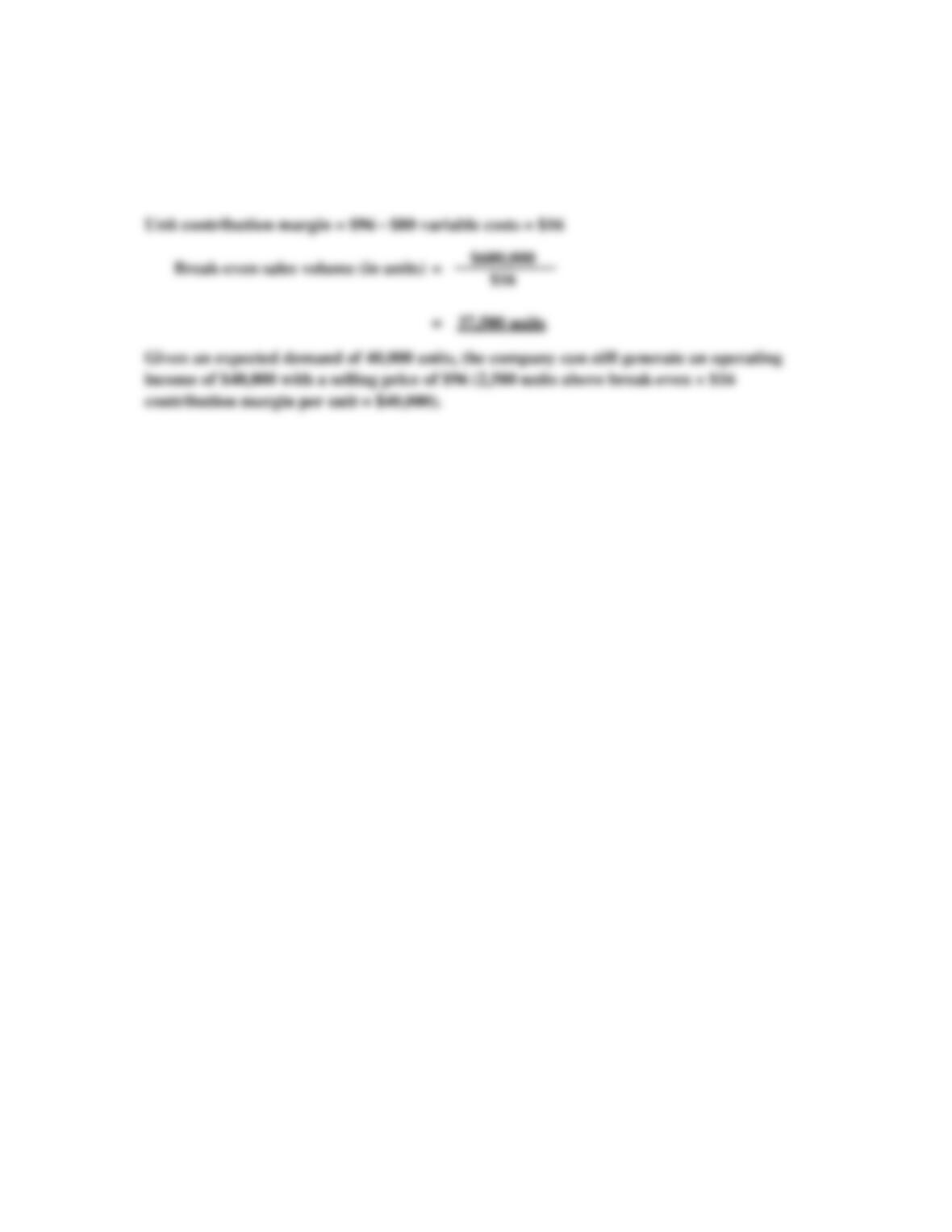
Yes. With a unit sales price of $96, the break-even sales volume is 37,500 units: