CE20.3
According to FASB ASC 715-30–35-4 (Defined-Benefit Plans – Pension – Components of Net Periodic
Cost):
All of the following components shall be included in the net pension cost recognized for a period by an
employer sponsoring a defined-benefit pension plan:
(a) Service cost
CE20.4
According to FASB ASC 715-20–50-6 (Defined-Benefit Plans – General – Interim Disclosure
Requirements for Publicly Traded Entities):
A publicly traded entity shall disclose the following information for its interim financial statements that
include a statement of income:
(a) The amount of net benefit cost recognized, for each period for which a statement of income is
presented, showing separately each of the following:
CODIFICATION RESEARCH CASE
(a) According to FASB ASC 715-30–35:
35–22 Asset gains and losses are differences between the actual
return on plan assets during a period and the expected return
on plan assets for that period. Asset gains and losses include
35–24 As a minimum, amortization of a net gain or loss included in
accumulated other comprehensive income (excluding asset
gains and losses not yet reflected in market-related value) shall
be included as a component of net pension cost for a year if,
as of the beginning of the year, that net gain or loss exceeds 10
CODIFICATION RESEARCH CASE (Continued)
(b) According to FASB ASC 715-30–35:
Gains and Losses
35–18 As established in the definition of the term, a gain or loss
results from a change in the value of either the projected
benefit obligation or the plan assets resulting from experience
35–19 Because gains and losses may reflect refinements in estimates
as well as real changes in economic values and because some
(c) According to FASB ASC 715-30–25:
25-1 If the projected benefit obligation exceeds the fair value of plan
assets, the employer shall recognize in its statement of
financial position a liability that equals the unfunded projected
IFRS CONCEPTS AND APPLICATION
IFRS20.1
Net interest is defined as the amount that accrues by multiplying the net
benefit obligation by the discount rate (using defined benefit obligation and
the pension asset balances as of the beginning of the year). The discount
rate is based on the yields of high-quality bonds with terms consistent with
IFRS20.2
The service cost component of pension expense is determined as the
actuarial present value of benefits attributed by the pension benefit formula
IFRS20.3
Past service cost is the cost of retroactive benefits (either positive or
negative) granted in a plan amendment or initiation of a pension plan. Also
IFRS20.4
Bill is not correct. Liability gains and losses, although not included in
pension expense, are recorded in other comprehensive income in the
IFRS20.5
Joshua Co. would report a pension asset of $10,000 ($345,000 – $335,000)
IFRS20.6
Current Service cost ……………………………………………….. $26,000
Past Service cost …………………………………………………….. (125,000)
IFRS20.7
Statement of Comprehensive Income
Revenues $125,000
Expenses 85,000
20-98 Copyright © 2019 WILEY Kieso, Intermediate Accounting, 17/e, Solutions Manual (For Instructor Use Only)
IFRS20-8
IFRS20.10
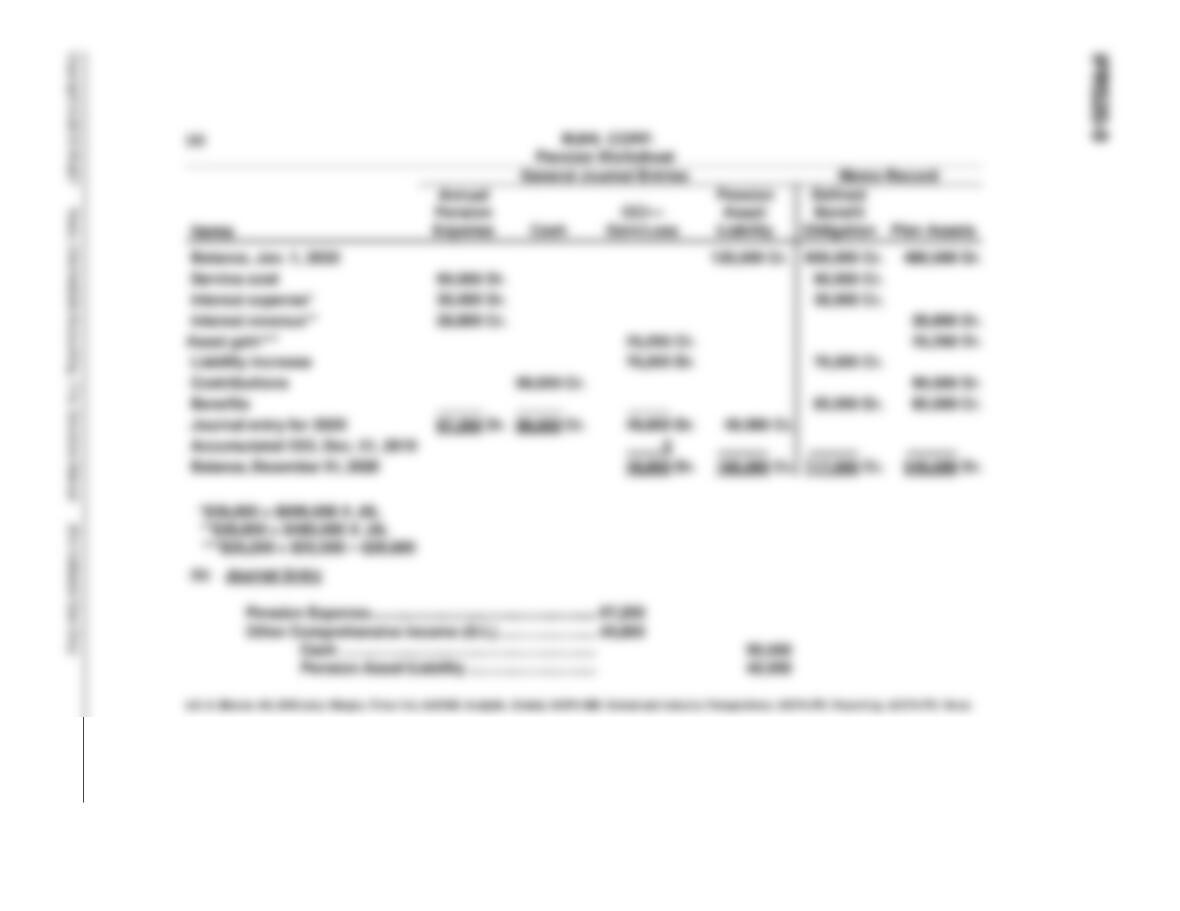
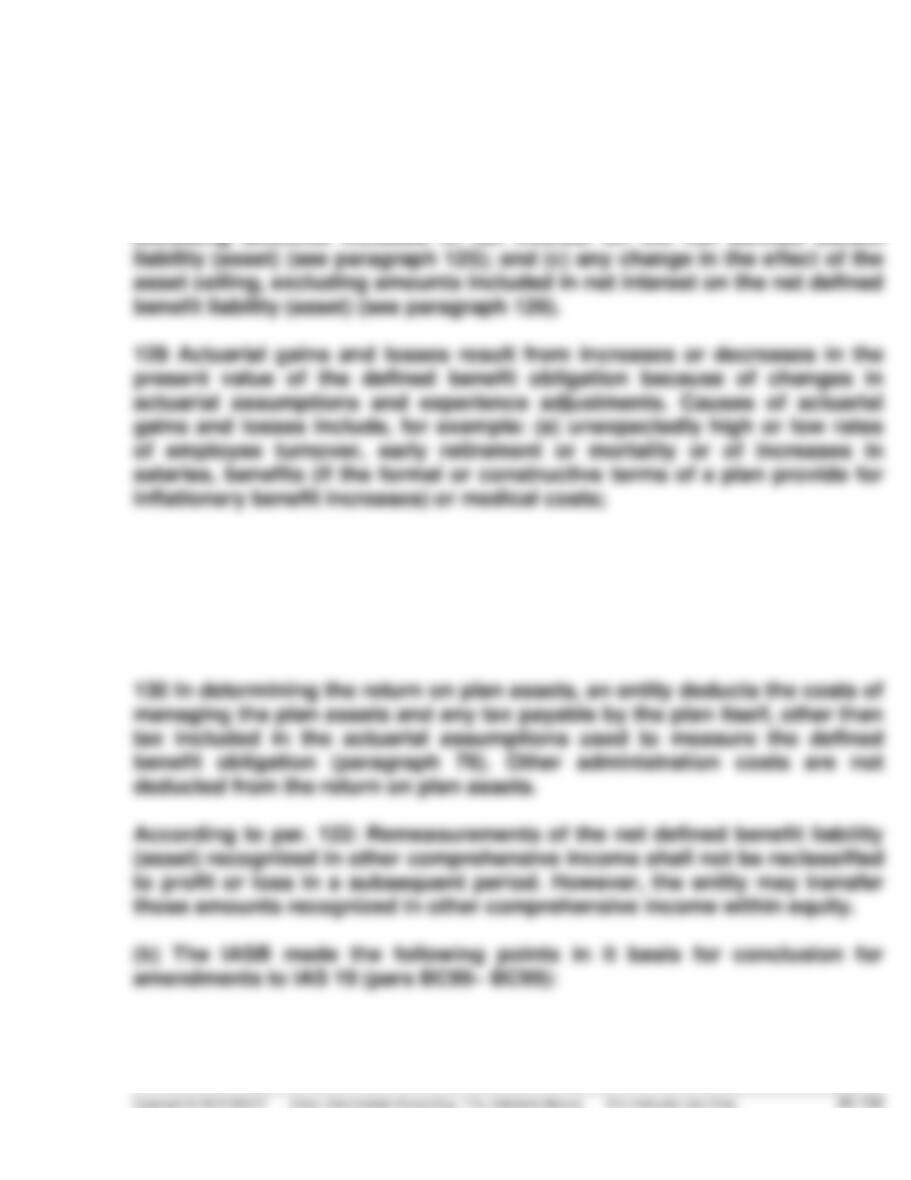
(a) Actual Return = (Ending – Beginning) – (Contributions – Benefits)
Fair value of plan assets,
(b) Computation of pension liability gains and losses and pension asset gains and losses.
Difference between 12/31/20 actuarially computed DBO and 12/31/20 recorded
projected benefit obligation (DBO):
DBO at end of year …………………………………. $3,300
DBO per memo records:
1/1/20 DBO …………………………………………. $2,500
The amount recorded in other comprehensive income is the asset gain and
liability loss:
Asset gain ………………………………………………………………………… $ 250
Liability loss ……………………………………………………………………… 350
IFRS20.11
Accounting Research
(a) According to IAS 19, (pars 127–130) 127 Remeasurements of the net
defined benefit liability (asset) comprise: (a) actuarial gains and losses (see
paragraphs 128 and 129); (b) the return on plan assets (see paragraph 130),
excluding amounts included in net interest on the net defined benefit
129 Actuarial gains and losses do not include changes in the present value
of the defined benefit obligation because of the introduction, amendment,
curtailment or settlement of the defined benefit plan, or changes to the
benefits payable under the defined benefit plan. Such changes result in
past service cost or gains or losses on settlement.
IFRS20.11 (Continued)
BC90 The Board confirmed the proposal made in the 2010 ED that an entity
should recognize remeasurements in other comprehensive income. The
Board acknowledged that the Conceptual Framework and IAS 1 do not
describe a principle that would identify the items an entity should
With respect to recycling these amounts into net income in subsequent
periods:
BC99 Both before and after the amendments made in 2011, IAS 19 prohibits
subsequent reclassification of remeasurements from other comprehensive
income to profit or loss. The Board prohibited such reclassification
because:
(1) there is no consistent policy on reclassification to profit or loss in
IFRS20.11 (Continued)
64 When an entity has a surplus in a defined benefit plan, it shall measure
the net defined benefit asset at the lower of: (a) the surplus in the defined
benefit plan; and (b) the asset ceiling, determined using the discount rate
specified in paragraph 83.
65 A net defined benefit asset may arise where a defined benefit plan has
been overfunded or where actuarial gains have arisen. An entity recognises
IFRS20.12
(a) The Group provides pension arrangements for the benefit of its UK
employees through the Marks & Spencer UK Pension Scheme (a
defined benefit (DB) arrangement) and Your M&S Pension Saving Plan
(a defined contribution (DC) arrangement). The UK DB pension
scheme operated on a final salary basis and is governed by a Trustee
board which is independent of the Group. On closure of the UK DB
pension scheme, all remaining active members moved to deferred
status which resulted in a curtailment charge of £127.0m. There will
(b)
2017
Pension expense
£198.4 million
2016
Pension expense
£86.7 million
(c) Impact on 2017 financial statements: pension expense decreased net
IFRS20.12 (Continued)
(d) The investment strategy of the UK DB pension scheme is driven by its
liability profile, including its inflation-linked pension benefits. In
addition to its interest in the Scottish Limited Partnership (see note