Exercise 2-14 (20 minutes)
1. The estimated total manufacturing overhead cost is computed as fol-
lows:
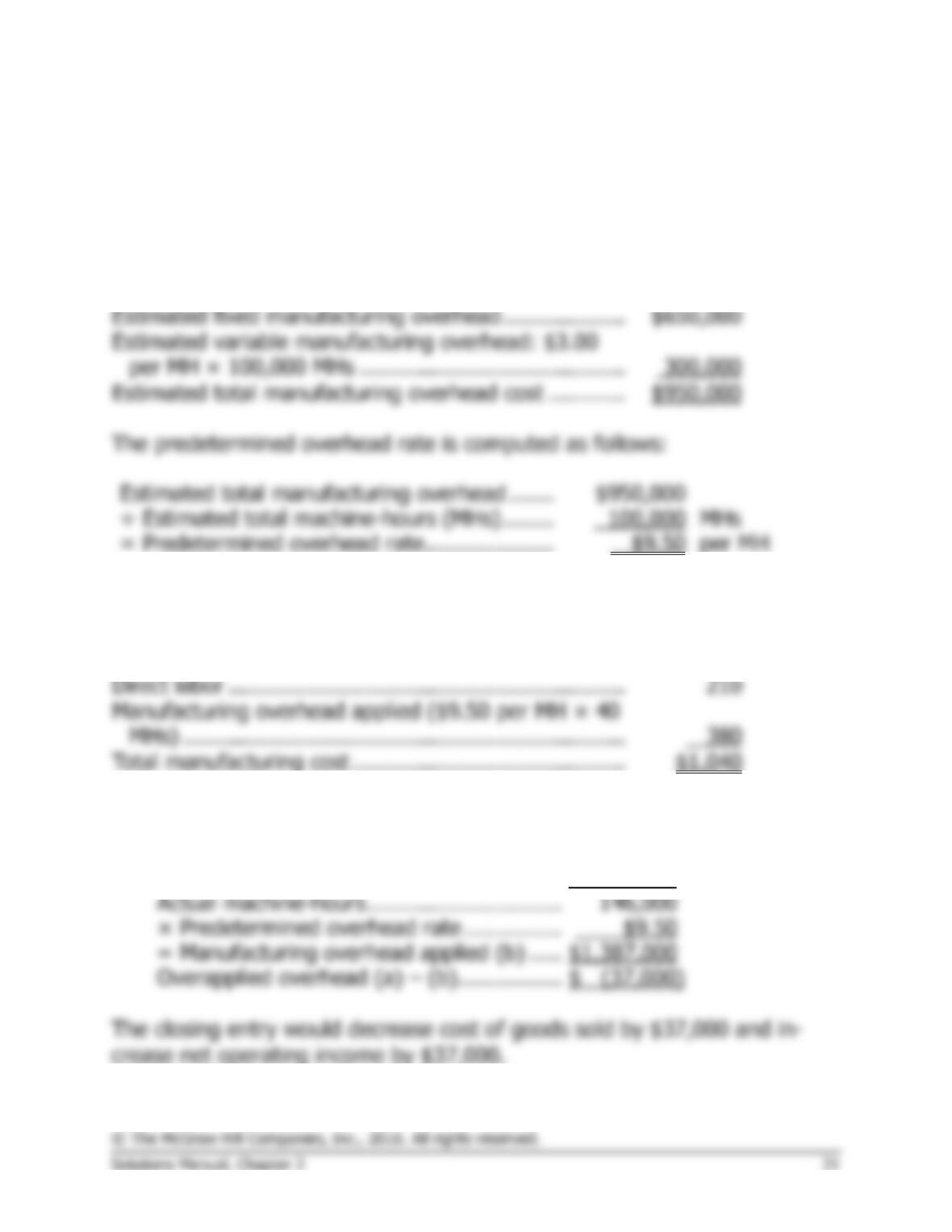
Y = $650,000 + ($3.00 per MH)(100,000 MHs)
$650,000
Estimated total manufacturing overhead cost …………
÷ Estimated total machine-hours (MHs) ……..
per MH
2. Total manufacturing cost assigned to Job 400:
Direct materials ……………………………………………….
$ 450
Direct labor …………………………………………………….
3. Computing underapplied/overapplied overhead:
Actual manufacturing overhead (a) ……….
$1,350,000
= Manufacturing overhead applied (b) …..
Exercise 2-15 (15 minutes)
1. Cutting Department:
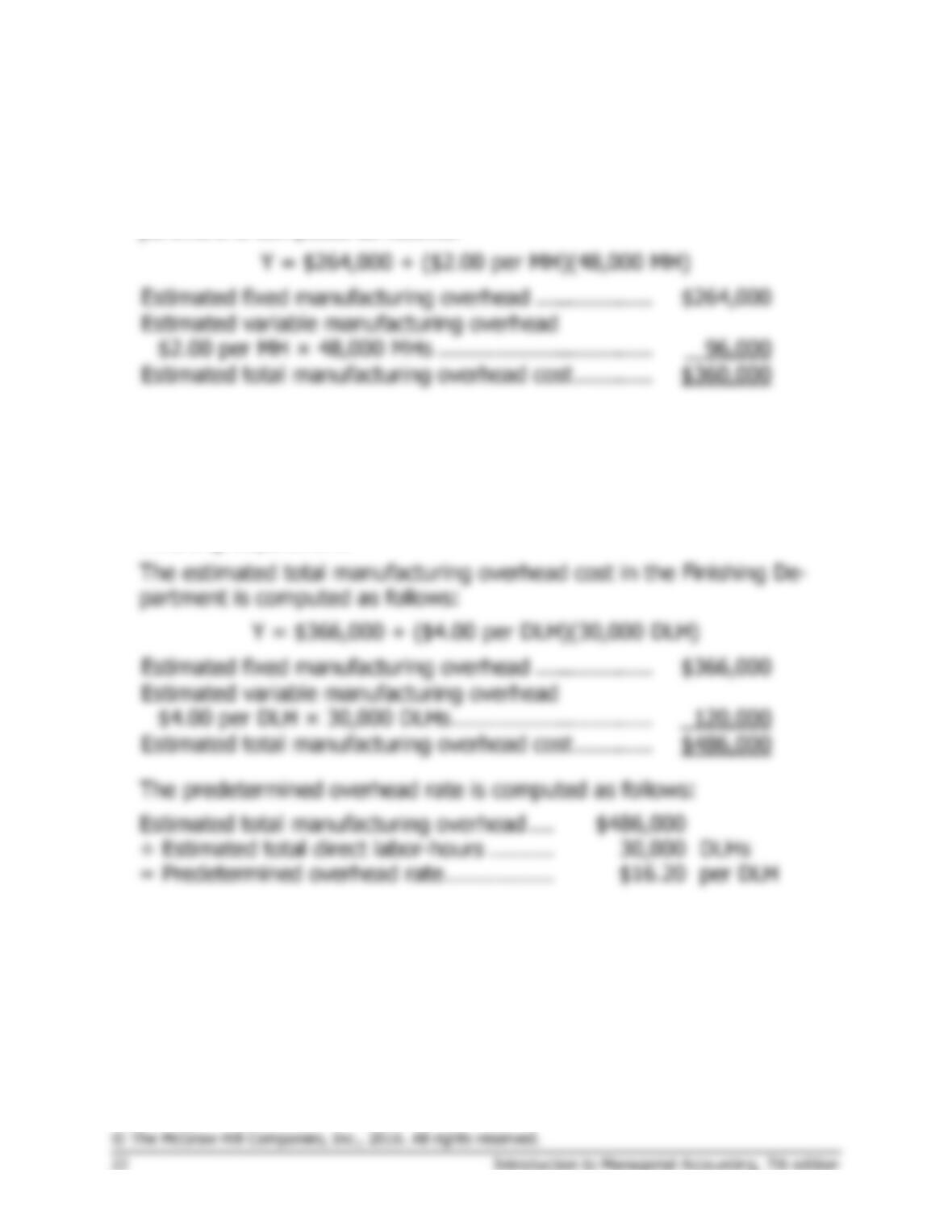
The estimated total manufacturing overhead cost in the Cutting De-
partment is computed as follows:
Estimated fixed manufacturing overhead ………………
Estimated total manufacturing overhead cost …………
The predetermined overhead rate is computed as follows:
Estimated total manufacturing overhead ….
$360,000
÷ Estimated total machine-hours ……………
48,000
MHs
= Predetermined overhead rate ……………..
$7.50
per MH
Finishing Department:
Estimated fixed manufacturing overhead ………………
Estimated total manufacturing overhead cost …………
Estimated total manufacturing overhead ….
DLHs
= Predetermined overhead rate ……………..
per DLH
Exercise 2-15 (continued)
2.
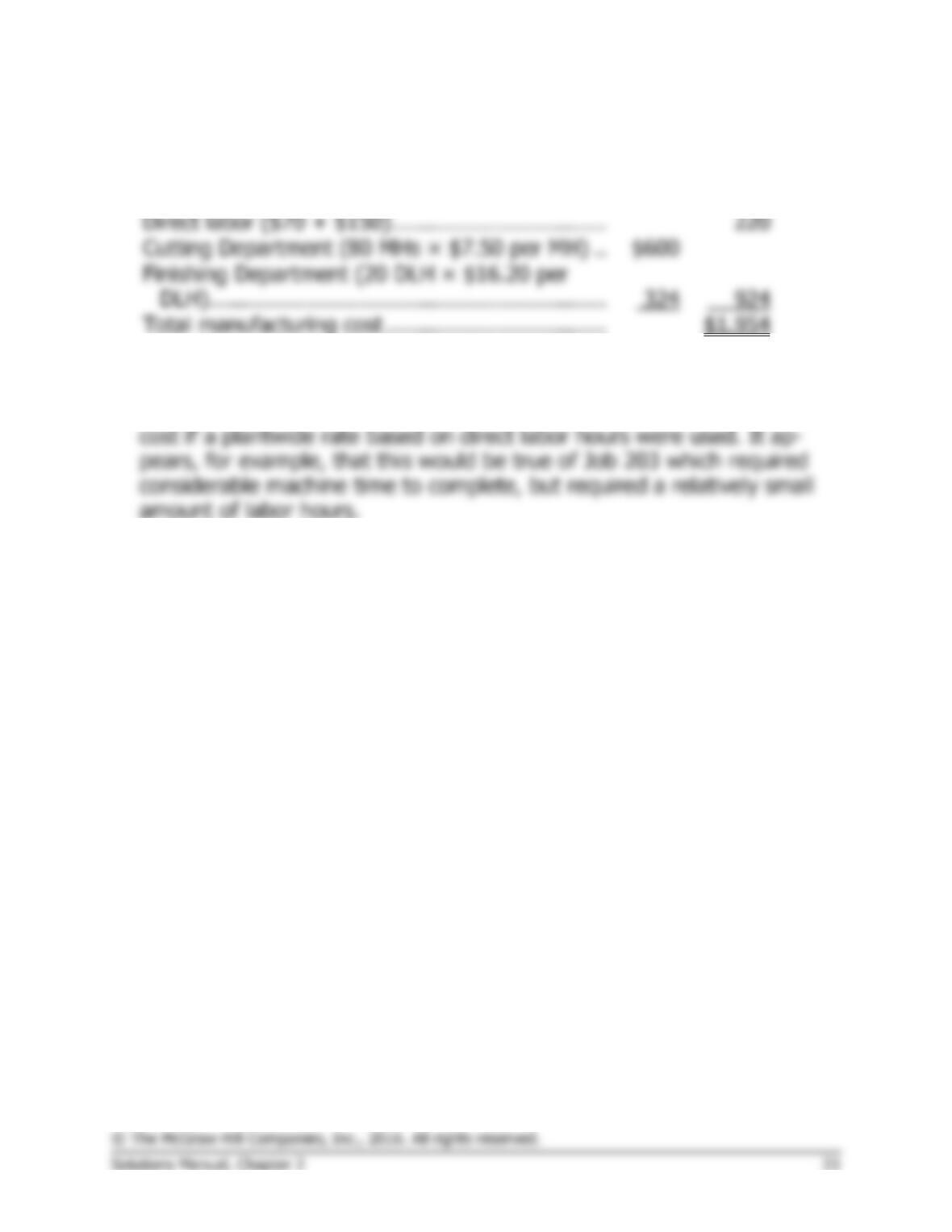
Total manufacturing cost assigned to Job 203:
Direct materials ($500 + $310) …………………….
$810
Direct labor ($70 + $150) …………………………...
Cutting Department (80 MHs × $7.50 per MH) ..
Total manufacturing cost …………………………….
3. Yes; if some jobs require a large amount of machine time and a small
amount of labor time, they would be charged substantially less overhead
Exercise 2-16 (15 minutes)
1.
Item (a):
Actual manufacturing overhead costs incurred for the year.
Item (b):
Overhead cost applied to work in process for the year.
Item (d):
Cost of goods sold for the year.
2.
Cost of Goods Sold ……………………………………
70,000
Manufacturing Overhead ……………………….
70,000
Exercise 2-17 (45 minutes)
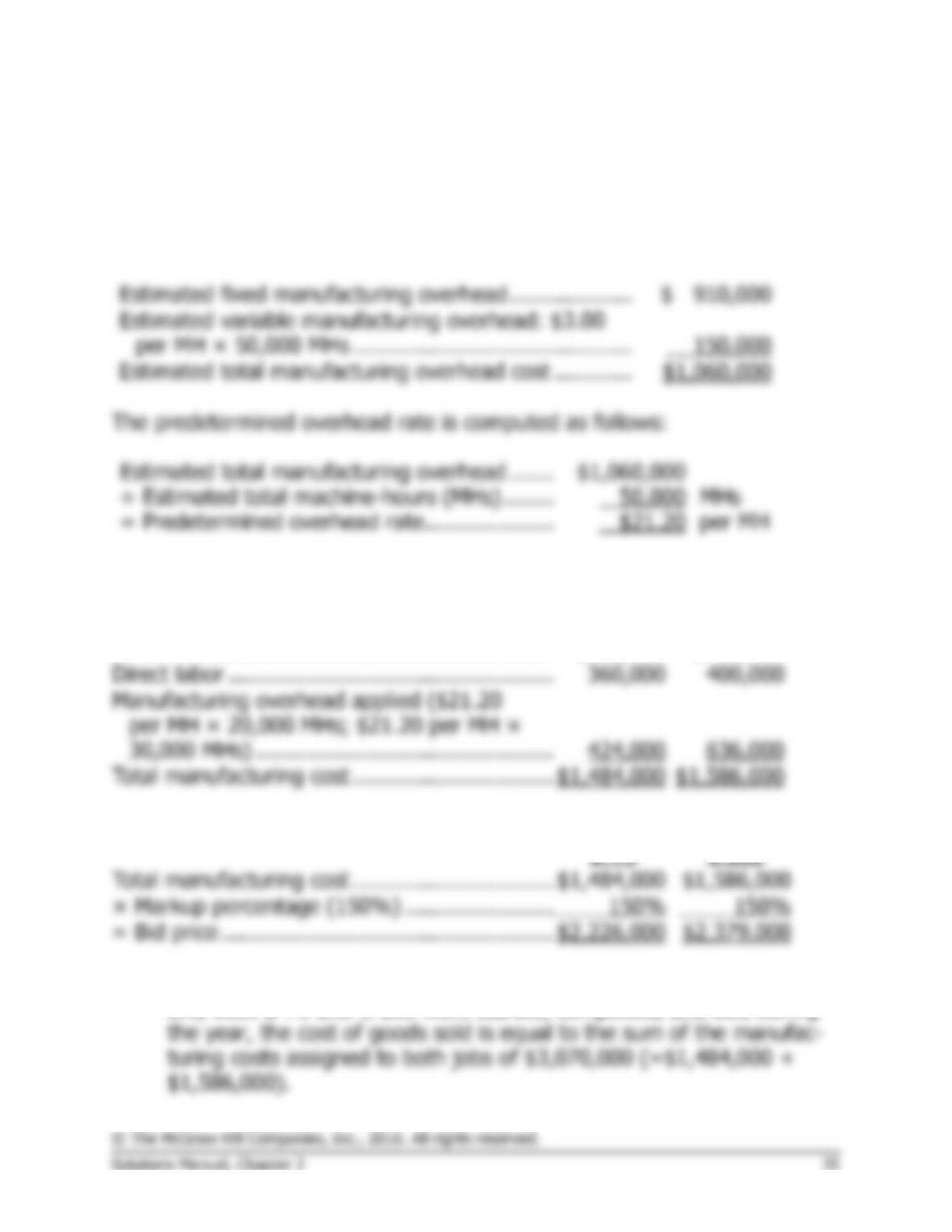
1a. The estimated total manufacturing overhead cost is computed as fol-
lows:
Y = $910,000 + ($3.00 per MH)(50,000 MHs)
Estimated fixed manufacturing overhead ……………….
MHs
per MH
1b. Total manufacturing cost assigned to Jobs D-70 and C-200:
D-70
C–200
Direct materials ……………………………………………….
$700,000
$550,000
Direct labor …………………………………………………….
Total manufacturing cost …………………………..
1c. Bid prices for Jobs D-70 and C-200:
D-75
C–200
Total manufacturing cost …………………………..
× Markup percentage (150%) …………………………..
= Bid price ……………………………………………………..
1d. Because the company has no beginning or ending inventories and
only Jobs D-70 and C-200 were started, completed, and sold during
Exercise 2-17 (continued)
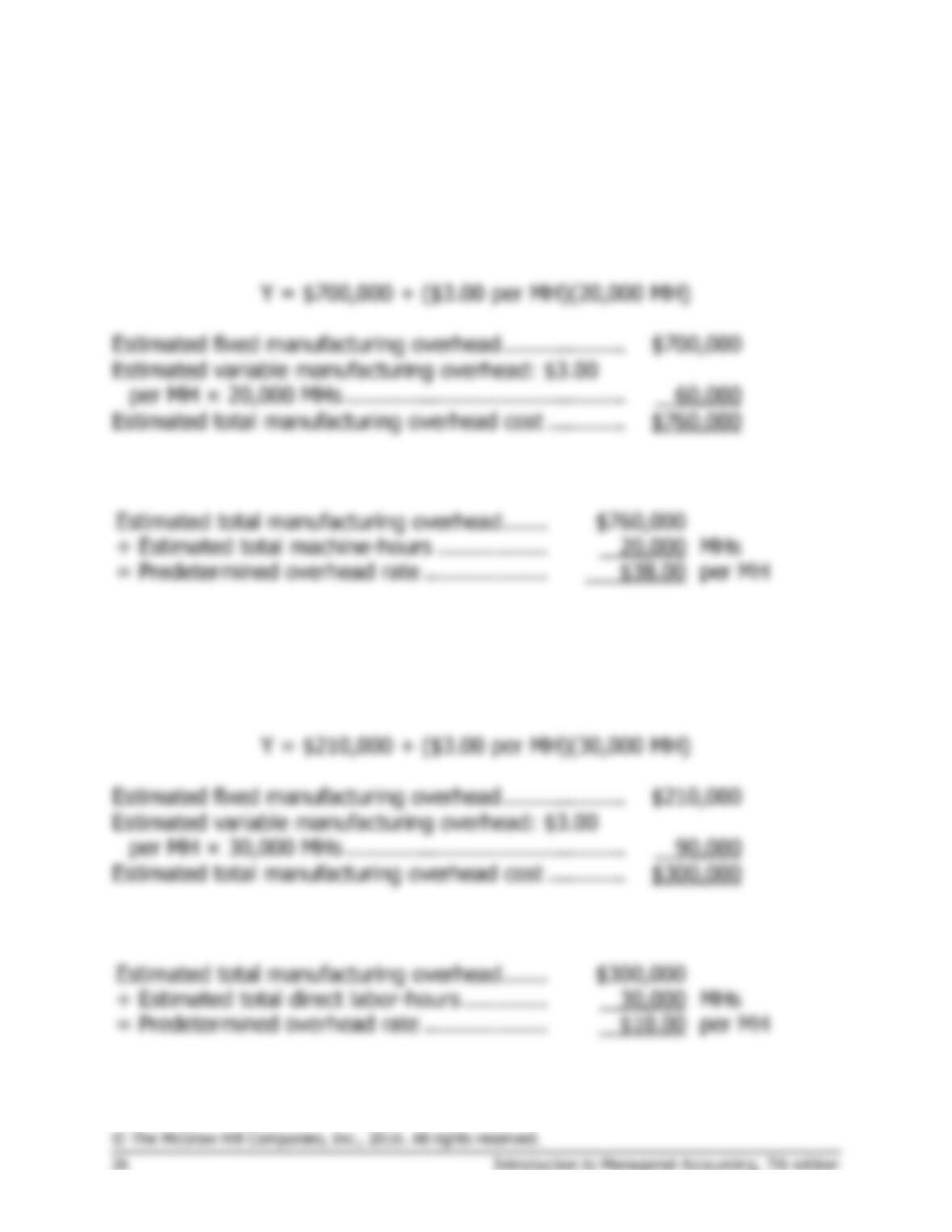
2a. Molding Department:
The estimated total manufacturing overhead cost in the Molding Depart-
ment is computed as follows:
The predetermined overhead rate is computed as follows:
Fabrication Department:
The estimated total manufacturing overhead cost in the Fabrication De-
partment is computed as follows:
The predetermined overhead rate is computed as follows:
Exercise 2-17 (continued)
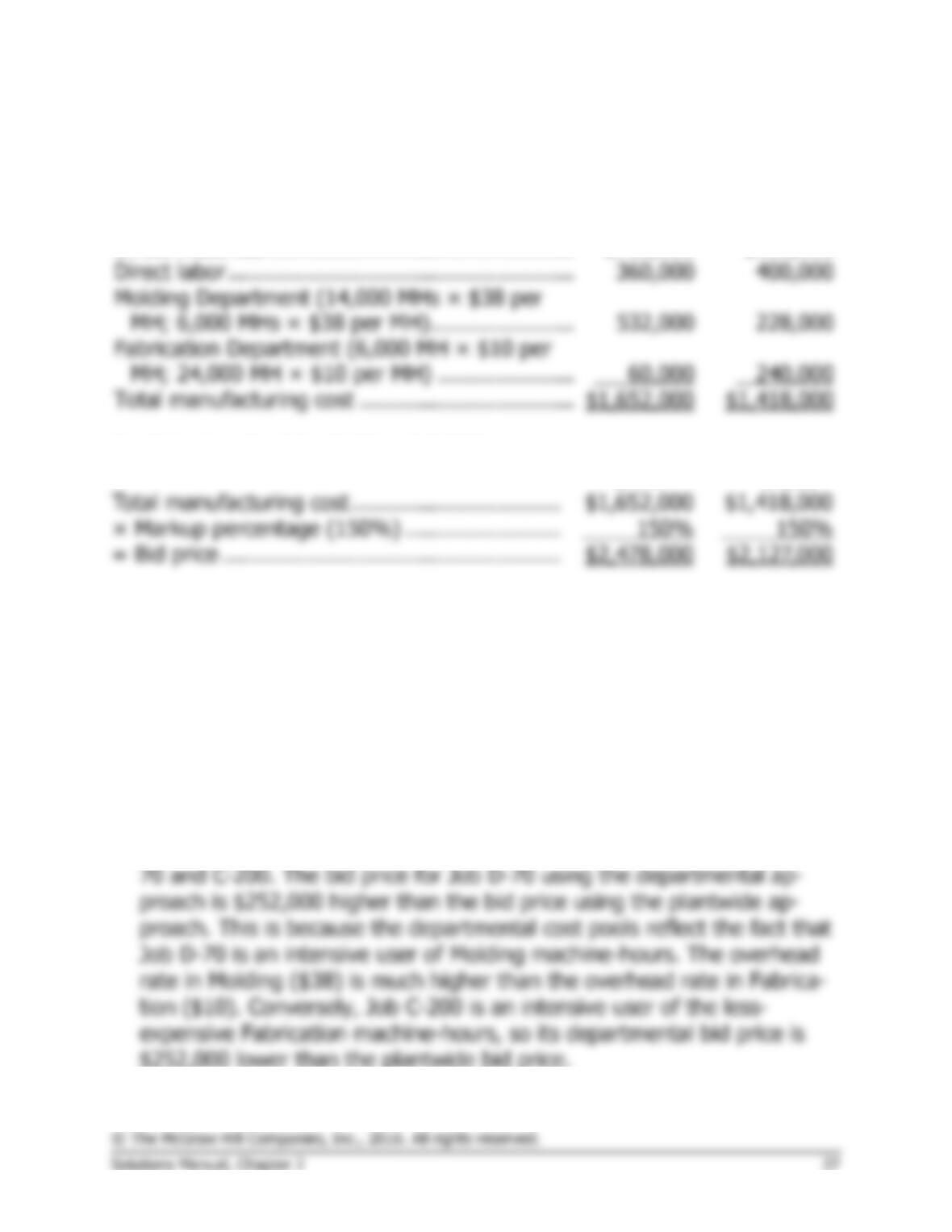
2b. Total manufacturing costs assigned to Jobs D-70 and C-200:
D-70
C-200
Direct materials ………………………………………..
$700,000
$550,000
2c. Bid prices for Jobs D-70 and C-200:
D-70
C–200
2d. Because the company has no beginning or ending inventories and
only Jobs D-70 and C-200 were started, completed, and sold during
the year, the cost of goods sold is equal to the sum of the manufac-
turing costs assigned to both jobs of $3,070,000 (= $1,652,000 +
$1,418,000).
3. The plantwide and departmental approaches for applying manufacturing
overhead costs to products produce identical cost of goods sold figures.
However, these two approaches lead to different bid prices for Jobs D–
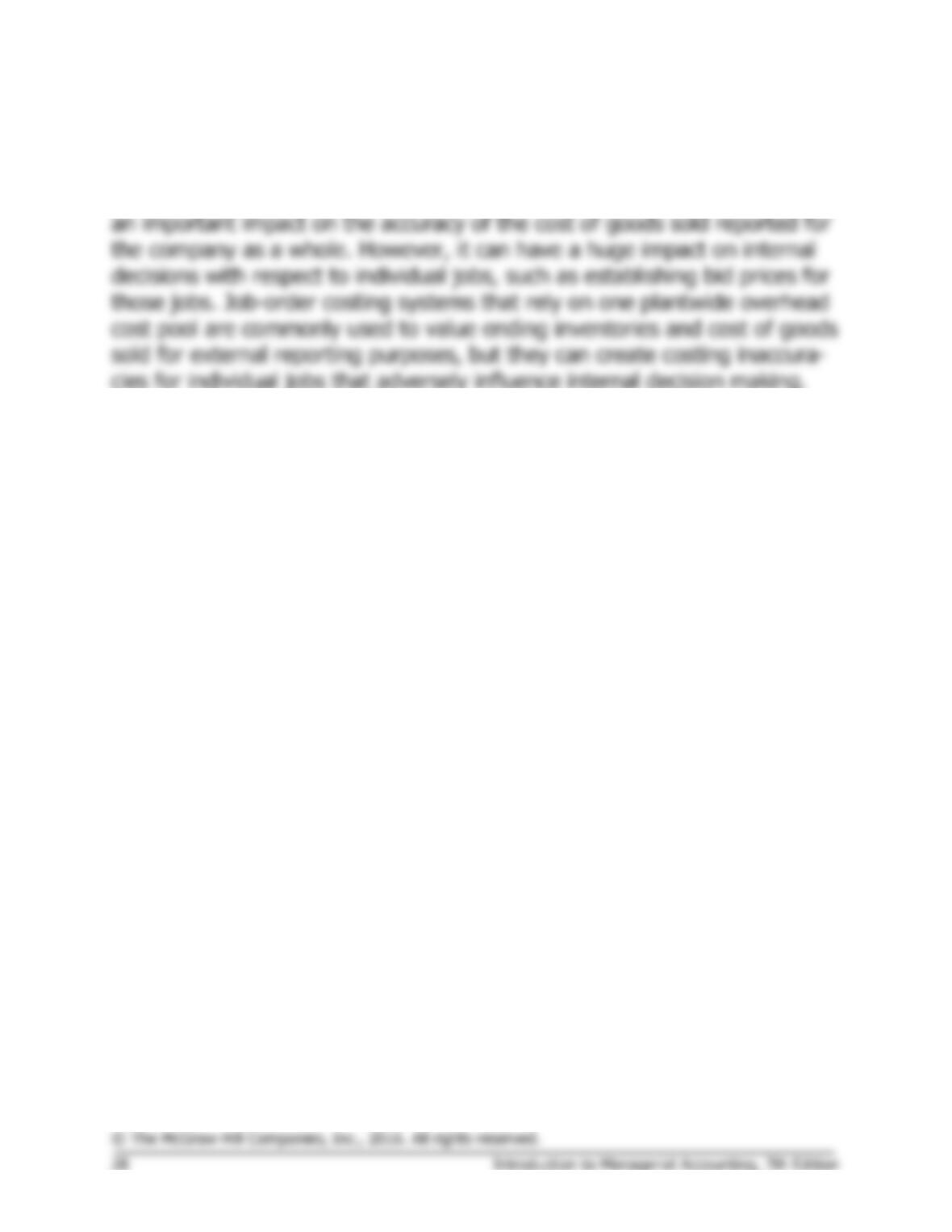
Exercise 2-17 (continued)
Whether a job-order costing system has only one plantwide overhead cost
pool or numerous departmental overhead cost pools does not usually have
Exercise 2-18 (30 minutes)
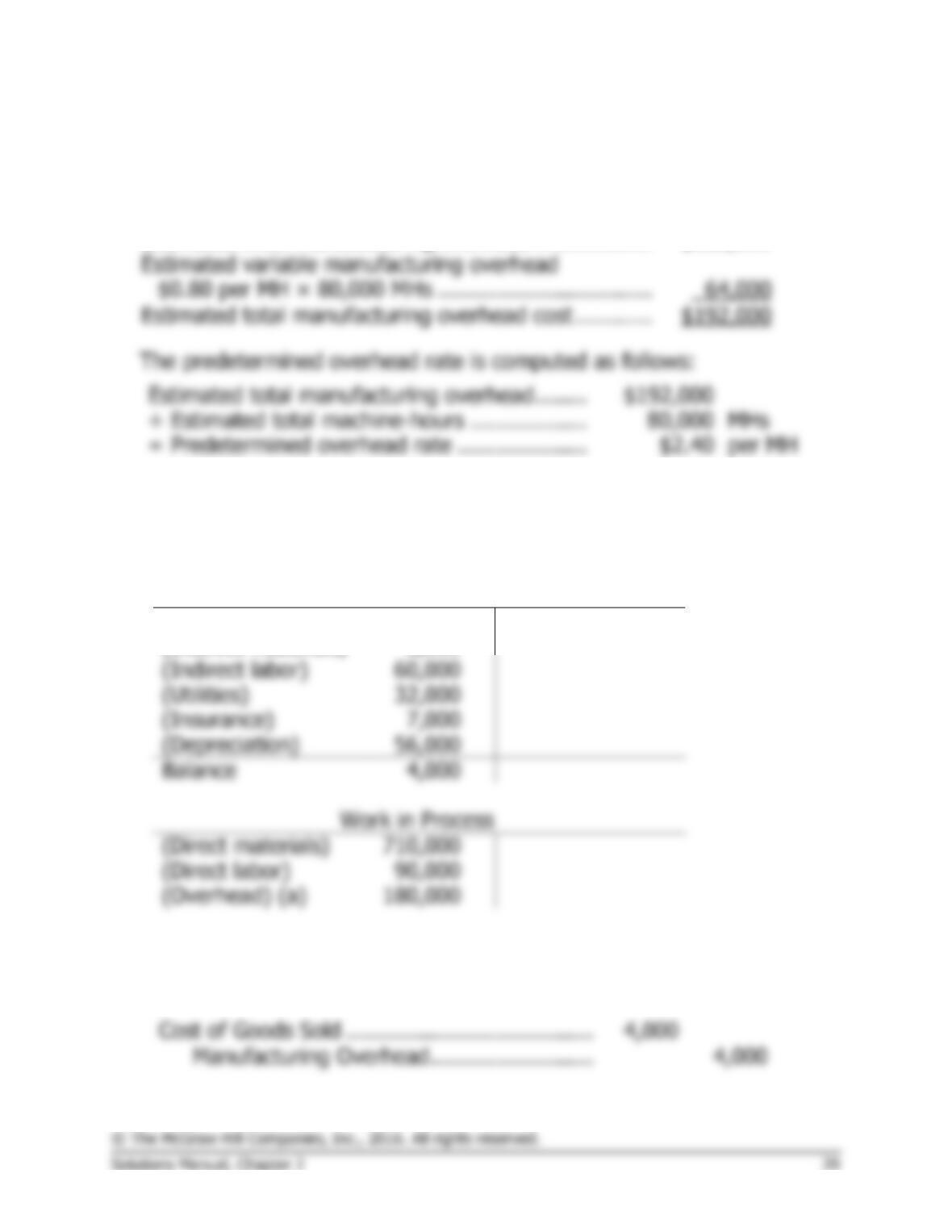
1. The predetermined overhead rate is computed as follows:
Y = $128,000 + $0.80 per MH × 80,000 MHs
Estimated fixed manufacturing overhead ………………
$128,000
Estimated total manufacturing overhead ……..
÷ Estimated total machine-hours ………………
= Predetermined overhead rate ………………..
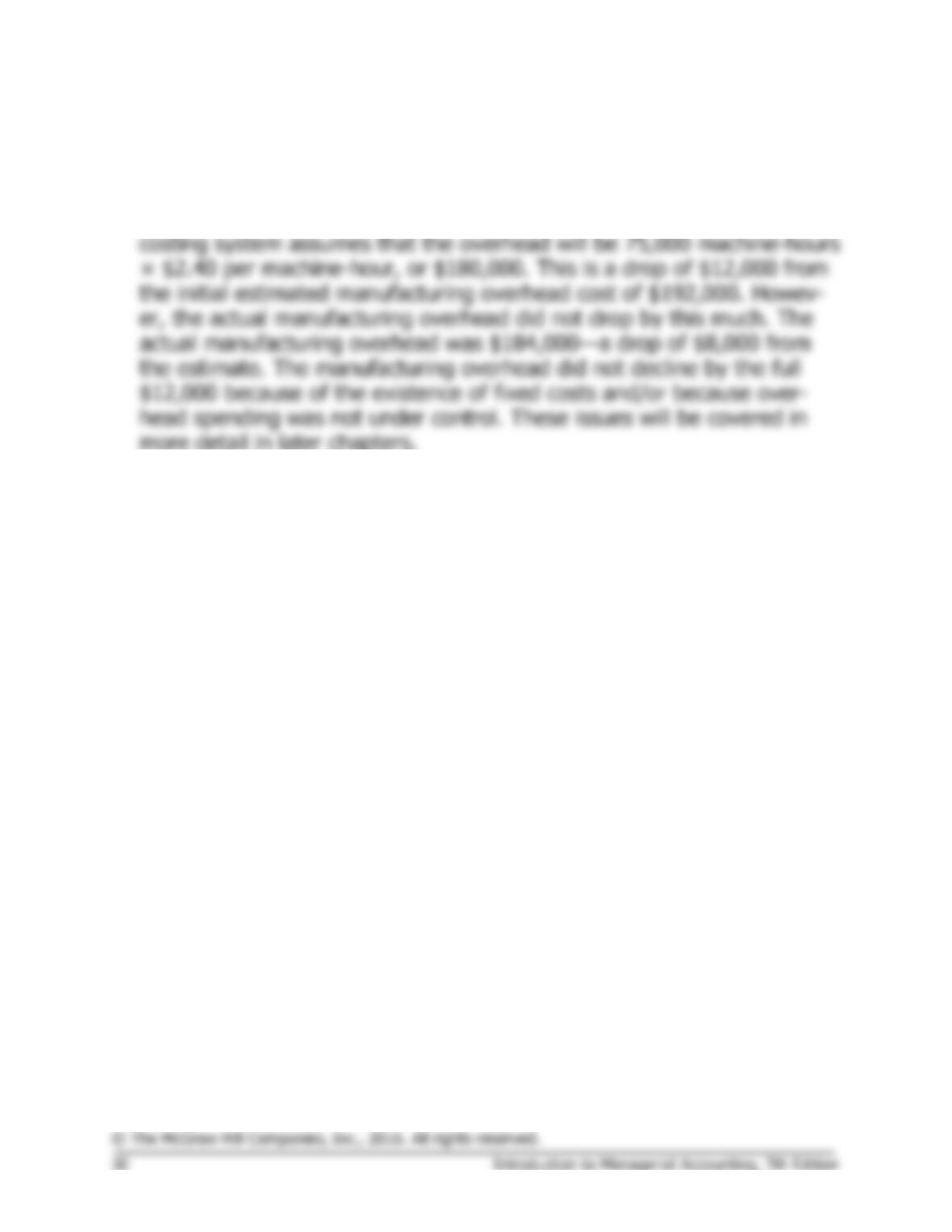
2. The amount of overhead cost applied to Work in Process for the year
would be: 75,000 machine-hours × $2.40 per machine-hour =
$180,000. This amount is shown in entry (a) below:
Manufacturing Overhead
(Maintenance)
21,000
(a)
180,000
(Indirect materials)
8,000
(Indirect labor)
(Utilities)
32,000
(Insurance)
7,000
(Depreciation)
Balance
4,000
(Direct materials)
(Direct labor)
(Overhead) (a)
3. Overhead is underapplied by $4,000 for the year, as shown in the Manu–
facturing Overhead account above. The entry to close out this balance
to Cost of Goods Sold would be:
4,000
4,000
Exercise 2-18 (continued)
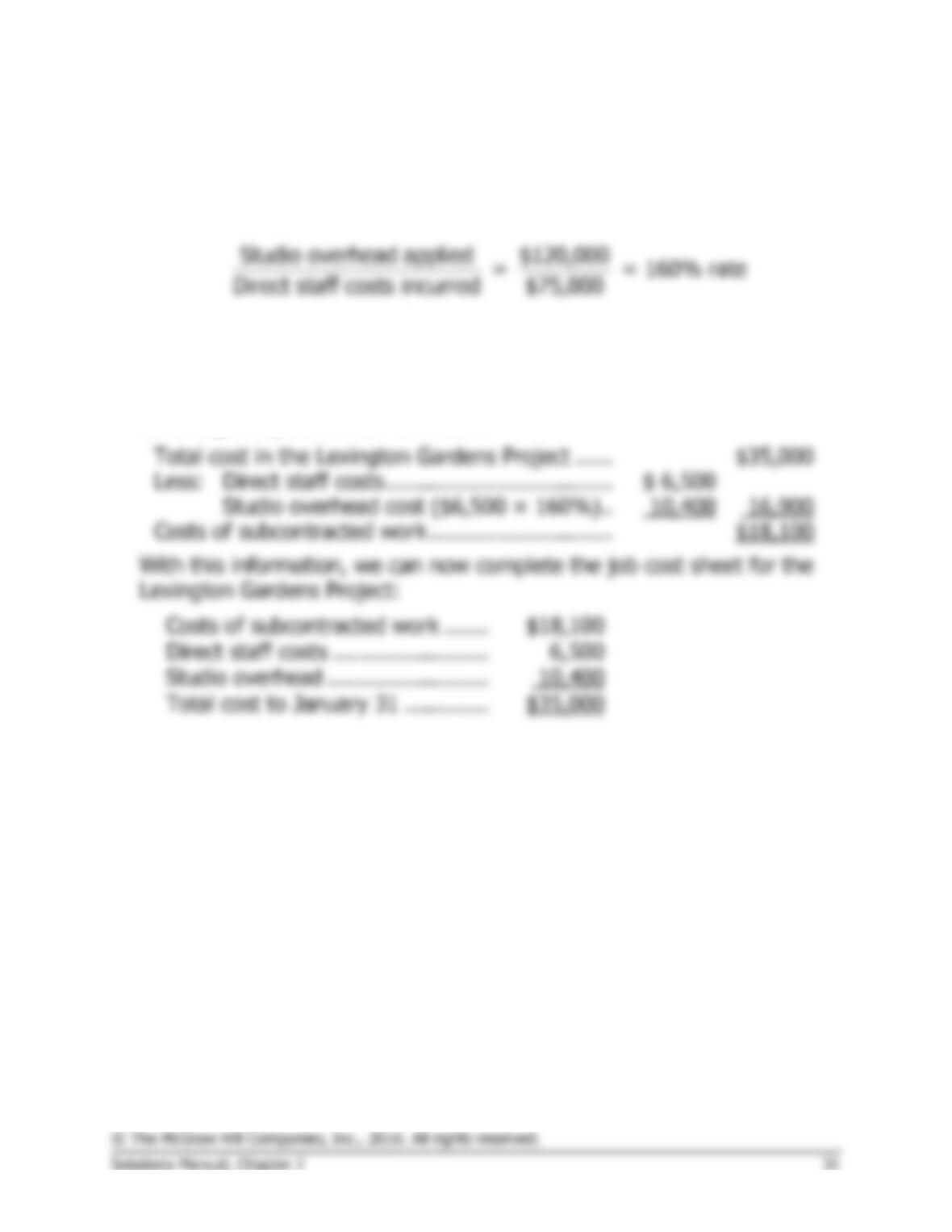
4. When overhead is applied using a predetermined rate based on ma-
chine-hours, it is assumed that overhead cost is proportional to ma–
chine-hours. When the actual machine-hours turn out to be 75,000, the
Exercise 2-19 (20 minutes)
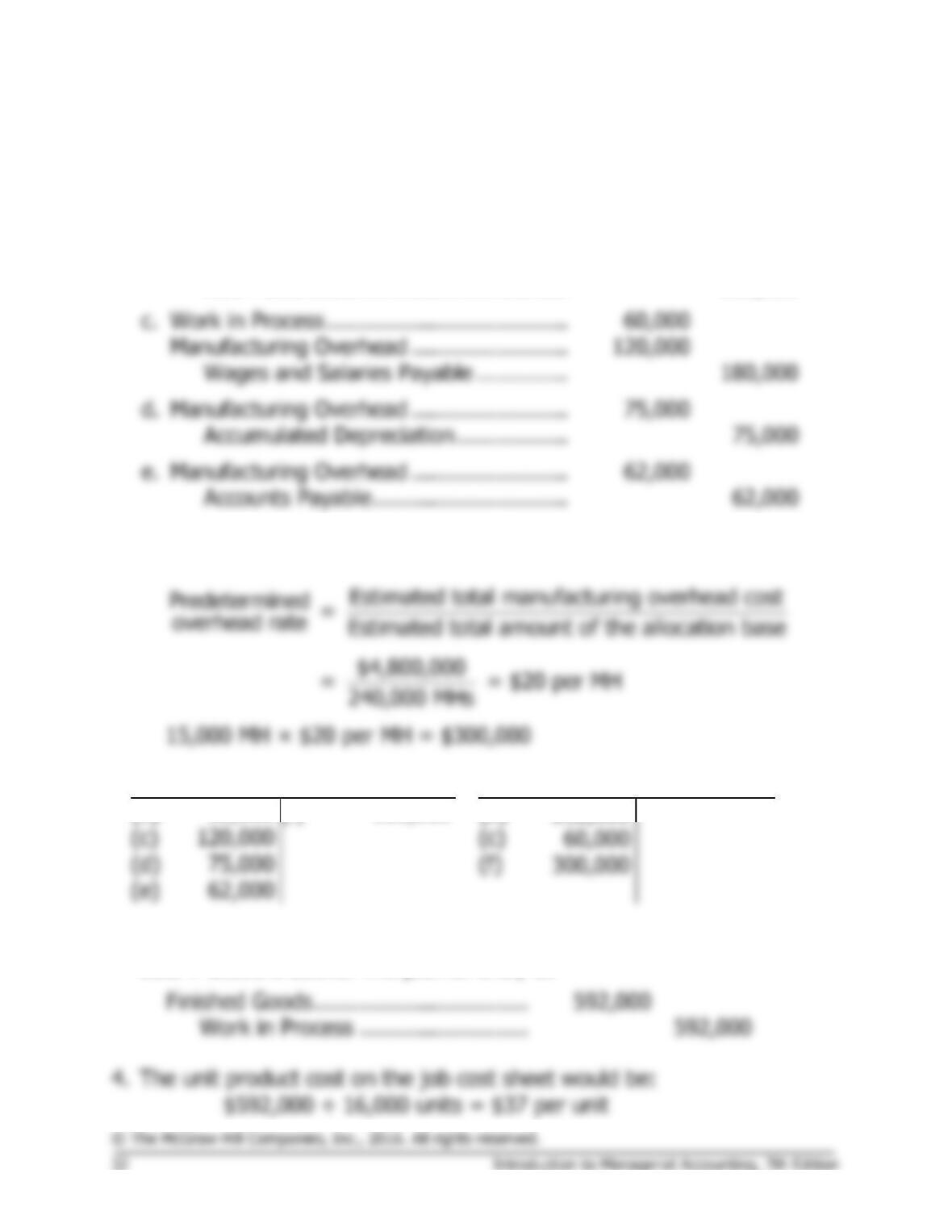
1. Because $120,000 of studio overhead was applied to Work in Process on
the basis of $75,000 of direct staff costs, the predetermined overhead
rate was 160%:
2. The Lexington Gardens Project is the only job remaining in Work in Pro-
cess at the end of the month; therefore, the entire $35,000 balance in
the Work in Process account at that point must apply to it. Recognizing
that the predetermined overhead rate is 160% of direct staff costs, the
following computation can be made:
Exercise 2-20 (30 minutes)
1.
a.
Raw Materials ………………………………….
325,000
Accounts Payable …………………………
325,000
b.
Work in Process ……………………………….
232,000
Manufacturing Overhead ……………………
58,000
Raw Materials ……………………………..
290,000
Work in Process ……………………………….
60,000
d.
Manufacturing Overhead ……………………
75,000
Accumulated Depreciation ……………..
Manufacturing Overhead ……………………
62,000
Accounts Payable …………………………
f.
Work in Process ……………………………….
300,000
Manufacturing Overhead ……………….
300,000
2.
Manufacturing Overhead
Work in Process
(b)
58,000
(f)
300,000
(b)
232,000
(c)
(c)
(d)
75,000
(f)
3. The cost of the completed job is $592,000 as shown in the Work in Pro–
cess T-account above. The journal entry is:
Problem 2-21A (45 minutes)
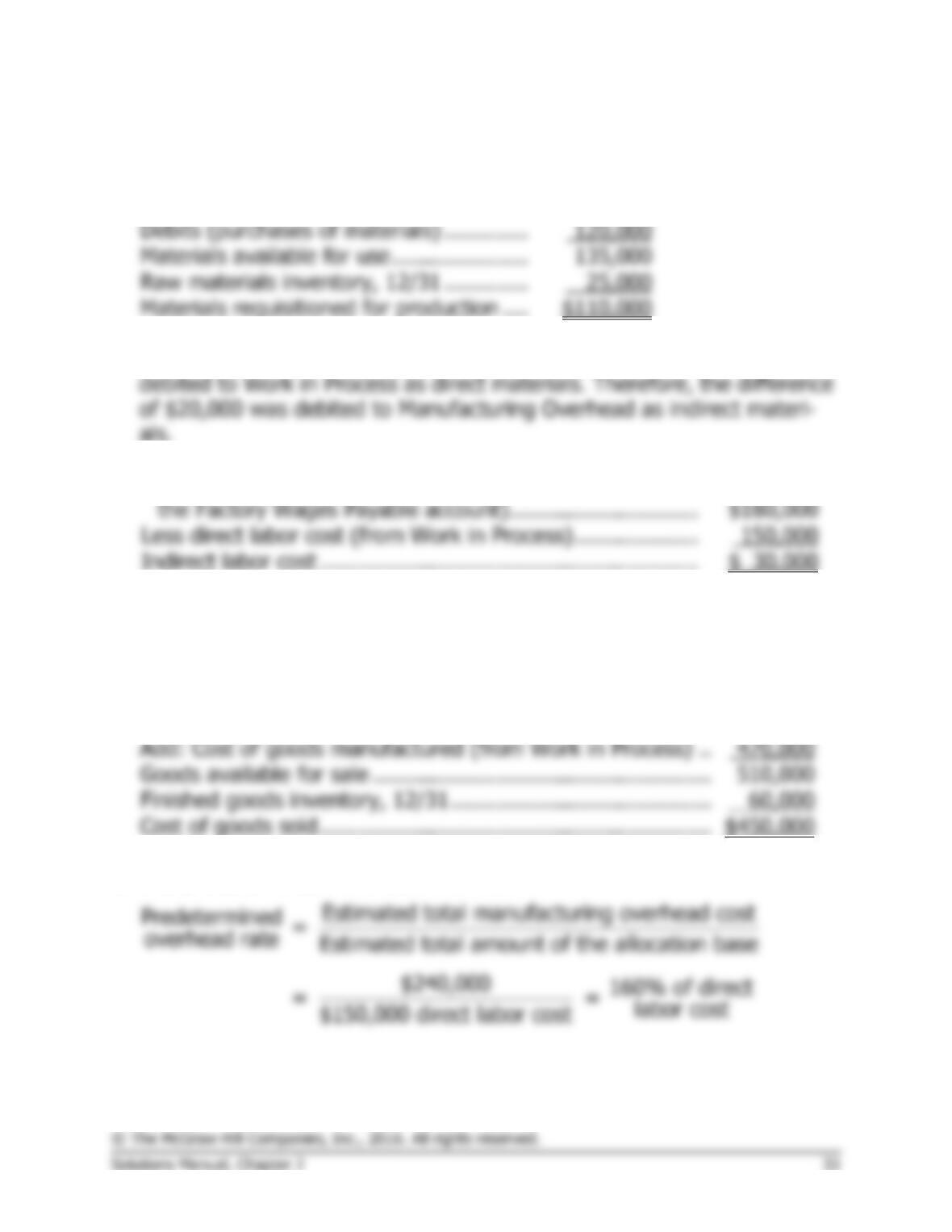
1. The cost of raw materials put into production was:
Raw materials inventory, 1/1 ……………..
$ 15,000
Debits (purchases of materials) ………….
Materials requisitioned for production ….
$110,000
2. Of the $110,000 in materials requisitioned for production, $90,000 was
3.
Less direct labor cost (from Work in Process) ……………….
Total factory wages accrued during the year (credits to
4. The cost of goods manufactured was $470,000—the credits to the Work
in Process account.
5. The Cost of Goods Sold for the year was:
Finished goods inventory, 1/1 …………………………………….
$ 40,000
Add: Cost of goods manufactured (from Work in Process) ..
Cost of goods sold ……………………………………………………
$450,000
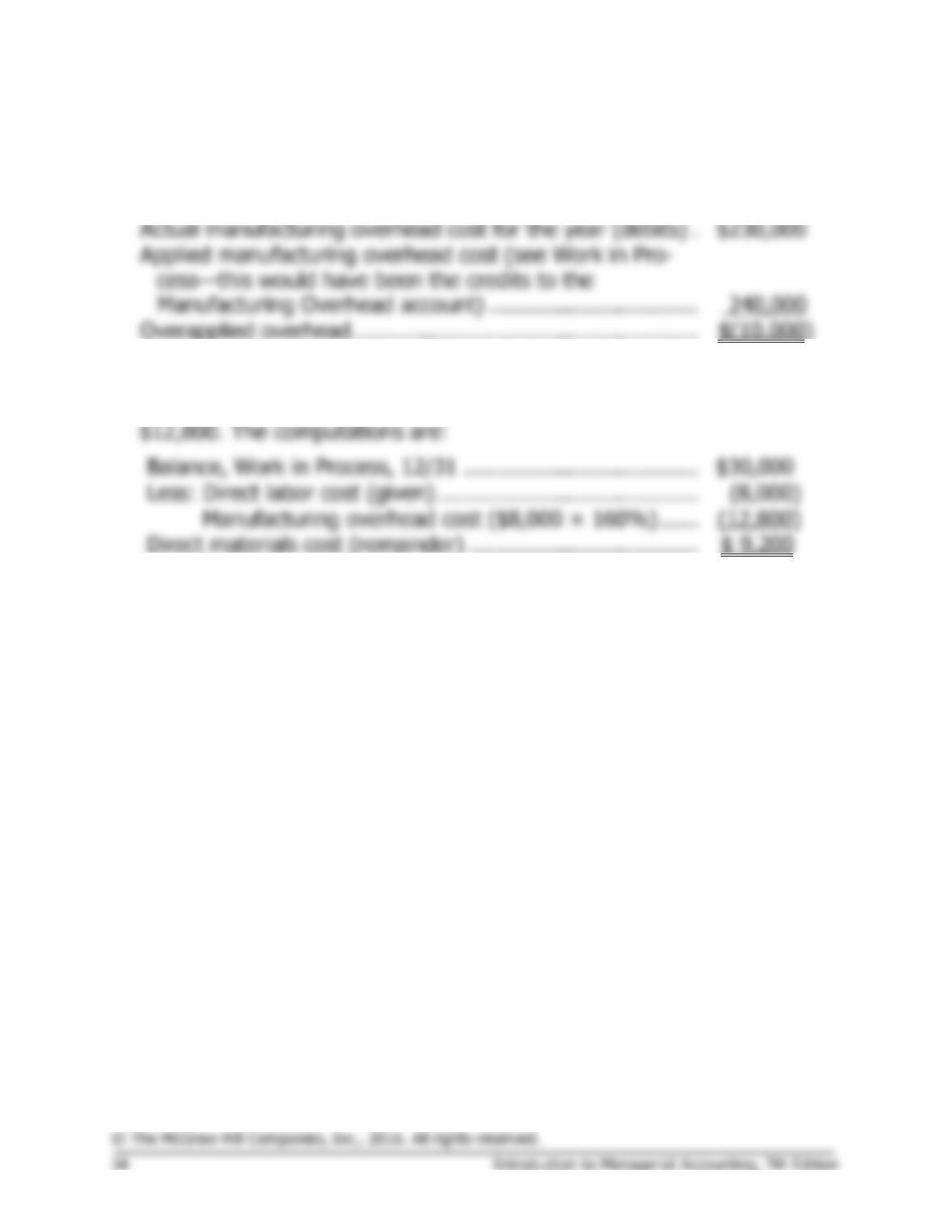
6. The predetermined overhead rate was:
Problem 2-21A (continued)
7. Manufacturing overhead was overapplied by $10,000, computed as fol-
lows:
8. The ending balance in Work in Process is $30,000. Direct materials
make up $9,200 of this balance, and manufacturing overhead makes up
Problem 2-22A (30 minutes)
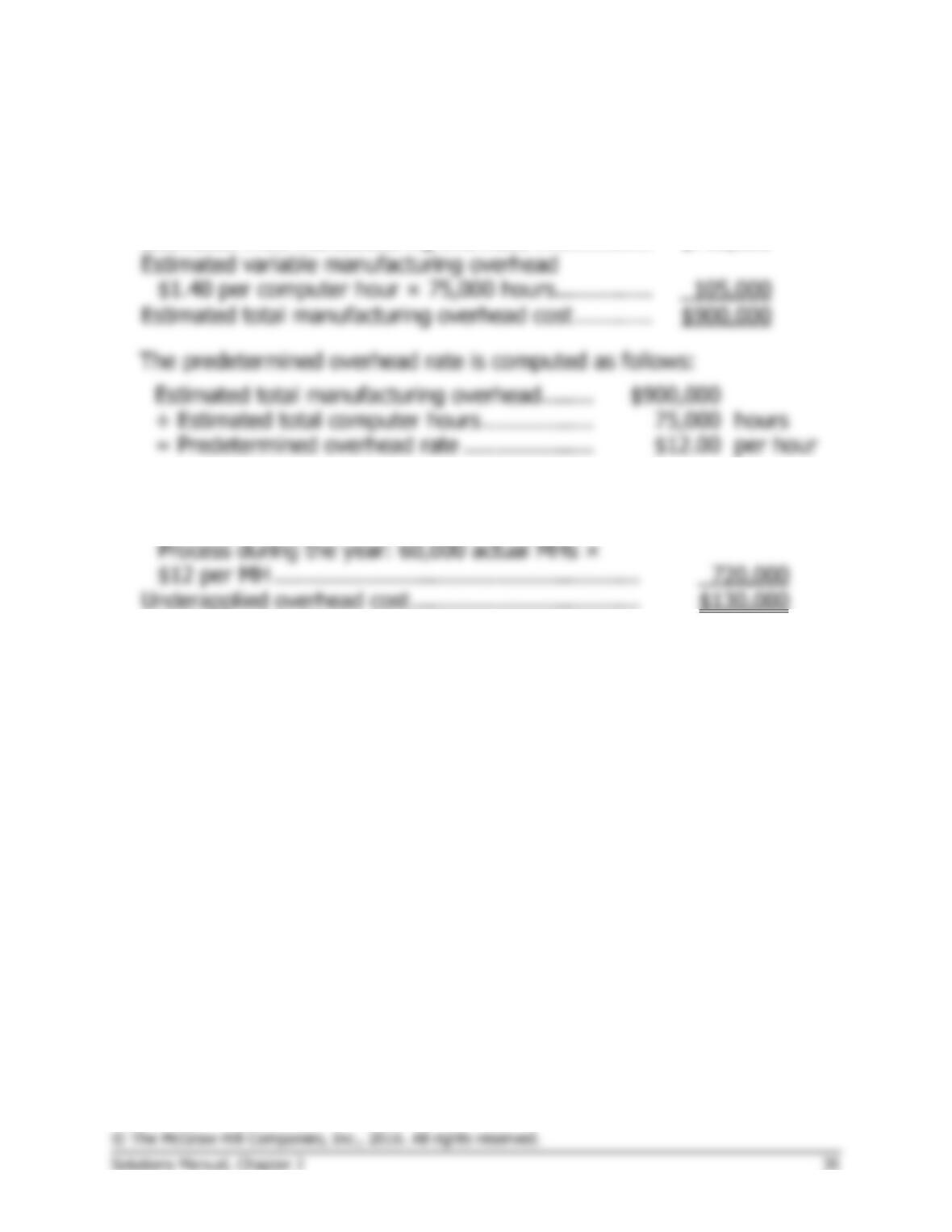
1. The predetermined overhead rate was:
Y = $795,000 + $1.40 per hour × 75,000 hours
Estimated fixed manufacturing overhead ………………
$795,000
Estimated total manufacturing overhead cost …………
hours
per hour
2.
Actual manufacturing overhead cost …………………..
$850,000
Underapplied overhead cost ……………………………..
$130,000
Manufacturing overhead cost applied to Work in
3.
Cost of Goods Sold ……………………………..
130,000
Manufacturing Overhead …………………
130,000
Problem 2-23A (30 minutes)
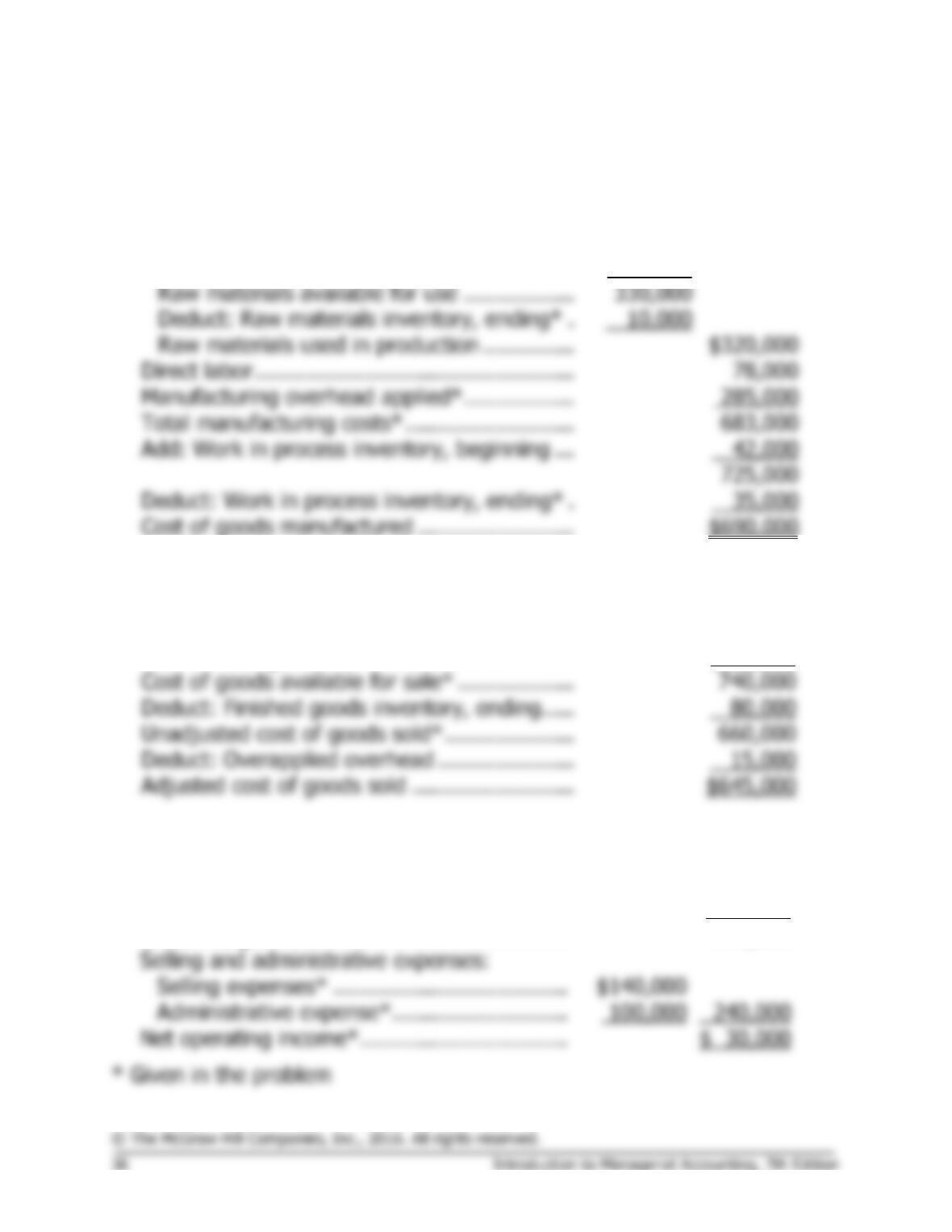
Schedule of cost of goods manufactured:
Direct materials:
Raw materials inventory, beginning* ……….
$ 40,000
Add: Purchases of raw materials* …………..
290,000
Raw materials available for use ……………..
Deduct: Raw materials inventory, ending* .
Manufacturing overhead applied* ……………..
285,000
Total manufacturing costs* ……………………..
Add: Work in process inventory, beginning …
Deduct: Work in process inventory, ending* .
Cost of goods manufactured ……………………
Schedule of cost of goods sold:
Finished goods inventory, beginning* ………..
$ 50,000
Add: Cost of goods manufactured …………….
690,000
Cost of goods available for sale* ………………
Deduct: Finished goods inventory, ending …..
Unadjusted cost of goods sold* ………………..
Deduct: Overapplied overhead …………………
Adjusted cost of goods sold …………………….
$645,000
Income statement:
Sales …………………………………………………
$915,000
Cost of goods sold ($660,000 – $15,000) …..
645,000
Gross margin ……………………………………….
270,000
Selling and administrative expenses:
Net operating income* …………………………..
$ 30,000
Problem 2-24A (30 minutes)
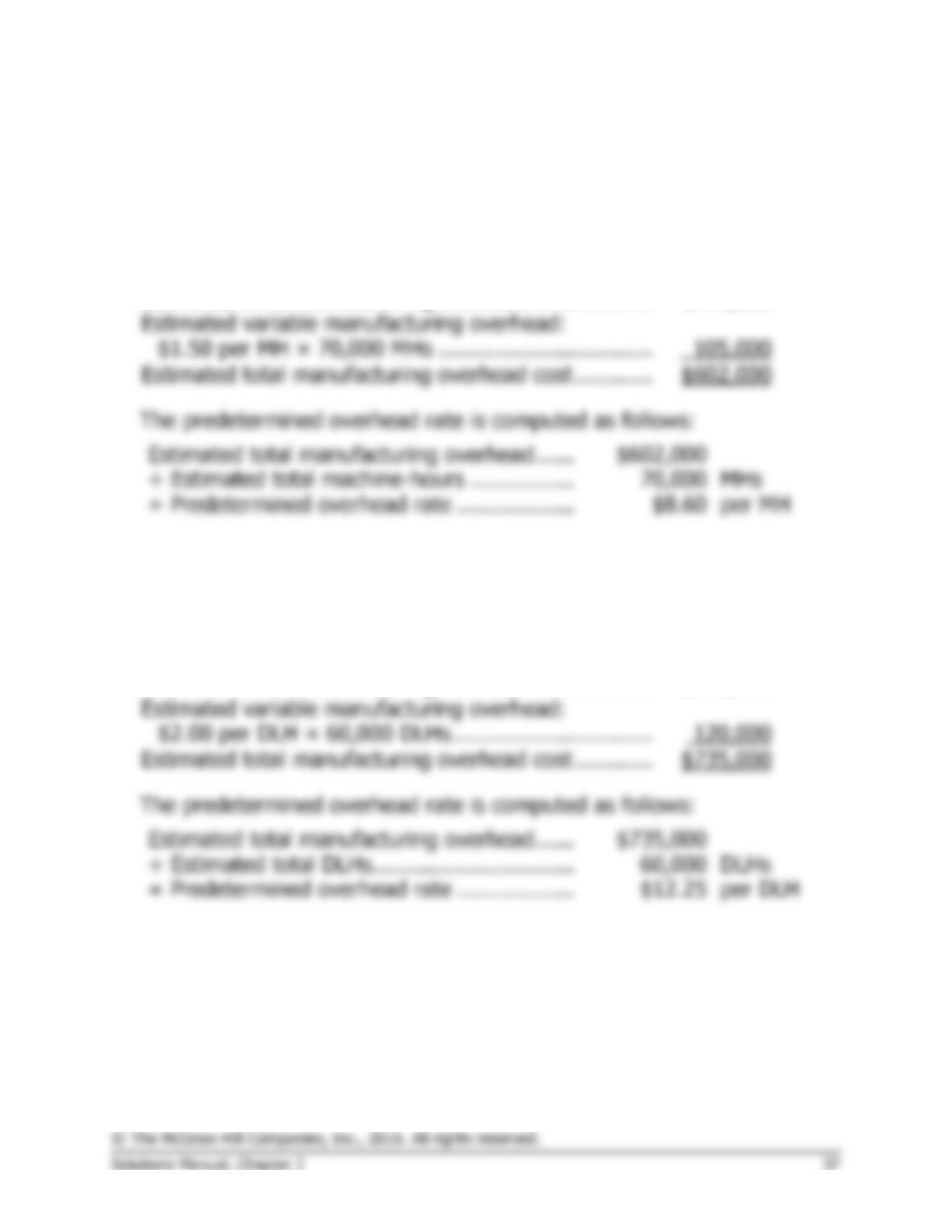
1. Molding Department:
The estimated total manufacturing overhead cost in the Molding De-
partment is computed as follows:
Y = $497,000 + $1.50 per MH × 70,000 MH
Estimated fixed manufacturing overhead ………………
$497,000
Estimated total manufacturing overhead cost …………
MHs
per MH
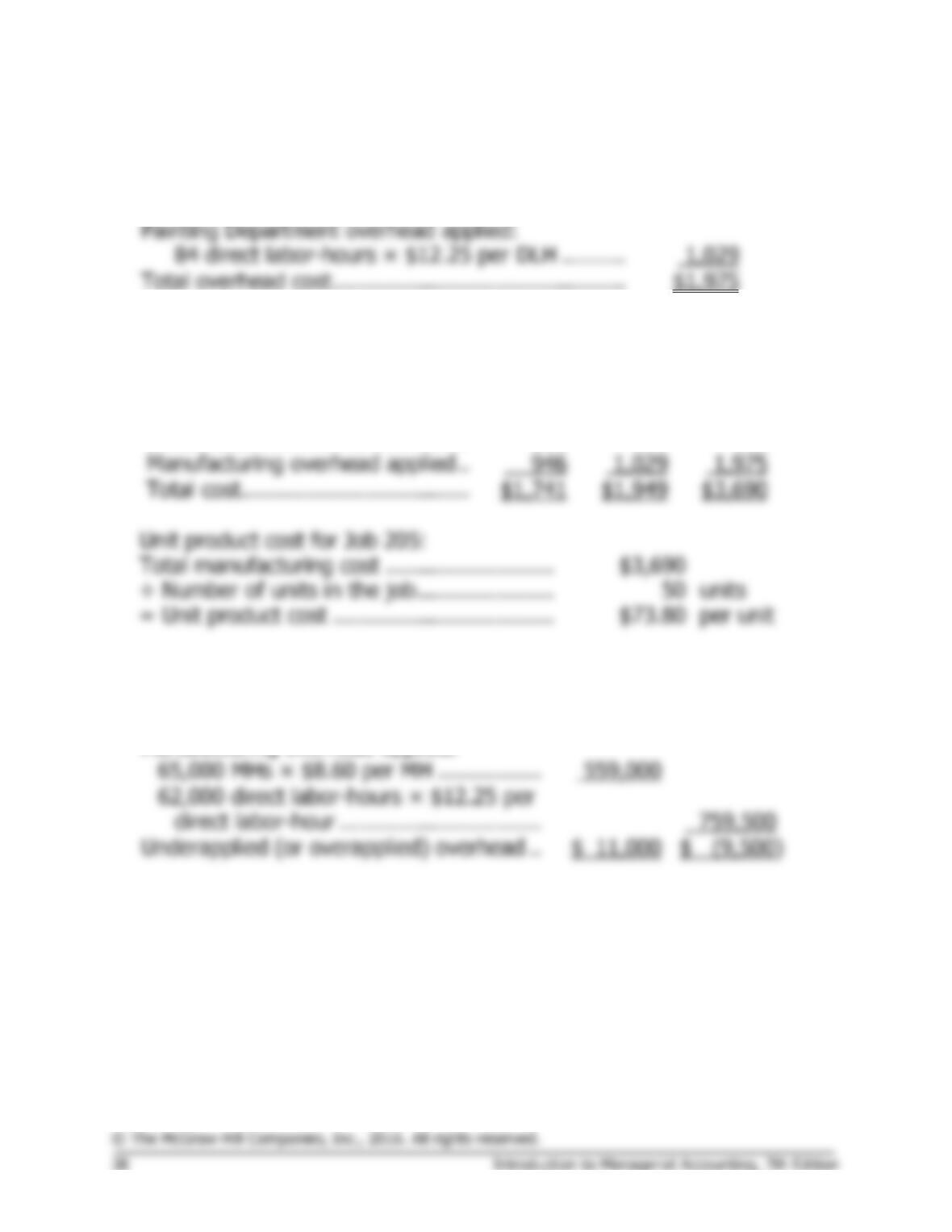
Painting Department:
The estimated total manufacturing overhead cost in the Painting De-
partment is computed as follows:
Y = $615,000 + $2.00 per DLH × 60,000 DLH
Estimated fixed manufacturing overhead ………………
$615,000
Estimated total manufacturing overhead cost …………
$735,000
DLHs
per DLH
Problem 2-24A (continued)
2.
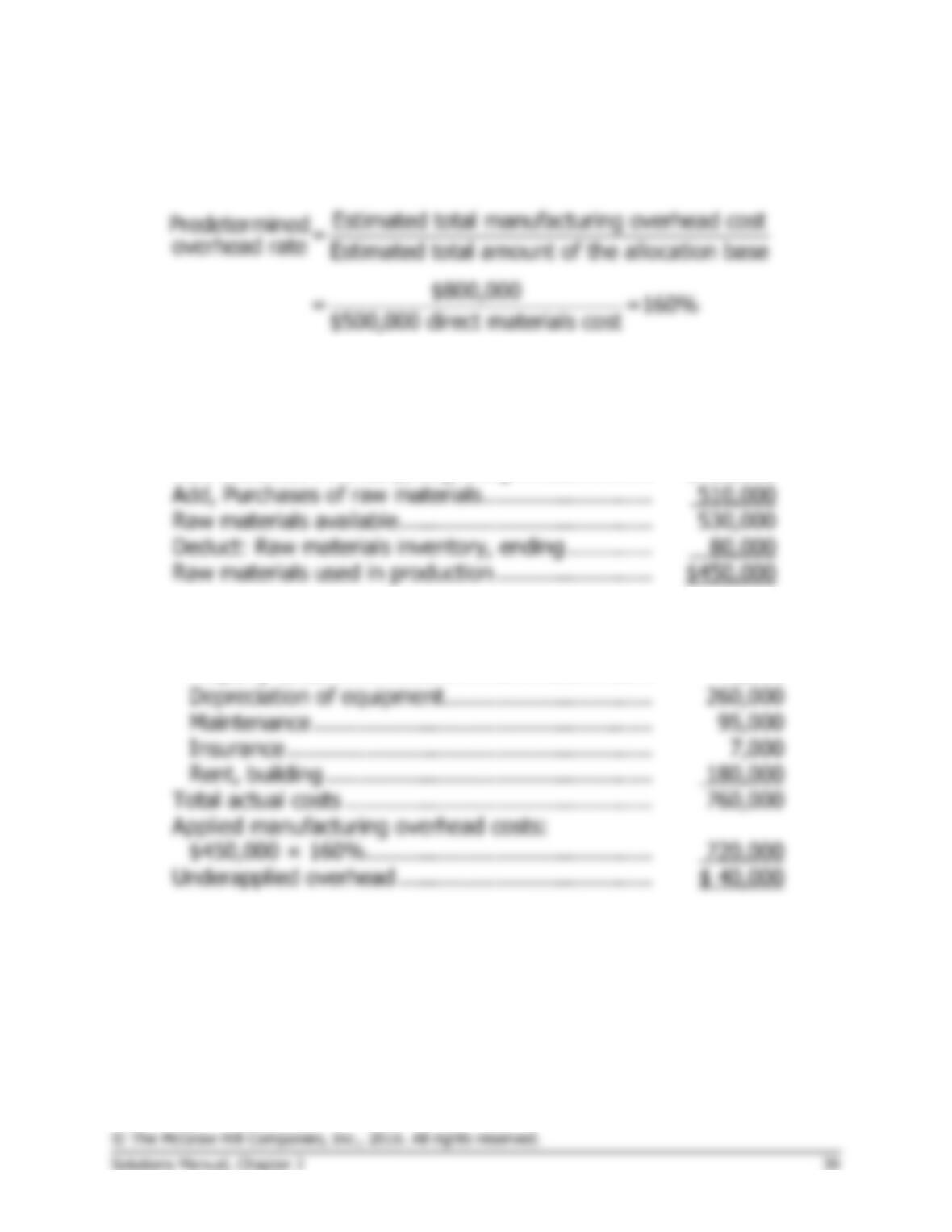
Molding Department overhead applied:
110 machine-hours × $8.60 per machine-hour
$ 946
Painting Department overhead applied:
Total overhead cost …………………………..………….
3. Total cost of Job 205:
Molding
Dept.
Painting
Dept.
Total
Direct materials ……………………..
$ 470
$ 332
$ 802
Direct labor …………………………..
325
588
913
Manufacturing overhead applied ..
per unit
4.
Molding
Dept.
Painting
Dept.
Manufacturing overhead incurred …………
$570,000
$750,000
Underapplied (or overapplied) overhead ..
$ 11,000
Manufacturing overhead applied:
Problem 2-25A (60 minutes)
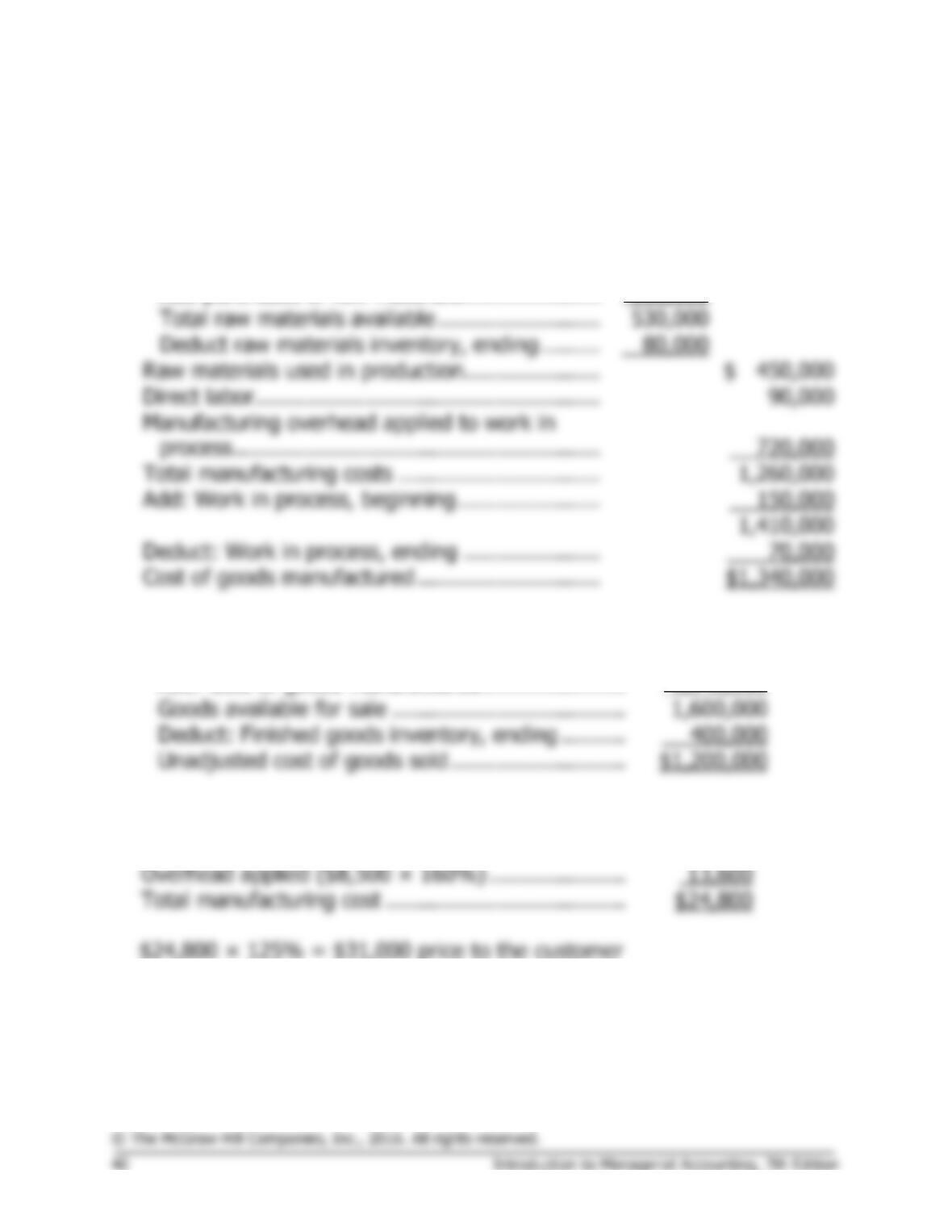
1. a.
b. Before the underapplied or overapplied overhead can be computed,
we must determine the amount of direct materials used in production
for the year.
Raw materials inventory, beginning …………………
$ 20,000
Add, Purchases of raw materials ……………………..
Raw materials available…………………………………
Deduct: Raw materials inventory, ending ………….
Raw materials used in production ……………………
Actual manufacturing overhead costs:
Indirect labor ……………………………………………
$170,000
Property taxes ………………………………………….
48,000
180,000
Total actual costs ………………………………………..
720,000
Underapplied overhead …………………………………
$ 40,000
Problem 2-25A (continued)
2.
Gitano Products
Schedule of Cost of Goods Manufactured
Direct materials:
Raw materials inventory, beginning ……………
$ 20,000
Add purchases of raw materials …………………
510,000
Total raw materials available …………………….
Deduct raw materials inventory, ending ………
Direct labor ……………………………………………..
Total manufacturing costs ………………………….
Add: Work in process, beginning ………………….
Deduct: Work in process, ending …………………
Cost of goods manufactured ……………………….
3.
Unadjusted cost of goods sold:
Finished goods inventory, beginning ………………
$ 260,000
Add: Cost of goods manufactured ………………….
1,340,000
Goods available for sale ………………………………
Deduct: Finished goods inventory, ending ……….
400,000
Unadjusted cost of goods sold ………………………
4.
Direct materials ……………………………………………
$ 8,500
Direct labor …………………………………………………
2,700
Overhead applied ($8,500 × 160%) …………………
Total manufacturing cost ……………………………….