Chapter 2
Job-Order Costing
Solutions to Questions
2-1 By definition, manufacturing overhead
consists of costs that cannot be practically traced
2-2 The first step is to estimate the total
amount of the allocation base (the denominator)
that will be required for next period’s estimated
level of production. The second step is to esti–
2-3 The job cost sheet is used to record all
costs that are assigned to a particular job. These
2-4 Some production costs such as a factory
manager’s salary cannot be traced to a particular
product or job, but rather are incurred as a result
2-5 If actual manufacturing overhead cost is
applied to jobs, the company must wait until the
seasonal factors or variations in output. For this
reason, most companies use predetermined over-
2-6 The measure of activity used as the allo-
cation base should drive the overhead cost; that
is, the allocation base should cause the overhead
cost. If the allocation base does not really cause
the overhead, then costs will be incorrectly at-
covered. Costs are recovered only by selling to
customers—not by allocating costs.
head rate is based on estimates.
2-9 Underapplied overhead occurs when the
overapplied overhead is disposed of by closing
out the amount to Cost of Goods Sold. The ad-
2-10 Manufacturing overhead may be un-
derapplied for several reasons. Control over over–
head spending may be poor. Or, some of the
2-11 Underapplied overhead implies that not
enough overhead was assigned to jobs during the
2-12 A plantwide overhead rate is a single
overhead rate used throughout a plant. In a mul-
tiple overhead rate system, each production de-
partment may have its own predetermined over-
head rate and its own allocation base. Some
sive.
The Foundational 15
1. The estimated total manufacturing overhead cost is computed as fol-
lows:
Y = $10,000 + ($1.00 per DLH)(2,000 DLHs)
Estimated fixed manufacturing overhead ………………
$10,000
$12,000
DLHs
2. The manufacturing overhead applied to Jobs P and Q is computed as
follows:
Actual direct labor hours worked (a) ……………
Predetermined overhead rate per DLH (b) …….
Manufacturing overhead applied (a) × (b) …….
3. The direct labor hourly wage rate can be computed by focusing on ei-
ther Job P or Job Q as follows:
Direct labor cost (a) …………………………………
The Foundational 15
4. Job P’s unit product cost and Job Q’s assigned manufacturing costs are
computed as follows:
Total manufacturing cost assigned to Job P:
Direct materials …………………………..
$13,000
Direct labor ………………………………..
Total manufacturing cost (a) ………….
$42,400
Number of units in the job (b) ………..
Direct materials …………………………..
Direct labor ………………………………..
5. The journal entries are recorded as follows:
Raw Materials …………………..
22,000
22,000
Work in Process ………………..
21,000
21,000
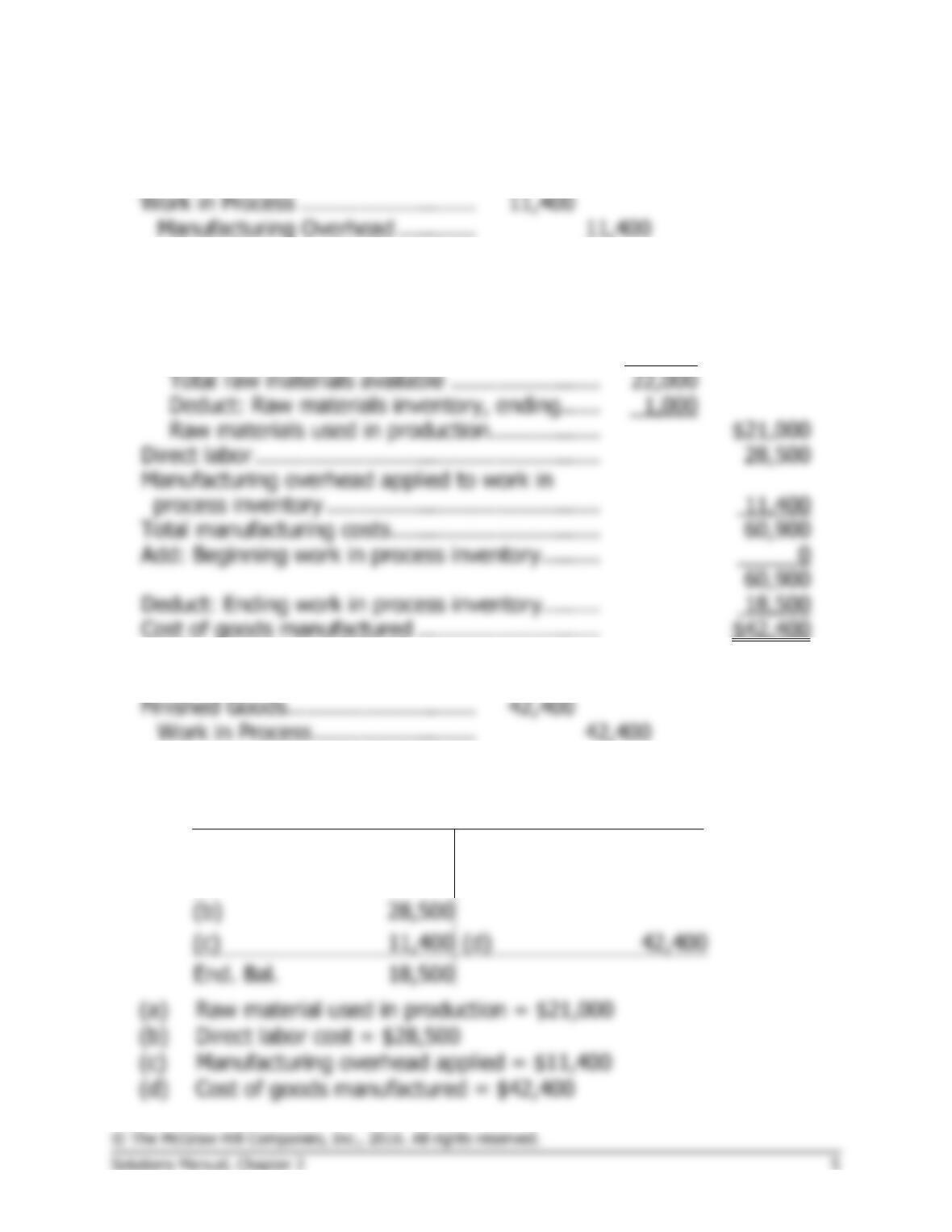
6. The journal entry is recorded as follows:
Work in Process ………………..
28,500
The Foundational 15
7. The journal entry is recorded as follows:
8. The Schedule of Cost of Goods Manufactured is as follows:
Direct materials:
Raw materials inventory, beginning ……………
$ 0
Add: Purchases of raw materials ……………….
22,000
Deduct: Raw materials inventory, ending …….
Raw materials used in production ………………
$21,000
Direct labor ………………………………………………
Total manufacturing costs …………………………..
Deduct: Ending work in process inventory……….
$42,400
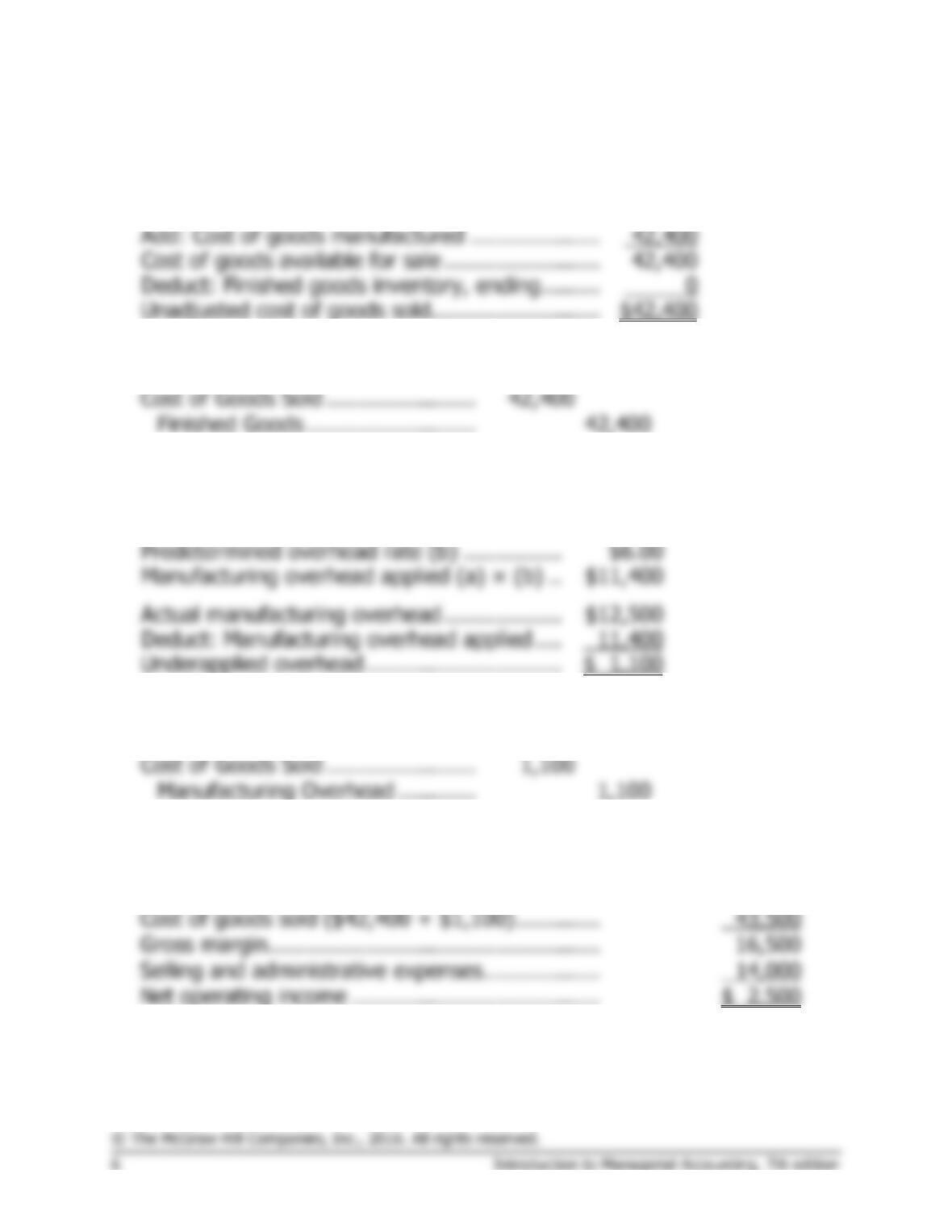
9. The journal entry is recorded as follows:
10. The completed T-account is as follows:
Work in Process
Beg. Bal.
0
(a)
21,000
(b)
28,500
(c)
11,400
(d)
End. Bal.
18,500
The Foundational 15
11. The Schedule of Cost of Goods Sold is as follows:
Finished goods inventory, beginning ………………
$ 0
Cost of goods available for sale …………………….
Deduct: Finished goods inventory, ending ……….
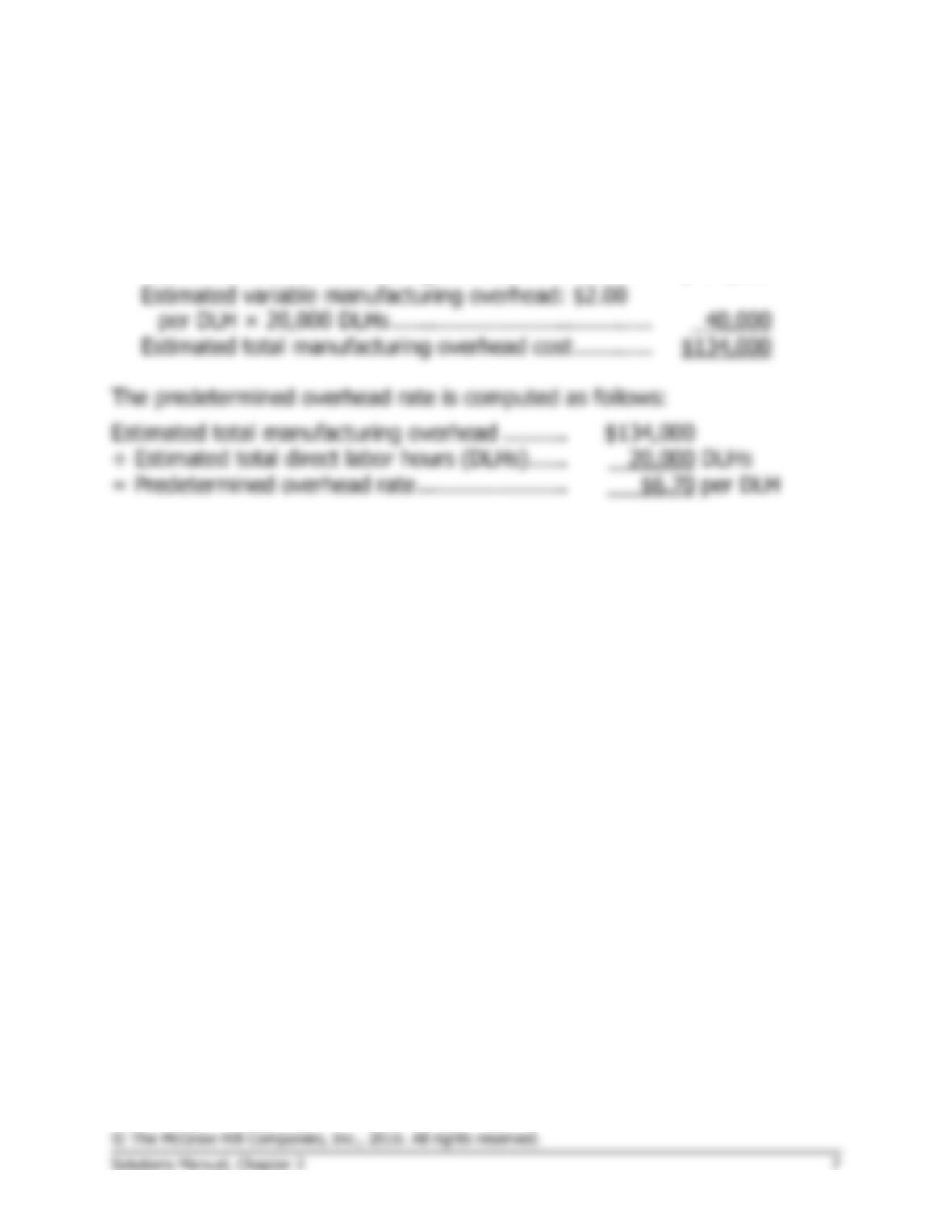
12. The journal entry is recorded as follows:
13. The amount of underapplied overhead is computed as follows:
Actual direct labor-hours (a) ………………….
1,900
Manufacturing overhead applied (a) × (b) ..
Actual manufacturing overhead ………………
Deduct: Manufacturing overhead applied ….
14. The journal entry is recorded as follows:
15. The income statement is as follows:
Sales …………………………..…………………………
$60,000
Exercise 2-1 (10 minutes)
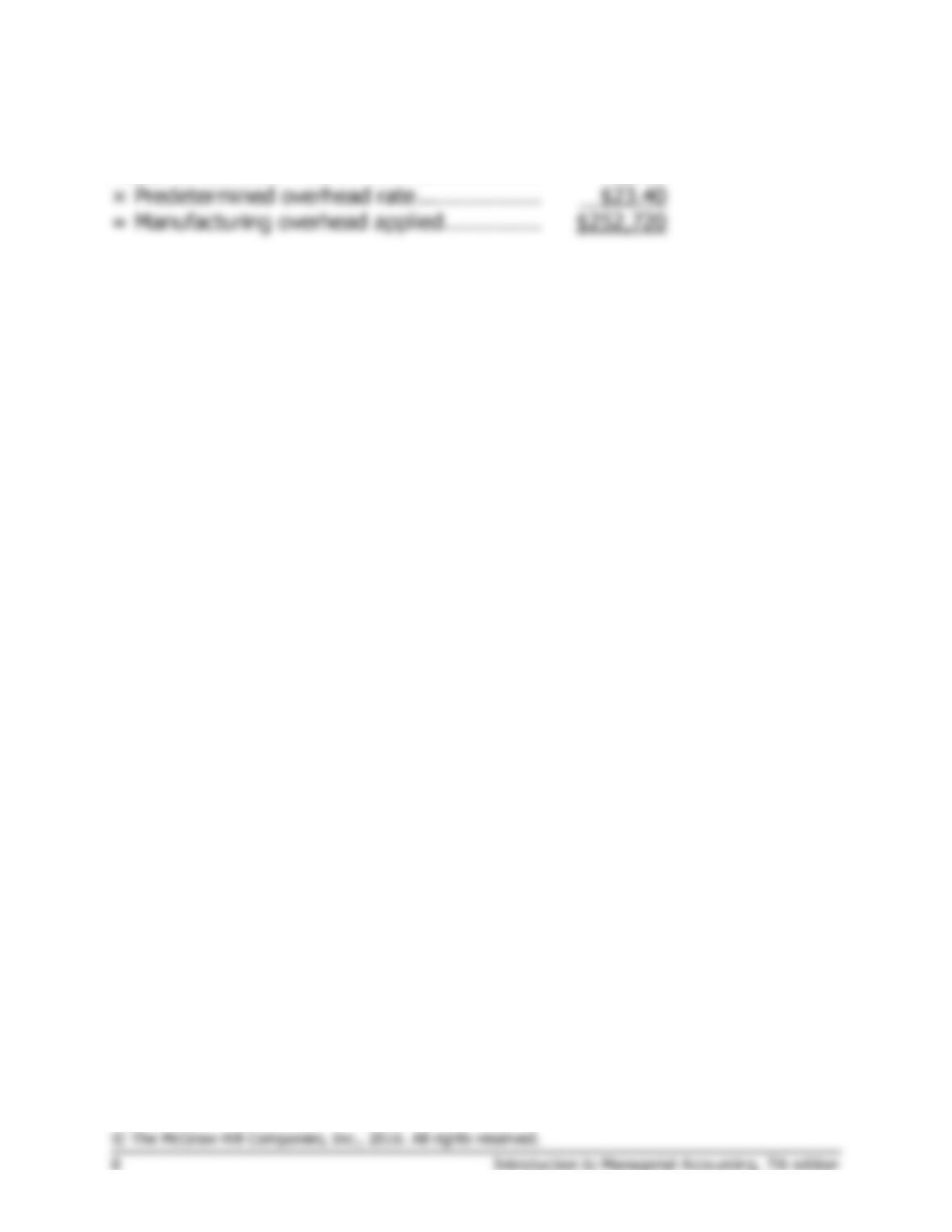
The estimated total manufacturing overhead cost is computed as follows:
Y = $94,000 + ($2.00 per DLH)(20,000 DLHs)
Estimated fixed manufacturing overhead ………………
$ 94,000
Estimated total manufacturing overhead cost …………
= Predetermined overhead rate …………………..
per DLH
Exercise 2-2 (10 minutes)
Actual direct labor-hours ………………………..
10,800
× Predetermined overhead rate ……………….
= Manufacturing overhead applied ……………
Exercise 2-3 (10 minutes)
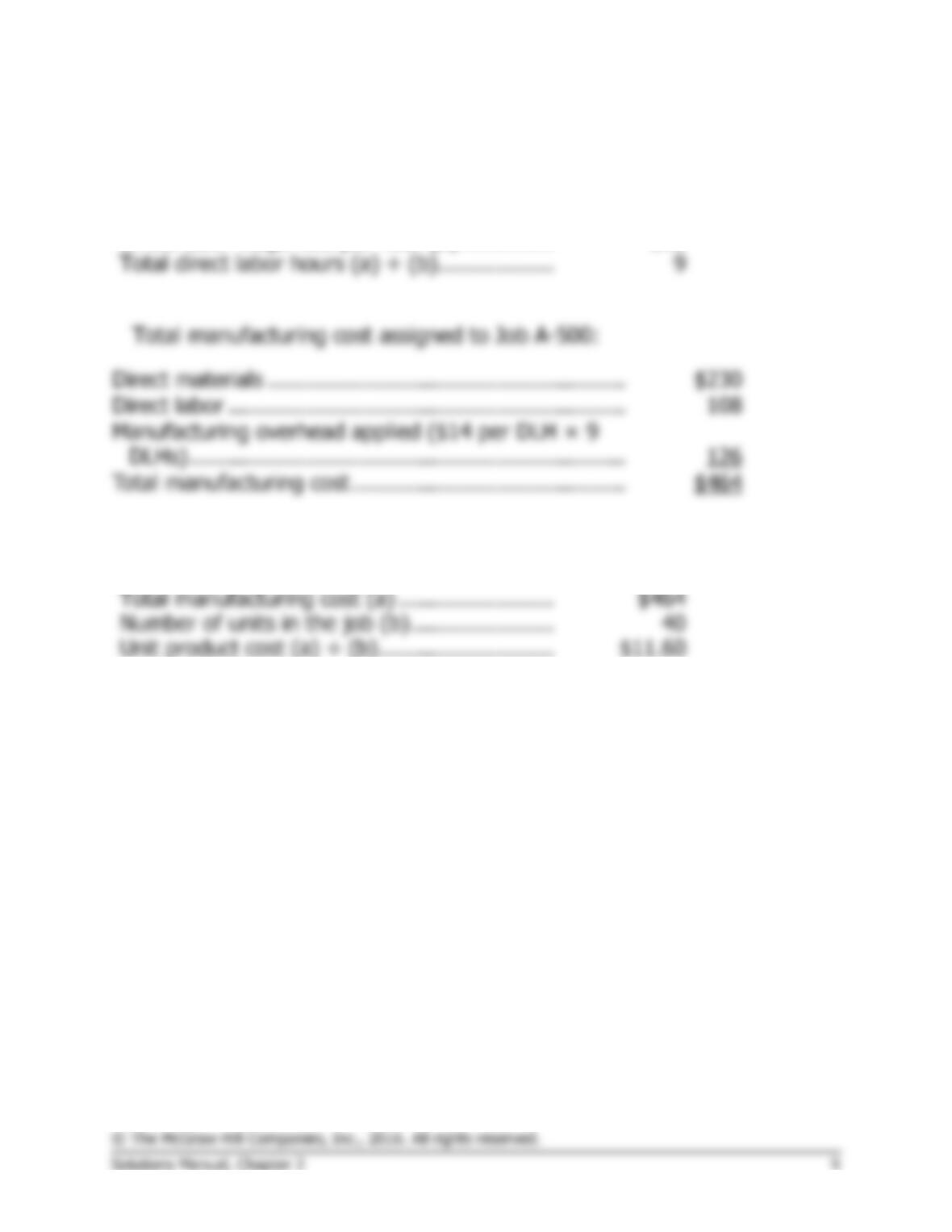
1. Total direct labor-hours required for Job A-500:
Direct labor cost (a) ……………………………….
$108
Direct labor wage rate per hour (b) …………..
$12
2. Unit product cost for Job A-500:
Total manufacturing cost (a) ……………………
Number of units in the job (b) ………………….
Exercise 2-4 (15 minutes)
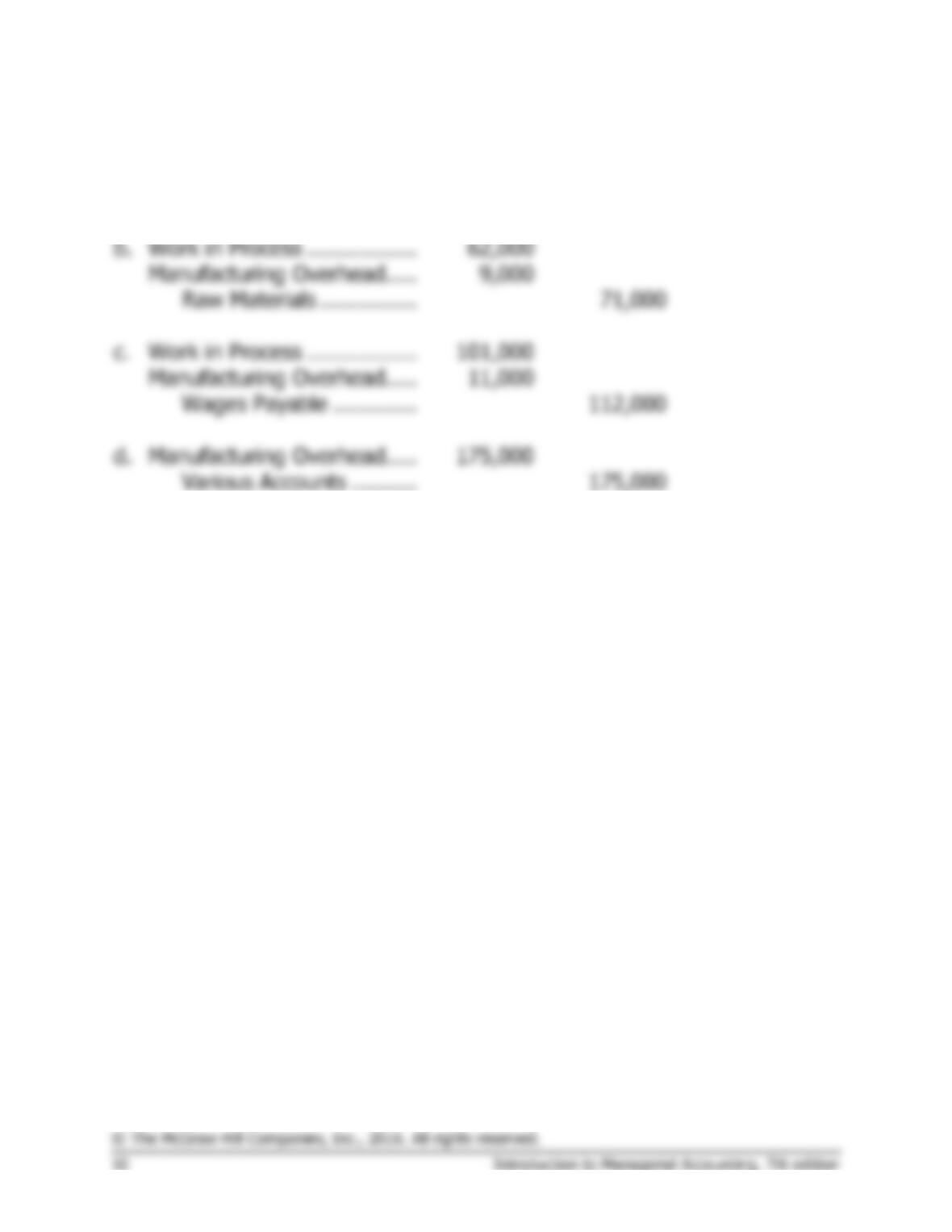
a.
Raw Materials ………………..
80,000
Accounts Payable ……….
80,000
Work in Process ……………..
62,000
Work in Process ……………..
Manufacturing Overhead…..
11,000
Manufacturing Overhead…..
Various Accounts ……….
Exercise 2-5 (20 minutes)
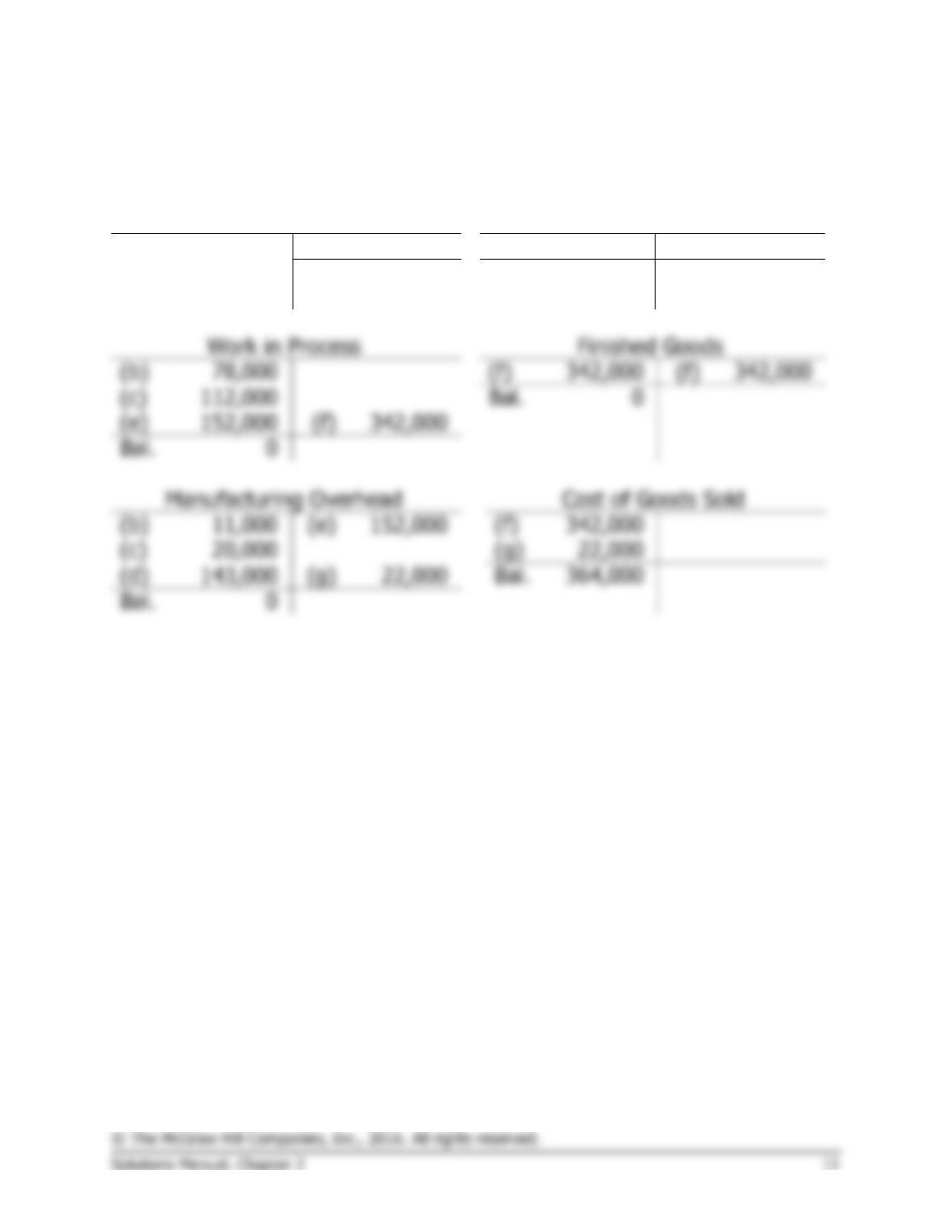
Parts 1 and 2.
Cash
Raw Materials
(a)
94,000
(a)
94,000
(b)
89,000
(c)
132,000
Bal.
5,000
(d)
143,000
(c)
Bal.
(e)
152,000
342,000
Bal.
(b)
152,000
(f)
342,000
(c)
(g)
(d)
143,000
22,000
Bal.
364,000
Bal.
Exercise 2-6 (20 minutes)
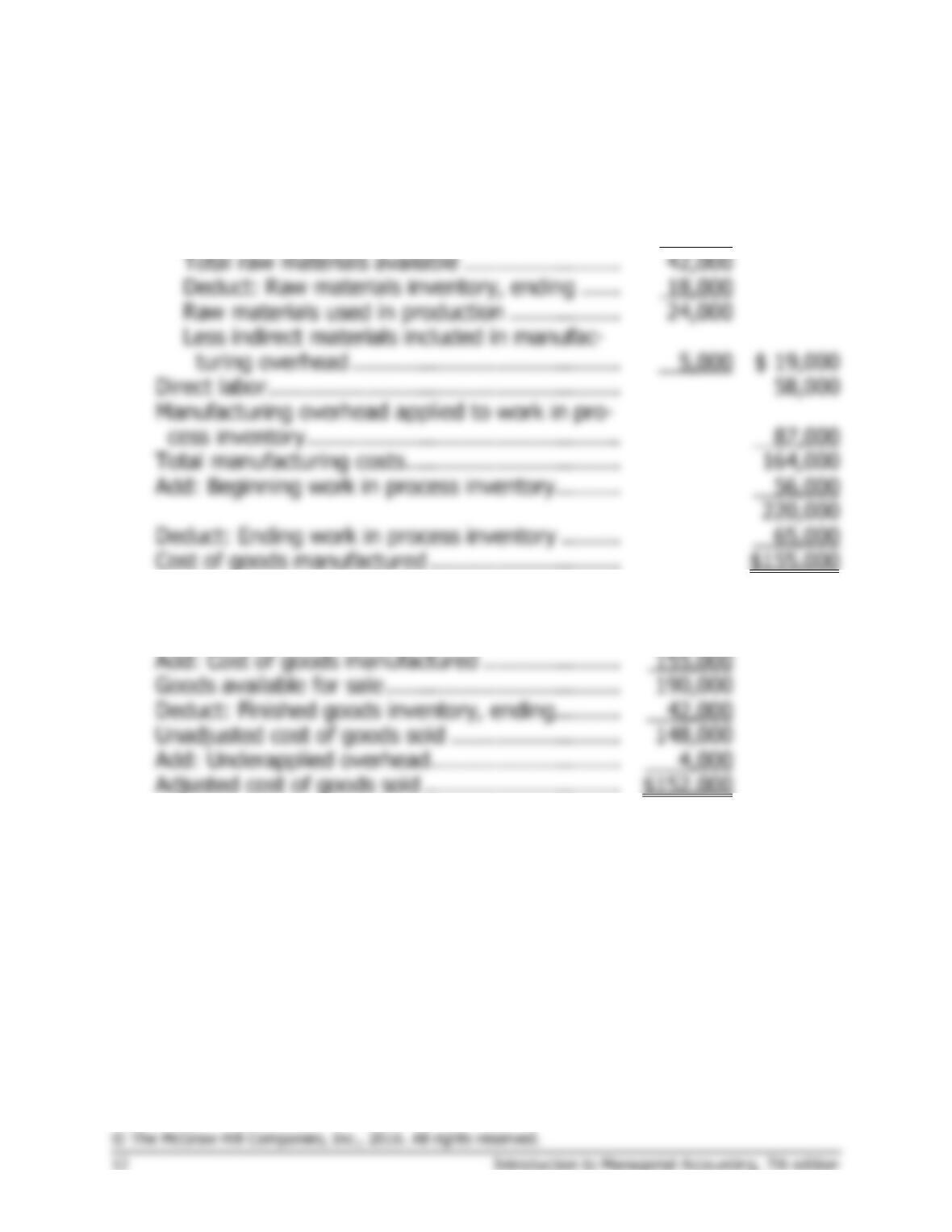
1.
Cost of Goods Manufactured
Direct materials:
Raw materials inventory, beginning……………
$12,000
Add: Purchases of raw materials ……………….
30,000
Total raw materials available ……………………
Deduct: Raw materials inventory, ending ……
Raw materials used in production ……………..
Direct labor ………………………………………………
87,000
Total manufacturing costs …………………………...
Add: Beginning work in process inventory……….
56,000
220,000
Deduct: Ending work in process inventory ………
Cost of goods manufactured ………………………..
$155,000
2.
Cost of Goods Sold
Finished goods inventory, beginning ………………
$ 35,000
Add: Cost of goods manufactured …………………
155,000
Goods available for sale ………………………………
Deduct: Finished goods inventory, ending……….
Unadjusted cost of goods sold ……………………..
148,000
Add: Underapplied overhead ………………………..
Adjusted cost of goods sold …………………………
$152,000
Exercise 2-7 (10 minutes)
1.
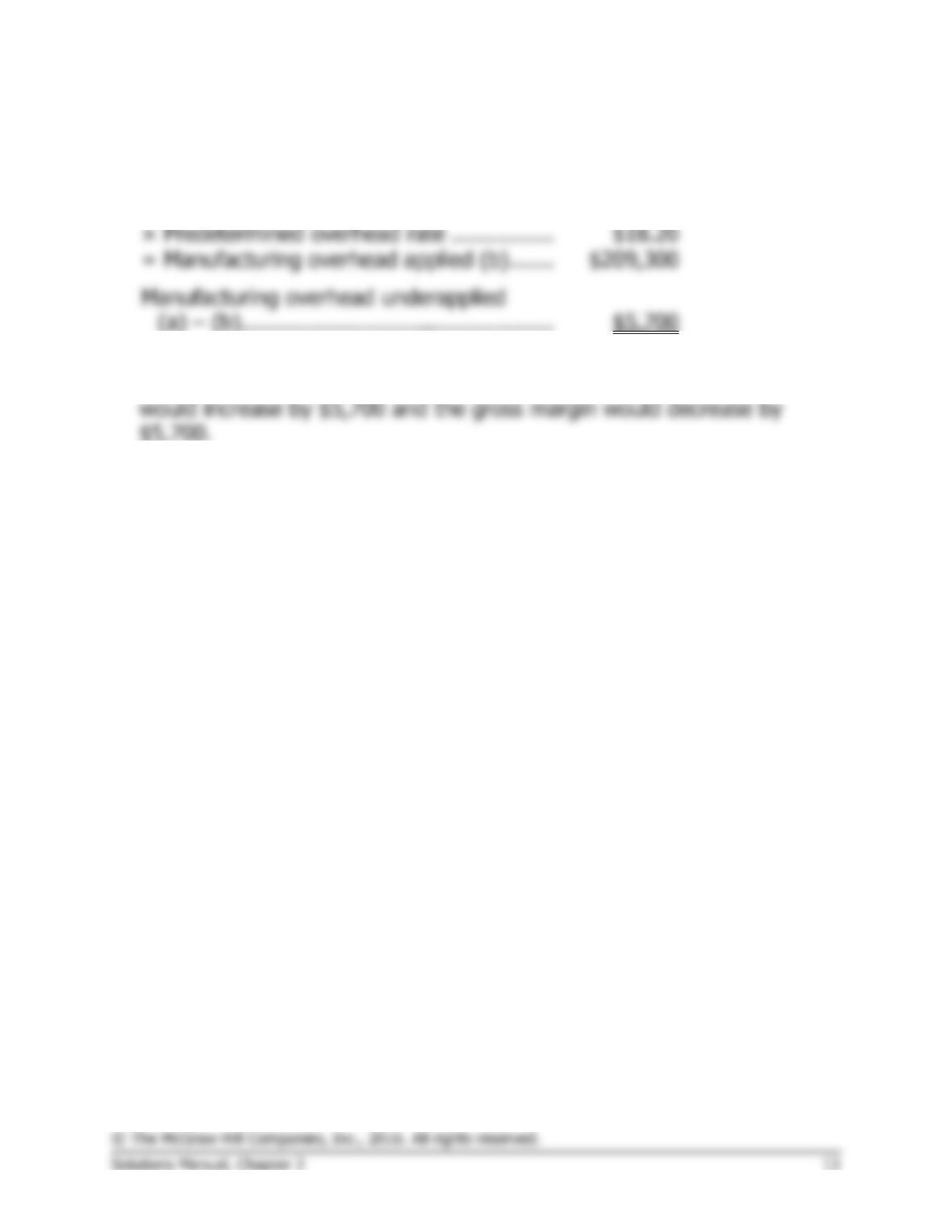
Manufacturing overhead incurred (a) ………
$215,000
Actual direct labor-hours ………………………
11,500
× Predetermined overhead rate …………….
$209,300
2. Because manufacturing overhead is underapplied, the cost of goods sold
Exercise 2-8 (10 minutes)
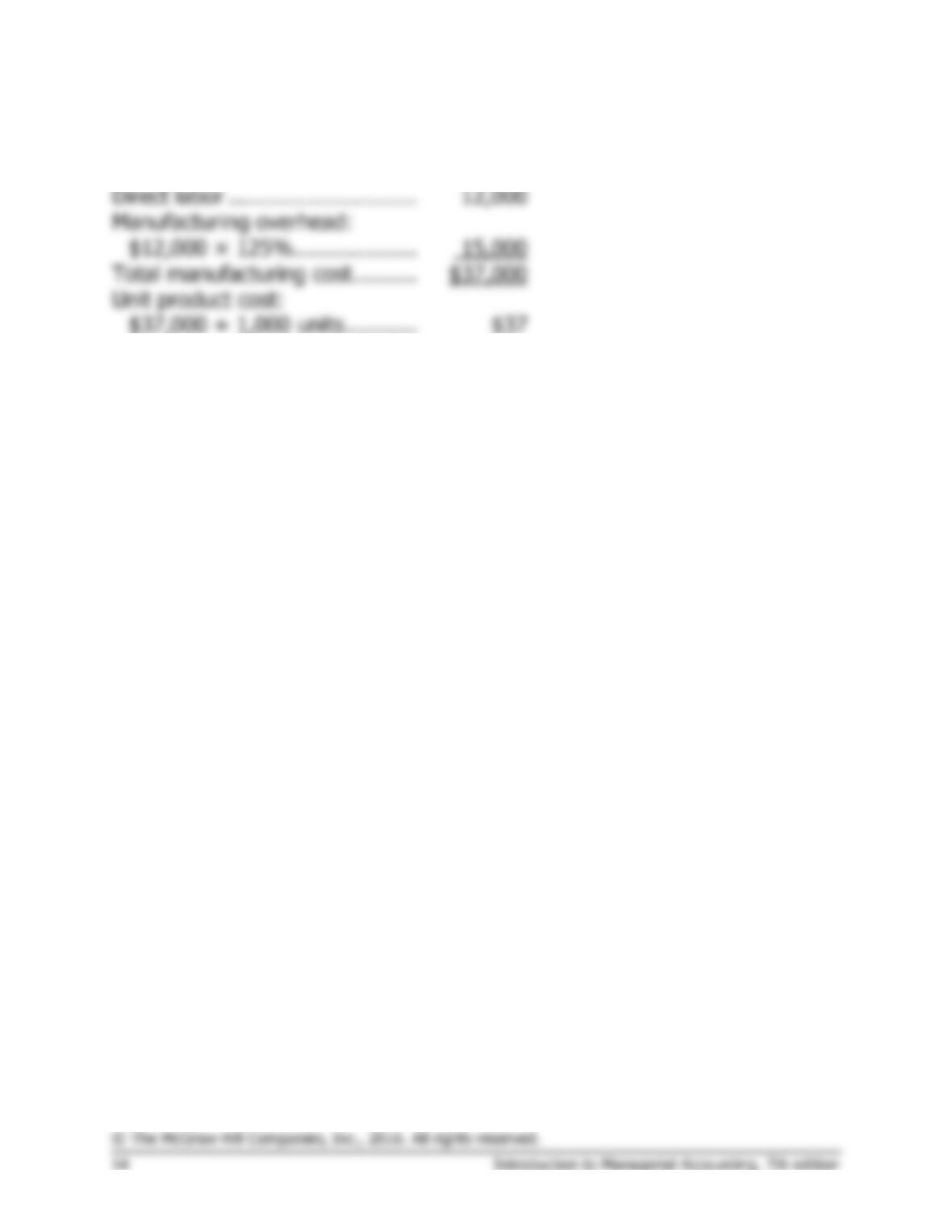
Direct material …………………….
$10,000
Direct labor ………………………..
Manufacturing overhead:
$12,000 × 125% ……………….
Exercise 2-9 (30 minutes)
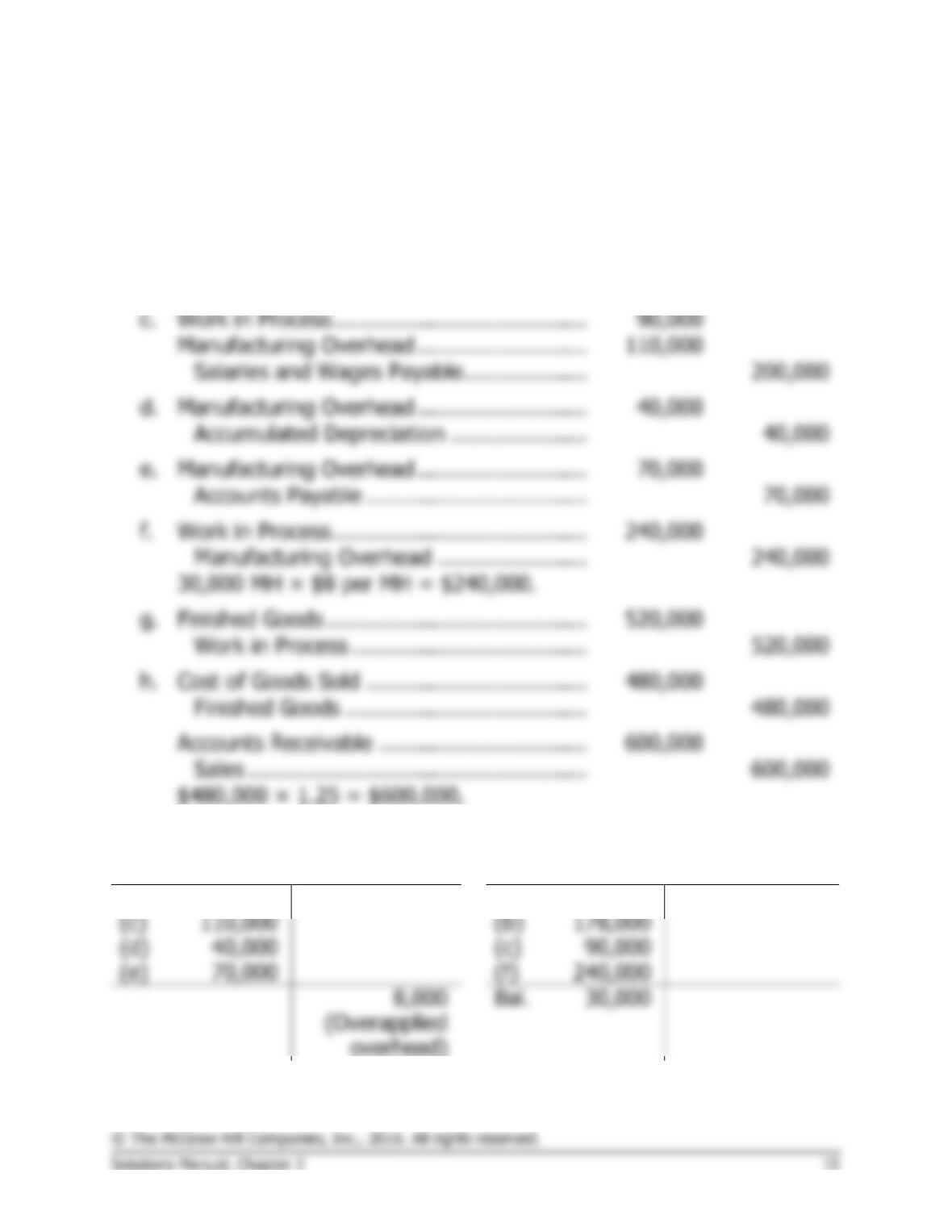
1.
a.
Raw Materials Inventory ………………………
210,000
Accounts Payable …………………………….
210,000
b.
Work in Process …………………………………
178,000
Manufacturing Overhead ……………………..
12,000
Raw Materials Inventory ……………………
190,000
Work in Process …………………………………
90,000
Manufacturing Overhead ……………………..
110,000
d.
Manufacturing Overhead ……………………..
40,000
Accumulated Depreciation …………………
Manufacturing Overhead ……………………..
70,000
Accounts Payable …………………………….
Work in Process …………………………………
Manufacturing Overhead …………………..
240,000
30,000 MH × $8 per MH = $240,000.
g.
Finished Goods ………………………………….
520,000
Work in Process ………………………………
520,000
Cost of Goods Sold …………………………….
480,000
Finished Goods ……………………………….
480,000
Accounts Receivable …………………………..
600,000
Sales …………………………………………….
600,000
$480,000 × 1.25 = $600,000.
2.
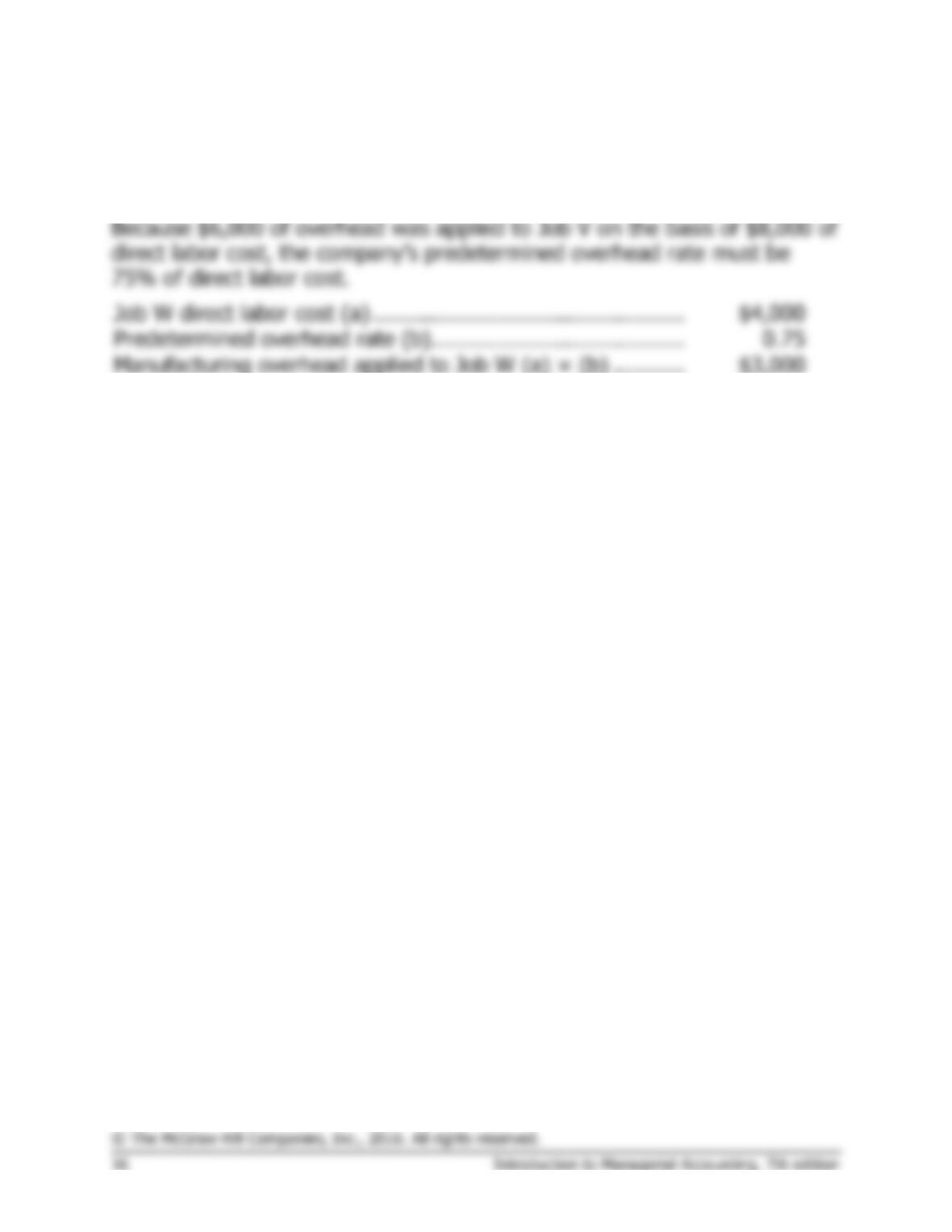
Manufacturing Overhead
Work in Process
(b)
12,000
(f)
240,000
Bal.
42,000
(g)
520,000
(d)
40,000
(c)
90,000
(e)
70,000
(f)
Bal.
30,000
Exercise 2-10 (10 minutes)
Yes, overhead should be applied to value the Work in Process inventory at
year-end.
Exercise 2-11 (30 minutes)
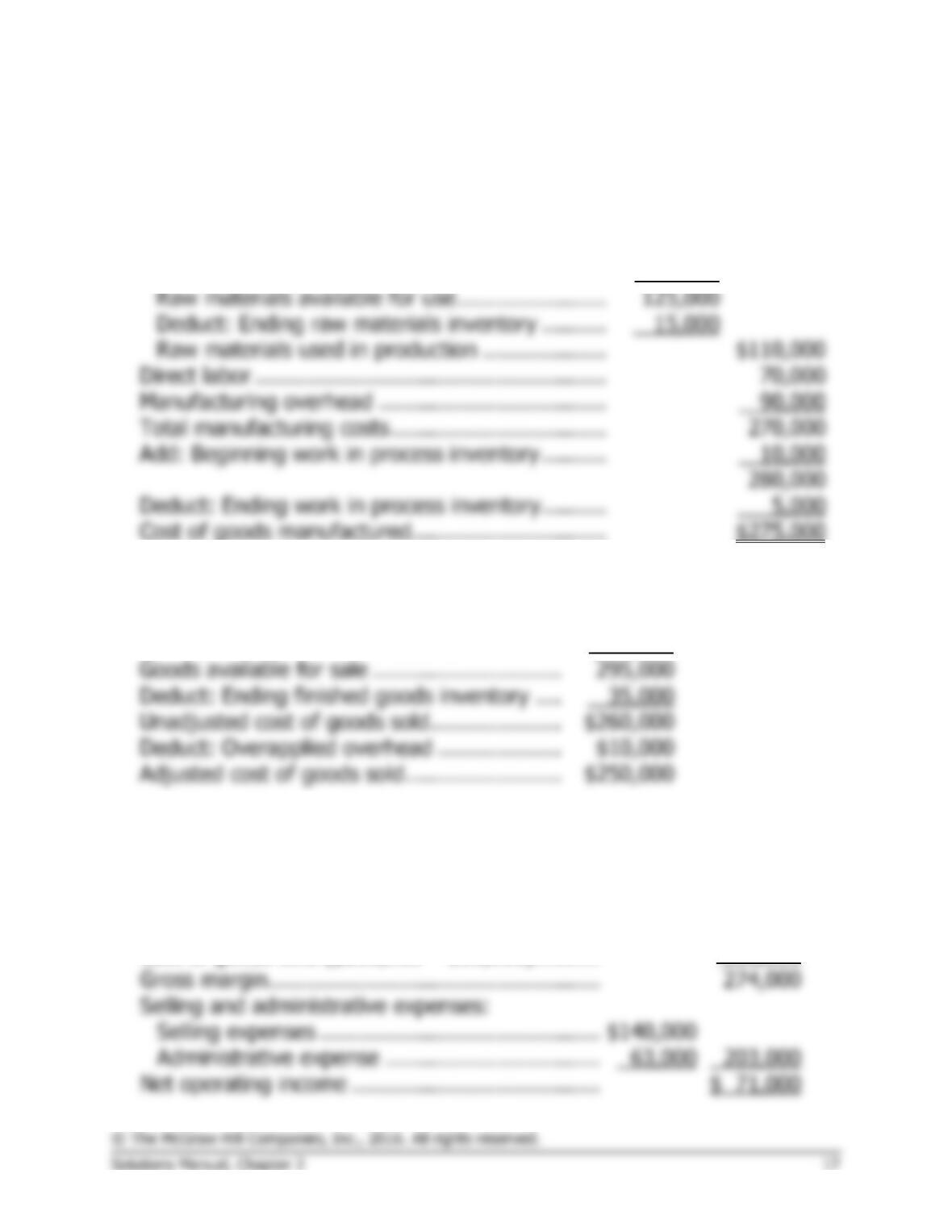
1. Mason Company’s schedule of cost of goods manufactured is as follows:
Direct materials:
Beginning raw materials inventory ………………
$ 7,000
Add: Purchases of raw materials …………………
118,000
Raw materials available for use …………………..
Deduct: Ending raw materials inventory ……….
Raw materials used in production ……………….
$110,000
Direct labor ………………………………………………
Manufacturing overhead ……………………………..
90,000
Total manufacturing costs …………………………...
Add: Beginning work in process inventory ……….
Deduct: Ending work in process inventory ……….
Cost of goods manufactured…………………………
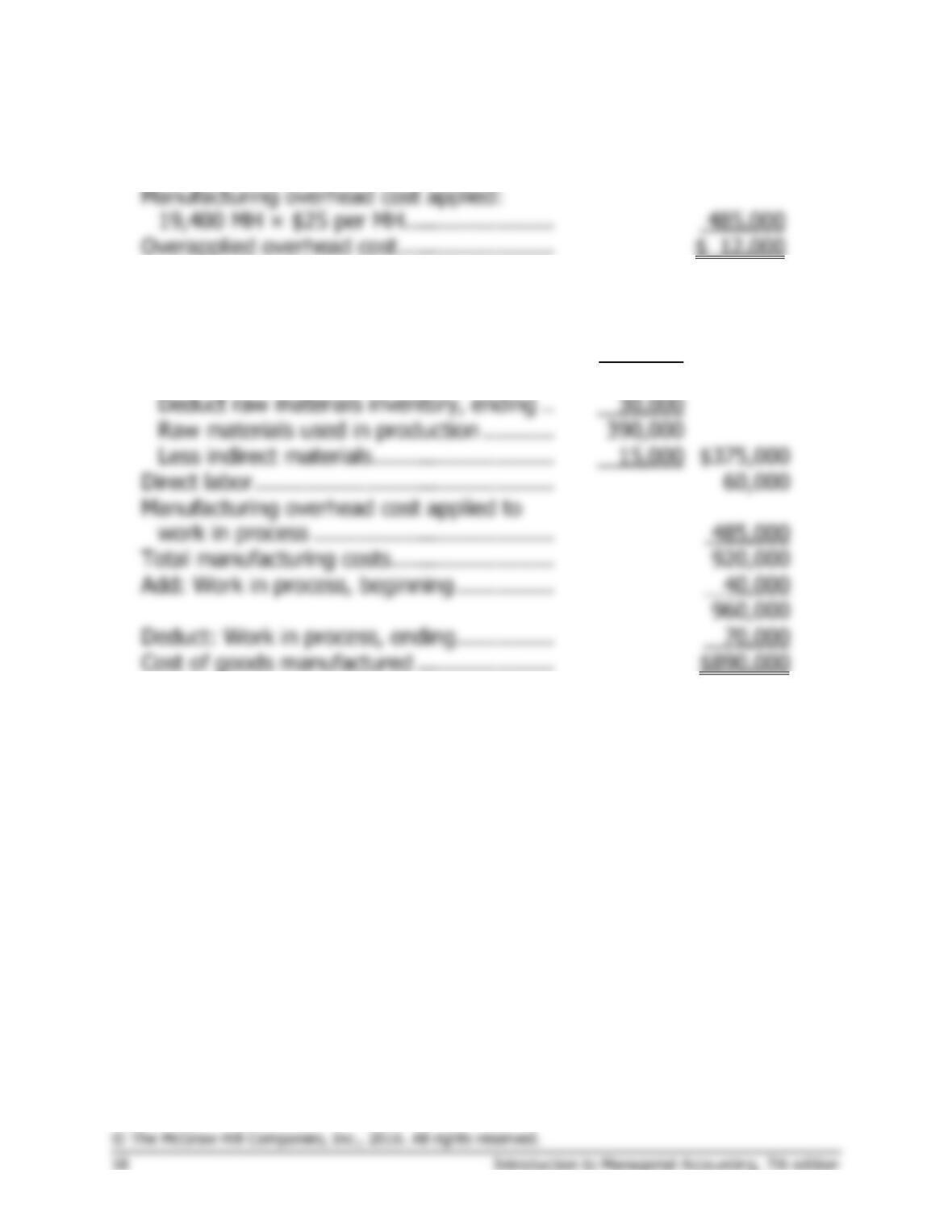
2. Mason Company’s schedule of cost of goods sold is as follows:
Beginning finished goods inventory ………….
$ 20,000
Add: Cost of goods manufactured ……………
275,000
Goods available for sale ………………………..
Deduct: Ending finished goods inventory ….
Unadjusted cost of goods sold ………………..
Deduct: Overapplied overhead ……………….
Adjusted cost of goods sold ……………………
3.
Mason Company
Income Statement
Sales …………………………..…………………………
$524,000
Cost of goods sold ($260,000 – $10,000) ……….
250,000
Gross margin ……………………………………………
Selling and administrative expenses:
Selling expenses …………………………………….
Administrative expense …………………………...
Net operating income ………………………………..
Exercise 2-12 (15 minutes)
1.
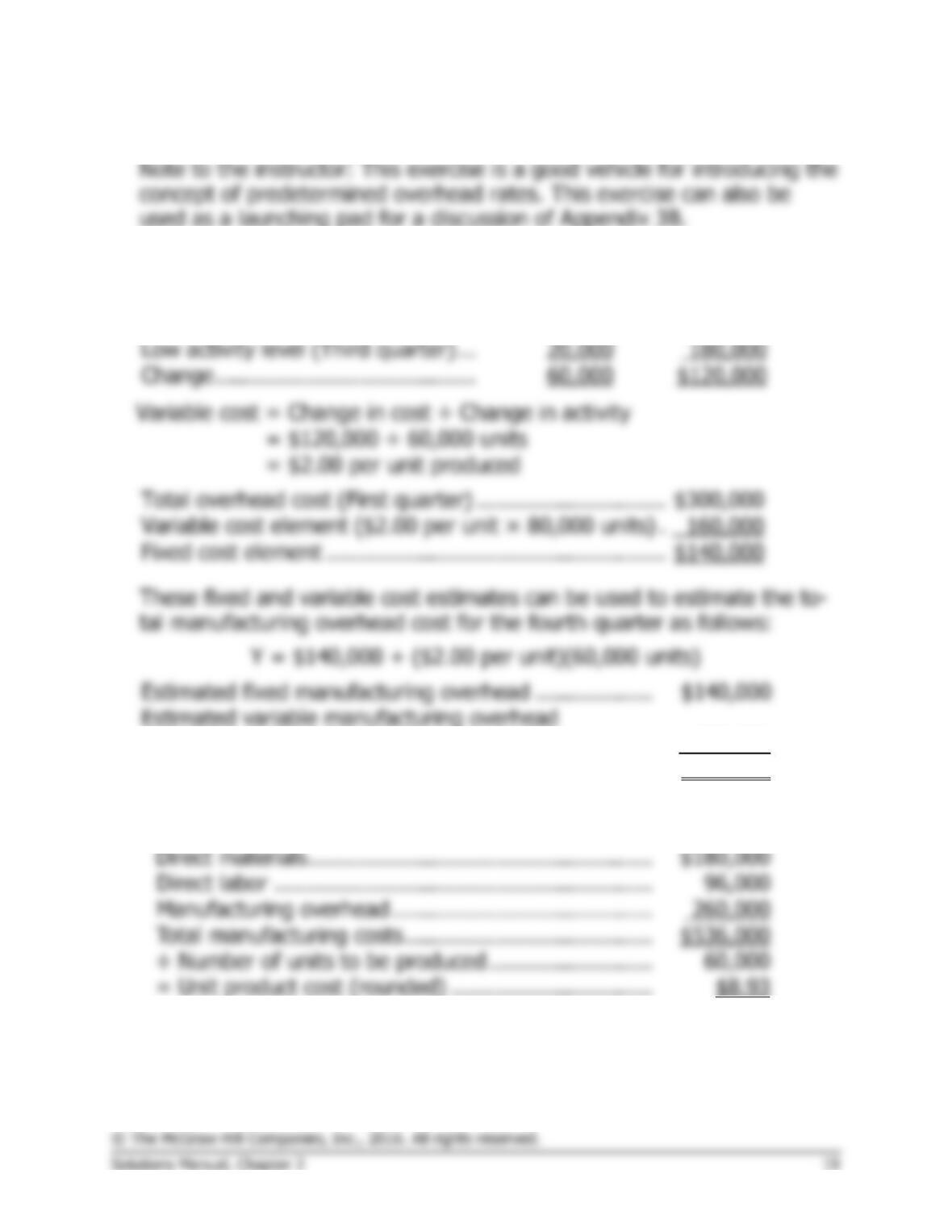
Actual manufacturing overhead costs ……..
$473,000
Overapplied overhead cost ……………………
2.
Direct materials:
Raw materials inventory, beginning ……..
$ 20,000
Add purchases of raw materials …………..
400,000
Raw materials available for use …………..
420,000
Deduct raw materials inventory, ending ..
Raw materials used in production ………..
390,000
Less indirect materials ……………………….
Direct labor ……………………………………….
Total manufacturing costs …………………….
Add: Work in process, beginning ……………
960,000
Deduct: Work in process, ending ……………
Cost of goods manufactured …………………
Exercise 2-13 (30 minutes)
1.
Units
Produced
Manufacturing
Overhead
High activity level (First quarter) …
80,000
$300,000
Low activity level (Third quarter) …
Change ………………………………….
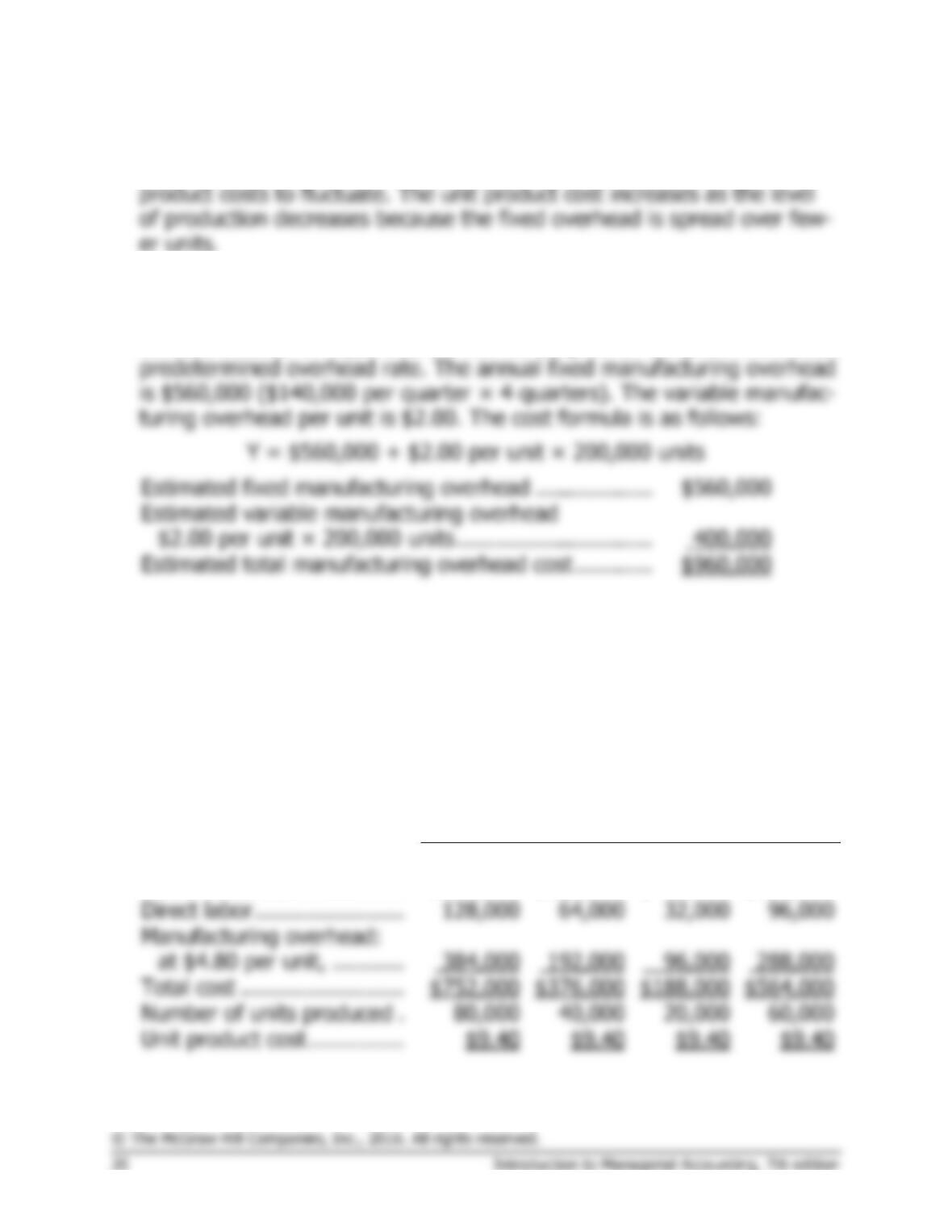
Total overhead cost (First quarter) ………………………..
Variable cost element ($2.00 per unit × 80,000 units) .
Fixed cost element …………………………………………….
Estimated fixed manufacturing overhead ………………
$2.00 per unit × 60,000 units …………………………..
120,000
Estimated total manufacturing overhead cost …………
$260,000
Total manufacturing cost and unit product cost:
Exercise 2-13 (continued)
2. The fixed portion of the manufacturing overhead cost is causing the unit
3. The unit product cost can be stabilized by using a predetermined over-
head rate that is based on expected activity for the entire year. The cost
formula created in requirement 1 can be adapted to compute the annual
Estimated total manufacturing overhead cost …………
The annual predetermined overhead rate is computed as follows:
Estimated total manufacturing overhead ….
$960,000
÷ Estimated total units produced ……………
200,000
= Predetermined overhead rate ……………..
$4.80
per unit
Using a predetermined overhead rate of $4.80 per unit, the unit product
costs would stabilize as shown below:
Quarter
First
Second
Third
Fourth
Direct materials ……………..
$240,000
$120,000
$ 60,000
$180,000
Direct labor …………………..
Number of units produced .
Unit product cost ……………