CASE 2.9
REGINA COMPANY, INC.
Synopsis
Donald Sheelen was an ambitious, 34-year-old executive when he was hired by Regina
Company in 1980 to head up its marketing department. Within three years, Sheelen was promoted
to company president. A few years later, after having acquired Regina along with several of his
fellow executives via a leveraged buyout, Sheelen’s investment in the company had a market value
of nearly $100,000,000. The record sales and earnings figures that were responsible for the rapid
Case 2.9 Regina Company, Inc. 143
142
Regina Company, Inc.—Key Facts
1. For most of its existence, Regina was known as a complacent, slow-growth company that
was overshadowed by Hoover and Eureka, the two leading firms in the floorcare industry.
2. In 1980, Donald Sheelen was hired to head up Regina’s marketing department; Sheelen
4. During the mid-1980s, Regina developed a number of new products in rapid succession,
5. Regina’s product quality problems undermined the company’s financial health.
7. Understating sales returns and recording bogus sales were the principal methods used by
Sheelen and the CFO to improve Regina’s reported operating results.
8. After Sheelen revealed the accounting scam to federal prosecutors both he and Regina’s
10. In response to criticism of Peat Marwick’s audits of Regina, a Peat Marwick partner
observed that his firm preferred to “trust the people we’re auditing.”
144 Case 2.9 Regina Company, Inc.
Instructional Objectives
1. To demonstrate the effect that a lack of management integrity has on the level of inherent
risk posed by an audit.
3. To illustrate common methods that client management may use to manipulate the reported
financial condition and operating results of a company.
Suggestions for Use
The assessment of inherent risk was a key issue in this case. The application of analytical
procedures to Regina’s financial data for the period 1986-1988 suggests that questions could have
been raised regarding the material accuracy of several key financial statement line items including
inventory, receivables, and cost of goods sold. For this reason, this case is probably best suited for
coverage during class discussion of the use of analytical procedures, particularly the use of such
Case 2.9 Regina Company, Inc. 145
Suggested Solutions to Case Questions
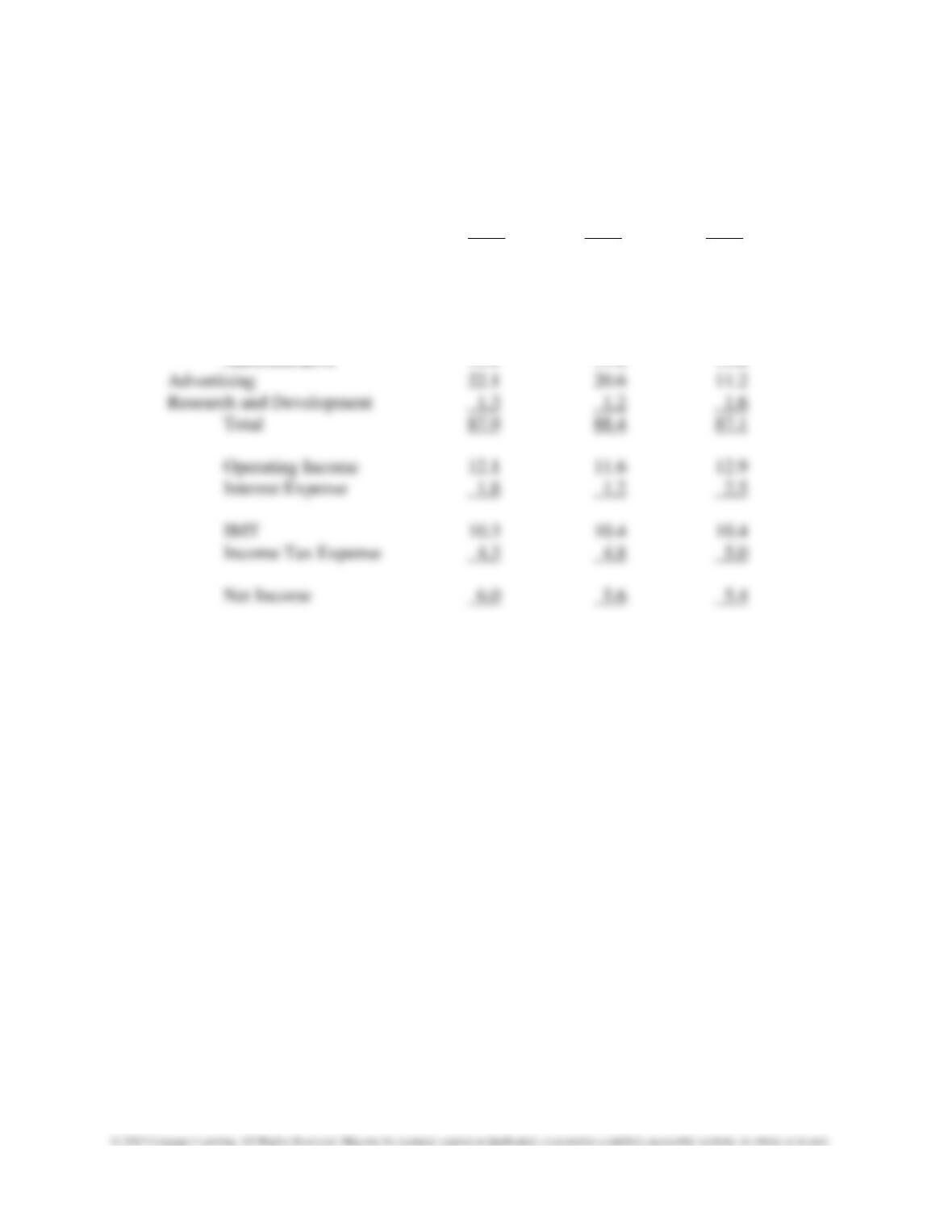
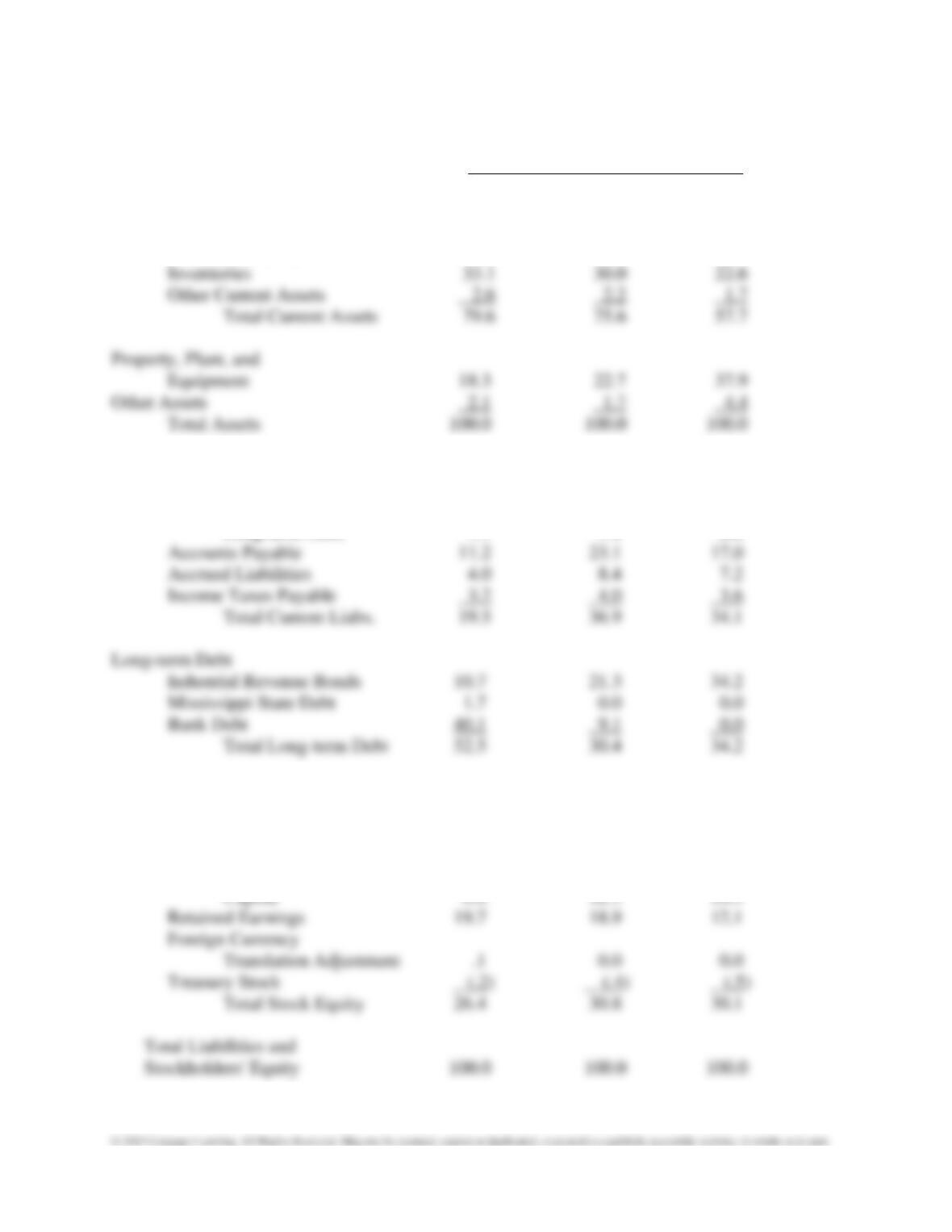
1. Common-sized income statements for Regina Company.
1988 1987 1986
Net Sales
100.0
100.0
100.0
Operating Costs and Expenses
Cost of Goods Sold
52.4
55.2
60.7
Research and Development
1.3
1.2
1.6
Total
87.9
88.4
87.1
Interest Expense
1.8
1.2
2.5
Income Tax Expense
4.3
4.8
5.0
Net Income
6.0
5.6
5.4
Selling, Distribution, and
146 Case 2.9 Regina Company, Inc.
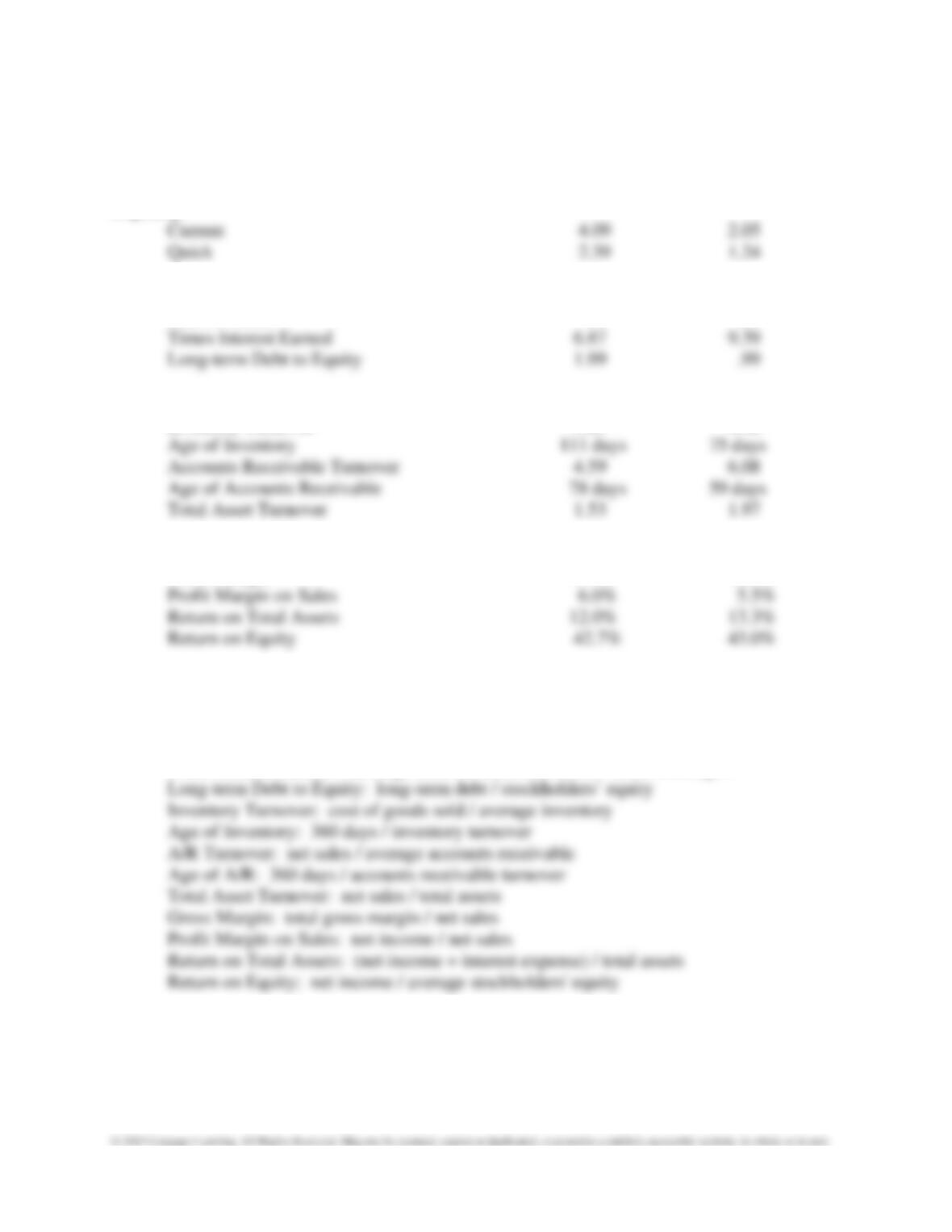
Common-sized balance sheets for Regina Company.
1988 1987 1986
Treasury Stock
Total Stock Equity
(.2)
26.4
(.4)
30.8
(.5)
30.1
Current Assets
Cash
Receivables (net)
Current Liabilities
Short-term Borrowings
Current Portion of
Long-term Debt
Deferred Income Taxes
Stockholders’ Equity:
Common Stock
Additional Paid-in
.7
43.2
0.0
1.1
1.6
0.0
.8
42.6
0.0
1.4
1.9
0.0
.1
33.3
6.3
0.0
1.6
0.0
Case 2.9 Regina Company, Inc. 147
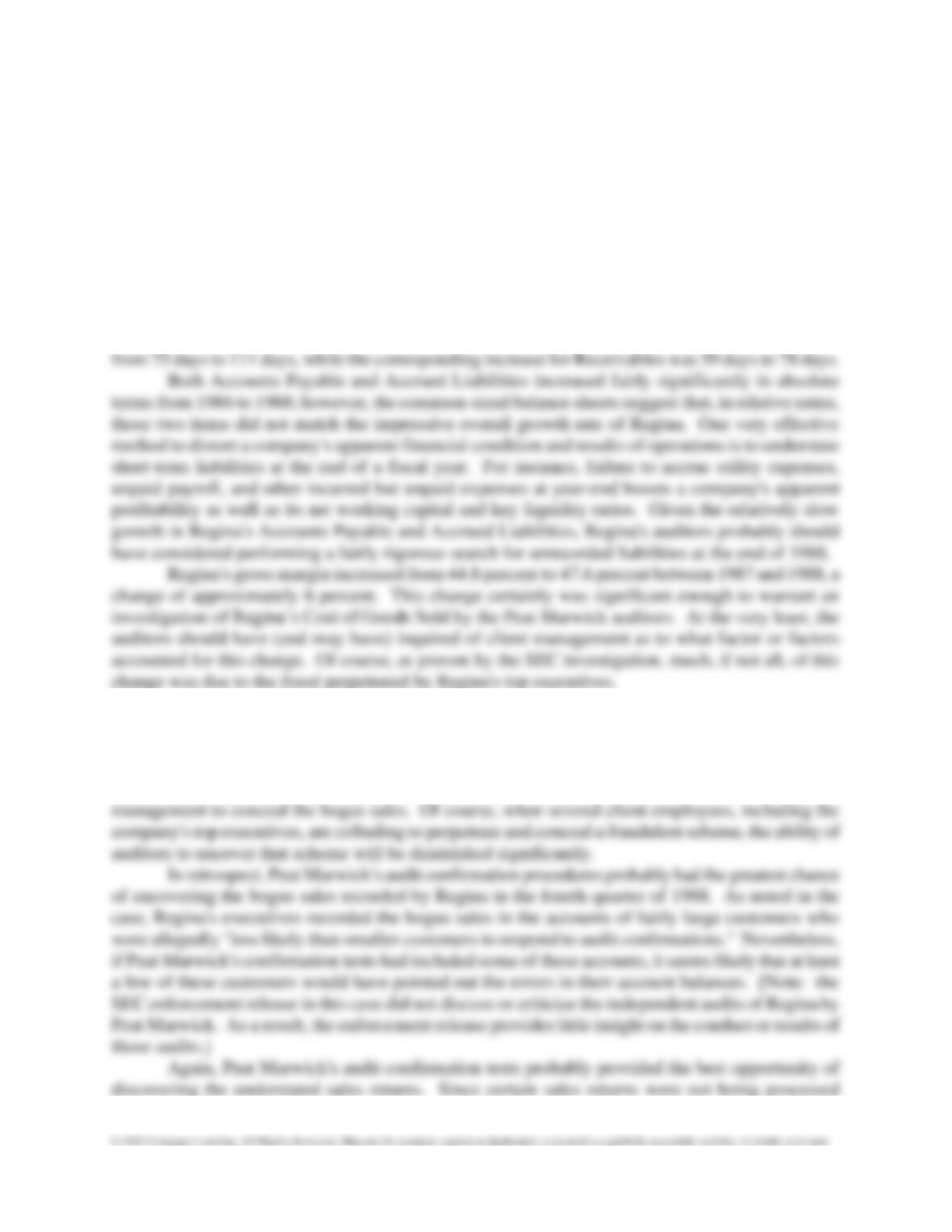
Financial ratios for Regina Company.
1988 1987
Liquidity:
Solvency:
Debt to Assets .72 .67
Activity:
Inventory Turnover 3.23 4.82
Profitability:
Gross Margin 47.6% 44.8%
Equations:
Current Ratio: current assets / current liabilities
Quick Ratio: (current assets – inventory) / current liabilities
Debt to Assets: total debt / total assets
Times Interest Earned: earnings before interest and taxes / interest charges
148 Case 2.9 Regina Company, Inc.
Discussion:
The above data suggest that for the 1988 audit of Regina Company the following financial
statement line items had a relatively high degree of inherent risk: Receivables, Inventories,
Accounts Payable, Accrued Liabilities, and Cost of Goods Sold. The common-sized balance sheets
show that both Receivables and Inventories increased by significant percentages between 1986 and
1988. In fact, Inventories, as a percentage of total assets, increased almost 50 percent during that
time frame. These increases suggest that Regina’s auditors should have been particularly concerned
with the material accuracy of the valuation assertion for those two items which, collectively,
accounted for 76 percent of Regina‘s total assets by the end of fiscal 1988. Of course, the activity
ratios reinforce this concern. From 1987 to 1988, the average age of Regina’s Inventories increased
2. Apparently, the Peat Marwick auditors did not suspect that Regina’s financial statements
were being intentionally misrepresented. Consequently, discovery of the bogus sales was entirely
dependent upon the standard audit tests for sales and accounts receivable that Peat Marwick typically
applied in a “normal” audit engagement. Complicating matters were the efforts of Regina’s
Case 2.9 Regina Company, Inc. 149
through the company’s accounting records, the confirmation tests seemingly should have resulted in
at least a few of Regina’s customers reporting discrepancies in the amounts they owed and the
amounts reported on the confirmations mailed to them by Peat Marwick.
3. The key objective of sales cutoff tests is to determine whether the client has violated the
“cutoff” assertion [for transactions] discussed in SAS No. 106, “Audit Evidence.” That is, the
auditor is looking for evidence of sales near year-end that were recorded in the wrong fiscal year.
Sales cutoff tests also provide evidence regarding the integrity of several other management
assertions such as the “existence” and “completeness” assertions for account balances. For example,
4. Obviously, whether to rely or not on this assertion of management was a matter of
professional judgment on the part of Peat Marwick. Since the Peat Marwick auditors apparently did
not doubt the integrity of Golden at this point in time, it does not seem unreasonable for the auditors
to have accepted the assertion that the erroneous transaction was an isolated item.
150 Case 2.9 Regina Company, Inc.
5. According to AU 316.13, an “auditor should conduct the engagement with a mindset that
recognizes the possibility that a material misstatement due to fraud could be present, regardless of