Chapter 02 – Investing and Financing Decisions and the Accounting System
2-1
CHAPTER 2
INVESTING AND FINANCING DECISIONS
AND THE ACCOUNTING SYSTEM
Learning Objectives and Related Assignment Materials
Learning Objectives
Mini-
Exercises
Exercises
Problems
Alternate
Problems
Continuing
Problem
Cases and
Projects
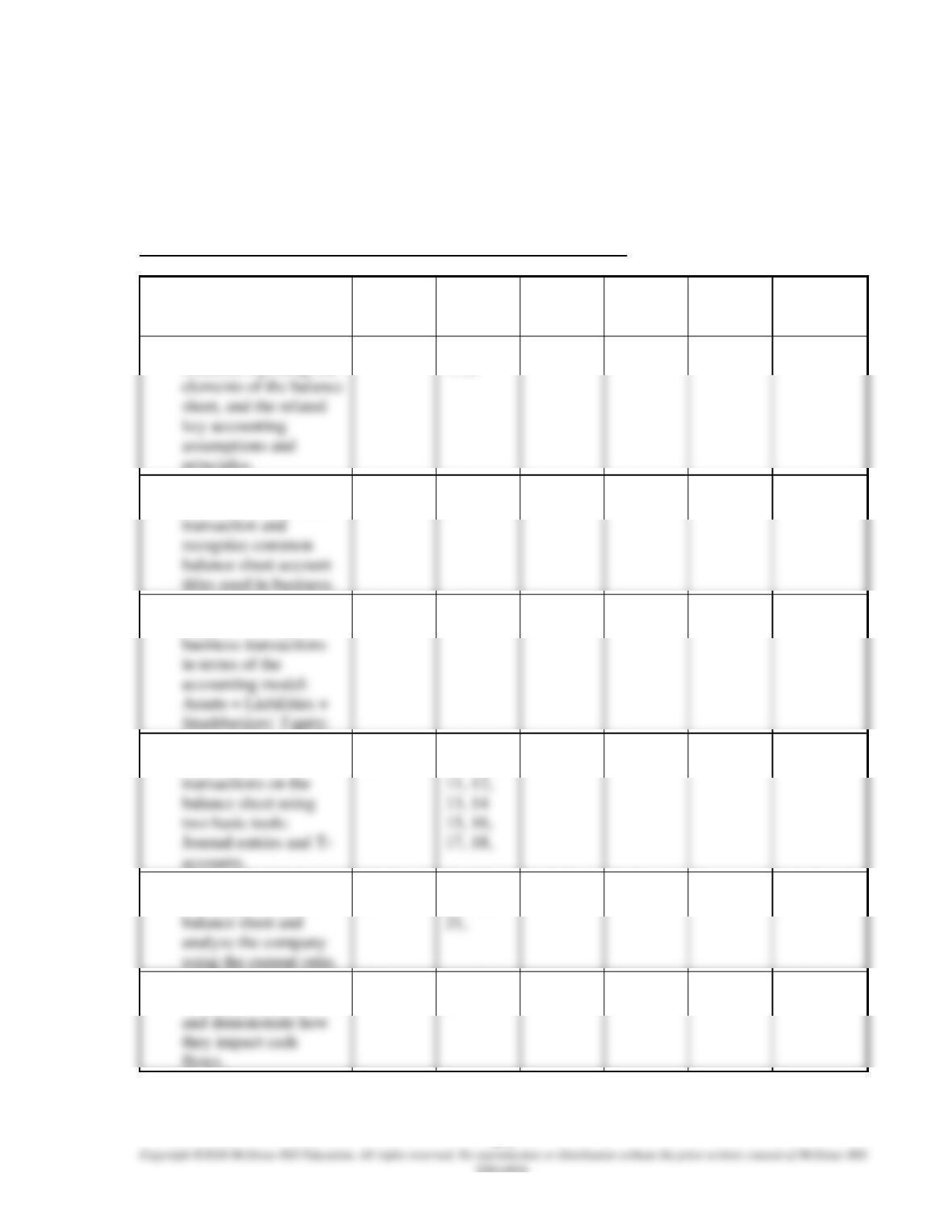
2-1 Define the objective of
financial reporting, the
principles.
1, 2, 4
1, 2, 3, 5,
7, 21
1
1
1, 2, 5, 7, 8
transaction and
2-2 Identify what
constitutes a business
2, 3, 4
1, 2, 3,
21
1, 2, 3, 5
1, 2, 3
1, 2, 3, 4, 6,
9
2-3 Apply transaction
analysis to simple
2, 5
1, 4, 5
2
2
2-4 Determine the impact
of business
1, 2, 6, 7,
8, 9
1, 3, 6, 7,
8, 9, 10,
1, 3, 5
1, 3
1
6
2-5 Prepare a trial balance
and simple classified
10, 11,
12
11, 12,
15, 16,
2, 3, 5
2, 3
1
1, 2, 3, 4, 5,
6, 7, 9
2-6 Identify investing and
financing transactions
13
19, 20,
21
4, 6
4
1
1, 2, 3, 4, 9
Chapter 02 – Investing and Financing Decisions and the Accounting System
2-2
Synopsis of Chapter Revisions
Focus Company: Chipotle Mexican Grill
• Chapter 2 introduces the accounting cycle for Chipotle Mexican Grill, a relatively simple
company facing mounting competition. The chapter integrates typical financial information for
investing and financing activities for the first quarter of 2018, resulting in a quarterly balance
sheet (with a few simplifications). This fast-casual restaurant does not utilize franchising, thus
• New General Ledger Problem designations for a few exercises and problems that also may be
completed manually.
• New General Ledger Problem designation for the CONTINUING PROBLEM in the end-of-
chapter problems based on the activities of Penny’s Pool Service & Supply and its supplier, Pool
Corporation. These companies provide a consistent context for summarizing the key points
emphasized in each chapter. In Chapter 2, students prepare journal entries, post to T-accounts,
PowerPoint Slides
Learning Objectives
PowerPoint® Slides
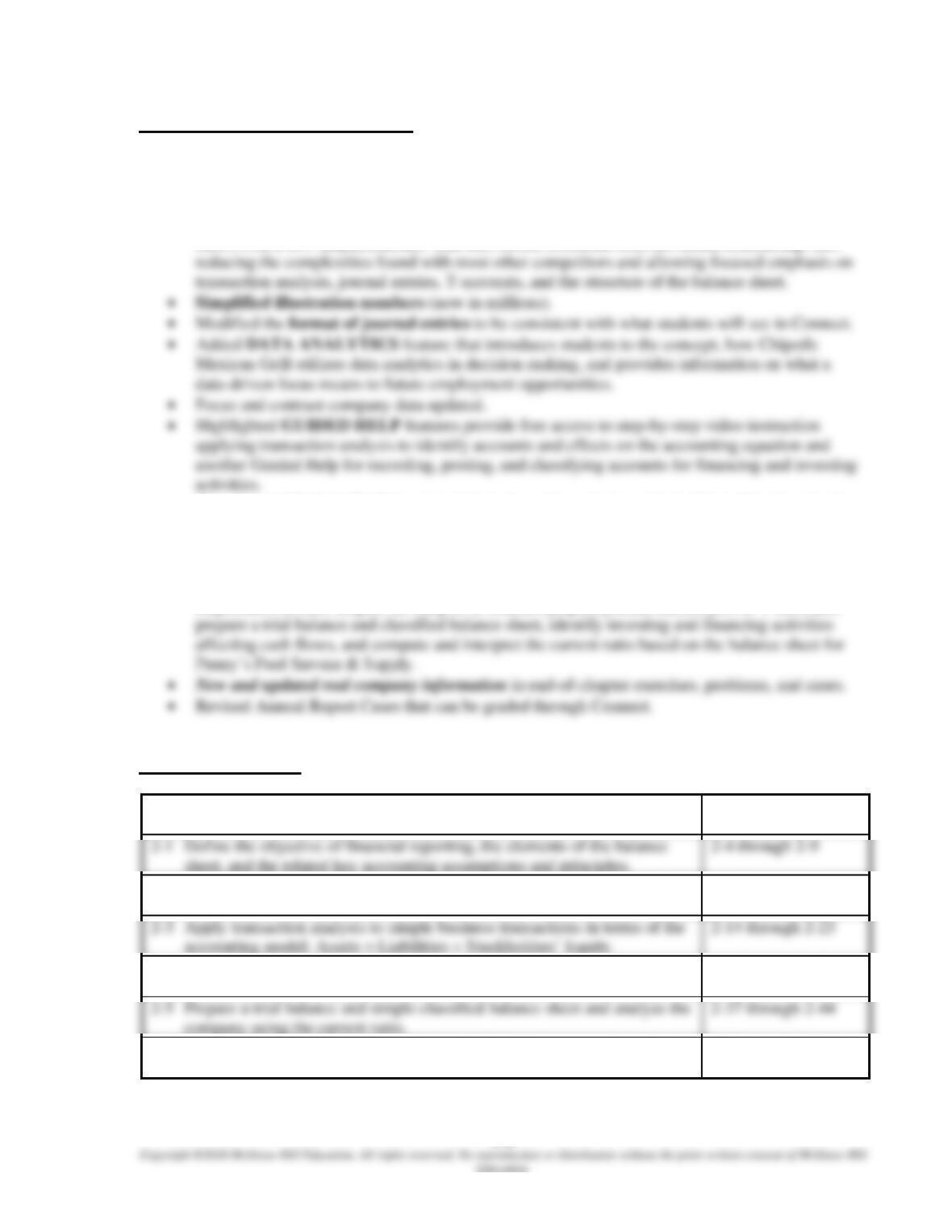
2-1 Define the objective of financial reporting, the elements of the balance
sheet, and the related key accounting assumptions and principles.
2-4 through 2-9
2-2 Identify what constitutes a business transaction and recognize common
balance sheet account titles used in business.
2-10 through 2-13
2-3 Apply transaction analysis to simple business transactions in terms of the
accounting model: Assets = Liabilities + Stockholders’ Equity.
2-14 through 2-23
2-4 Determine the impact of business transactions on the balance sheet using
two basic tools: Journal entries and T-accounts.
2-24 through 2-36
2-5 Prepare a trial balance and simple classified balance sheet and analyze the
company using the current ratio.
2-37 through 2-44
2-6 Identify investing and financing transactions and demonstrate how they
impact cash flows.
2-45 through 2-46
Chapter 02 – Investing and Financing Decisions and the Accounting System
2-3
Chapter Take-Aways
2-1 Define the objective of financial reporting, the elements of the balance sheet, and the related
key accounting assumptions and principles.
Objective:
▪ The primary objective of financial reporting to external users is to provide financial information
about the reporting entity that is useful to existing and potential investors, lenders, and other
creditors in making decisions about providing resources to the entity.
Qualitative characteristics of useful financial information:
▪ Relevance (including materiality) allows users to assess past activities and/or predict future
Key recognition, measurement, and disclosure concepts:
Assumptions—
▪ Separate entity assumption—Transactions of the business are accounted for separately from
transactions of the owner.
Principles—
▪ Mixed-attribute measurement model—Most balance sheet elements are recorded following the
Elements of the balance sheet:
▪ Assets—Probable future economic benefits owned or controlled by the entity as a result of past
transactions.
2-2 Identify what constitutes a business transaction and recognize common balance sheet account
titles used in business.
▪ An exchange of cash, goods, or services for cash, goods, services, or promises between a business
and one or more external parties to a business (not the exchange of a promise for a promise), or
▪ A measurable internal event, such as adjustments for the use of assets in operations.
An account is a standardized format that organizations use to accumulate the dollar effects of
Chapter 02 – Investing and Financing Decisions and the Accounting System
2-4
Chapter Take-Aways, continued
2-3 Apply transaction analysis to simple business transactions in terms of the accounting model:
Assets = Liabilities + Stockholders’ Equity.
To determine the economic effect of a transaction on an entity in terms of the accounting equation,
each transaction must be analyzed to determine the accounts (at least two) that are affected. In an
exchange, the company receives something and gives up something. If the accounts, direction of the
effects, and amounts are correctly analyzed, the accounting equation will stay in balance. The
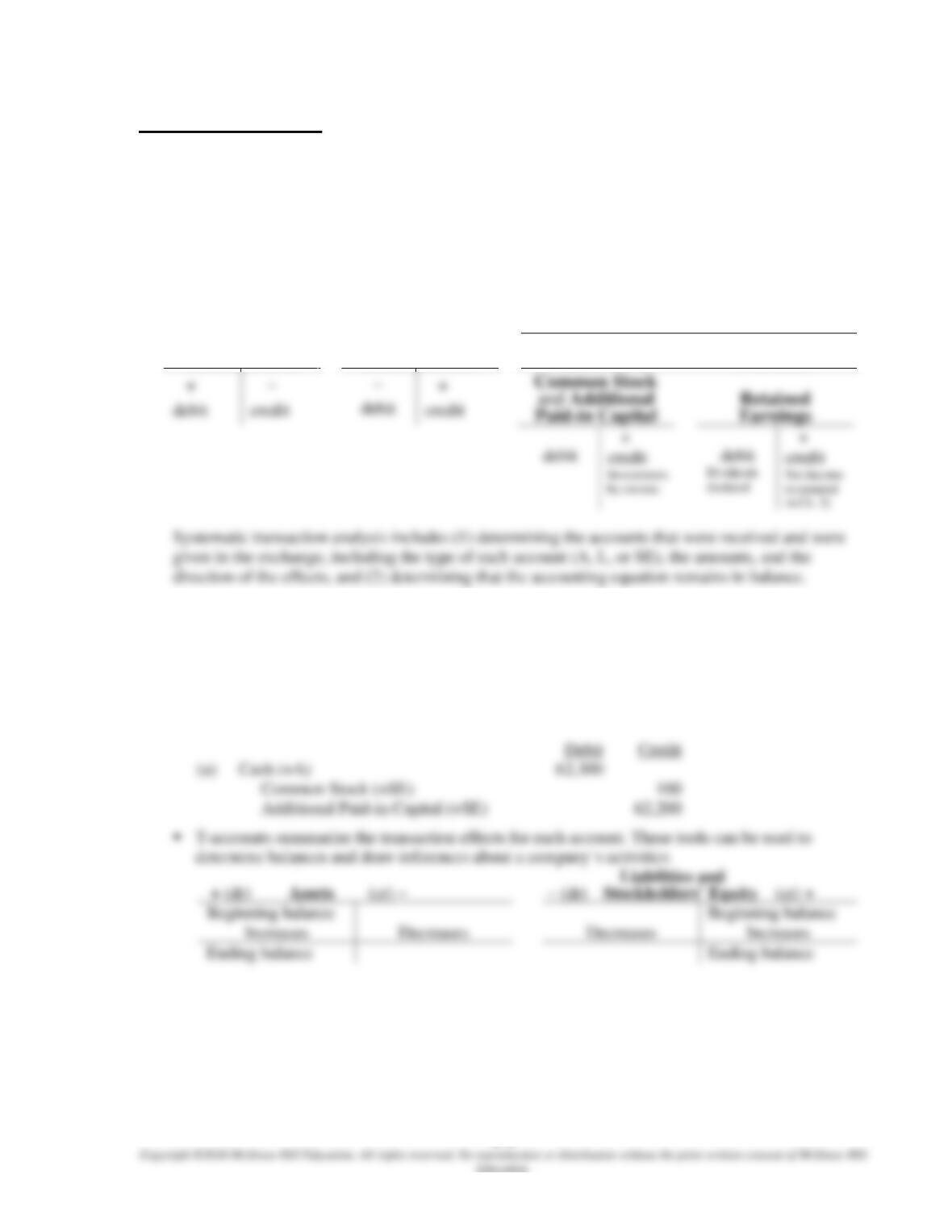
transaction analysis model is:
ASSETS
(many accounts)
=
LIABILITIES
(many accounts)
+
STOCKHOLDERS’ EQUITY
Contributed Capital
(2 accounts)
Earned Capital
(1 account)
2-4 Determine the impact of business transactions on the balance sheet using two basic tools:
Journal entries and T-accounts.
▪ Journal entries express the effects of a transaction on accounts in a debits-equal-credits format.
The accounts and amounts to be debited are listed first. Then the accounts and amounts to be
credited are listed below the debits and indented, resulting in debit amounts on the left and credit
amounts on the right. Each entry needs a reference (date, number, or letter).
Chapter 02 – Investing and Financing Decisions and the Accounting System
2-5
Chapter Take-Aways, continued
2-5 Prepare a trial balance and simple classified balance sheet and analyze the company using the
current ratio.
A trial balance lists all accounts and their balances, with debit balances in left column and credit
balances in the right column. The two columns are added to determine if debits equal credits.
2-6 Identify investing and financing transactions and demonstrate how they impact cash flows.
A statement of cash flows reports the sources and uses of cash for the period by the type of activity
Key Ratio
Current ratio measures the ability of the company to pay its short-term obligations with current assets.
Although a ratio above 1.0 indicates sufficient current assets to meet obligations when they come due,
Chapter 02 – Investing and Financing Decisions and the Accounting System
2-6
Finding Financial Information
BALANCE SHEET
Current Assets
Cash
Short-term investments
Accounts receivable
Current Liabilities
Accounts payable
Accrued expenses payable
Short-term notes payable
INCOME STATEMENT
To be presented in
Chapter 3
STATEMENT OF CASH FLOWS
Operating Activities
To be presented in Chapter 3
Investing Activities
+ Sales of noncurrent assets and investments for cash
− Purchases of noncurrent assets and investments for cash
NOTES
To be discussed in
future chapters
Chapter 02 – Investing and Financing Decisions and the Accounting System
Chapter Outline
Teaching Notes
LO 2-1 Define the objective of financial reporting, the elements of the balance sheet, and
the related key accounting assumptions and principles.
I. Overview of Accounting Concepts––Concepts Emphasized in
Chapter 2
Conceptual Framework
summarized in Exhibit 2.1
A. Objective of Financial Reporting
help external parties make sound financial decisions
about providing resources to the entity
3. Most are interested in information needed to assess
1. Primary objective of external financial reporting is to
provide useful economic information about a business to
B. Qualitative Characteristics of Financial Information
include: comparability, verifiability, timeliness, and
1. Relevant information––can influence a decision; it is
timely and has predictive and/or feedback value. To be
reported, the information should also be material in
C. Recognition and Measurement Concepts
1. Separate-entity assumption––business transactions are
accounted for separately from the transactions of owners
3. Monetary unit assumption––each business entity accounts
the national monetary unit without any adjustments for
b. Most balance sheet elements are recorded at their cost
2. Going concern assumption (also called continuity
assumption)––unless there is evidence to the contrary,
business is expected to continue operating into the
D. Elements of the Balance Sheet
Chipotle’s Balance Sheet
illustrated in Exhibit 2.2
1. Assets––probable future economic benefits owned or
controlled by an entity as a result of past transactions or
events
Chapter 02 – Investing and Financing Decisions and the Accounting System
2-8
2. Assets are listed in order of liquidity––how soon an asset
is expected by management to be turned into cash or used
3. Liabilities––probable future sacrifices of economic
benefits arising from present obligations of a business to
transfer cash or other assets or to provide services as a
result of past transactions or events
4. Stockholders’ equity (also called shareholders’ equity or
owners’ equity)––the residual interest in the assets of the
entity after subtracting liabilities
a. Financing provided by owners––referred to as
LO 2-2 Identify what constitutes a business transaction and recognize common balance
sheet account titles used in business.
II. What Business Activities Cause Changes in Financial Statement
Amounts?
A. Nature of Business Transactions
1. A transaction is an event that has economic impact on the
2. Only economic resources and debts resulting from past
transactions are recorded on the balance sheet
a. External events––exchanges of assets, goods, or
b. Internal events––include certain events that are not
Chapter 02 – Investing and Financing Decisions and the Accounting System
2-9
c. Some important events have a future economic impact
statements (e.g., an exchange of promises)
B. Accounts
1. Account––a standardized format that organizations use to
accumulate the dollar effect of transactions on each
financial statement item
Illustrated in Exhibit 2.3
4. The accounts in the financial statements of large
companies are actually summations of a number of
LO 2-3 Apply transaction analysis to simple business transactions in terms of the
accounting model: Assets = Liabilities + Stockholders’ Equity.
III. How Do Transactions Affect Accounts?
A. Principles of Transaction Analysis
transaction to determine its economic effect on the entity
1. Transaction analysis is the process of studying a
2. Two principles underlying the transaction analysis:
b. The accounting equation must remain in balance after
a. Every transaction affects at least two accounts;
Stress the importance of a
3. Dual effects concept––every transaction has at least two
effects on the basic accounting equation
4. Most transactions with external parties involve an
exchange by which the business entity both receives
something and gives up something in return
a. If Chipotle purchases tomatoes for cash, it receives
Chapter 02 – Investing and Financing Decisions and the Accounting System
2-10
result in an accounting transaction that is recorded
ii. For example, if Chipotle sent an order for tomatoes
to its food supplier and the supplier accepted the
c. Not all important business activities result in a
5. Balancing the Accounting Equation
a. Step 1: Ask––What was received and what was given?
i. Identify the account affected by title, making sure
that at least two accounts change
b. Step 2: Verify––Is the accounting equation in balance?
(A = L + SE)
B. Analyzing Chipotle’s Transactions (all amounts in millions,
except per share data)
Use Supplemental
1. Transaction (a) Chipotle issued (sold) 100 additional
shares of common stock with a par value of $.01 per
share and at a market value of $3.00 per share, receiving
$300 in cash from investors—a financing activity
Enrichment Activity #1
Use Supplemental
Enrichment Activity#2
a. Related terminology
i. Par value––a legal amount per share established by
the board of directors; it represents the minimum
par value of the stock
a. Step 1: What was received and what was given?
Received: Cash (+A) $300
Given: Additional stock shares, Common Stock (+SE)
$1 (100 shares × $0.01) and Additional Paid-in Capital
$299 ($300 -$1 )
Additional Paid-in Capital (SE) + 299
b. Step 2: Is the accounting equation in balance?
Chapter 02 – Investing and Financing Decisions and the Accounting System
2. Transaction (b) Chipotle borrowed $2 from its local bank,
signing a note to be paid in three years—a financing
activity
b. Step 2: Is the accounting equation in balance?
Yes. The left side increased by $2 and the right side
Cash (A) + 2= Long-Term Notes Payable (L) + 2
a. Step 1: What was received and what was given?
Received: Cash (+A) $2
3. Transaction (c) Chipotle purchased $8 in additional land,
$34 in new buildings, $10 in new equipment, and $3 in
additional intangible assets; paid $54 in cash and signed a
short-term note payable for the remainder owed ($1)—an
investing activity
Intangible Assets (+A) $3
b. Step 2: Is the accounting equation in balance?
Yes. The left side increased by $1 and the right side
a. Step 1: What was received and what was given?
Received: Property and Equipment (+A) $52 and
4. Transaction (d) Chipotle paid $1 on the short-term note
payable in (c)—a financing activity (ignore interest)
a. Step 1: What was received and what was given?
Received: Reduction in amount due: Short-Term
Notes Payable (−L) $1 Given: Cash (−A) $1
Yes. The equation stays in balance because assets and
Cash (A) –1 = Short-Term Notes Payable (L) – 1
b. Step 2: Is the accounting equation in balance?
Chapter 02 – Investing and Financing Decisions and the Accounting System
2-12
5. Transaction (e) Chipotle purchased the stock of other
companies as investments, paying $44 in cash; of this $9
was in short-term investments and $35 was in long-term
investments—an investing activity
a. Step 1: What was received and what was given?
Received: Short-Term Investments (+A) $9 and Long-
6. Transaction (f) Chipotle’s board of directors declared that
the Company will pay $2 in cash dividends to
shareholders next quarter—a financing activity
Note that Chipotle does
actually not pay dividends; it
reinvests profits
2-1
a. Step 1: What was received and what was given?
Received: Lower claim from stockholders, Retained
Refer students to Pause for
LO2-4 Determine the impact of business transactions on the balance sheet using two basic
tools: Journal entries and T-accounts.
IV. How Do Companies Keep Track of Account Balances?
A. The accounting cycle––the process followed by entities to
analyze and record transactions, adjust the records at the end
of the period, prepare financial statements, and prepare the
Accounting cycle illustrated
in Exhibit 2.4
B. The Direction of Transaction Effects
Illustrated in Exhibit 2.5
1. Each account is set up as a “T” with the following
structure:
Chapter 02 – Investing and Financing Decisions and the Accounting System
2-13
2. Names for each side of an account:
a. Debit (dr) is on the left side of the T
4. Summary:
Assets
=
Liabilities
+
Stockholders’
Equity
Increase with
Increase with
Increase with
5. If the correct accounts and effects are identified, the
accounting equation will remain in balance because the
total debits will equal the total credits in a transaction
Refer students to Pause for
Feedback – Self-Study Quiz
C. Analytical Tools:
1. Transactions are recorded in chronological order in a
general journal (or simply, journal)
2. Journal entry––an accounting method for expressing the
effects of a transaction on accounts in a debits-equal-
credits format
e. Compound entry––a journal entry that affects more
a. It is useful to include a date or some form of reference
3. T-account––A tool for summarizing transaction effects
for each account, determining balances, and drawing
inferences about a company’s activities
Posting transaction effects
illustrated in Exhibit 2.6
Chapter 02 – Investing and Financing Decisions and the Accounting System
2-14
D. Transaction Analysis Illustrated (all amounts in millions,
except per share data)
Use Supplemental
Enrichment Activity #3
Use Supplemental
Enrichment Activity#4
Paid-in Capital + 299 (SE)
1. Transaction (a) Chipotle issued (sold) 100 additional
shares of common stock with a par value of $.01 per
share and at a market value of $3 per share, receiving
2. Transaction (b) Chipotle borrowed $2 from its local bank,
signing a note to be paid in three years
3. Transaction (c) Chipotle purchased $8 in additional land,
$34 in new buildings, $10 in new equipment, and $3 in
additional intangible assets; paid $54 in cash and signed a
short-term note payable for the remainder owed ($1)
Equipment (A) + 10 + Intangible Assets (A) + 3 = Short-
Term Notes Payable (L) + 1
4. Transaction (d) Chipotle paid $1 on the short-term note
payable in (c) (ignore interest)
Cash (A) − $1= Short -Term Notes Payable (L) − $11 1
Chapter 02 – Investing and Financing Decisions and the Accounting System
2-15
Cash (A) – 44 + Short-Term Investments (A) + 35 +
Long-Term Investments (A) + 9 = No change
Refer students to Pause for
5. Transaction (e) Chipotle purchased the stock of other
companies as investments, paying $44 in cash; of this $9
was in short-term investments and $35 was in long-term
shareholders next quarter
See Data Analytics feature
Assets = Liabilities + Stockholders’ Equity
6. Transaction (f) Chipotle’s board of directors declared that
the Company will pay $3,000 in cash dividends to
Refer students to Guided
Help 2-2
7. Posting of these transactions to the T-accounts is
illustrated in the text after the analysis of transaction (f)
Use Supplemental
Enrichment Activity #5
LO 2-5 Prepare a trial balance and simple classified balance sheet and analyze the
company using the current ratio.
V. How Is the Balance Sheet Prepared and Analyzed?
A. Trial Balance
1. Trial balance––list of all accounts with their balances to
provide a check on the equality of the debits and credits
Use Supplemental
Enrichment Activity #6
2. A trial balance spreadsheet is created first for internal
purposes before preparing statements for external users
3. A trial balance lists the names of the T-accounts in one
column in financial statement order (assets, liabilities,
5. Then the two columns are totaled to provide a check on
the equality of the debits and credits
6. Errors in a computer-generated trial balance may exist if
entries
B. Classified Balance Sheet
Chipotle’s Balance Sheet
1. Prepared from the trial balance
illustrated in Exhibit 2.8
2. The assets and liabilities are classified into two
categories: current and noncurrent
Use Supplemental
Enrichment Activity #7
3. Dollar signs are indicated at the top and bottom of the
asset section and top and bottom of the liabilities and
Chapter 02 – Investing and Financing Decisions and the Accounting System
4. Includes comparative data; when multiple periods are
See International Perspective
C. Ratio Analysis in Decision Making
Statements”
1. Users of financial information compute a number of
ratios in analyzing a company’s past performance and
D. Key Ratio Analysis: Current Ratio
1. Current Ratio = Current Assets – Current Liabilities
4. While a high ratio normally suggests good liquidity, too
2. Creditors and security analysts use the current ratio to
measure the ability of the company to pay its short-term
Use Supplemental
Enrichment Activity #8
LO 2-6 Identify investing and financing transactions and demonstrate how they impact
cash flows.
VI. Focus on Cash Flows – Investing and Financing Activities
A. The statement of cash flows divides all transactions that
affect cash into three categories:
1. Operating activities (covered in Chapter 3)
2. Investing activities include buying and selling noncurrent
Chapter 02 – Investing and Financing Decisions and the Accounting System
2-17
4. Effects of transactions in this chapter on the statement of
cash flows:
Refer students to Pause for
Feedback – Self-Study Quiz
Operating Activities
(None of the transactions impact operating activities)
Chapter 02 – Investing and Financing Decisions and the Accounting System
2-18
Supplemental Enrichment Activities
Note: These activities would be suitable for individual or group activities.
1. Handout 2-1
2. Handout 2-2
This activity is a continuation of Activity #1. Use this handout for an in-class activity designed to
3. Handout 2-3
Use Handout 2-3 for an in-class activity designed to review the debit/credit framework. Note that
4. Handout 2-4
This activity is a continuation of Activity #3. Use this handout for an in-class activity designed to
5. Handout 2-5
Use this handout for an in-class activity designed to review the posting of various investing and
6. Handout 2-6
Use this handout for an in-class activity designed to review the preparation of a trial balance. This
7. Handout 2-7
Use this handout for an in-class activity designed to review the preparation of a classified balance
8. Use Handout 2-8
Use this handout for an in-class activity designed to review the calculation and interpretation of the
Chapter 02 – Investing and Financing Decisions and the Accounting System
2-19
HANDOUT 2 – 1
ANALYZING TRANSACTIONS
Analyze each of the following transactions of World Wide Webster by performing each of the following
steps. Then, use the chart on the following page to (1) keep track of the amount in each account and (2)
ensure the accounting equation is in balance.
(a) Stockholder invests $10,000 into the business in exchange for 10,000 shares of $1 par value common
stock.
1.
Decide if a transaction took place.
2.
Identify the accounts affected.
3.
Classify each account affected.
4.
Identify direction and amount.
5.
Ensure the accounting equation is in balance.
(b) Borrow $15,000 signing a note payable to the bank that is due in three months.
1.
Decide if a transaction took place.
2.
Identify the accounts affected.
3.
Classify each account affected.
4.
Identify direction and amount.
5.
Ensure the accounting equation is in balance.
(c) Acquire a $15,000 truck and $5,000 worth of equipment.
1.
Decide if a transaction took place.
2.
Identify the accounts affected.
3.
Classify each account affected.
4.
Identify direction and amount.
5.
Ensure the accounting equation is in balance.
Chapter 02 – Investing and Financing Decisions and the Accounting System
2-20
HANDOUT 2 – 1, continued
(d) Purchase $300 worth of supplies from a vendor on credit. (“On credit,” or “on account,” means that
the company received the supplies now and will pay for them later.)
1.
Decide if a transaction took place.
2.
Identify the accounts affected.
3.
Classify each account affected.
4.
Identify direction and amount.
(e) Sign contract for first website design for $10,000.
1.
Decide if a transaction took place.
2.
Identify the accounts affected.
3.
Classify each account affected.
4.
Identify direction and amount.
5.
Ensure the accounting equation is in balance.
Chart
Assets
=
Liabilities
+
Stockholders’
Equity
Ref.
Cash
+
Supplies
+
Equipment
=
Accounts
Payable
+
Short-
Term
Notes
Payable
+
Common Stock
(a)
=
(b)
=
(d)
=
Total
=
=
=