Case 2A-6 (continued)
ALTERNATIVE SOLUTION:
Most students will compute the manufacturing overhead cost per pound
of the two coffees as shown above. However, the per pound cost can
also be computed as shown below.
This alternative approach provides
additional insight into the data and facilitates emphasis of some points
made in the chapter.
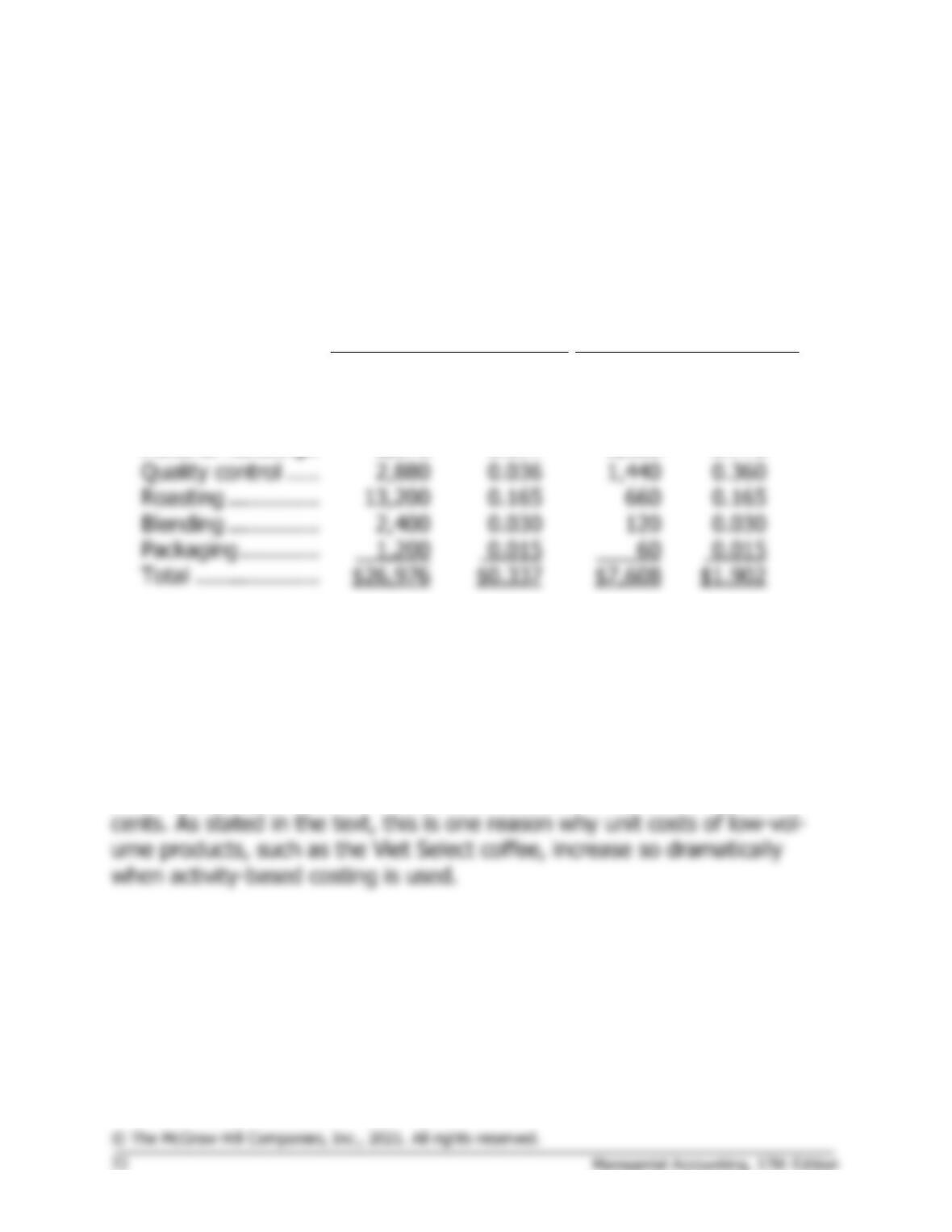
Kenya Dark
Viet Select
Total
Per Pound
(÷ 80,000)
Total
Per Pound
(÷ 4,000)
Purchasing ………..
$ 1,120
$0.014
$2,240
$0.560
Material handling ..
Blending …………..
Packaging …………
Total ……………….
$0.337
$7,608
$1.902
Note particularly how batch size impacts unit cost data. For example, the
cost to the company to process a purchase order is $280, regardless of
how many pounds of coffee are contained in the order. Twenty thousand
pounds of the Kenya Dark coffee are purchased per order (with four orders
per year), and just 500 pounds of the Viet Select coffee are purchased per
order (with eight orders per year). Thus, the purchase order cost
per
pound
for the Kenya Dark coffee is just 1.4 cents, whereas the purchase
order cost
per pound
for the Viet Select coffee is 40 times as much, or 56
Appendix 2B
The Predetermined Overhead Rate
and Capacity
Exercise 2B-1 (20 minutes)
1. There were no beginning or ending inventories, so all of the jobs were
started, finished, and sold during the month. Therefore, cost of goods
sold equals the total manufacturing cost. We can verify that by compu-
ting the cost of goods sold as shown below:
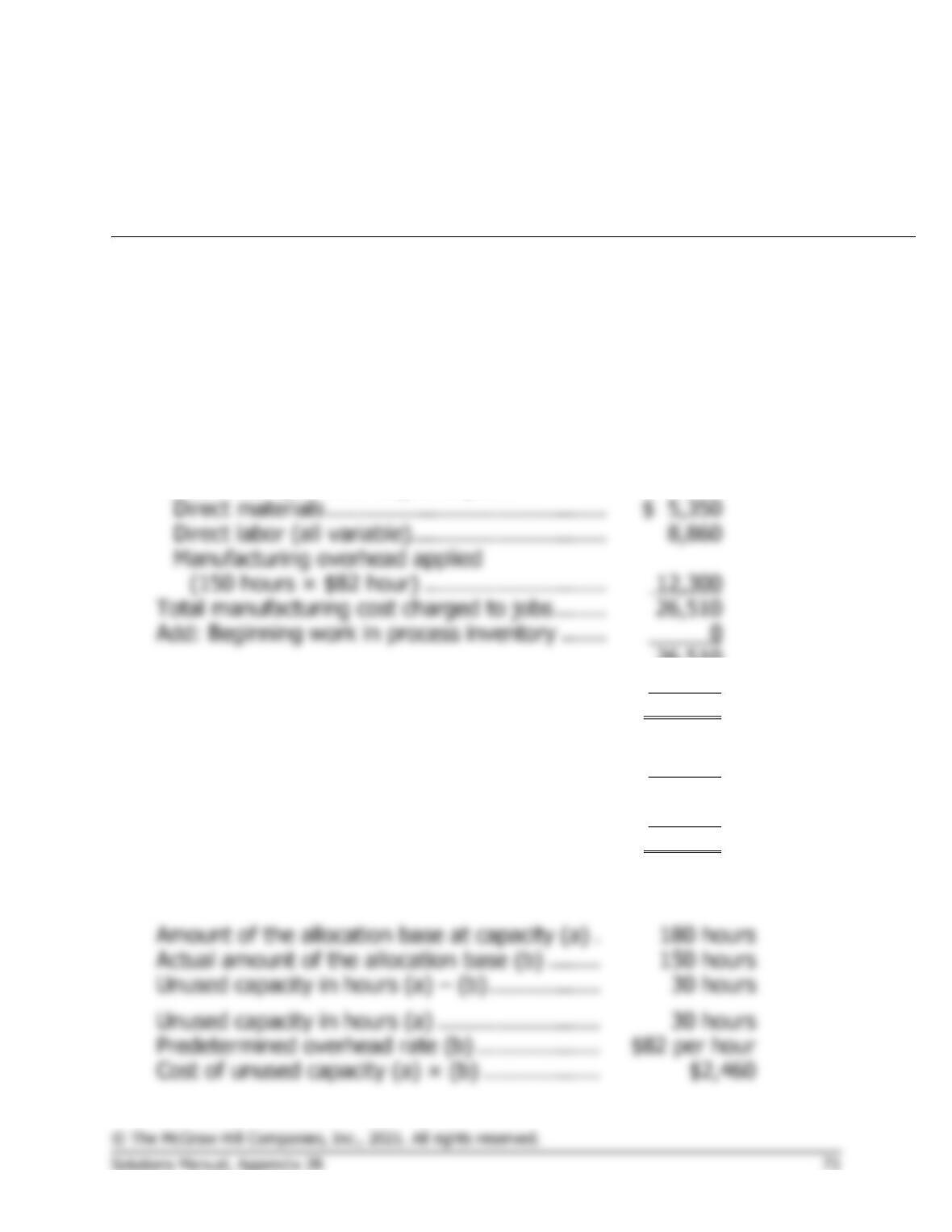
Manufacturing costs charged to jobs:
Direct materials …………………………………….
Direct labor (all variable)…………………………
12,300
Total manufacturing cost charged to jobs ……..
26,510
Add: Beginning work in process inventory …….
0
26,510
Deduct: Ending work in process inventory …….
0
Cost of goods manufactured ………………………
$26,510
Beginning finished goods inventory ……………..
$ 0
Add: Cost of goods manufactured ……………….
26,510
Goods available for sale …………………………….
26,510
Deduct: Ending finished goods inventory ………
0
Cost of goods sold …………………………………..
$26,510
At the end of the month, the cost of unused capacity is computed as
shown below:
Amount of the allocation base at capacity (a) .
Actual amount of the allocation base (b) ……..
Unused capacity in hours (a) – (b) ……………..
Unused capacity in hours (a) …………………….
Predetermined overhead rate (b) ……………….
$82 per hour
Exercise 2B-1 (continued)
Consequently, the income statement, prepared for internal management
purposes, would appear as follows:
Wixis Cabinets
Income Statement
Sales …………………………………………….
$43,740
Cost of goods sold (see above) …………..
26,510
Gross margin ………………………………….
17,230
Other expenses:
Cost of unused capacity ………………….
$2,460
Selling and administrative expenses ….
8,180
10,640
Net operating income ……………………….
$ 6,590
2. When the predetermined overhead rate is based on capacity, unused
capacity costs ordinarily arise because manufacturing overhead usually
contains significant amounts of fixed costs. Suppose, for example, that
manufacturing overhead includes $10,000 of fixed costs and the capac–
Exercise 2B-2 (30 minutes)
1. The overhead applied to Mrs. Brinksi’s account would be computed as
follows:
Last Year
This Year
Estimated overhead cost (a) ………………………..
$310,500
$310,500
Estimated professional staff hours (b) ……………
4,600
4,500
Predetermined overhead rate (a) ÷ (b) ………….
$67.50
$69.00
Professional staff hours charged to Ms. Brinksi’s
account …………………………………………………
× 2.5
× 2.5
Overhead applied to Ms. Brinksi’s account ………
$168.75
$172.50
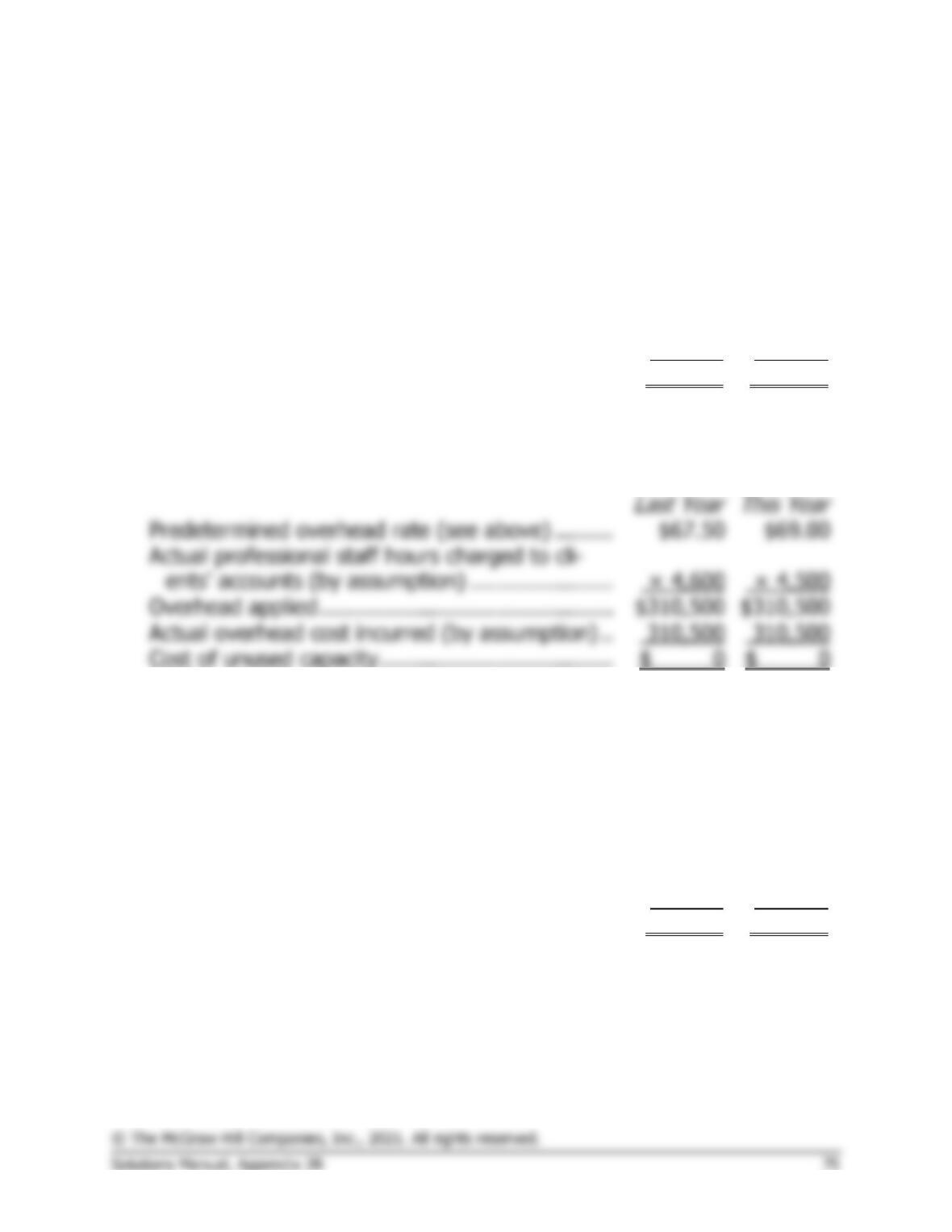
2. If the actual overhead cost and the actual professional hours charged
turn out to be exactly as estimated there would be no cost of unused
capacity.
Last Year
This Year
Predetermined overhead rate (see above) ………
Actual professional staff hours charged to cli-
Overhead applied ………………………………………
$310,500
Actual overhead cost incurred (by assumption) ..
Cost of unused capacity ………………………………
3. If the predetermined overhead rate is based on the professional staff
hours available, the computations would be:
Last Year
This Year
Estimated overhead cost (a) ………………………….
$310,500
$310,500
Professional staff hours available (b) ………………
6,000
6,000
Predetermined overhead rate (a) ÷ (b) ……………
$51.75
$51.75
Professional staff hours charged to Ms. Brinksi’s
account ………………………………………………….
× 2.5
× 2.5
Overhead applied to Ms. Brinksi’s account ………..
$129.38
$129.38
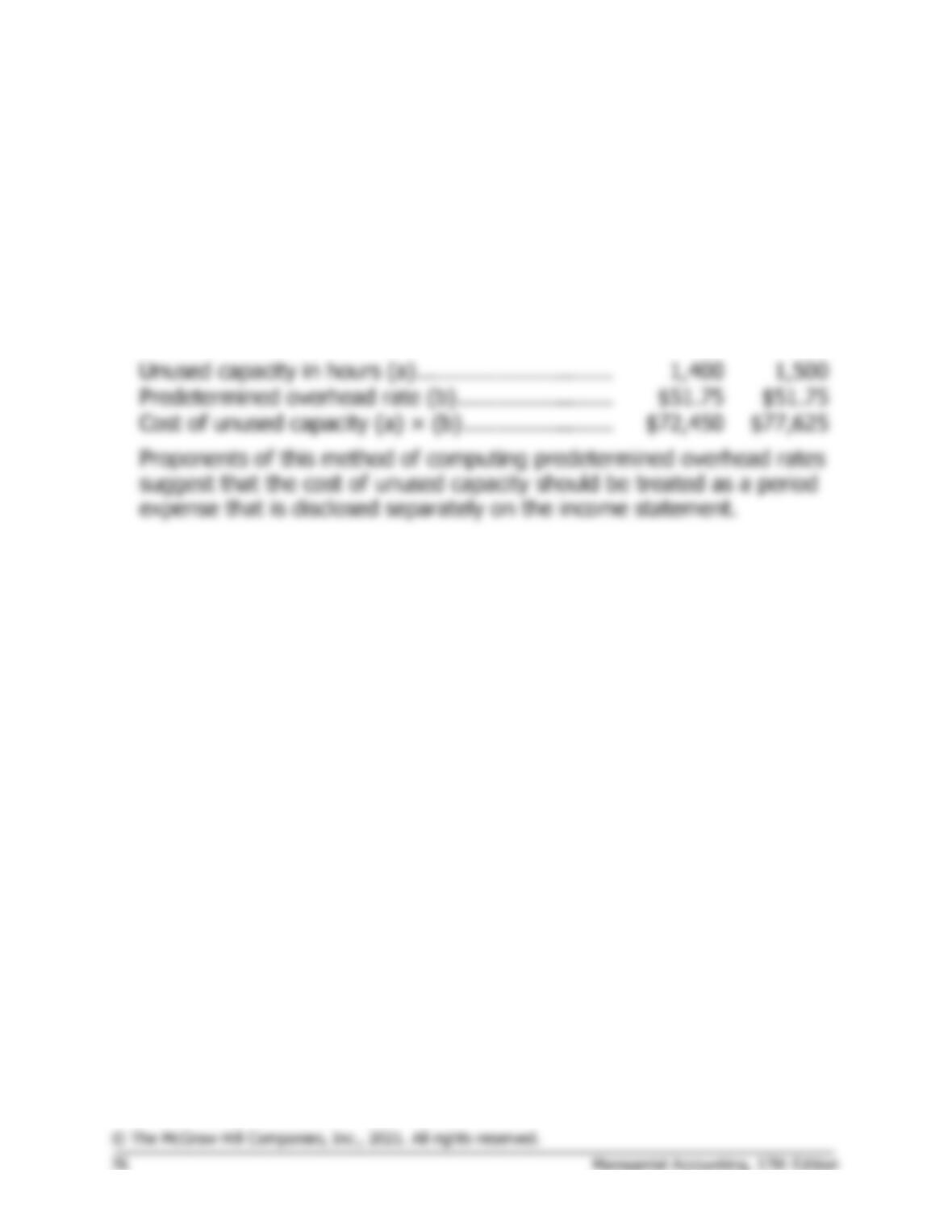
Exercise 2B-2 (continued)
4. If the actual overhead cost and the actual professional staff hours
charged to clients’ accounts turn out to be exactly as estimated, the cost
of unused capacity would be calculated as shown below.
Last Year
This Year
Amount of the allocation base at capacity (a) ……
6,000
6,000
Actual amount of the allocation base (b) ………….
4,600
4,500
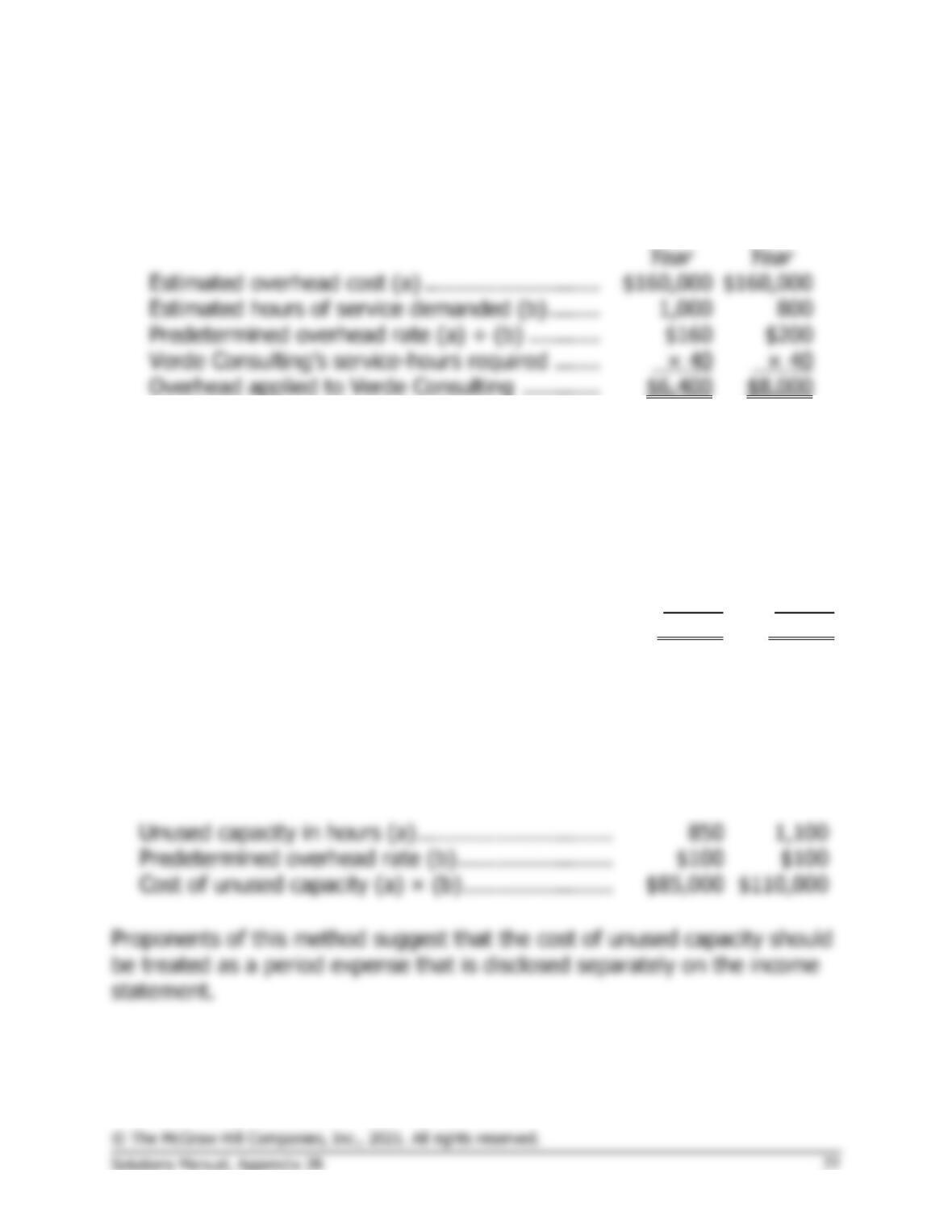
Unused capacity in hours (a) – (b) ………………….
1,400
1,500
Unused capacity in hours (a) …………………………
1,400
Predetermined overhead rate (b) ……………………
Cost of unused capacity (a) × (b) …………………..
Problem 2B-3 (60 minutes)
1. The overhead applied to the Verde Consulting job is computed as fol-
lows:
Estimated overhead cost (a) ………………………
Estimated hours of service demanded (b) ……..
1,000
Predetermined overhead rate (a) ÷ (b) ………..
Verde Consulting’s service-hours required …….
Overhead applied to Verde Consulting …………
Last
This
2. If the predetermined overhead rate is based on the hours of service
available at capacity, the computations would be:
Last Year
This Year
Estimated overhead cost at capacity (a) ……….
$160,000
$160,000
Hours of service available at capacity (b) ………
1,600
1,600
Predetermined overhead rate (a) ÷ (b) ………..
$100
$100
Verde Consulting’s service-hours required …….
× 40
× 40
Overhead applied to Verde Consulting …………
$4,000
$4,000
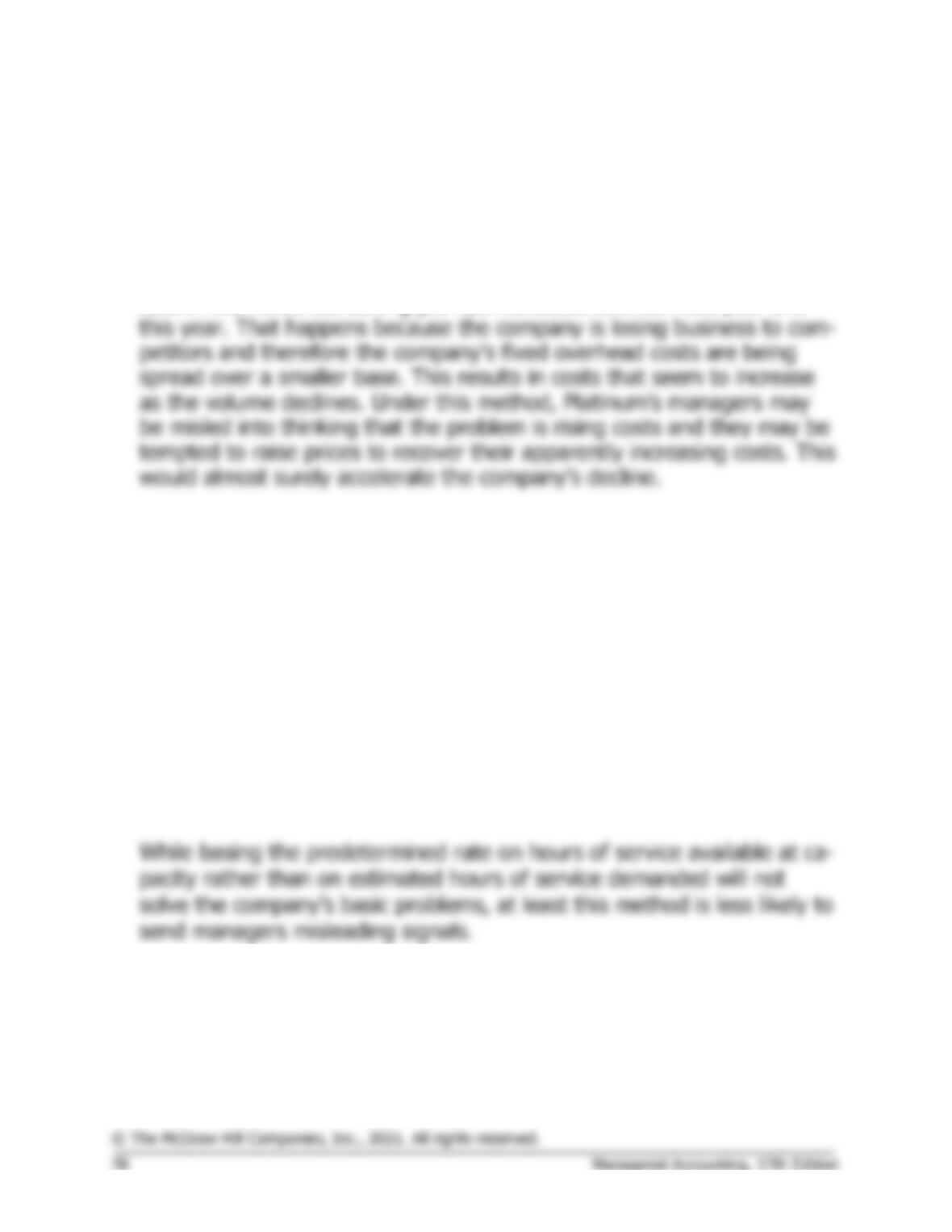
3. The cost of unused capacity for both years is computed as follows:
Last Year
This Year
Amount of the allocation base at capacity (a) ……
1,600
1,600
Actual amount of the allocation base (b) ………….
750
500
Unused capacity in hours (a) – (b) ………………….
850
1,100
Unused capacity in hours (a) …………………………
Predetermined overhead rate (b) ……………………
Cost of unused capacity (a) × (b) …………………..
Problem 2B-3 (continued)
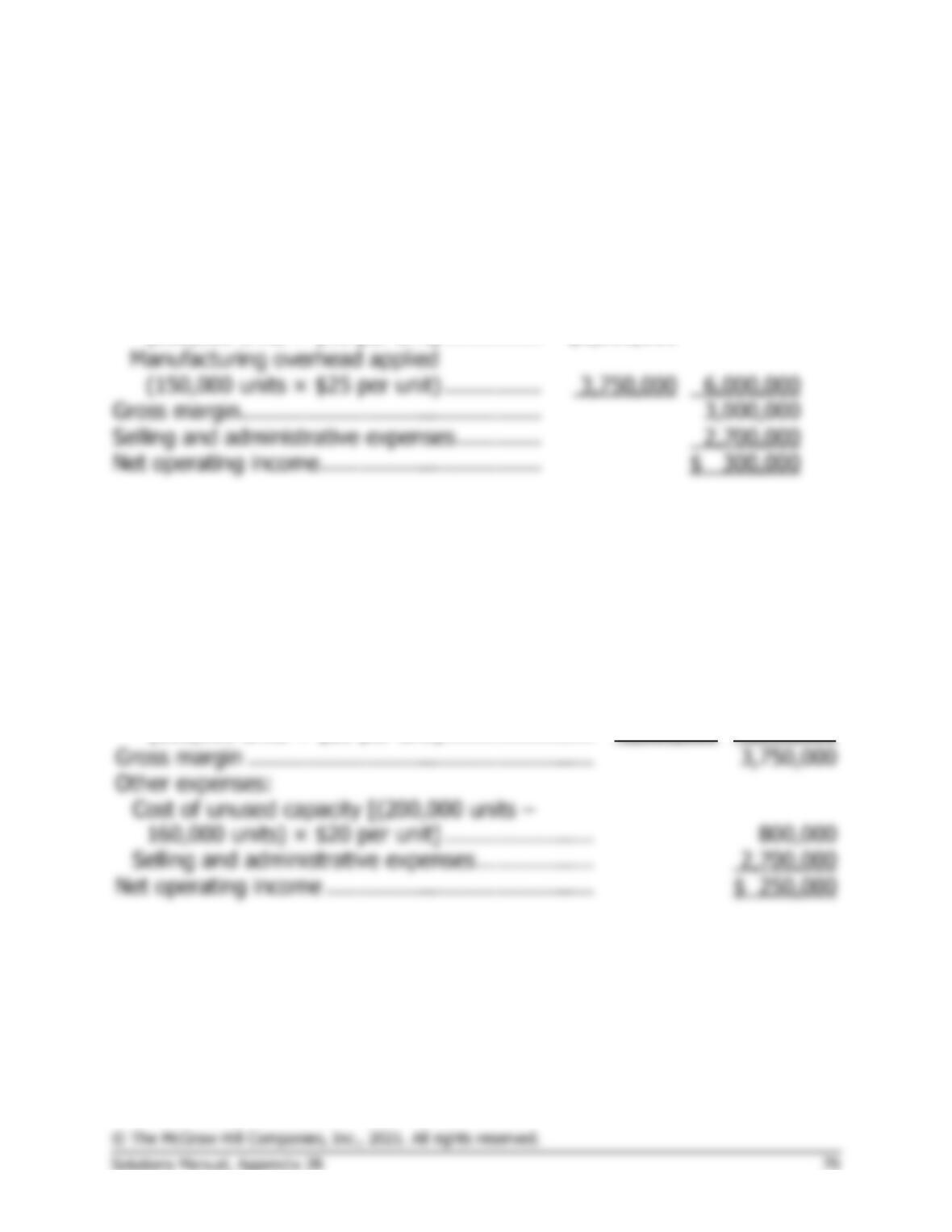
4. Platinum Web Design’s fundamental problem is the competition that is
drawing customers away. The company must do something to counter
this threat or it will ultimately face failure.
Under the conventional approach in which the predetermined overhead
rate is based on the estimated hours of service demanded, the apparent
Under the alternative approach, the overhead cost of the Verde Consult-
ing job is stable at $4,000 and lower than the costs reported under the
conventional method. Under the conventional method, managers may
be misled into thinking that they are actually losing money on the Verde
Consulting job and they might refuse such jobs in the future—another
sure road to disaster. This is much less likely to happen if the lower cost
of $4,000 is reported. It is true that the cost of unused capacity under
the alternative approach is pretty large and is growing. However, if it is
properly labeled as the cost of unused capacity, management is much
more likely to draw the appropriate conclusion that the real problem is
the loss of business (and therefore more idle capacity) rather than an
increase in costs.
Case 2B-4 (120 minutes)
1a.
Vault Hard Drives, Inc.
Income Statement: Traditional Approach
Sales (150,000 units × $60 per unit)…………
$9,000,000
Cost of goods sold:
Variable manufacturing
(150,000 units × $15 per unit) ……………
Manufacturing overhead applied
Gross margin …………………………..…………..
Selling and administrative expenses ………….
Net operating income …………………………….
1b.
Vault Hard Drives, Inc.
Income Statement: New Approach
Sales (150,000 units × $60 per unit) ……………….
$9,000,000
Cost of goods sold:
Variable manufacturing
(150,000 units × $15 per unit) …………………..
$2,250,000
Manufacturing overhead applied
3,000,000
5,250,000
Gross margin ……………………………………………..
Other expenses:
2,700,000
Net operating income …………………………………..
2. Net operating income is more volatile under the new method than under
the old method (because the income drops from $500,000 to $250,000
under the new method, whereas it only drops to $300,000 under the old
method). This occurs because the reported profit per unit sold is $5
higher under the new method, the difference in the predetermined over-
head rates. Therefore, swings in sales in either direction will have a
more dramatic impact on reported profits under the new method.
Case 2B-4 (continued)
3. Under the traditional approach, all of the company’s fixed manufacturing
overhead must be included in either cost of goods sold (in the income
statement) or ending inventory (in the balance sheet) at the end of an
accounting period. For each additional unit produced but not sold, it en–
ables the company to include an extra $25 of fixed overhead in ending
inventory, which in turn lowers the company’s cost of goods sold by
$25.
Additional net operating income required to attain target
net operating income ($500,000 – $300,000) (a) ………
$200,000
Fixed overhead applied to each unit of additional inven-
tory (b) ……………………………………………………………
$25 per unit
Additional output required to attain target net operating
income (a) ÷ (b) ………………………………………………..
8,000 units
Case 2B-4 (continued)
4. Under the new approach, all of the company’s fixed manufacturing
overhead must be included in either cost of goods sold (in the income
statement), ending inventory (in the balance sheet), or cost of unused
capacity (in the income statement) at the end of an accounting period.
For each additional unit produced but not sold, it enables the company
to include an extra $20 of fixed overhead in ending inventory, which in
turn lowers the company’s cost of unused capacity by $20.
Additional net operating income required to attain target
net operating income ($500,000 – $250,000) (a) ………..
$250,000
Fixed overhead applied to each unit of additional inven-
tory (b) ……………………………………………………….…….
$20 per unit
Additional output required to attain target net operating
income (a) ÷ (b)………………………………………………….
12,500 units
Estimated number of units produced ………………………….
160,000 units
Actual number of units to be produced ……………………….
172,500 units
5. The “hat trick” is a bit harder to perform under the new method. Un-
der the old method, the target net operating income can be attained
by producing an additional 8,000 units. Under the new method, the
production would have to be increased by 12,500 units. Again, this is a

Case 2B–4 (continued)
6. One can argue that whether the “hat trick” is unethical depends on the
level of sophistication of the owners of the company and others who
read the financial statements. If they understand the effects of excess
production on net operating income and are not misled, it can be ar-
gued that the hat trick is not unethical. However, if that were the case,
there does not seem to be any reason to use the hat trick. Why would
the owners want to tie up working capital in inventories just to artifi-
cially attain a target net operating income for the period? And increasing
the rate of production toward the end of the year is likely to increase
overhead costs due to overtime and other costs. Building up inventories
all at once is very likely to be much more expensive than increasing the
rate of production uniformly throughout the year. In this case, we as-