2-1
CHAPTER 2
AN INTRODUCTION TO COST TERMS AND PURPOSES
2-1 A cost object is anything for which a separate measurement of costs is desired. Examples
include a product, a service, a project, a customer, a brand category, an activity, and a
department.
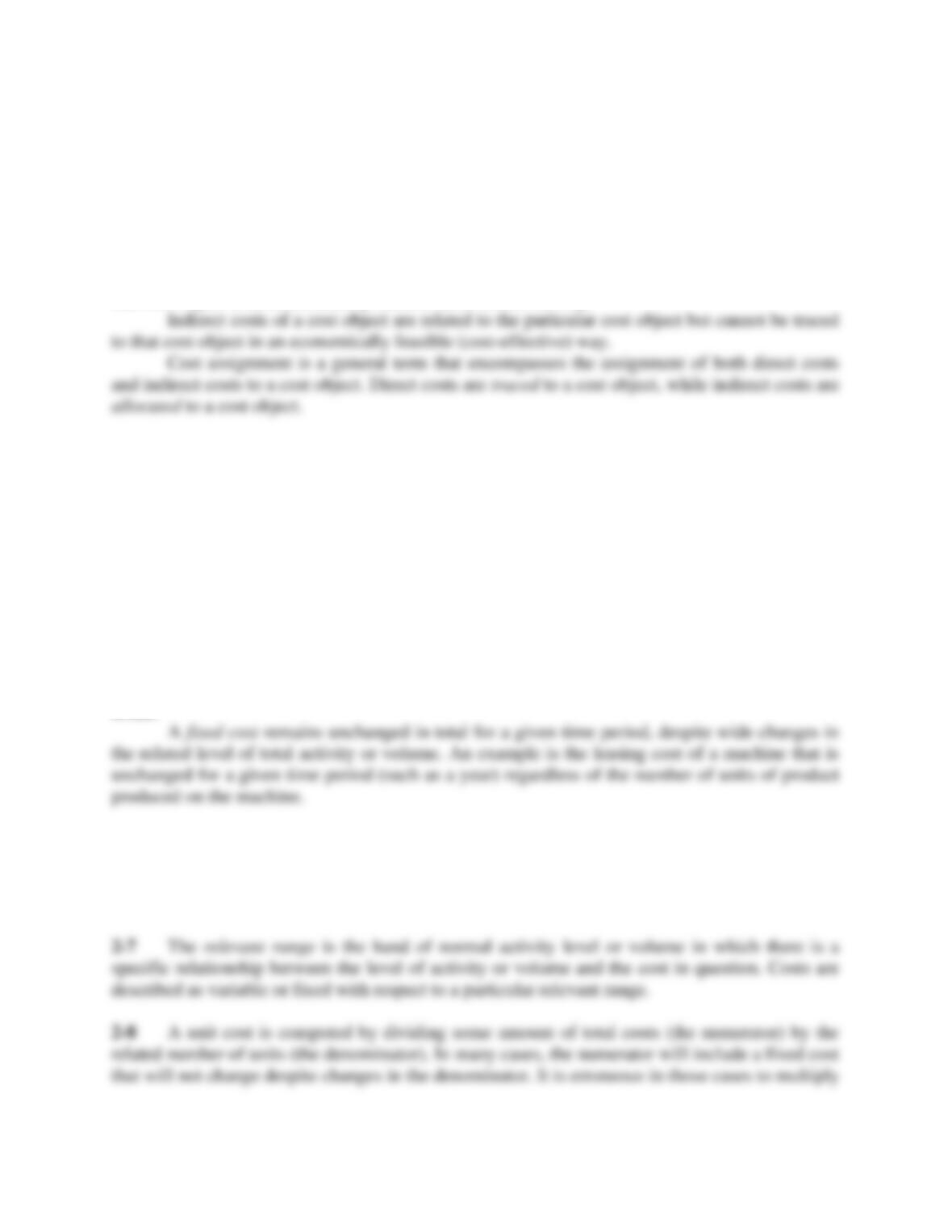
2-2 Direct costs of a cost object are related to the particular cost object and can be traced to
that cost object in an economically feasible (cost-effective) way.
2-3 Managers believe that direct costs that are traced to a particular cost object are more
accurately assigned to that cost object than are indirect allocated costs. When costs are allocated,
managers are less certain whether the cost allocation base accurately measures the resources
demanded by a cost object. Managers prefer to use more accurate costs in their decisions.
2-4 Factors affecting the classification of a cost as direct or indirect include
• the materiality of the cost in question
• available information-gathering technology
• design of operations
2-5 A variable cost changes in total in proportion to changes in the related level of total
activity or volume. An example is a sales commission that is a percentage of each sales revenue
dollar.
2-6 A cost driver is a variable, such as the level of activity or volume, that causally affects
total costs over a given time span. A change in the cost driver results in a change in the level of
total costs. For example, the number of vehicles assembled is a driver of the costs of steering
wheels on a motor-vehicle assembly line.
2-2
the unit cost by activity or volume change to predict changes in total costs at different activity or
volume levels.
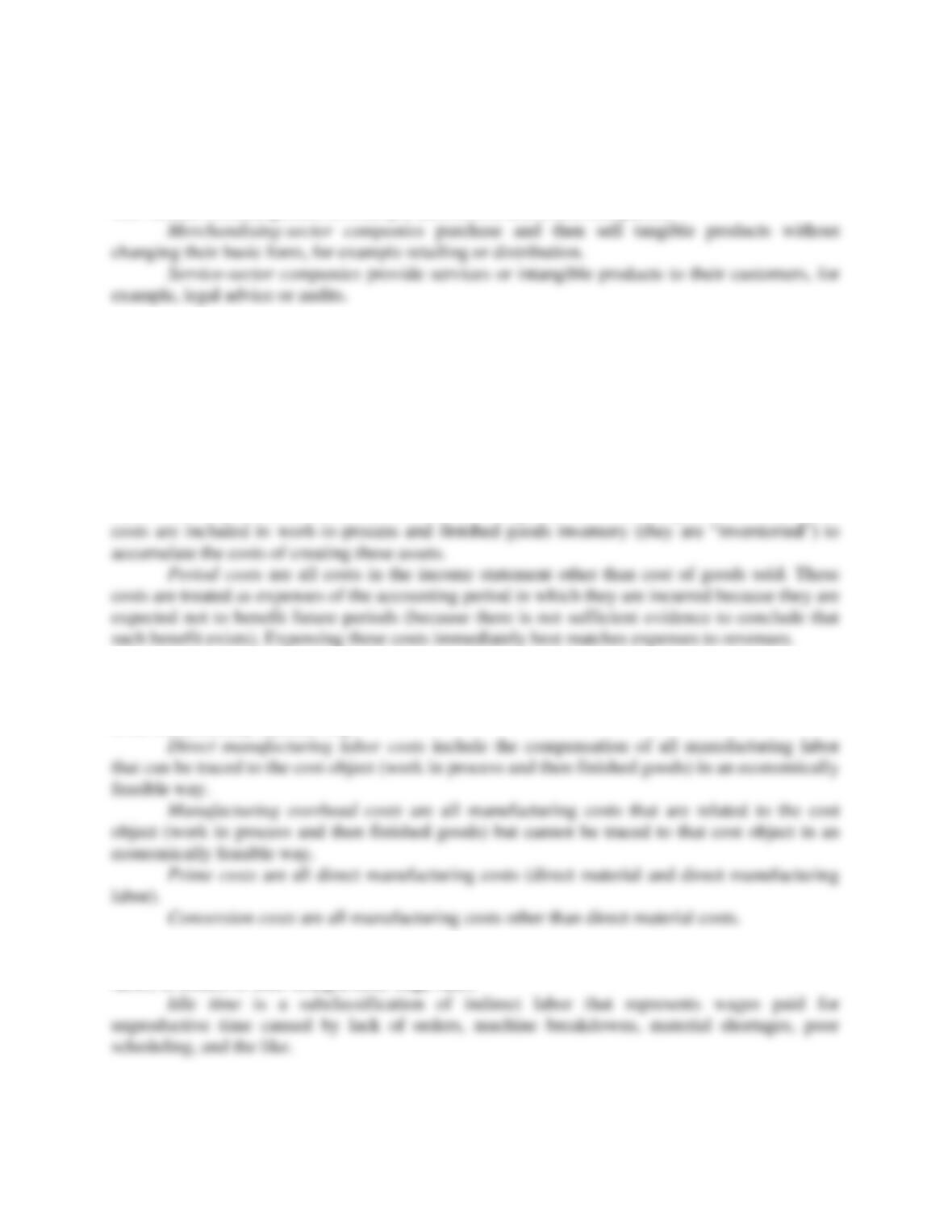
2-9 Manufacturing-sector companies purchase materials and components and convert them
into various finished goods, for example automotive and textile companies.
2-10 Manufacturing companies have one or more of the following three types of inventory:
1. Direct materials inventory. Direct materials in stock and awaiting use in the
manufacturing process.
2. Work-in-process inventory. Goods partially worked on but not yet completed. Also
called work in progress.
3. Finished goods inventory. Goods completed but not yet sold.
2-11 Inventoriable costs are all costs of a product that are considered as assets in the balance
sheet when they are incurred and that become cost of goods sold when the product is sold. These
2-12 Direct material costs are the acquisition costs of all materials that eventually become part
of the cost object (work in process and then finished goods) and can be traced to the cost object
in an economically feasible way.
2-13 Overtime premium is the wage rate paid to workers (for both direct labor and indirect
labor) in excess of their straight-time wage rates.
2-3
2-14 A product cost is the sum of the costs assigned to a product for a specific purpose.
Purposes for computing a product cost include
• pricing and product mix decisions,
• contracting with government agencies, and
• preparing financial statements for external reporting under GAAP.
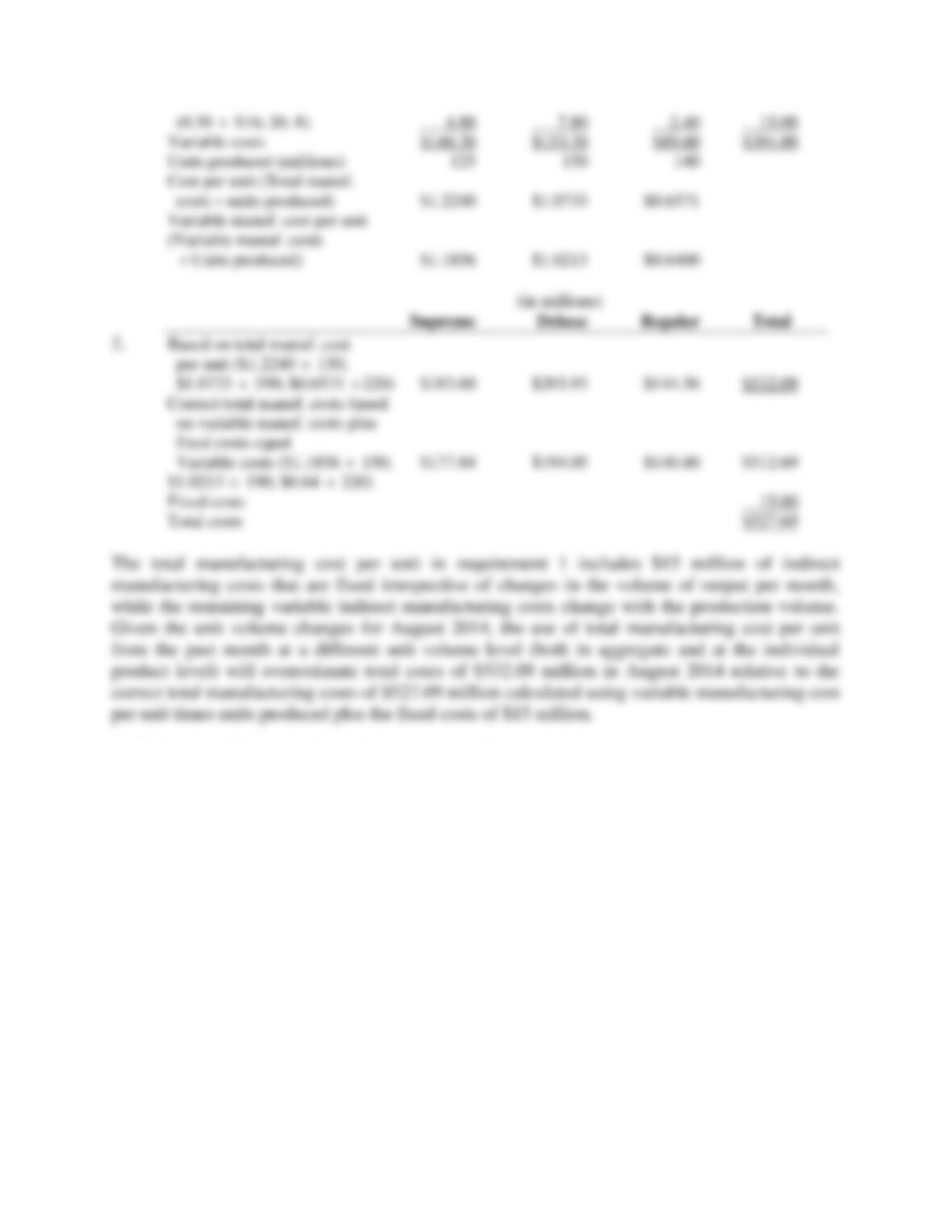
2-16 (15 min.) Computing and interpreting manufacturing unit costs.
Minnesota Office Products (MOP) produces three different paper products at its Vaasa lumber
plant: Supreme, Deluxe, and Regular. Each product has its own dedicated production line at the
plant. It currently uses the following three-part classification for its manufacturing costs: direct
materials, direct manufacturing labor, and manufacturing overhead costs. Total manufacturing
overhead costs of the plant in July 2014 are $150 million ($15 million of which are fixed). This
total amount is allocated to each product line on the basis of the direct manufacturing labor costs
of each line. Summary data (in millions) for July 2014 are as follows:
Supreme
Deluxe
Regular
Direct material costs
$ 89
$ 57
$ 60
Direct manufacturing labor costs
$ 16
$ 26
$ 8
Manufacturing overhead costs
$ 48
$ 78
$ 24
Units produced
125
150
140
Required:
1. Compute the manufacturing cost per unit for each product produced in July 2014.
2. Suppose that, in August 2014, production was 150 million units of Supreme, 190 million
units of Deluxe, and 220 million units of Regular. Why might the July 2014 information on
manufacturing cost per unit be misleading when predicting total manufacturing costs in
August 2014?
SOLUTION
2-4
2-17 (15 min.) Direct, indirect, fixed, and variable costs.
Wonder Bakery manufactures two types of bread, which it sells as wholesale products to various
specialty retail bakeries. Each loaf of bread requires a three-step process. The first step is mixing.
The mixing department combines all of the necessary ingredients to create the dough and
processes it through high-speed mixers. The dough is then left to rise before baking. The second
step is baking, which is an entirely automated process. The baking department molds the dough
into its final shape and bakes each loaf of bread in a high-temperature oven. The final step is
finishing, which is an entirely manual process. The finishing department coats each loaf of bread
with a special glaze, allows the bread to cool, and then carefully packages each loaf in a specialty
carton for sale in retail bakeries.
Required:
1. Costs involved in the process are listed next. For each cost, indicate whether it is a direct
variable, direct fixed, indirect variable, or indirect fixed cost, assuming “units of production
of each kind of bread” is the cost object.
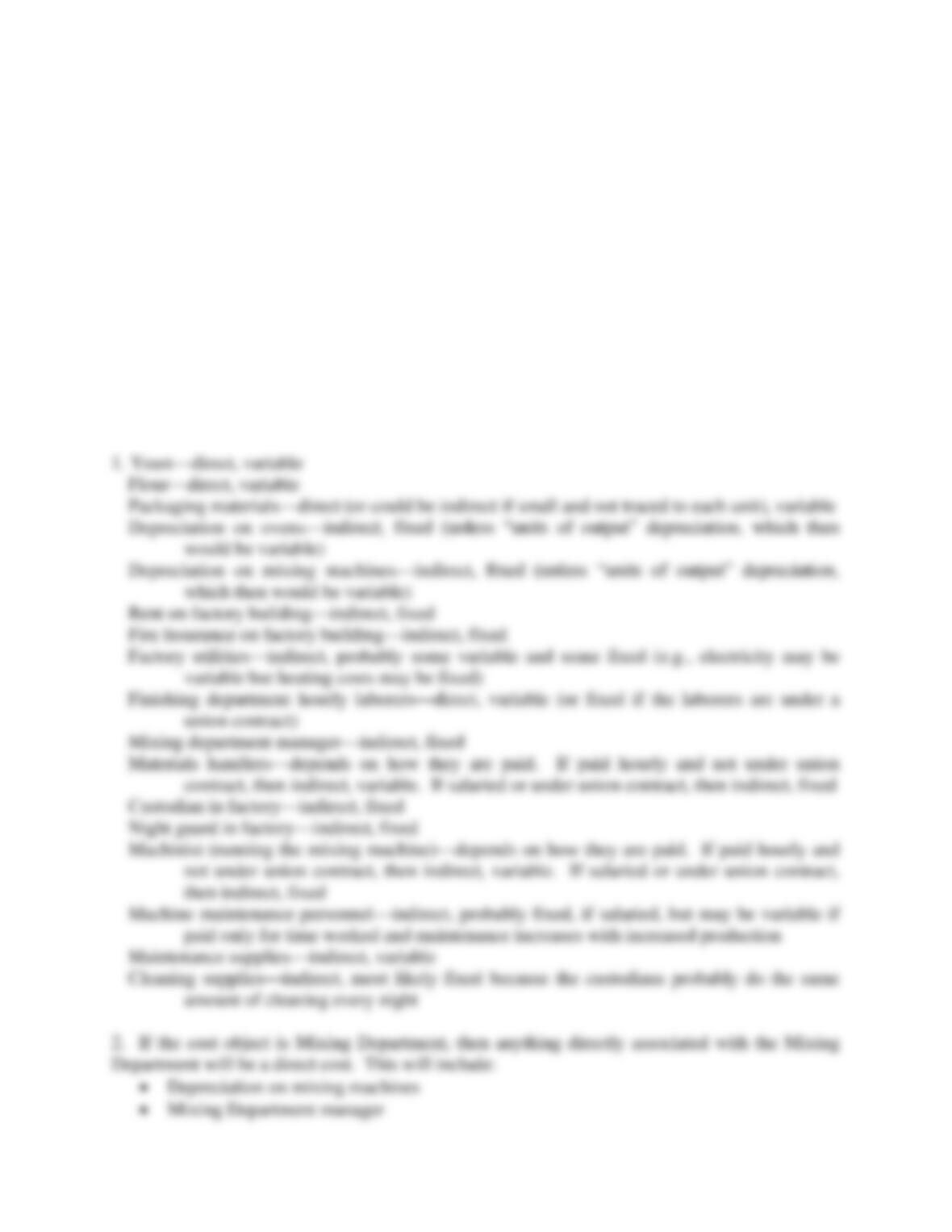
2-5
Costs:
Yeast Mixing department manager
Flour Materials handlers in each department
Packaging materials Custodian in factory
Depreciation on ovens Night guard in factory
Depreciation on mixing machines Machinist (running the mixing machine)
Rent on factory building Machine maintenance personnel in each department
Fire insurance on factory building Maintenance supplies for factory
Factory utilities Cleaning supplies for factory
Finishing department hourly laborers
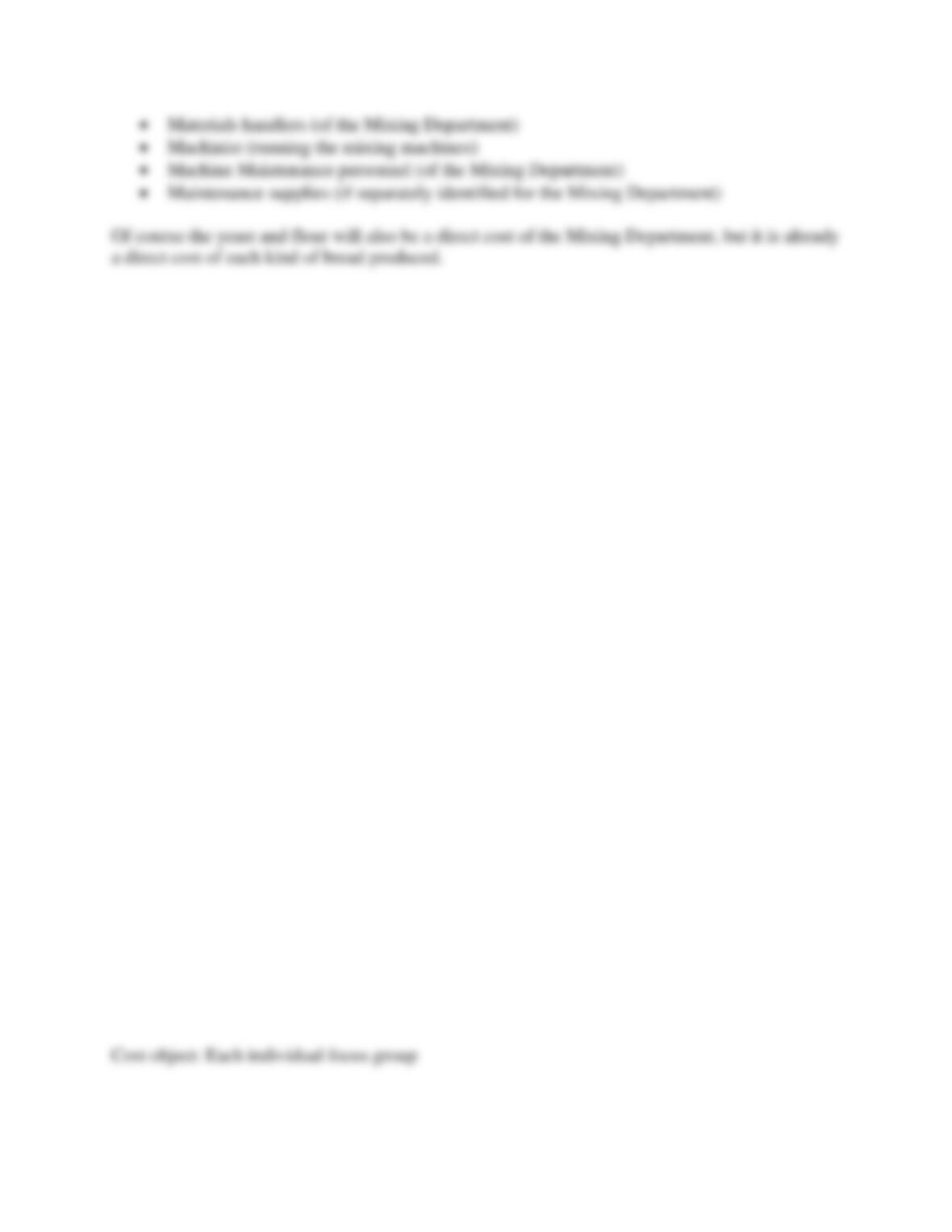
2. If the cost object were the “mixing department” rather than units of production of each kind
of bread, which preceding costs would now be direct instead of indirect costs?
SOLUTION
2-6
2-18 (15–20 min.) Classification of costs, service sector.
Market Focus is a marketing research firm that organizes focus groups for consumer-product
companies. Each focus group has eight individuals who are paid $60 per session to provide
comments on new products. These focus groups meet in hotels and are led by a trained,
independent marketing specialist hired by Market Focus. Each specialist is paid a fixed retainer
to conduct a minimum number of sessions and a per session fee of $2,200. A Market Focus staff
member attends each session to ensure that all the logistical aspects run smoothly.
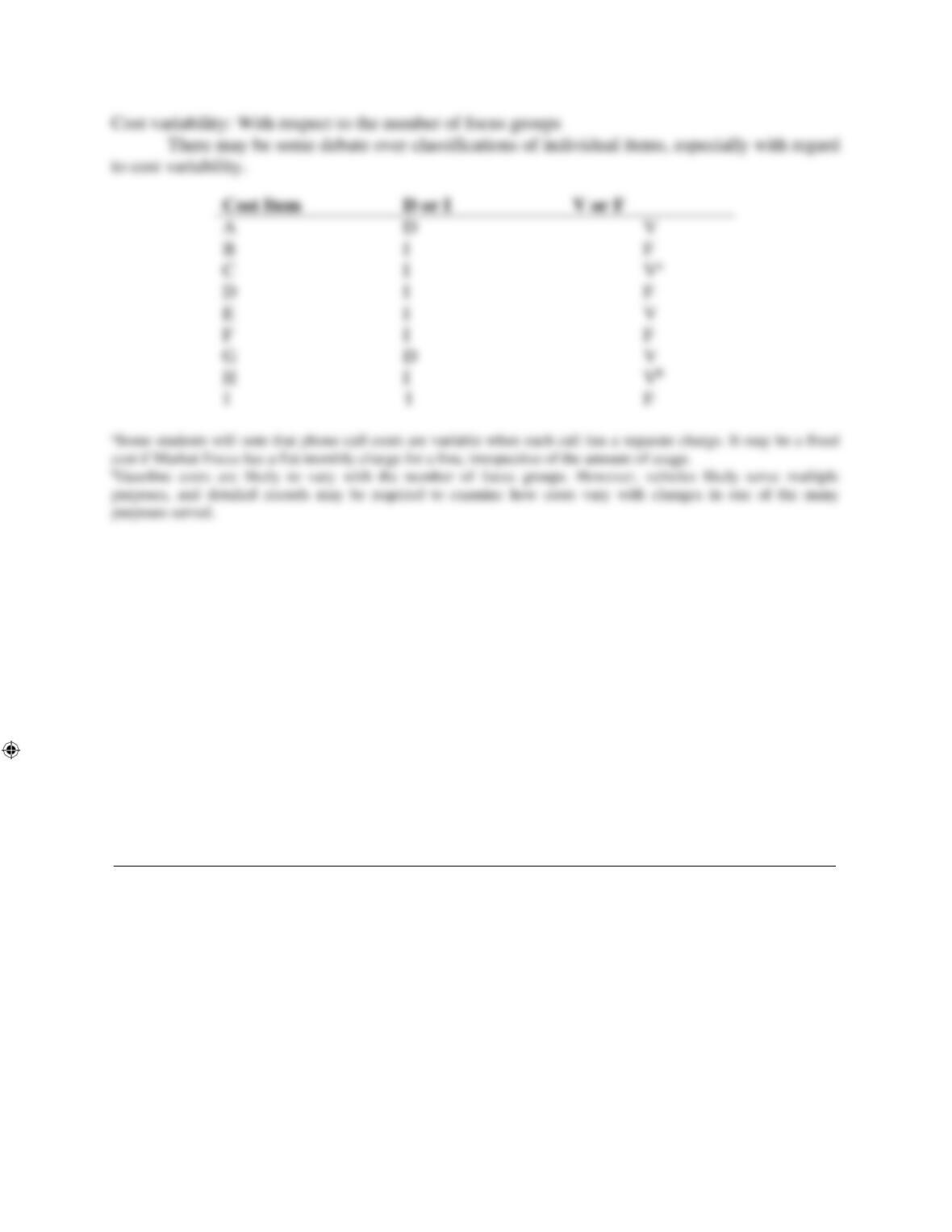
Required: Classify each cost item (A–H) as follows:
a. Direct or indirect (D or I) costs of each individual focus group.
b. Variable or fixed (V or F) costs of how the total costs of Market Focus change as the number
of focus groups conducted changes. (If in doubt, select on the basis of whether the total costs
will change substantially if there is a large change in the number of groups conducted.)
You will have two answers (D or I; V or F) for each of the following items:
Cost Item
D or I V or F
A. Payment to individuals in each focus group to provide comments on new products
B. Annual subscription of Market Focus to Consumer Reports magazine
C. Phone calls made by Market Focus staff member to confirm individuals will attend a focus
group session (Records of individual calls are not kept.)
D. Retainer paid to focus group leader to conduct 18 focus groups per year on new medical
products
E. Recruiting cost to hire marketing specialists
F. Lease payment by Market Focus for corporate office
G. Cost of tapes used to record comments made by individuals in a focus group session (These
tapes are sent to the company whose products are being tested.)
H. Gasoline costs of Market Focus staff for company-owned vehicles (Staff members submit
monthly bills with no mileage breakdowns.)
I. Costs incurred to improve the design of focus groups to make them more effective
SOLUTION
2-7
2-19 (15–20 min.) Classification of costs, merchandising sector.
Band Box Entertainment (BBE) operates a large store in Atlanta, Georgia. The store has both a
movie (DVD) section and a music (CD) section. BBE reports revenues for the movie section
separately from the music section.
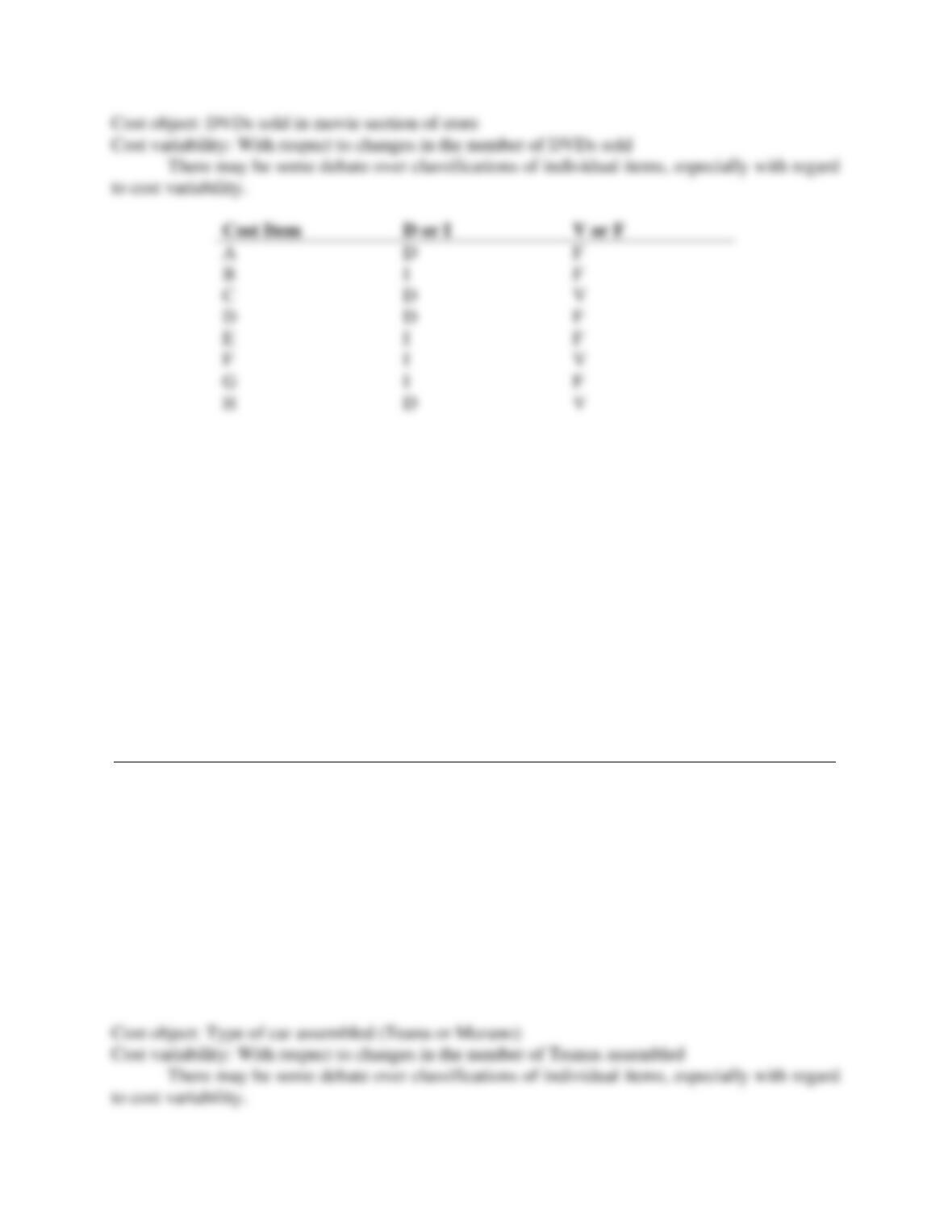
Required: Classify each cost item (A–H) as follows:
a. Direct or indirect (D or I) costs of the total number of DVDs sold.
b. Variable or fixed (V or F) costs of how the total costs of the movie section change as the total
number of DVDs sold changes. (If in doubt, select on the basis of whether the total costs will
change substantially if there is a large change in the total number of DVDs sold.)
You will have two answers (D or I; V or F) for each of the following items:
Cost Item
D or I V or F
A. Annual retainer paid to a video distributor
B. Cost of store manager’s salary
C. Costs of DVDs purchased for sale to customers
D. Subscription to DVD Trends magazine
E. Leasing of computer software used for financial budgeting at the BBE store
F. Cost of popcorn provided free to all customers of the BBE store
G. Cost of cleaning the store every night after closing
H. Freight-in costs of DVDs purchased by BBE
SOLUTION
2-8
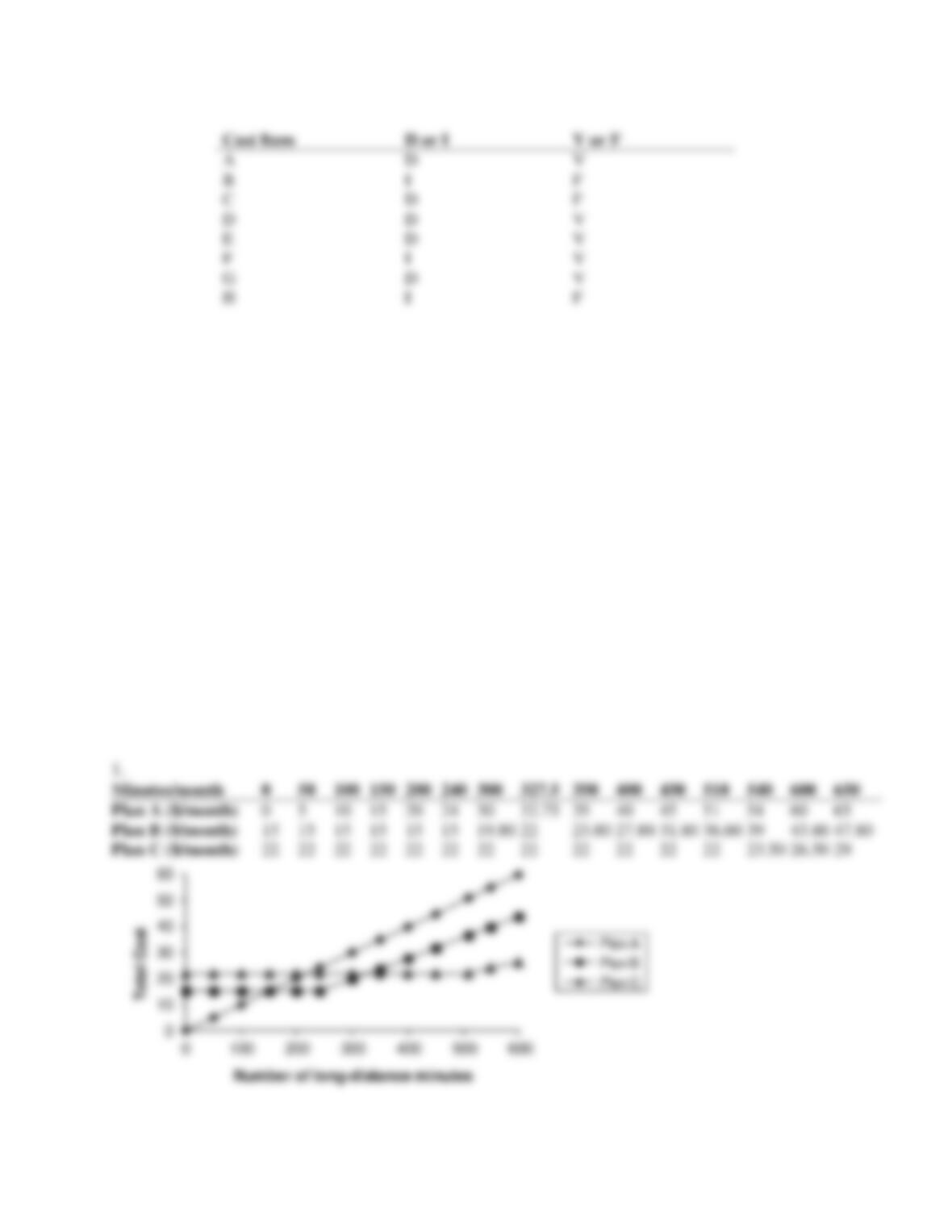
2-20 (15–20 min.) Classification of costs, manufacturing sector.
The Kitakyushu, Japan, plant of Nissan Motor Corporation assembles two types of cars (Teanas
and Muranos). Separate assembly lines are used for each type of car.
Required: Classify each cost item (A–H) as follows:
a. Direct or indirect (D or I) costs for the total number of Teanas assembled.
b. Variable or fixed (V or F) costs depending on how total costs change as the total number of
Teanas assembled changes. (If in doubt, select on the basis of whether the total costs will
change substantially if there is a large change in the total number of Teanas assembled.)
You will have two answers (D or I; V or F) for each of the following items:
Cost Item
D or I V or F
A. Cost of tires used on Teanas
B. Salary of public relations manager for Kitakyushu plant
C. Annual awards dinner for Teana suppliers
D. Cost of lubricant used on the Teana assembly line
E. Freight costs of Teana engines shipped from Yokohama to Kitakyushu
F. Electricity costs for Teana assembly line (single bill covers entire plant)
G. Wages paid to temporary assembly-line workers hired in periods of high Teana production
(paid on hourly basis)
H. Annual fire-insurance policy cost for Kitakyushu plant
SOLUTION
2-9
2-21 (20 min.) Variable costs, fixed costs, total costs.
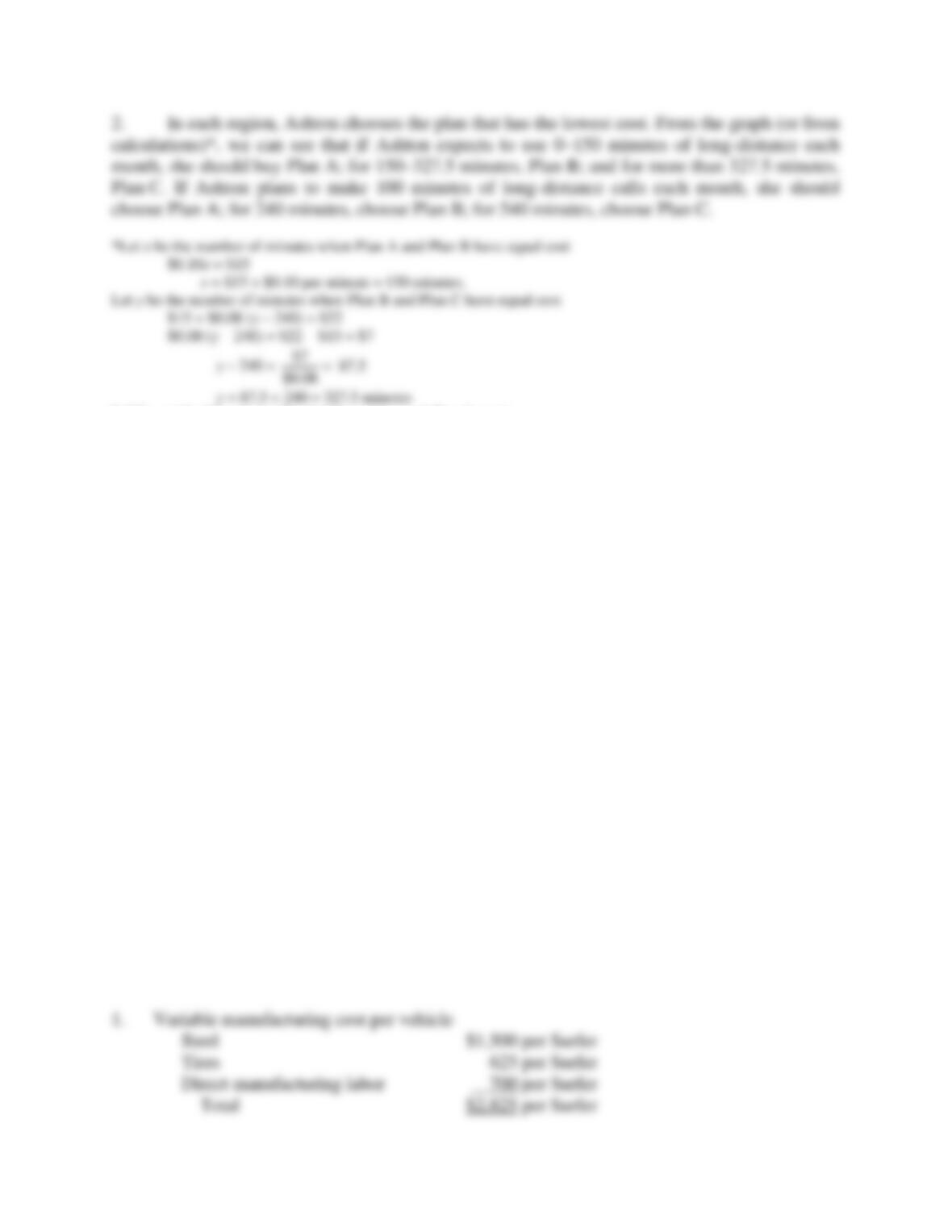
Bridget Ashton is getting ready to open a small restaurant. She is on a tight budget and must
choose between the following long-distance phone plans:
Plan A: Pay 10 cents per minute of long-distance calling.
Plan B: Pay a fixed monthly fee of $15 for up to 240 long-distance minutes and 8 cents per
minute thereafter (if she uses fewer than 240 minutes in any month, she still pays $15
for the month).
Plan C: Pay a fixed monthly fee of $22 for up to 510 long-distance minutes and 5 cents per
minute there- after (if she uses fewer than 510 minutes, she still pays $22 for the month).
Required:
1. Draw a graph of the total monthly costs of the three plans for different levels of monthly
long-distance calling.
2. Which plan should Ashton choose if she expects to make 100 minutes of long-distance calls?
240 minutes? 540 minutes?
SOLUTION
2-10
2-22 (15–20 min.) Variable costs and fixed costs.
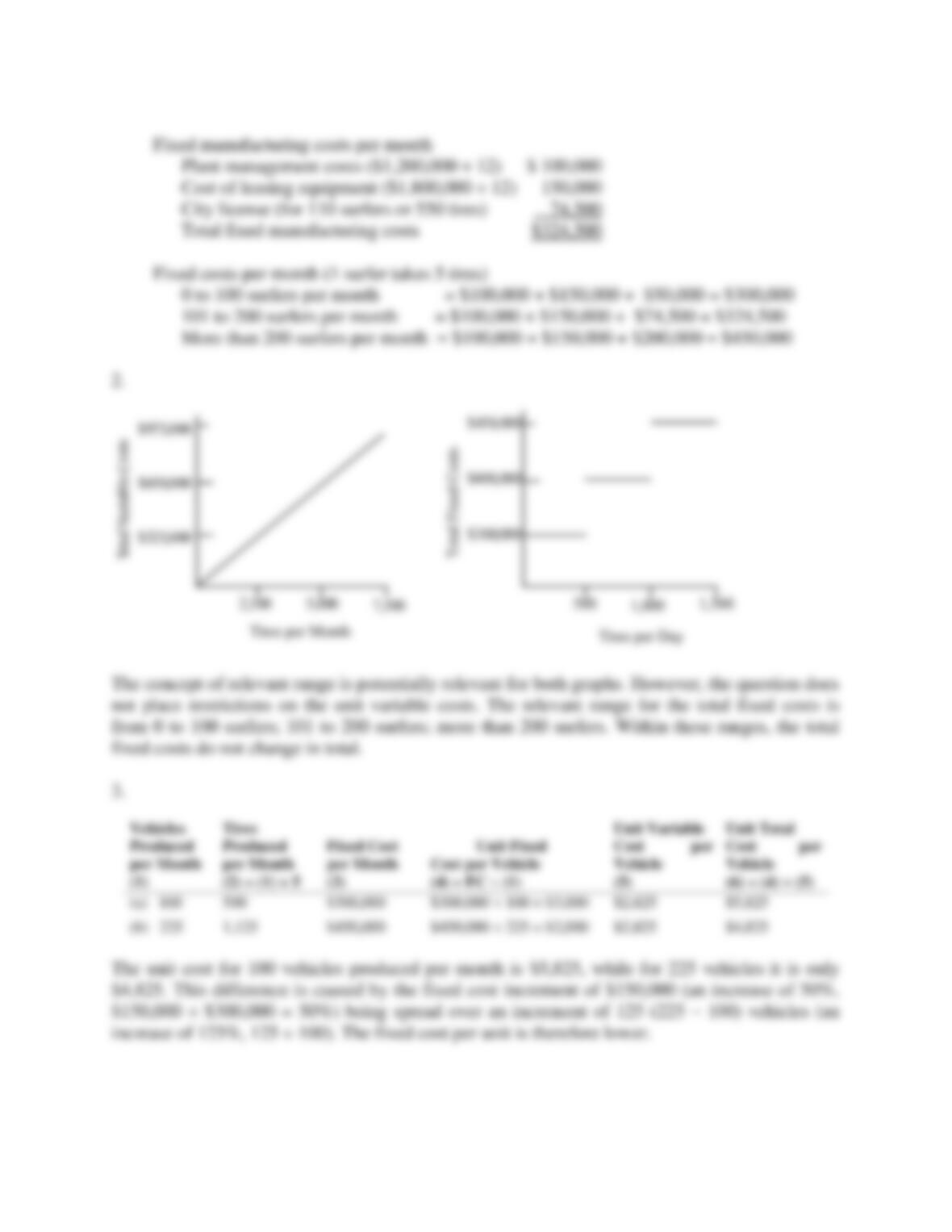
Beacher Motors specializes in producing one specialty vehicle. It is called Surfer and is styled to
easily fit multiple surfboards in its back area and top-mounted storage racks. Beacher has the
following manufacturing costs:
Plant management costs, $1,200,000 per year
Cost of leasing equipment, $1,800,000 per year
Workers’ wages, $700 per Surfer vehicle produced
Direct materials costs: Steel, $1,500 per Surfer; Tires, $125 per tire, each Surfer takes 5 tires
(one spare).
City license, which is charged monthly based on the number of tires used in production:
0–500 tires
$ 50,000
501–1,000 tires
$ 74,500
more than 1,000 tires
$200,000
Beacher currently produces 110 vehicles per month.
Required:
1. What is the variable manufacturing cost per vehicle? What is the fixed manufacturing cost
per month?
2. Plot a graph for the variable manufacturing costs and a second for the fixed manufacturing
costs per month. How does the concept of relevant range relate to your graphs? Explain.
3. What is the total manufacturing cost of each vehicle if 100 vehicles are produced each
month? 225 vehicles? How do you explain the difference in the manufacturing cost per unit?
SOLUTION
2-11
2-23 (20 min.) Variable costs, fixed costs, relevant range.
2-12
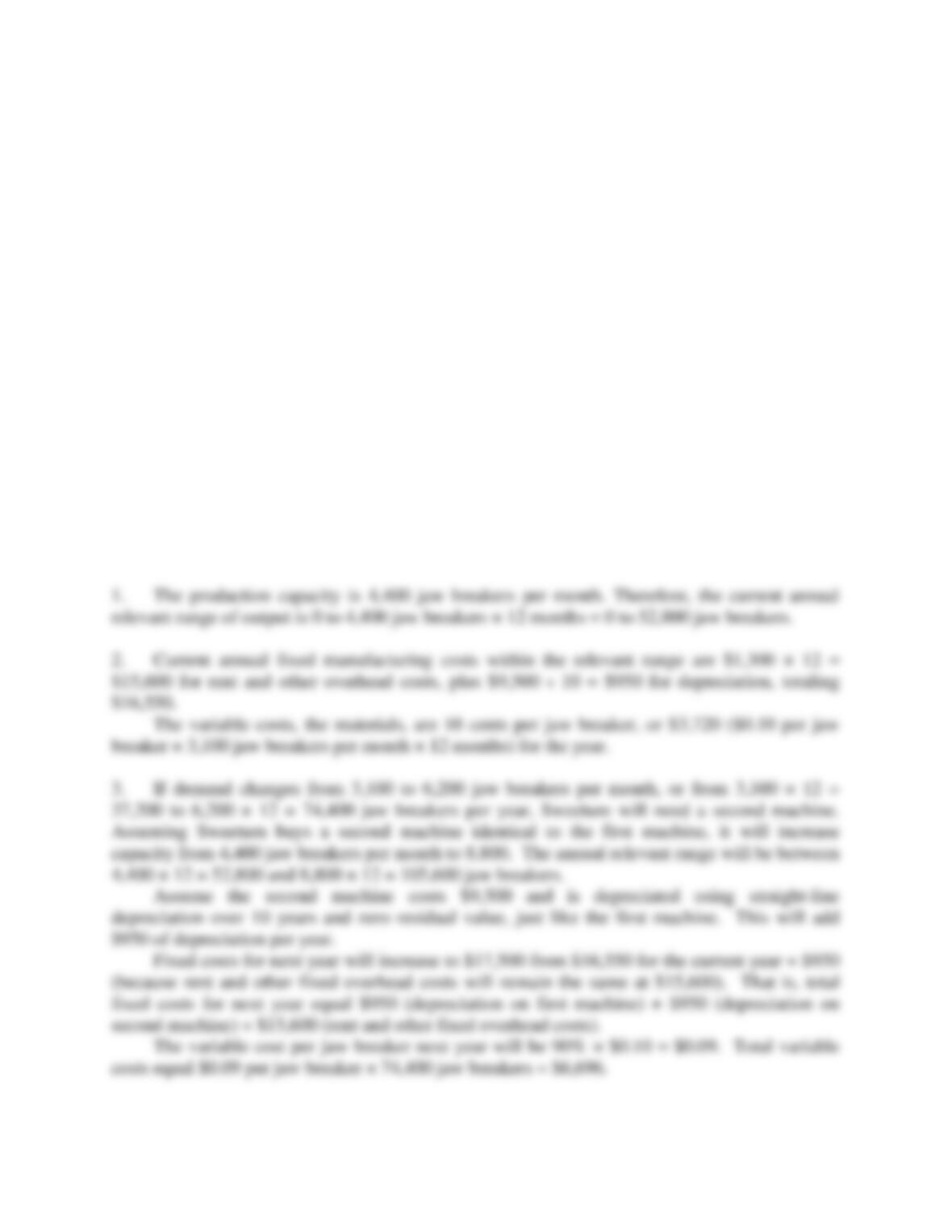
Dotball Candies manufactures jaw-breaker candies in a fully automated process. The machine
that produces candies was purchased recently and can make 4,400 per month. The machine costs
$9,500 and is depreciated using straight-line depreciation over 10 years assuming zero residual
value. Rent for the factory space and warehouse and other fixed manufacturing overhead costs
total $1,300 per month.
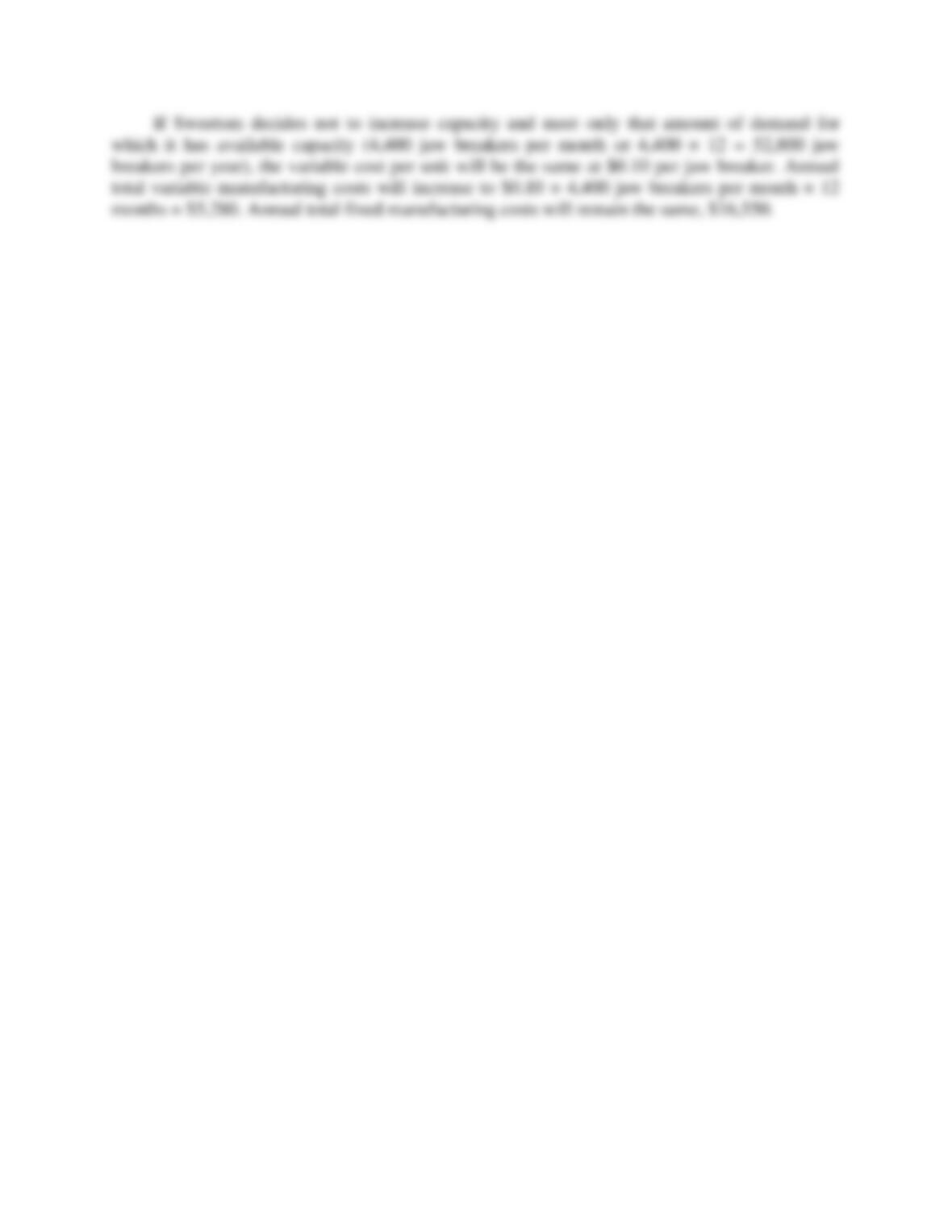
Dotball currently makes and sells 3,100 jaw-breakers per month. Dotball buys just
enough materials each month to make the jaw-breakers it needs to sell. Materials cost 10 cents
per jawbreaker.
Next year Dotball expects demand to increase by 100%. At this volume of materials
purchased, it will get a 10% discount on price. Rent and other fixed manufacturing overhead
costs will remain the same.
Required:
1. What is Dotball’s current annual relevant range of output?
2. What is Dotball’s current annual fixed manufacturing cost within the relevant range? What is
the annual variable manufacturing cost?
3. What will Dotball’s relevant range of output be next year? How, if at all, will total annual
fixed and variable manufacturing costs change next year? Assume that if it needs to Dotball
could buy an identical machine at the same cost as the one it already has.
SOLUTION
2-13
2-24 (20 min.) Cost drivers and value chain.
Roxbury Mobile Company (RMC) is developing a new touch-screen smartphone to compete in
the cellular phone industry. The company will sell the phones at wholesale prices to cell phone
companies, which will in turn sell them in retail stores to the final customer. RMC has
undertaken the following activities in its value chain to bring its product to market:
Identify customer needs (What do smartphone users want?)
Perform market research on competing brands
Design a prototype of the RMC smartphone
Market the new design to cell phone companies
Manufacture the RMC smartphone
Process orders from cell phone companies
Package the RMC smartphones
Deliver the RMC smartphones to the cell phone companies
Provide online assistance to cell phone users for use of the RMC smartphone
Make design changes to the smartphone based on customer feedback
During the process of product development, production, marketing, distribution, and customer
service, RMC has kept track of the following cost drivers:
Number of smartphones shipped by RMC
Number of design changes
Number of deliveries made to cell phone companies
Engineering hours spent on initial product design
Hours spent researching competing market brands
Customer-service hours
Number of smartphone orders processed
Number of cell phone companies purchasing the RMC smartphone
Machine hours required to run the production equipment
Number of surveys returned and processed from competing smartphone users
Required:
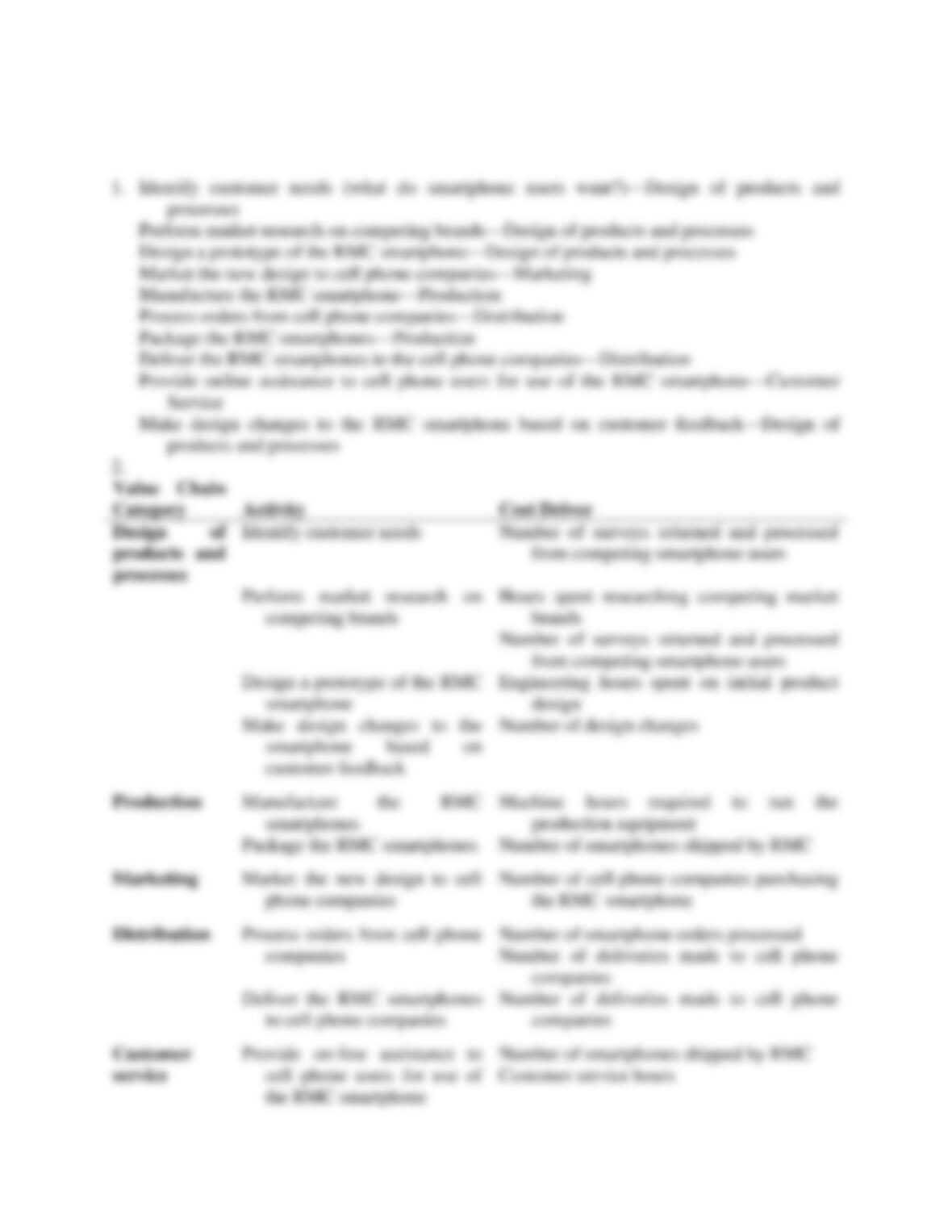
1. Identify each value chain activity listed at the beginning of the exercise with one of the
following value-chain categories:
a. Design of products and processes
b. Production
c. Marketing
d. Distribution
e. Customer service
2. Use the list of preceding cost drivers to find one or more reasonable cost drivers for each of
the activities in RMC’s value chain.
2-14
SOLUTION
2-15
2-25 (10–15 min.) Cost drivers and functions.
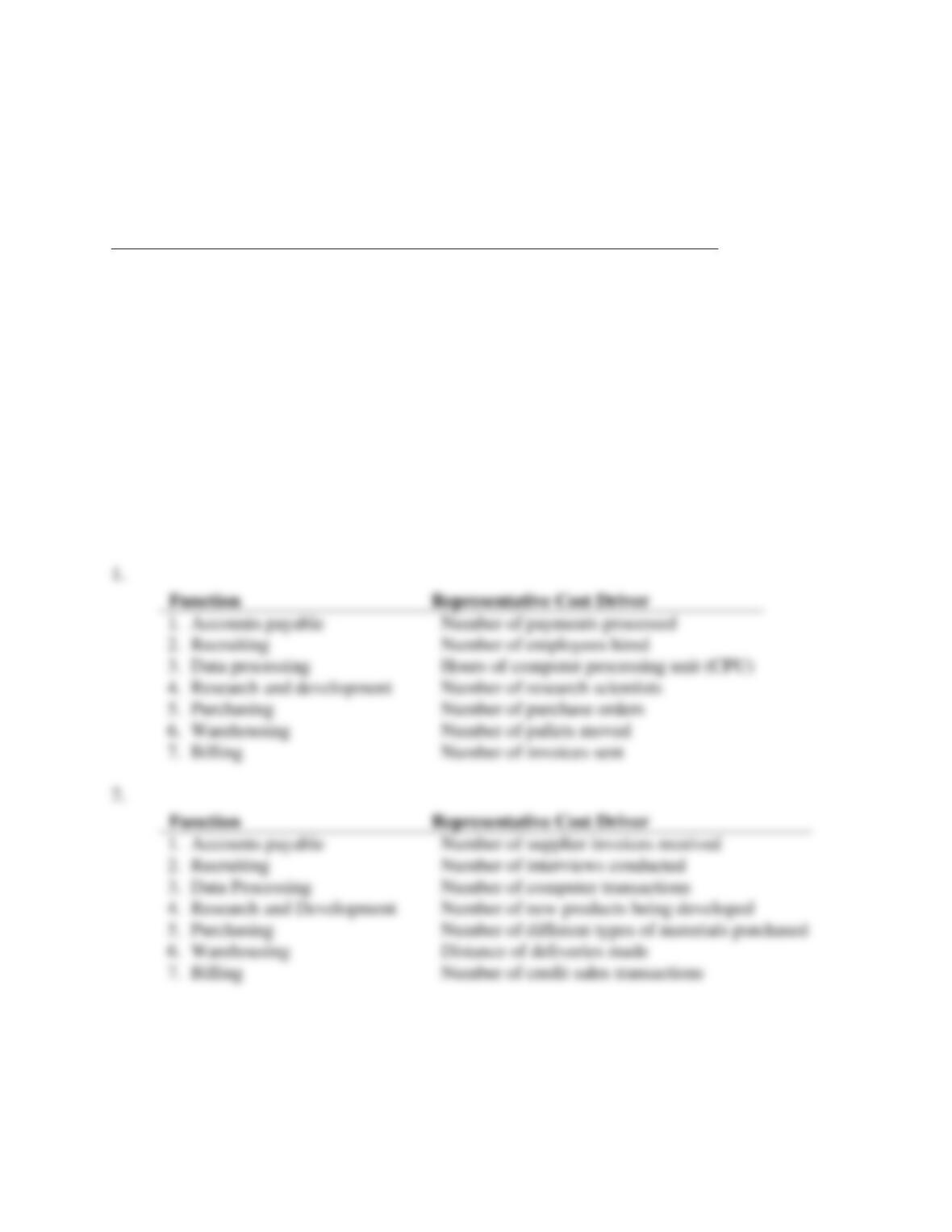
The representative cost drivers in the right column of this table are randomized so they do not
match the list of functions in the left column.
Function Representative Cost Driver
1. Accounts payable A. Number of invoices sent
2. Recruiting B. Number of purchase orders
3. Data processing C. Number of research scientists
4. Research and development D. Hours of computer processing unit (CPU)
5. Purchasing E. Number of employees hired
6. Warehousing F. Number of payments processed
7. Billing G. Number of pallets moved
Required:
1. Match each function with its representative cost driver.
2. Give a second example of a cost driver for each function.
SOLUTION
2-16
2-26 (20 min.) Total costs and unit costs
The Big Event (TBE) recently started a business organizing food and music at weddings and
other large events. In order to better understand the profitability of the business, the owner has
asked you for an analysis of costs—what costs are fixed, what costs are variable, and so on, for
each event. You have the following cost information:
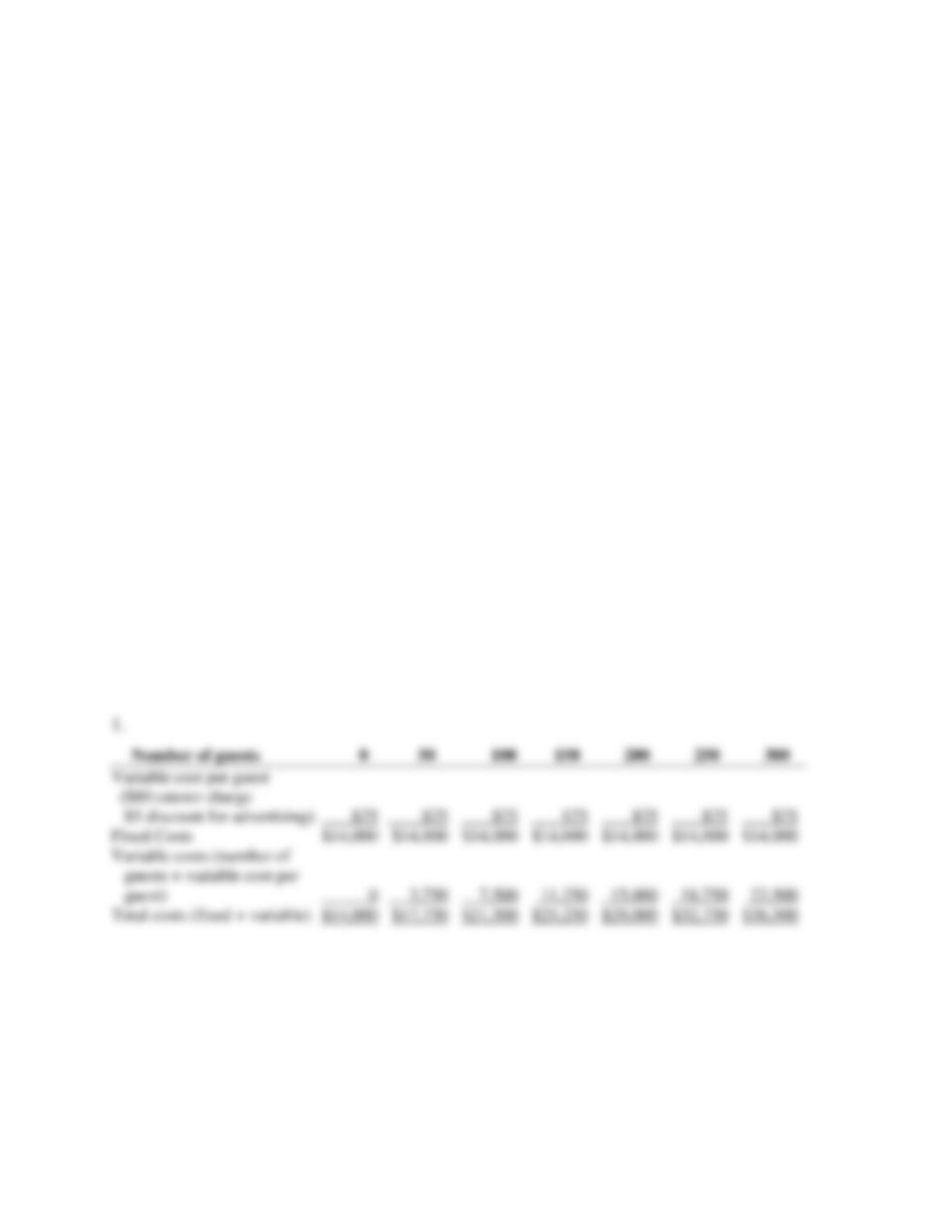
Music costs: $10,000 per event
Catering costs:
Food: $65 per guest
Setup/cleanup: $15 per guest
Fixed fee: $4,000 per event
The Big Event has allowed the caterer, who is also new in business, to place business cards on
each table as a form of advertising. This has proved quite effective, and the caterer gives TBE a
discount of $5 per guest in exchange for allowing the caterer to advertise.
Required:
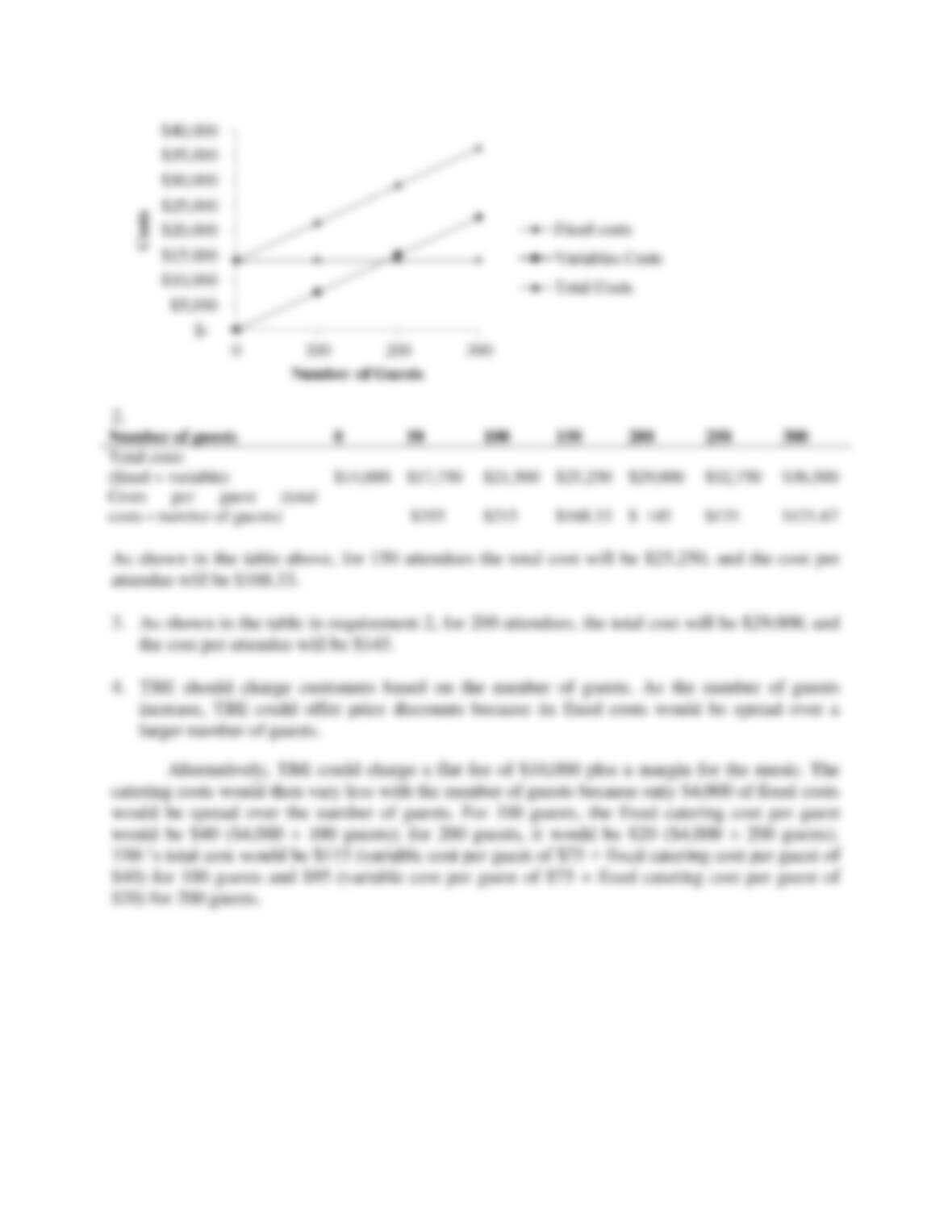
1. Draw a graph depicting fixed costs, variable costs, and total costs for each event versus the
number of guests.
2. Suppose 150 persons attend the next event. What is TBE’s total net cost and the cost per
attendee?
3. Suppose instead that 200 persons attend. What is TBE’s total net cost and the cost per
attendee.
4. How should TBE charge customers for its services? Explain briefly.
SOLUTION
2-17
2-27 (25 min.) Total and unit cost, decision making.
Gayle’s Glassworks makes glass flanges for scientific use. Materials cost $1 per flange, and the
glass blowers are paid a wage rate of $28 per hour. A glass blower blows 10 flanges per hour.
Fixed manufacturing costs for flanges are $28,000 per period. Period (nonmanufacturing) costs
associated with flanges are $10,000 per period and are fixed.
Required:
2-18
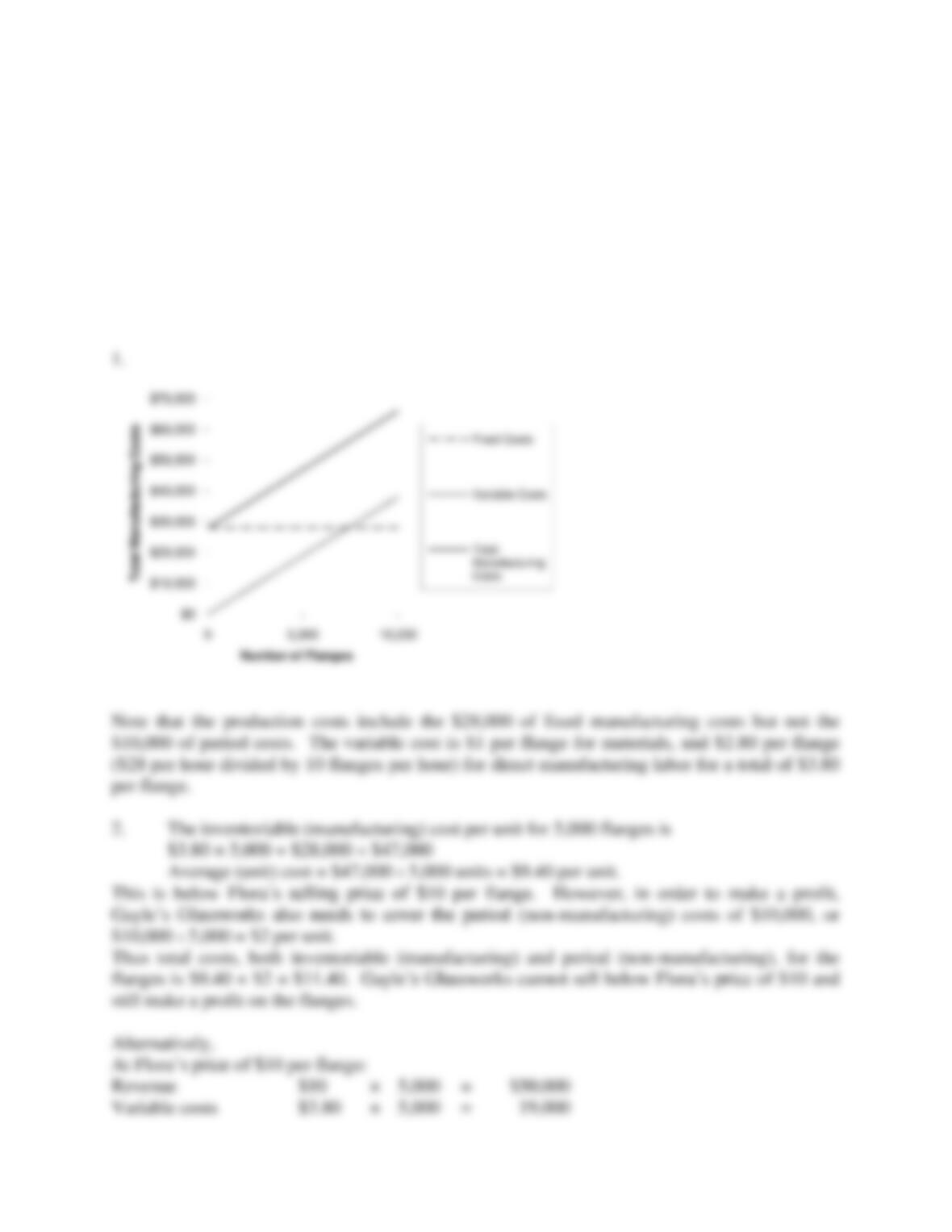
1. Graph the fixed, variable, and total manufacturing cost for flanges, using units (number of
flanges) on the x-axis.
2. Assume Gayle’s Glassworks manufactures and sells 5,000 flanges this period. Its competitor,
Flora’s Flasks, sells flanges for $10 each. Can Gayle sell below Flora’s price and still make a
profit on the flanges?
3. How would your answer to requirement 2 differ if Gayle’s Glassworks made and sold 10,000
flanges this period? Why? What does this indicate about the use of unit cost in decision
making?
SOLUTION
2-19
2-28 (20–30 min.) Inventoriable costs versus period costs.
Each of the following cost items pertains to one of these companies: Star Market (a
merchandising-sector company), Maytag (a manufacturing-sector company), and Yahoo! (a
service-sector company):
a. Cost of lettuce and tomatoes on sale in Star Market’s produce department
b. Electricity used to provide lighting for assembly-line workers at a Maytag refrigerator-
assembly plant
c. Depreciation on Yahoo!’s computer equipment used to update its Website
d. Electricity used to provide lighting for Star Market’s store aisles
2-20
e. Depreciation on Maytag’s computer equipment used for quality testing of refrigerator
components during the assembly process
f. Salaries of Star Market’s marketing personnel planning local-newspaper advertising
campaigns
g. Perrier mineral water purchased by Yahoo! for consumption by its software engineers
h. Salaries of Yahoo!’s marketing personnel selling advertising
i. Depreciation on vehicles used to transport Maytag refrigerators to retail stores
Required:
1. Distinguish between manufacturing-, merchandising-, and service-sector companies.
2. Distinguish between inventoriable costs and period costs.
3. Classify each of the cost items (a–h) as an inventoriable cost or a period cost. Explain your
answers.
SOLUTION