CHAPTER 2 Analyzing Transactions
Prob. 2-4B (Concluded)
5. (a) The unadjusted trial balance in (4) still balances because the debits equaled
the credits in the original journal entry.
(b) The correcting entry for $9,000 ($10,000 – $1,000) would be as follows:
Page 19
Post.
Ref. Debit Credit
(c) Slide
Date
JOURNAL
Description
CHAPTER 2 Analyzing Transactions
Prob. 2-5B
1.
Debit Credit
Balances Balances
Cash* 20,250
Accounts Receivable 56,400
Supplies 6,750
Prepaid Insurance 9,600
Equipment 162,000
Notes Payable 54,000
Accounts Payable 16,650
712,500 712,500
*$25,550 – $8,000 (a) + $2,700 (b)
2. No. The trial balance indicates only that the debits and credits are equal.
Tech Support Services
Unadjusted Trial Balance
January 31, 20Y8
CHAPTER 2 Analyzing Transactions
2. and 3.
Page 1
Post.
Ref. Debit Credit
20Y9
July 1 Cash 11 5,000
Peyton Smith, Capital 31 5,000
2 Cash 11 1,000
Accounts Receivable 12 1,000
3 Cash 11 7,200
Unearned Revenue 23 7,200
5 Office Equipment 17 7,500
Accounts Payable 21 7,500
8 Advertising Expense 55 200
Cash 11 200
11 Cash 11 1,000
Fees Earned 41 1,000
Date
CONTINUING PROBLEM
JOURNAL
Description
CHAPTER 2 Analyzing Transactions
Continuing Problem (Continued)
2. and 3.
Page 2
Post.
Ref. Debit Credit
20Y9
July 16 Cash 11 2,000
Fees Earned 41 2,000
22 Advertising Expense 55 800
Cash 11 800
23 Cash 11 750
Accounts Receivable 12 1,750
Fees Earned 41 2,500
29 Miscellaneous Expense 59 540
Cash 11 540
30 Cash 11 500
Accounts Receivable 12 1,000
Fees Earned 41 1,500
31 Cash 11 3,000
Fees Earned 41 3,000
Date
JOURNAL
Description
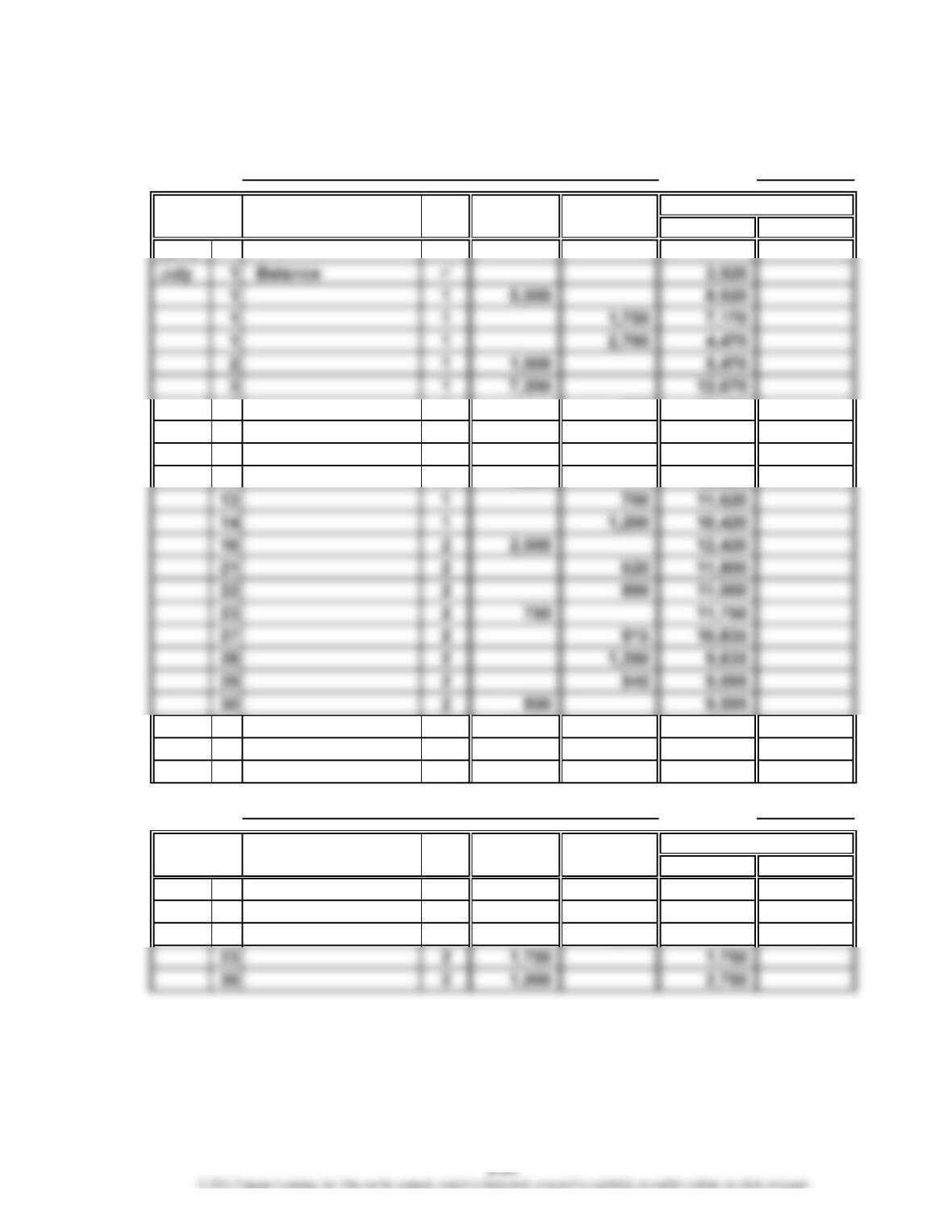
CHAPTER 2 Analyzing Transactions
Continuing Problem (Continued)
1. and 3.
Account No. 11
Post.
Item Ref. Debit Credit Debit Credit
3 1 250 12,420
4 1 900 11,520
8 1 200 11,320
11 1 1,000 12,320
31 2 3,000 12,595
31 2 1,400 11,195
31 2 1,250 9,945
Account No. 12
Post.
Item Ref. Debit Credit Debit Credit
20Y9
July 1 Balance 1,000
2 1 1,000 — —
Date
Date
Balance
Cash
Account:
Account: Accounts Receivable
Balance
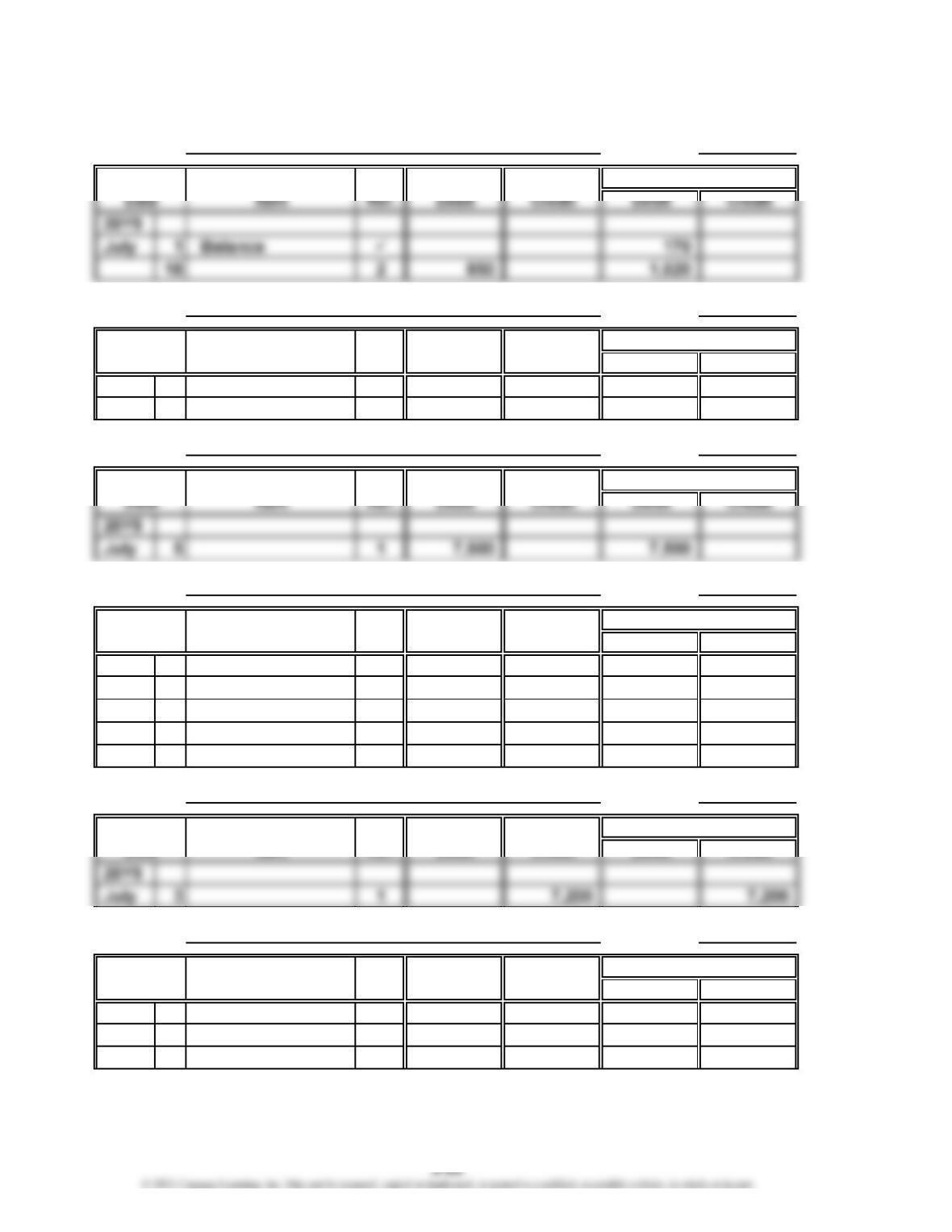
CHAPTER 2 Analyzing Transactions
Continuing Problem (Continued)
Account No. 14
Post.
Account No. 15
Post.
Item Ref. Debit Credit Debit Credit
20Y9
July 1 1 2,700 2,700
Account No. 17
Post.
Account No. 21
Post.
Item Ref. Debit Credit Debit Credit
20Y9
July 1 Balance 250
3 1 250 — —
5 1 7,500 7,500
18 2 850 8,350
Account No. 23
Post.
Account No. 31
Post.
Item Ref. Debit Credit Debit Credit
20Y9
July 1 Balance 4,000
1 1 5,000 9,000
Balance
Date
Account: Office Equipment
Account: Unearned Revenue
Account: Accounts Payable
Balance
Date
Balance
Account: Peyton Smith, Capital
Supplies
Account:
Account: Prepaid Insurance
Balance
Balance
Balance
Date
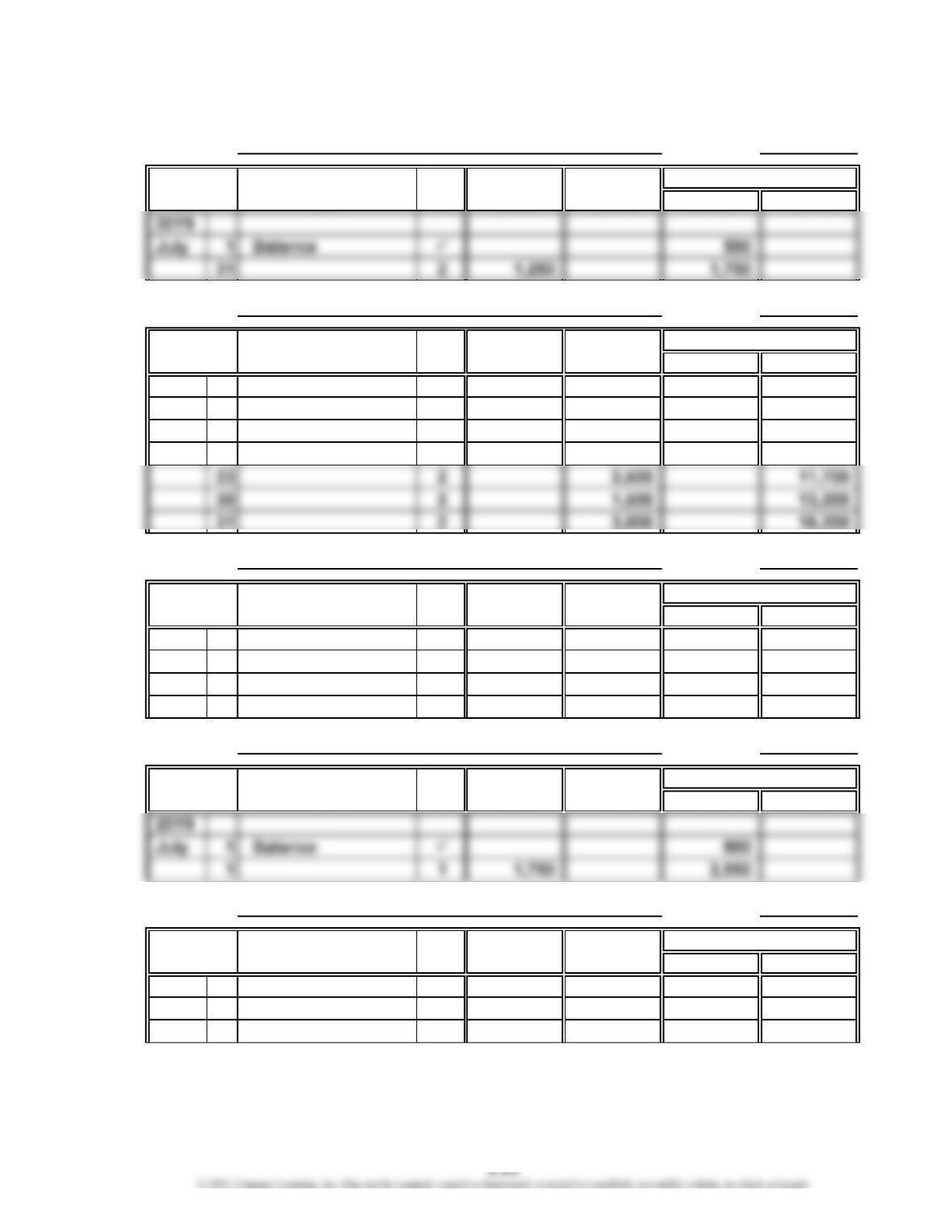
CHAPTER 2 Analyzing Transactions
Continuing Problem (Continued)
Account No. 32
Post.
Item Ref. Debit Credit Debit Credit
Account No. 41
Post.
Item Ref. Debit Credit Debit Credit
20Y9
July 1 Balance 6,200
11 1 1,000 7,200
16 2 2,000 9,200
Account No. 50
Post.
Item Ref. Debit Credit Debit Credit
20Y9
July 1 Balance 400
14 1 1,200 1,600
28 2 1,200 2,800
Account No. 51
Post.
Item Ref. Debit Credit Debit Credit
Account No. 52
Post.
Item Ref. Debit Credit Debit Credit
20Y9
July 1 Balance 675
13 1 700 1,375
Date
Balance
Peyton Smith, Drawing
Account:
Balance
Date
Account: Fees Earned
Balance
Date
Balance
Date
Account: Equipment Rent Expense
Account: Wages Expense
Balance
Date
Account: Office Rent Expense
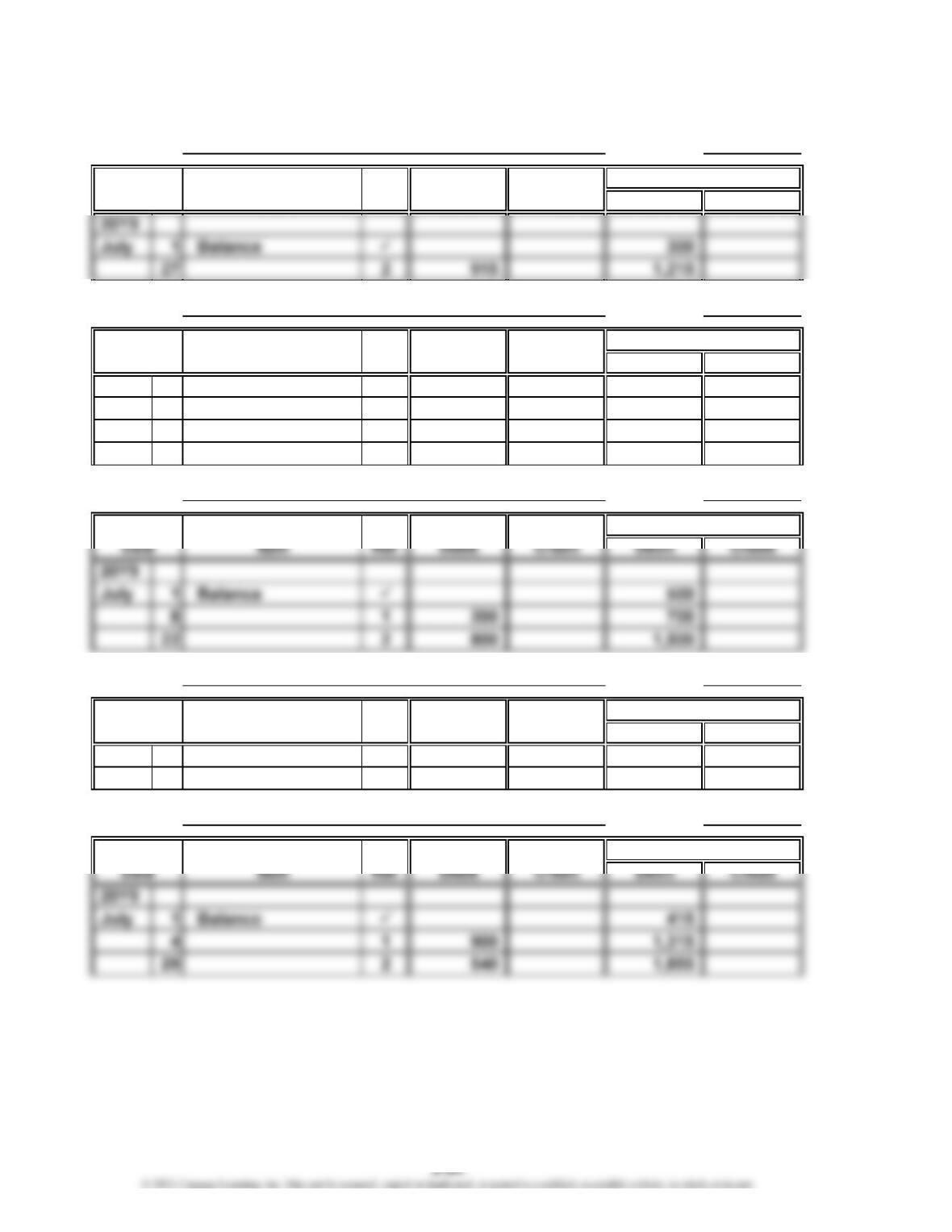
CHAPTER 2 Analyzing Transactions
Continuing Problem (Continued)
Account No. 53
Post.
Item Ref. Debit Credit Debit Credit
Account No. 54
Post.
Item Ref. Debit Credit Debit Credit
20Y9
July 1 Balance 1,590
21 2 620 2,210
31 2 1,400 3,610
Account No. 55
Post.
Account No. 56
Post.
Item Ref. Debit Credit Debit Credit
20Y9
July 1 Balance 180
Account No. 59
Post.
Account: Supplies Expense
Balance
Date
Account: Miscellaneous Expense
Balance
Account: Utilities Expense
Balance
Date
Balance
Date
Balance
Music Expense
Account:
Account: Advertising Expense
CHAPTER 2 Analyzing Transactions
Continuing Problem (Concluded)
4.
Account Debit Credit
No. Balances Balances
Cash 11 9,945
Accounts Receivable 12 2,750
Peyton Smith, Capital 31 9,000
Peyton Smith, Drawing 32 1,750
Fees Earned 41 16,200
Wages Expense 50 2,800
Office Rent Expense 51 2,550
Equipment Rent Expense 52 1,375
Utilities Expense 53 1,215
PS Music
Unadjusted Trial Balance
July 31, 20Y9
CHAPTER 2 Analyzing Transactions
CP 2-1
1. No. For financial accounting information to be useful, it must accurately reflect
an entity’s business transactions and economic activity. For this to happen,
each account must reflect the increases or decreases that result from each
2. The users of the financial information who rely on this information will be
affected, as the information will not be a faithful representation of the entity’s
economic activity.
CP 2-2
A sample solution based on Nike Inc.’s Form 10-K for the fiscal year ended May 31,
2018, follows:
1. $22,536 million
2. $12,724 million ($6,040 + $3,468 + $3,216)
3. $9,812 million ($22,536 million on total assets – $12,724 million total liabilities)
CP 2-3
1. The rules of debit and credit must be memorized. Dot is correct in that the rules
of debit and credit could be reversed as long as everyone accepted and abided
by the rules. However, the important point is that everyone accepts the rules as
the way in which transactions should be recorded. This generates uniformity
across the accounting profession and reduces errors and confusion. Because the
current rules of debit and credit have been used for centuries, Dot should adapt
to the current rules of debit and credit, rather than devise her own.
CASES & PROJECTS
CHAPTER 2 Analyzing Transactions
CP 2-3 (Concluded)
assets is a debit would also be removed. The accounting equation would still
hold, but the control over recording transactions would be weakened.
(debit) means “left” and credere (credit) means “right.”
2. The accounting system may be designed to capture information about the
buying habits of various customers or vendors, such as the quantity
normally ordered, average amount ordered, and number of returns. Thus, in
CP 2-4
Note to Instructors: The purpose of this activity is to familiarize students with the job
opportunities available in accounting and allow them to demonstrate their ability to
communicate the role of accounting in the context of a specific position that requires
knowledge of accounting. An example of an advertisement for such a position is
shown below. Individual student answers will vary depending on the specific scenario
they select.
ABOUT THE COMPANY
Our client is looking to add a Financial Analyst. With a large and growing finance team,
there is significant opportunity for growth and advancement within the department.
opportunities for growth.
RESPONSIBILITIES OF THE FINANCIAL ANALYST
The Financial Analyst will:
•Conduct special studies to analyze complex financial actions and prepare
recommendations for policy, procedure, control, or action.
•Analyze financial information to determine present and future financial performance.
•Evaluate complex profit plans, operating records, and financial statements.
CHAPTER 2 Analyzing Transactions
CP 2-5
The following general journal entry should be used to record the receipt of tuition
payments received in advance of classes:
Cash…………………………………………………………………
…
XXX
Unearned Tuition Deposits…………………………………… XXX
Cash is an asset account, and Unearned Tuition Deposits is a liability account. As
CP 2-6
The journal is called the book of original entry. It provides a time-ordered history
of the transactions that have occurred for the firm. This time-ordered history is
very important because it allows one to trace ledger account balances back to
the original transactions that created those balances. This is called an “audit
trail.” If the firm recorded transactions by posting to ledgers directly, it would be
nearly impossible to reconstruct actual transactions. The debits and credits
would all be separated and accumulated into the ledger balances. Once the
CP 2-7
a. Although the titles and numbers of accounts may differ, depending on how
expenses are classified, the following accounts would be adequate for
recording transaction data for Eagle Caddy Service:
11 Cash 41 Fees Earned
12 Accounts Receivable
13 Supplies
b.
Fees earned $11,400
Expenses:
Rent expense $3,500
Supplies expense 1,925
Wages expense 850
Note to Instructors: Students may have prepared slightly different income
statements, depending upon the titles of the major expense classifications
chosen. Regardless of the classification of expenses, however, the total
sales, total expenses, and net income should be as presented above.
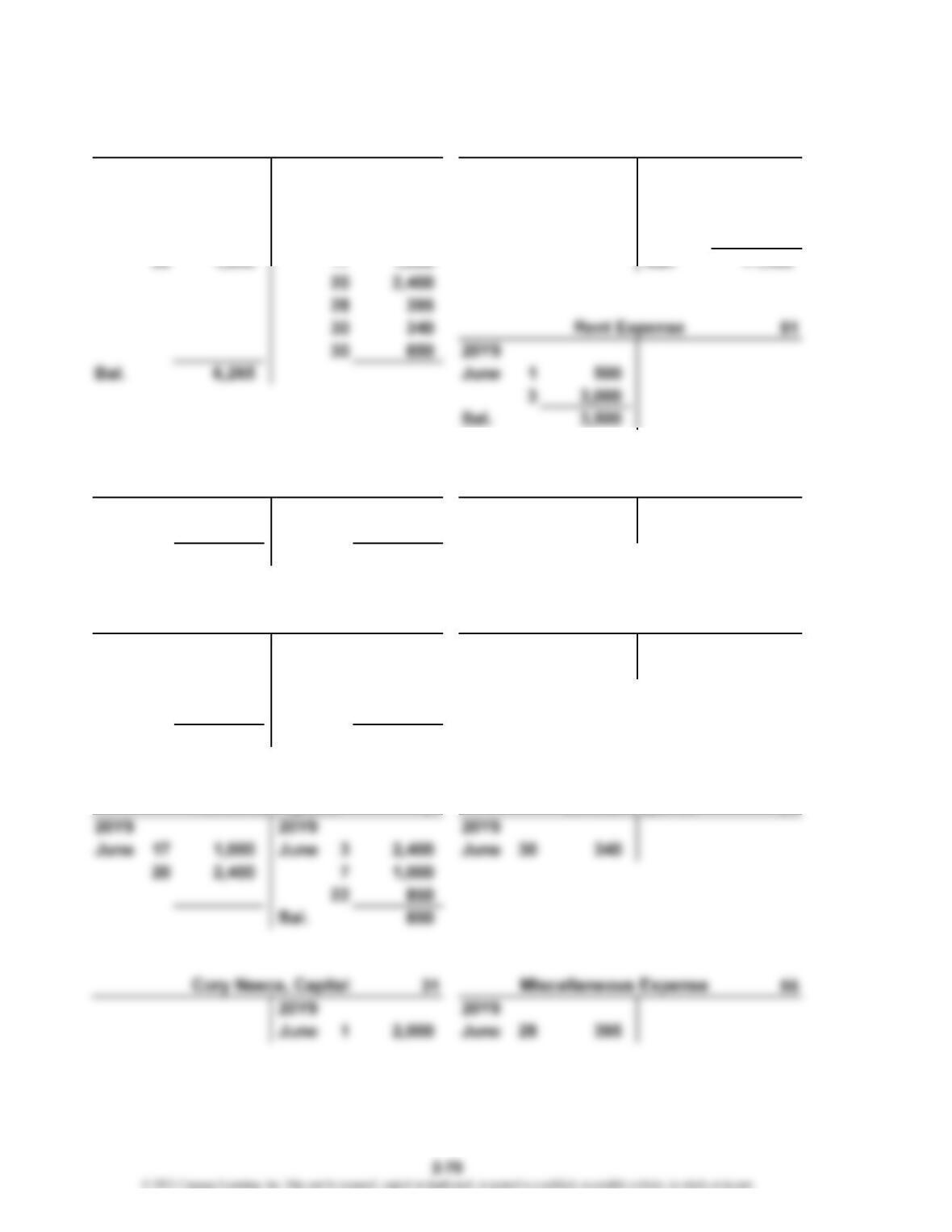
T accounts are not required for the preparation of the income statement of
Eagle Caddy Service. The following presentation illustrates one solution using
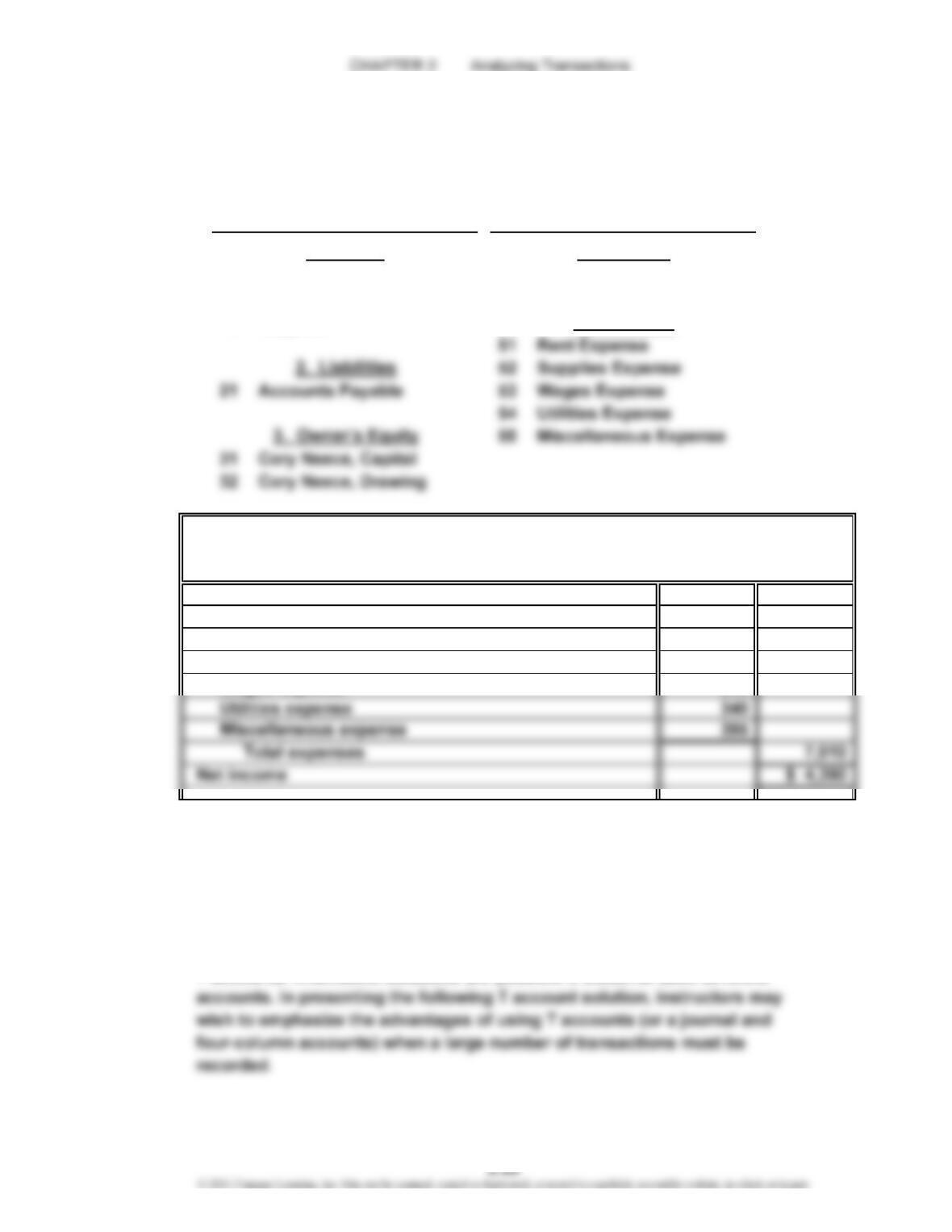
Balance Sheet Accounts Income Statement Accounts
1. Assets 4. Revenue
Income Statement
For the Month Ended June 30, 20Y9
5. Expenses
Eagle Caddy Service
CHAPTER 2 Analyzing Transactions
CP 2-7 (Continued)
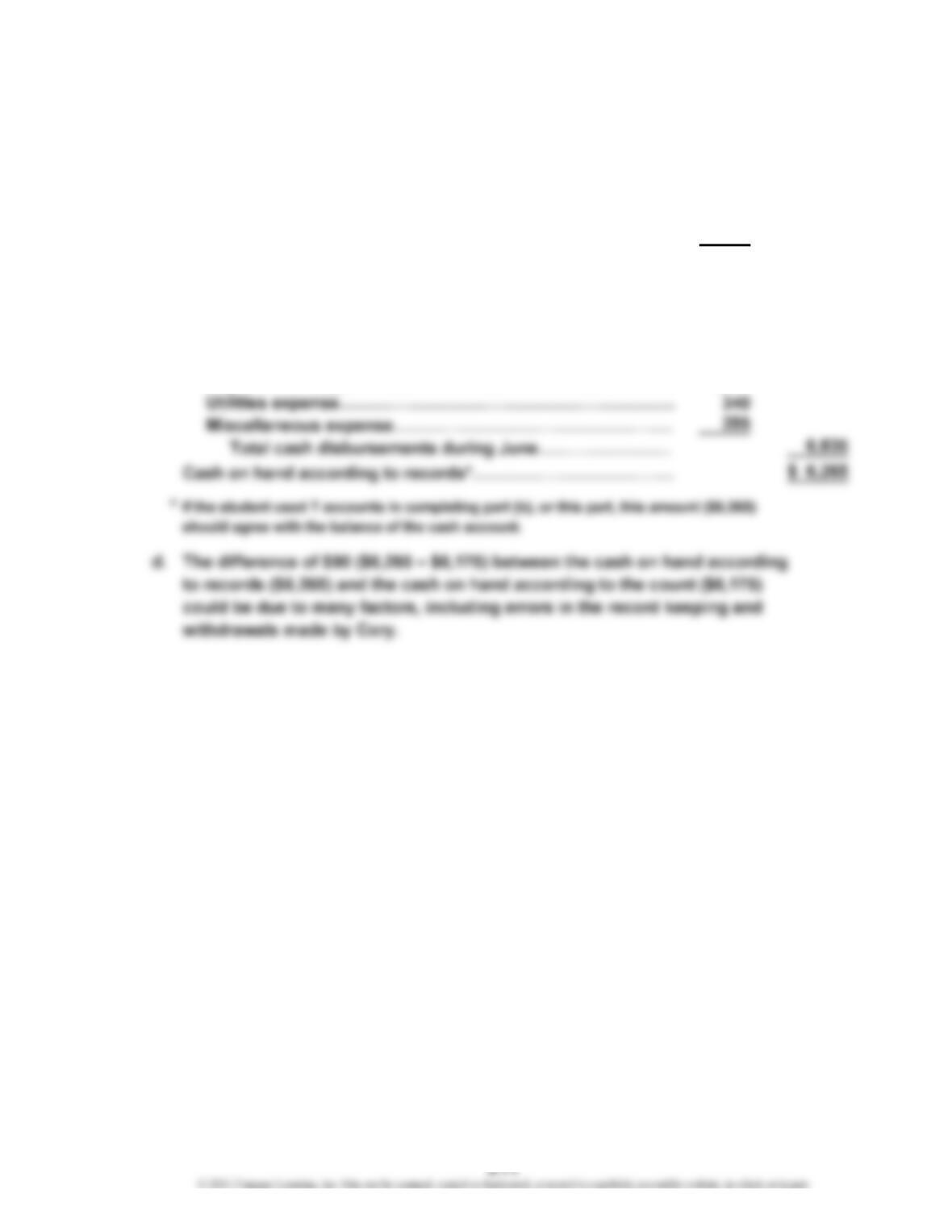
11 41
20Y9 20Y9 20Y9
June 1 2,000 June 1 500 June 15 5,400
15 5,400 2 750 25 1,800
30 4,200 3 600 30 4,200
12 52
20Y9 20Y9 20Y9
June 25 1,800 June 30 1,500 June 30 1,925
Bal. 300
13 53
20Y9 20Y9 20Y9
June 2 750 June 30 1,925 June 30 850
7 1,000
22 850
Bal. 675
21 54
Utilities Expense
Cash Fees Earned
Supplies ExpenseAccounts Receivable
Supplies
Accounts Payable
Wages Expense
CHAPTER 2 Analyzing Transactions
CP 2-7 (Concluded)
c. $6,265, computed in the following manner:
Cash receipts:
Initial investment…………………………………………………
…
$2,000
Cash sales ($5,400 + $4,200)……………………………………
…
9,600
Collections on accounts…………………………………………
…
1,500
Total cash receipts during June……………………………
…
$13,100
Cash disbursements:
Rent expense ($500 + $3,000)…………………………………… $3,500
Supplies purchased for cash……………………………………
…
750
Wages expense……………………………………………………
…
850
Payment for supplies on account……………………………… 1,000