CHAPTER 2 Basic Managerial Accounting Concepts
E 2-48
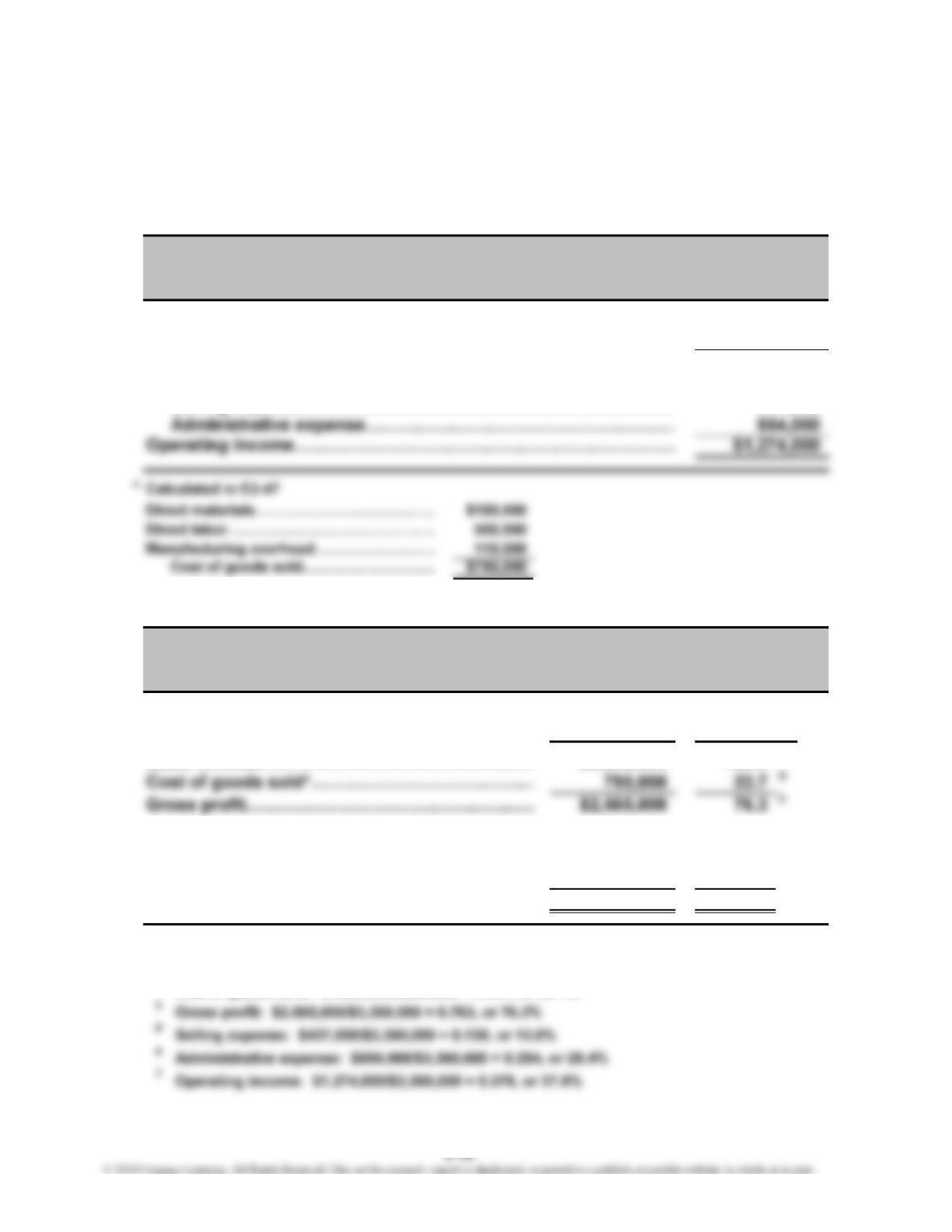
1. Sales Revenue = Number of Units Sold × Selling Price
= 280,000 units × $12
= $3,360,000
2.
Sales revenue……………………………………………………………
…
Cost of goods sold*………………………………………………………
Gross profit………………………………………………………………
…
Less:
Selling expense………………………………………………………
…
E 2-49
1.
Sales &
Expenses
b
a
Less:
Selling expense…………………………………
…
437,000 13.0
d
Administrative expense………………………
…
854,000 25.4
e
Operating income…………………………………
…
$1,274,000 37.9
f
*
See solution to Exercise 2-48, Requirement 2.
a
Sales revenue: $3,360,000/$3,360,000 = 1.00, or 100%
b
Cost of goods sold: $795,000/$3,360,000 = 0.237, or 23.7%
f
$2,565,000
of Sales
Percent
Jasper Company
Income Statement
For the Last Yea
r
437,000
Jasper Company
Income Statement
For the Last Yea
r
$3,360,000
795,000
CHAPTER 2 Basic Managerial Accounting Concepts
E 2-49 (Concluded)
2. The income statement showing each account as a percentage of sales helps focus
managerial attention on those expenses that are relatively high. For Jasper, it
appears as though administrative expense is twice as large as selling expense.
E 2-50
a (Direct Materials Used in Production) = Beginning Inventory Direct Materials +
Purchases – Ending Inventory Direct Materials
a = $10,000 + $45,000 – $15,000
= $40,000
To find b, one can rearrange the Cost of Goods Manufactured equation to solve for
Direct Labor Used in Production (i.e., the unknown, or b):
Thus, in order to find b, we first need to calculate Cost of Goods Manufactured as
follows:
Cost of Goods Manufactured = Cost of Goods Sold – Beginning Finished Goods
Inventory + Ending Finished Goods Inventory
COGM = $169,000 – $8,000 + $7,000
= $168,000
Finally, inserting Cost of Goods Manufactured into the earlier equation:
b = $168,000 – $40,000 – $80,000 – $17,000 + $14,000
= $45,000
c (Direct Materials Beginning Inventory for Year 2) = Direct Materials Ending
Inventory for Year 1 = $15,000
CHAPTER 2 Basic Managerial Accounting Concepts
E 2-50 (Concluded)
So, COGM = Direct Materials Used in Production + Direct Labor Used in Production +
MOH Costs Used in Production + Beginning WIP Inventory – Ending WIP Inventory
CHAPTER 2 Basic Managerial Accounting Concepts
P 2-51
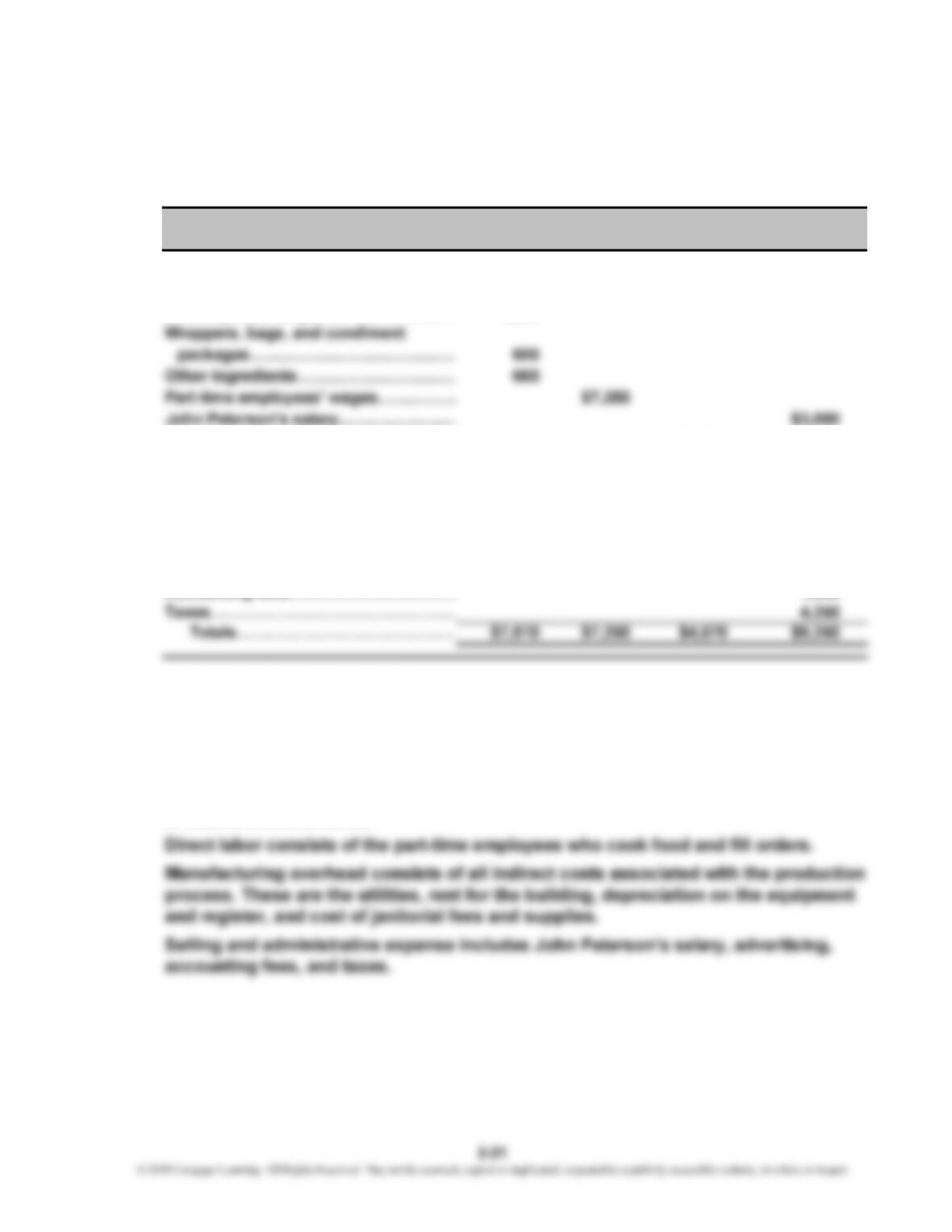
1. Direct Direct Manufact.
Materials Labo
r
Overhead
Hamburger meat…………………………
…
$4,500
Buns, lettuce, pickles, and onions……
…
800
Frozen potato strips……………………
…
1,250
Utilities……………………………………
…
$1,500
Rent………………………………………… 1,800
Depreciation, cooking equipment
and fixtures……………………………
…
600
Advertising………………………………
…
500
Janitor’s wages…………………………
…
520
Janitorial supplies………………………
…
150
…
Explanation of Classification
Direct materials include all the food items that go into a burger bag, as well as the
condiment packages and the wrappers and bags themselves. These materials go
“out the door” in the final product. “Other ingredients” might include the oil to fry
the potato strips and grease the frying surface for the hamburgers and the salt for
the fries. They are direct materials but could also be classified as overhead because
of cost and convenience.
Selling and
Administrative Cost
PROBLEMS
…
CHAPTER 2 Basic Managerial Accounting Concepts
P 2-51 (Concluded)
2.
Sales ($3.50 × 10,000)………………………………………………… $35,000
Less cost of goods sold:
Direct materials…………………………………………………
…
$7,810
3. Elena’s simplifying assumptions were:
(1) all part-time employees are production workers,
These make it easy to classify 100% of each expense as product cost or selling
and administrative cost. The result is that she does not have to perform studies
of the time spent by each employee on producing versus selling burger bags. In
addition, it is likely that John Peterson pitches in to help fry burgers or assemble
burger bags when things get hectic. Of course, during those times, he is engaged
in production—not selling or administration. The cost of determining just exactly
how many minutes of each employee’s day is spent in production versus selling
is probably not worth it. (Remember, accountants charge by the number of hours
spent—the more time Elena spends separating costs into categories, the higher
Pop’s Drive-Thru Burger Heaven
Income Statement
For the Month of Decembe
r
…
CHAPTER 2 Basic Managerial Accounting Concepts
P 2-52
1. Cost per Page for Black Ink = $25.50 = $0.03
850 pages
Total Owed to Harry by Mary = $0.03 × 500 pages = $15
Total Owed to Harry by Natalie = $0.03 × 1,000 pages = $30
3. Cost per Page for Color Ink = $31 = $0.10
310 pages
Number of Black Ink Pages for Natalie = 1,000 × 0.80 = 800
Number of Color Ink Pages for Natalie = 1,000 × 0.20 = 200
Total Owed to Harry by Natalie = ($0.03 × 800 pages) + ($0.10 × 200) = $44
Total Cost to Natalie = [($0.03 + $0.005) × 800 pages] + [($0.10 + $0.005)
× 200 pages] = $49
P 2-53
1. Direct Materials = $40,000 + $64,000 – $19,800 = $84,200
…
…
3. Cost of goods manufactured………………………………………………
…
$224,950
Finished goods inventory, July 1…………………………………………
…
23,200
Finished good inventory, July 31…………………………………………
…
(22,100)
Cost of goods sold………………………………………………………
…
$226,050
CHAPTER 2 Basic Managerial Accounting Concepts
P 2-54
1. Direct materials……………………………
…
$18
Direct labor…………………………………
…
12
Manufacturing overhead…………………
…
16
Unit product cost………………………
…
$46
Total Product Cost = $46 × 200,000 units = $9,200,000
2.
Sales revenue ($60 × 200,000)…………………………………………
…
$12,000,000
Cost of goods sold………………………………………………………
…
9,200,000
Gross margin……………………………………………………………
…
$ 2,800,000
Less:
3. The 10,000 tents in beginning finished goods inventory have a cost of $40, and
that is lower than the year’s unit product cost of $46. The FIFO assumption says
that beginning inventory is sold before current year production. Therefore, the
cost of goods sold will be lower than it would be if there were no beginning
inventory. This can be seen in the following statement of cost of goods sold.
Laworld Inc.
Income Statement
For Last Year
…
CHAPTER 2 Basic Managerial Accounting Concepts
P 2-54 (Concluded)
Sales revenue ($60 × 200,000)…………………………………………
…
$12,000,000
Cost of goods sold………………………………………………………
…
9,140,000
Gross margin………………………………………………………………
…
$ 2,860,000
P 2-55
1. Direct Materials = $3,475 + $15,000 – $9,500 = $8,975
Direct materials used…………………………………… $ 8,975
Direct labor………………………………………………
…
10,500
Manufacturing overhead:
Factory supplies……………………………………
…
$ 675
Factory insurance……………………………………
…
350
…
2.
Cost of goods manufactured……………………………………………
…
$24,725
…
…
For the Month of May
Hayward Company
Statement of Cost of Goods Manufactured
For the Month of May
Hayward Company
Revised Income Statement
For Last Year
Laworld Inc.
Statement of Cost of Goods Sold
…
CHAPTER 2 Basic Managerial Accounting Concepts
P 2-56
1. c. These costs include direct materials, direct labor, and manufacturing
overhead. The total of these three types of costs equals product cost.
2. a. If Linda returns to school, she will need to quit her job. The lost salary is the
opportunity cost of returning to school.
5. i. All factory costs other than direct materials and direct labor are, by definition,
overhead.
6. d. The design engineer is estimating the total number of labor hours required to
complete the manufacturing of a product. This total will be used to compute
direct labor cost.
7. h. This is direct materials cost.
8. g. The sum of direct materials and direct labor is, by definition, prime cost.
CHAPTER 2 Basic Managerial Accounting Concepts
P 2-57
1. Before COGM can be calculated, Direct Materials Used in Production must first be
calculated as:
Direct Materials Used in Production = Beginning Direct Materials Inventory +
Direct Materials Purchases – Ending Direct Materials Inventory
= $20,000 + $40,000 – $10,000
= $50,000
Now,
CHAPTER 2 Basic Managerial Accounting Concepts
P 2-57 (Concluded)
3.
Sales ($2,100 × 700)…………………………………………………………
…
$1,470,000
Cost of goods sold…………………………………………………………
…
930,000
Gross margin……………………………………………………………
…
$ 540,000
4. The dominant cost is direct labor cost of $800,000. Direct labor is the dominant
cost because Berry’s core business is creating building plans, which is a labor-
P 2-58
1.
Direct materials*…………………………………………
…
$300,000
Direct labor…………………………………………………
…
200,000
Manufacturing overhead:
Indirect labor…………………………………………… $40,000
Rent, factory building………………………………… 42,000
Depreciation, factory equipment…………………… 60,000
Utilities, factory………………………………………
…
11,900 153,900
Income Statement
Berry Company
Statement of Cost of Goods Manufactured
For Last Yea
r
For Last Yea
r
W. W. Phillips Company
…
CHAPTER 2 Basic Managerial Accounting Concepts
P 2-58 (Concluded)
2. Average Cost of One Unit of Product = $652,000 = $163
4,000
3.
Sales ($400 × 3,800*)……………………………….…………
…
$1,520,000
Cost of goods sold**…………………………………………
…
617,900
Gross margin…………………………………………………
…
$ 902,100
Less:
Selling expense:
*Units Sold = 4,000 + 500 – 700 = 3,800
** Cost of Goods Sold = $652,000 + $80,000 – $114,100 = $617,900
P 2-59
1. The Internet payment of $40 is an expense that would appear on the income
statement. This is because the Internet services are used up each month
—
Luisa
cannot “save” any unused Internet time for the next month.
W. W. Phillips Company
Income Statement
For Last Year
CHAPTER 2 Basic Managerial Accounting Concepts
P 2-60
1. Direct materials:
Magazine (5,000 × $0.40)…………………………………
…
$2,000
Brochure (10,000 × $0.08)…………………………………
…
800 $2,800
Direct labor:
Magazine (5,000/20 × $10)…………………………………
…
$2,500
Brochure (10,000/100 × $10)………………………………
…
1,000 3,500
*Production is 20 units per printing hour for magazines and 100 units per printing hour for
brochures, yielding monthly machine hours of 350 [(5,000/20) + (10,000/100)]. This is also
monthly labor hours as machine labor only operates the presses.
2. Direct materials…………………………………………………
…
$2,800
Direct labor………………………………………………………
…
3,500
Total prime costs……………………………………………
…
$6,300
Magazine:
Direct materials……………………………………………… $2,000
Direct labor…………………………………………………
…
2,500
Total prime costs………………………………………
…
$4,500
…
…
3. Total monthly conversion cost:
Direct labor…………………………………………………
…
$3,500
Manufacturing overhead…………………………………
…
3,190
Total………………………………………………………
…
$6,690
Magazine:
Direct labor…………………………………………………… $2,500
…
CHAPTER 2 Basic Managerial Accounting Concepts
P 2-60 (Concluded)
Brochures:
Direct labor………………………………………………
…
$1,000
Manufacturing overhead:
Power ($1 × 100)……………………………………… $100
Depreciation ($2 × 100)……………………………
…
200
Setups (1/3 × $600)…………………………………
…
200
Rent and insurance ($4.40 × 100 DLH)*…………
…
440 940
Total ………………………………………………
…
$1,940
4. Sales [(5,000 × $1.80) + (10,000 × $0.45)]………………
…
$13,500
Less cost of goods sold……………………………………
…
9,490
Gross margin…………………………………………………
…
$ 4,010
Less operating expenses:
Selling ……………………………………………………
…
$ 500 **
Administrative …………………………………………… 1,500 *** 2,000
…
CHAPTER 2 Basic Managerial Accounting Concepts
P 2-61
1. The costs of the tent sales are accounted for as selling expense. The tent
sales are designed to sell outdated or remanufactured products. They are
2. Revenue…………………………………………………………………
…
$ 20,000
Cost of goods sold……………………………………………………
…
(7,000)
Tent sale expense……………………………………………………
…
(14,300)
Tent sale loss………………………………………………………
…
$ (1,300)
A couple of actions could be taken. First, it could look for a more
CHAPTER 2 Basic Managerial Accounting Concepts
Case 2-62
1.
(DL) Machine operators Sales salaries
(DL) Other direct labor
A
dvertising
(OH) Supervisory salaries
(DM) Pipe
2. Traceable costs using equipment hours:
Machine operators…………………………
…
$ 218,000
Other direct labor…………………………… 265,700
Pipe……………………………………………
…
1,401,340
Machine operators, tires and fuel, and depreciation are all directly caused by
equipment usage, which is measured by equipment hours. One can also argue that
the amount of mechanic time required is also a function of equipment hours and so
the salaries of mechanics can be assigned using equipment hours. Pipe and other
direct labor can be assigned using equipment hours because their usage should
be highly correlated with equipment hours. That is, equipment hours increase
CASES
Production Selling
Administrativ
e
Utilities
Rent
CPA fees
Adm. salaries
CHAPTER 2 Basic Managerial Accounting Concepts
Case 2-63
1. Leroy should politely and firmly decline the offer. The offer includes an implicit
request to use confidential information to help Jean win the bid. Use of such
information for personal advantage is wrong. Leroy has a professional and
personal obligation to his current employer. This obligation must take
precedence over the opportunity for personal financial gain.
2. If Leroy agrees to review the bid, he will likely use his knowledge of his current
employer’s position to help Jean win the bid. In fact, agreement to help probably
would reflect a desire for the bonus and new job with the associated salary
increase. Helping would likely ensure that Jean would win the bid. Leroy was
concerned about the political fallout and subsequent investigation revealing
his involvement—especially if he sent up a red flag by switching to his friend’s
firm. An investigation may reveal the up-front bonus and increase the