
2-15
Vocabulary Quiz Name _______________
Chapter 2
1. Assets of a relatively permanent nature that are being used in the
business and are not intended for resale.
2. The quality of information that indicates the information makes a
difference in a decision.
3. A measure used to evaluate a company’s liquidity and short-term
debt-paying ability, computed by dividing current assets by current
liabilities.
4. A financial statement that presents the factors that caused
stockholders’ equity to change during the period, including those
things that caused retained earnings to change.
5. The constraint of determining whether an item is large enough to
likely influence the decision of an investor or creditor.
6. An assumption that economic events can be identified with a
particular unit of accountability.
7. Obligations that companies reasonably expected to pay within the
next year or operating cycle, whichever is longer.
8. Use of the same accounting principles and methods from year to
year within a company.
9. Cash provided by operating activities adjusted for capital
expenditures and dividends paid.
10. An accounting principle that states that companies should record
assets at their cost.
2-16
Solutions to Vocabulary Quiz
Chapter 2
1. Property, plant, and equipment, or fixed assets, or plant assets

2-17
Multiple Choice Name _______________
Chapter 2
1. Earnings per share is:
a. a measure of liquidity.
b. most meaningful when used to analyze the performance of different companies.
c. a measure of net income earned on each share of common stock.
d. determines the amount of dividends that a company pays.
2. Which of the characteristics is not necessary in order for accounting information to
provide faithful representation?
a. conservative.
b. free from error.
c. complete.
d. neutral.
3. Consistency of information means that:
a. the information would influence a decision.
b. different companies use the same accounting principles.
c. the amounts involved are material.
d. a company uses the same accounting principles and methods from year to year.
4. Comparability of information results when:
a. the information would influence a decision.
b. different companies use the same accounting principles.
c. the amounts involved are material.
d. a company uses the same accounting principles and methods from year to year.
5. The periodicity assumption:
a. indicates that the company will continue in operation long enough to carry out its
existing objectives.
b. requires that financial statements be prepared each month.
c. states that the life of a business can be divided into artificial time periods.
d. is an example of a constraint.
6. Current liabilities include:
a. obligations to be paid within the coming year.
b. accounts payable.
c. wages payable.
d. all of these answer choices are correct.
7. Working capital is:
a. current assets less current liabilities.
b. current assets divided by current liabilities.
c. income divided by average assets.
d. net income divided by net sales.

2-18
8. All of the following are current assets except:
a. accounts receivable.
b. cash.
c. patents.
d. marketable securities.
9. The current ratio is a:
a. solvency ratio.
b. profitability ratio.
c. liquidity ratio.
d. none of these answer choices are correct.
10. Free cash flow:
a. describes an unlimited supply of cash.
b. provides additional insight regarding a company’s cash-generating ability.
c. describes the cash remaining from operations after adjusting for capital expendi–
tures and dividends.
d. Both provides additional insight regarding a company’s cash-generating ability
and describes the cash remaining from operations after adjusting for capital
expenditures and dividends.

2-19
Solutions to Multiple Choice
Chapter 2
1. c
2-20
Exercise 1 – Research and Communication Activity
Chapter 2
Blaire and Mark married last year and immediately opened a small computer business. Blaire
is responsible for managing the business while Mark is responsible for the accounting. At the
end of each month, Mark tells Blaire that the business is earning a profit. Blaire, however, is
very frustrated and skeptical. She calls the bank periodically and much to her amazement, the
business has no more money in the checking account than it did on the opening day. Blaire
and Mark heard that you were taking an accounting course at a local university and have come
to you, a friend, for help.
Write a memo to the young entrepreneurs explaining how it is indeed possible to have a net
income and not have an increase in cash.
Solution:
DATE: 9/5/201X
TO: Blaire and Mark
FROM: Accounting Student
2-21
Exercise 2 – Financial Statement Analysis and Decision Making Activity
Chapter 2
Select two competing companies (i.e. Ford—GM, Eli Lilly—Merck, Ben & Jerry’s—Edy’s), and
locate annual reports for these companies on the internet. These companies can be found on
the Internet at http://www.ford.com, http://www.gm.com, http://www.elililly.com,
http://www.merck.com, http://www.benjerry.com, and http://www.edys.com.
1. Compute the current ratio, debt to total assets ratio, and free cash flow for the
companies you have selected. Discuss your findings.
2. Which company would you recommend as an investment?
3. Why did you answer Question 2 as you did? Have you considered the issues presented
in the Decision Toolkits in Chapter 2? Explain how this affected your recommendation.

2-22
Exercise 3 – Ratio Analysis and Creative Activity
Chapter 2
Refer to the loan application prepared for your fictitious business in Campus Town USA in
Exercise 3 of Chapter 1 in answering the following questions:
1. Compute the current ratio and debt to total assets ratio for your fictitious company.
2. Would you like to amend the financial statements prepared in chapter 1? Additional loan
application forms are provided for your convenience.

2-23
Exercise 3 – Ratio Analysis and Creative Activity (Continued)
Chapter 2
LOAN APPLICATION FORM
Name of Company
Address
Phone Number
Annual Income
Revenues
Cost of goods sold
Operating expenses
Rent
Utilities
Wages
Advertising
Other
Net income (loss)
Assets
Cash
Accounts receivable
Inventory
Property, plant, & equipment
Other
Total assets
Liabilities
Accounts payable
Notes payable
Other
Total liabilities
Stockholders’ Equity
Total stockholders’ equity
Total liabilities & stockholders’ equity

2-24
Exercise 4 – Financial Statements and Creative Activity
Chapter 2
1. Prepare personal financial statements, including an income statement and a balance
sheet. Remember to include all of your sources of revenues; income from jobs,
allowance from parents, etc. In addition, please consider all of your assets, clothes,
jewelry, automobiles, electronic equipment, etc.
2. Keep a record of your income and expenses for a month.
3. At the end of the month, prepare financial statements, including an income statement,
balance sheet, and a statement of cash flows.
2-25
Exercise 5 – Financial Statements and Creative Activity
Chapter 2
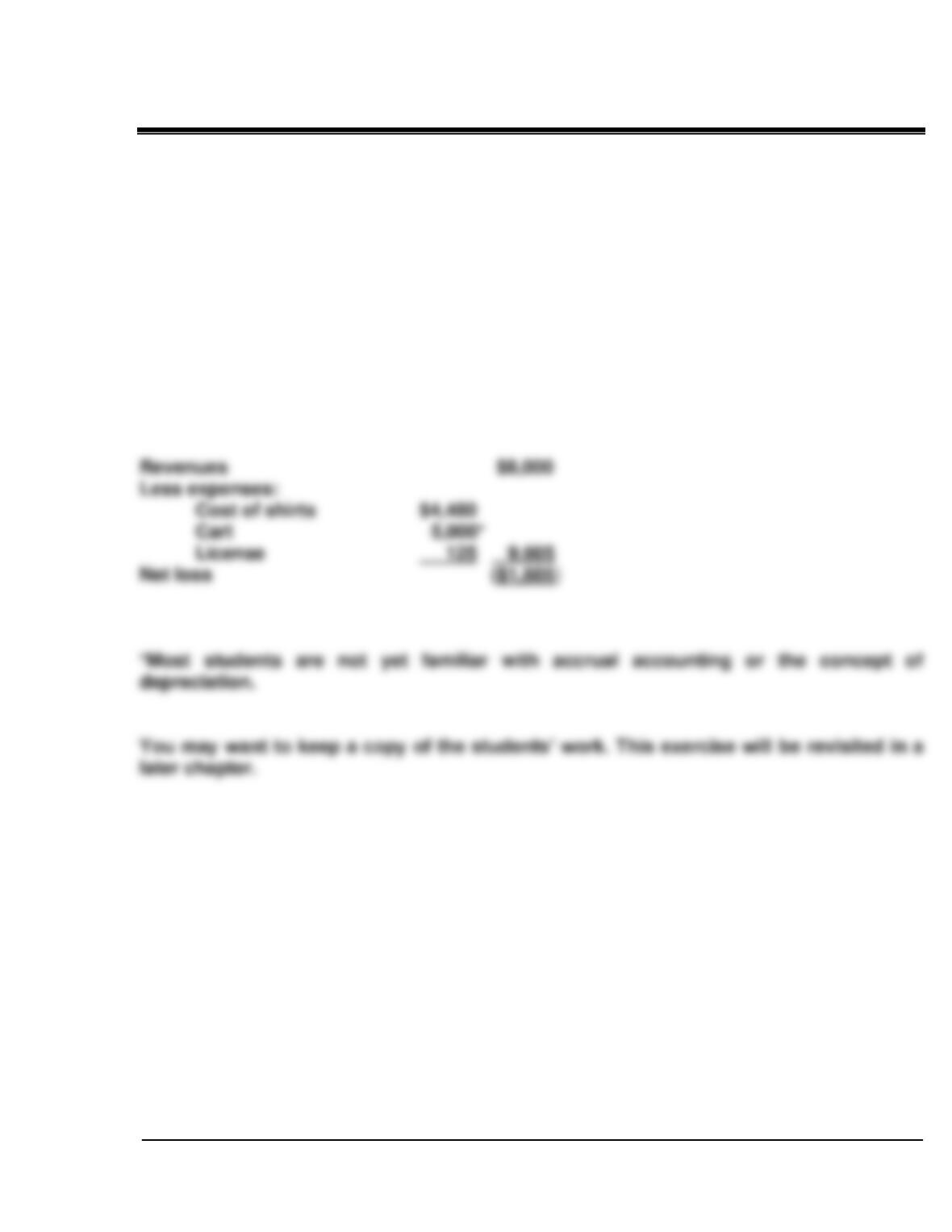
The Ice Cats, a professional ice hockey team moved to College Town USA. Joe Enterprise,
organized Joe’s Tees to take advantage of the large number of fans the team attracted by
selling tee shirts with the team’s name and logo printed in the team’s colors. Joe sold the shirts
from a cart in front of the arena where the Ice Cats perform. Joe bought the cart for $5,000.
Joe anticipates the cart will last for five years. The shirts cost $14 and Joe sold them for $25.
In addition, Joe is required to buy a city license for $125.
During the first season, there were 10 home games at which Joe averaged selling 32 shirts a
game. Compute Joe’s net income or net (loss).
Solution:
2-26
Exercise 6 – World Wide Web Research, Financial Statement Analysis, and
International Activity
Chapter 2
Select two competing companies, one a domestic company, the other a foreign company (i.e.
Nike—Fila and ExxonMobil—BP), and locate annual reports for these companies on the
internet. These companies can be found at http://www.nike.com, http://www.fila.com,
http://www.exxon.com, and http://www.bp.com.
1. Where are the headquarters for the two companies you selected?
2. In what currency are the financial statements of the foreign company stated?
3. How are the financial statements similar? How are the financial statements different?

2-27
Exercise 7 – Accounting Career Activity
Chapter 2
Public accounting is one of the largest sectors of the accounting field. In order to retain a job in
public accounting, one must become a Certified Public Accountant (CPA). An accountant may
be designated a CPA only after he or she has passed a uniform exam and has met the
experience requirements of the state in which they are certified. The American Institute of
Certified Public Accountants is responsible for administering the CPA exam. Visit the AICPA at
http://www.aicpa.org and click on Students to find answers to the following questions.
1. What is a CPA? What are the requirements to become a CPA?
2. What are the recommended areas of study to become a CPA?
3. What skills are needed to become a successful accountant/CPA?
4. What are the different career paths in accounting?
2-28
Exercise 8 – World Wide Web Financial Research Activity
Chapter 2
Johnson & Johnson is an international company committed to social responsibility. Visit
Johnson & Johnson at http://www.johnsonjohnson.com and click on our Company and Our
Credo values.
1. Provide a brief summary outlining Johnson & Johnson’s executives’ position on social
responsibility.
2. List specific examples of social programs in which Johnson & Johnson is involved.