Ethical Obligations and Decision Making in Accounting, 4/e 1
Major Case 2 Royal Ahold N.V. (Ahold)
Summary of Court Ruling
The U.S. Court of Appeals for the Fourth Circuit affirmed the lower court ruling in the case
Public Employees’ Retirement Association of Colorado; Generic Trading of Philadelphia, LLC
v. Deloitte & Touche, LLP that Deloitte defendants lacked the necessary scienter to conclude that
they knowingly or recklessly perpetrated a fraud on Ahold’s investors.
The Appeals Court found that Deloitte, like the plaintiffs, were victims of Ahold’s fraud rather
than its enablers. In its decision, the court relied on the PSLRA and the decision in Tellabs.
Circuit Judge Wilkinson wrote the conclusion for the court. The court ruling will be explained
later on.
ERISA Class Action Settlement
Class action lawsuits are common in cases such as Ahold where dozens of separate private class
action securities are combined. In this case the Employee Retirement Income Security Act of
1974 (ERISA) actions were filed against Ahold, Deloitte, and other defendants. On June 18,
2003, the Judicial Panel on Multidistrict Litigation transferred these actions to the U.S. District
Summary of Accounting Fraud
Beginning in the 1990s, and continuing until 2003, Ahold and USF perpetrated frauds that led it
to overstate its earnings on financial reports significantly:
• Ahold improperly “consolidated” the revenue from a number of joint ventures (JVs) with
supermarket operators in Europe and Latin America. That is, for accounting purposes,
Ahold treated these JVs as if it fully controlled them—and thus treated all revenue from
the ventures as revenue to Ahold—when in fact, Ahold did not have a controlling stake.
Ethical Obligations and Decision Making in Accounting, 4/e 2
had been overstated by at least $500 million as a result of the fraudulent accounting for
promotional allowances at USF, and that Ahold would be restating revenues because it
would cease treating the joint ventures as fully consolidated. After this announcement,
Ahold common stock trading on the Euronext stock exchange and Ahold American
Ahold Fraud—Joint Ventures
With respect to the JV fraud, both Deloittes advised Ahold on the consolidation of the joint
ventures. Five joint ventures were at issue in this litigation: JMR, formed in August 1992;
Bompreço, formed in November 1996; DAIH, formed in January 1998; Paiz-Ahold, formed in
December 1999; and ICA, formed in February 2000. Ahold had a 49 percent stake in JMR and a
50 percent share of each of the other ventures at their respective times of formation. Prior to
Ahold began consolidating the joint ventures as they were formed. The various JV agreements
did not indicate that Ahold controlled the ventures. For example, the JMR joint venture
agreement specified that decisions would be made by a board of directors, “deciding
unanimously,” and that the board would consist of three members appointed by Ahold and four
members appointed by JMH, Ahold’s partner in the venture. However, Ahold represented to
Ethical Obligations and Decision Making in Accounting, 4/e 3
partner in the Bompreço joint venture. The letter stated that the parties agreed that if they were
unable to reach a consensus on a particular issue, “Ahold’s proposal to solve that issue will in the
end be decisive.” After reviewing the draft letter, Deloitte Netherlands advised Ahold that if
At this point, Deloitte Netherlands and Deloitte U.S. began trying to get Ahold to obtain an
amendment to the shareholder agreement in order to justify ongoing consolidation. At a February
14, 2003, meeting, Deloitte Netherlands and Deloitte U.S. told Ahold that Ahold lacked the
necessary control for consolidation. On February 22, 2003, Ahold revealed to Deloitte
USF Fraud—Promotional Allowances
Ahold acquired USF in early 2000. Prior to the acquisition, Deloitte U.S. participated in Ahold’s
due diligence on USF. In a February 2000 memo, Deloitte U.S. noted that USF’s internal system
for recording promotional allowances received was weak because it heavily relied on vendors’
figures, and that the system could “easily result in losses and in frauds.” Deloitte U.S. also noted
in the memo that USF’s use of value-added service providers, special-purpose entities that
bought products from vendors and then resold them to USF for a higher price, needed to be
evaluated for their “tax and legal implications and associated business risks.”
After Ahold’s acquisition of USF was finalized, Deloitte U.S. became USF’s external auditor.
When performing an opening balance sheet audit of USF, Deloitte U.S. discovered that a USF
division in Buffalo, New York, had been fraudulently accounting for PA income. This fraud
required a restatement of $11 million of PA income. USF also downwardly adjusted its income
2001.
Auditing Issues
Because USF lacked an internal auditing department, in April 2000, Ahold hired Deloitte U.S. to
perform internal auditing services at USF. The internal auditors did not report to the Deloitte
U.S. external auditors. Instead, they reported initially to Ahold USA’s internal audit director and,
In a February 5, 2001, draft report, van Cleave described how management’s failure to produce
requested documents resulted in her inability to complete some of the goals of the audit. Grubel
instructed van Cleave to soften the report’s language, and the version submitted to Michael
Resnick, director of USF’s Internal Audit Department, simply stated that Deloitte U.S. “was
unable to obtain supporting documentation for some of the promotional allowance sample
items,” without more specifically detailing management’s failures and lack of cooperation.
In its February 2003 external audit for 2002, Deloitte U.S. discovered through the PA
confirmation process that USF had been inflating its recorded PA income. An investigation
ensued. Ultimately, USF’s former chief marketing officer (CMO), Mark Kaiser, was convicted
PSLRA: Fraud and Scienter
In passing the PSLRA in 1995, Congress imposed heightened pleading requirements for private
securities fraud actions. As a general matter, heightened pleading is not the norm in federal civil
procedure. Frequently stated reasons include protecting defendants’ reputations from baseless
particularity facts giving rise to a strong inference that the defendant acted with the required state
of mind.” Complaints that do not plead scienter adequately are to be dismissed.
Because the PSLRA did not define “a strong inference,” the courts of appeals disagreed on how
much factual specificity plaintiffs must plead in private securities actions. The Supreme Court
resolved that issue in Tellabs, in which the Court prescribed the following analysis for Rule
12(b)(6) motions to dismiss Section 10(b) actions:
• First, courts must, as with any motion to dismiss for failure to plead a claim on which
relief can be granted, accept all factual allegations in the complaint as true.
• Second, courts must consider the complaint in its entirety, as well as other sources that
courts ordinarily examine, when ruling on Rule 12(b) motions to dismiss. The inquiry, as
Legal Reasoning
The “strong inference” requirement and the comparative analysis of inferences still leave
unanswered the question of exactly what state of mind satisfies the scienter requirement of a
10b-5 action. In Ernst & Ernst v. Hochfelder, the Supreme Court held that a plaintiff must show
that the defendant possessed the “intent to deceive, manipulate, or defraud” in an action brought
under Rule 10b-5 of the Securities and Exchange Act of 1934. However, the Court never made
clear what mental state suffices to meet this requirement. (“We need not address here the
Thus, the court ruled, the question is whether the allegations in the complaint, viewed in their
totality and in light of all the evidence in the record, allow us to draw a strong inference, at least
for consolidation. The thrust of their argument was that the control letters and Ahold’s oral
representations were insufficient evidence of control under Dutch and U.S. GAAP. Thus, they
argued, the defendants were complicit in the fraud. According to the plaintiffs, the secret side
letters, in which the JV partners contradicted Ahold’s interpretations of the JV agreements in the
control letters, were irrelevant because the control letters themselves did not amend the JV
control from Ahold. Indeed, as the district court noted, it may have been negligent for the
defendants to accept as the only evidence of control Ahold’s repeated representations that it
controlled JMR, the one joint venture for which Ahold never produced a control letter.
Nonetheless, the evidence as a whole leads to the strong inference that defendants were deceived
by their clients into approving the consolidation. Ahold would not have needed to go out of its
which “requires more than a misapplication of accounting principles.”
The court then examined the PA fraud. The plaintiffs argued that Deloitte U.S. was knowingly
complicit in the fraud when it ignored several red flags, including USF’s lack of internal controls
to track PA income and USF management’s obstruction of the internal audit and the facts and the
circumstances of USF CFO Ernie Smith’s resignation. With respect to USF’s problems with
be said that it was anything but proper to attempt to check the accuracy of representations made
by USF management.
The plaintiffs attempted to suggest that the confirmation process was unsound because, for
example, Deloitte U.S. accepted confirmation letters via fax and the letters were sent to brokers
or sale executives instead of financial officers. But even if the confirmation process was
internal audit, the internal auditors reported not to the Deloitte U.S. external auditors but to USF,
as was consistent with professional standards.
The rest of the supposed red flags pointed to by the plaintiffs also failed to create a strong
inference of scienter. With respect to the plaintiffs’ allegations that Smith told Deloitte U.S.
Conclusion
“Seeing the forest as well as the trees is essential.” With respect to both frauds, the plaintiffs
pointed to ways that the defendants could have been more careful and perhaps discovered the
frauds earlier. But the plaintiffs could not escape the fact that Ahold and USF went to
considerable lengths to conceal the frauds from the accountants and that it was the defendants
that ultimately uncovered the frauds. The strong inference to be drawn from this fact is that
Deloitte U.S. and Deloitte Netherlands lacked the requisite scienter and instead were deceived by
Ahold and USF. That inference is significantly more plausible than the competing inference that
defendants somehow knew that Ahold and USF were defrauding their investors.
The court reiterated that it is not an accountant’s fault if its client actively conspires with others
in order to deprive the accountant of accurate information about the client’s finances. It would be
Ethical Obligations and Decision Making in Accounting, 4/e 8
Questions
1. The court found that Deloitte should not be held liable for the efforts of the client to
deprive the auditors of accurate information needed for the audit and masking the
true nature of other evidence. Still, the facts of the case do raise questions about
whether Deloitte compromised its ethical and professional responsibilities in
accepting evidence and explanations provided by the client for the joint venture and
promotional allowance transactions. Identify those instances and explain why you
believe ethical and professional standards may have been violated.
In the JV fraud, Deloitte advised Ahold on the consolidation of the joint ventures and
consolidation of revenue under Dutch and U.S. GAAP. A memo explained that control of a
joint venture is required for consolidation of a venture’s revenues; control could be shown by
a majority of voting interest, a large minority in certain circumstances, or by a contractual
agreement. In 1999 to 2000, in response to Deloitte’s requests Ahold obtained “control
letters” countersigned by the joint ventures partners giving control to Ahold if consensus was
reached by the venture partners. In October 2002 Deloitte learned of a “side letter”
contradicting the control letters in one of the joint ventures. In early 2003, Ahold revealed to
Deloitte that side letters existed for all the joint ventures. It is possible in the JV fraud that
Ethical Obligations and Decision Making in Accounting, 4/e 9
2. Evaluate the decisions made by Deloitte from an ethical reasoning perspective
including the effects of its decisions on the stakeholders.
Deloitte had a duty and obligation of independence, objectivity, skepticism, due care, and
competence in conducting the audit. From a utilitarian perspective, the interests of all
stakeholders (public, investors, creditors, employees, and regulators) should have been
considered but were not. The auditors emphasized the client’s self-interests throughout
(stage 3), which were perceived to be in the firm’s interests (stage 2).
Using rule-utilitarianism, GAAP and GAAS should be followed and interpretations made
by adhering to the spirit, not only the letter, of the rules. Any attempt to rationalize its
actions from an act-utilitarianism perspective ignores the ethical point that rules should
never be violated regardless of any utilitarian benefits to the stakeholders. From a justice
3. The Ahold case is an example of how the courts have, sometimes, ruled more
liberally with respect to auditors’ legal obligations since the passage of the PSLRA.
In the wake of Enron, WorldCom, Adelphia, and other high-profile securities
frauds, critics suggest that the law made it too easy to escape liability for securities
fraud and thus created a climate in which frauds are more likely to occur. Comment
on that statement with respect to the fraud at Royal Ahold. Do you support the
more liberal interpretation of proportional liability under the PSLRA versus the
previous stricter standard under joint-and-several liability?
Prior to passage of the PSLRA that established a proportional liability standard (a party
would be held legally liable only for their portion of the fraud/loss), the joint and several
liability principle provided that each negligent party could be held liable for the total of
damages suffered, even though it was deemed responsible for only a small portion of the
were also involved in the fraud. Ask students whether this may create an environment
where auditors are less likely to go the extra mile to ferret out fraud. Proportional
liability reduces accountants’ liability exposure.
There is no evidence that auditors have been less diligent since passage of the PSLRA. It
would seem unprofessional to approach difficult issues with a client in an audit of financial
statements with an attitude that since our liability is limited, we can give this one to the
client. Auditors have to apply appropriate standards before making such a decision including
the assessment of materiality.
Extended Discussion
This is a good case to extend the discussion about auditor legal liability to include limiting
liability through various regimes. A good paper on this matter is by Nili Karako-Eya, in The
Rutgers Business Law Review, Vol. 10 No. 1 Spring 2013. What follows is selected
discussion material from the paper.
1
Currently, auditor liability is limited in approximately thirty-three countries. Liability is
limited via one or more of the following methods: contractual stipulations; setting a
statutory compensation cap; adopting a proportionate liability rule; or permitting association
of accountants in a limited liability corporation. Eleven countries out of the thirty-three with
limited auditor liability use a statutory cap.
Ethical Obligations and Decision Making in Accounting, 4/e 11
added), this cap has the following impact. Where the defendant’s proportionate share in the
compensation exceeds or is equivalent to the cap, he/she cannot be charged for a sum
higher than the cap even if the other “tortfeasors” are unavailable to pay. When the
defendant’s proportionate share in the compensation does not exceed the cap, the injured
party can collect compensation from him/her to the cap limit (because of the joint and
several liability rule). Thereafter, the defendant can collect from the remaining tortfeasors a
sum between his proportionate share of compensation and the cap limit.
One or more of the following criteria can be used to calculate the cap
• Setting a fixed, uniform sum that would apply in all cases;
• The type or size of company under audit. When the cap is set according to the type of
company, the possible categories are as follows: listed companies, unlisted companies and
public-interest entities (such as banks and insurance companies). When the cap amount is
set according to company size, the following criteria can be used to determine its size:
equity, market capitalization, net turnover, total annual revenue, total assets, and the
average number of employees during the fiscal year; or
• The audit fee received by the auditor. This alternative requires an answer to an
Ethical Obligations and Decision Making in Accounting, 4/e 12
for audit services in the relevant fiscal year; and finally, a function of the total fee (for
audit and non-audit services) received by the auditor (from a specific client or all of
clients) in the relevant fiscal year.
With a given criterion for setting the cap, a method for applying the cap must be
determined; the options for applying the cap are as follows:
• The cap is applied separately to each successful claim against the auditor
• The cap is applied to all successful claims against the auditor in a calendar year, even if
they are for different actions or omissions; or
The high number of possible methods for setting as well as applying a cap and the necessity
for approximating the cap limit raise the question, “What are the relevant considerations in
deciding such issues?”
Optional Question
This is a good question to add to the case for those faculty covering chapter 6 as part of
the course.
4. Explain the legal liability of auditors under SEC regulations and the Telltabs ruling
relied on by the Court. Include in your discussion how scienter is determined. Do you
agree with the commission’s conclusion that the Deloitte auditors did not violate their
legal obligations to shareholders? Why or why not?
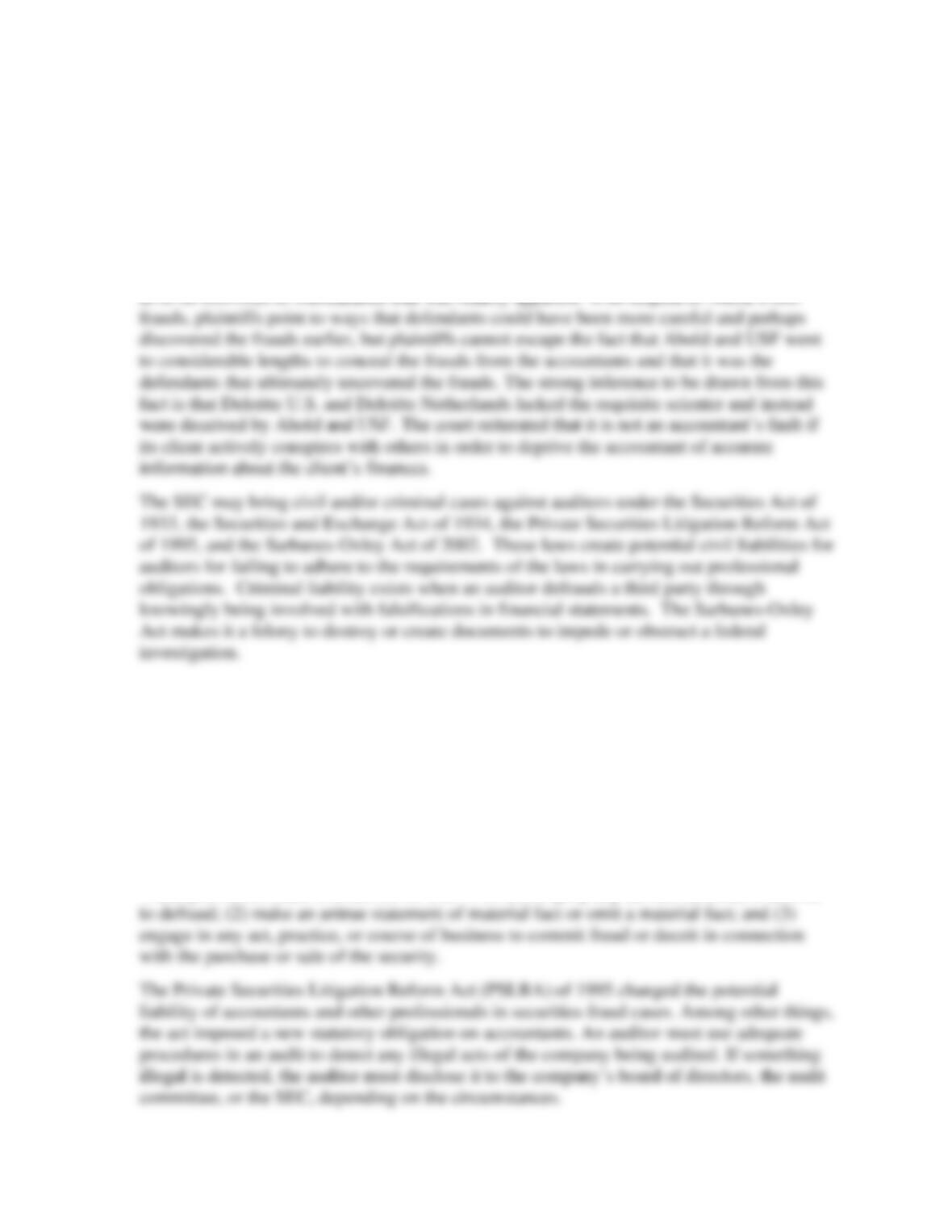
In Tellabs, the Court prescribed the following analysis for Rule 12(b)(6) motions to dismiss
Section 10(b) actions:
Ethical Obligations and Decision Making in Accounting, 4/e 13
• Third, in determining whether the pleaded facts give rise to a “strong” inference of scienter,
the court must take into account plausible opposing inferences. The inference of scienter
must be more than merely “reasonable” or “permissible” — it must be cogent and compelling,
thus strong in light of other explanations.
In order to establish a strong inference of scienter, plaintiffs must do more than merely
demonstrate that defendants should or could have done more. They must demonstrate that the
Deloitte auditors were either knowingly complicit in the fraud, or so reckless in their duties
Section 11 of the Securities Act of 1933 imposes a liability on issuer companies and others,
including auditors, for losses suffered by third parties when false or misleading information
is included in a registration statement. Any purchaser of securities may sue; the purchaser
generally must prove that: (1) the specific security was offered through the registration
statements; (2) damages were incurred; and (3) there was a material misstatement or
omission in the financial statements included in the registration statement. The plaintiff need
not prove reliance on the financial statements unless the purchase took place after one year of
the offering.
The liability of auditors under the 1934 Act often centers on Section 10 and Rule 10b-5.
These provisions make it unlawful for a CPA to: (1) employ any device, scheme, or artifice
Ethical Obligations and Decision Making in Accounting, 4/e 14
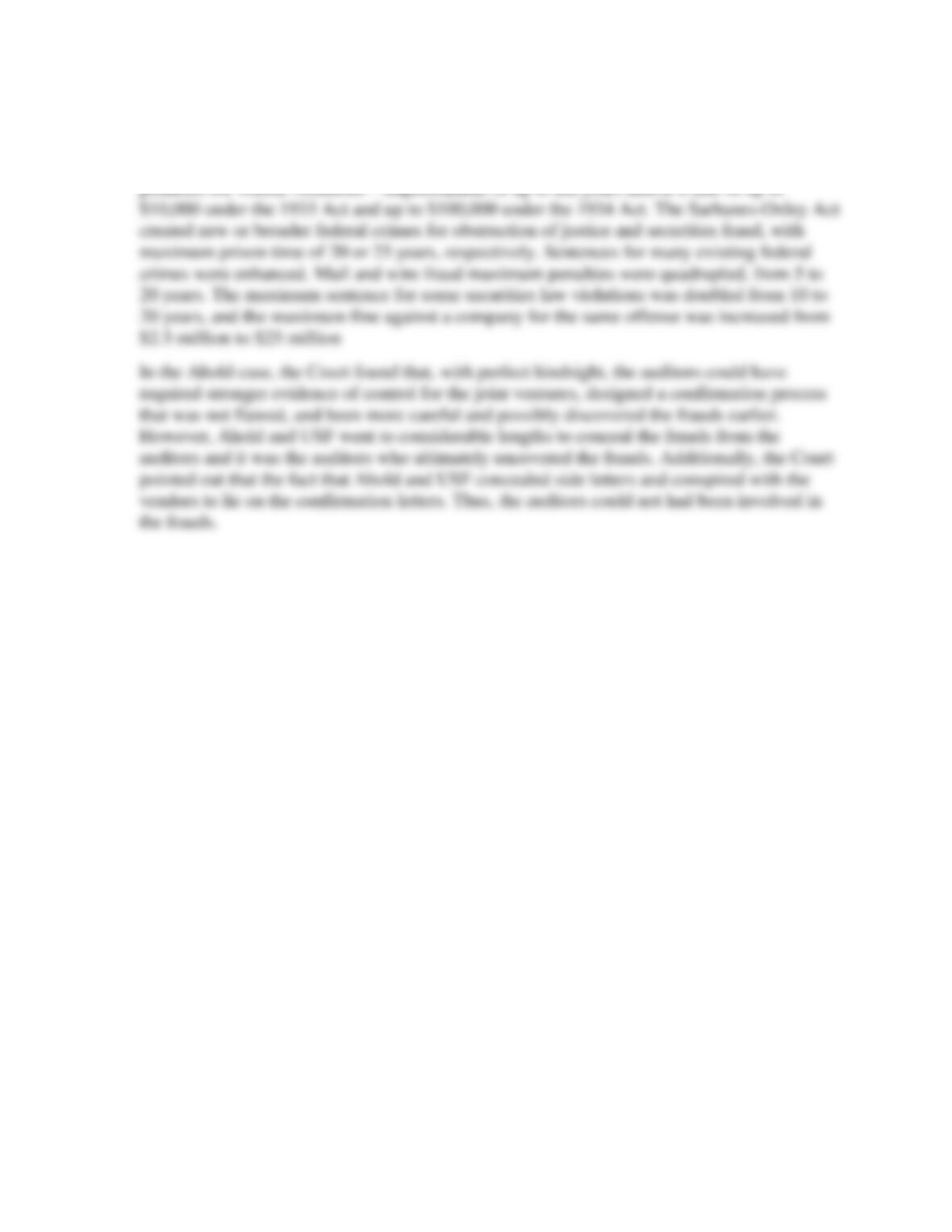
An accountant may be found criminally liable for violations of the Securities Acts of 1933
and the Securities Exchange Act of 1934, the Internal Revenue Code, and state and federal
criminal codes. Under both the 1933 and 1934 Acts, accountants may be subject to criminal