Chapter 2
Job-Order Costing: Calculating Unit Product
Costs
Questions
2-1 Job-order costing is used in situations
where many different products, each with individ-
ual and unique features, are produced each pe-
riod.
2-2 In absorption costing, all manufacturing
costs, both fixed and variable, are assigned to
units of product—units are said to
fully absorb
manufacturing costs
. Conversely, all nonmanufac-
turing costs are treated as period costs and they
2-4 Unit product cost is computed by taking
the total manufacturing costs assigned to a job
and dividing it by the number of units contained
in the job.
2-5 The first step is to estimate the total
amount of the allocation base (the denominator)
that will be required for next period’s estimated
level of production. The second step is to esti–
When a job is completed, the job cost sheet is
used to compute the unit product cost.
2-7 Some production costs such as a factory
manager’s salary cannot be traced to a particular
product or job, but rather are incurred as a result
of overall production activities. In addition, some
production costs such as indirect materials cannot
be easily traced to jobs. If these costs are to be
assigned to products, they must be allocated to
overhead rates more frequently to get around this
problem, the rates may fluctuate widely due to
seasonal factors or variations in output. For this
reason, most companies use predetermined over-
head rates to apply manufacturing overhead costs
to jobs.
2-9 The measure of activity used as the allo-
cation base should drive the overhead cost; that
is, the allocation base should cause the overhead
2-12 When a company applied less overhead
to production than it actually incurs, it creates
what is known as underapplied overhead. When it
applies more overhead to production than it actu-
ally incurs, it results in overapplied overhead.
plantwide rates to more appropriately allocate
overhead costs among products. Multiple over-
head rates should be used, for example, in situa-
tions where one department is machine intensive
and another department is labor intensive.
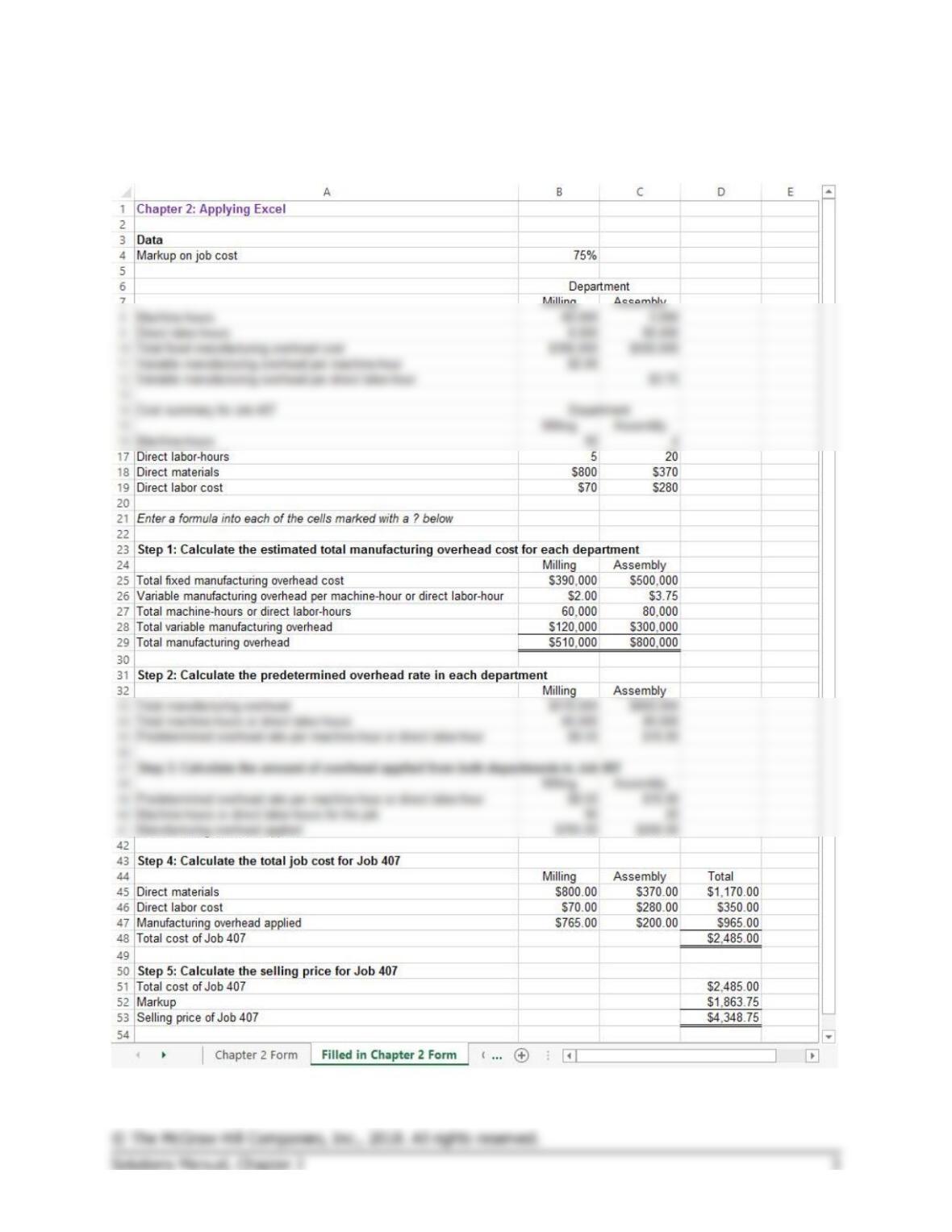
Chapter 2: Applying Excel
The completed worksheet is shown below.
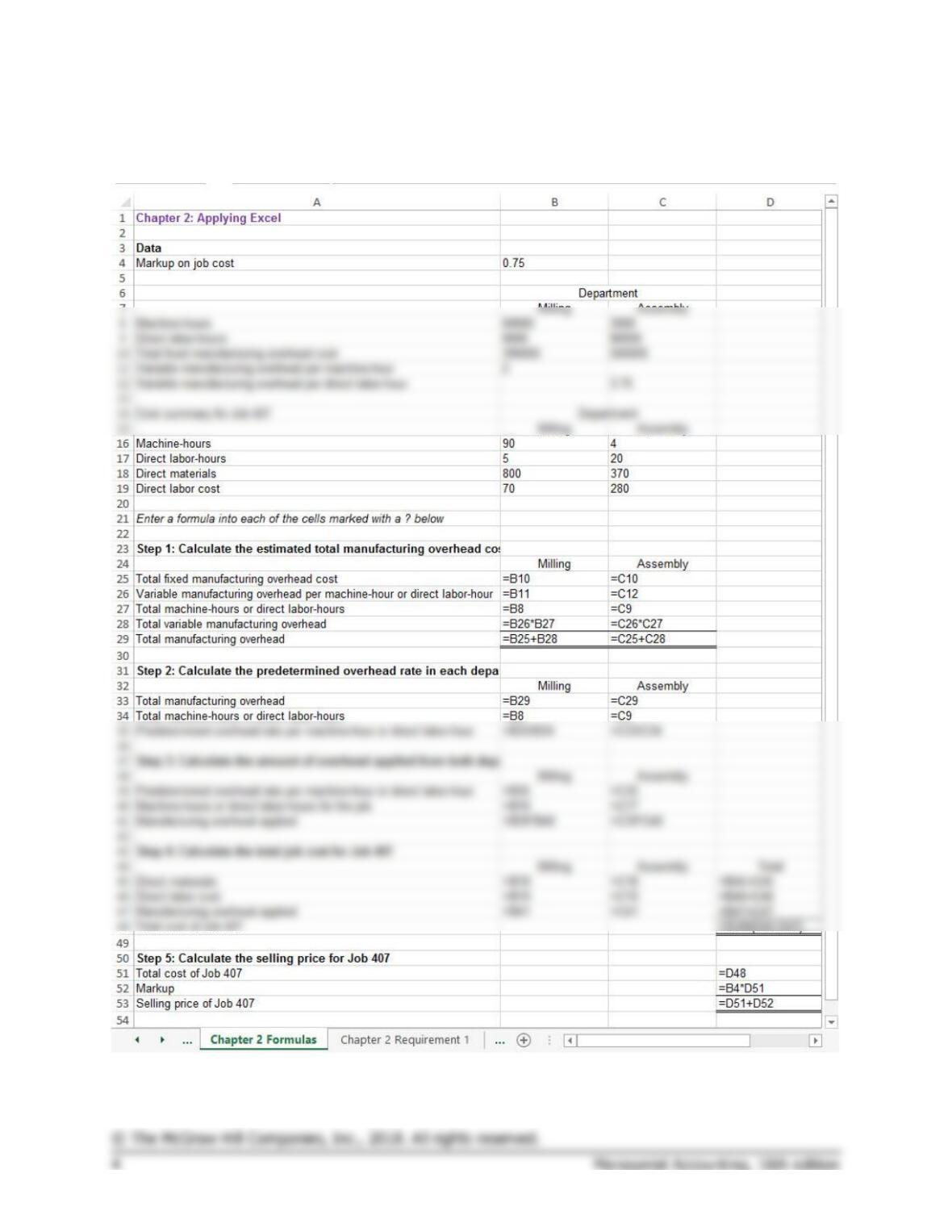
Chapter 2: Applying Excel (continued)
The completed worksheet, with formulas displayed, is shown below.

Chapter 2: Applying Excel (continued)
[Note: To display formulas in Excel 2013, select File > Options > Advanced
> Display options for this worksheet > Show formulas in cells instead of
their calculated amounts. To display the formulas in other versions of Ex-
cel, consult Excel Help.]
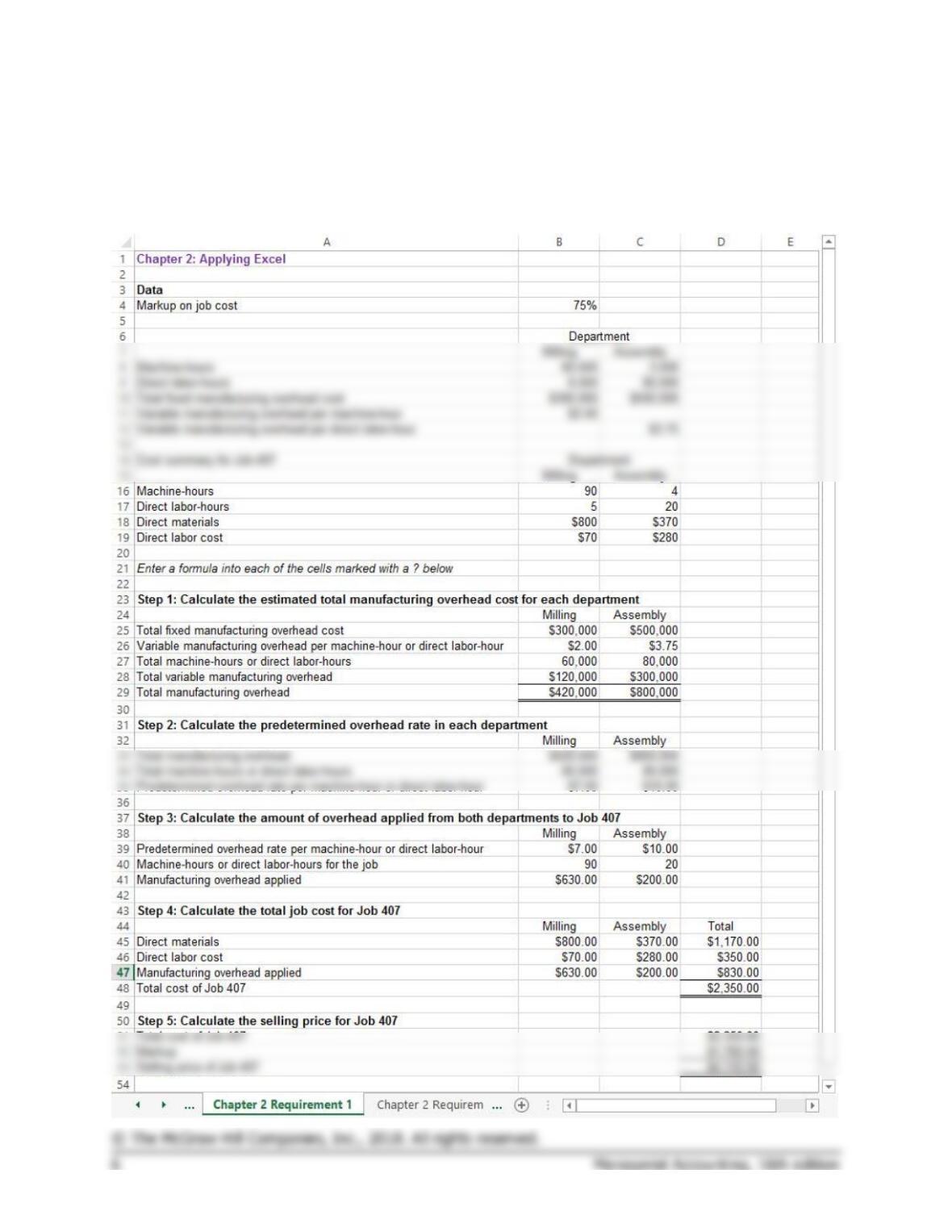
Chapter 2: Applying Excel (continued)
1. When the total fixed manufacturing overhead cost for the Milling De-
partment is changed to $300,000, the worksheet changes as shown be-
low:
Chapter 2: Applying Excel (continued)
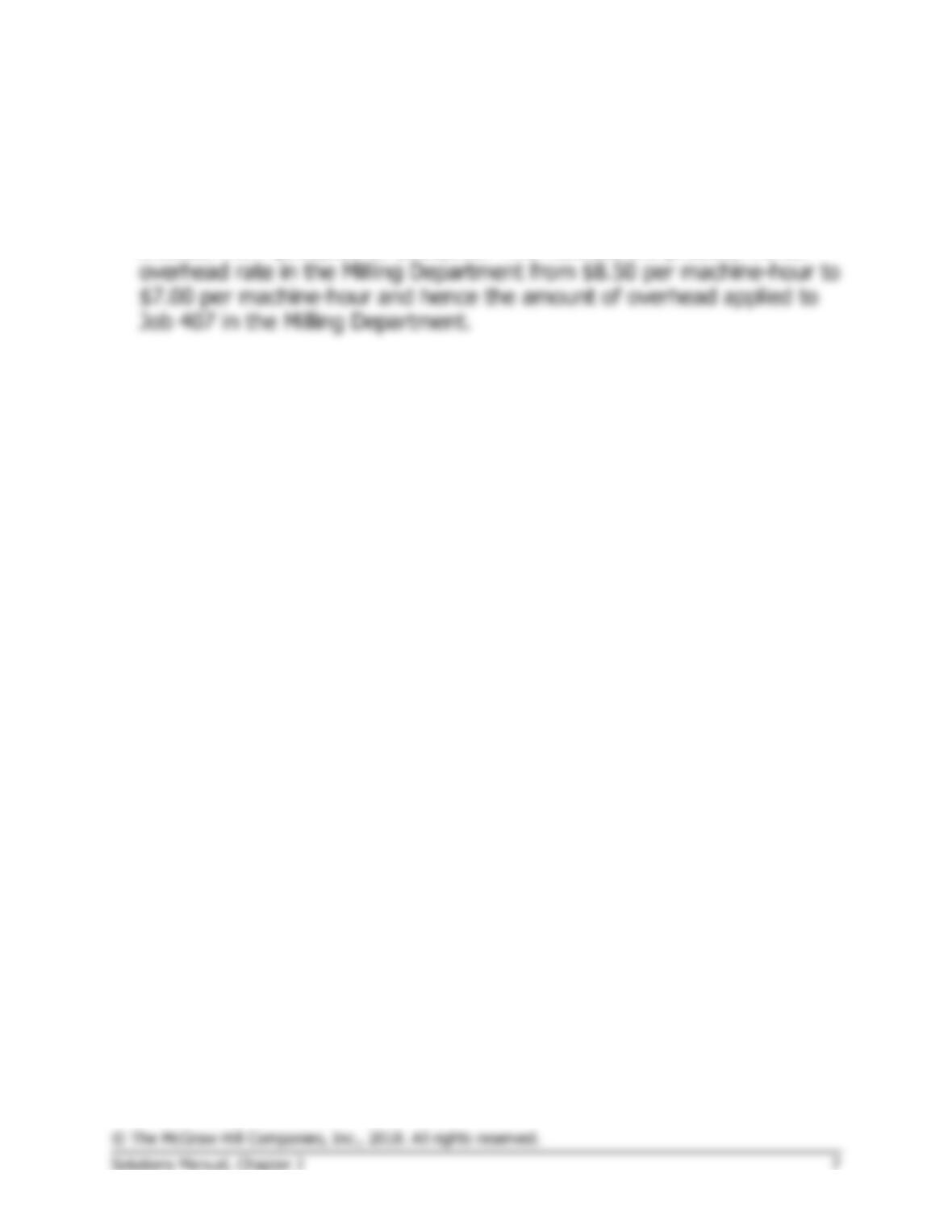
The selling price of Job 407 has dropped from $4,348.75 to $4,112.50
because the fixed manufacturing overhead in the Milling Department de-
creased from $390,000 to $300,000. This reduced the predetermined
Chapter 2: Applying Excel (continued)
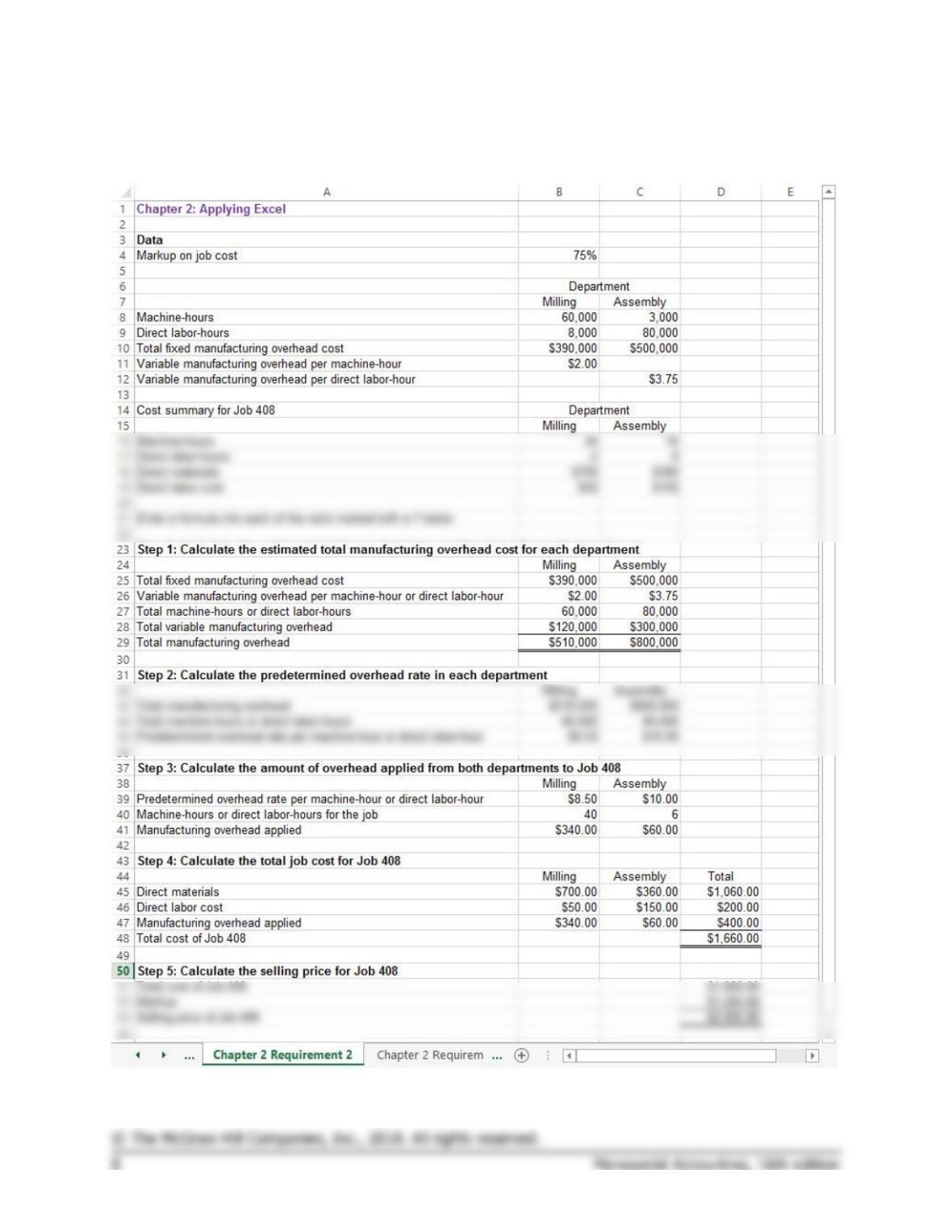
2. For the new Job 408, the worksheet should look like the following:
Chapter 2: Applying Excel (continued)
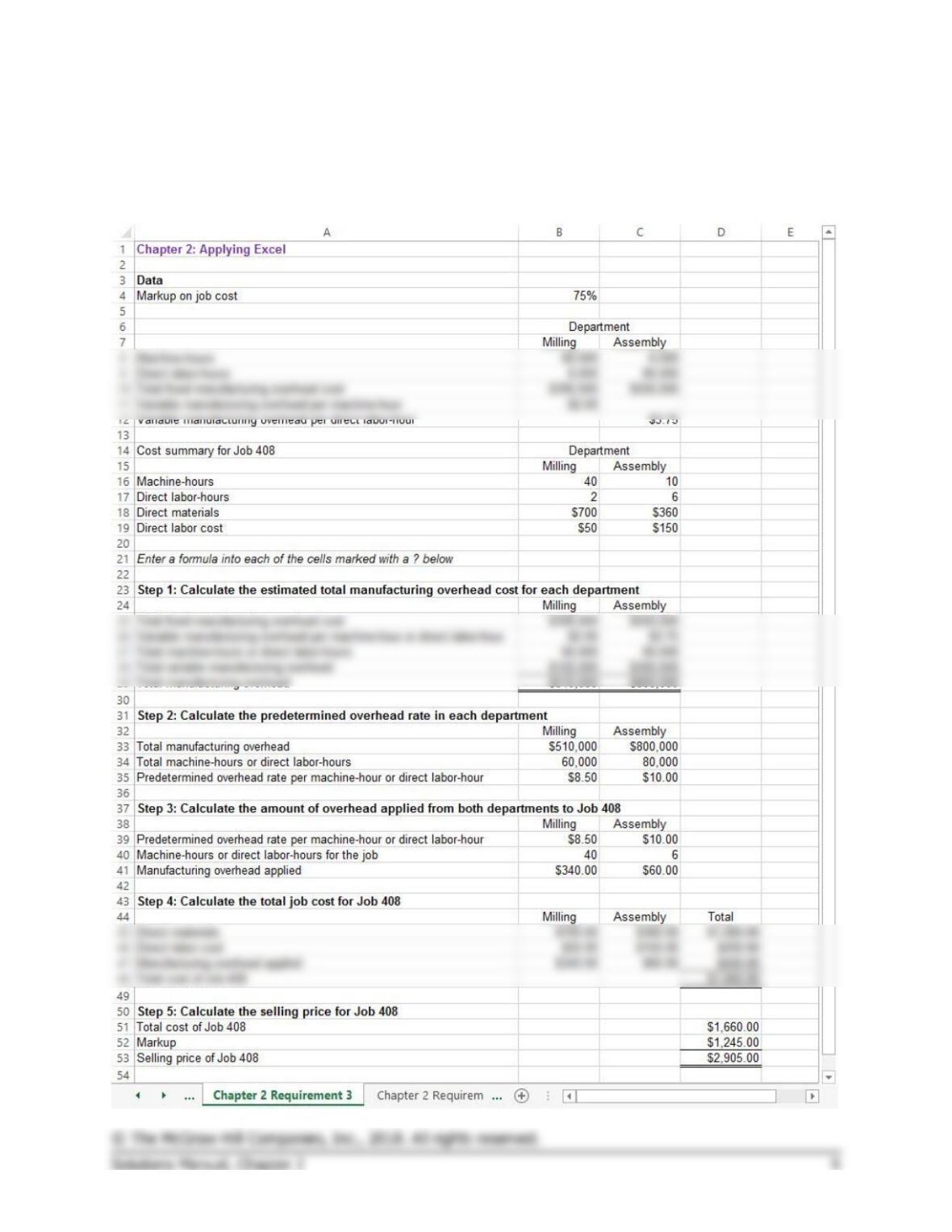
3. When the total number of machine-hours in the Assembly Department
increases from 3,000 machine-hours to 6,000 machine-hours, the work–
sheet looks like the following:
Chapter 2: Applying Excel (continued)
The selling price for Job 408 is not affected by this change. The reason
for this is that the total number of machine-hours in the Assembly De-
partment has no effect on any cost. There would have been a change in
costs and in the selling price if the total machine-hours in the Milling De-
partment would have changed. This is because the predetermined over-
Chapter 2: Applying Excel (continued)
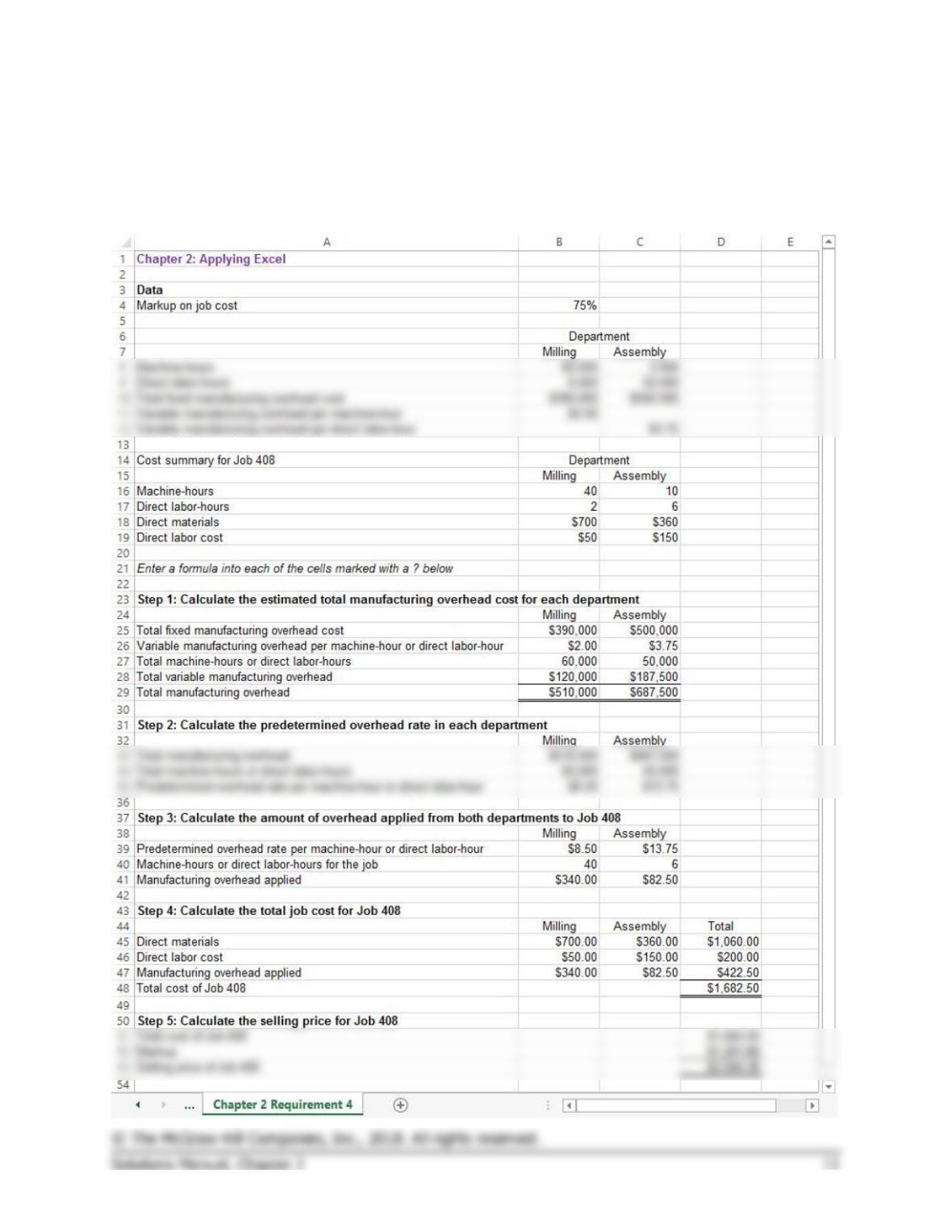
4. When the total number of direct labor-hours in the Assembly Depart–
ment decreases from 80,000 direct labor-hours to 50,000 direct labor-
hours, the worksheet looks like the following:
Chapter 2: Applying Excel (continued)
The selling price of Job 408 has increased from $2,905.00 to $2,944.38.
This occurs because the decrease in the total number of direct labor-
hours in the Assembly Department increases the predetermined over-
The Foundational 15
1. Molding: Using the equation
Y
=
a
+
bX
, the estimated total manufac-
turing overhead cost is computed as follows:
Y = $10,000 + ($1.40 per MH)(2,500 MHs)
Estimated fixed manufacturing overhead ………………
$10,000
Estimated variable manufacturing overhead:
$1.40 per MH × 2,500 MHs ……………………………..
3,500
Estimated total manufacturing overhead cost …………
$13,500
The predetermined overhead rate in Molding is computed as follows:
Estimated total manufacturing overhead (a) …
$13,500
Estimated total machine-hours (MHs) (b) ……..
2,500
MHs
Predetermined overhead rate (a) ÷ (b) ………..
per MH
Estimated fixed manufacturing overhead ………………
$15,000
3,300
Estimated total manufacturing overhead cost …………
The predetermined overhead rate in Fabrication is computed as follows:
Estimated total manufacturing overhead (a) …
$18,300
Estimated total machine-hours (MHs) (b) ……..
1,500
MHs
Predetermined overhead rate (a) ÷ (b) ………..
$12.20
per MH
2. The applied overhead from Molding is computed as follows:
Job P
Job Q
Machine-hours worked on job (a) ……………..
1,700
800
Molding overhead rate (b) ……………………….
$5.40
$5.40
Manufacturing overhead applied (a) × (b) ….
$9,180
$4,320
The Foundational 15
3. The applied overhead from Fabrication is computed as follows:
Job P
Job Q
Machine-hours worked on job (a) ……………..
600
900
Fabrication overhead rate (b) …………………..
$12.20
$12.20
Manufacturing overhead applied (a) × (b) ….
$7,320
$10,980
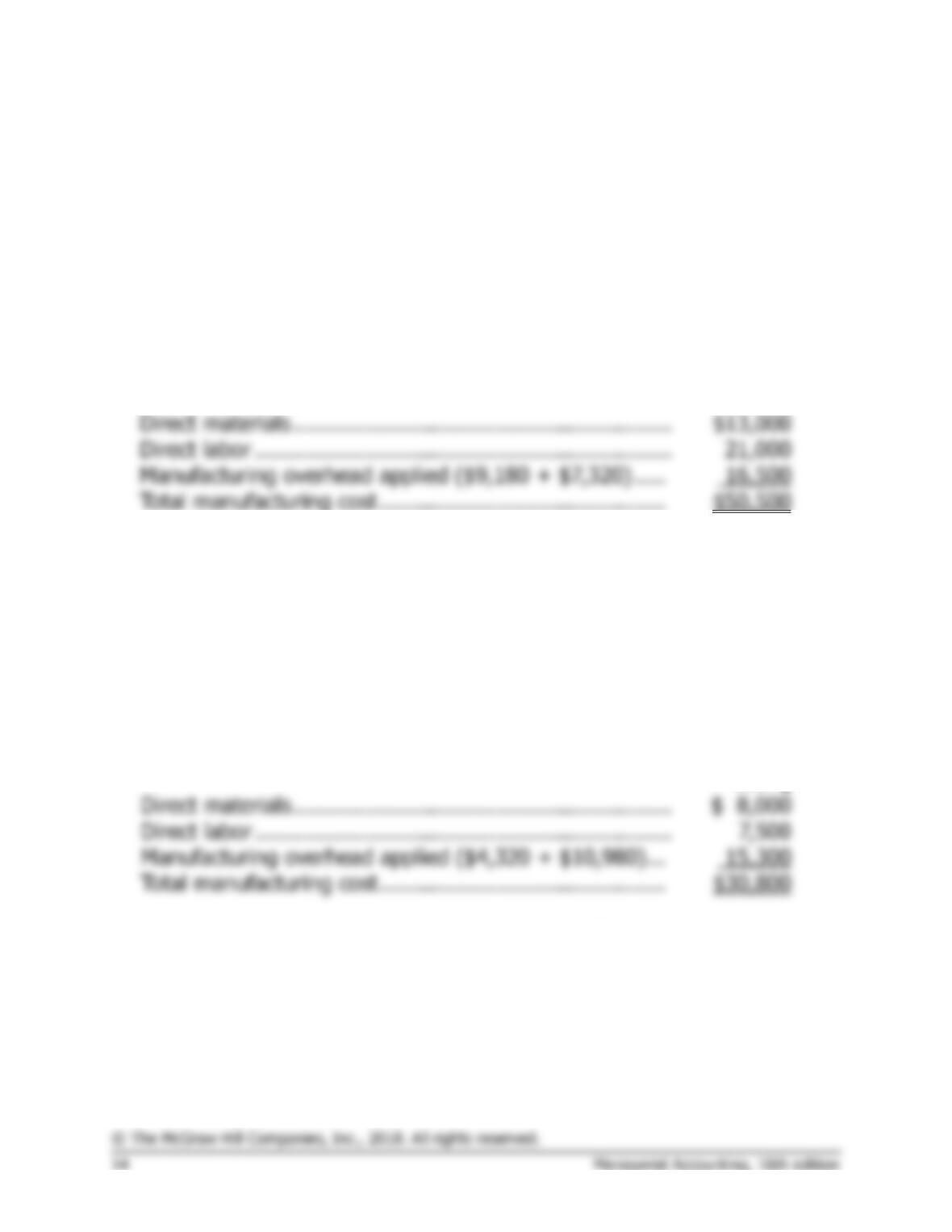
4. The total manufacturing cost assigned to Job P is computed as follows:
Job P
Direct materials ………………………………………………….
$13,000
Direct labor ……………………………………………………….
Manufacturing overhead applied ($9,180 + $7,320) …..
16,500
Total manufacturing cost ……………………………………..
5. The unit product cost for Job P is computed as follows:
Total manufacturing cost (a) …………………..
$50,500
Number of units in the job (b) …………………
20
Unit product cost (a) ÷ (b) ……………………..
$2,525
6
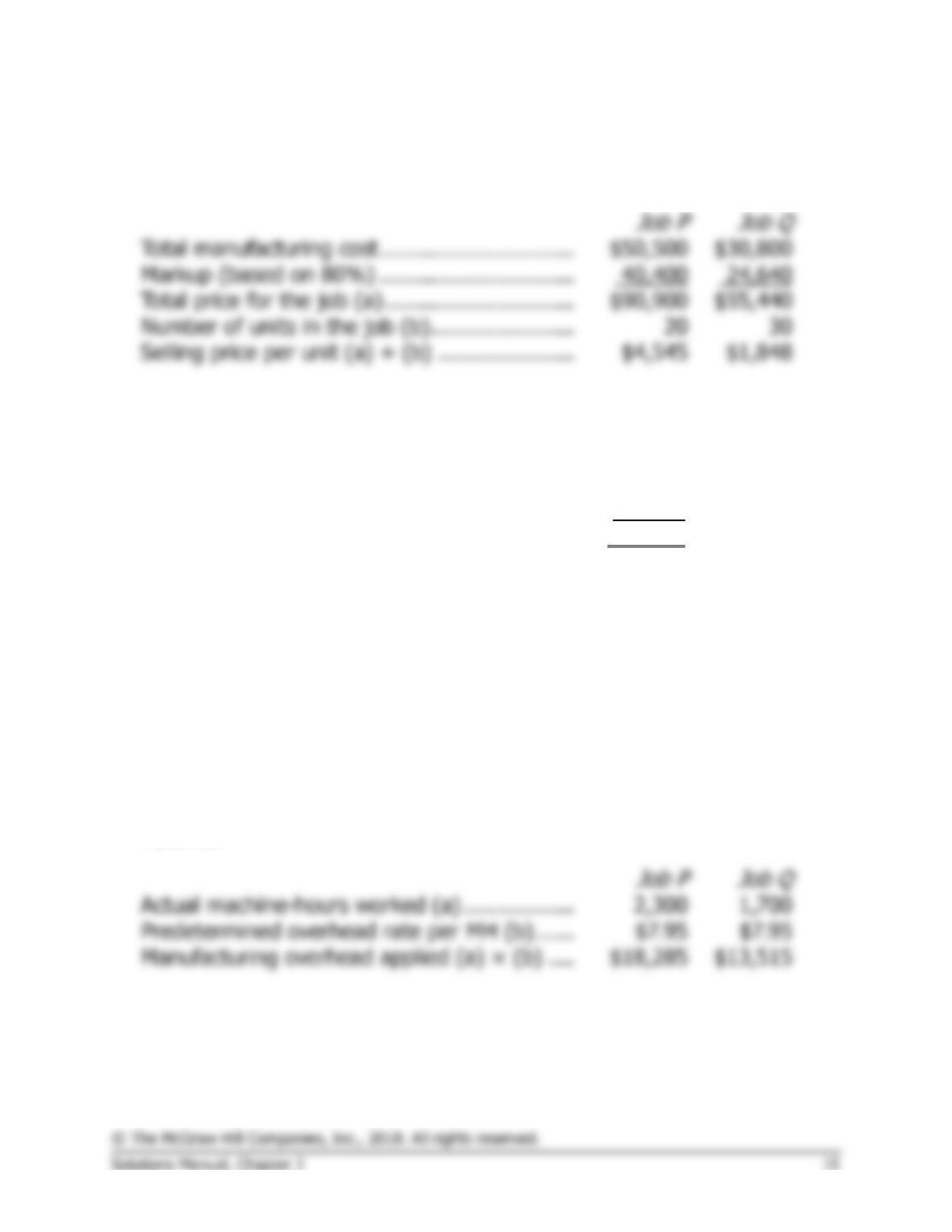
. The total manufacturing cost assigned to Job Q is computed as follows:
Job Q
Direct materials ………………………………………………….
Direct labor …………………………..…………………………..
Manufacturing overhead applied ($4,320 + $10,980) …
15,300
Total manufacturing cost ……………………………………..
7. The unit product cost for Job Q is computed as follows:
Total manufacturing cost (a) …………………..
$30,800
Number of units in the job (b) …………………
30
Unit product cost (rounded) (a) ÷ (b) ……….
$1,027
The Foundational 15
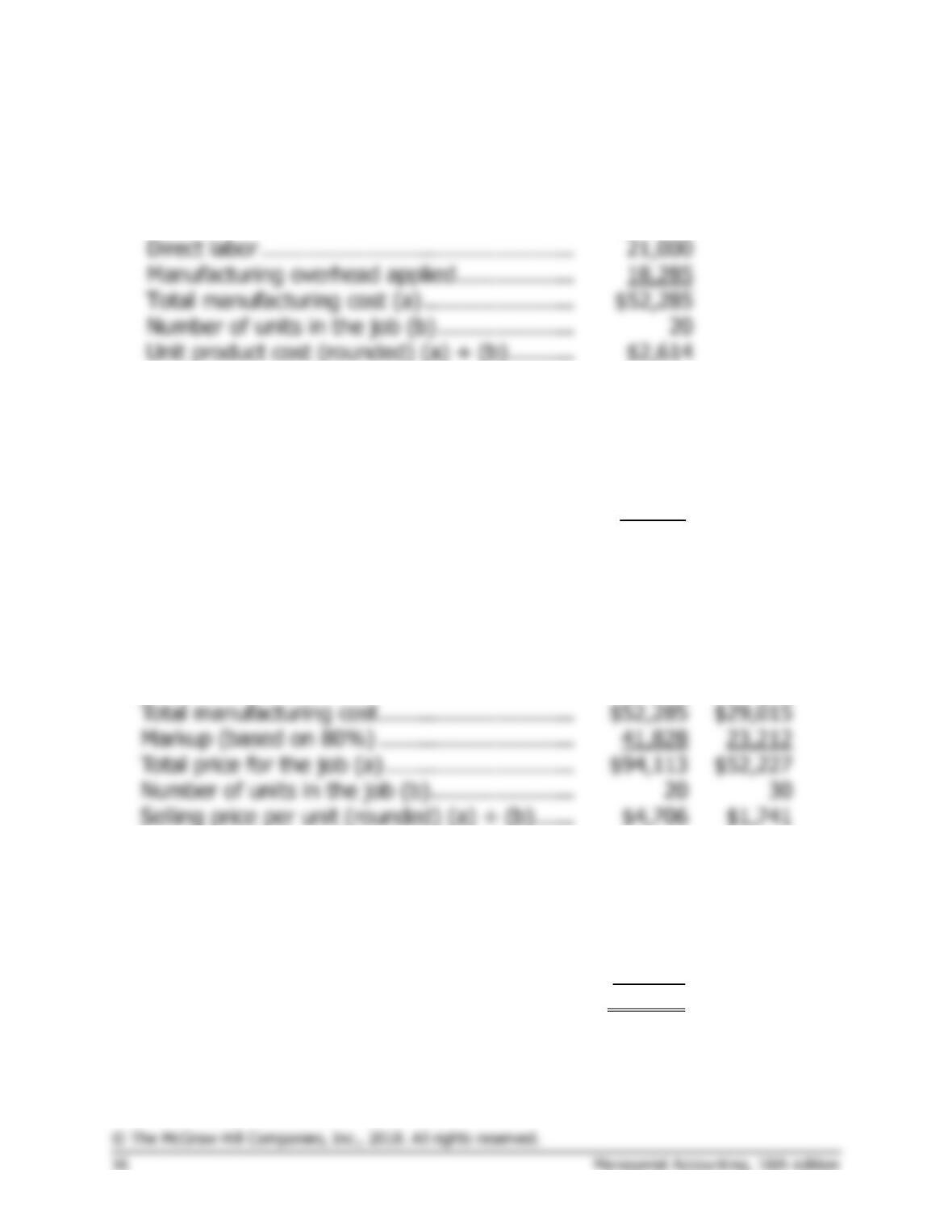
8. The selling prices are calculated as follows:
Total manufacturing cost …………………………
Markup (based on 80%) …………………………
Total price for the job (a) ………………………..
Number of units in the job (b) ………………….
Selling price per unit (a) ÷ (b) …………………
9. The cost of goods sold is the sum of the manufacturing costs assigned
to Jobs P and Q:
Total manufacturing cost assigned to Job P …..
$50,500
Total manufacturing cost assigned to Job Q ….
30,800
Cost of goods sold …………………………………..
$81,300
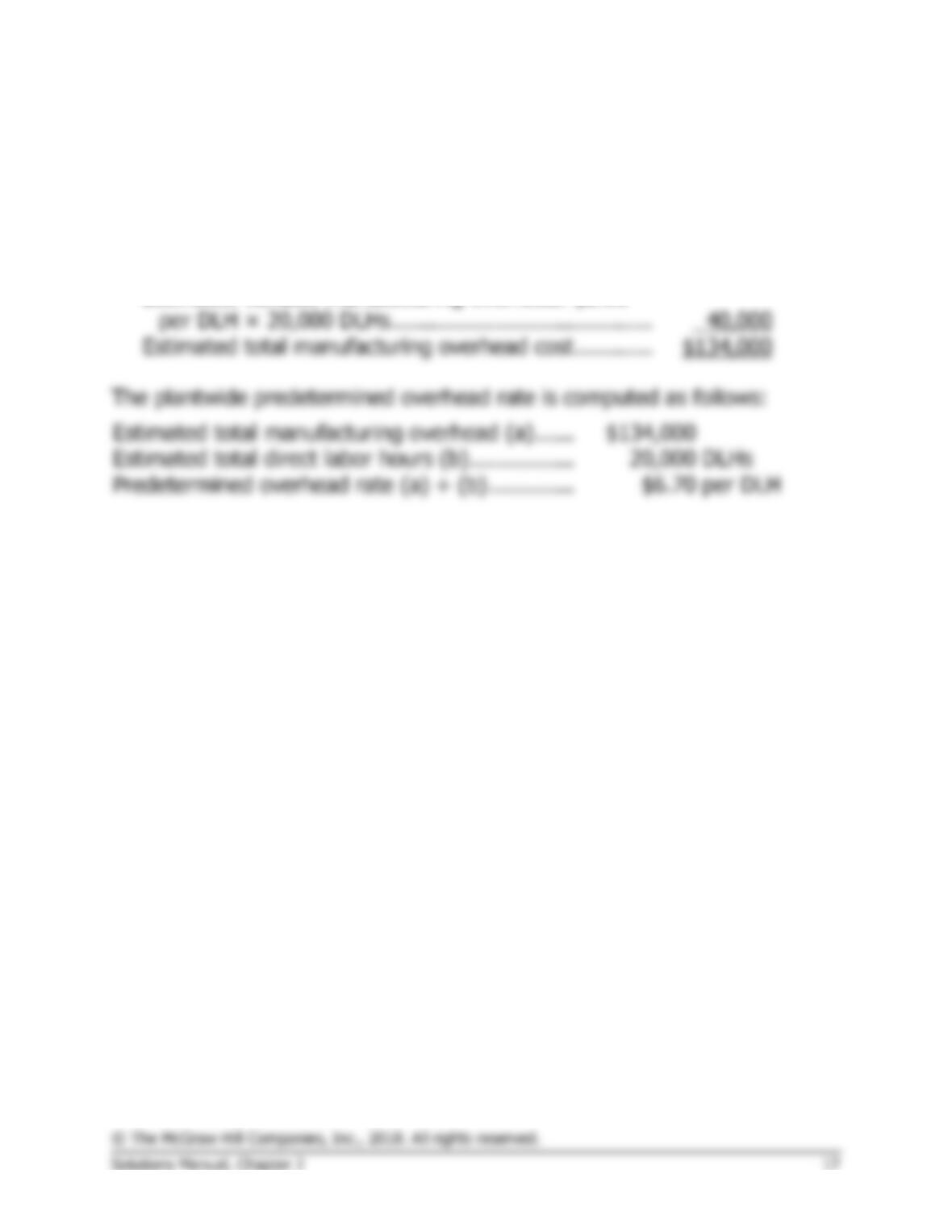
10. The plantwide overhead rate of $7.95 per machine-hour is calculated
by combining the estimated manufacturing overhead costs computed in
requirement 1 for Molding and Fabrication ($13,500 + $18,300 =
$31,800) and then dividing by the estimated total machine-hours:
Estimated total manufacturing overhead (a) .
$31,800
Estimated total machine-hours (MHs) (b) ……..
4,000
MHs
Predetermined overhead rate (a) ÷ (b) ………
$7.95
per MH
11. The manufacturing overhead applied to Jobs P and Q is computed as
follows:
Actual machine-hours worked (a) ……………..
Predetermined overhead rate per MH (b) ……
Manufacturing overhead applied (a) × (b) ….
The Foundational 15
12. Job P’s unit product cost is computed as follows:
Direct materials ……………………………………
$13,000
Direct labor …………………………..…………….
Manufacturing overhead applied ………………
Total manufacturing cost (a) …………………..
$52,285
Number of units in the job (b) …………………
Unit product cost (rounded) (a) ÷ (b) ……….
13. Job Q’s unit product cost is computed as follows:
Direct materials ……………………………………
$8,000
Direct labor …………………………..…………….
7,500
Manufacturing overhead applied ………………
13,515
Total manufacturing cost (a) …………………..
$29,015
Number of units in the job (b) …………………
30
Unit product cost (rounded) (a) ÷ (b) ……….
$967
14. The selling prices are calculated as follows:
Job P
Job Q
Total manufacturing cost …………………………
Markup (based on 80%) …………………………
Total price for the job (a) ………………………..
$94,113
$52,227
Number of units in the job (b) ………………….
Selling price per unit (rounded) (a) ÷ (b) ……
$4,706
$1,741
15. The cost of goods sold is the sum of the manufacturing costs assigned
to Jobs P and Q:
Total manufacturing cost assigned to Job P …..
$52,285
Total manufacturing cost assigned to Job Q ….
29,015
Cost of goods sold …………………………………..
$81,300
Exercise 2-1 (10 minutes)
The estimated total manufacturing overhead cost is computed as follows:
Y = $94,000 + ($2.00 per DLH)(20,000 DLHs)
Estimated fixed manufacturing overhead ………………
$ 94,000
Estimated total manufacturing overhead cost …………
Predetermined overhead rate (a) ÷ (b) ………….
per DLH
Exercise 2-2 (10 minutes)
Actual direct labor-hours (a) ……………………
10,800
Predetermined overhead rate (b) ……………..
$23.40
Manufacturing overhead applied (a) × (b) ….
Exercise 2-3 (10 minutes)
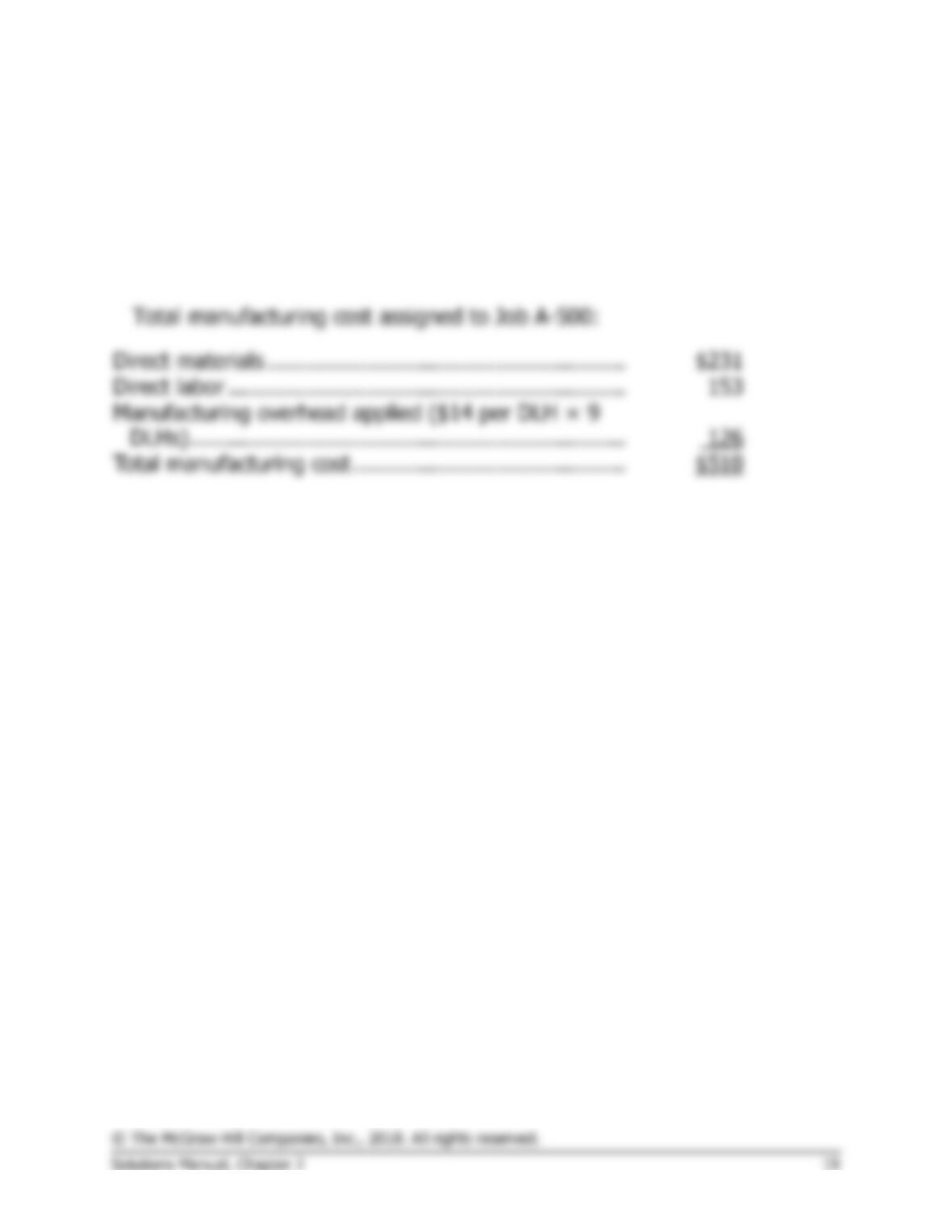
1. Total direct labor-hours required for Job A-500:
Direct labor cost (a) ……………………………….
$153
Direct labor wage rate per hour (b) ……………
$17
Total direct labor hours (a) ÷ (b) ………………
9
2. Unit product cost for Job A-500:
Total manufacturing cost (a) …………………….
$510
Number of units in the job (b) …………………..
40
Unit product cost (a) ÷ (b) ………………………
$12.75
Exercise 2-4 (10 minutes)
1 and 2.
The total direct labor-hours required for Job N-60:
Assembly
Testing &
Packaging
Direct labor cost (a) ……………………………….
$180
$40
Direct labor wage rate per hour (b) ……………
$20
$20
Total direct labor hours (a) ÷ (b) ………………
9
2
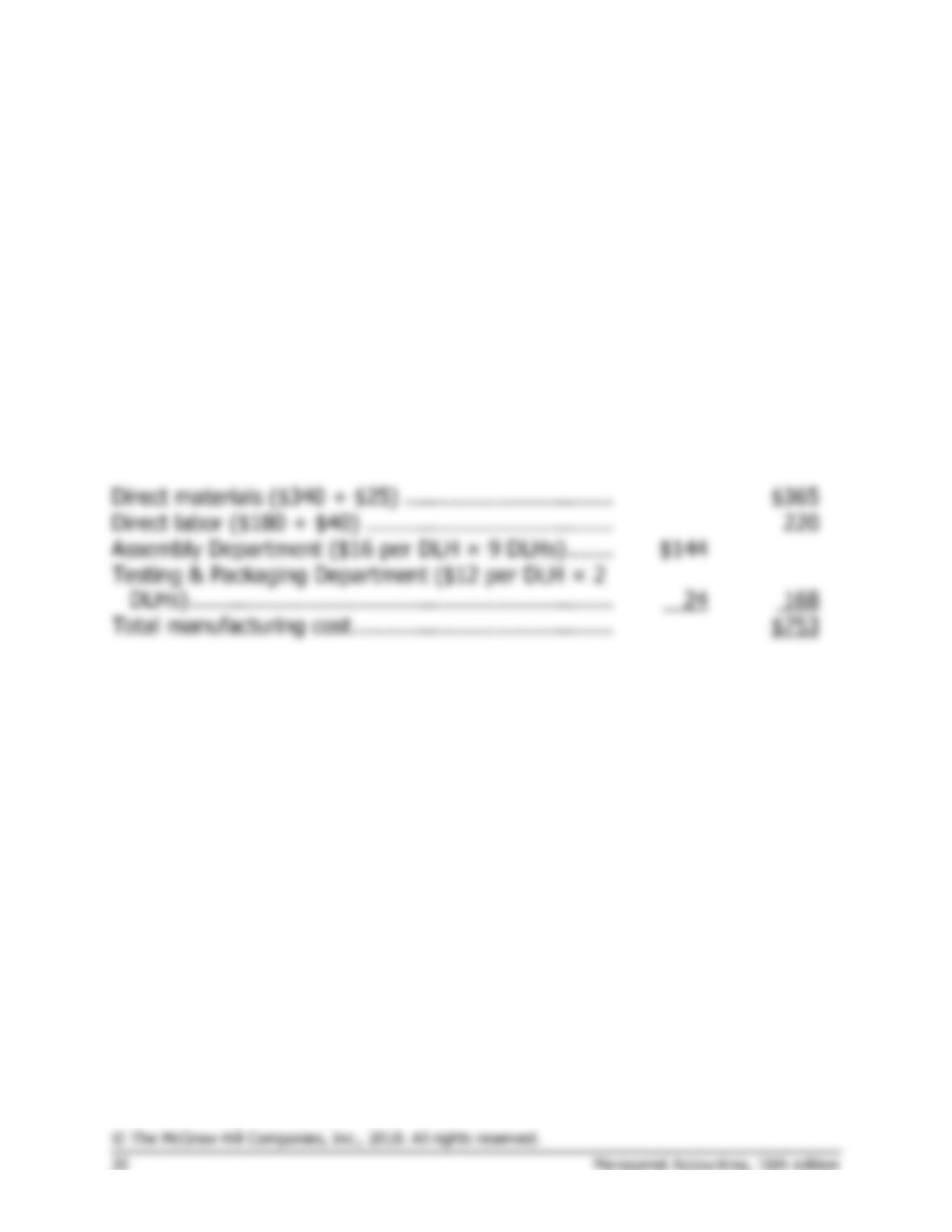
The total manufacturing cost and unit product cost for Job N-60 is com-
puted as follows:
Direct labor ($180 + $40) ………………………………..
Assembly Department ($16 per DLH × 9 DLHs) …….
Total manufacturing cost (a) …………………………….
$753
Number of units in the job (b) …………………………..
10
Unit product cost (a) ÷ (b) ……………………………….
$75.30