Financial Accounting, 9/e 2-41
AP2–2.
Req. 1
Adamson Incorporated was organized as a corporation. Only a corporation issues
shares of capital stock to its owners in exchange for their investment, as Adamson did
in transaction (c).
Req. 2 (On next page)
Req. 3
Req. 4
(a) Total assets = $35,000 + $2,000 + $85,000 + $107,000 + $510,000 = $739,000
(e) Total current assets = $35,000 + $2,000 = $37,000
Req. 5
Current
=
Current Assets
=
$35,000 + $2,000
=
$37,000
=
0.22
Ratio
Current Liabilities
$169,000
$169,000
AP2–2. (continued)
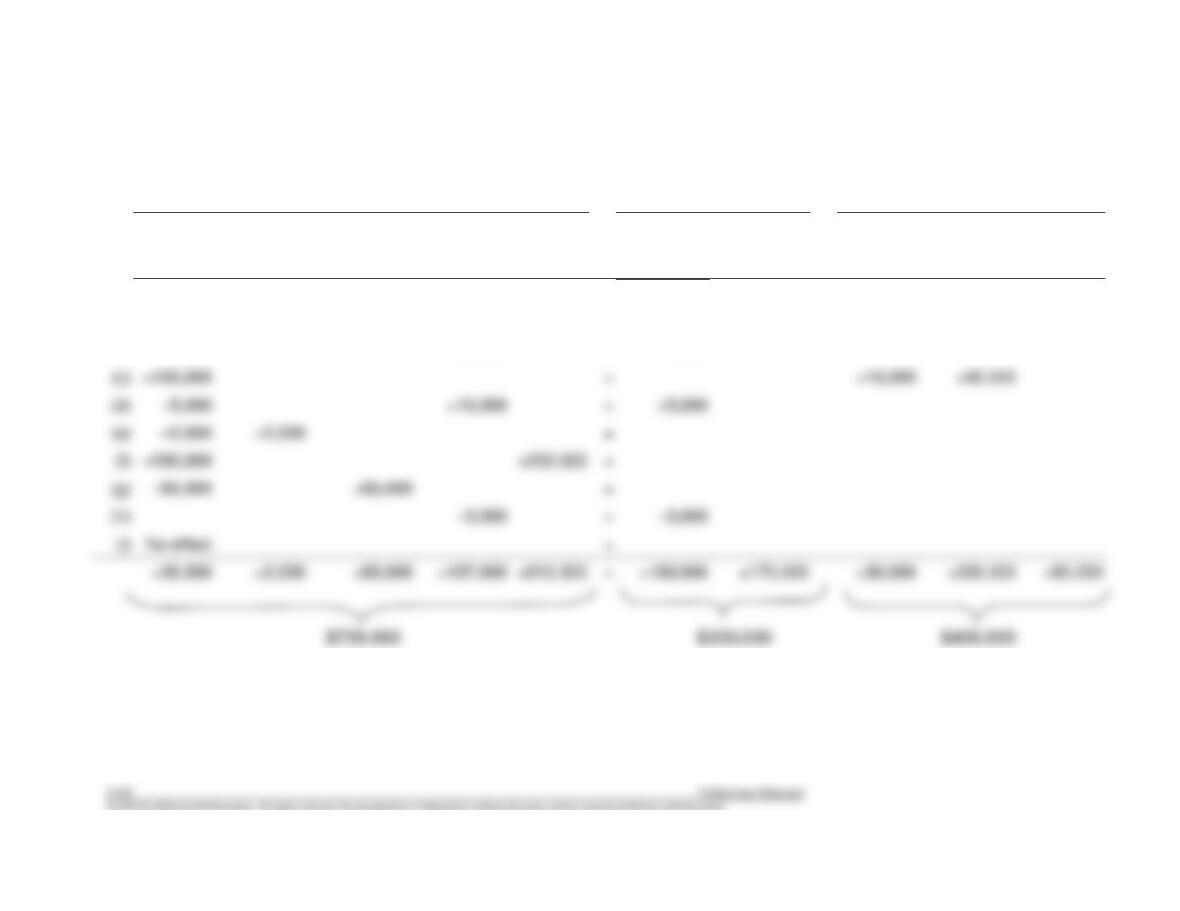
Req. 2
Assets
=
Liabilities
+
Stockholders’ Equity
Cash
Notes
Receivable
Long-Term
Investments
Equipment
Building
Short-Term
Notes
Payable
Long-Term
Notes
Payable
Common
Stock
Additional
Paid-in
Capital
Retained
Earnings
Beg.
120,000
70,000
310,000
=
140,000
60,000
20,000
200,000
80,000
(a)
+110,000
=
+110,000
(b)
–3,000
+30,000
=
+27,000
(c)
+100,000
=
+10,000
(d)
–5,000
+10,000
=
+5,000
(e)
=
=
(g)
=
(h)
=
=
+35,000
+510,000
=
+170,000
+30,000
Financial Accounting, 9/e 2-43
AP2–3.
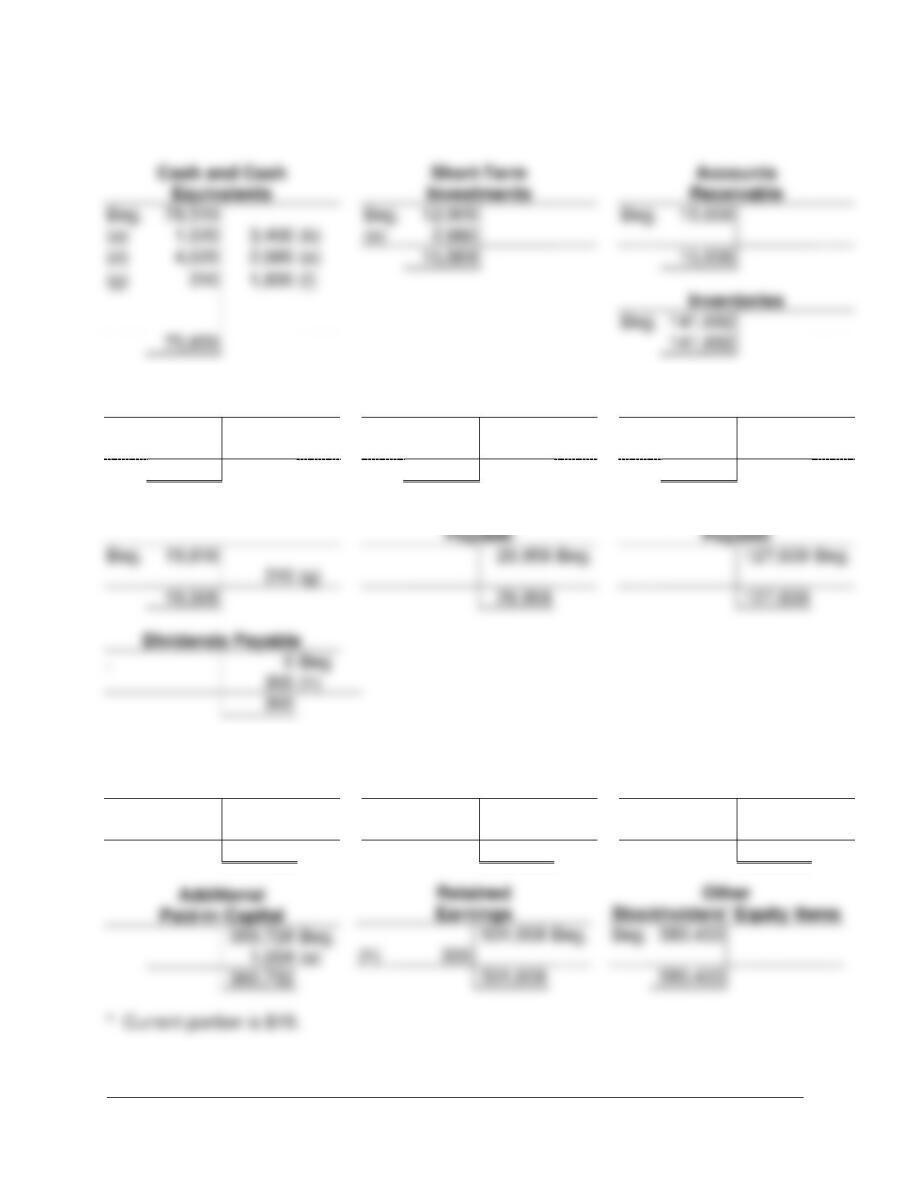
Req. 1 and 2
Prepaid Expenses and
Other Current Assets
Property, Plant,
and Equipment
Intangibles
Beg.
20,372
Beg.
294,853
Beg.
45,128
(f)
11,230
4,020
(d)
(b)
3,400
20,372
302,063
48,528
Other Assets
Beg.
19,816
26,958
Beg.
Beg.
310
(g)
19,506
26,958
Beg
300
(h)
300
Accounts
Accrued Expenses
Long-Term
Debt*
Other Long-Term
Liabilities
Common
Stock
165,032
Beg.
27,009
Beg.
484
Beg.
9,400
(f)
16
(a)
174,432
27,009
500
359,728
Beg.
(a)
360,732
Retained
501,908
Beg.
(h)
300
501,608
Beg.
Accounts
Beg.
78,519
Beg.
12,909
Beg.
15,036
(a)
1,020
3,400
(b)
(e)
2,980
(d)
4,020
2,980
(e)
15,889
15,036
(g)
1,830
(f)
Beg.
75,659
141,692
AP2–3. (continued)
Req. 3
No effect was recorded for (c). Ordering goods involves no exchange or receipt of
cash, goods, or services and thus is not a transaction.
Req. 4
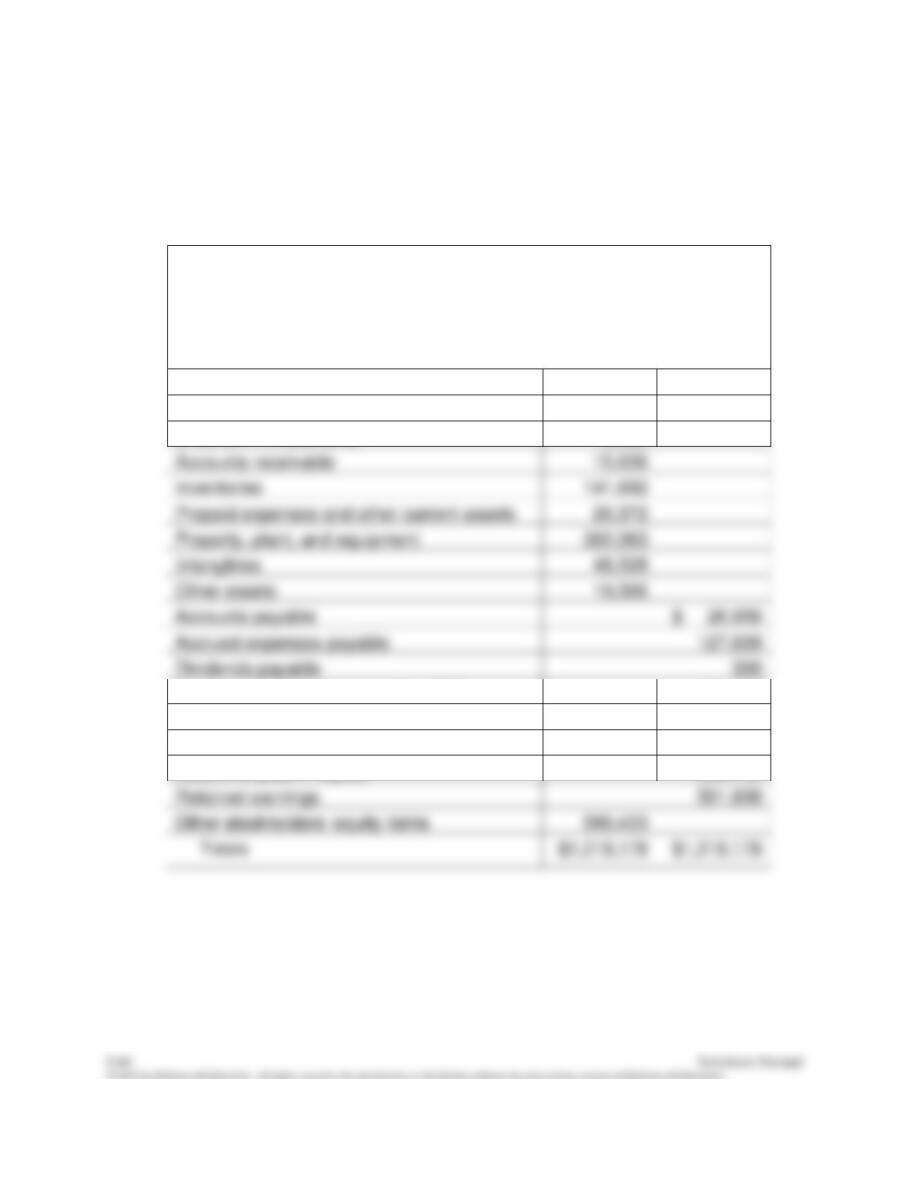
Ethan Allen Interiors, Inc.
Trial Balance
At September 30
(in thousands of dollars)
Debit
Credit
Cash and cash equivalents
$ 75,659
Short-term investments
15,889
Accounts receivable
15,036
Inventories
Prepaid expenses and other current assets
20,372
Property, plant, and equipment
Intangibles
48,528
Other assets
19,506
Accrued expenses payable
Dividends payable
300
Long-term debt (current portion, $19)
174,432
Other long-term liabilities
27,009
Common stock
500
Additional paid-in capital
360,732
Retained earnings
Financial Accounting, 9/e 2-45
AP2–3. (continued)
Req. 5
Ethan Allen Interiors, Inc.
Balance Sheet
At September 30
(in thousands of dollars)
Assets
Current assets
Other assets
19,506
Total Assets
$638,745
Liabilities
Current liabilities
Accounts payable
$ 26,958
Accrued expenses payable
127,639
Dividends payable
300
Current portion of long-term debt
19
174,413
Total Liabilities
Common stock ($0.01 par value)
500
Additional paid-in capital
360,732
Retained earnings
Total Stockholders’ Equity
Total Liabilities and Stockholders’ Equity
$638,745
Req. 6
Current
=
Total Current Assets
=
$268,648
=
1.73
Ratio
Total Current Liabilities
$154,916
AP2–4.
Cash and cash equivalents
Short-term investments
15,889
Accounts receivable
15,036
141,692
Prepaid expenses and other current assets
20,372
Property, plant, and equipment
Intangibles
48,528
Transaction
Type of Activity
Effect on Cash
(a)
F
+1,020
(b)
I
−3,400
(c)
(e)
I
−2,980
(h)
Financial Accounting, 9/e 2-47
CONTINUING PROBLEM
CON2–1.
Req. 1
Debit
Credit
a.
Cash (+A) ………………………………………………….
25,000
Equipment (+A) ………………………………………….
36,000
Common stock (+SE)…………………….
200
Additional paid-in capital (+SE)…………
60,800
d.
No transaction
e.
Mortgage notes payable (−L)…………………..
1,000
Cash (−A)…………………………………
1,000
Short-term investments (+A)……………………
Cash (−A)………………………………….
g.
No transaction
b.
Land (+A)…………………………………………
18,000
Building (+A)……………………………………..
72,000
Mortgage notes payable (+L)……………
80,000
c.
Equipment (+A)………………………………….
Cash (−A)…………………………………
Short-term notes payable (+L)………….
CON2–1. (continued)
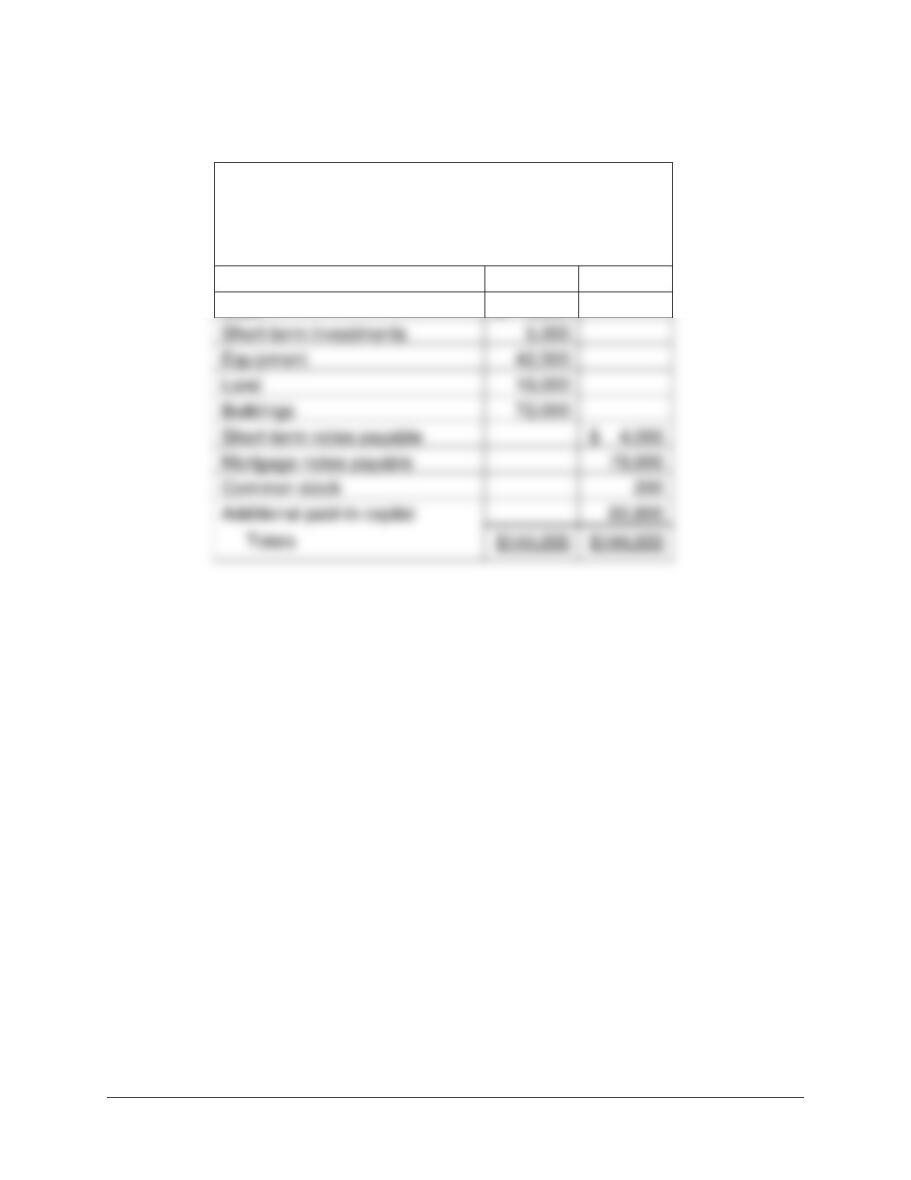
Req. 2
Cash
Short-term Investments
Equipment
Beg.
0
Beg.
0
Beg.
0
(a)
25,000
10,000
(b)
(f)
5,000
(a)
36,000
2,500
(c)
5,000
(c)
6,500
1,000
(e)
42,500
5,000
(f)
6,500
Beg.
0
Beg.
0
(b)
18,000
(b)
72,000
18,000
72,000
0
Beg.
0
Beg.
4,000
(c)
(e)
1,000
80,000
(b)
4,000
79,000
0
Beg.
0
Beg.
(a)
60,800
(a)
Financial Accounting, 9/e 2-49
CON2–1. (continued)
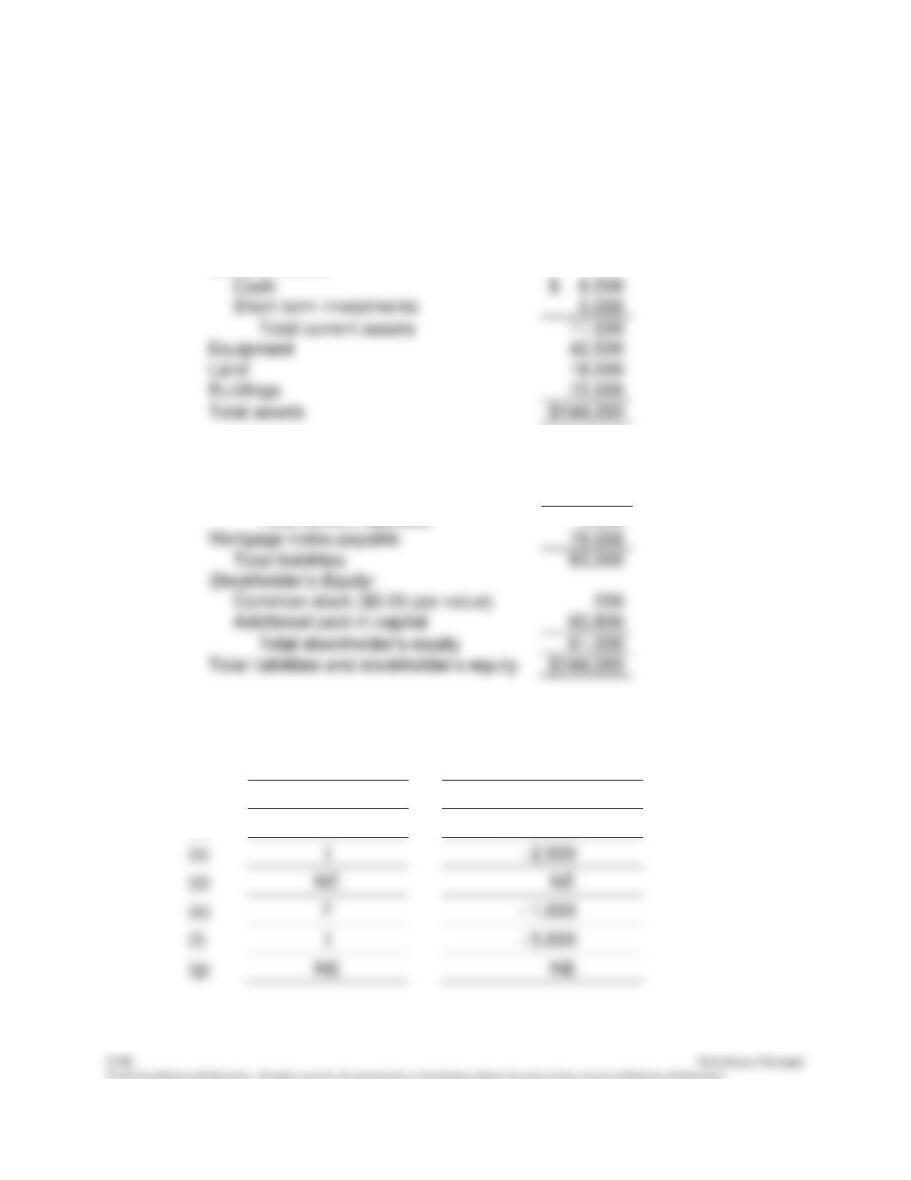
Req. 3
Penny’s Pool Service and Supply, Inc.
Trial Balance
March 31
Debit
Credit
Cash
$ 6,500
Short-term investments
Equipment
Land
Buildings
Short-term notes payable
Mortgage notes payable
Common stock
Additional paid-in capital
CON2–1. (continued)
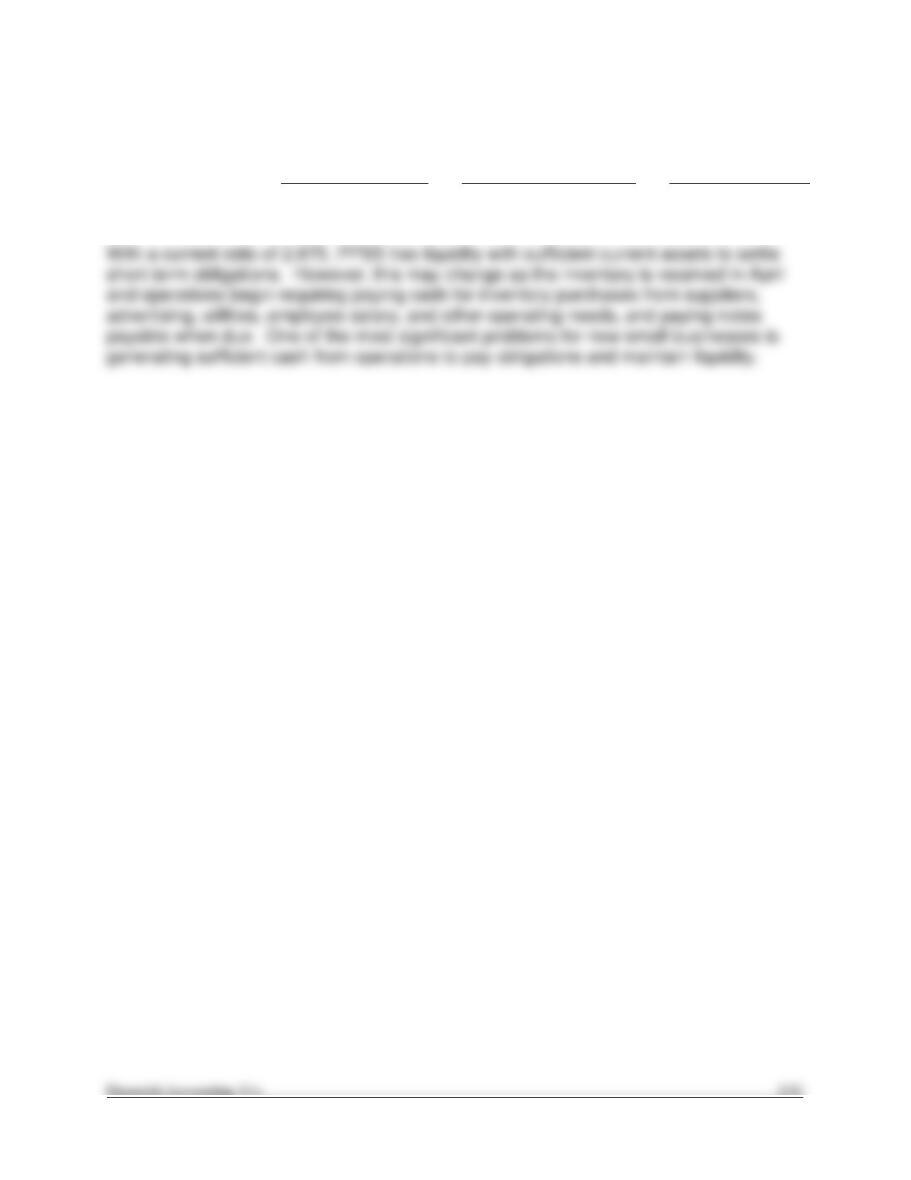
Req. 4
Penny’s Pool Service and Supply, Inc.
Balance Sheet
On March 31
Assets
Current Assets:
Cash
Short-term investments
5,000
Total current assets
Equipment
Land
Buildings
Total assets
Liabilities and Stockholder’s Equity
Current Liabilities:
Short-term notes payable
$4,000
Total current liabilities
4,000
Mortgage notes payable
Total liabilities
Common stock ($0.05 par value)
Additional paid-in capital
Req. 5
Type of Activity
(I, F, or NE)
Effect on Cash Flows
(+ or – and amount)
(a)
F
+ 25,000
(b)
I
– 10,000
(c)
I
– 2,500
(d)
(e)
F
(f)
(g)
CON2–1. (continued)
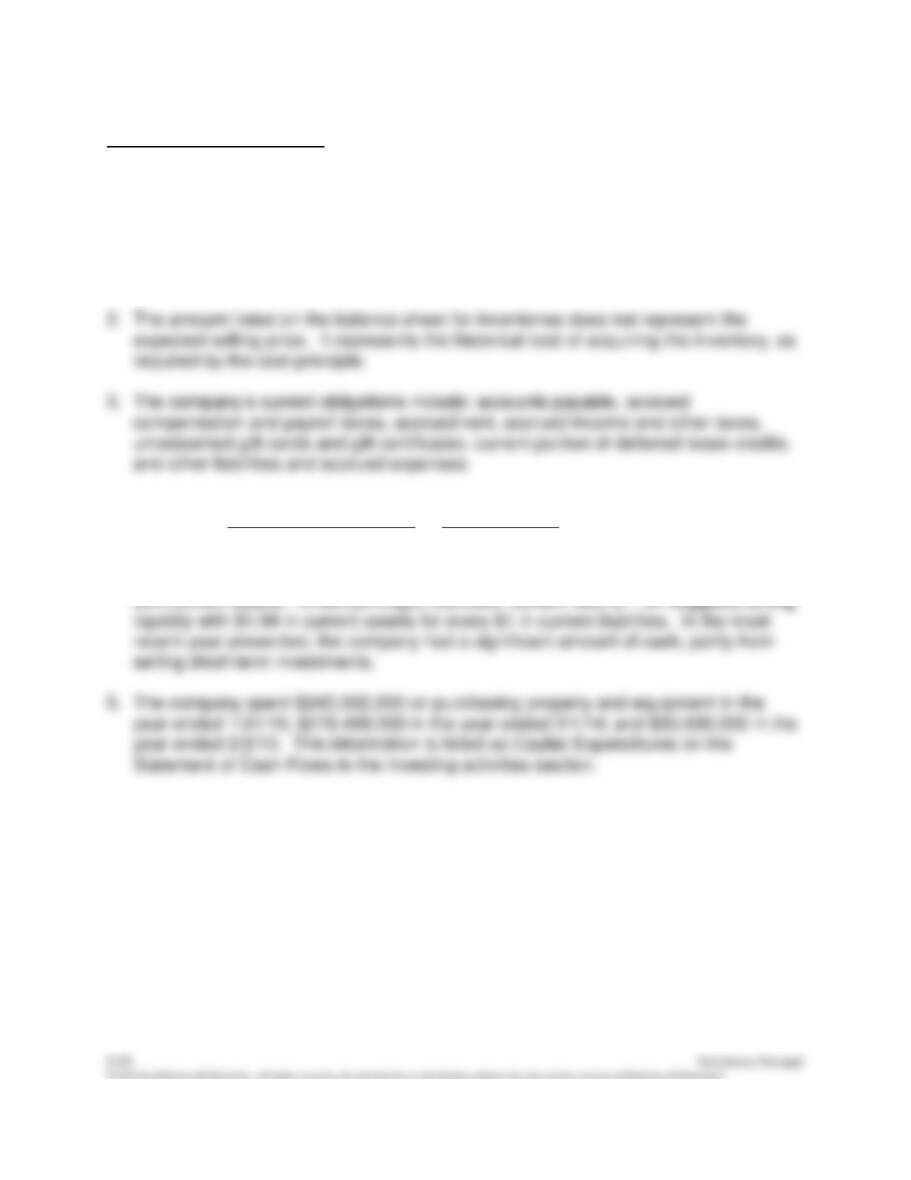
Req. 6
Current Assets
÷
Current Liabilities
=
Current Ratio
On March 31
$11,500
÷
$4,000
=
2.875
CASES AND PROJECTS
ANNUAL REPORT CASES
CP2–1.
1. The company is a corporation since it maintains share capital and its owners are
referred to as “stockholders.” (Refer to the stockholders’ equity section of the
balance sheet).
4
Current
=
Current Assets
=
$890,513
=
1.94
Ratio
Current Liabilities
$459,093
The current ratio measures the ability of the company to settle short-term obligations
Financial Accounting, 9/e 2-53
CP2–2.
1. Assets = Liabilities + Shareholders’ Equity
$1,888,741,000 = $560,772,000 + $1,327,969,000
2. No – shareholders’ equity is a residual balance, meaning that the shareholders will
receive what remains in cash and assets after the creditors have been satisfied. It is
likely that shareholders would receive less than $1,327,969,000. In addition, nearly
all assets on the balance sheet are stated at historical cost, not at market value (the
amount that could be received if the assets are sold at the end of the year).
CP2–3.
1.
Industry
Average
American Eagle
Outfitters
Urban
Outfitters
Current Ratio =
2.03
1.94
2.29
2. As indicated in the financing activities section of each company’s statement of cash
flows, during the most recent year, American Eagle Outfitters spent $7,464,000
repurchasing common stock from employees and did not repurchase any common
stock from investors. Urban Outfitters spent $611,475,000 repurchasing shares.
3. As indicated in the statement of cash flows, American Eagle Outfitters paid
$97,224,000 in dividends. Urban Outfitters did not pay any dividends during the
year. Refer to the financing activities section of the statement of cash flows.
Financial Accounting, 9/e 2-55
FINANCIAL REPORTING AND ANALYSIS CASES
CP2–4.
Dollars are in thousands:
1. (a) Chipotle’s total assets reported for the quarter ended September 30, 2014 are
$2,437,053.
(b) Current liabilities increased over nine months from $199,228 at December 31,
2013, to $264,986 on June 30, 2014.
2. (a) For the three months ended September 30, 2014, Chipotle spent $160,400 on
the purchase of leasehold improvements, property, and equipment.
CP2–5.
The major deficiency in this balance sheet is the inclusion of the owner’s personal
residence as a business asset. Under the separate entity assumption, each business
must be accounted for as an individual organization, separate and apart from its
owners. The improper inclusion of this asset as part of Frances Sabatier’s business:
CP2–6.
Dollars are in thousands:
1. The company is a corporation because its owners are referred to as “stockholders.”
3.
Current Assets
÷
Current Liabilities
=
Current Ratio
2014
$4,255,853
$393,794
10.81
2013
2,574,679
225,430
11.42
4.
Accounts Payable (−L) …………………………..
53,241
Cash (−A) ……………………………………………………….
53,241
5. Over its years in business, it appears that Twitter has been unprofitable, based on a
negative amount in Accumulated Deficit of $1,582,470. The Accumulated Deficit
account represents the cumulative losses of the firm since the business began.
Financial Accounting, 9/e 2-57
CRITICAL THINKING CASES
CP2–7.
Req. 1
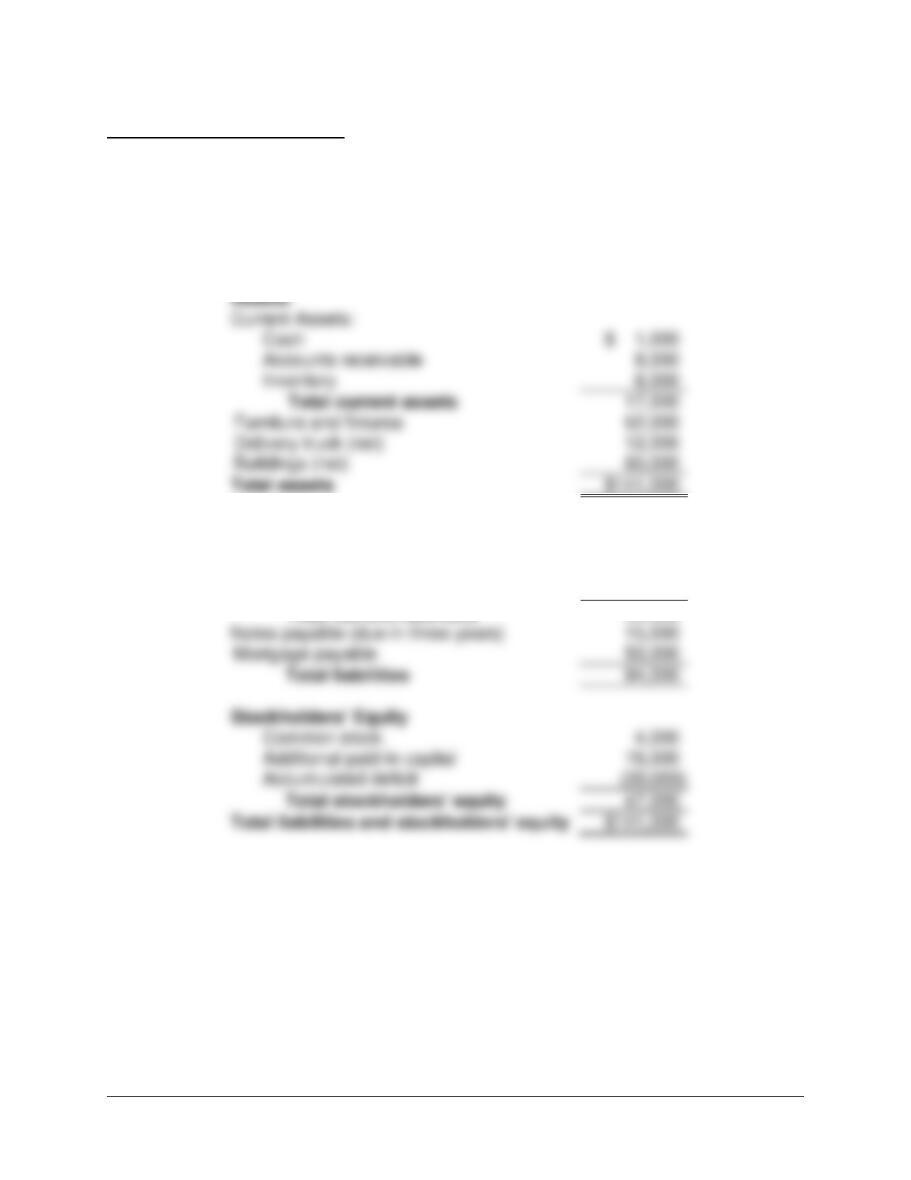
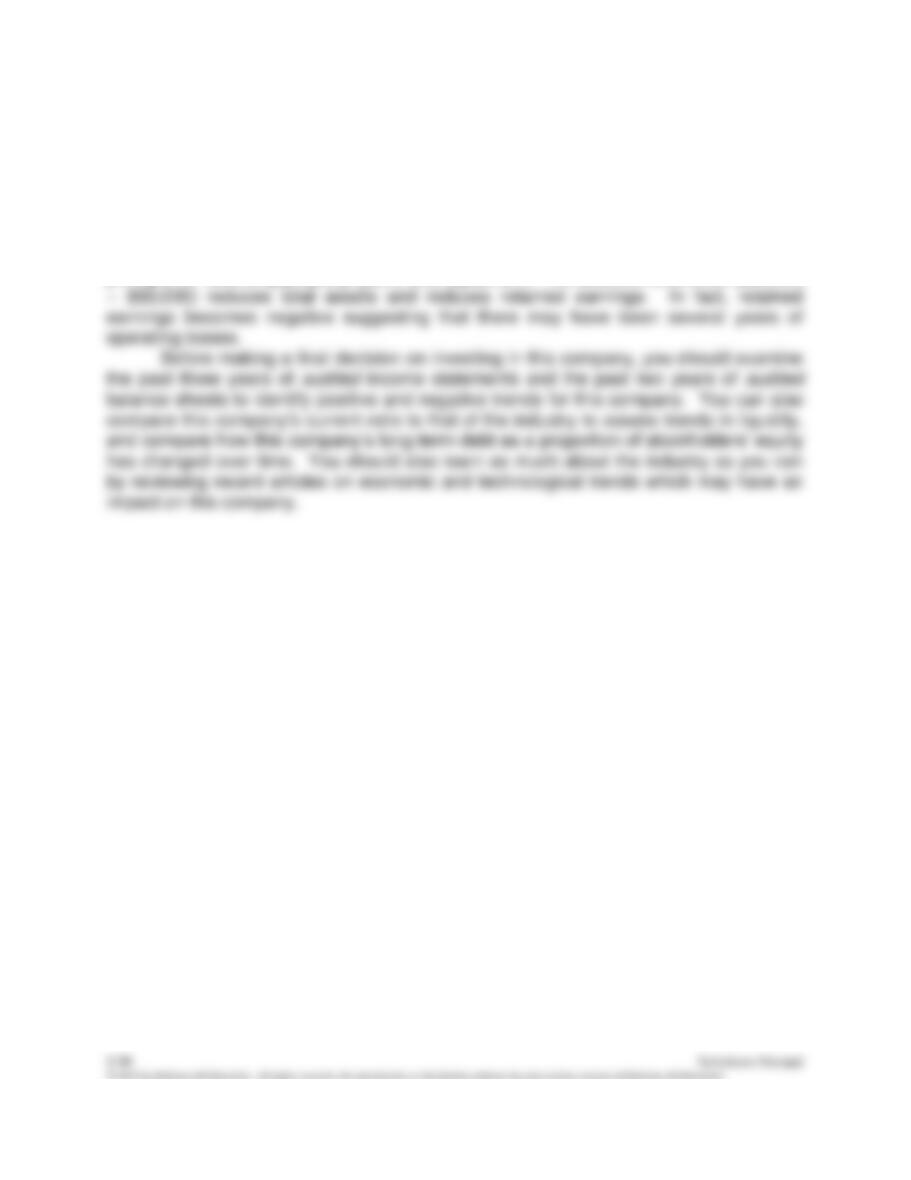
Dewey, Cheetum, and Howe, Inc.
Balance Sheet
December 31
Liabilities
Current Liabilities:
Accounts payable
$ 16,000
Payroll taxes payable
13,000
Total current liabilities
29,000
Notes payable (due in three years)
15,000
Mortgage payable
50,000
Total liabilities
Stockholders’ Equity
Common stock
Additional paid-in capital
Accumulated deficit
(33,000)
Total stockholders’ equity
Total liabilities and stockholders’ equity
$141,000
Assets
Current Assets:
Cash
Accounts receivable
Inventory
Total current assets
17,000
Furniture and fixtures
52,000
Delivery truck (net)
12,000
Buildings (net)
60,000
Total assets
$141,000
CP2–7. (continued)
Req. 2
Dear ___________,
I corrected the balance sheet for Dewey, Cheetum, and Howe, Inc. Primarily, I
reduced the amount reported for buildings to $60,000 which is the historical cost less
any depreciation. Estimated market value is not a generally accepted accounting
principle for recording property, plant, and equipment. The $38,000 difference ($98,000
Financial Accounting, 9/e 2-59
CP2–8.
1. The most obvious parties harmed by the fraud at Ahold’s U.S. Foodservice, Inc.,
were the stockholders and creditors. Stockholders were purchasing shares of stock
that were inflated due to the fraud. Creditors were lending funds to the company
2. U.S. Foodservice set certain financial goals and tied the former executives’ bonuses
to meeting the goals. Adopting targets is a good tool for monitoring progress toward
goals and identifying problem areas, such as rising costs or sagging sales. Better
decision making can result by heading off potential problems before they grow too
large. However, setting unrealistic financial targets, especially in poor economic
times, can result in those responsible for meeting the targets circumventing
appropriate procedures and policies for their own benefit.
3. In many cases of fraudulent activity, auditors are named in lawsuits along with the
company. If the auditors are found to be negligent in performing their audit, then
FINANCIAL REPORTING AND ANALYSIS TEAM PROJECT
CP2–9.
The solution to this team project will depend on the companies and/or accounting
period selected for analysis.