2-33
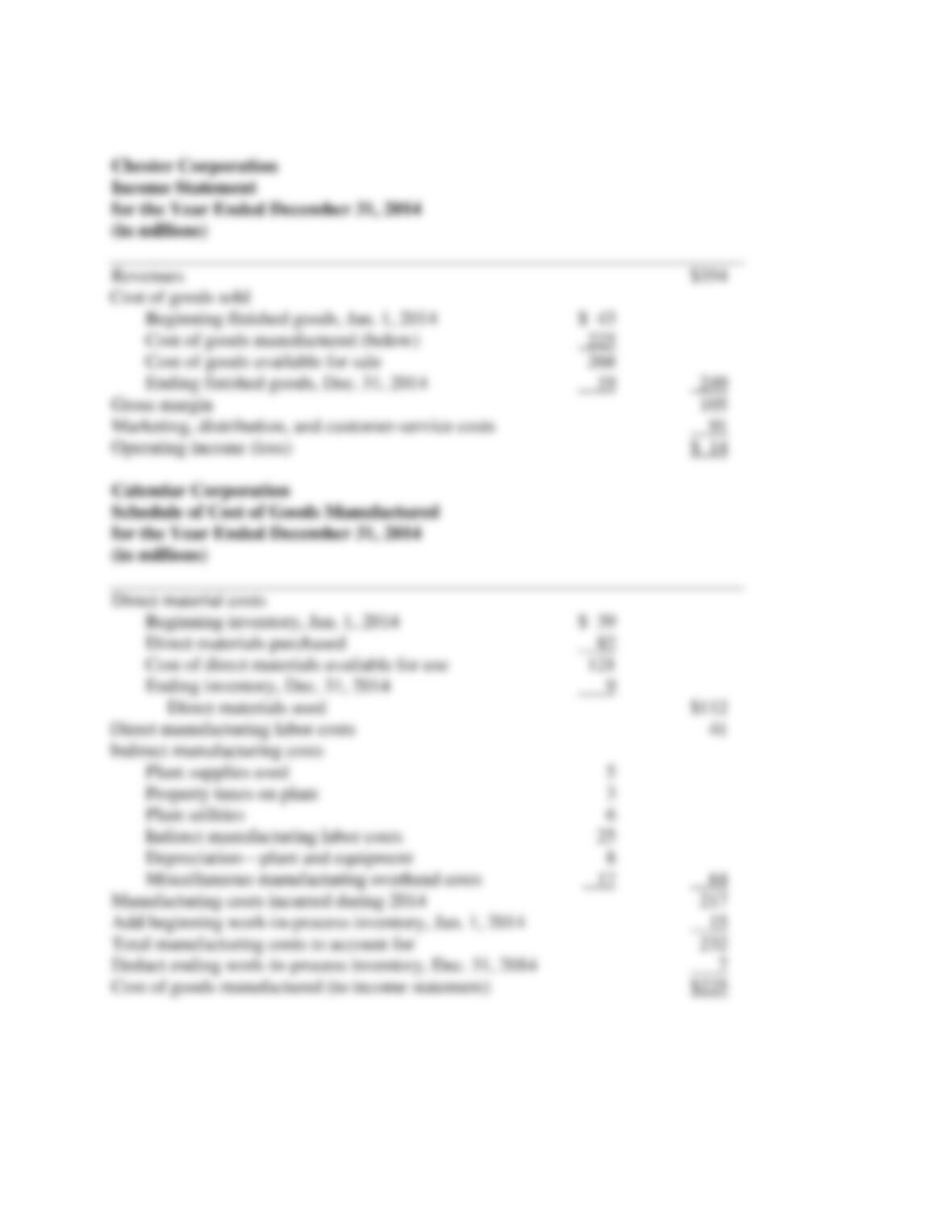
2-36 (25–30 min.) Income statement and schedule of cost of goods manufactured.
The following items (in millions) pertain to Chester Corporation:
Chester’s manufacturing costing system uses a three-part classification of direct
materials, direct manufacturing labor, and manufacturing overhead costs.
For Specific Date
For Year 2014
Work-in-process inventory, Jan. 1, 2014
$15
Plant utilities
$6
Direct materials inventory, Dec. 31, 2014
9
Indirect manufacturing labor
25
Finished goods inventory, Dec. 31, 2014
19
Depreciation—plant and equipment
8
Accounts payable, Dec. 31, 2014
28
Revenues
354
Accounts receivable, Jan. 1, 2014
57
Miscellaneous manufacturing overhead
17
Work-in-process inventory, Dec. 31, 2014
7
Marketing, distribution, and
customer-service costs
91
Finished goods inventory, Jan. 1, 2014
43
Direct materials purchased
82
Accounts receivable, Dec. 31, 2014
30
Direct manufacturing labor
41
Accounts payable, Jan. 1, 2014
40
Plant supplies used
5
Direct materials inventory, Jan. 1, 2014
39
Property taxes on plant
3
Required: Prepare an income statement and a supporting schedule of cost of goods
manufactured. (For additional questions regarding these facts, see the next problem.)
2-34
SOLUTION
2-35
2-37 (15–20 min.) Terminology, interpretation of statements (continuation of 2-36).
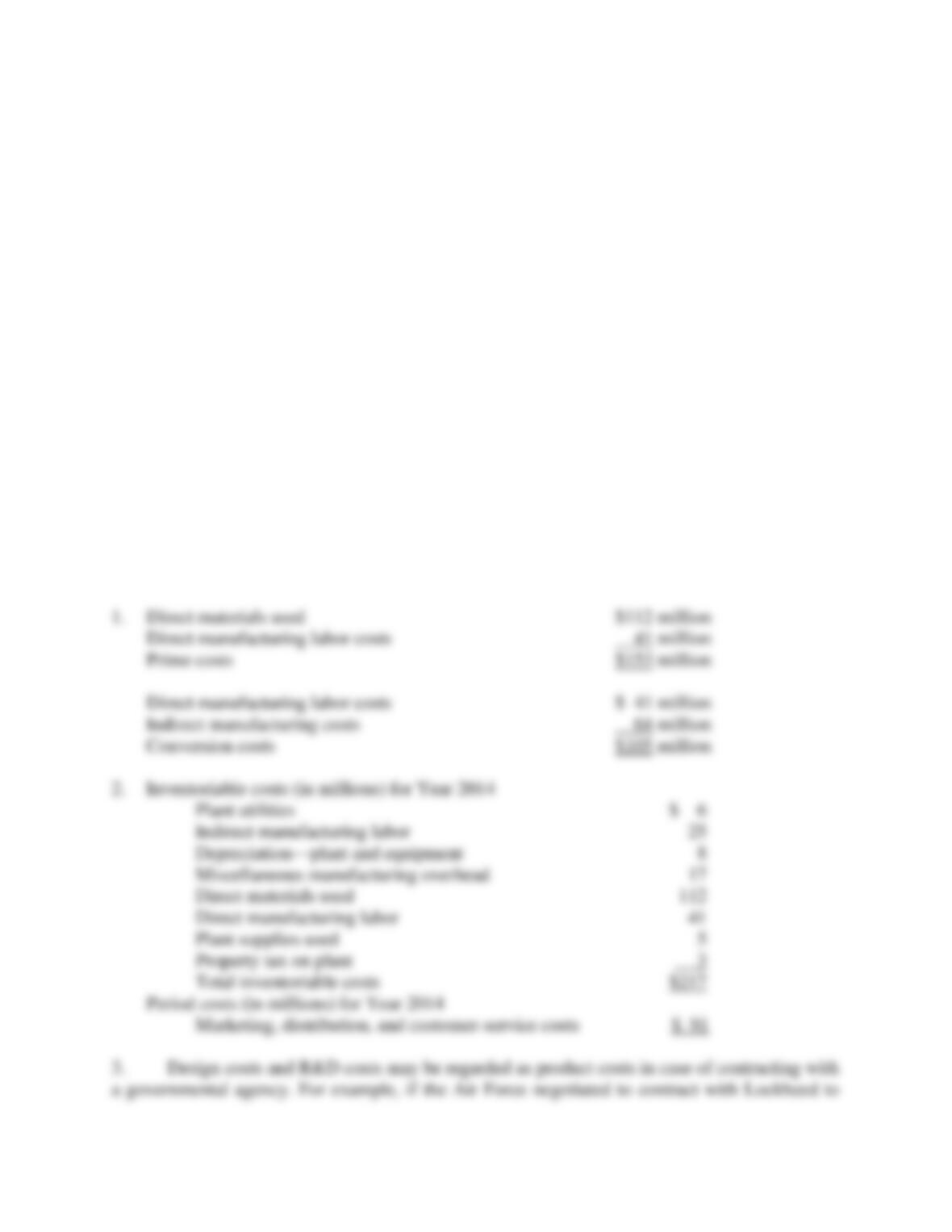
1. Calculate total prime costs and total conversion costs.
2. Calculate total inventoriable costs and period costs.
3. Design costs and R&D costs are not considered product costs for financial statement
purposes. When might some of these costs be regarded as product costs? Give an example.
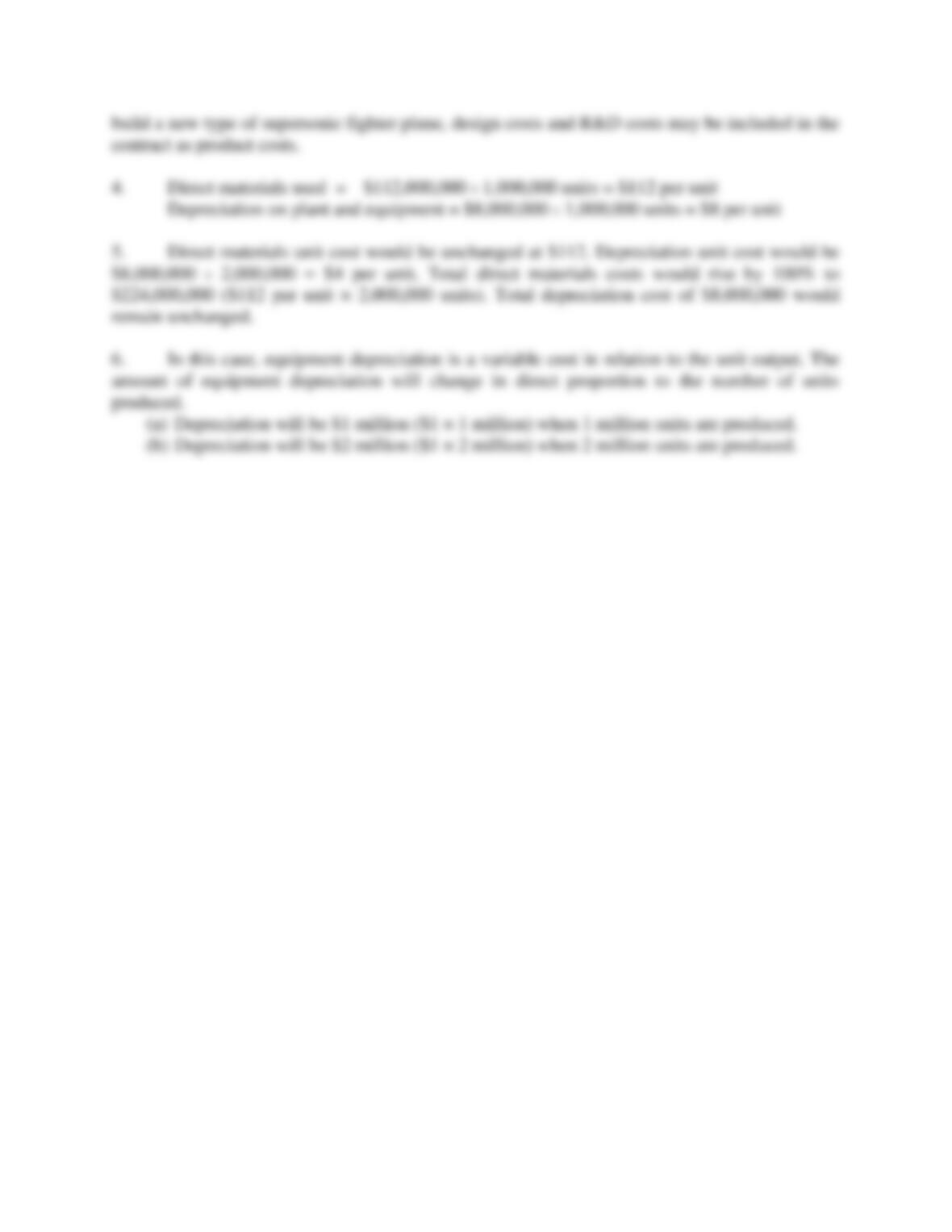
4. Suppose that both the direct materials used and the depreciation on plant and equipment are
related to the manufacture of 1 million units of product. Determine the unit cost for the direct
materials assigned to those units and the unit cost for depreciation on plant and equipment.
Assume that yearly depreciation is computed on a straight-line basis.
5. Assume that the implied cost-behavior patterns in requirement 4 persist. That is, direct
material costs behave as a variable cost and depreciation on plant and equipment behaves as
a fixed cost. Repeat the computations in requirement 4, assuming that the costs are being
predicted for the manufacture of 2 million units of product. Determine the effect on total
costs.
6. Assume that depreciation on the equipment (but not the plant) is computed based on the
number of units produced because the equipment deteriorates with units produced. The
depreciation rate on equipment is $1 per unit. Calculate the depreciation on equipment
assuming (a) 1 million units of product are produced and (b) 2 million units of product are
produced.
SOLUTION
2-36
2-38 (20 min.) Labor cost, overtime and idle time.
Louie Anderson works in the production department of Southwest Plasticworks as a machine
operator. Louie, a long-time employee of Southwest, is paid on an hourly basis at a rate of $20
per hour. Louie works five 8-hour shifts per week Monday–Friday (40 hours). Any time Louie
works over and above these 40 hours is considered overtime for which he is paid at a rate of time
and a half ($30 per hour). If the overtime falls on weekends, Louie is paid at a rate of double
time ($40 per hour). Louie is also paid an additional $20 per hour for any holidays worked, even
if it is part of his regular 40 hours. Louie is paid his regular wages even if the machines are down
(not operating) due to regular machine maintenance, slow order periods, or unexpected
mechanical problems. These hours are considered “idle time.”
During December Louie worked the following hours:
Included in the total hours worked are two company holidays (Christmas Eve and Christmas
Day) during Week 4. All overtime worked by Louie was Monday–Friday, except for the hours
worked in Week 3; all of the Week 3 overtime hours were worked on a Saturday.
Required:
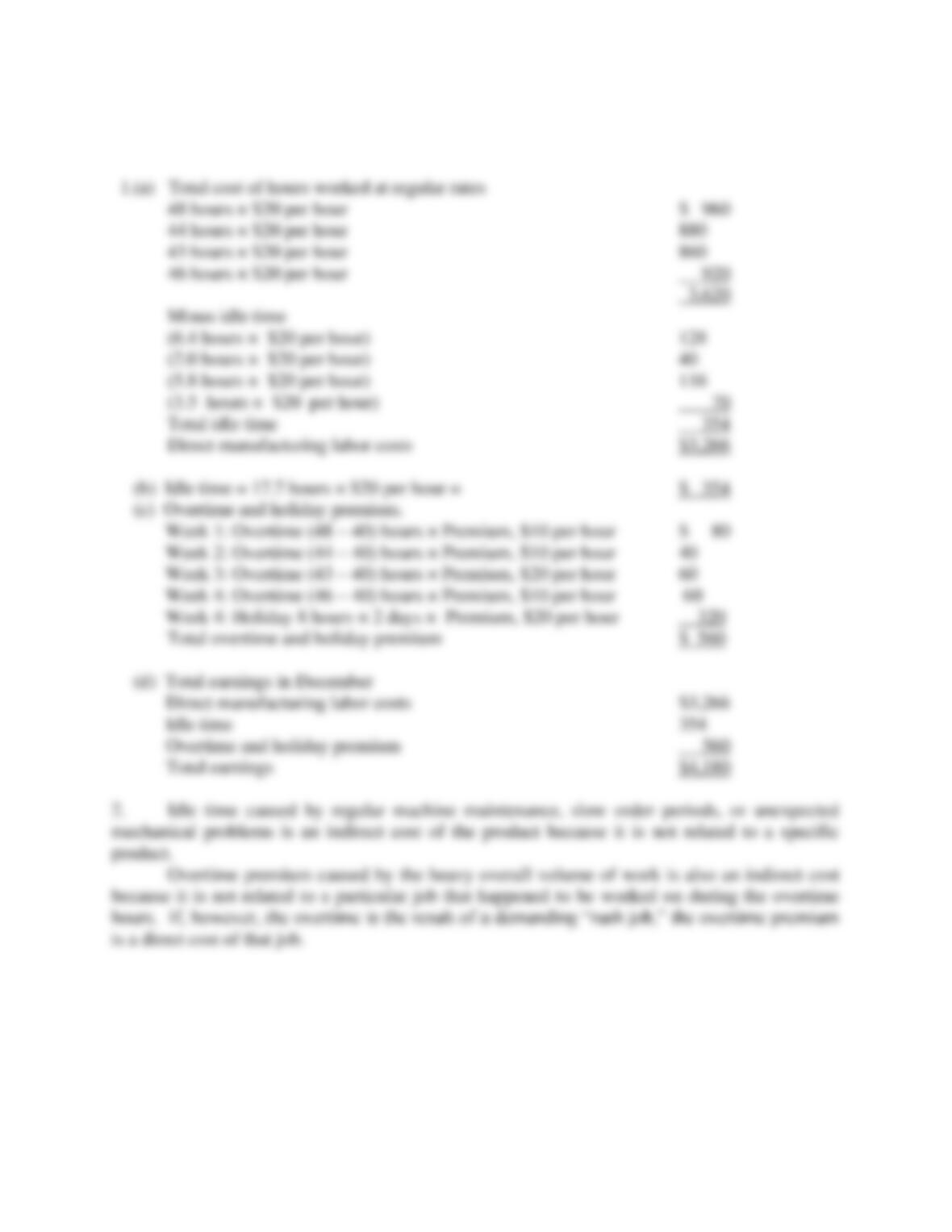
1. Calculate (a) direct manufacturing labor, (b) idle time, (c) overtime and holiday premium,
and (d) total earnings for Louie in December.
2. Is idle time and overtime premium a direct or indirect cost of the products that Louie worked
on in December? Explain.
Hours worked including
machine downtime
Machine downtime
Week 1
48
6.4
Week 2
44
2.0
Week 3
43
5.8
Week 4
46
3.5
2-37
SOLUTION
2-39 (30–40 min.) Missing records, computing inventory costs.
Ron Howard recently took over as the controller of Johnson Brothers Manufacturing. Last
month, the previous controller left the company with little notice and left the accounting records
in disarray. Ron needs the ending inventory balances to report first-quarter numbers.
2-38
For the previous month (March 2014) Ron was able to piece together the following
information:
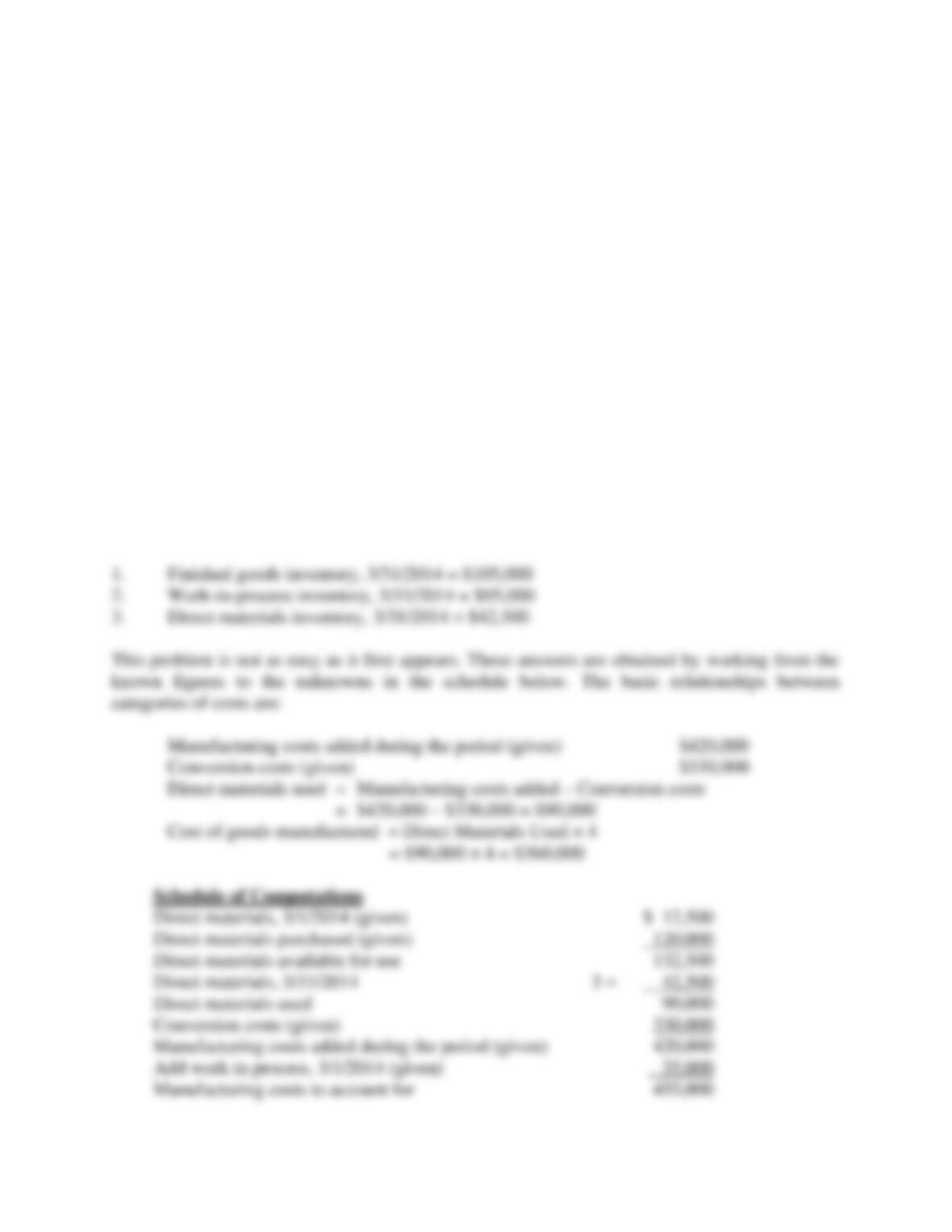
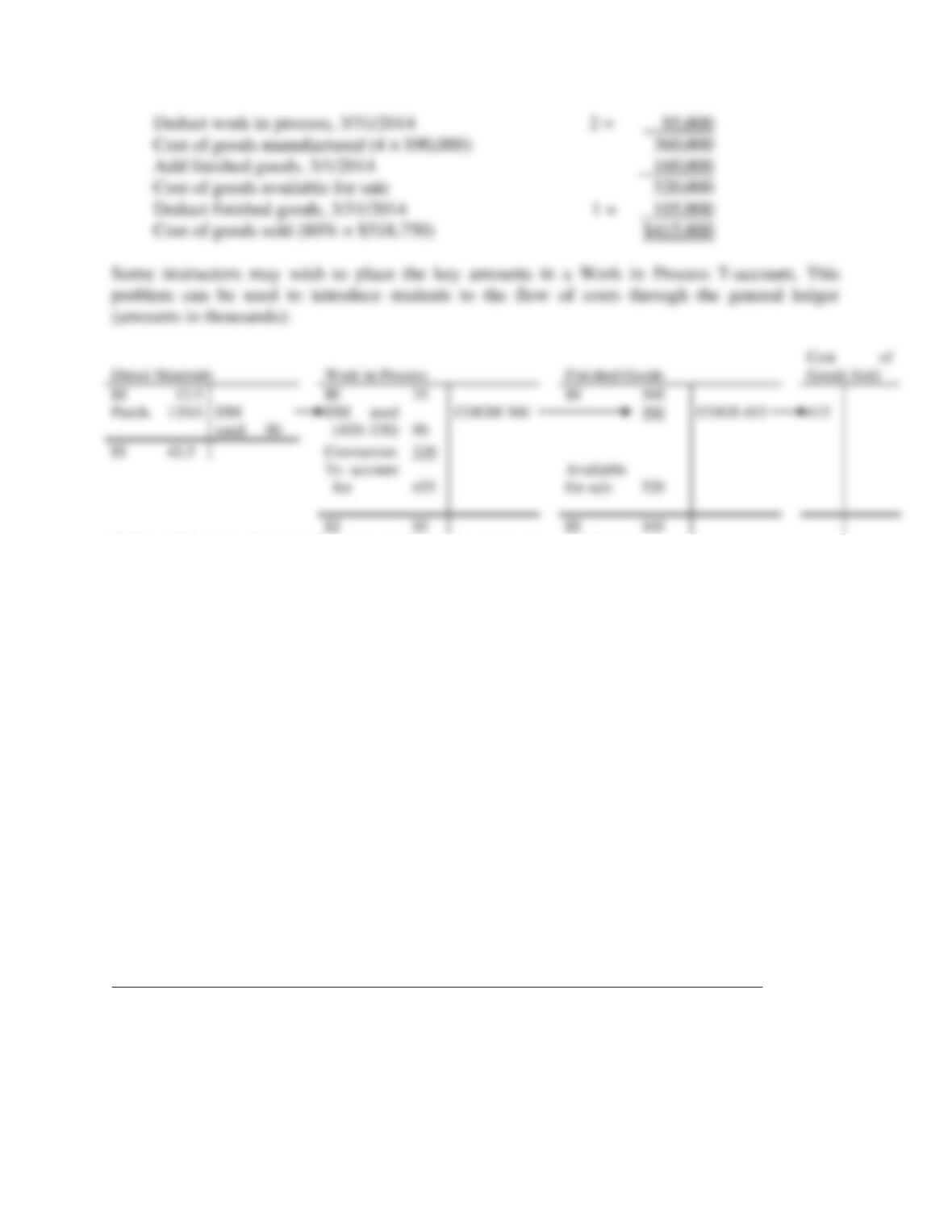
Required: Calculate the cost of:
1. Finished goods inventory, 3/31/2014
2. Work-in-process inventory, 3/31/2014
3. Direct materials inventory, 3/31/2014
SOLUTION
Direct materials purchased
$120,000
Work-in-process inventory, 3/1/2014
$ 35,000
Direct materials inventory, 3/1/2014
$ 12, 500
Finished goods inventory, 3/1/2014
$160,000
Conversion costs
$330,000
Total manufacturing costs added during the period
$420,000
Cost of goods manufactured
4 times direct materials
Gross margin as a percentage of revenues
20%
Revenues
$518,750
2-39
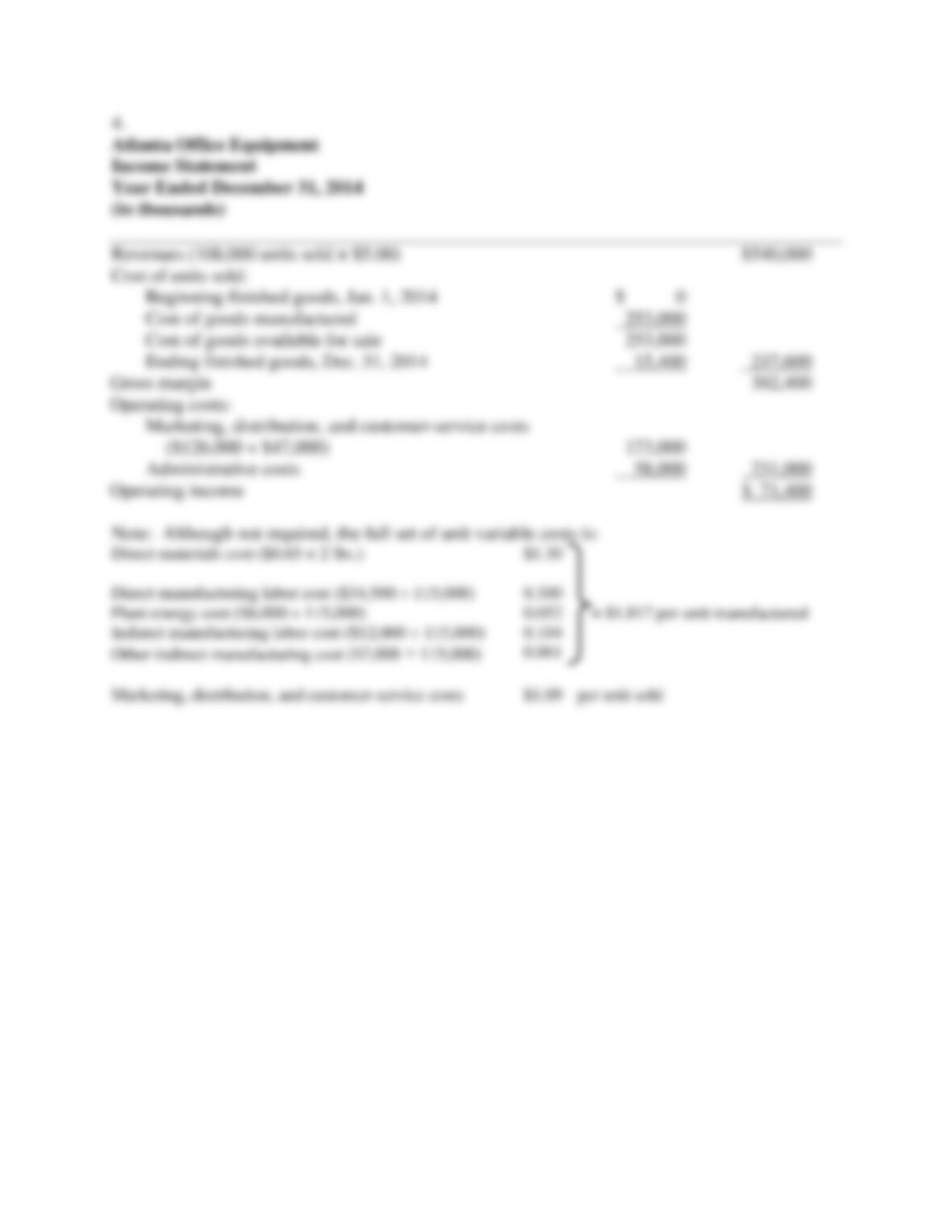
2-40 (30 min.) Comprehensive problem on unit costs, product costs.
Atlanta Office Equipment manufactures and sells metal shelving. It began operations on January
1, 2014. Costs incurred for 2014 are as follows (V stands for variable; F stands for fixed):
Direct materials used
$149,500 V
Direct manufacturing labor costs
34,500 V
Plant energy costs
6,000 V
Indirect manufacturing labor costs
12,000 V
Indirect manufacturing labor costs
17,000 F
Other indirect manufacturing costs
7,000 V
Other indirect manufacturing costs
27,000 F
Marketing, distribution, and customer-service costs
126,000 V
Marketing, distribution, and customer-service costs
47,000 F
Administrative costs
58,000 F
Variable manufacturing costs are variable with respect to units produced. Variable marketing,
distribution, and customer-service costs are variable with respect to units sold.
Inventory data are as follows:
Beginning: January 1, 2014
Ending: December 31, 2014
Direct materials
0 lb
2,300 lbs
Work in process
0 units
0 units
Finished goods
0 units
? units
Production in 2014 was 115,000 units. Two pounds of direct materials are used to make one unit
of finished product.
2-40
Revenues in 2014 were $540,000. The selling price per unit and the purchase price per
pound of direct materials were stable throughout the year. The company’s ending inventory of
finished goods is carried at the average unit manufacturing cost for 2014. Finished-goods
inventory at December 31, 2014, was $15,400.
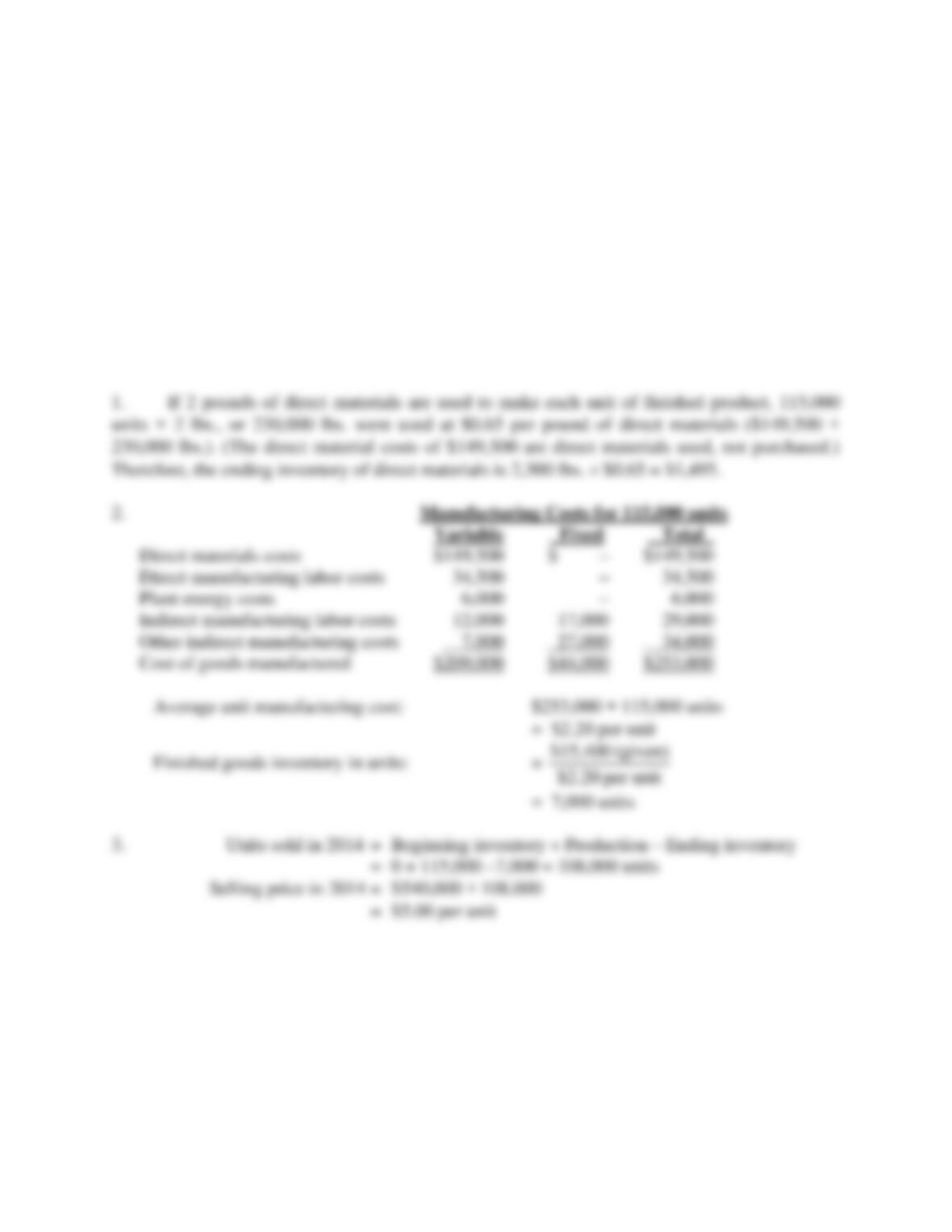
Required:
1. Calculate direct materials inventory, total cost, December 31, 2014.
2. Calculate finished-goods inventory, total units, December 31, 2014.
3. Calculate selling price in 2014.
4. Calculate operating income for 2014.
SOLUTION
2-41
2-41 (20-25 min.) Classification of costs; ethics.
Jason Hand, the new plant manager of Old Tree Manufacturing Plant Number 7, has just
reviewed a draft of his year-end financial statements. Hand receives a year-end bonus of 8% of
the plant’s operating income before tax. The year–end income statement provided by the plant’s
controller was disappointing to say the least. After reviewing the numbers, Hand demanded that
his controller go back and “work the numbers” again. Hand insisted that if he didn’t see a better
operating income number the next time around he would be forced to look for a new controller.
Old Tree Manufacturing classifies all costs directly related to the manufacturing of its
product as product costs. These costs are inventoried and later expensed as costs of goods sold
when the product is sold. All other expenses, including finished goods warehousing costs of
$3,570,000, are classified as period expenses. Hand had suggested that warehousing costs be
included as product costs because they are “definitely related to our product.” The company
produced 210,000 units during the period and sold 190,000 units.
2-42
As the controller reworked the numbers, he discovered that if he included warehousing
costs as product costs, he could improve operating income by $340,000. He was also sure these
new numbers would make Hand happy.
Required:
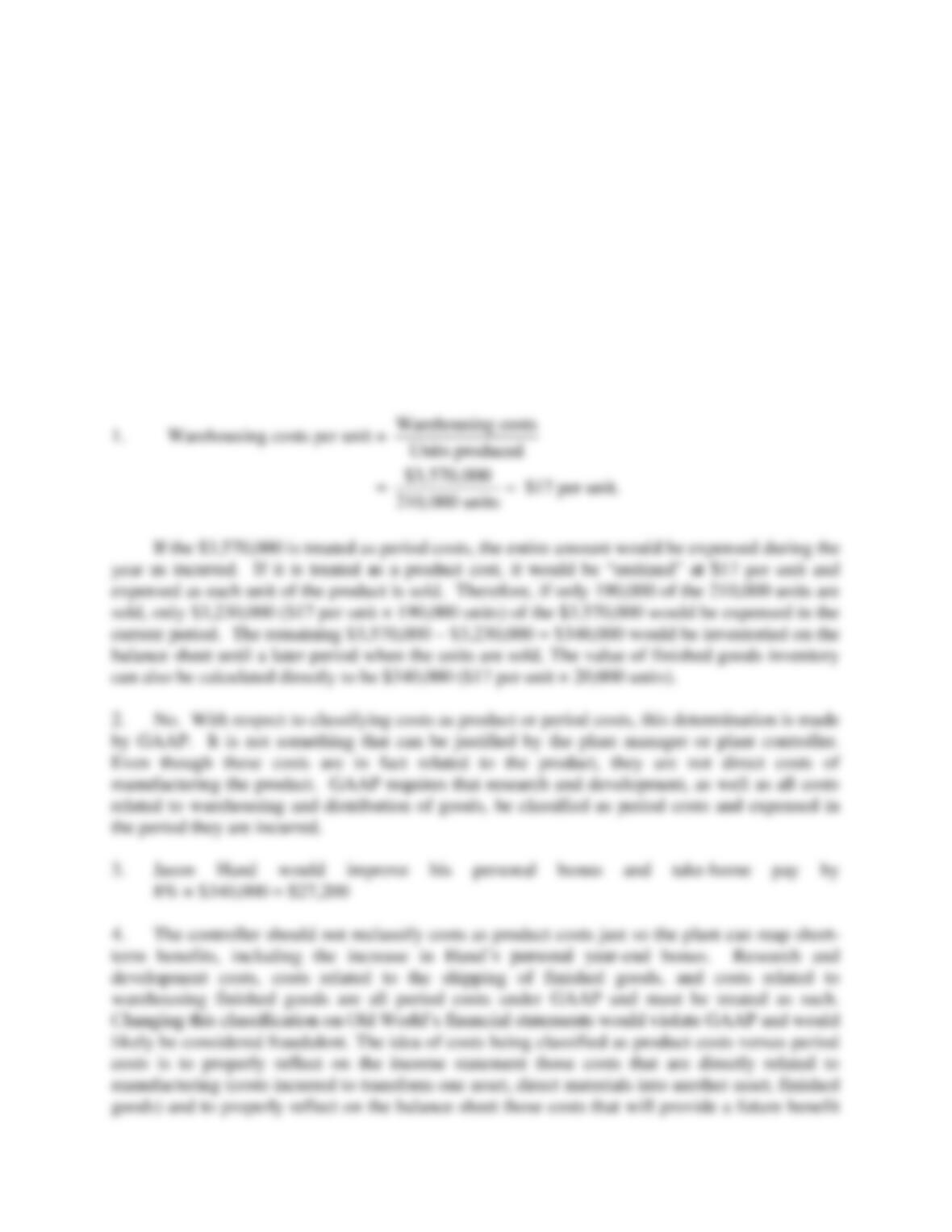
1. Show numerically how operating income would improve by $340,000 just by classifying the
preceding costs as product costs instead of period expenses.
2. Is Hand correct in his justification that these costs are “definitely related to our product”?
3. By how much will Hand profit personally if the controller makes the adjustments in
requirement 1?
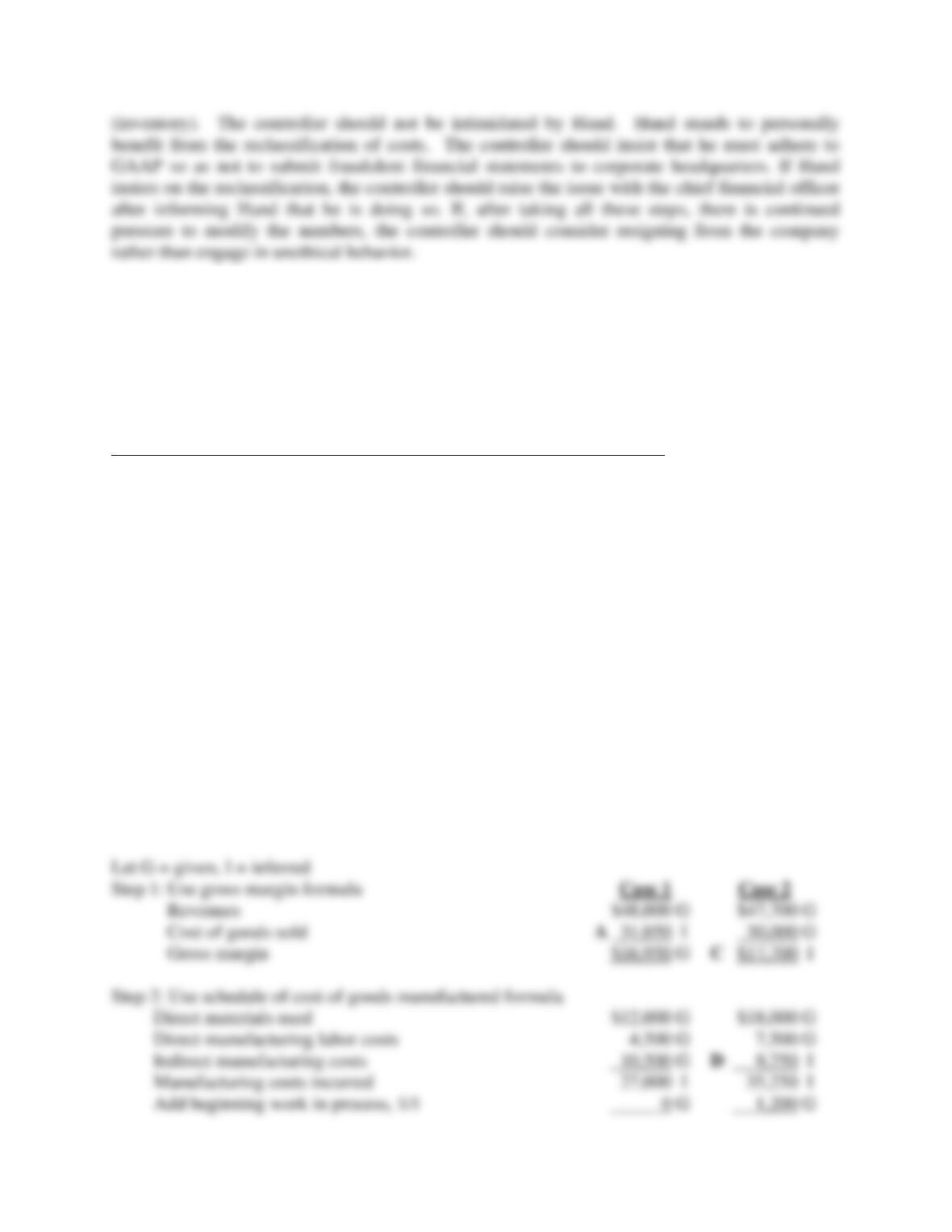
4. What should the plant controller do?
SOLUTION
2-43
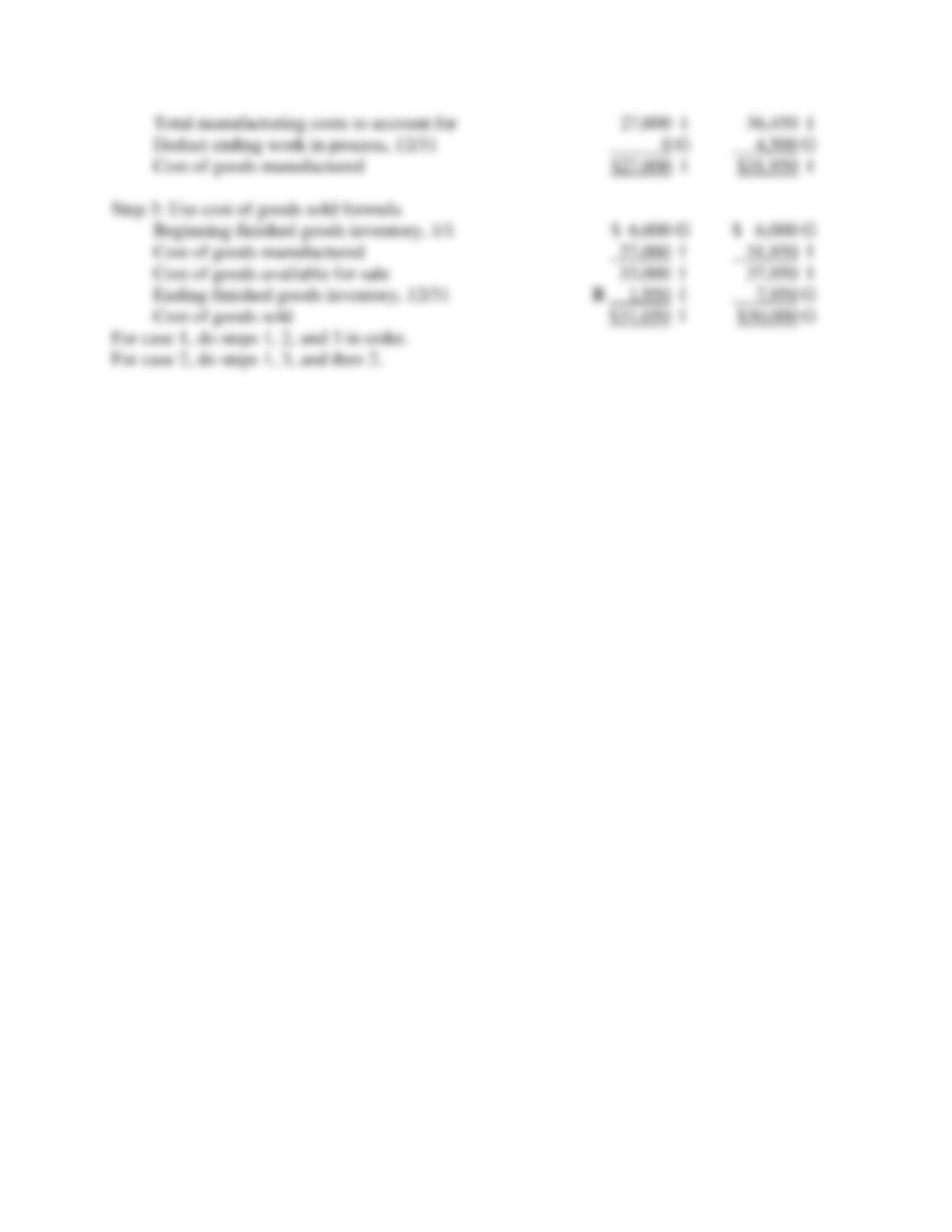
2-42 (20–25 min.) Finding unknown amounts.
An auditor for the Internal Revenue Service is trying to reconstruct some partially destroyed
records of two taxpayers. For each of the cases in the accompanying list, find the unknowns
designated by the letters A through D.
Case 1
(in thousands)
Case 2
Accounts receivable, 12/31
$ 9,000
$ 3,150
Cost of goods sold
A
30,000
Accounts payable, 1/1
4,500
2,550
Accounts payable, 12/31
2,700
2,250
Finished goods inventory, 12/31
B
7,950
Gross margin
16,950
C
Work-in-process inventory, 1/1
0
1,200
Work-in-process inventory, 12/31
0
4,500
Finished goods inventory, 1/1
6,000
6,000
Direct materials used
12,000
18,000
Direct manufacturing labor
4,500
7,500
Manufacturing overhead costs
10,500
D
Purchases of direct materials
13,500
10,500
Revenues
48,000
47,700
Accounts receivable, 1/1
3,000
2,100
SOLUTION
2-44