1. An account is a form designed to record changes in a particular asset, liability, owner’s equity,
revenue, or expense. A ledger is a group of related accounts.
2. The terms debit and credit may signify either an increase or a decrease, depending upon the nature
of the account. For example, debits signify an increase in asset and expense accounts but a decrease
in liability, owner’s equity, and revenue accounts.
5. No. Errors may have been made that had the same erroneous effect on both debits and credits, such
as failing to record and/or post a transaction, recording the same transaction more than once, and
p
osting a transaction correctly but to the wrong account.
6. Recording $9,800 instead of the correct amount of $8,900 is a transposition. Recording $100 instead
of the correct amount of $1,000 is a slide.
7. a. No. Because the same error occurred on both the debit side and the credit side of the trial
b
alance, the trial balance would not be out of balance.
b. Yes. The trial balance would not balance. The error would cause the debit total of the trial
b
alance to exceed the credit total by $90.
9. a. The equality of the trial balance would not be affected.
b. On the income statement, revenues (fees earned) would be overstated by $300,000, and net
income would be overstated by $300,000. On the statement of owner’s equity, the beginning
capital would be correct. However, net income and ending capital would be overstated by
$300,000. The balance sheet total assets is correct. However, liabilities (notes payable) is
understated by $300,000, and owner’s equity is overstated by $300,000. The understatement
of liabilities is offset by the overstatement of owner’s equity, and thus, total liabilities and
owner’s equity is correct.
CHAPTER 2
ANALYZING TRANSACTIONS
DISCUSSION QUESTIONS
CHAPTER 2 Analyzing Transactions
PE 2-1A
1. Debit and credit entries (c), normal debit balance
2. Credit entries only (b), normal credit balance
3. Credit entries only (b), normal credit balance
PE 2-1B
1. Debit and credit entries (c), normal credit balance
2. Debit and credit entries (c), normal debit balance
3. Debit entries only (a), normal debit balance
PE 2-2A
Feb. 19 Office Equipment 14,800
PE 2-2B
Sept. 30 Office Supplies 1,900
Cash 600
PRACTICE EXERCISES
CHAPTER 2 Analyzing Transactions
PE 2-3A
Apr. 30 Accounts Receivable 12,980
Fees Earned 12,980
PE 2-3B
PE 2-4A
Dec. 23 Graeme Schneider, Drawing 27,000
Cash 27,000
PE 2-4B
PE 2-5A
Using the following T account, solve for the amount of cash receipts (indicated
by ? below).
July 1 Bal. 42,830 132,500 Cash payments
Cash receipts ?
PE 2-5B
Using the following T account, solve for the amount of supplies expense
(indicated by ? below).
Aug. 1 Bal. 1,240 ? Supplies expense
Cash
Supplies
CHAPTER 2 Analyzing Transactions
PE 2-6A
a. The trial balance totals are unequal. The debit total is higher by $900 ($9,800 –
$8,900).
b. The trial balance totals are equal because both the debit and credit entries were
PE 2-6B
a. The trial balance totals are equal because both the debit and credit entries were
journalized and posted for $14,200.
b. The trial balance totals are unequal. The credit total is higher by $360 ($1,730 –
$1,370).
CHAPTER 2 Analyzing Transactions
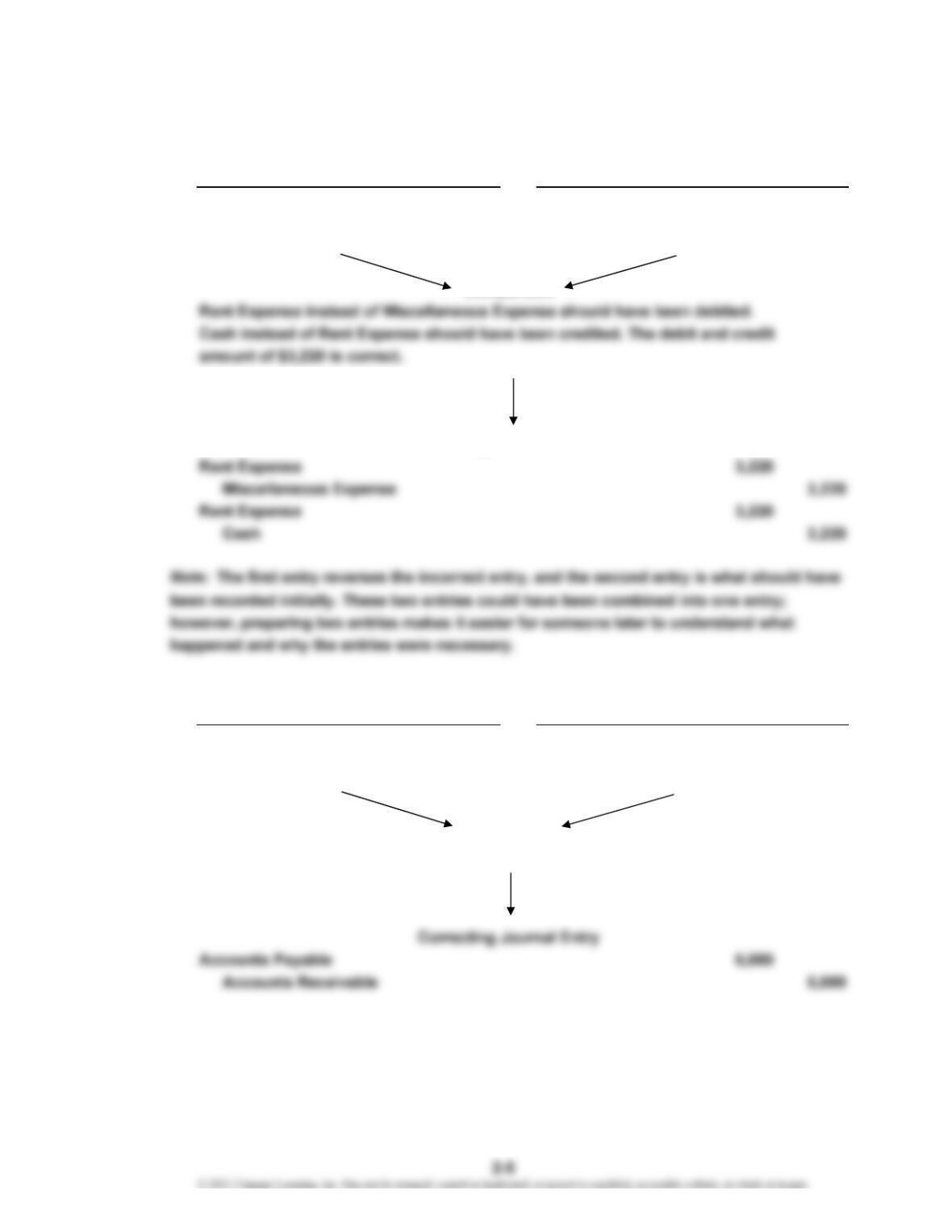
PE 2-7A
a.
Miscellaneous Expense 3,220 Rent Expense 3,220
Rent Expense 3,220 Cash 3,220
b.
Cash 5,080 Cash 5,080
Accounts Payable 5,080 Accounts Receivable 5,080
Accounts Receivable instead of Accounts Payable should have been credited.
Comparison
Made in Error Have Been Made
Journal Entry That Was Journal Entry That Should
Journal Entry That Was Journal Entry That Should
Made in Error Have Been Made
Correcting Journal Entries
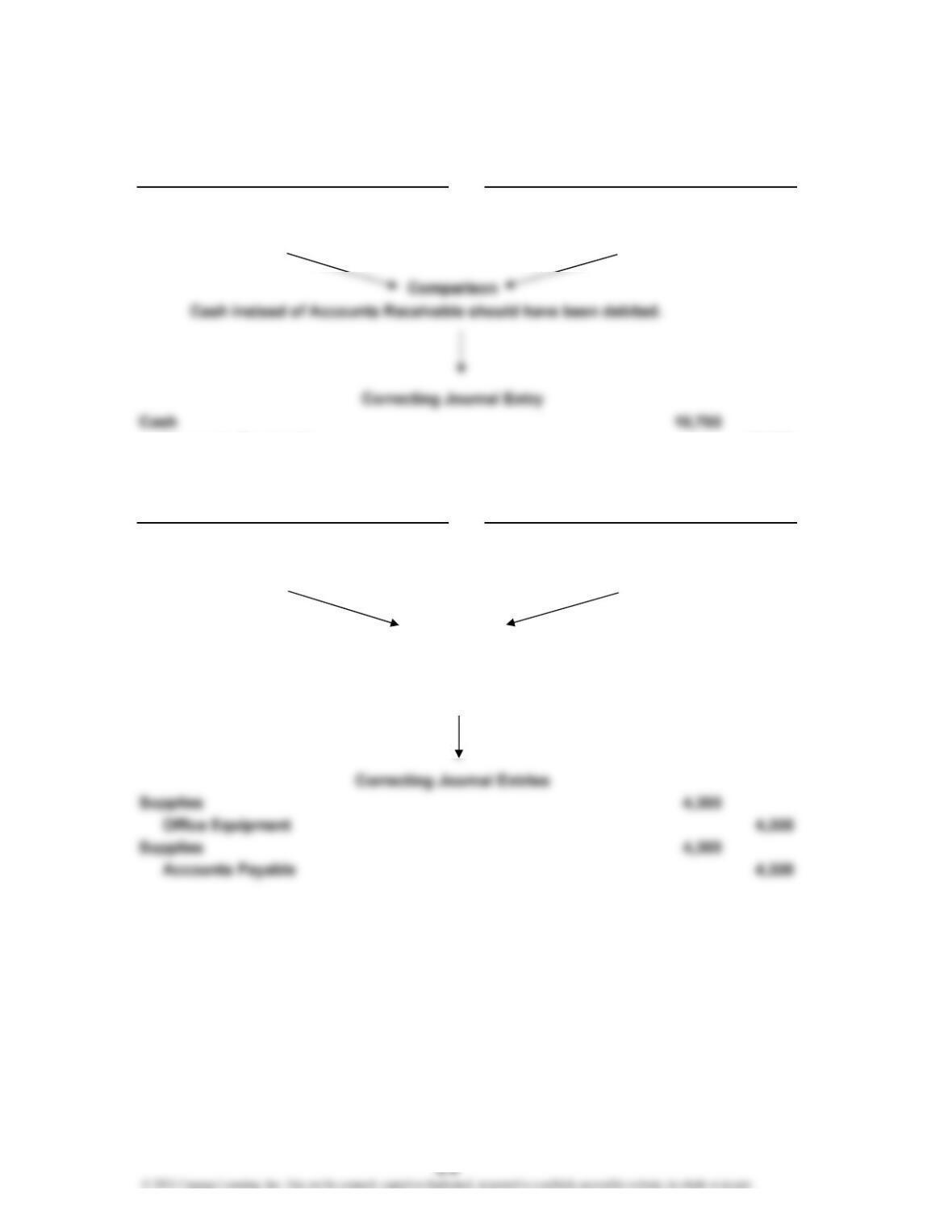
CHAPTER 2 Analyzing Transactions
PE 2-7B
a.
Accounts Receivable 10,700 Cash 10,700
Fees Earned 10,700 Fees Earned 10,700
Accounts Receivable 10,700
b.
Office Equipment 4,300 Supplies 4,300
Supplies 4,300 Accounts Payable 4,300
Supplies instead of Office Equipment should have been debited.
Accounts Payable instead of Supplies should have been credited.
The debit and credit amount of $4,300 is correct.
Note: The first entry reverses the incorrect entry, and the second entry is what should have
been recorded initially. These two entries could have been combined into one entry;
however, preparing two entries makes it easier for someone later to understand what
happened and why the entries were necessary.
Journal Entry That Was Journal Entry That Should
Made in Error Have Been Made
Journal Entry That Was Journal Entry That Should
Made in Error Have Been Made
Comparison
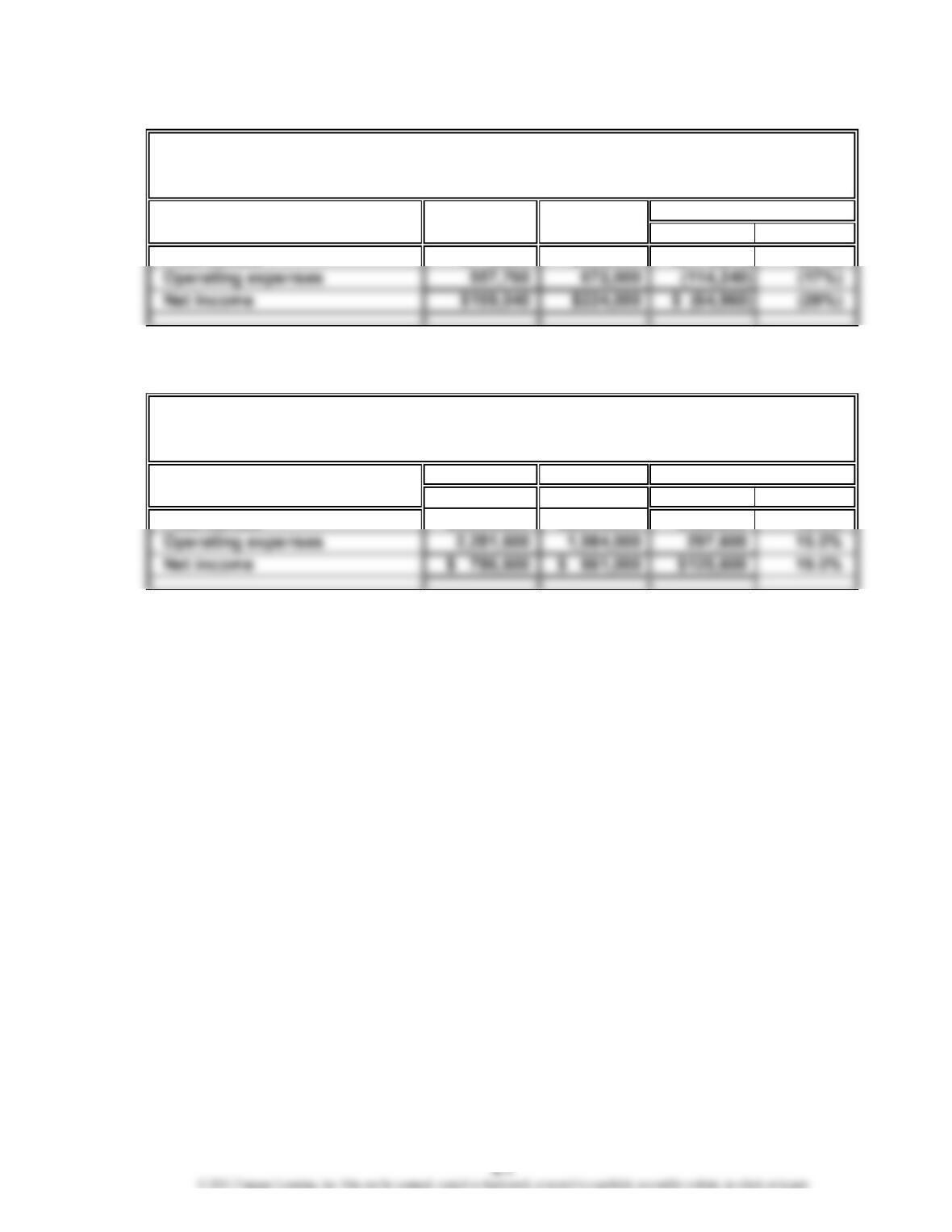
CHAPTER 2 Analyzing Transactions
PE 2-8A
20Y1 20Y0 Amount Percent
Fees earned $716,800 $896,000 $(179,200) (20%)
PE 2-8B
20Y1 20Y0
Amount Percent
Vaughn Company
Income Statements
For the Years Ended December 31
Increase/(Decrease)
Increase/(Decrease)
Satterfield Company
Income Statements
For the Years Ended December 31
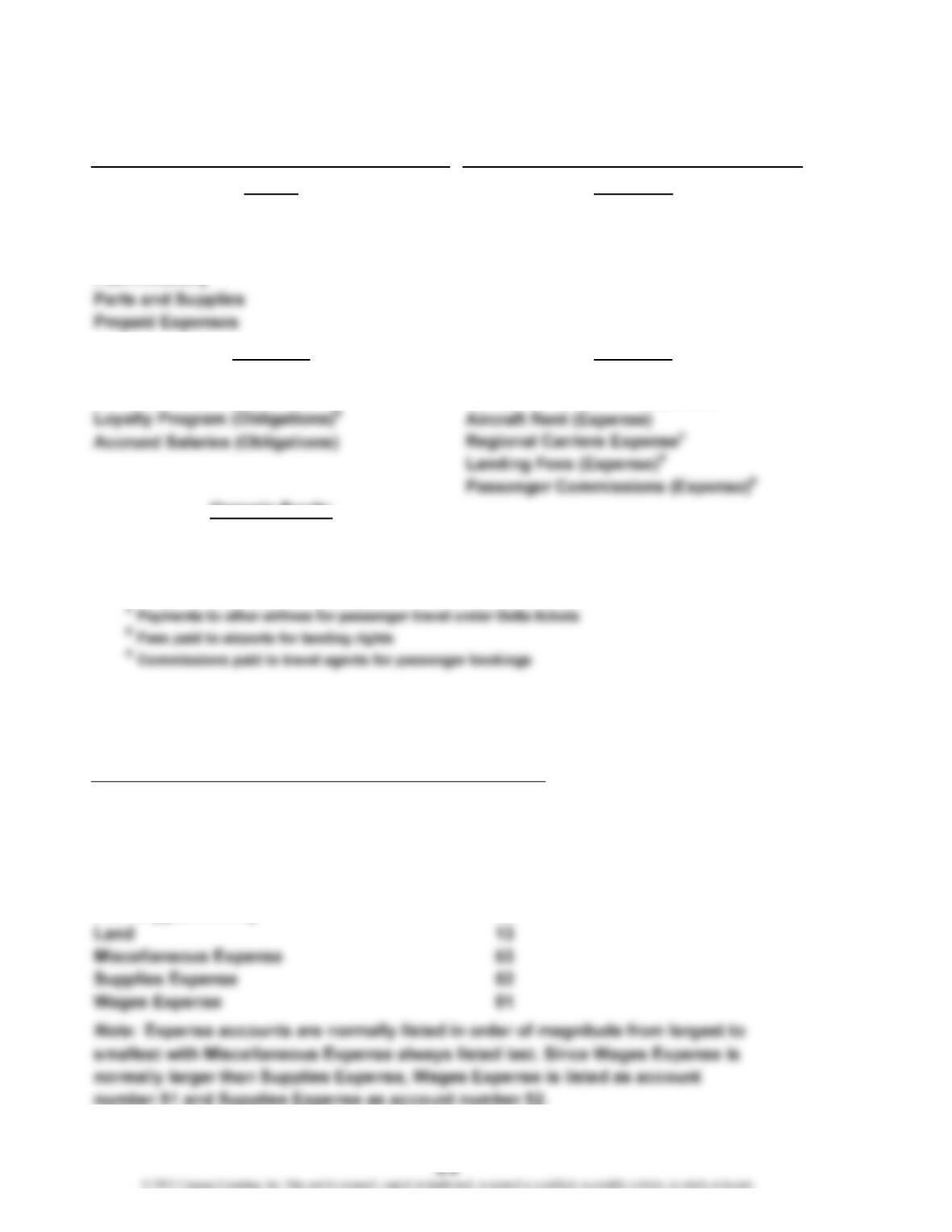
CHAPTER 2 Analyzing Transactions
Ex. 2-1
Cash Cargo Revenue
Accounts Receivable Passenger Revenue
Property and Equipment
Accounts Payable Aircraft Fuel (Expense)
Air Traffic LiabilityaAircraft Maintenance (Expense)
b
d
None
aPassenger ticket sales for future flights
b
Obligations to provide frequent flyers future travel and other benefits
d
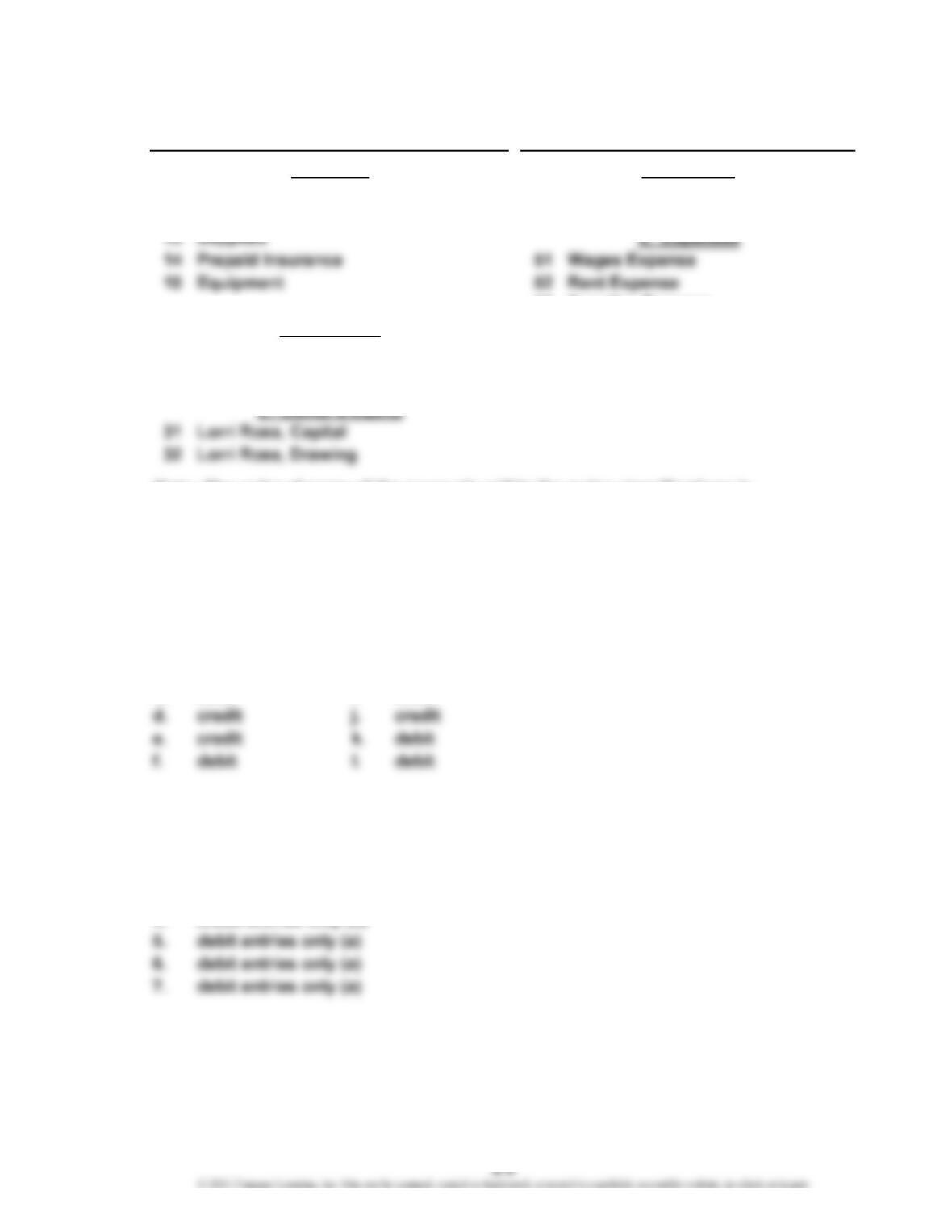
Ex. 2-2
Account
Number
Accounts Payable 21
Accounts Receivable 12
Cash 11
Fees Earned 41
Fred Biggs, Capital 31
Fred Biggs, Drawing 32
Expenses
Liabilities
Owner’s Equity
Account
EXERCISES
Assets Revenues
Balance Sheet Accounts Income Statement Accounts
CHAPTER 2 Analyzing Transactions
Ex. 2-3
11 Cash 41 Fees Earned
12 Accounts Receivable
53 Supplies Expense
59 Miscellaneous Expense
21 Accounts Payable
22 Unearned Rent
Note: The order of some of the accounts within the major classifications is
somewhat arbitrary, as in accounts 13–14, accounts 21–22, and accounts 51–53.
In a new business, the order of magnitude of balances in such accounts is not
determinable in advance. The magnitude may also vary from period to period.
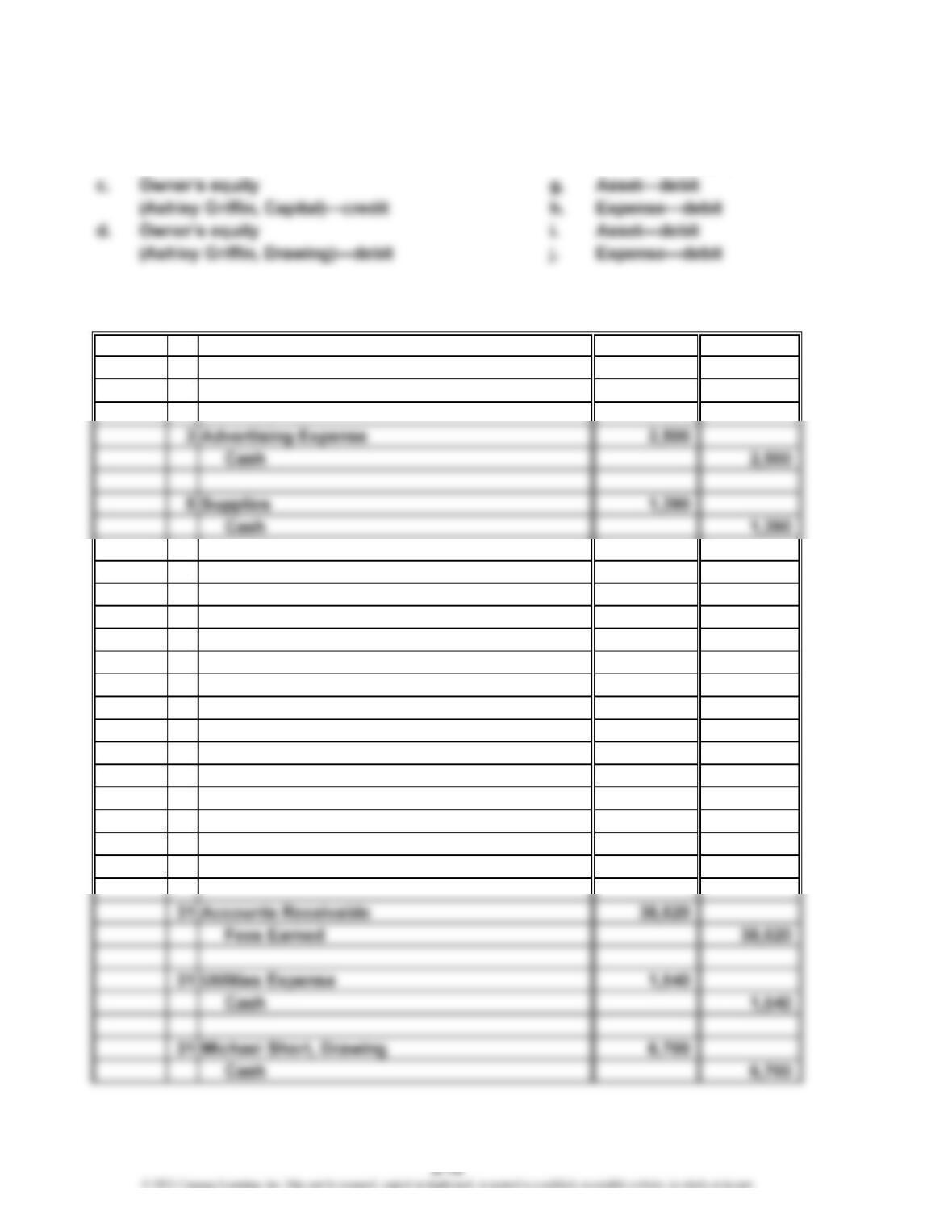
Ex. 2-4
a. debit g. debit
b. credit h. credit
c. debit i. debit
Ex. 2-5
1. debit and credit entries (c)
2. debit and credit entries (c)
3. debit and credit entries (c)
2. Liabilities
1. Assets 4. Revenue
Balance Sheet Accounts Income Statement Accounts
CHAPTER 2 Analyzing Transactions
Ex. 2-6
a. Liability—credit e. Asset—debit
b. Asset—debit f. Revenue—credit
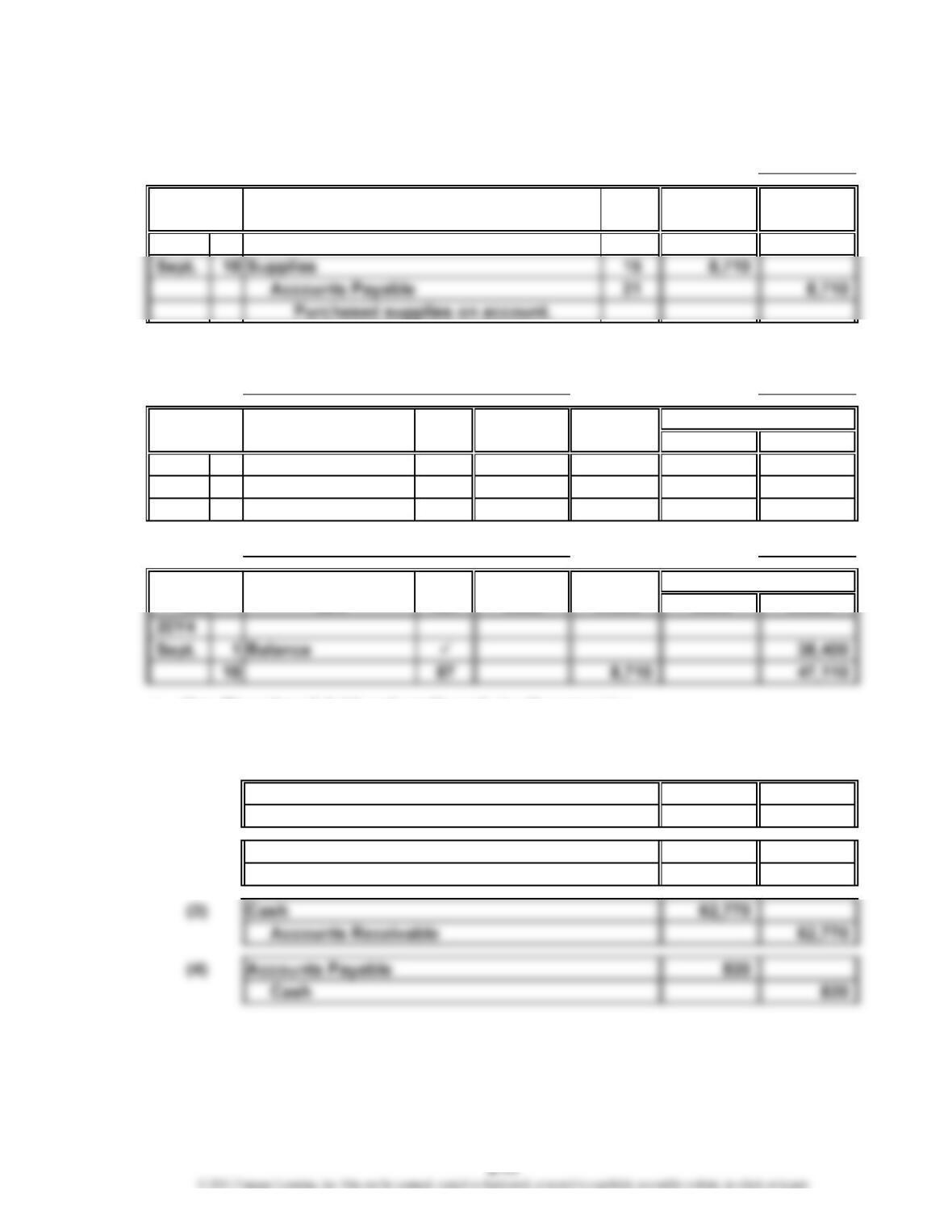
Ex. 2-7
20Y3
Oct. 1 Rent Expense 4,800
Cash 4,800
6 Office Equipment 10,670
Accounts Payable 10,670
10 Cash 19,730
Accounts Receivable 19,730
15 Accounts Payable 9,480
Cash 9,480
27 Miscellaneous Expense 530
Cash 530
30 Utilities Expense 220
Cash 220
CHAPTER 2 Analyzing Transactions
Ex. 2-8
a.
Page 87
Post.
Ref. Debit Credit
20Y4
b., c., d.
Account No. 15
Post.
Ref. Debit Debit Credit
20Y4
Sept. 1 Balance 2,960
18 87 8,710 11,670
Account No. 21
Post.
e. Yes. The rules of debit and credit apply to all companies.
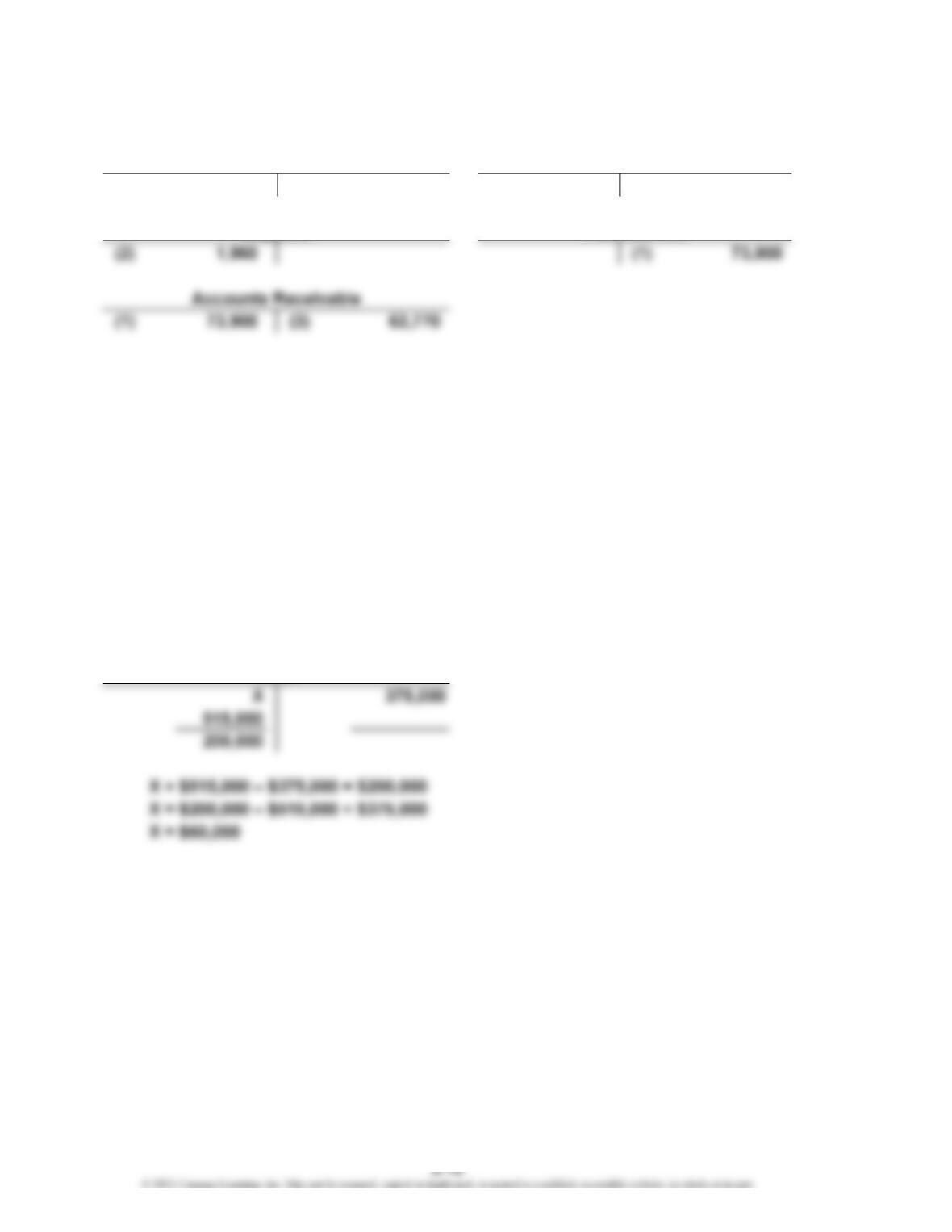
Ex. 2-9
a. (1) Accounts Receivable 73,900
Fees Earned 73,900
(2) Supplies 1,960
Accounts Payable 1,960
Balance
Credit
Balance
JOURNAL
Account:
Account: Supplies
Accounts Payable
Date
Date Description
Item
CHAPTER 2 Analyzing Transactions
Ex. 2-9 (Concluded)
b.
(3) 62,770 (4) 820 (4) 820 (2) 1,960
c. No. An error may not have necessarily occurred. A credit balance in Accounts
Receivable could occur if a customer overpaid his or her account. Regardless,
the credit balance should be investigated to verify that an error has not occurred.
Ex. 2-10
a. The increase of $140,000 ($515,000 – $375,000) in the cash account does not
indicate net income of that amount. Net income is the excess of revenues
over expenses and is normally not the same as the change in the cash account.
b. $60,000 ($200,000 – $140,000)
or
Cash
Cash Accounts Payable
Supplies Fees Earned
CHAPTER 2 Analyzing Transactions
Ex. 2-11
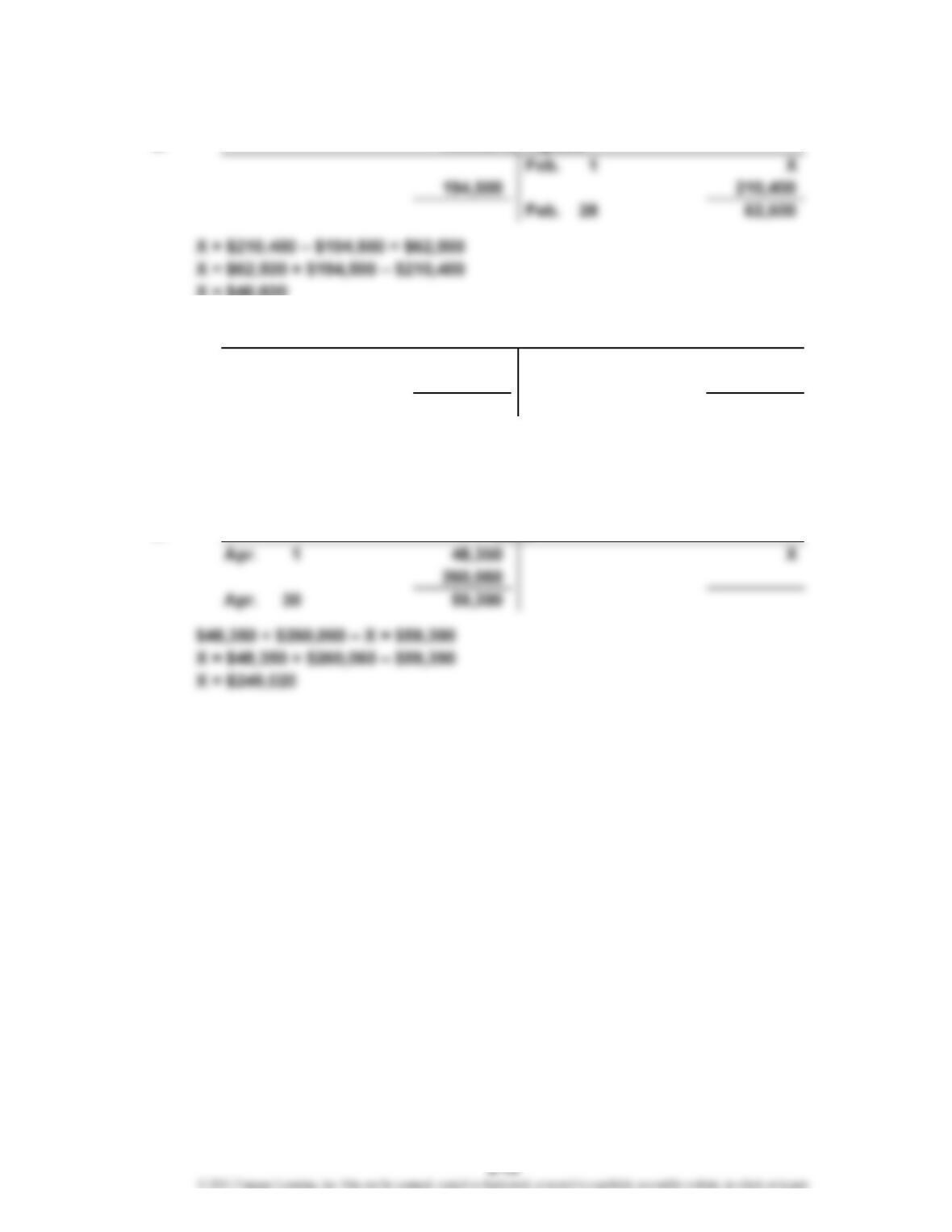
X = $46,600
b.
Oct. 1 121,100 470,500
X
Oct. 31 136,800
$121,100 + X – $470,500 = $136,800
X = $136,800 + $470,500 – $121,100
X = $486,200
c.
Ex. 2-12
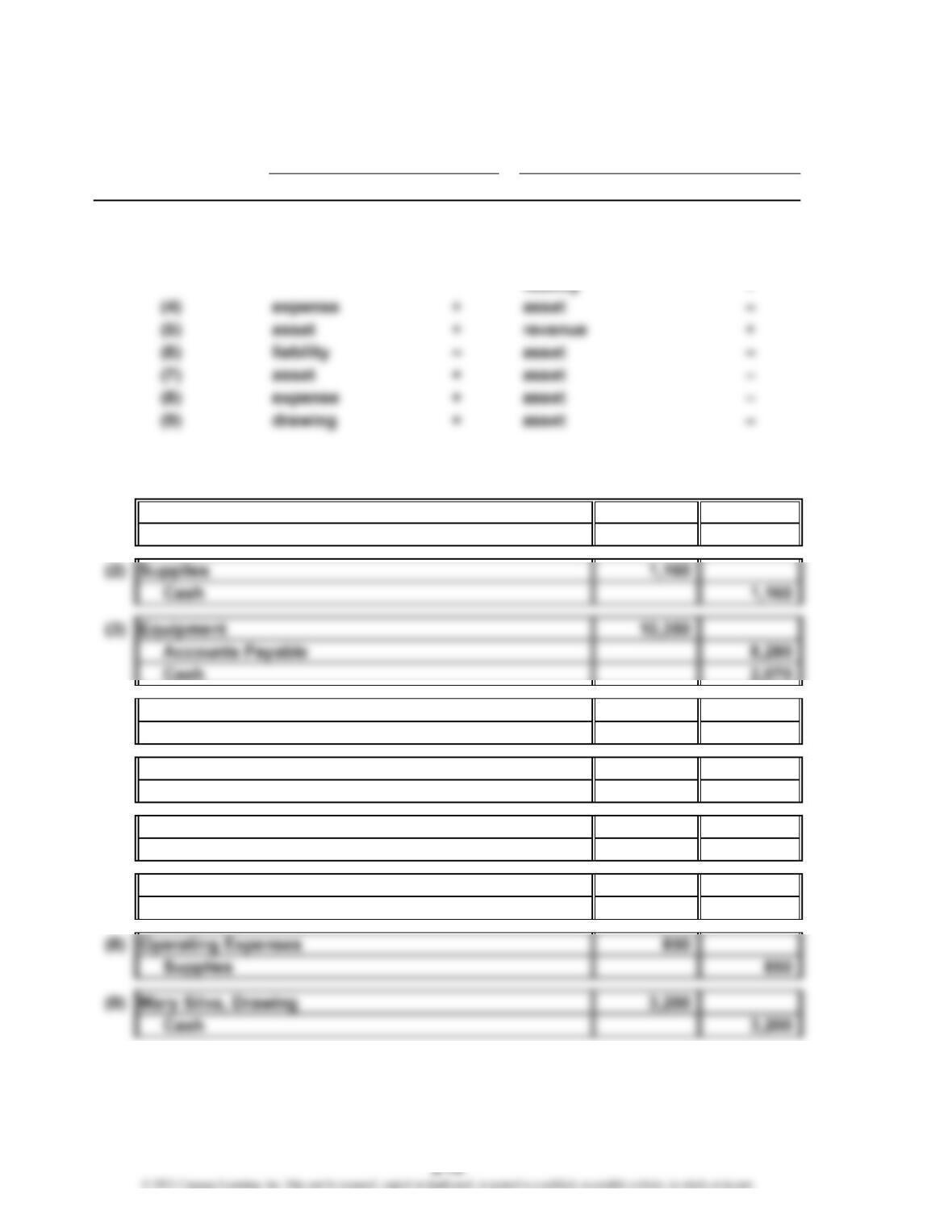
a. Credit balance of $170,000 ($500,000 – $10,000 – $320,000).
b. Yes. The balance sheet prepared at December 31 will balance, with Terrace
Waters, Capital, being reported in the owner’s equity section as $170,000.
Cash
Accounts Receivable
CHAPTER 2 Analyzing Transactions
Ex. 2-13
a. and b.
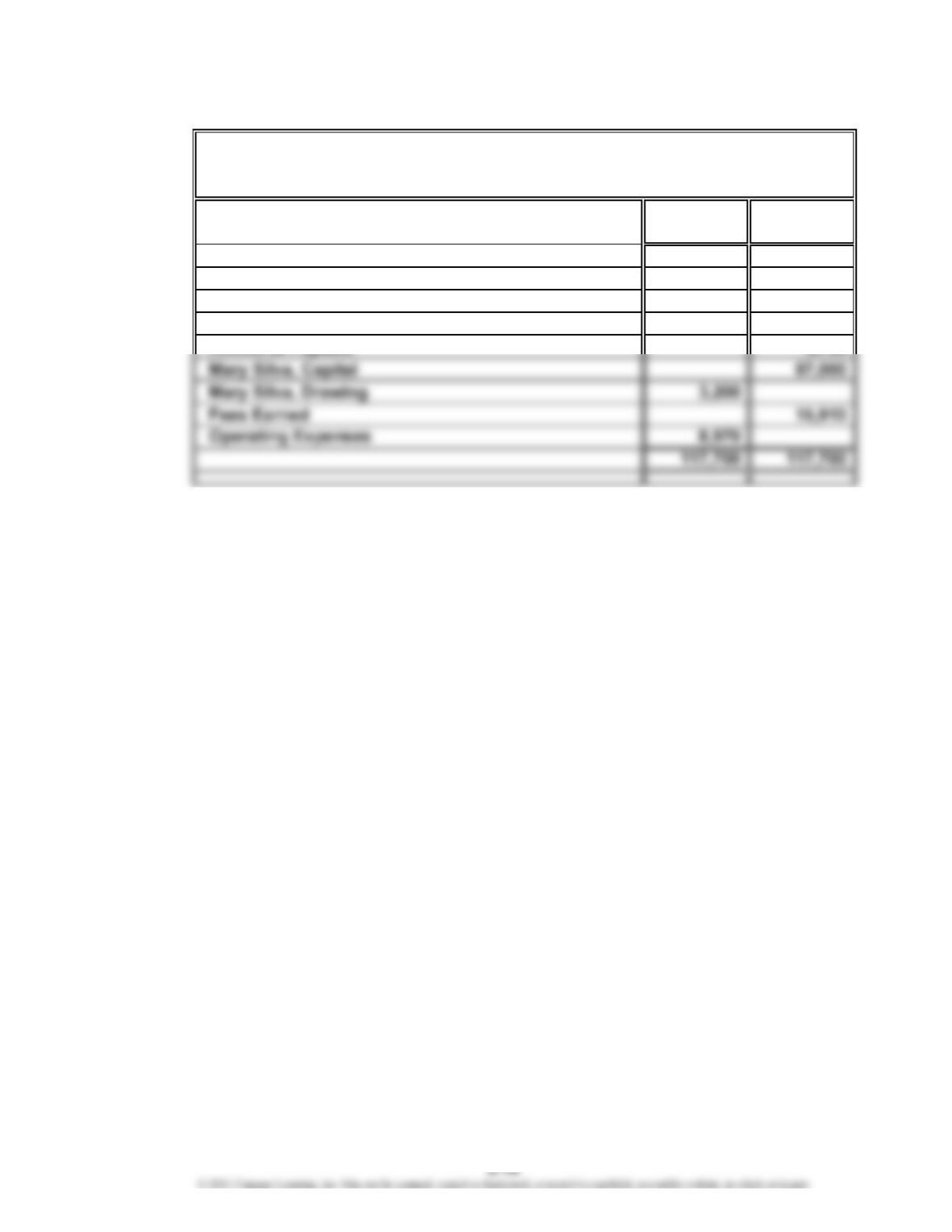
Effect Type Effect
asset + owner’s equity +
asset + asset –
asset + asset –
Ex. 2-14
(1) Cash 97,000
Mary Silva, Capital 97,000
Cash 2,070
(4) Operating Expenses 8,120
Cash 8,120
(5) Accounts Receivable 15,910
Fees Earned 15,910
(6) Accounts Payable 3,490
Cash 3,490
(7) Cash 10,540
Accounts Receivable 10,540
(3)
(2)
Account Debited Account Credited
Type
(1)
Transaction
CHAPTER 2 Analyzing Transactions
Ex. 2-15
a.
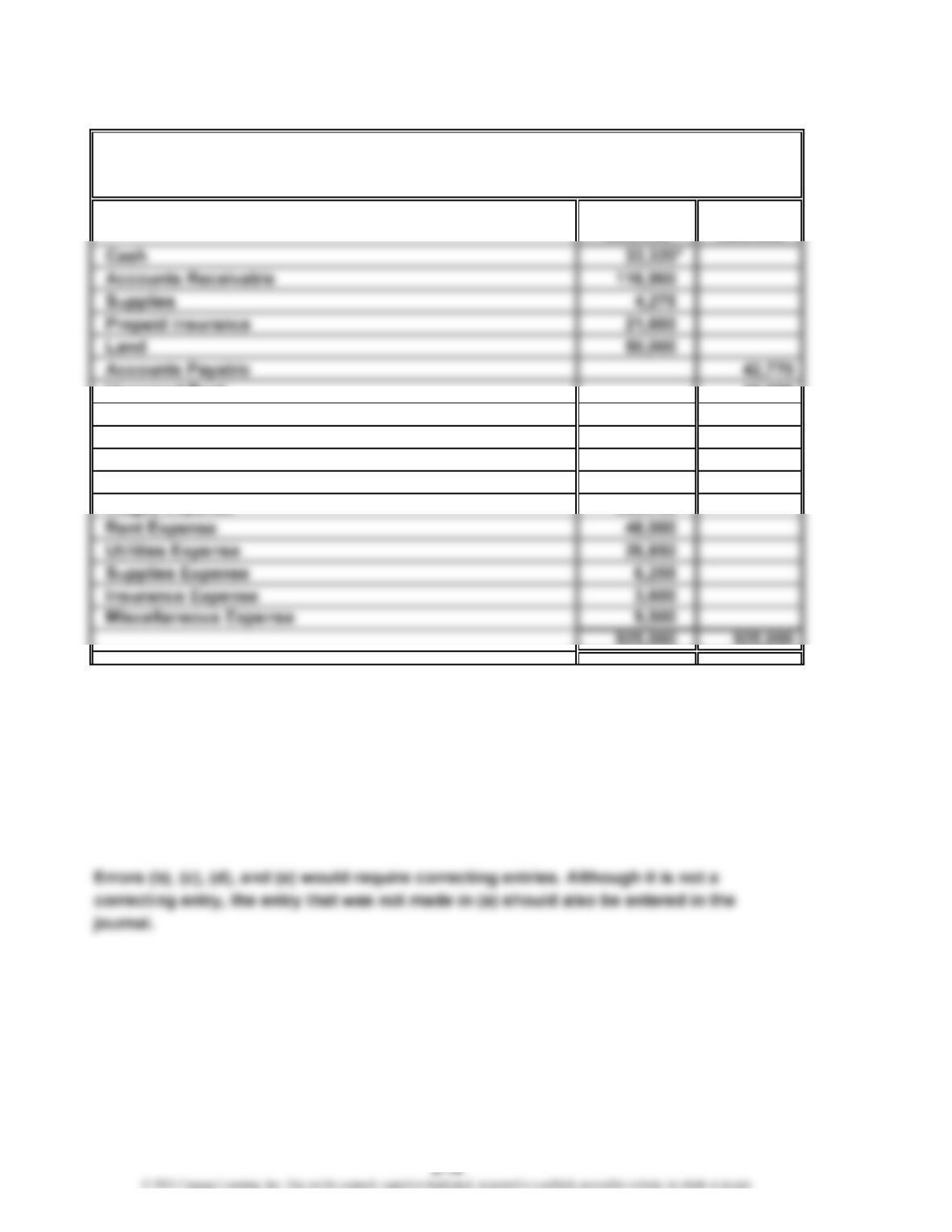
Debit Credit
Balances Balances
Cash 89,500
Accounts Receivable 5,370
Supplies 310
Equipment 10,350
b. Net income, $6,940 ($15,910 – $8,970)
Emerald Tours Co.
Unadjusted Trial Balance
May 31, 20Y5
CHAPTER 2 Analyzing Transactions
Ex. 2-16
Debit Credit
Unearned Rent 12,000
Notes Payable 50,000
Elaine Wells, Capital 75,000
Elaine Wells, Drawing 24,000
Fees Earned 745,230
925,000 925,000
*
$33,320 = $925,000 – $9,500 – $3,600 – $6,255 – $26,850 – $48,000 – $580,700 – $24,000
– $50,000 – $21,600 – $4,275 – $116,900
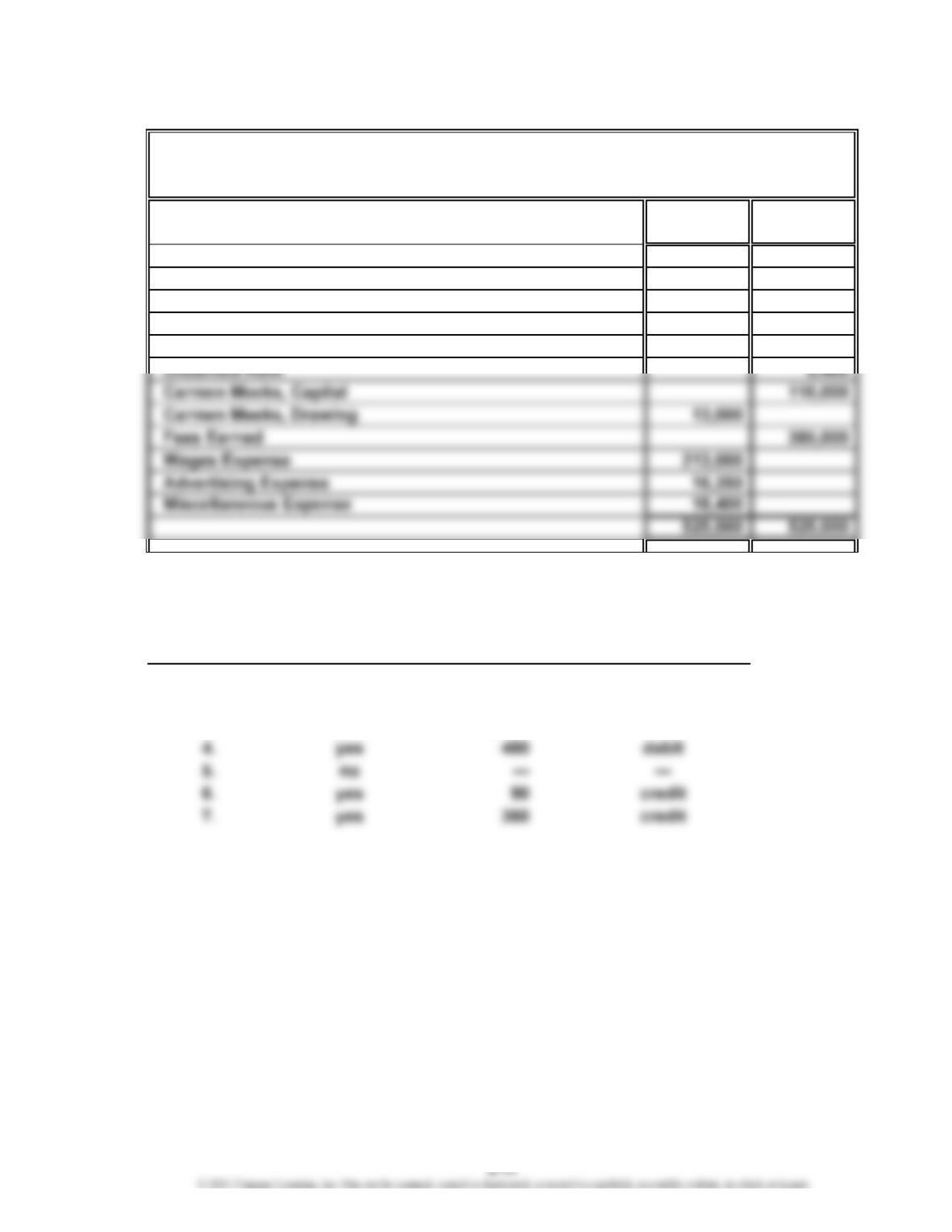
Ex. 2-17
Inequality of trial balance totals would be caused by errors described in (c) and
(e). For (c), the debit total would exceed the credit total by $9,900 ($4,950 + $4,950).
For (e), the credit total would exceed the debit total by $17,100 ($19,000 – $1,900).
Hickory Furniture Company
Unadjusted Trial Balance
December 31, 20Y6
CHAPTER 2 Analyzing Transactions
Ex. 2-18
Debit Credit
Balances Balances
Cash 15,500
Accounts Receivable 46,750
Prepaid Insurance 12,000
Equipment 190,000
Accounts Payable 24,600
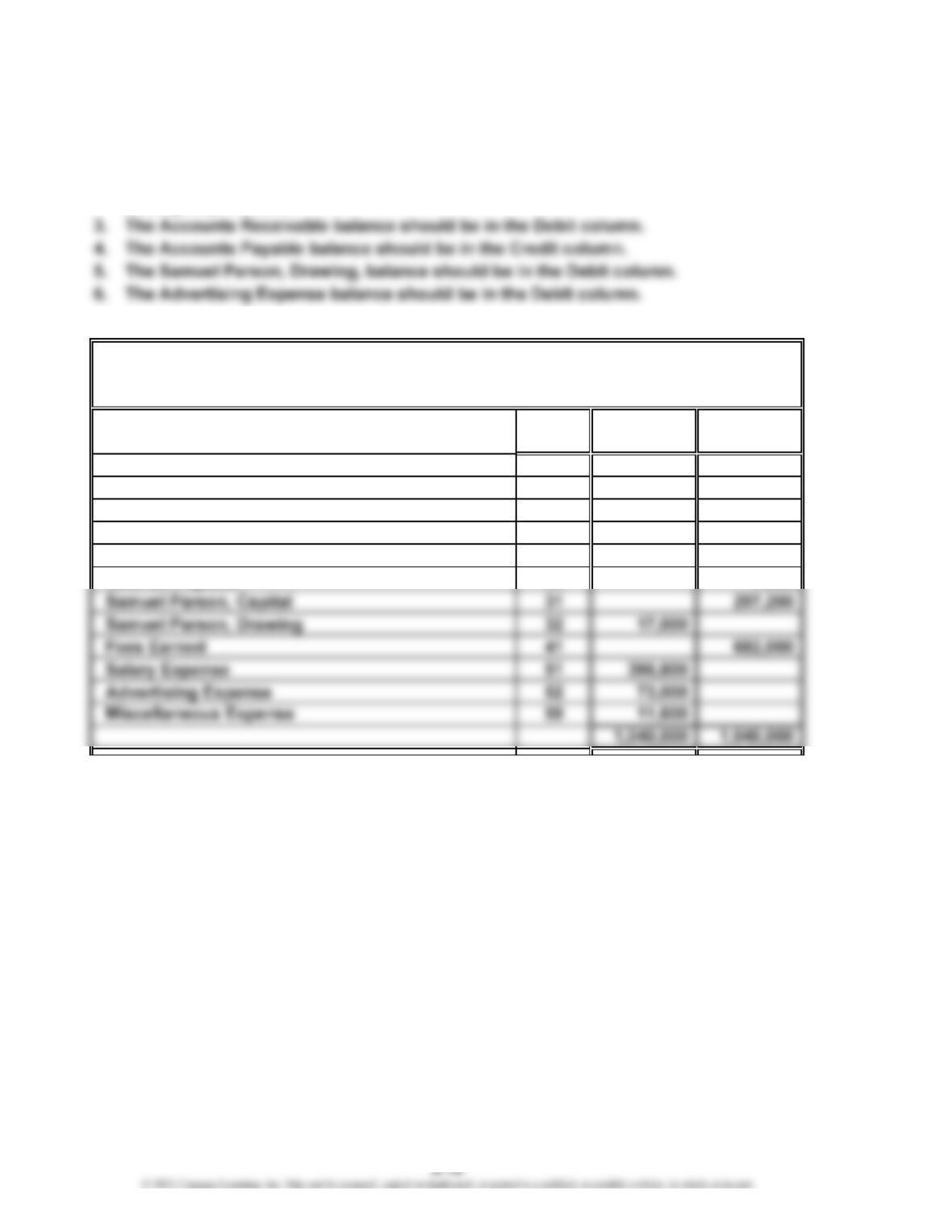
Ex. 2-19
(a) (b)
Error Out of Balance Difference
1. yes $6,000
2. no —
3. yes 5,400
(c)
Larger Total
Ranger Co.
Unadjusted Trial Balance
August 31, 20Y7
debit
—
credit
CHAPTER 2 Analyzing Transactions
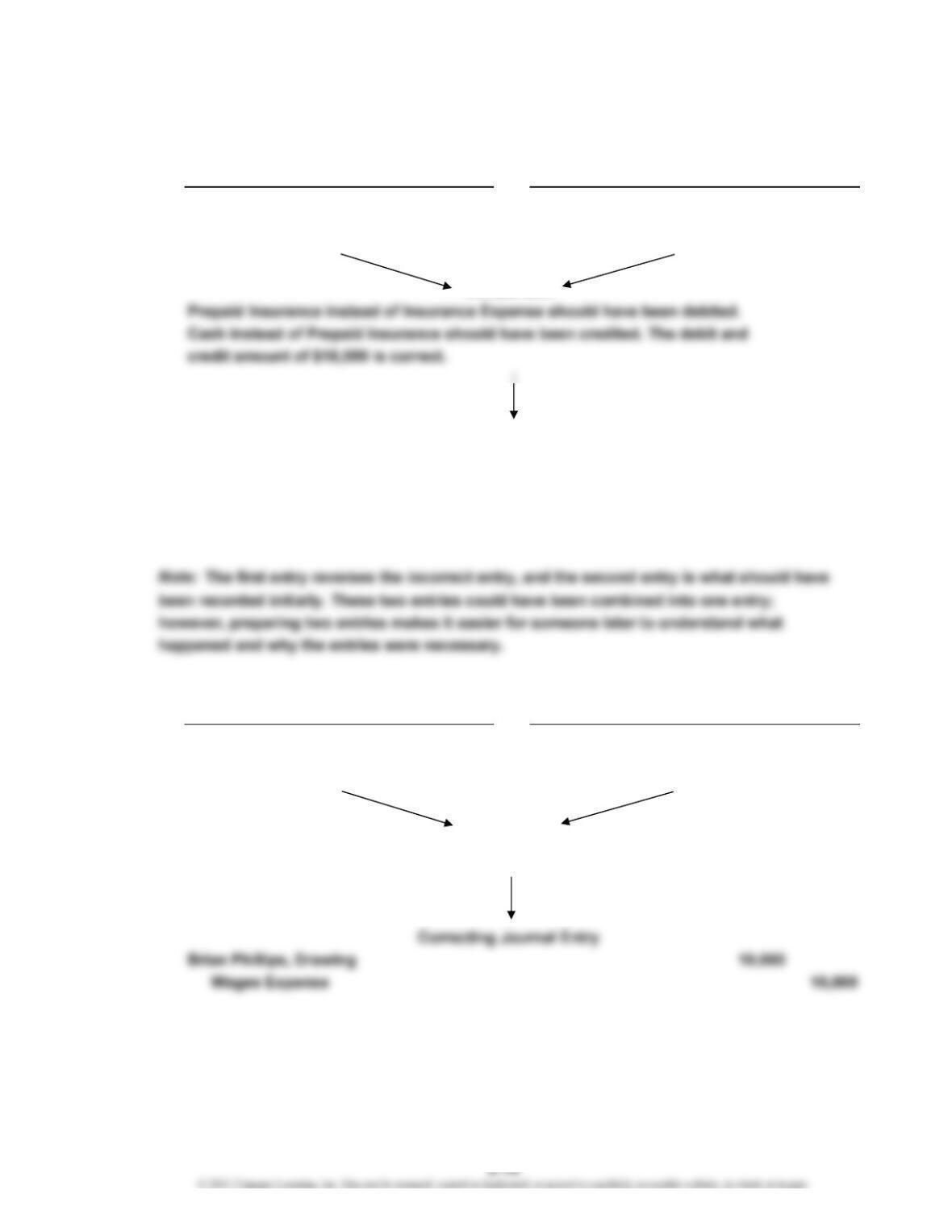
Ex. 2-20
1. The Debit column total is added incorrectly. The sum is $890,700 rather than
$1,189,300.
2. The trial balance should be dated “July 31, 20Y3,” not “For the Month
Ending July 31, 20Y3.”
A corrected trial balance would be as follows:
Account Debit Credit
No. Balances Balances
Cash 11 36,000
Accounts Receivable 12 112,600
Prepaid Insurance 13 18,000
Equipment 14 375,000
Accounts Payable 21 53,300
Salaries Payable 22 7,500
Mascot Co.
Unadjusted Trial Balance
July 31, 20Y3
CHAPTER 2 Analyzing Transactions
Ex. 2-21
a.
Insurance Expense 18,000 Prepaid Insurance 18,000
Prepaid Insurance 18,000 Cash 18,000
Prepaid Insurance 18,000
Insurance Expense 18,000
Prepaid Insurance 18,000
Cash 18,000
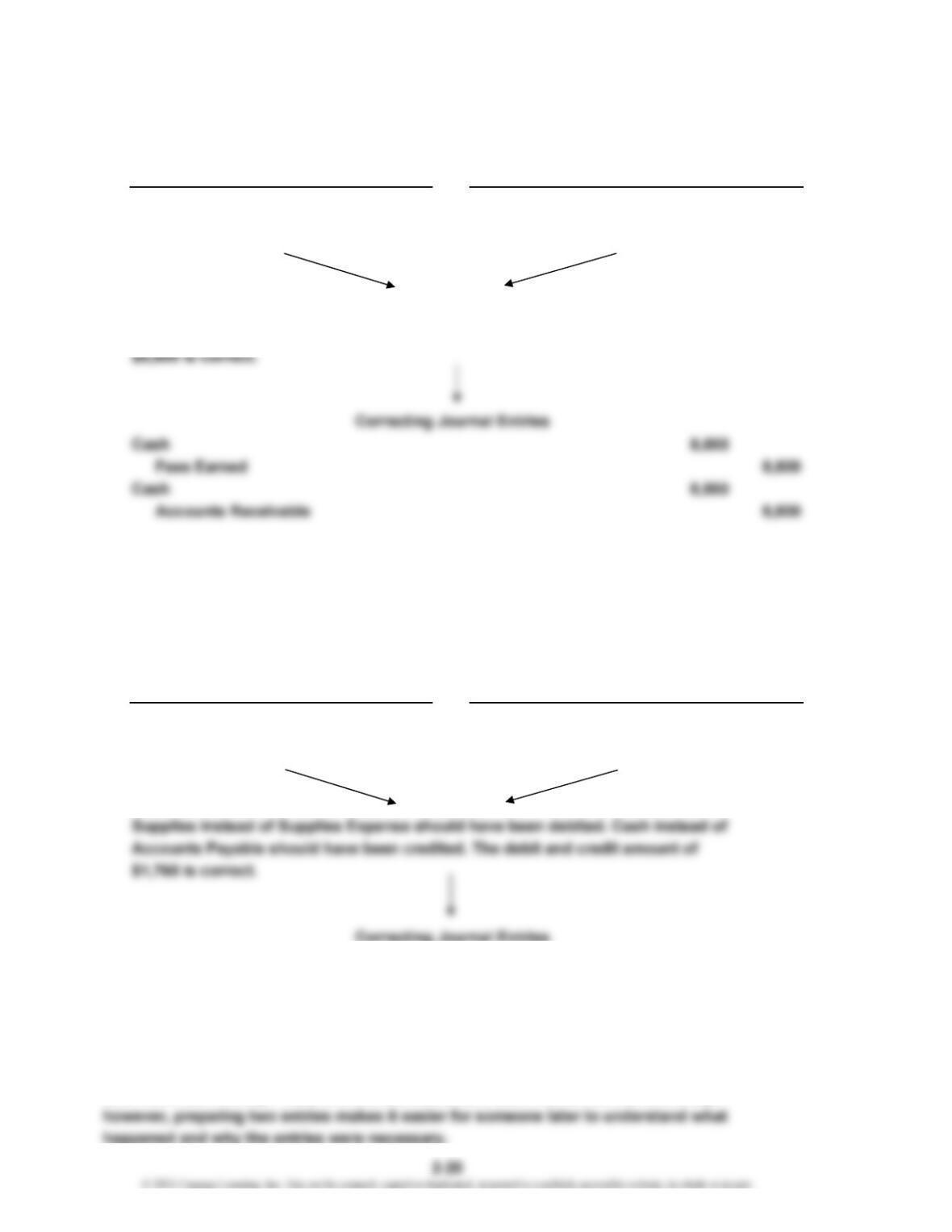
b.
Wages Expense 10,000 Brian Phillips, Drawing 10,000
Cash 10,000 Cash 10,000
Brian Phillips, Drawing instead of Wages Expense should have been debited.
Journal Entry That Was Journal Entry That Should
Made in Error Have Been Made
Correcting Journal Entries
Journal Entry That Was Journal Entry That Should
Made in Error Have Been Made
Comparison
CHAPTER 2 Analyzing Transactions
Ex. 2-22
a.
Fees Earned 8,800 Cash 8,800
Cash 8,800 Accounts Receivable 8,800
Cash instead of Fees Earned should have been debited. Accounts Receivable
instead of Cash should have been credited. The debit and credit amount of
Note: The first entry reverses the incorrect entry, and the second entry is what should have
been recorded initially. These two entries could have been combined into one entry;
however, preparing two entries makes it easier for someone later to understand what
happened and why the entries were necessary.
b.
Supplies Expense 1,760 Supplies 1,760
Accounts Payable 1,760 Cash 1,760
Accounts Payable 1,760
Supplies Expense 1,760
Supplies 1,760
Cash 1,760
Note: The first entry reverses the incorrect entry, and the second entry is what should have
been recorded initially. These two entries could have been combined into one entry;
Correcting Journal Entries
Journal Entry That Was Journal Entry That Should
Made in Error Have Been Made
Comparison
Journal Entry That Was Journal Entry That Should
Made in Error Have Been Made
Comparison