Problem 2A-4 (60 minutes)
1. a. When direct labor-hours are used to apply overhead cost to products,
the company’s predetermined overhead rate would be:
Manufacturing overhead cost
Predetermined =
overhead rate Direct labor-hours
$1,800,000
= = $50 per DLH
36,000 DLHs
X200
Direct materials ……………………………………
$ 72
Total unit product cost …………………………..
2. a. Predetermined overhead rates for the activity cost pools:
Activity Cost Pool
(a)
Estimated
Total Cost
(b)
Estimated
Total Activity
(a) ÷ (b)
Activity Rate
Machine setups ……
$360,000
150
setups
$2,400
per setup
Special processing .
$180,000
12,000
MHs
$15
per MH
General factory ……
$1,260,000
36,000
DLHs
$35
per DLH
Problem 2A-4 (continued)
The overhead applied to each product can be determined as follows:
Model X200
Activity Cost Pool
(a)
Activity Rate
(b)
Activity
(a) × (b)
ABC Cost
Machine setups ………………………………
$2,400
per setup
50
setups
$120,000
Special processing …………………………..
$15
per MH
12,000
MHs
180,000
General factory …………………………….
$35
per DLH
9,000
DLHs
315,000
Total manufacturing overhead cost (a)
$615,000
Number of units produced (b) ………….
5,000
Overhead cost per unit (a) ÷ (b) ………
$123.00
Activity Cost Pool
Machine setups ………………………………
$2,400
per setup
setups
Special processing …………………………..
$15
per MH
MHs
General factory …………………………….
$35
per DLH
DLHs
Total manufacturing overhead cost (a)
Number of units produced (b) ………….
Overhead cost per unit (a) ÷ (b) ………
Problem 2A-4 (continued)
b. The unit product cost of each model under the activity-based ap–
proach would be computed as follows:
Model
X200
X99
Direct materials ……………………………….
$ 72.00
$50.00
Direct labor:
$20 per DLH × 1.8 DLHs, 0.9 DLHs ……
36.00
18.00
Manufacturing overhead (above) …………
123.00
39.50
Total unit product cost ………………………
$231.00
$107.50
3. It is especially important to note that, even under activity-based costing,
70% of the company’s overhead costs continue to be applied to prod-
ucts on the basis of direct labor-hours:
Machine setups (number of setups) …
$ 360,000
20
%
Special processing (machine-hours) …
180,000
10
General factory (direct labor-hours) …
1,260,000
70
Total overhead cost ……………………..
$1,800,000
100
%
Thus, the shift in overhead cost from the high-volume product (Model
X99) to the low-volume product (Model X200) occurred as a result of re-
assigning only 30% (=20% + 10%) of the company’s overhead costs.
The increase in unit product cost for Model X200 can be explained as
follows: First, where possible, overhead costs have been traced to the
products rather than being lumped together and spread uniformly over
production. Therefore, the special processing costs, which are traceable
Problem 2A-4 (continued)
Second, the costs associated with the batch-level activity (machine set-
ups) have also been assigned to the specific products to which they re-
late. These costs have been assigned according to the number of setups
completed for each product. However, because a batch-level activity is
involved, another factor affecting unit costs comes into play. That factor
is batch size. Some products are produced in large batches and some
are produced in small batches.
The smaller the batch, the higher the per
unit cost of the batch activity.
In the case at hand, the data can be ana-
lyzed as follows:
Thus, the cost per unit for setups is three times as great for Model
X200, the low-volume product, as it is for Model X99, the high-volume
product. Such differences in cost are obscured when direct labor-hours
(or any other volume measure) is used as a basis for applying overhead
cost to products.
In sum, overhead cost has shifted from the high-volume product to the
low-volume product as a result of more appropriately assigning some
costs to the products on the basis of the activities involved, rather than
on the basis of direct labor-hours.
Problem 2A-5 (60 minutes)
1. The company’s estimated direct labor-hours can be computed as fol-
lows:
Deluxe model: 5,000 units × 2 DLHs per unit ….
10,000 DLHs
Regular model: 40,000 units × 1 DLH per unit …
40,000 DLHs
Total direct labor hours ………………………………
50,000 DLHs
Using just direct labor-hours as the base, the predetermined overhead
rate would be:
Estimated overhead cost $900,000
= = $18 per DLH
Estimated direct labor-hours 50,000 DLHs
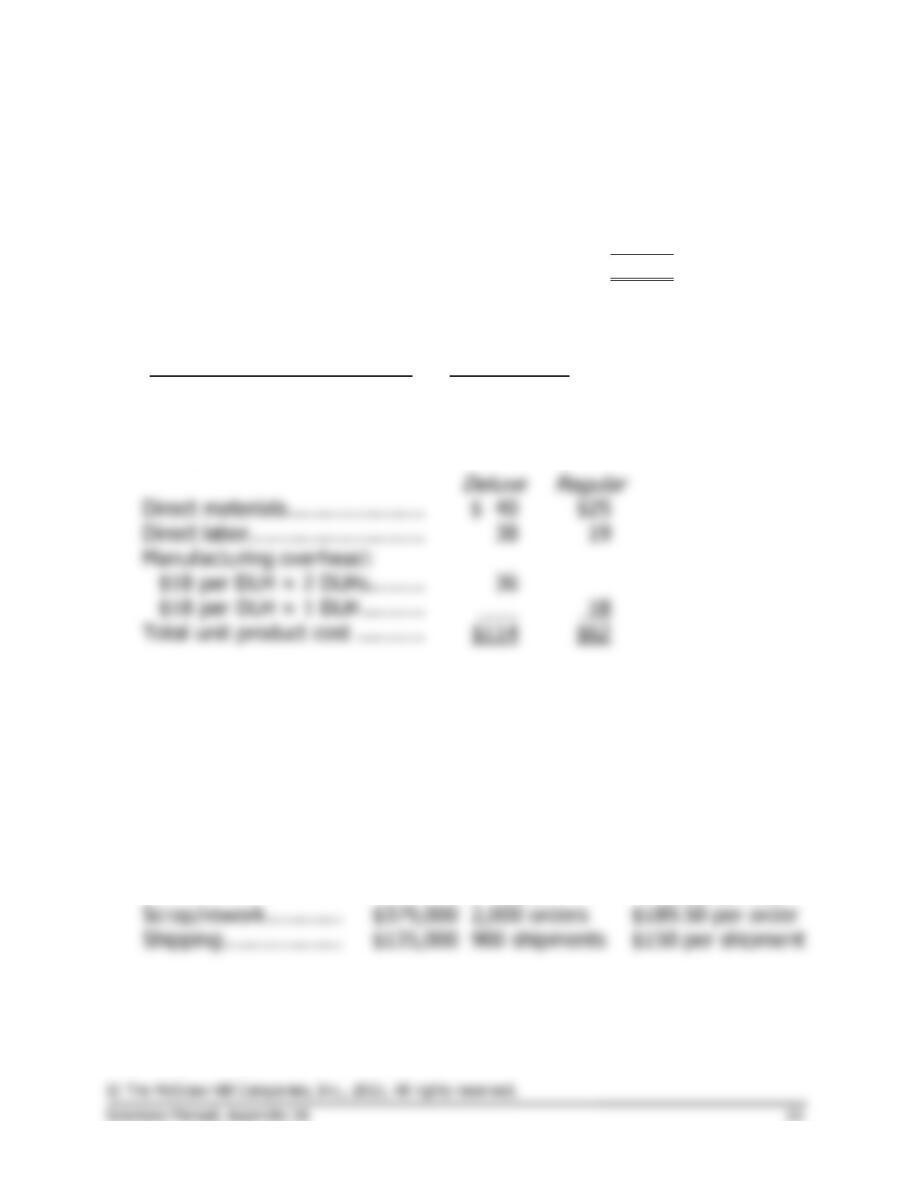
The unit product cost of each model using the company’s traditional
costing system would be:
Direct materials ………………….
Direct labor ……………………….
Manufacturing overhead:
Total unit product cost ………..
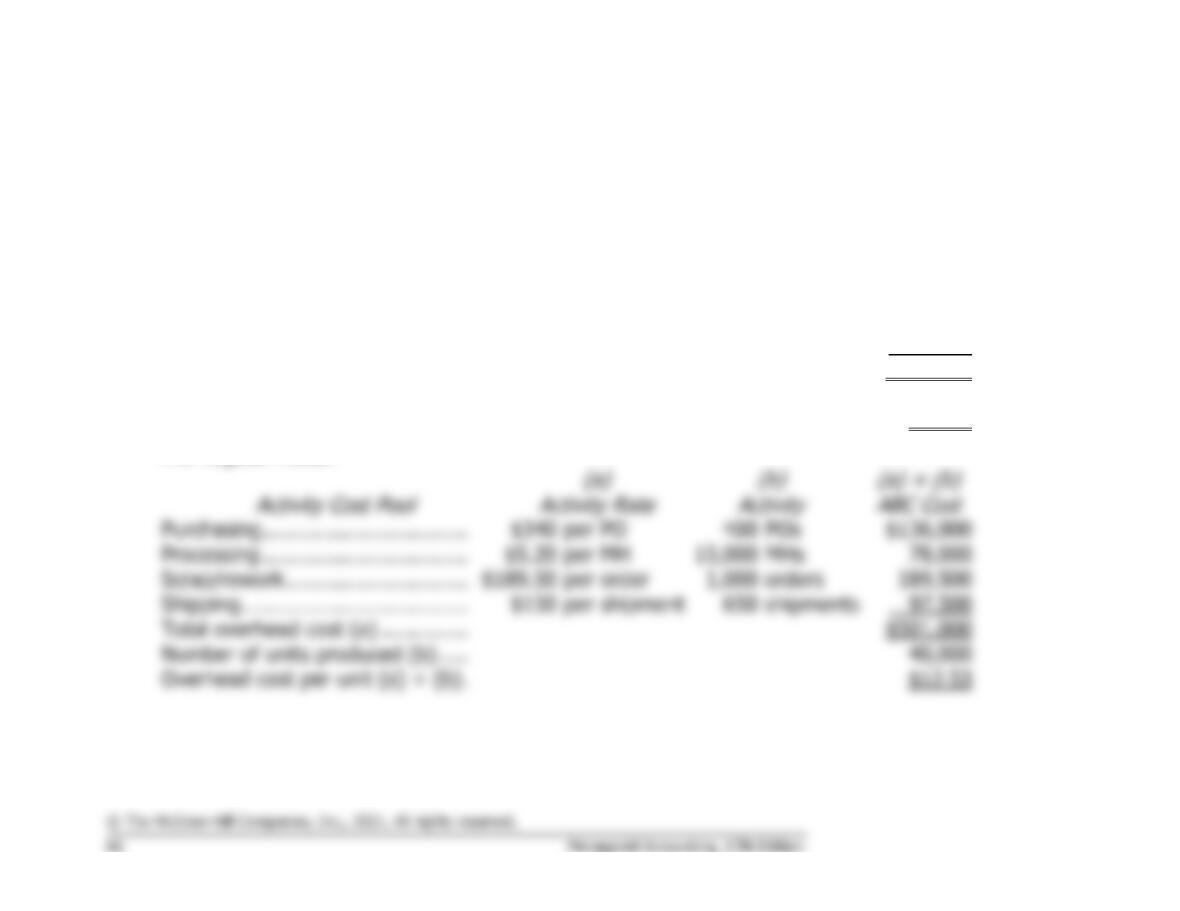
2. Predetermined overhead rates are computed below:
Activity Cost Pool
(a)
Estimated
Overhead
Cost
(b)
Expected
Activity
(a) ÷ (b)
Activity Rate
Purchasing …………….
$204,000
600 purchase or-
ders
$340 per purchase
order
Processing …………….
$182,000
35,000 machine-
hours
$5.20 per
machine-hour
Scrap/rework …………
2,000 orders
$189.50 per order
Shipping ……………….
900 shipments
$150 per shipment
Problem 2A-5 (continued)
3. a. The overhead applied to each product can be determined as follows:
The Deluxe Model
Activity Cost Pool
(a)
Activity Rate
(b)
Activity
(a) × (b)
ABC Cost
Purchasing …………………………...
$340
per PO
200
POs
$ 68,000
Processing …………………………...
$5.20
per MH
20,000
MHs
104,000
Scrap/rework ………………………..
$189.50
per order
1,000
tests
189,500
Shipping ………………………………
$150
per shipment
250
shipments
37,500
Total overhead cost (a) …………..
$399,000
Number of units produced (b) …..
5,000
Overhead cost per unit (a) ÷ (b) .
$79.80
The Regular Model
Activity Cost Pool
Purchasing …………………………...
$340
per PO
400
POs
$136,000
Processing …………………………...
per MH
MHs
78,000
Scrap/rework ………………………..
$189.50
per order
1,000
orders
189,500
Shipping ………………………………
$150
per shipment
650
shipments
Total overhead cost (a) …………..
Number of units produced (b) …..
40,000
Overhead cost per unit (a) ÷ (b) .
Problem 2A-5 (continued)
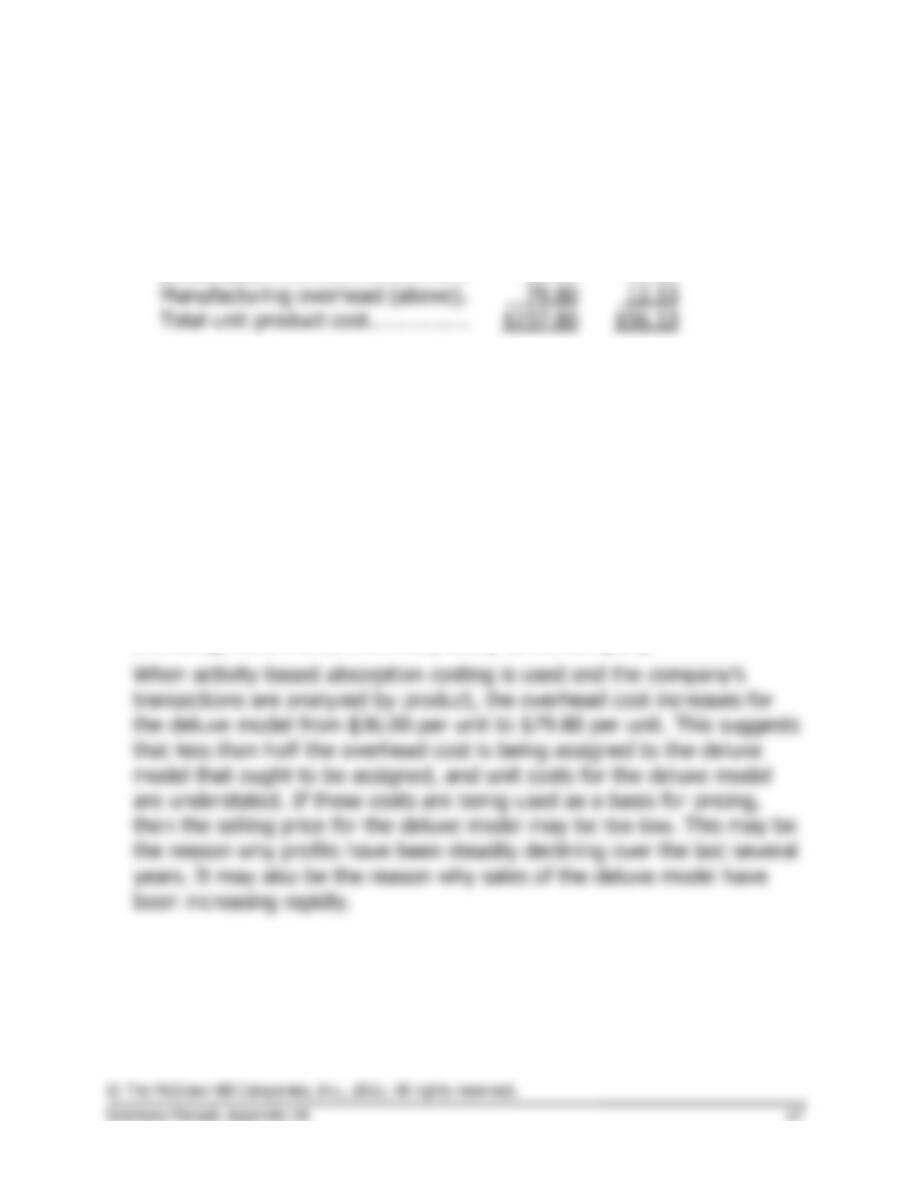
b. Using activity-based absorption costing, the unit product cost of each
model would be:
Deluxe
Regular
Direct materials ……………………..
$ 40.00
$25.00
Direct labor …………………………..
4. Unit costs appear to be distorted as a result of using direct labor-hours
as the base for assigning overhead cost to products. Although the
deluxe model requires twice as much labor time as the regular model, it
still is not being assigned enough overhead cost, as shown in the analy-
sis in part 3(a).
When the company’s overhead costs are analyzed on an activities basis,
it appears that the deluxe model is more expensive to manufacture than
the company realizes. Note that the deluxe model accounts for a major-
ity of the machine-hours worked, even though it accounts for only 20%
(= 10,000 DLHs ÷ 50,000 DLHs) of the company’s direct labor-hours.
Also, it requires just as many scrap/rework orders as the regular model,
and scrap/rework orders are very costly to the company.
Case 2A-6 (90 minutes)
1. a. The predetermined overhead rate would be computed as follows:
Expected manufacturing overhead cost $2,200,000
=
Estimated direct labor-hours 50,000 DLHs
= $44 per DLH
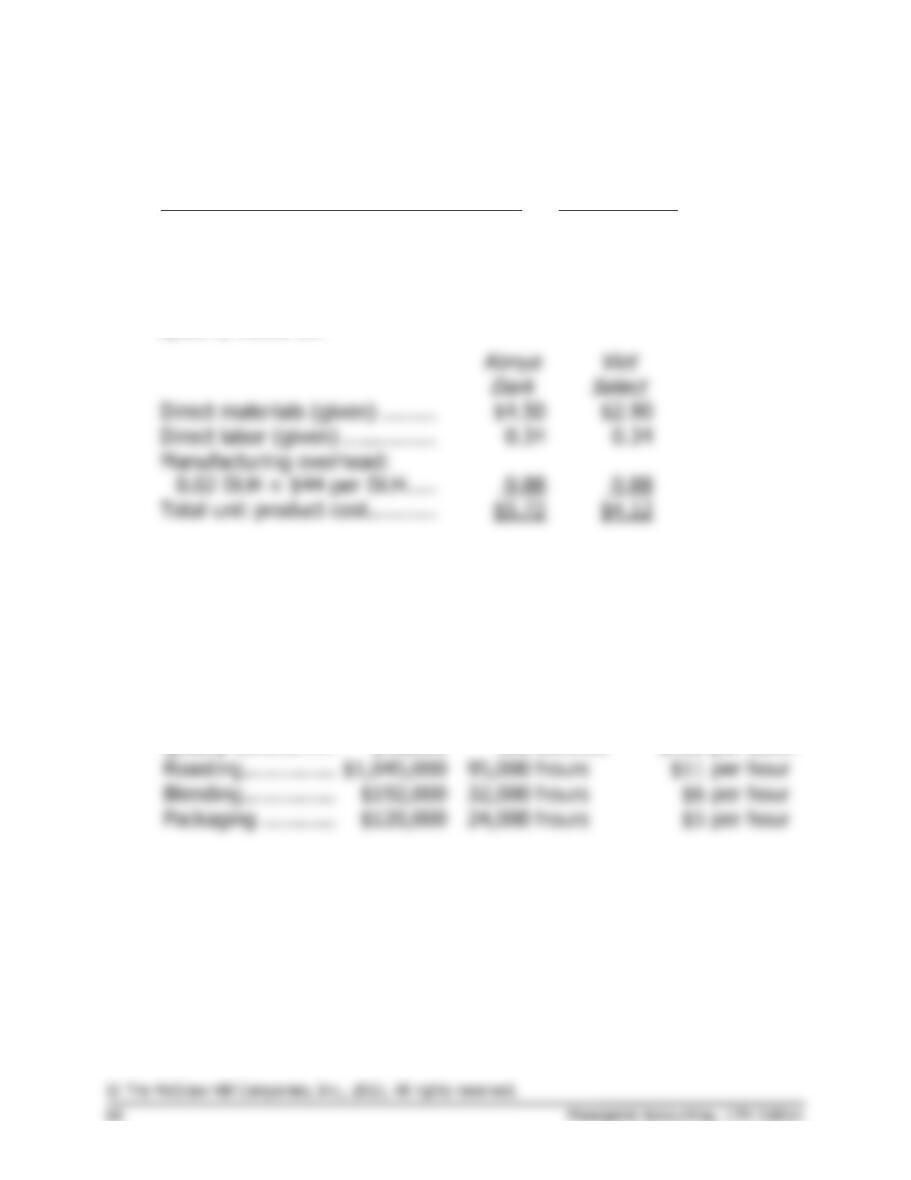
b. The unit product cost per pound, using the company’s present costing
Direct materials (given) ………
Direct labor (given) ……………
Total unit product cost ………..
2. a. Overhead rates for each activity cost pool:
Activity Cost
Pools
(a)
Estimated
Overhead
Costs
(b)
Expected
Activity
(a) ÷ (b)
Activity Rate
Purchasing ………..
$560,000
2,000
orders
$280
per order
Material handling ..
$193,000
1,000
setups
$193
per setup
Quality control ……
batches
$180
per batch
Roasting ……………
$1,045,000
hours
per hour
Blending ……………
$192,000
hours
per hour
Packaging …………
$120,000
hours
per hour
Case 2A-6 (continued)
Before we can determine the amount of overhead cost to assign to
the products, we must first determine the activity for each of the
products in the six activity centers. The necessary computations fol–
low:
Number of purchase orders:
Kenya Dark: 80,000 pounds ÷ 20,000 pounds per order = 4 orders
Number of setups:
Viet Select: (4,000 pounds ÷ 500 pounds per batch) × 2 setups per
Number of batches:
Kenya Dark: 80,000 pounds ÷ 5,000 pounds per batch = 16 batches
Viet Select: 4,000 pounds ÷ 500 pounds per batch = 8 batches
Roasting hours:
Kenya Dark: 1.5 hours × (80,000 pounds ÷ 100 pounds) = 1,200
hours
Viet Select: 1.5 hours × (4,000 pounds ÷ 100 pounds) = 60 hours
Blending hours:
Packaging hours:
Kenya Dark: 0.3 hour × (80,000 pounds ÷ 100 pounds) = 240 hours
Viet Select: 0.3 hour × (4,000 pounds ÷ 100 pounds) = 12 hours
Case 2A-6 (continued)
The overhead applied to each product can be determined as follows:
Kenya Dark
Activity Cost Pool
Activity Rate
Expected Activity
Amount
Purchasing ……………
$280
per order
4
orders
$ 1,120
Material handling ……
$193
per setup
32
setups
6,176
Quality control ……….
$180
per batch
16
batches
2,880
Roasting ……………….
$11
per roasting hour
roasting hours
13,200
Blending ……………….
$6
per blending hour
400
blending hours
2,400
Packaging ……………..
$5
per packaging hour
240
packaging hours
Total ……………………
Viet Select
Activity Cost Pool
Activity Rate
Expected Activity
Amount
Purchasing ……………
$280
per order
8
orders
$2,240
Material handling ……
$193
per setup
16
setups
3,088
Quality control ……….
$180
per batch
8
batches
1,440
Roasting ……………….
$11
per roasting hour
60
roasting hours
660
Blending ……………….
$6
per blending hour
20
blending hours
120
Packaging ……………..
$5
per packaging hour
12
packaging hours
Total ……………………
$7,608
Case 2A-6 (continued)
b. According to the activity-based absorption costing system, the manu-
facturing overhead cost per pound is:
Kenya
Dark
Viet
Select
Total overhead cost assigned (above) (a) …
$26,976
$7,608
Number of pounds manufactured (b) ……….
80,000
4,000
Cost per pound (a) ÷ (b) ………………………
$0.34
$1.90
c. The unit product costs according to the activity-based absorption
costing system are:
Dark
Direct materials (given) …………
Direct labor (given) ………………
Manufacturing overhead ………..
Total unit product cost …………..
Kenya
Viet
3. MEMO TO THE PRESIDENT: Analysis of JSI’s data shows that several
activities other than direct labor drive the company’s manufacturing
overhead costs. These activities include purchase orders issued, number
of setups for material processing, and number of batches processed.
The company’s present costing system, which relies on direct labor time
as the sole basis for assigning overhead cost to products, significantly
undercosts low-volume products, such as the Viet Select coffee, and sig-
nificantly overcosts high-volume products, such as our Kenya Dark cof-
fee.