2-17
©
a
ac
cc
ce
es
ss
si
ib
bl
le
e
w
we
eb
bs
si
it
te
e,
,
i
in
n
w
wh
ho
ol
le
e
o
or
r
i
in
n
p
pa
ar
rt
t.
.
CPA-TYPE EXERCISES
Exercise 2.23
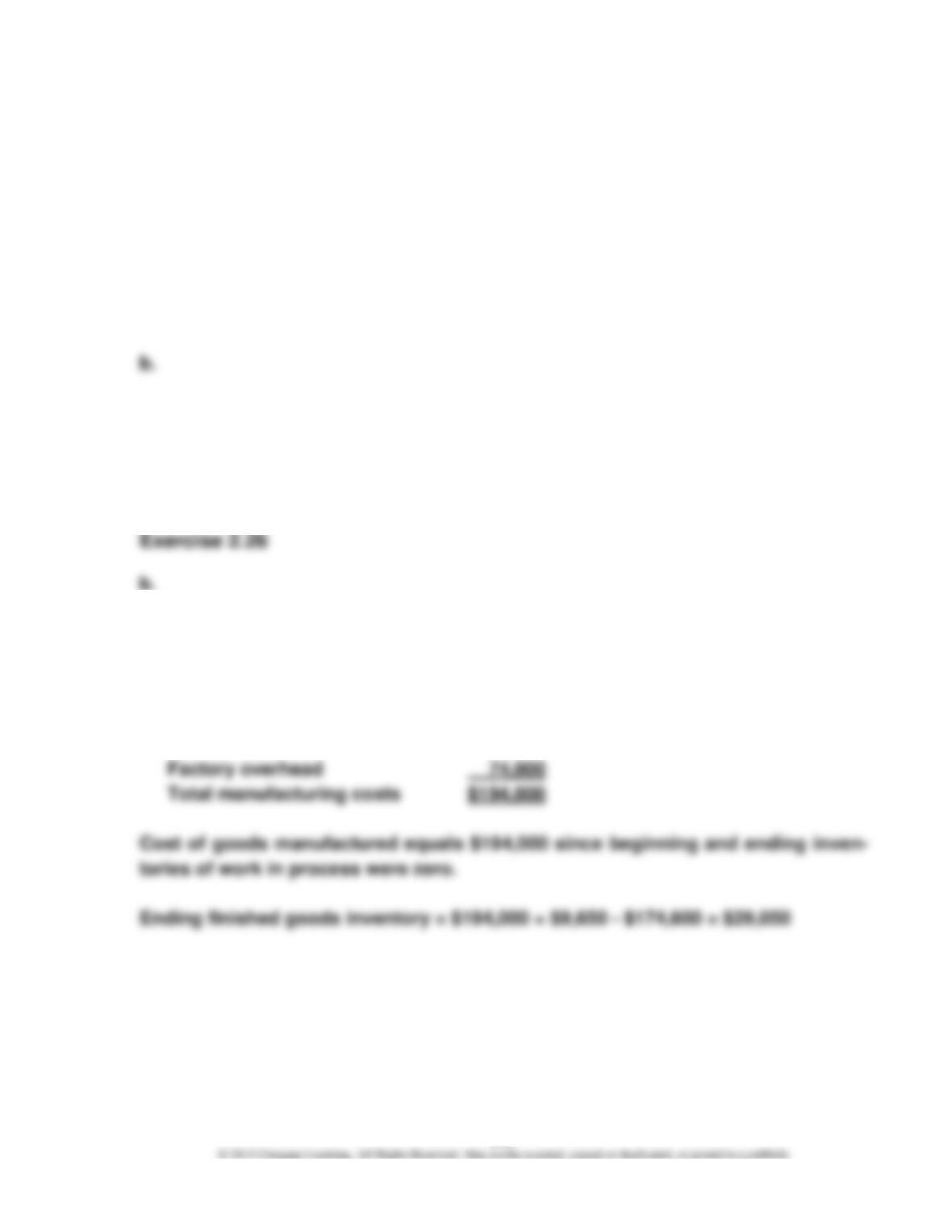
b.
Exercise 2.24
Exercise 2.25
d.
Exercise 2.27
c.
Direct materials $ 80,000
Direct labor 40,000
PROBLEMS
Problem 2.28
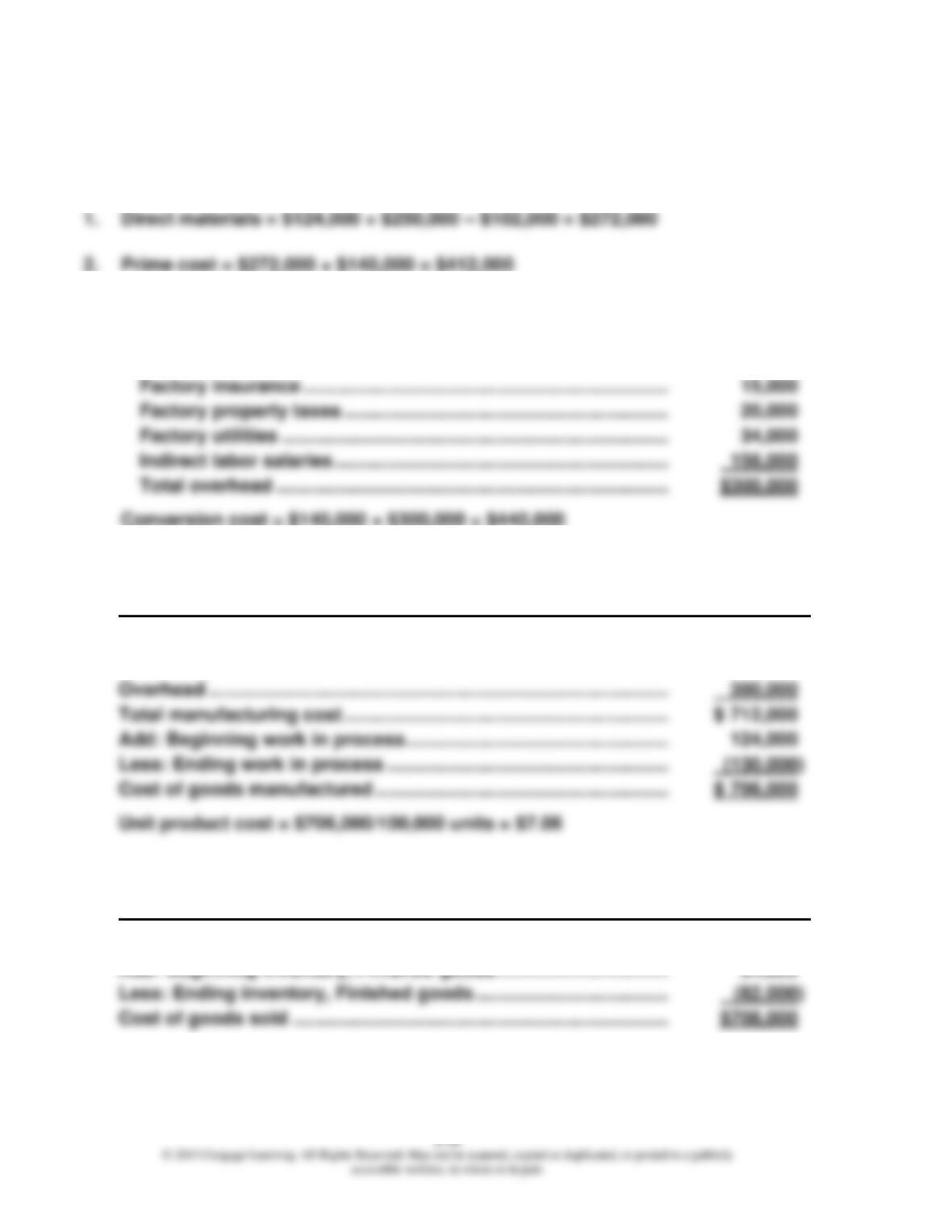
3. First, calculate total overhead cost:
Depreciation on factory equipment …………………………………… $ 45,000
Depreciation on factory building ………………………………………. 30,000
4. Brody Company
Statement of Cost of Goods Manufactured
For Last Year
Direct materials …………………………………………………………………… $ 272,000
Direct labor …………………………………………………………………………. 140,000
5. Brody Company
Statement of Cost of Goods Sold
For Last Year
Cost of goods manufactured ……………………………………………….. $706,000
Add: Beginning inventory, Finished goods …………………………... 84,000
Problem 2.28 (Concluded)
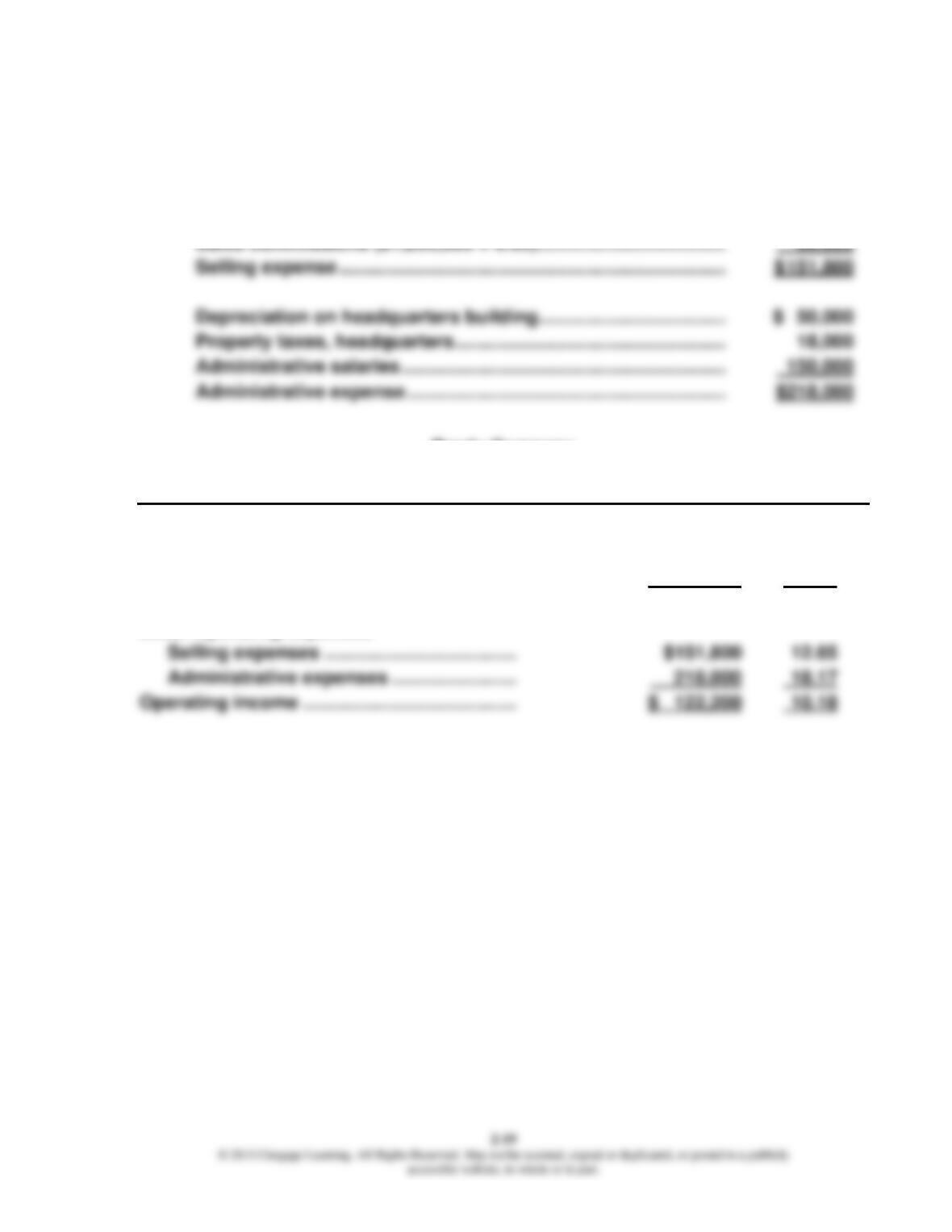
6. First, compute selling expense and administrative expense:
Utilities, sales office …………………………………………………………. $ 1,800
Sales office salaries …………………………..…………………………….. 90,000
Brody Company
Income Statement
For Last Year
Percent
Sales …………………………………………………….. $ 1,200,000 100.00
Cost of goods sold ………………………………… 708,000 59.00
Gross margin…………………………………………. $ 492,000 41.00
Less: Operating expenses
Problem 2.29
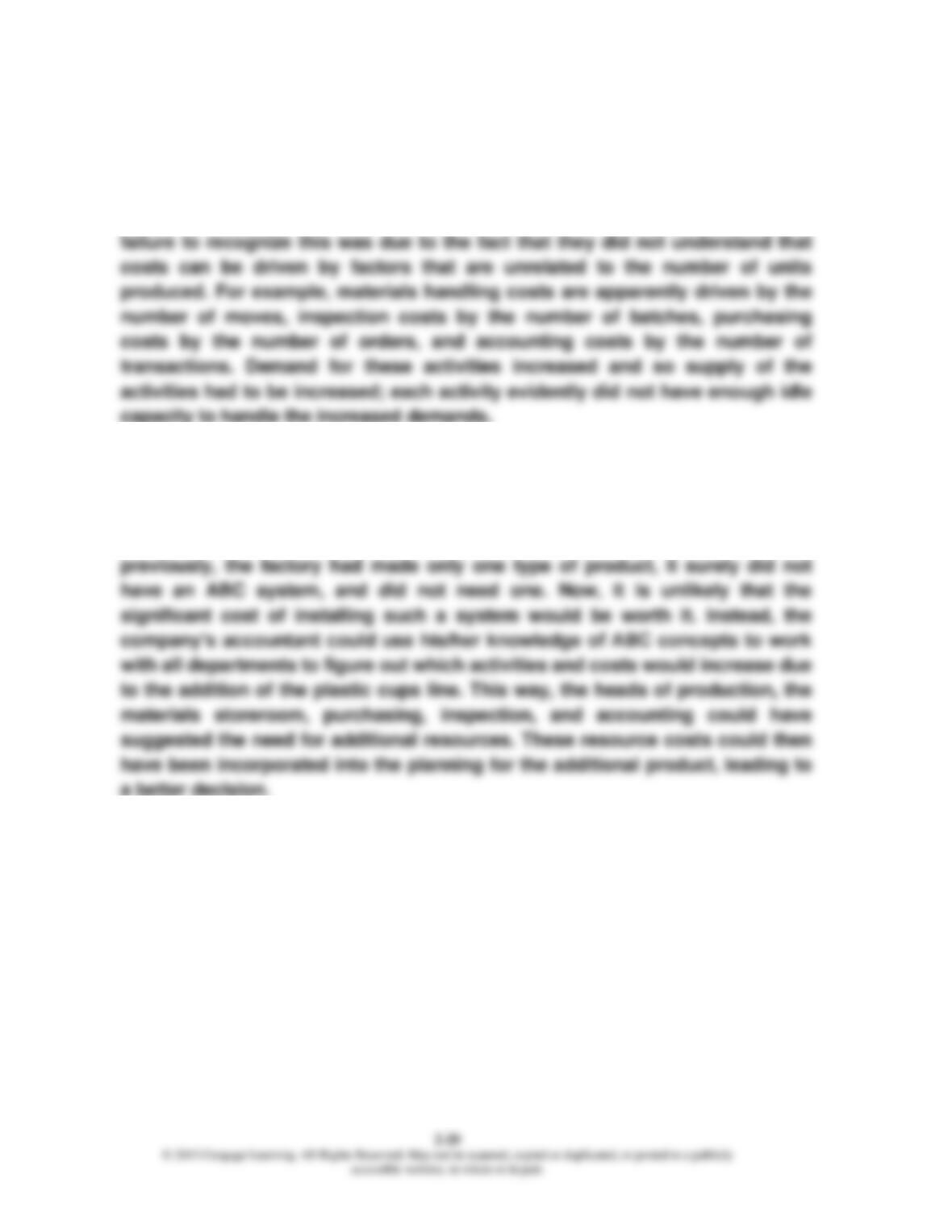
1. The decision to add plastic cups was made assuming that the fixed cost pool
would remain unchanged. However, management failed to realize that
additional demands on activities would be made by the new product line. Their
2. An activity-based cost management system provides information about both
unit-based and non-unit-based drivers and is concerned with tracing these
costs to the individual product lines. Using this system, the need for additional
resources would have been revealed, leading to a better decision. Because
Problem 2.30
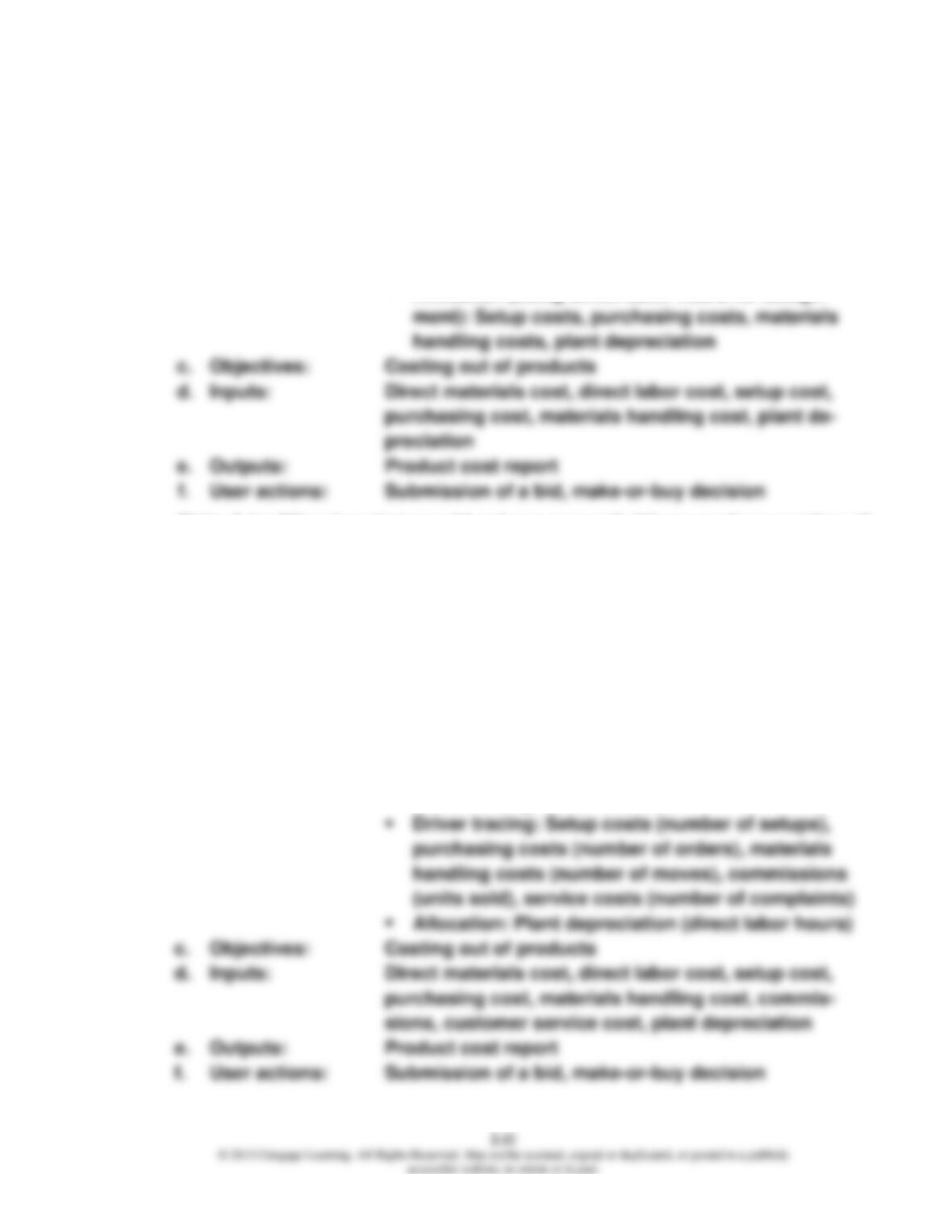
1. Traditional Cost System:
a. Interrelated parts: Cost accounting staff, computer, printer
b. Processes: Cost assignment:
▪ Direct tracing: Materials, labor
▪ Driver tracing: None
▪ Allocation (using direct labor hours for assign-
Note: A traditional system would not use non-unit-drivers such as number of
setups, moves, and orders to assign overhead costs to products. This leaves
direct labor hours, a unit-based driver, as the only possibility. Since direct la-
bor hours is not a good driver for the overhead activities listed, then alloca-
tion is the principal means of cost assignment. Furthermore, a traditional
cost system would not assign sales or service costs to products, so these
two items cannot be inputs for the system.
Activity-Based Cost System:
a. Interrelated parts: Cost accounting staff, computer, printer
b. Processes: Cost assignment:
▪ Direct tracing: materials, labor
Problem 2.30 (Continued)
2. The differences between the two systems are found in the processes. The ABC
system is driver-intensive; non-unit drivers are used to trace costs to products,
whereas this is not part of the traditional system (which is allocation-intensive).
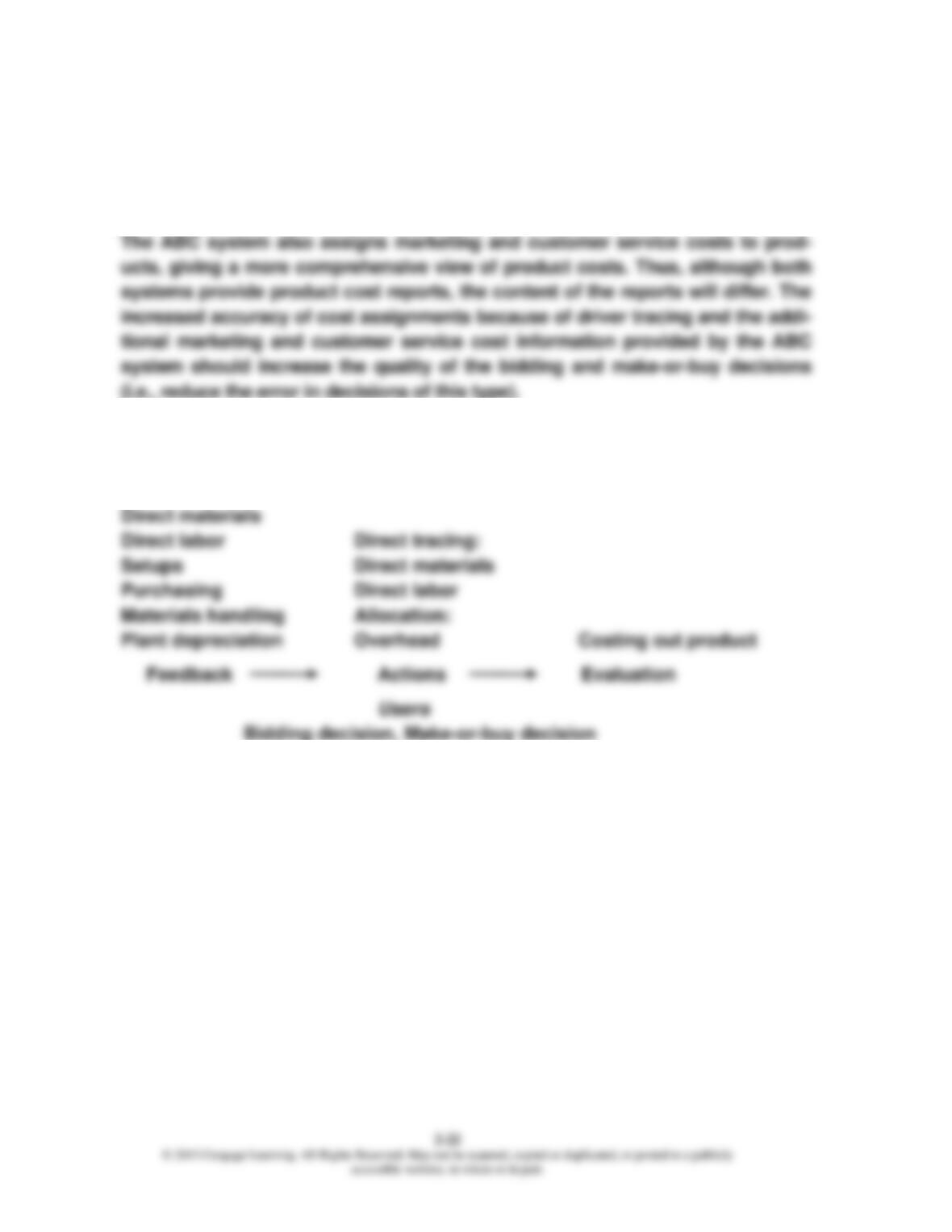
3. Operational Model: Traditional Cost Accounting System
Inputs Processes Output
Costs of:
Problem 2.30 (Concluded)
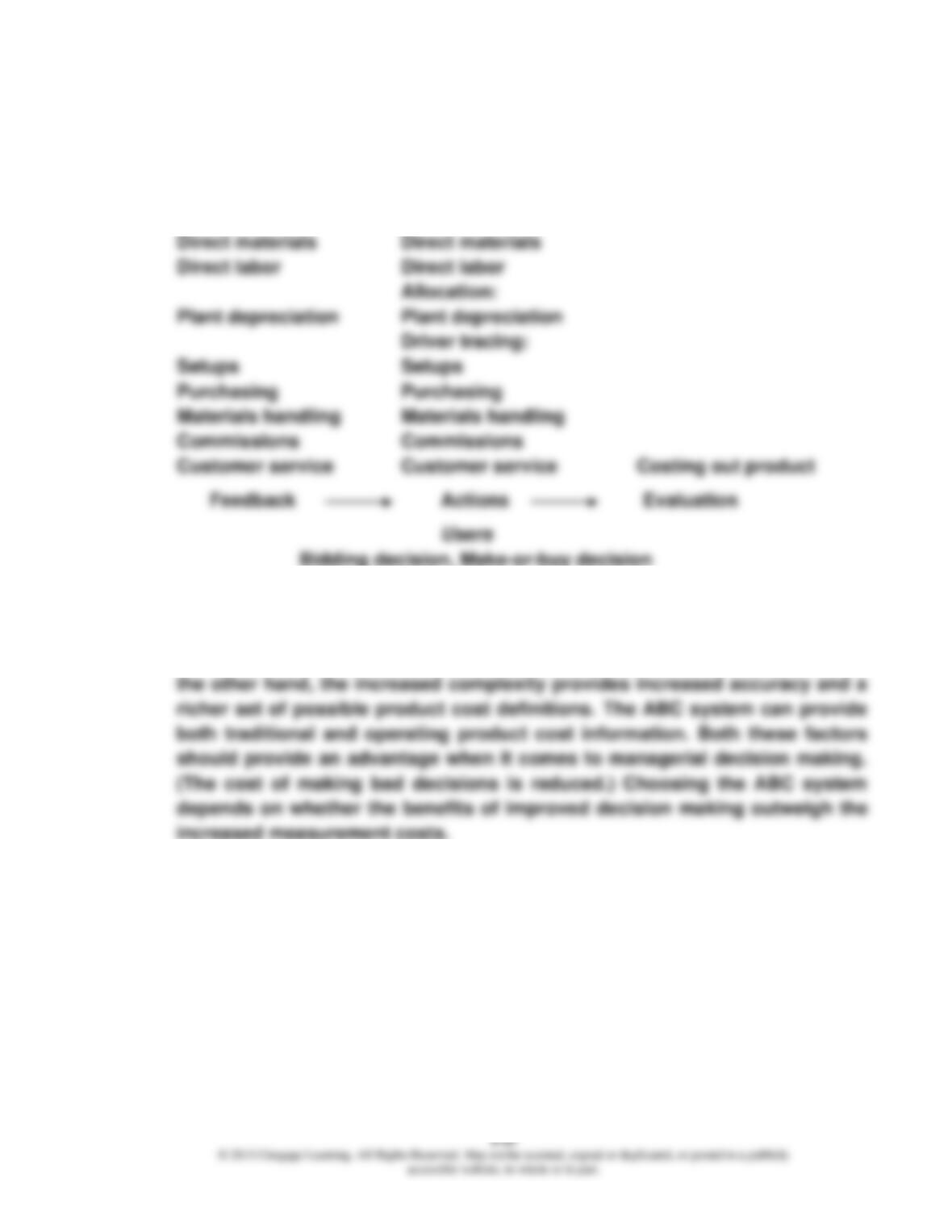
Operational Model: ABC Cost Accounting System
Inputs Processes Output
Costs of: Direct tracing:
4. The operational models reveal that the ABC cost system is more complex,
requires more inputs, and uses more complicated processes to transform the
inputs. Thus, we would expect this system to be more costly to operate. On
Problem 2.31
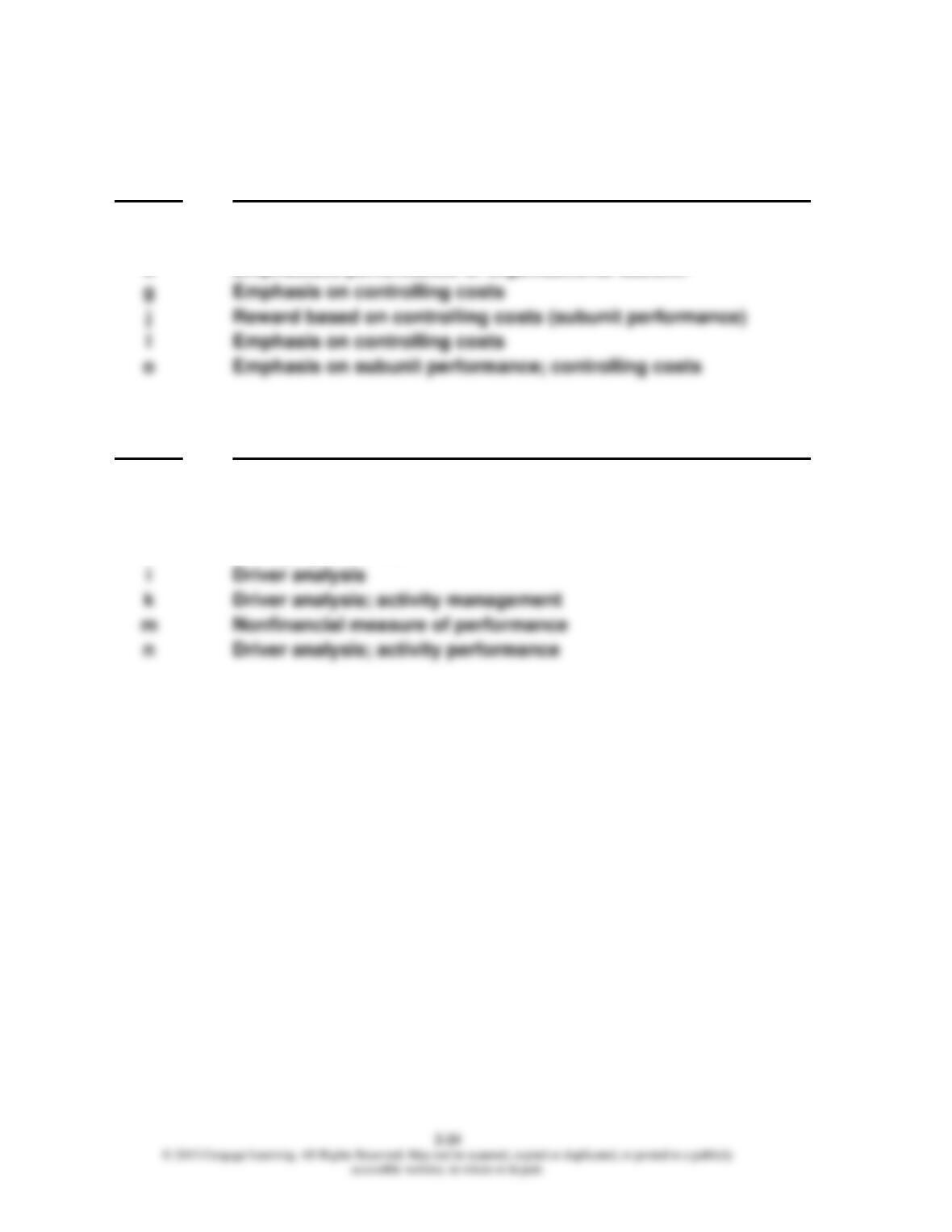
Traditional Control System:
Actions Justification
a Performance, organizational subunit; managing costs
b Rewards manager for subunit performance
d Emphasizes performance of organizational subunit
Activity-Based Control System:
Actions Justification
c Activity-based cost used as input for activity control
e Emphasis on activity analysis
f Emphasis on managing activities (activity analysis)
h Managing activities
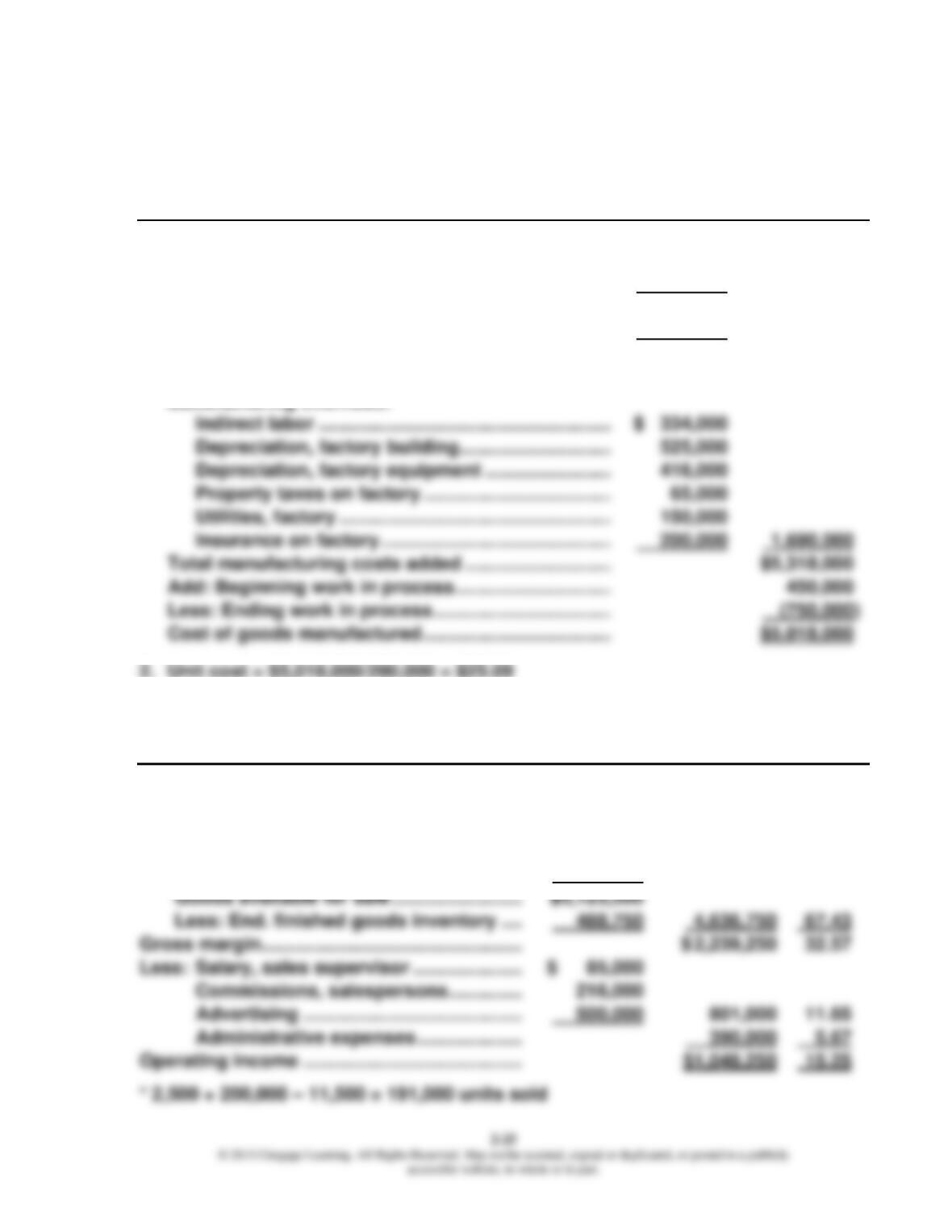
Problem 2.32
Spencer Company
Statement of Cost of Goods Manufactured
For the Year Ended December 31
1. Direct materials:
Beginning inventory …………………………………….. $ 290,000
Add: Purchases ……………………………………………. 2,350,000
Materials available ……………………………………….. $2,640,000
Less: Ending inventory…………………………………. 112,000
Direct materials used in production …………………… $2,528,000
Direct labor……………………………………………………….. 1,100,000
Manufacturing overhead:
3. Spencer Company
Income Statement: Absorption Costing
For the Year Ended December 31
Percent
Sales (191,000* × $36) ……………………………… $6,876,000 100.00
Cost of goods sold:
Cost of goods manufactured …………….. $5,018,000
Add: Beg. finished goods inventory …… 107,500
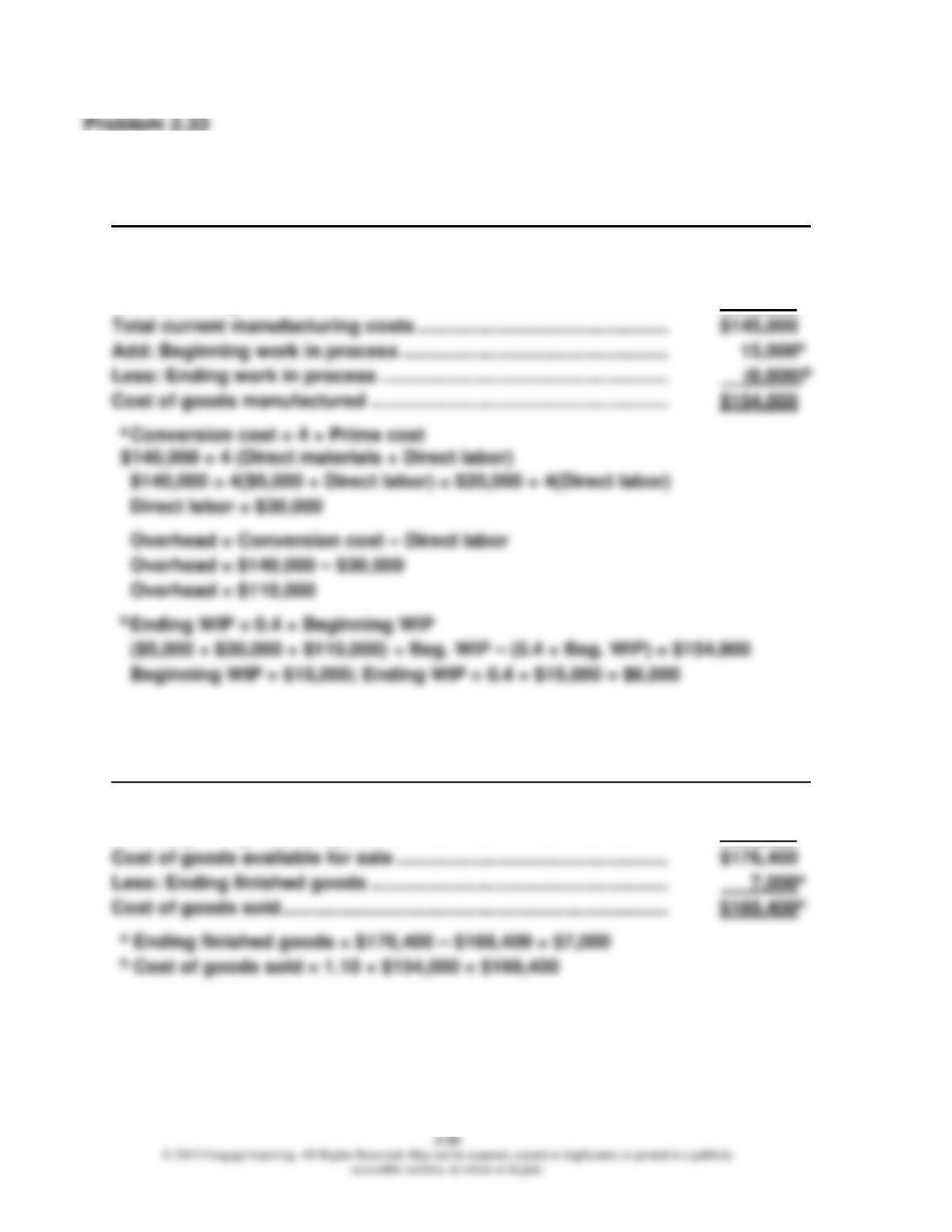
1. Mythic, Inc.
Statement of Cost of Goods Manufactured
For the Previous Year
Direct materials ……………………………………………………….…………… $ 5,000
Direct labor ………………………………………………………………………….. 30,000a
Manufacturing overhead ……………………………………………………….. 110,000a
2. Mythic, Inc.
Statement of Cost of Goods Sold
For the Previous Year
Cost of goods manufactured ………………………………………………… $154,000
Add: Beginning finished goods …………………………………………….. 22,400
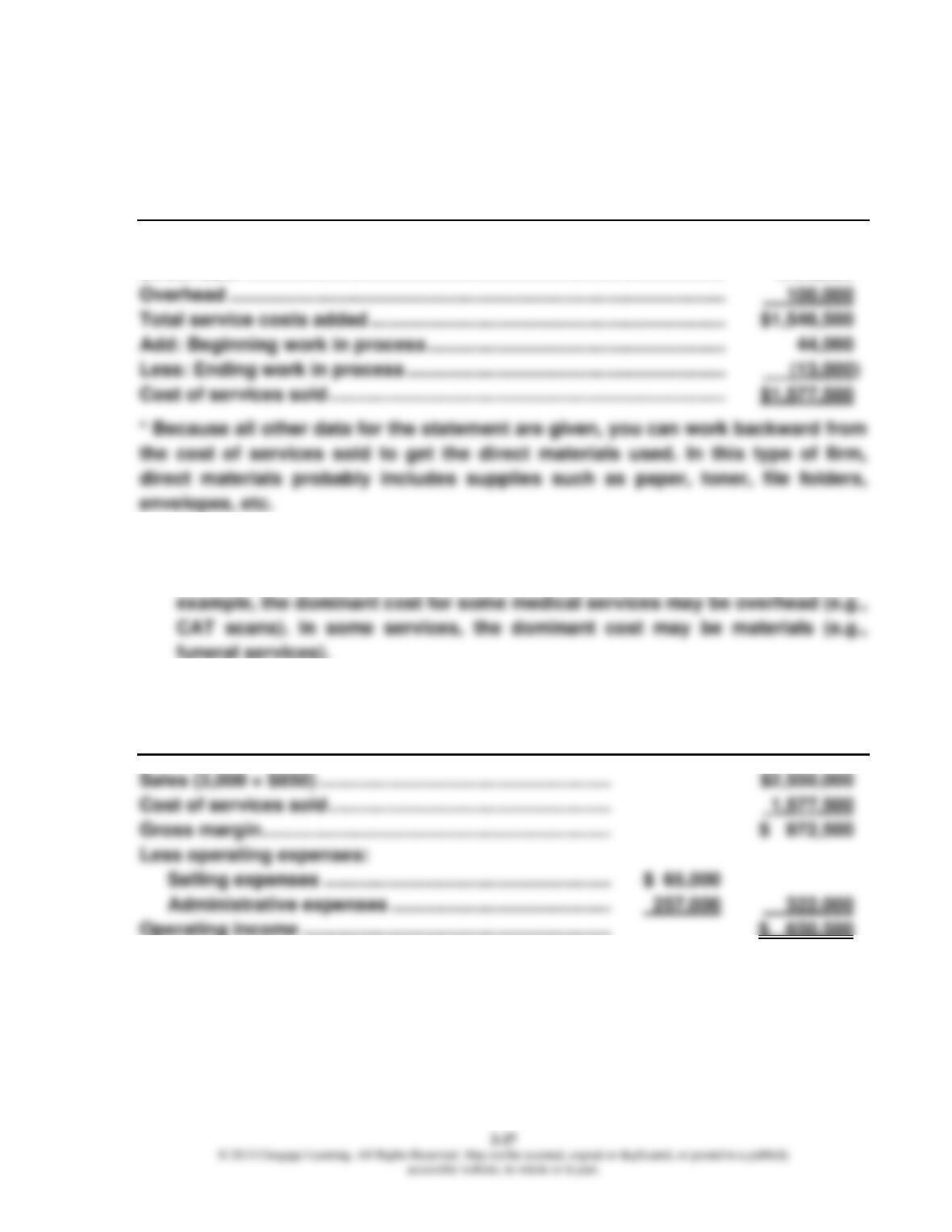
Problem 2.34
1. Mason, Durant, and Westbrook
Statement of Cost of Services Sold
For the Year Ended June 30
Direct materials used* ……………………………………………………………….. $ 46,500*
Direct labor ……………………………………………………………………………….. 1,400,000
2. The dominant cost is direct labor (for the 15 professionals). Although labor is
the major cost of providing many services, it is not always the case. For
3. Mason, Durant, and Westbrook
Income Statement
For the Year Ended June 30
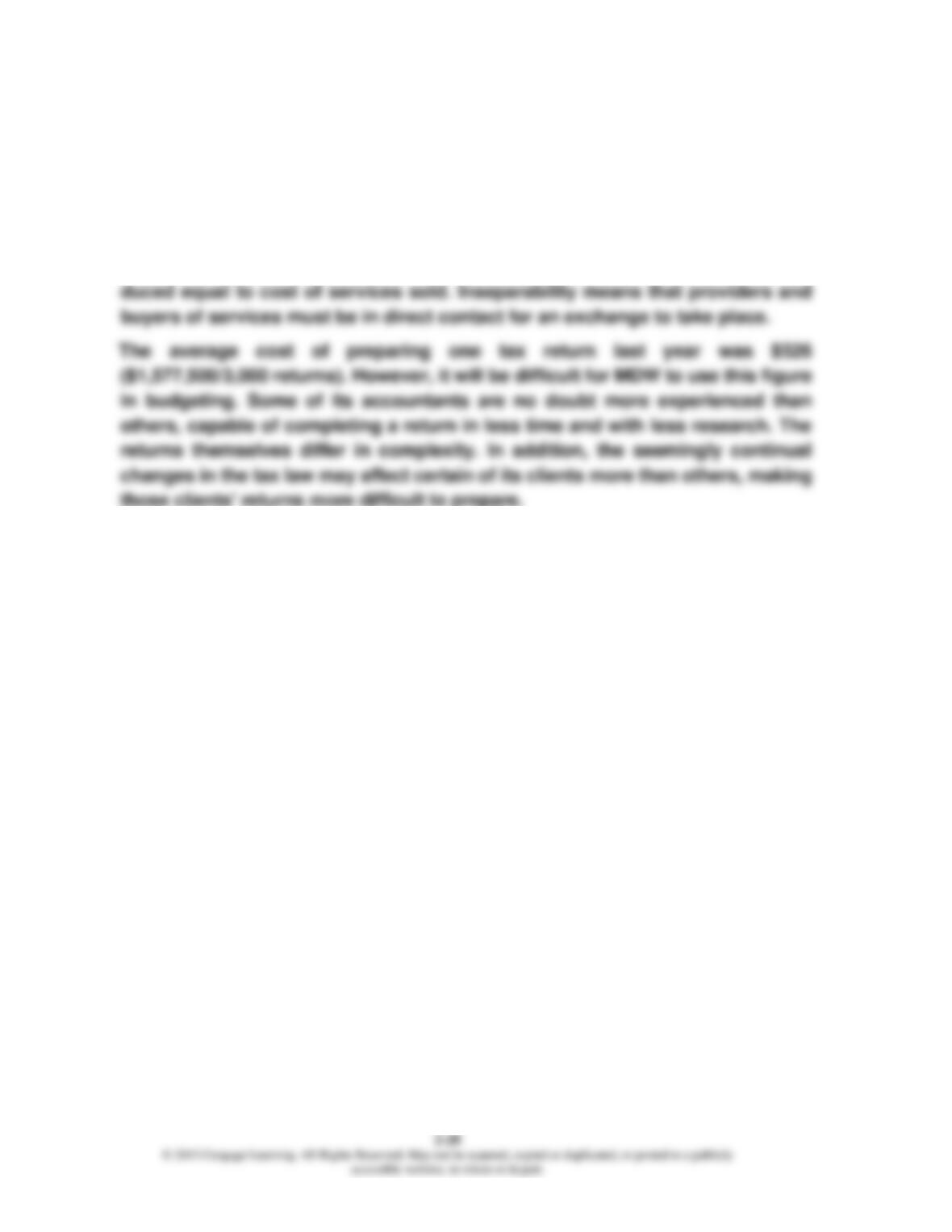
Problem 2.34 (Concluded)
4. Services have three attributes that are not possessed by tangible products:
(1) intangibility, (2) perishability, and (3) inseparability. Intangibility means that
the buyers of services cannot see, feel, hear, or taste a service before it is
bought. Perishability means that services cannot be stored. Therefore, there
will never be any finished goods inventories, making the cost of services pro-
Problem 2.35
1. Orman Company
Statement of Cost of Goods Manufactured
For Last Year
Direct materials:
Beginning inventory ………………………………………….. $ 3,450
Add: Purchases ………………………………………………… 183,750
Less: Ending inventory ……………………………………… (2,700)
Direct materials used in production ………………………… $184,500
Direct labor ……………………………………………………………. 138,000
Manufacturing overhead:
2. Orman Company
Income Statement: Absorption Costing
For Last Year
Sales (90,500 × $10.50) …………………………………………… $ 950,250
Cost of goods sold:
Beginning finished goods inventory ………………….. $113,000
2.36 PRODUCT COST DEFINITIONS ETHICS CASE
1. The consumer groups are using a cost definition that relies on manufacturing
costs. The pharmaceutical companies’ definition of cost is based on the val-
2. As the accountant compiling costs for the drug, it is reasonable to include all
costs related to research, development, and manufacture of the drug. The
relevant cost of selling and delivering the drug would also be included. Allo-
cation of costs across the corporation would be less defensible. For example,
CYBER RESEARCH CASE
2.37
Answers will vary.
The Collaborative Learning Exercise Solutions can be found on the in-
The following problems can be assigned within CengageNOW and are auto-
graded. See the last page of each chapter for descriptions of these new assign-
ments.
• Analyzing Relationships – Cost of Goods Manufactured and Cost of Goods