chapter
2
Analyzing Transactions
______________________________________________
OPENING COMMENTS
Chapter 2 is the most important chapter in the text. It introduces students to the rules of debit and credit,
chart of accounts, two-column journals, four-column ledgers, T accounts, and the trial balance. Quite
frankly, if students fail to grasp the concepts in this chapter, the first seeds of destruction will be sown for
those students who will ultimately withdraw from or fail the course.
Emphasize that Chapter 2 builds the foundation for all that will be learned about accounting principles.
Unlike many other college courses, it is impossible to understand Chapter 3 and beyond if the principles
of Chapter 2 are not mastered. You need to dispel the false belief that “maybe I’ll get the next chapter—
even though I’m totally lost now.”
After studying the chapter, your students should be able to:
2. Describe and illustrate journalizing transactions using the double-entry accounting system.
3. Describe and illustrate the journalizing and posting of transactions to accounts.
5. Describe and illustrate the use of horizontal analysis in evaluating a company’s performance and
financial condition.
STUDENT FAQS
• Why does Cash have a debit balance instead of a credit? My bank tells me they are crediting my
account when I put money in. This question has to be answered several times until the student realizes
that to the bank it is a liability, and they are telling the student what they are doing to their books.
• Why is the abbreviation for a debit “Dr” when there is no “r” in the spelling?
• Why can’t the normal balances of all the accounts be opposite what they are?
• Who dreamed this accounting system up?
• Who uses these statements, and what do they do with the information?
• What is the difference between journalizing and posting?
• What is the difference between an expense and a liability?
Chapter 2 Analyzing Transactions 21
OBJECTIVE 1
Describe the characteristics of an account and a chart of accounts.
KEY TERMS
Account Drawing
Assets Expenses
Balance of the Account Ledger
Capital Account Liabilities
Chart of Accounts Owner’s Equity
Credit Revenues
Debit T Account
SUGGESTED APPROACH
Remind students that accounts are used to record business transactions. An account is simply a record of
all the increases and decreases in a financial statement item (such as cash, supplies, and accounts
payable). A group of accounts is called a ledger.
Point out that only a very small enterprise with very few transactions (such as a lawn-mowing service run
by students) could use the accounting system illustrated in Chapter 1. For most businesses, this system
GROUP LEARNING ACTIVITY—Chart of Accounts
Objective 1 also introduces a chart of accounts and a flexible system of numbering accounts. Under the
text’s indexing system, accounts are assigned a two–digit number. The first digit indicates the account’s
classification (1 = assets, 2 = liabilities, 3 = owner’s equity, 4 = revenue, and 5 = expenses). Stress that all
enterprises will have the same categories of accounts; however, the account titles used and the number of
accounts will vary. You can emphasize this variety by asking students to bring in charts of accounts from
businesses where they or a relative work.
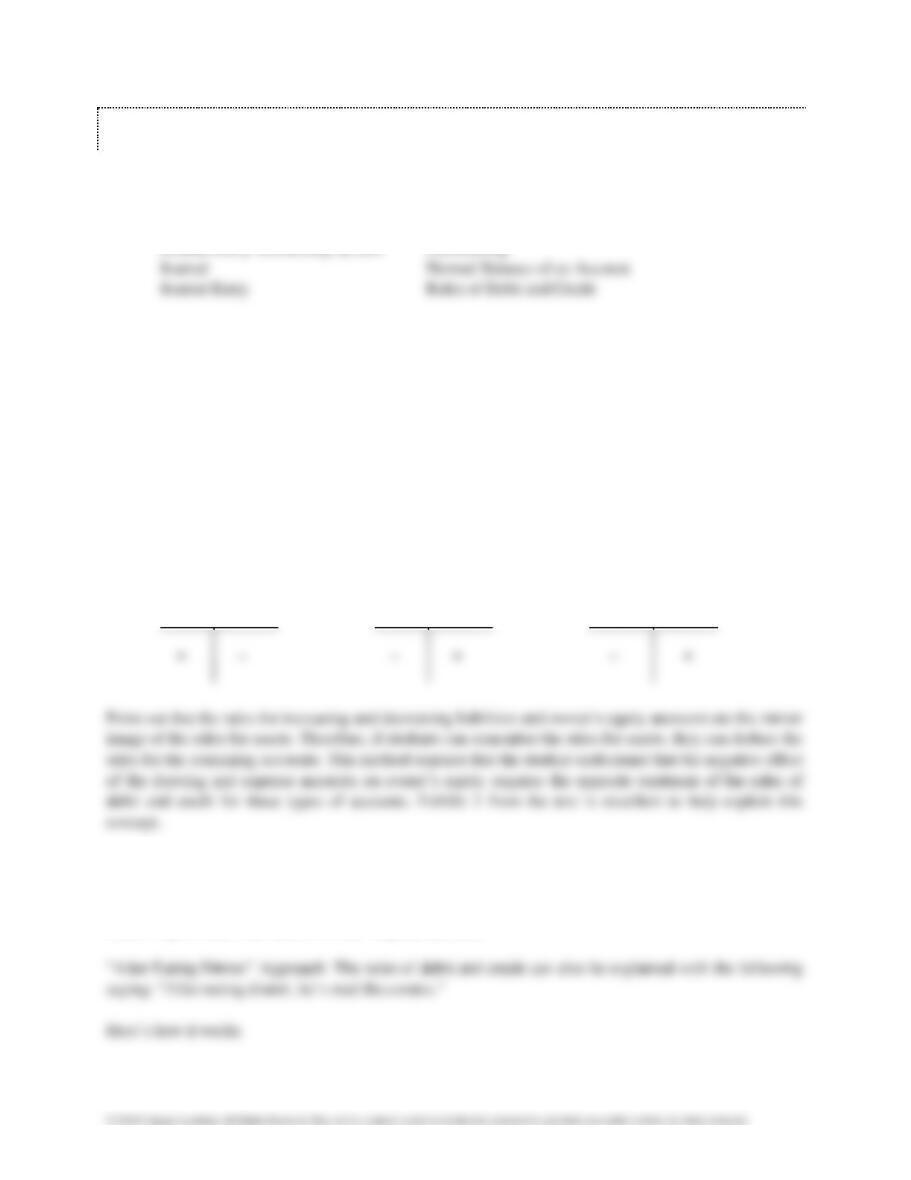
TM 2-2 presents information related to the business transactions of Larry Sharp, M.D. Divide students
into small groups and ask them to use the information to develop a chart of accounts for Dr. Sharp. Also
TM 2-3 presents a suggested chart of accounts that you may want to share with the class after they have
completed their group work. Remind them that the chart of accounts is different for every company,
reflecting each company’s typical business transactions.
INTERNET ACTIVITY—Chart of Accounts
There are organizations that post recommended charts of accounts on the Internet, so your students can
see some real-world examples. For example, the American Booksellers Association provides a suggested
chart of accounts for its members. It also provides an extensive explanation of why a standard chart of
accounts is helpful. The Web address is:
http://www.ambook.org/membership/products/scoa/scoa2.html
Chapter 2 Analyzing Transactions 23
OBJECTIVE 2
Describe and illustrate journalizing transactions using the double-entry accounting system.
KEY TERMS
Double-Entry Accounting System Journalizing
SUGGESTED APPROACH
Learning the rules of debit and credit is one of the first major hurdles for students in accounting
principles. Remind students that debit and credit simply represent the left and right sides of an account.
The trick is remembering which accounts are increased with debits and which are increased with credits.
LECTURE AID—Rules of Debit and Credit
Three approaches to explain the rules of debit and credit follow. You may want to present all methods to
your class and encourage each student to use the approach that he or she understands best.
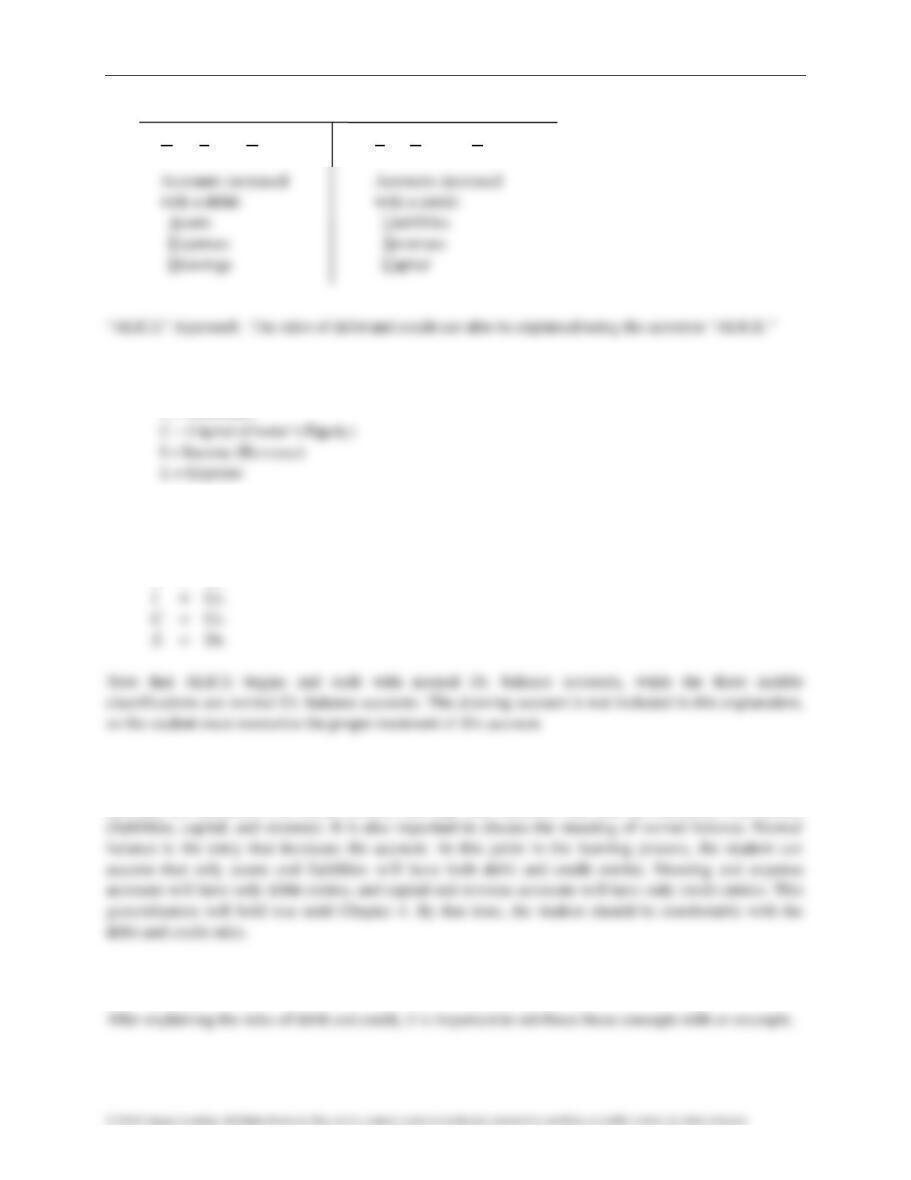
“Mirror Image” Approach: One way to explain the rules of debit and credit is to draw the following
equation on the board.
Assets = Liabilities + Owner’s Equity
Although this is the most simplistic approach, some students become very confused by the treatment of
the drawings and expense accounts. Increases to these accounts are debits, since they reduce owner’s
equity. However, some students want to record expenses and drawings as credits because the schematic
has a + sign on the credit side of owner’s equity accounts.
24 Chapter 2 Analyzing Transactions
After Eating Dinner, Let’s Read the Comics
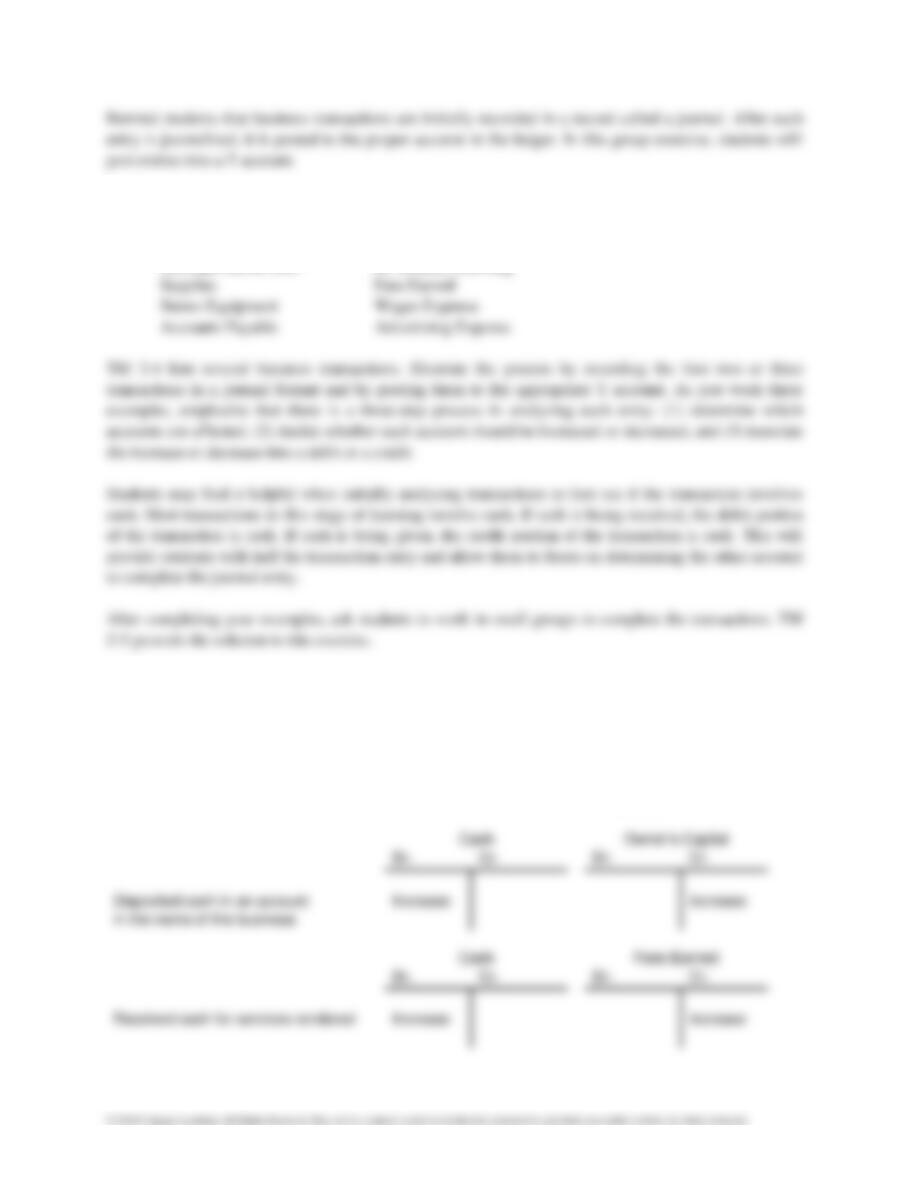
List the types of classifications of accounts:
A = Assets
L = Liabilities
Arrange the letters to read “ALICE.” Then list normal balances by the side of each.
A
=
Dr.
L
=
Cr.
C
=
Cr.
E
=
Dr.
No matter which approach the student uses to learn the rules, you will need to reinforce the categories and
the proper treatment of increases and decreases over and over. Start by emphasizing that half of the
accounts are increased with debits (assets, drawing, and expenses) and half are increased with credits
GROUP LEARNING ACTIVITY—Rules of Debit and Credit
Chapter 2 Analyzing Transactions 25
Ask your students to draw the following T accounts on a sheet of paper:
Cash M. Gordon, Capital
Accounts Receivable M. Gordon, Drawing
LECTURE AID—Double-Entry Accounting
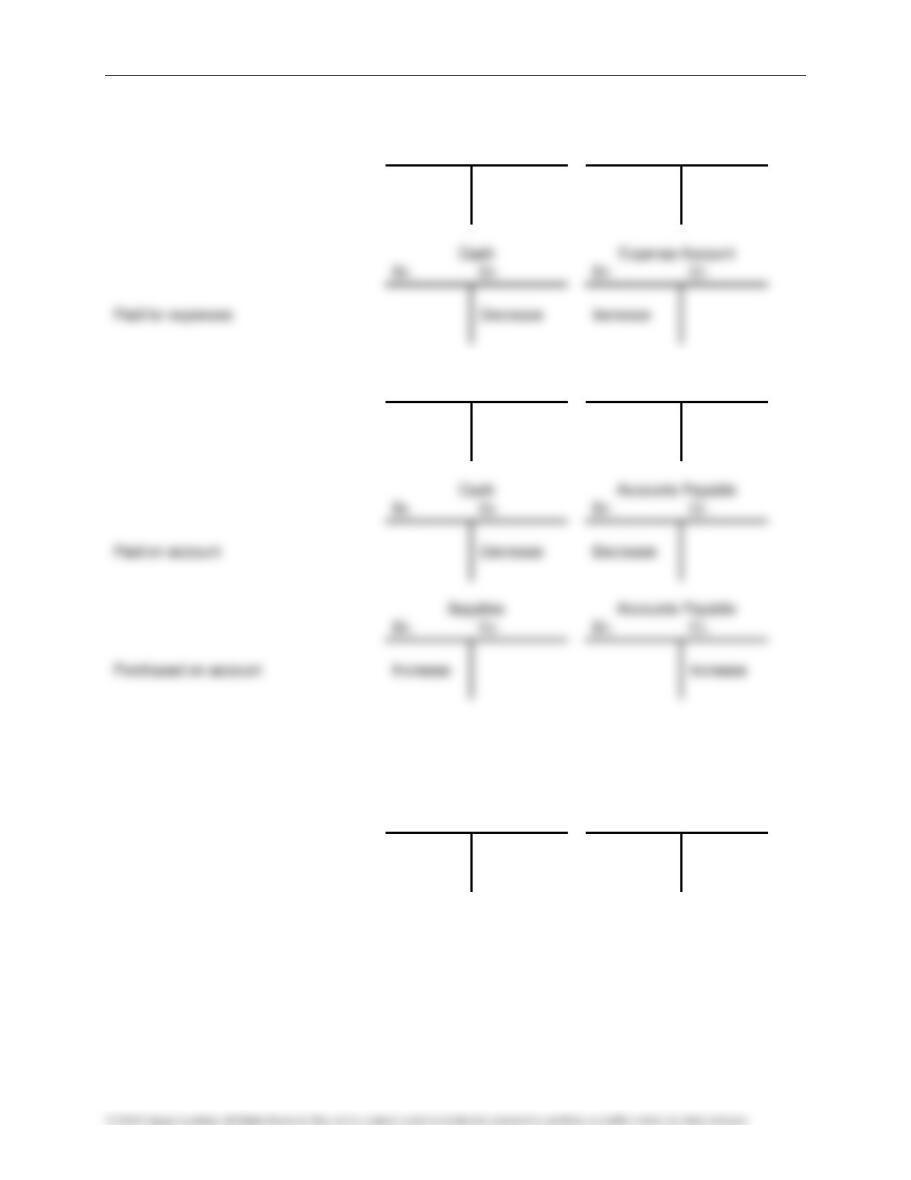
To help the student understand the effect of double-entry accounting, it can be helpful to illustrate
examples of some more common transactions, such as the ones below, as you lecture.
TRANSACTION
AFFECTED ACCOUNTS
Deposited cash in an account
Increase
Increase
in the name of the business
Received cash for services rendered
Increase
Increase
26 Chapter 2 Analyzing Transactions
Accounts Receivable
Fees Earned
Dr.
Cr.
Dr.
Cr.
Billed customers on account
Increase
Increase
Cash
Dr.
Cr.
Dr.
Cr.
Paid for expenses
Decrease
Increase
Cash
Accounts Receivable
Dr.
Cr.
Dr.
Cr.
Received cash on account
Increase
Decrease
Cash
Dr.
Cr.
Dr.
Cr.
Paid on account
Decrease
Decrease
Dr.
Cr.
Dr.
Cr.
Purchased on account
Increase
Increase
Cash
Owner’s Drawing
Dr.
Cr.
Dr.
Cr.
Withdrew cash for personal use
Decrease
Increase
LECTURE AID—Journalizing
At this point, it is time to introduce your students to the standard journal format. It is interesting to point
out that while T accounts are not actually used to record business transactions, accountants frequently use
them to analyze complex transactions. In the same way, students will find the T account a useful tool
throughout this and future accounting courses.
Chapter 2 Analyzing Transactions 27
TM 2-6 shows a series of transactions recorded in a two-column journal. Use this exhibit to review the
two-column journal format with your students. You may want to stress the following format issues:
1. Dates: The year is entered only at the top of the date column. The month is entered on the first line of
3. Proper journalizing always has at least one debit and one credit, and total debits must always equal
total credits. Proper journalizing will keep the accounting equation in balance.
4. Explanations: A brief description of the transaction should be written below the debit and credit
5. Blank Lines: A blank line should separate all transactions in a manual journal to make them easier to
read. Computerized systems are normally designed to separate journal entries without special input.
It is also helpful to emphasize the importance of using the correct journal entry format of left justifying
debits and indenting credits by writing the following entry on the board and asking students to identify
what is wrong:
OBJECTIVE 3
Describe and illustrate the journalizing and posting of transactions to accounts.
KEY TERMS
Account Receivable Unearned Revenue
Posting
28 Chapter 2 Analyzing Transactions
SUGGESTED APPROACH
Remind students that journalizing transactions is a sequential record of business dealings and posting is
the updating of individual account balances. Getting the journal entry correct is the bigger challenge; the
DEMONSTRATION PROBLEM—The Ledger
TM 2-7 is a series of four-column ledger accounts. Use these blank accounts to demonstrate posting of the
first three transactions from TM 2-6. As you post the transactions, remind students that a posting
WRITING EXERCISE—The Journal and the Ledger
It is important for students to understand the reason that business transactions are recorded in a journal as
the book of original entry and later posted to a ledger. To check their understanding of these concepts, ask
them to write a response to the following questions. These questions are also found on TM 2-8.
1. Why are business transactions initially recorded in a journal?
2. Why are business transactions posted from the journal to a ledger?
Question 2 possible response: The ledger tracks the balance of the individual accounts. Without posting
transaction to the ledger, the accountant would have to go back and track every individual transaction to
find those that impact the account in question and track the increases and decreases over the accounting
period to determine the balance in the account.
GROUP LEARNING ACTIVITY—The Journal and the Ledger
Chapter 2 Analyzing Transactions 29
OBJECTIVE 4
Prepare an unadjusted trial balance and explain how it can be used to discover errors.
KEY TERM
Correcting Journal Entry Trial Balance
Slide Unadjusted Trial Balance
Transposition
SUGGESTED APPROACH
Remind students that a trial balance is simply a listing of accounts and their balances. It is used to check
the accuracy of posting by testing to see that total debits equal total credits. At this point, students have
learned two controls over recording entries in a double-entry accounting system: (1) Debits = Credits and
(2) Assets = Liabilities + Owner’s Equity.
You may point out at this time that this is the first of three times in the accounting cycle that the trial
balance will be completed.
DEMONSTRATION PROBLEM—Preparing a Trial Balance
GROUP LEARNING ACTIVITY—Errors in a Trial Balance
The goal of this activity is to demonstrate the use of a trial balance in detecting errors made while
recording journal entries, posting, and computing account balances. TM 2-12 presents journal entries, T
You may want to give your students the following hints to help them detect the errors:
2. Look for accounts with abnormal balances on the trial balance. This usually points to an error.
4. Re–compute the balance of each account to check for math errors. Again, this usually doesn’t happen
5. Trace each posting back to the journal entry to make sure the proper amount was posted. Watch for
slide or transposition errors.
1. Failing to record a transaction or to post a transaction.
3. Recording the same transaction more than once.
4. Posting part of a transaction correctly as a debit or credit but to the wrong account.
As an example, ask your class the following question: Would recording an $800 sale on account as a debit
to Cash and a credit to Fees Earned cause the columns of a trial balance to be unequal? Answer: No.
OBJECTIVE 5
Describe and illustrate the use of horizontal analysis in evaluating a company’s
performance and financial condition.
KEY TERM
Horizontal Analysis
SUGGESTED APPROACH
This objective introduces the value of horizontal analysis as a tool to indicate trends in a company’s
performance. Remind students that financial statements are a “snapshot” in time without any means of
comparison to other time periods. The horizontal analysis indicates changes (increase or decrease) in both
amounts and percentages.
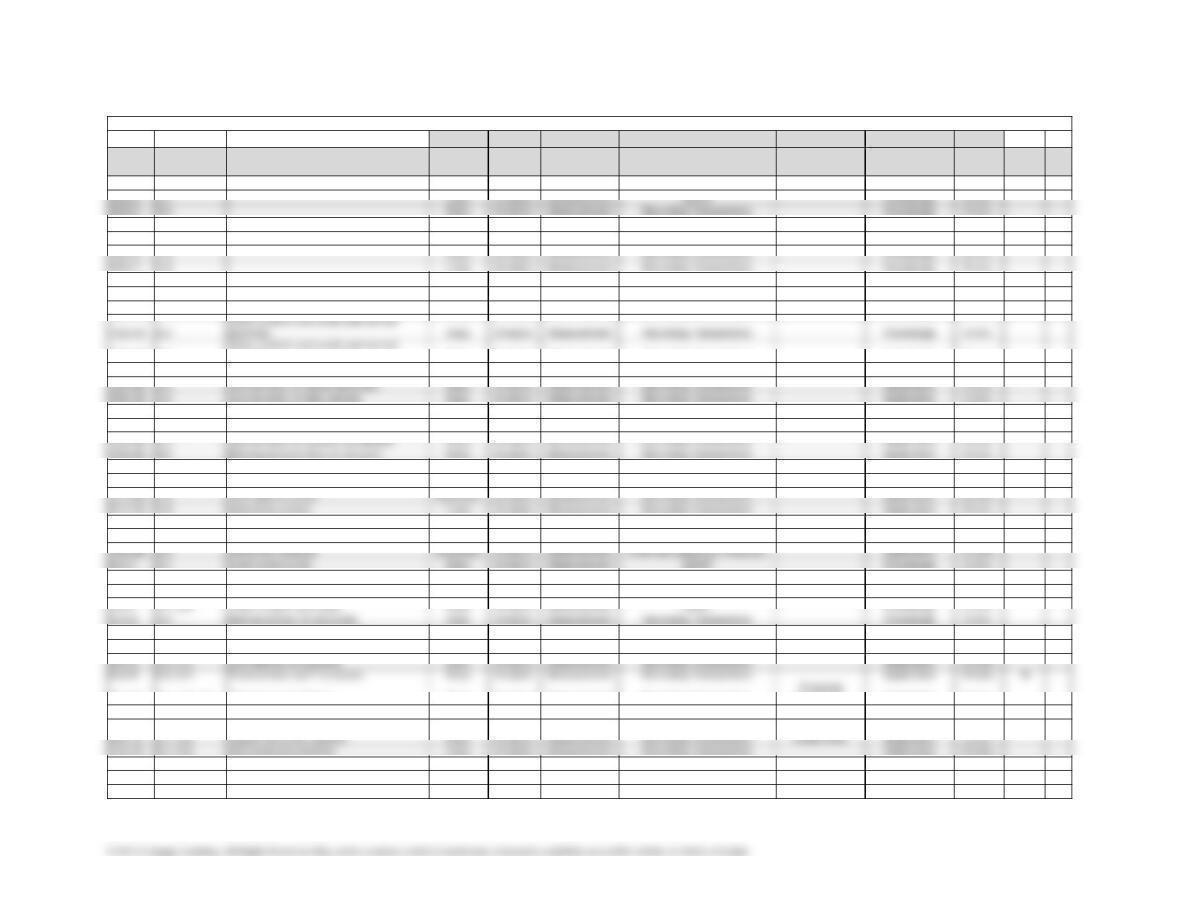
DIFFICULTY BUSPROG AICPA ACBSP ACBSP BLOOM’S TIME
Number
Learning
Objective
Description Primary Functional Primary Secondary
Spread-
sheet
GL
DQ2-1 2-2 Easy Analytic Measurement GAAP Knowledge 5 min.
DQ2-2 2-1 Easy Analytic Measurement GAAP Knowledge 5 min.
DQ2-4 2-1 Easy Analytic Measurement Recording Transactions Knowledge 5 min.
DQ2-5 2-3 Easy Analytic Measurement Recording Transactions Knowledge 5 min.
DQ2-6 2-4 Easy Analytic Measurement Recording Transactions Knowledge 5 min.
DQ2-7 2-4 Easy Analytic Measurement Recording Transactions Knowledge 5 min.
DQ2-8 2-4 Easy Analytic Measurement Recording Transactions Knowledge 5 min.
DQ2-9 2-4 Easy Analytic Measurement Recording Transactions Knowledge 5 min.
DQ2-10 2-1 Easy Analytic Measurement Recording Transactions Knowledge 5 min.
PE2-1A 2-2
balances
Easy Analytic Measurement Recording Transactions Knowledge 5 min.
PE2-1B 2-2
balances
Easy Analytic Measurement Recording Transactions Knowledge 5 min.
PE2-2A 2-2 Journal entry for asset purchase Easy Analytic Measurement Recording Transactions Application 5 min.
PE2-2B 2-2 Journal entry for asset purchase Easy Analytic Measurement Recording Transactions Application 5 min.
PE2-3A 2-3 Journal entry for fees earned Easy Analytic Measurement Recording Transactions Application 5 min.
PE2-3B 2-3 Journal entry for fees earned Easy Analytic Measurement Recording Transactions Application 5 min.
PE2-4A 2-3 Journal entry for owner’s withdrawal Easy Analytic Measurement Recording Transactions Application 5 min.
PE2-5A 2-3 Missing amount from an account Easy Analytic Measurement Recording Transactions Application 5 min.
PE2-5B 2-3 Missing amount from an account Easy Analytic Measurement Recording Transactions Application 5 min.
PE2-6A 2-4 Trial balance errors Moderate Analytic Measurement Recording Transactions Application 10 min.
PE2-6B 2-4 Trial balance errors Moderate Analytic Measurement Recording Transactions Application 10 min.
PE2-7A 2-4 Correcting entries Easy Analytic Measurement Recording Transactions Application 5 min.
PE2-7B 2-4 Correcting entries Easy Analytic Measurement Recording Transactions Application 5 min.
PE2-8A 2-5 Horizontal analysis Moderate Analytic Measurement Financial Statement Analysis Application 10 min.
PE2-8B 2-5 Horizontal analysis Moderate Analytic Measurement Financial Statement Analysis Application 10 min.
Ex2-1 2-1 Chart of accounts Easy Analytic Measurement GAAP Knowledge 5 min.
Ex2-2 2-1 Chart of accounts Easy Analytic Measurement GAAP Knowledge 5 min.
Ex2-3 2-1 Chart of accounts Easy Analytic Measurement GAAP Knowledge 10 min.
Ex2-4 2-1, 2-2 Rules of debit and credit Easy Analytic Measurement GAAP Knowledge 5 min.
Ex2-6 2-1, 2-2 Normal balances of accounts Easy Analytic Measurement Recording Transactions Knowledge 5 min.
Ex2-7 2-2 Transactions Moderate Analytic Measurement Recording Transactions Application 15 min.
Ex2-8 2-2, 2-3 Journalizing and posting Easy Analytic Measurement Recording Transactions Application 10 min.
Ex2-10 2-1, 2-2, 2-3 Cash account balance Easy Analytic Measurement Recording Transactions
Statements
Application 5 min.
Ex2-11 2-1, 2-2, 2-3 Accounts balances Moderate Analytic Measurement Recording Transactions Application 10 min.
Ex2-12 2-1, 2-2 Capital accounts balance Easy Analytic Measurement Recording Transactions
Statements
Application 5 min.
Ex2-13 2-1, 2-2 Identifying transactions Easy Analytic Measurement Recording Transactions Application 10 min.
Financial
Ex2-14 2-1, 2-2 Journal entries Easy Analytic Measurement Recording Transactions Application 10 min.
Ex2-15 2-4 Trial balance Easy Analytic Measurement Recording Transactions Application 5 min. X
Ex2-16 2-4 Trial balance Moderate Analytic Measurement Recording Transactions Application 10 min.
HOMEWORK CHART WITH LEARNING OUTCOMES TAGGING
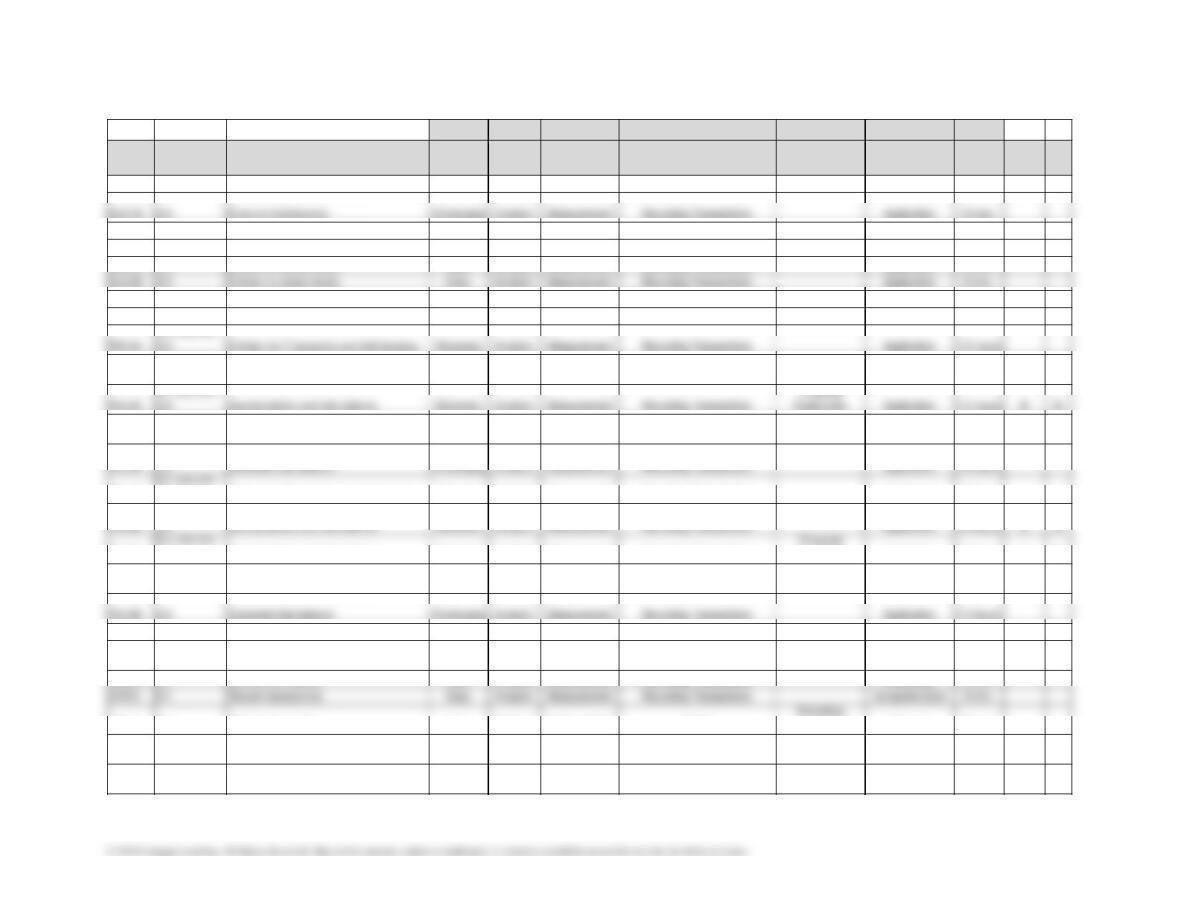
DIFFICULTY BUSPROG AICPA ACBSP ACBSP BLOOM’S TIME
Number
Learning
Objective
Description Primary Functional Primary Secondary
Spread-
sheet
GL
Ex2-17 2-4 Effect of errors on trial balance Moderate Analytic Measurement Recording Transactions Application 10 min.
Ex2-19 2-4 Effect of errors on trial balance Moderate Analytic Measurement Recording Transactions Application 10 min.
Ex2-20 2-4 Errors in trial balance Easy Analytic Measurement Recording Transactions Application 10 min.
Ex2-21 2-4 Entries to correct errors Easy Analytic Measurement Recording Transactions Application 5 min.
Ex2-23 2-5 Horizontal analysis of income statement Moderate Analytic Measurement Financial Statement Analysis Application 10 min.
Ex2-24 2-5 Horizontal analysis of income statement Moderate Analytic Measurement Financial Statement Analysis Application 10 min.
Pr2-1A
2-1, 2-2, 2-3,
2-4
Entries into T accounts and trial balance Moderate Analytic Measurement Recording Transactions Application 1.5 hours
Pr2-2A
2-1, 2-2, 2-3,
2-4
Journal entries and trial balance Moderate Analytic Measurement Recording Transactions Application 1.5 hours X X
Pr2-3A
2-1, 2-2, 2-3,
2-4
Journal entries and trial balance Moderate Analytic Measurement Recording Transactions
Statements
Application 1.5 hours X X
Pr2-4A
2-1, 2-2, 2-3,
2-4
Journal entries and trial balance Moderate Analytic Measurement Recording Transactions Application 2 hours X
Pr2-5A 2-4 Corrected trial balance Challenging Analytic Measurement Recording Transactions Application 1.5 hours
2-1, 2-2, 2-3,
Pr2-1B
2-4
Entries into T accounts and trial balance Moderate Analytic Measurement Recording Transactions Application 1.5 hours
Pr2-2B
2-4
Journal entries and trial balance Moderate Analytic Measurement Recording Transactions Application 1.5 hours X X
2-1, 2-2, 2-3,
2-1, 2-2, 2-3,
Pr2-3B
2-4
Journal entries and trial balance Moderate Analytic Measurement Recording Transactions
Statements
Application 1.5 hours X X
Pr2-4B
2-1, 2-2, 2-3,
2-4
Journal entries and trial balance Moderate Analytic Measurement Recording Transactions Application 2 hours X
Pr2-5B 2-4 Corrected trial balance Challenging Analytic Measurement Recording Transactions Application 1.5 hours
MD-2 Continuing Problem X
CP2-1 2-3
Ethics and professional conduct in
business
Easy Ethics Measurement Recording Transactions Application 5 min.
CP2-2 2-1 Account for revenue Easy Analytic Measurement Recording Transactions Knowledge 5 min.
CP2-3 2-1 Record transactions Easy Analytic Measurement Recording Transactions Comprehension 5 min.
CP2-4 2-1 Debits and credits Easy Analytic Measurement GAAP
Transactions
Analysis 15 min.
CP2-5 2-1, 2-2 Transactions and income statement Moderate Analytic Measurement Recording Transactions
Financial
Statements
Application 1 hour
CP2-6 2-1 Opportunities for accountants Easy
Reflective
Thinking
Research Purpose Knowledge 15 min.