2-21
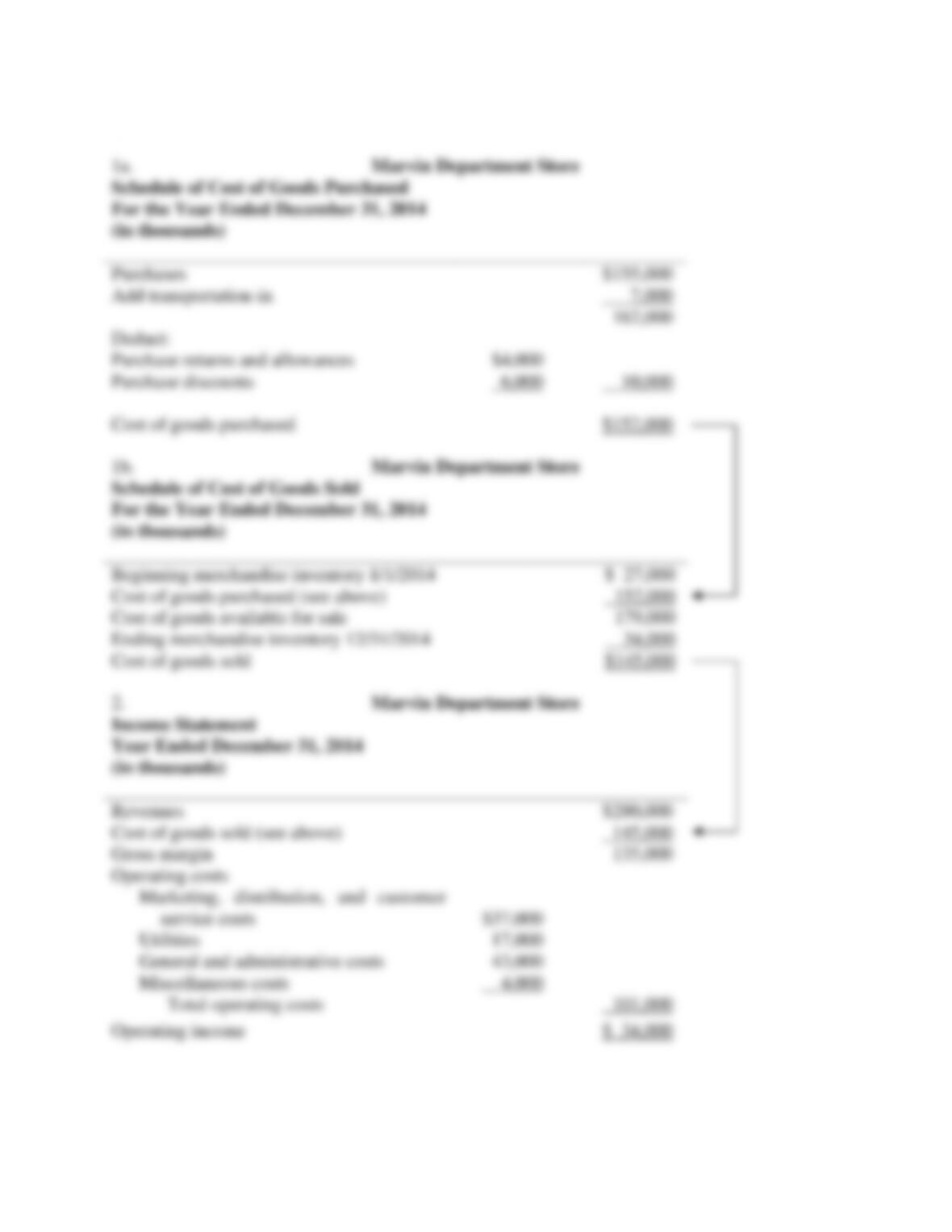
2-29 (20 min.) Computing cost of goods purchased and cost of goods sold.
The following data are for Marvin Department Store. The account balances (in thousands) are for
2014.
Marketing, distribution, and customer-service costs
$ 37,000
Merchandise inventory, January 1, 2014
27,000
Utilities
17,000
General and administrative costs
43,000
Merchandise inventory, December 31, 2014
34,000
Purchases
155,000
Miscellaneous costs
4,000
Transportation-in
7,000
Purchase returns and allowances
4,000
Purchase discounts
6,000
Revenues
280,000
Required:
1. Compute (a) the cost of goods purchased and (b) the cost of goods sold.
2. Prepare the income statement for 2014.
2-22
SOLUTION
2-23
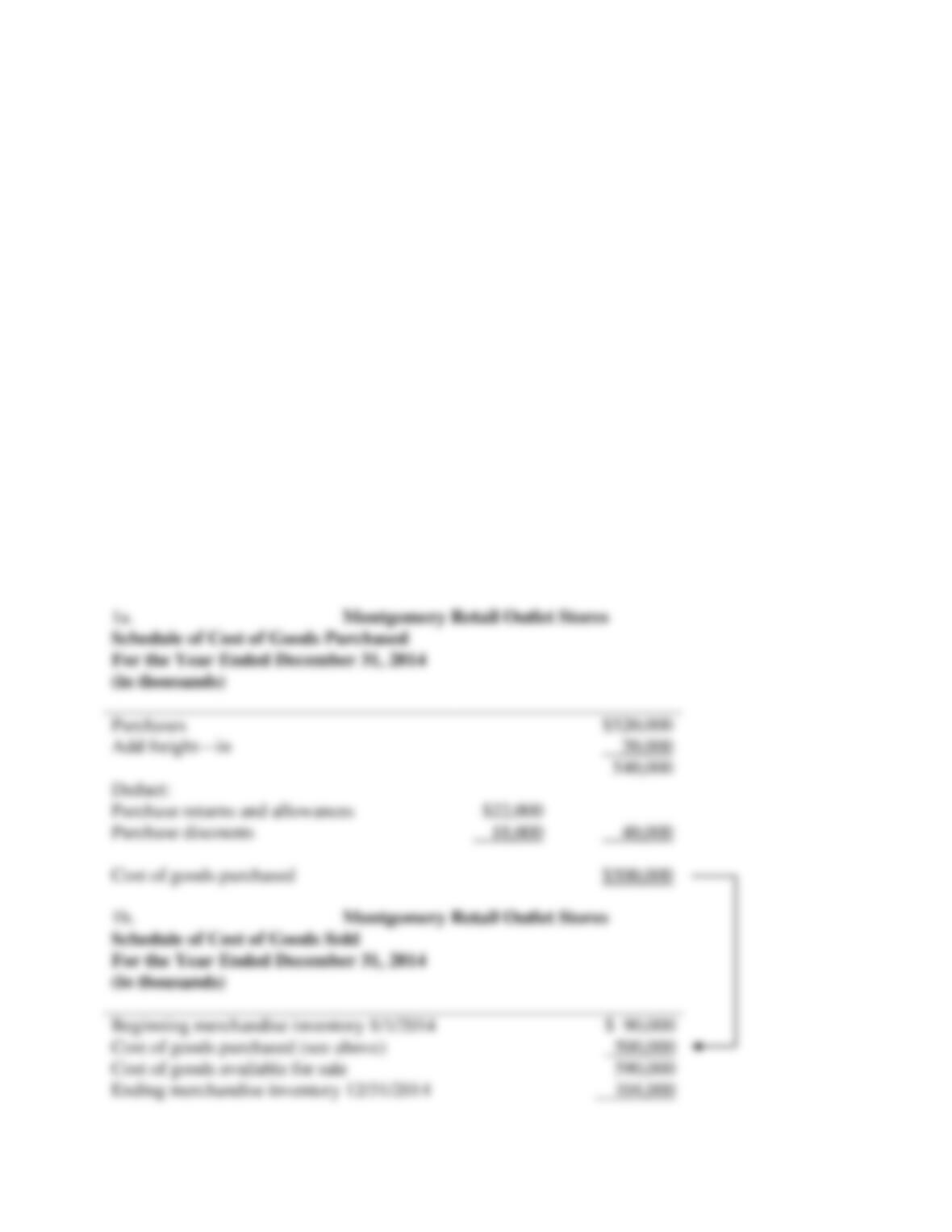
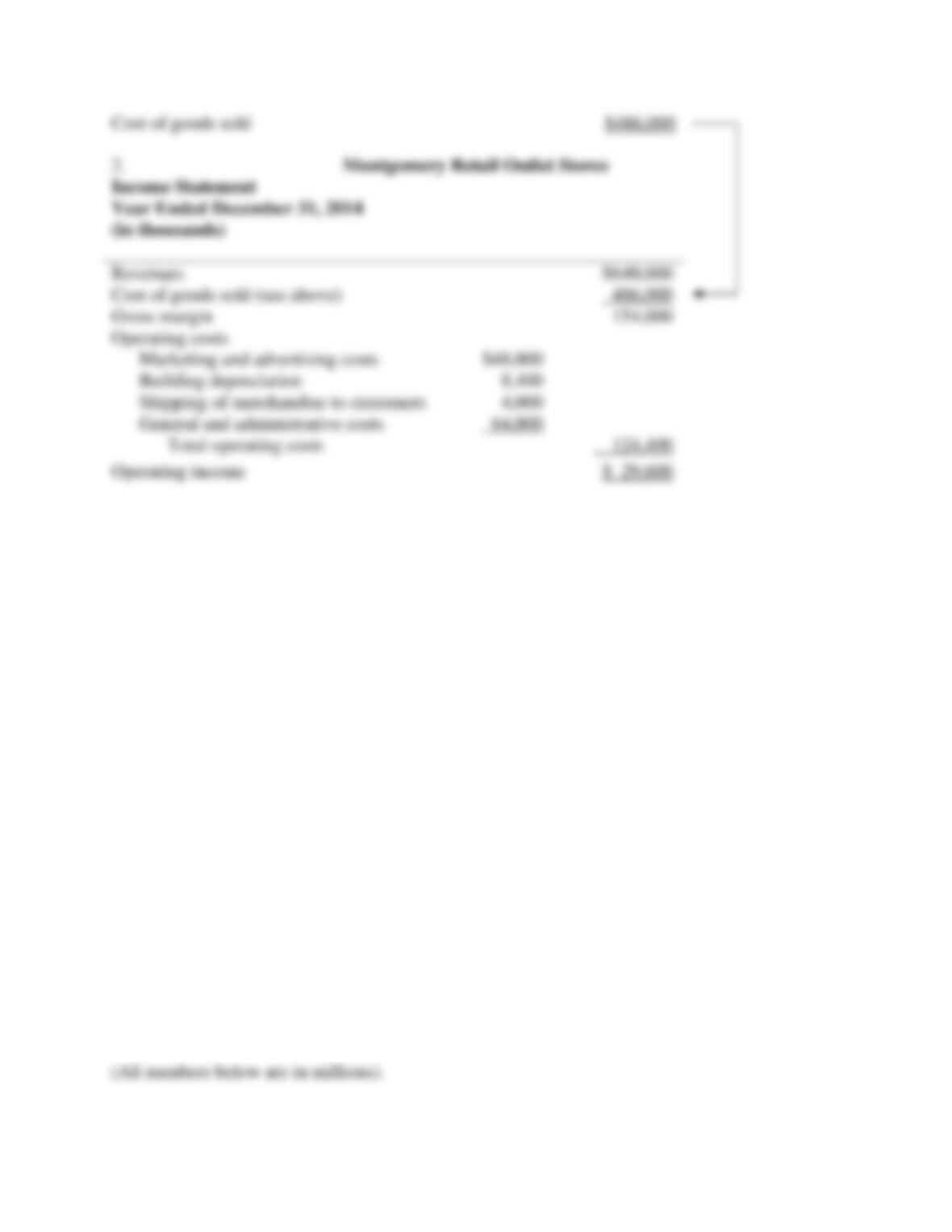
2-30 (20 min.) Cost of goods purchased, cost of goods sold, and income statement.
The following data are for Montgomery Retail Outlet Stores. The account balances (in
thousands) are for 2014.
Required:
1. Compute (a) the cost of goods purchased and (b) the cost of goods sold.
2. Prepare the income statement for 2014.
SOLUTION
Marketing and advertising costs
$ 48,000
Merchandise inventory, January 1, 2014
90,000
Shipping of merchandise to customers
4,000
Building depreciation
8,400
Purchases
520,000
General and administrative costs
64,000
Merchandise inventory, December 31, 2014
104,000
Merchandise freight-in
20,000
Purchase returns and allowances
22,000
Purchase discounts
18,000
Revenues
640,000
2-24
2-31 (20 min.) Flow of Inventoriable Costs.
Renka’s Heaters selected data for October 2014 are presented here (in millions):
Required: Calculate the following costs:
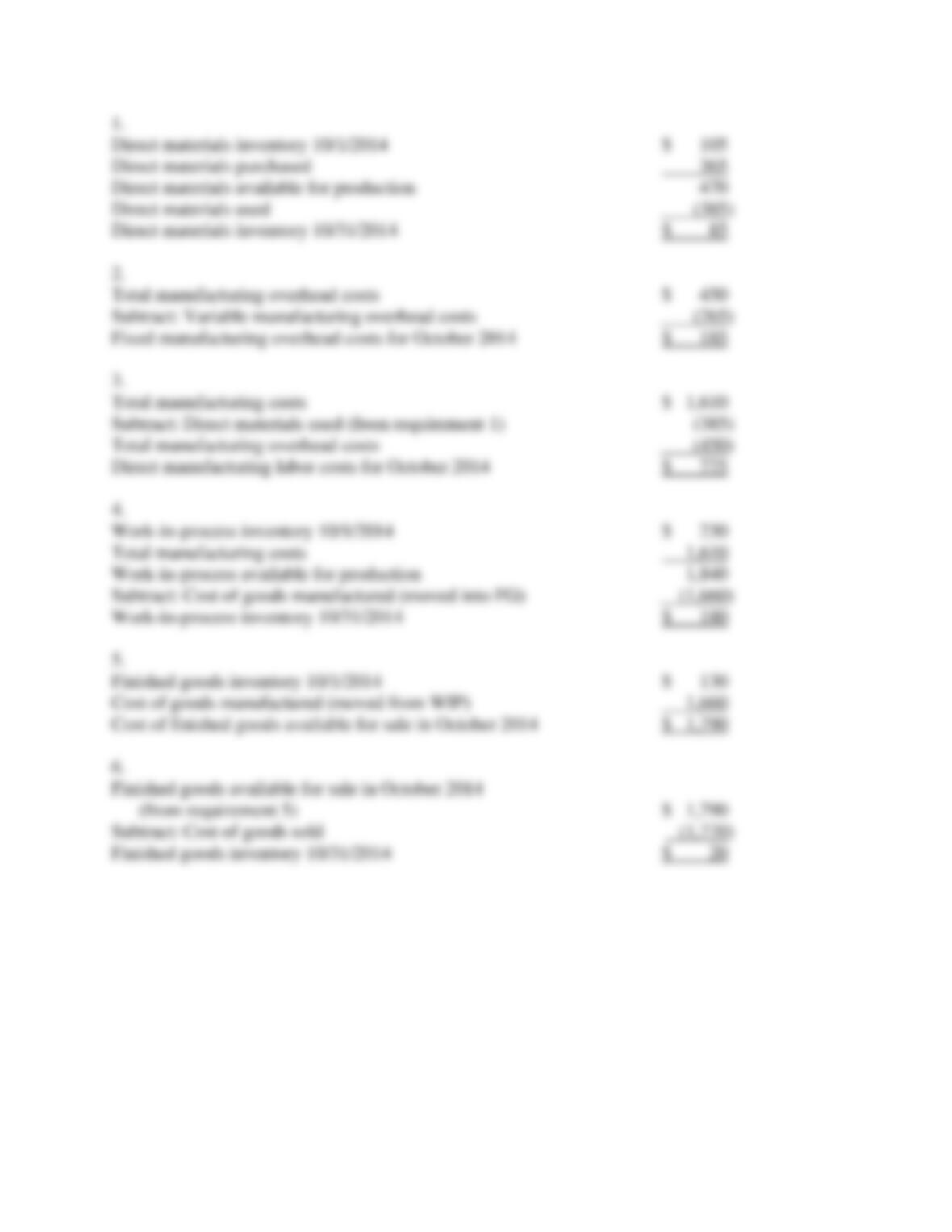
1. Direct materials inventory 10/31/2014
2. Fixed manufacturing overhead costs for October 2014
3. Direct manufacturing labor costs for October 2014
4. Work-in-process inventory 10/31/2014
5. Cost of finished goods available for sale in October 2014
6. Finished goods inventory 10/31/2014
SOLUTION
Direct materials inventory 10/1/2014
$ 105
Direct materials purchased
365
Direct materials used
385
Total manufacturing overhead costs
450
Variable manufacturing overhead costs
265
Total manufacturing costs incurred during October 2014
1,610
Work-in-process inventory 10/1/2014
230
Cost of goods manufactured
1,660
Finished goods inventory 10/1/2014
130
Cost of goods sold
1,770
2-25

2-26
2-32 (30–40 min.) Cost of goods manufactured, income statement, manufacturing
company.
Consider the following account balances (in thousands) for the Peterson Company:
Peterson Company
Beginning of
2014
End of
2014
Direct materials inventory
21,000
23,000
Work-in-process inventory
26,000
25,000
Finished goods inventory
13,000
20,000
Purchases of direct materials
74,000
Direct manufacturing labor
22,000
Indirect manufacturing labor
17,000
Plant insurance
7,000
Depreciation—plant, building, and equipment
11,000
Repairs and maintenance—plant
3,000
Marketing, distribution, and customer-service costs
91,000
General and administrative costs
24,000
Required:
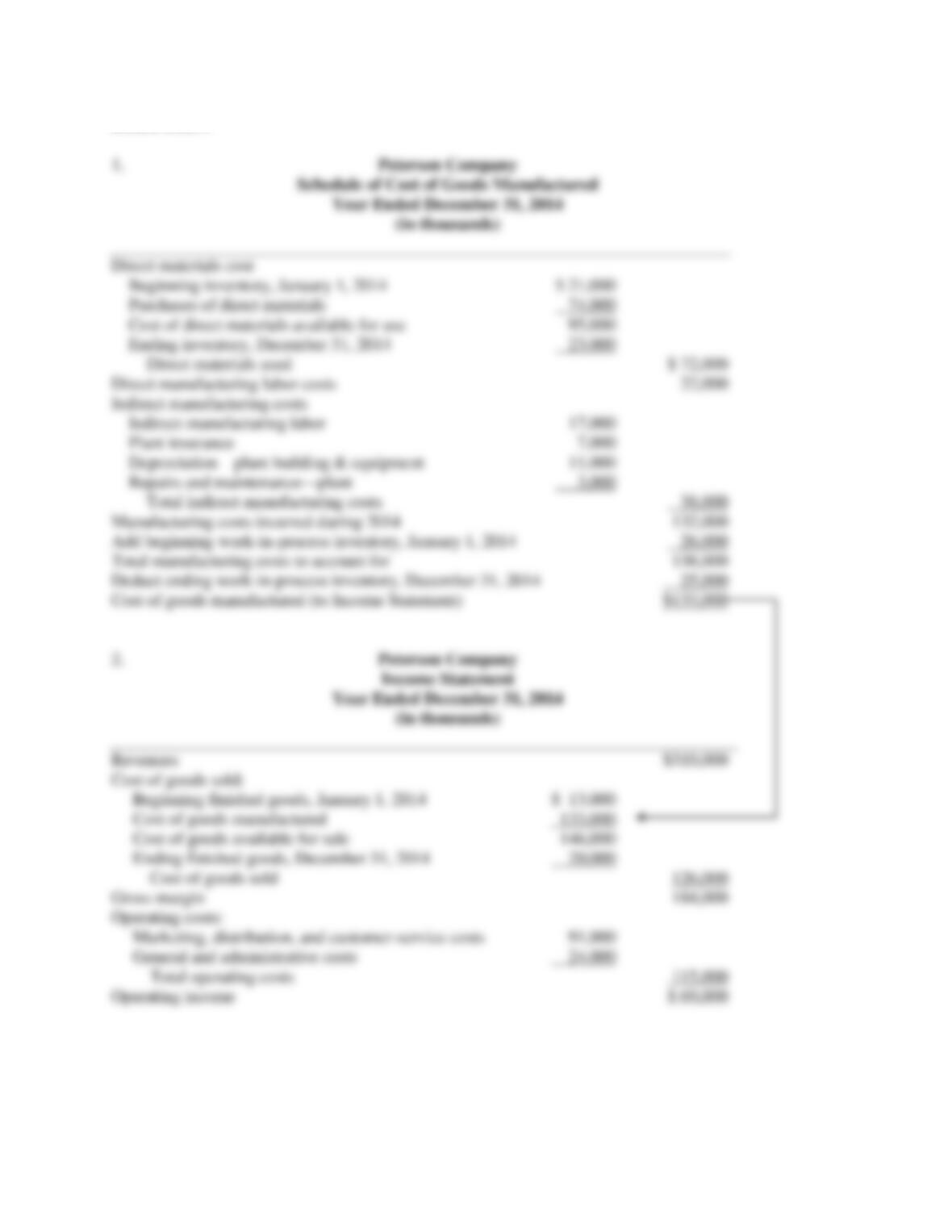
1. Prepare a schedule for the cost of goods manufactured for 2014.
2. Revenues for 2014 were $310 million. Prepare the income statement for 2014.
2-27
SOLUTION

2-28
2-33 (30–40 min.) Cost of goods manufactured, income statement, manufacturing
company.
Consider the following account balances (in thousands) for the Shaler Corporation:
Shaler Corporation
Beginning of
2014
End of
2014
Direct materials inventory
130,000
68,000
Work-in-process inventory
166,000
144,000
Finished goods inventory
246,000
204,000
Purchases of direct materials
256,000
Direct manufacturing labor
212,000
Indirect manufacturing labor
96,000
Indirect materials
28,000
Plant insurance
4,000
Depreciation—plant, building, and equipment
42,000
Plant utilities
24,000
Repairs and maintenance—plant
16,000
Equipment leasing costs
64,000
Marketing, distribution, and customer-service costs
124,000
General and administrative costs
68,000
Required:
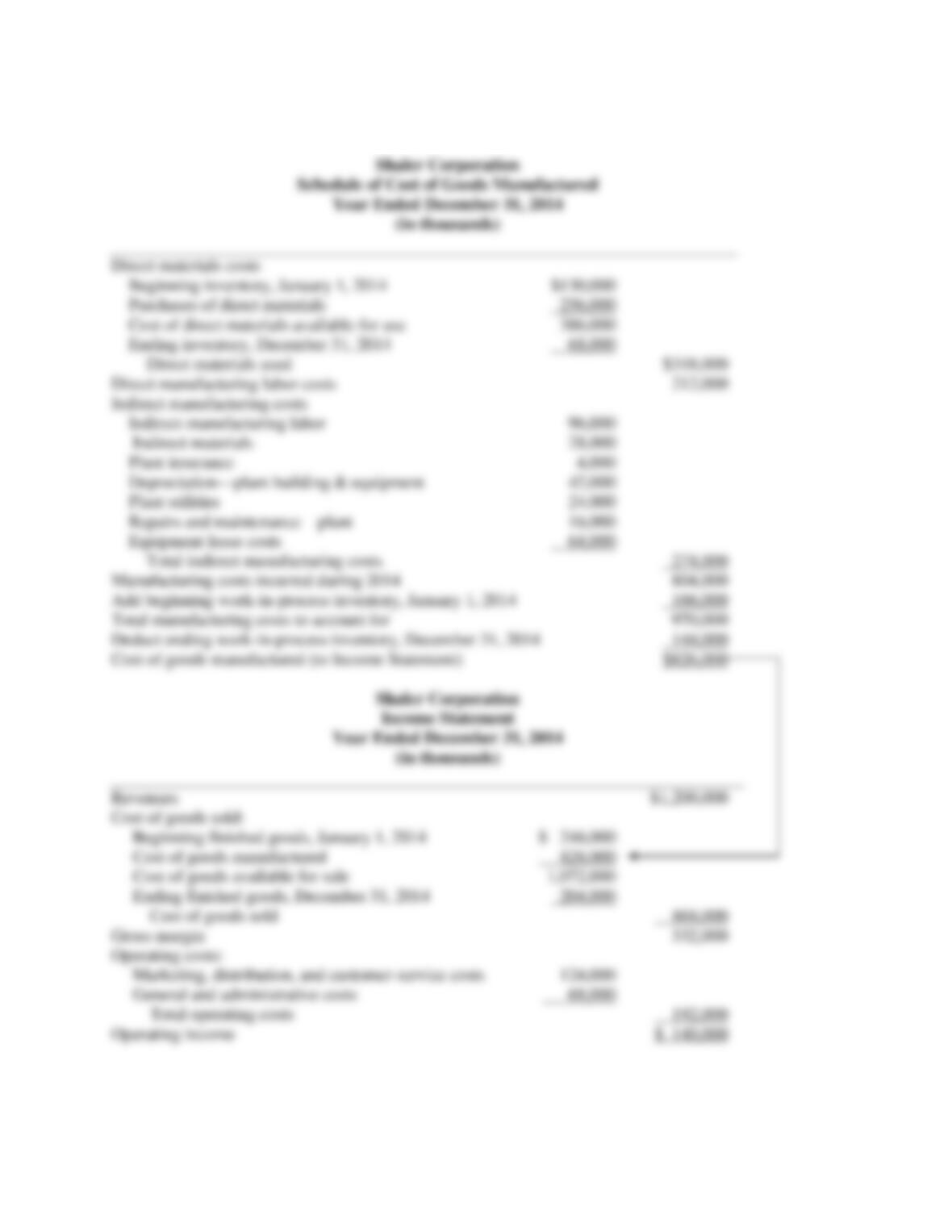
1. Prepare a schedule for the cost of goods manufactured for 2014.
2. Revenues (in thousands) for 2014 were $1,200,000. Prepare the income statement for 2014.
2-29
SOLUTION

2-30
2-34 (25–30 min.) Income statement and schedule of cost of goods manufactured.
The Howell Corporation has the following account balances (in millions):
For Specific Date
For Year 2014
Direct materials inventory, Jan. 1, 2014
$15
Purchases of direct materials
$325
Work-in-process inventory, Jan. 1, 2014
10
Direct manufacturing labor
100
Finished goods inventory, Jan. 1, 2014
70
Depreciation—plant and equipment
80
Direct materials inventory, Dec. 31, 2014
20
Plant supervisory salaries
5
Work-in-process inventory, Dec. 31, 2014
5
Miscellaneous plant overhead
35
Finished goods inventory, Dec. 31, 2014
55
Revenues
950
Marketing, distribution, and
customer-service costs
240
Plant supplies used
10
Plant utilities
30
Indirect manufacturing labor
60
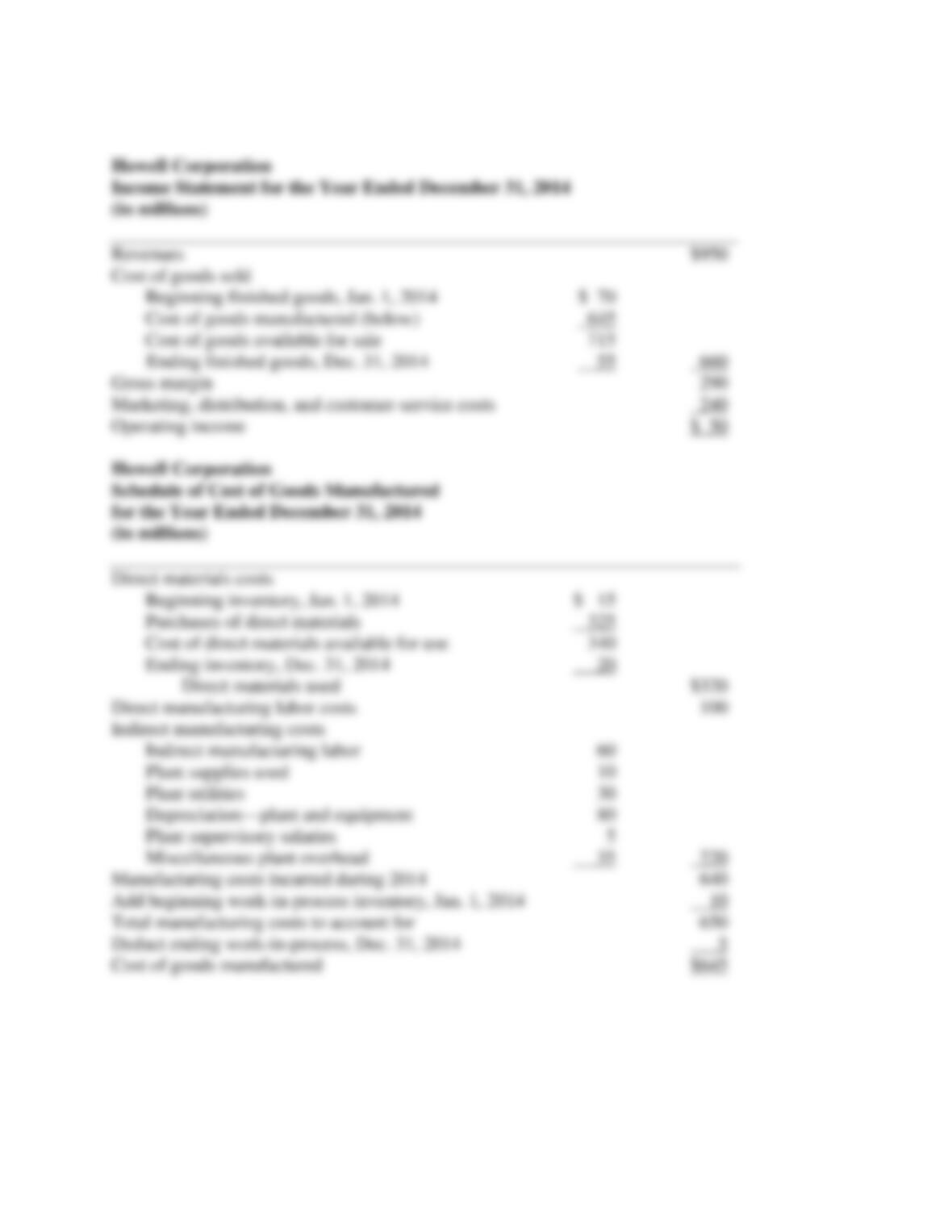
Required: Prepare an income statement and a supporting schedule of cost of goods manufactured
for the year ended December 31, 2014. (For additional questions regarding these facts, see the
next problem.)
2-31
SOLUTION
2-32
2-35 (15–20 min.) Interpretation of statements (continuation of 2-34).
1. How would the answer to Problem 2-34 be modified if you were asked for a schedule of cost
of goods manufactured and sold instead of a schedule of cost of goods manufactured? Be
specific.
2. Would the sales manager’s salary (included in marketing, distribution, and customer-service
costs) be accounted for any differently if the Howell Corporation were a merchandising-
sector company instead of a manufacturing-sector company? Using the flow of
manufacturing costs outlined in Exhibit 2-9 (page 43), describe how the wages of an
assembler in the plant would be accounted for in this manufacturing company.
3. Plant supervisory salaries are usually regarded as manufacturing overhead costs. When might
some of these costs be regarded as direct manufacturing costs? Give an example.
4. Suppose that both the direct materials used and the plant and equipment depreciation are
related to the manufacture of 1 million units of product. What is the unit cost for the direct
materials assigned to those units? What is the unit cost for plant and equipment depreciation?
Assume that yearly plant and equipment depreciation is computed on a straight-line basis.
5. Assume that the implied cost-behavior patterns in requirement 4 persist. That is, direct
material costs behave as a variable cost and plant and equipment depreciation behaves as a
fixed cost. Repeat the computations in requirement 4, assuming that the costs are being
predicted for the manufacture of 1.2 million units of product. How would the total costs be
affected?
6. As a management accountant, explain concisely to the president why the unit costs differed
in requirements 4 and 5.
SOLUTION