
CHAPTER 2
BASIC COST MANAGEMENT CONCEPTS
DISCUSSION QUESTIONS
1. An accounting information system is a sys-
tem consisting of interrelated manual and
computer parts, using processes such as
collecting, recording, classifying, summariz-
ing, analyzing, and managing data to pro-
vide output information to users.
2. The financial accounting information system
is primarily concerned with producing out-
puts for external users using well-specified
economic events as inputs and processes
that meet certain rules. The cost manage-
ment system, on the other hand, produces
outputs for internal users, and the criteria
that govern inputs and processes are direct-
ly related to management objectives. As a
result, the cost management system is more
flexible than the financial system.
3. The three broad objectives of a cost man-
agement information system are: (1) to cost
out products, services, and other cost ob-
jects; (2) to provide information for planning
and control; and (3) to provide information
for decision making.
4. The cost accounting information system is a
cost management subsystem designed to
assign costs to products, services, and other
objects as management needs specify. The
operational control information system is a
cost management information subsystem
designed to provide accurate and timely
feedback concerning the performance of
managers and others relative to their plan-
ning and control of activities.
5. A cost object is anything for which costs are
measured and assigned. Examples include:
activities, products, plants, and projects.
6. An activity is a basic unit of work performed
within an organization. Examples include
materials handling, inspection, purchasing,
billing, and maintenance.
7. A direct cost is a cost that can be easily and
accurately traced to a cost object. An indi-
rect cost is a cost that cannot be easily and
accurately traced to cost objects.
8. Traceability is the ability to assign a cost
directly to a cost object in an economically
feasible way using physical observation or a
causal relationship.
9. Allocation is the assignment of indirect costs
to cost objects based on convenience or as-
sumed linkages.
10. Driver tracing uses drivers based on a causal
relationship to trace costs to cost objects.
Often, this means that costs are first traced to
activities using resource drivers and then to
cost objects using activity drivers.
11. Tangible products are goods that are made by
converting raw materials into a final product
through the use of labor and capital inputs.
12. A service is a task or activity performed for a
customer or an activity performed by a cus-
tomer using an organization’s products or fa-
cilities. Services differ from tangible products
on three important dimensions: intangibility,
perishability, and inseparability. Intangibility
means that buyers of services cannot see,
feel, taste, or hear a service before it is
bought. Perishability means that services
cannot be stored. Inseparability means that
producers of services and buyers of services
must be in direct contact (not true for tangible
products).
13. Three examples of product cost definitions
are value-chain, operating, and traditional def-
initions. The value-chain definition includes
cost assignments for research and develop-
ment, production, marketing, and customer
service (all value–chain activities). Operational
product costs include all costs except for re-
search and development. Traditional product
costs include only production costs. Different
costs are needed because they serve differ-
ent managerial objectives.
14. The three cost elements are direct materials,
direct labor, and overhead.
15. The income statement for a service firm
does not need a supporting cost of goods
manufactured schedule. Since services
cannot be stored, the cost of services pro-
duced equals the cost of services sold (not
necessarily true for a manufacturing firm).
CORNERSTONE EXERCISES
Cornerstone Exercise 2.1
1. Unit prime cost
= (Direct materials + Direct labor)/Units
2. Unit conversion cost
= (Direct labor + Variable overhead + Fixed overhead)/Units
3. Unit variable product cost
= (Direct materials + Direct labor + Variable overhead)/Units
4. Unit product cost
5. Total direct materials, total direct labor, and total variable overhead would all
increase by 10 percent since the units increased by 10 percent and these are
strictly variable costs. Total fixed overhead would remain the same. Unit prime
Cornerstone Exercise 2.2
1. Pietro Frozen Foods, Inc.
Statement of Cost of Goods Manufactured
For the Coming Year
Direct materials
Beginning inventory ………………………………………….. $ 5,600
Add: Purchases ………………………………………………… 119,300
2. If the ending inventory of direct materials were $2,000 higher, then the direct
Cornerstone Exercise 2.3
1. Pietro Manufacturing, Inc.
Statement of Cost of Goods Sold
For the Coming Year
Cost of goods manufactured ……………………………………………………… $422,900
Add: Beginning finished goods ………………………………………………….. 42,500
2. If beginning finished goods were $5,000 lower, then the cost of goods sold
2-4
Cornerstone Exercise 2.4
Pietro Manufacturing, Inc.
Income Statement
For the Coming Year
Percent
Sales ($12.50 × 49,300) ………………………… $ 616,250 100.00
2. If the cost of goods sold has been 65 percent of sales for the past few years,
managers would probably be concerned. Cost of goods sold has risen by 5%,
Cornerstone Exercise 2.5
1. Unit prime cost
2. Unit conversion cost
3. Unit variable services production cost
4. Unit services production cost
2-5
5. Since office rent is a fixed cost, no variable cost would be affected, and prime
cost and total variable cost stay the same. Since conversion cost includes
the new higher fixed overhead, it would increase. Similarly, total unit service
cost would increase as shown below.
Unit services production cost
Cornerstone Exercise 2.6
1. Happy Home Helpers, Inc.
Statement of Cost of Services Produced
For the Coming Year
Direct materials
Beginning inventory ………………………………………….. $ 4,000
Add: Purchases ………………………………………………… 25,600
2. If purchases of direct materials increased to $30,000, and materials invento-
2-6
Cornerstone Exercise 2.7
1. Happy Home Helpers, Inc.
Statement of Cost of Services Sold
For the Coming Year
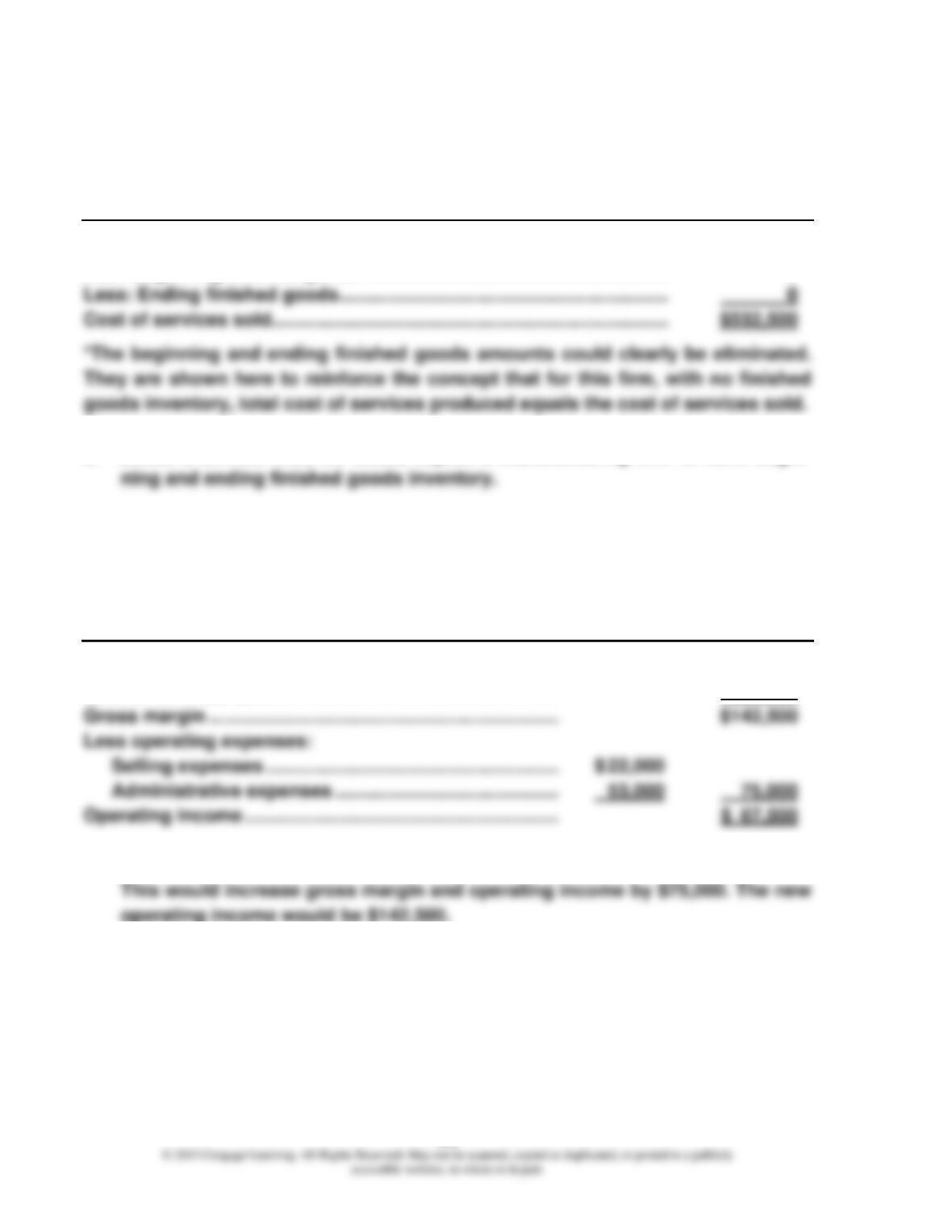
Cost of services produced …………………………………………………………. $532,500
Add: Beginning finished goods* ………………………………………………… 0
2. Unlike a service firm, we would expect a manufacturing firm to have begin-
Cornerstone Exercise 2.8
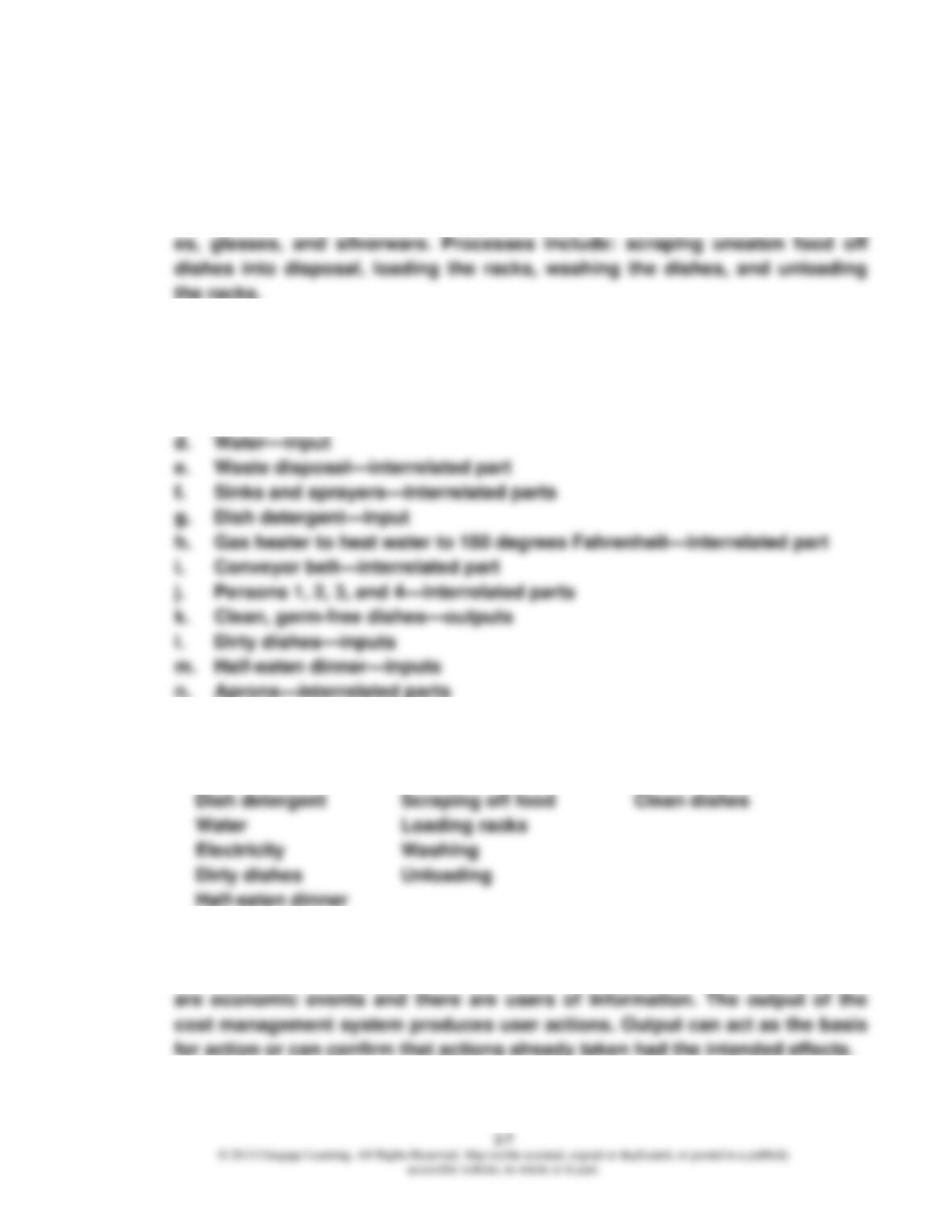
1. Happy Home Helpers, Inc.
Income Statement
For the Coming Year
Sales ($45 × 15,000) ………………………………………………… $675,000
Cost of services sold………………………………………………. 532,500
2. If the price increased to $50, sales would be $750,000, a $75,000 increase.
EXERCISES
Exercise 2.9
1. The objective of the dishwashing system is to provide clean, germ-free dish-
2. The items are classified as follows:
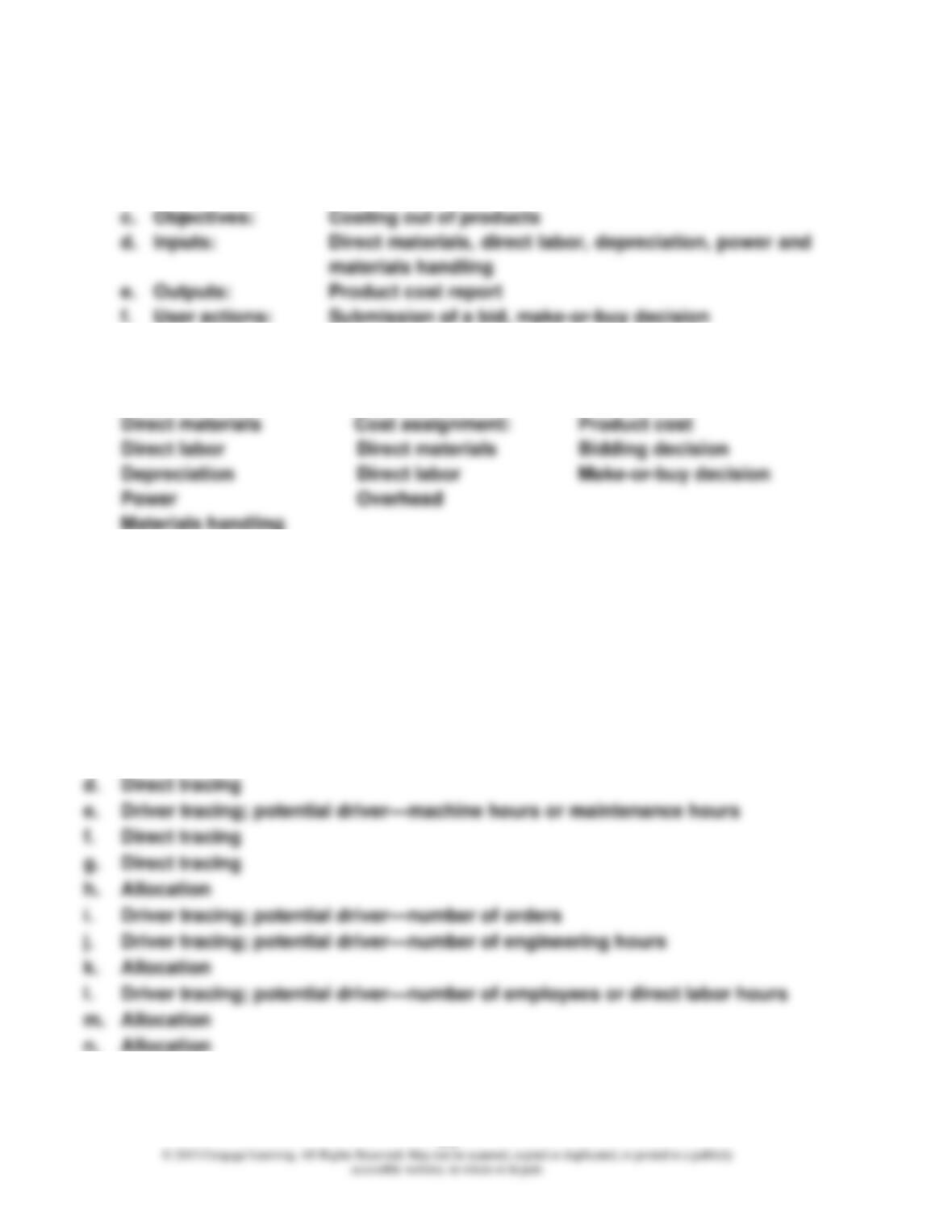
a. Automatic dishwasher—interrelated part
b. Racks to hold the dirty glasses, silverware, and dishes—interrelated part
c. Electricity—input
3. Operational Model: Dishwashing System
Inputs: Processes: Output:
4. The cost management information system is similar in that it has interrelated
parts: processes, objectives, inputs, and outputs. The differences are: inputs
2-8
Exercise 2.10
1. a. Interrelated parts: Cost accounting personnel, computer, printer
b. Processes: Cost assignment: materials, labor, and overhead
2. Operational Model: Cost Accounting System
Inputs: Processes: Output:
3. The inputs consist of only production costs suggesting a traditional product
cost definition.
Exercise 2.11
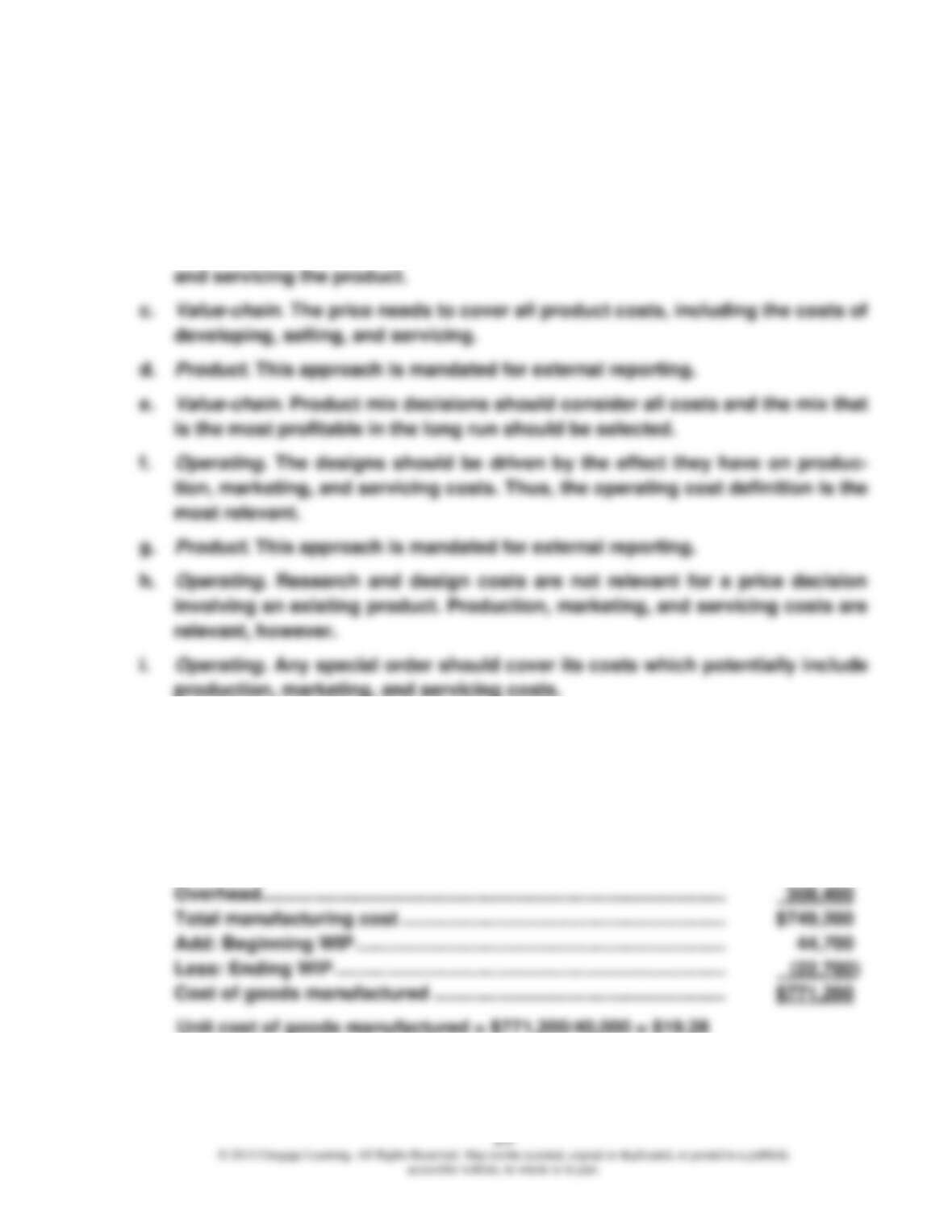
a. Direct tracing
b. Allocation
c. Direct tracing
Exercise 2.12
a. Value-chain. This is a strategic decision and involves activities and costs
throughout the entire value chain.
b. Operating. At this point, the costs of design and development are sunk costs;
the decision to produce should consider the costs of production, marketing,
Exercise 2.13
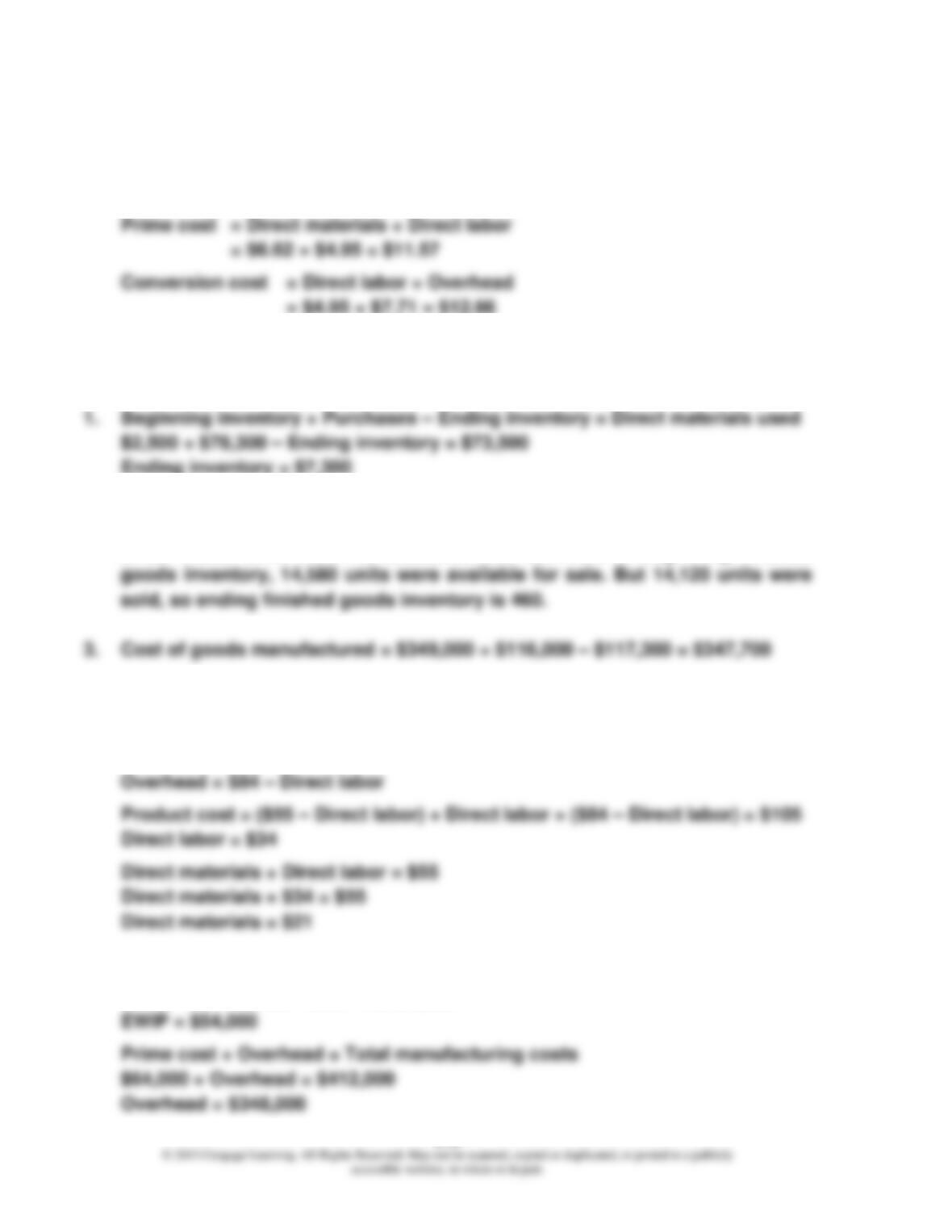
1. Direct materials used = $25,900 + $256,900 – $18,000 = $264,800
2. Direct materials …………………………………………………………………… $264,800
Direct labor ……………………………………………………….………………… 176,000
2-10
Exercise 2.13 (Concluded)
3. Direct labor = Product cost – Direct materials – Overhead
= $19.28 – $6.62 – $7.71 = $4.95
Exercise 2.14
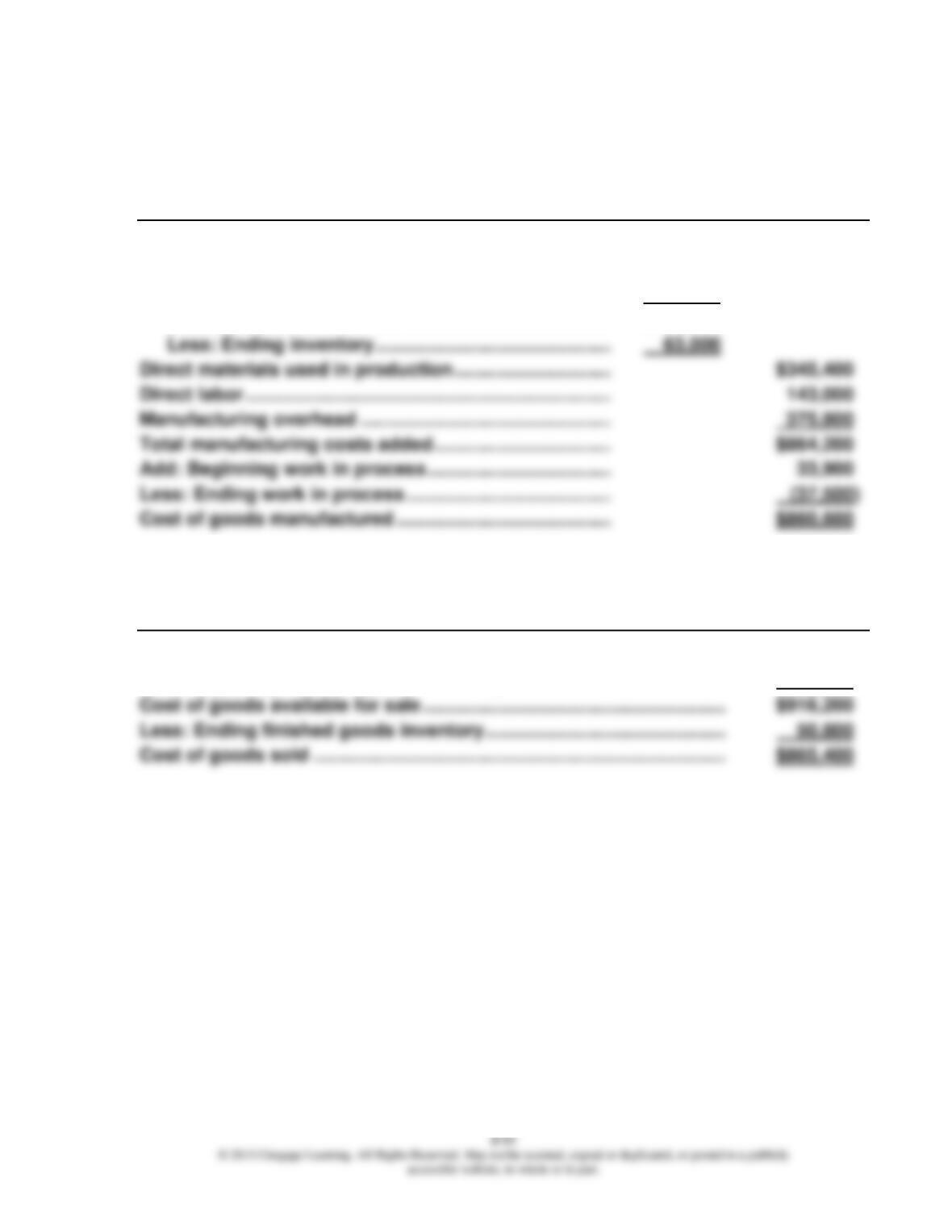
2. Units in beginning finished goods inventory = $3,422/$5.90 = 580
Since 14,000 units were manufactured and 580 were in beginning finished
4. Prime cost = $55 = Direct materials + Direct labor
Direct materials = $55 – Direct labor
Conversion cost = $84 = Direct labor + Overhead
5. Total manufacturing costs + BWIP – EWIP = COGM
$412,000 + $76,000 – EWIP = $434,000
Exercise 2.15
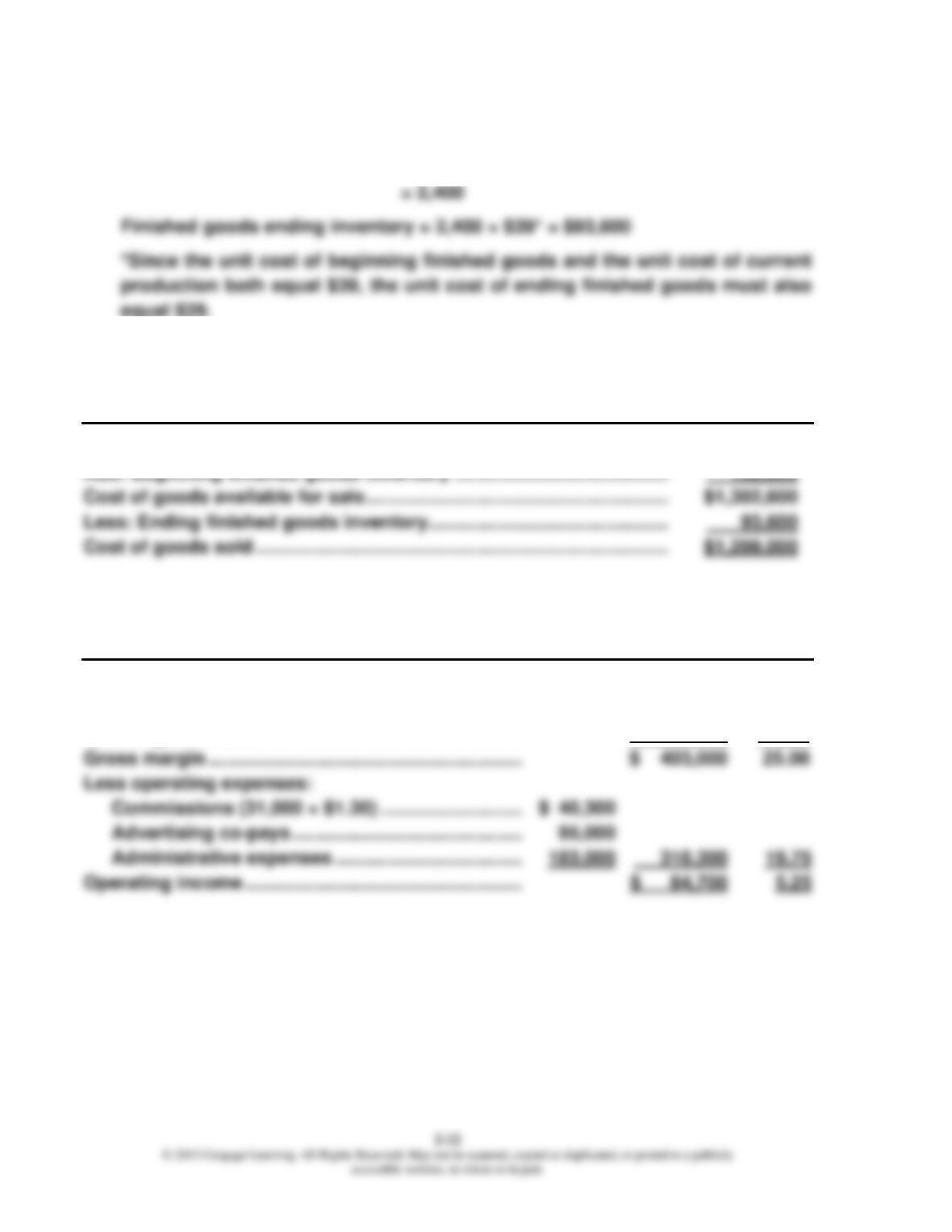
1. LeMans Company
Statement of Cost of Goods Manufactured
For the Month of June
Direct materials:
Beginning inventory ………………………………………….. $ 62,400
Add: Purchases ………………………………………………… 346,000
Materials available …………………………………………….. $408,400
2. LeMans Company
Statement of Cost of Goods Sold
For the Month of June
Cost of goods manufactured ……………………………………………………… $860,600
Add: Beginning finished goods inventory …………………………………… 55,600
Exercise 2.16
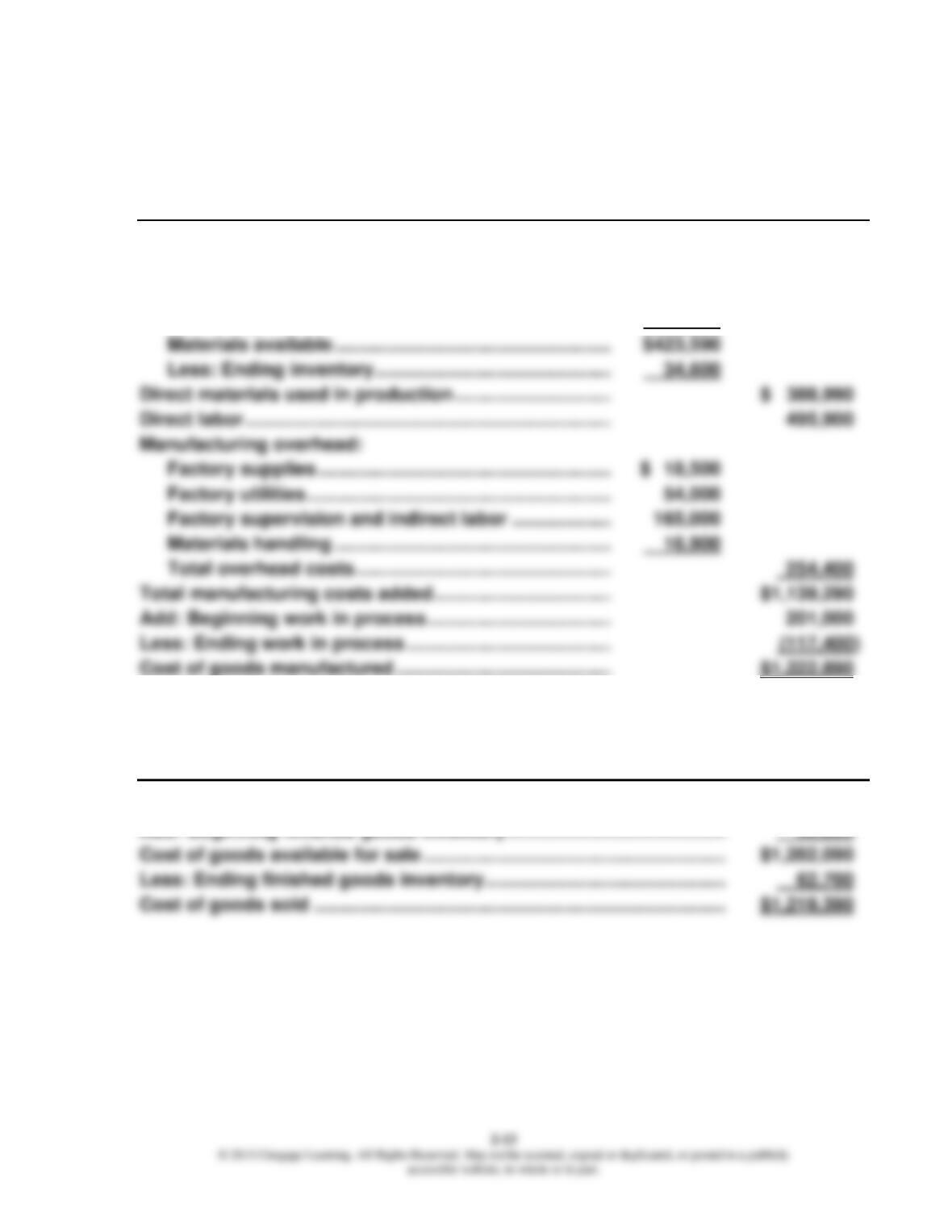
1. Units ending finished goods = 3,400 + 30,000 – 31,000
2. Kildeer Company
Statement of Cost of Goods Sold
For the Year Ended December 31
Cost of goods manufactured ($39 × 30,000)………………………………… $1,170,000
3. Kildeer Company
Income Statement: Absorption Costing
For the Year Ended December 31
Percent
Sales (31,000 × $52) ………………………………………….. $ 1,612,000 100.00
Cost of goods sold …………………………………………… 1,209,000 75.00
Exercise 2.17
1. Anglin Company
Statement of Cost of Goods Manufactured
For the Year Ended December 31
Direct materials:
Beginning inventory ………………………………………….. $ 37,200
Add: Purchases ………………………………………………… 378,890
Freight-in on materials ………………………………. 7,500
2. Anglin Company
Statement of Cost of Goods Sold
For the Year Ended December 31
Cost of goods manufactured ……………………………………………………… $1,222,890
Exercise 2.18
1. Beginning inventory, materials …………………………………………….. $ 1,050
4. Direct materials …………………………………………………………………… $ 11,550
5. Send it Packing
Income Statement
For the Month Ended May 31
Sales revenues …………………………………………………………………………. $102,100
Cost of services sold…………………………………………………………………. 55,250
6. Clearly, the rent, insurance, and utilities are indirect costs. No matter how
many packages Lakeesha and her workers package and send off for delivery,
2-15
Exercise 2.19
1. Shelly is interested in the manufacturing costs of Glaxane. In particular, the
2. Leslie will be concerned with all costs along the value chain. Clearly, the
after-sale costs will be an important factor in pricing since the potential for
3. Dante will be primarily concerned with the overall research and development
Exercise 2.20
1. Given the description provided, it appears that Jazon uses a traditional cost
management system. First, product costs are determined only by production
costs. Apparently, the financial accounting system is driving the type of
2. Product costing accuracy can be improved by placing more emphasis on
tracing and less on allocation. There is enough information provided to reveal
that the two products make quite different demands on certain activities.
Setup, receiving, and purchasing resources are consumed differently by the
3. Jazon would need to change its control focus from managing costs to manag-
ing activities. This would entail shifting emphasis from departmental perfor-
Exercise 2.21
1. Direct materials used = $68,000 + $278,000 – $70,400 = $275,600
2. Direct materials …………………………………………………………………… $275,600
Direct labor …………………………………………………………………………. 189,000
3. Direct labor per unit = $9.77 – $2.70 – $5.30 = $1.77
Exercise 2.22
1. Cost of goods manufactured ……………………………………………….. $977,000
2. Ellerson Company
Income Statement
For the Year Ended December 31
Sales ………………………………………………………………………………………… $1,312,000