
Chapter 02 – The Accounting Cycle: During the Period
Chapter 2
The Accounting Cycle: During the Period
INSTRUCTOR’S MANUAL
Learning Objectives
LO2-1 Identify the basic steps in measuring external transactions.
LO2-2 Analyze the impact of external transactions on the accounting equation.
LO2-3 Assess whether the impact of external transactions results in a debit or credit to
an account balance.
LO2-4 Record transactions in a journal using debits and credits.
LO2-5 Post transactions to the general ledger.
LO2-6 Prepare a trial balance.

Chapter 02 – The Accounting Cycle: During the Period
Teaching Suggestions
Chapter 2 builds on the financial statements of Eagle Golf Academy presented in Chapter 1.
Part A provides 10 external transactions. Students first learn the impact that each transaction
has on the accounting equation and that the equation remains in balance after each transaction.
The first five transactions involve only the basic accounting equation (A = L + SE). The final
five transactions involve issues with the expanded accounting equation—revenue recognition,
expense recognition, and dividends. Illustration 2-3 is a useful tool to show students the
relationship between the basic accounting equation and the expanded accounting equation.
Part B introduces debits and credits and how to record transactions in a journal. The same 10
transactions in Part A are covered again in Part B using debits and credits. Debits and credits are
taught as the language of accounting (or terminology used to indicate an increase or decrease in
accounts). A journal entry is the sentence form of the accounting language. It’s important for
students to see debit and credit as accounting terms used to describe economic events.
Illustration 2-6 is the corollary to Illustration 2-3 and shows students how debits and credits are
used in the expanded accounting equation. Illustration 2-7 provides a simple memorization tool
to help students with debits and credits (DEALOR).
The chapter ends with a full summary of the transactions recorded in the journal (Illustration
2-11), the posting to the general ledger (Illustration 2-12), and the preparation of the trial balance
(Illustration 2-13).
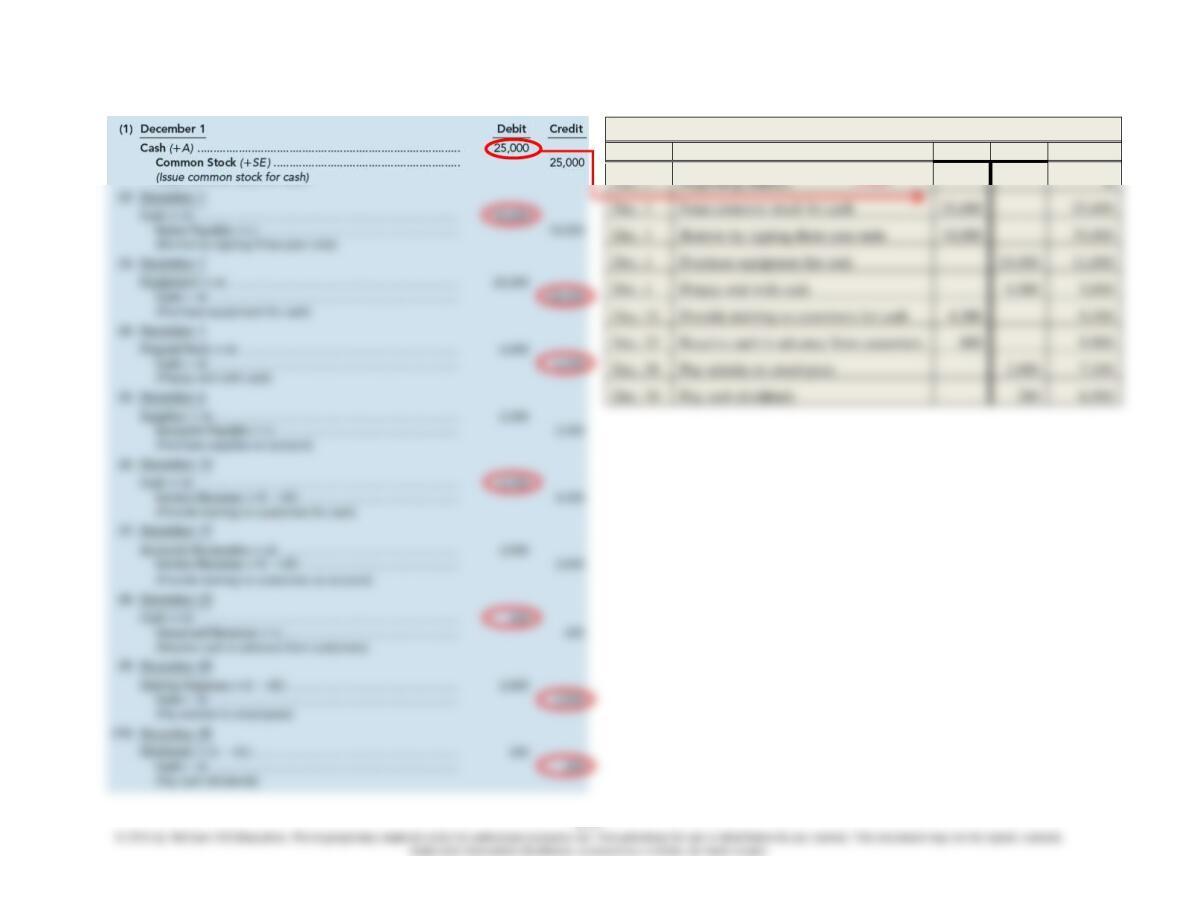
At the end of this document, instructors will find a detailed illustration of the posting of
Eagle Golf Academy’s 10 transactions to the Cash general ledger account. The 10 transactions
correspond to those in Illustration 2-11, and the Cash account corresponds to the one shown in
Illustration 2-12. Students can see how each debit to the Cash account in a journal entry is posted
to the debit side of the general ledger account, increasing the balance. Similarly, credits to the
Cash account are posted to the credit side of the general ledger account, reducing the balance.

Chapter 02 – The Accounting Cycle: During the Period
A
As
ss
si
ig
gn
nm
me
en
nt
t
C
Ch
ha
ar
rt
ts
s
Questions
Learning
Objective(s)
Topic
Time
(Min.)
1
LO2-1
Understand the difference between external and
internal transactions
5
2
LO2-1
List steps to measure external transactions
5
3
LO2-2
Explain the dual effect of transactions
5
4
LO2-2
Describe the impact of transactions on the
accounting equation
5
5
LO2-2
Explain the dual effect of transactions
5
6
LO2-3
Identify normal accounting balances
5
7
LO2-3
Understand the effects of debits and credits on
account balances
5
8
LO2-3
Determine whether a debit or credit increases an
account balance
5
9
LO2-3
Determine whether a debit or credit decreases an
account balance
5
10
LO2-3
Explain the relation between retained earnings and
its revenue and expense components
5
11
LO2-4
Describe a journal and a journal entry
5
12
LO2-4
Understand the proper format for recording
transactions
5
13
LO2-4
Explain why debits equal credits
5
14
LO2-4
Record transactions
5
15
LO2-4
Describe recorded transactions
5
16
LO2-5
Explain a T-account
5
17
LO2-5
Post transactions
5
18
LO2-5
Describe a general ledger
5
19
LO2-6
Describe a trial balance
5
20
LO2-6
Understand total debits and total credits in a trial
balance
5

Chapter 02 – The Accounting Cycle: During the Period
Brief
Exercises
Learning
Objective(s)
Topic
Time
(Min.)
BE2-1
LO2-1
List steps in the measurement process
5
BE2-2
LO2-2
Balance the accounting equation
5
BE2-3
LO2-2
Balance the accounting equation
10
BE2-4
LO2-2
Analyze the impact of transactions on the
accounting equation
10
BE2-5
LO2-3
Understand the effect of debits and credits on
accounts
10
BE2-6
LO2-3
Understand the effect of debits and credits on
accounts
10
BE2-7
LO2-4
Record transactions
10
BE2-8
LO2-4
Record transactions
10
BE2-9
LO2-5
Analyze T-accounts
10
BE2-10
LO2-2, 2-3,
2-4, 2-5
Analyze the impact of transactions on the
accounting equation, record transactions, and post
10
BE2-11
LO2-6
Prepare a trial balance
10
BE2-12
LO2-6
Correct a trial balance
10
Exercises
Learning
Objective(s)
Topic
Time
(Min.)
E2-1
LO2-1
Identify terms associated with the measurement
process
5
E2-2
LO2-2
Analyze the impact of transactions on the
accounting equation
5
E2-3
LO2-2
Analyze the impact of transactions on the
accounting equation
10
E2-4
LO2-2
Analyze the impact of transactions on the
accounting equation
5
E2-5
LO2-2
Understand the components of retained earnings
10
E2-6
LO2-3
Indicate the debit or credit balance of accounts
10
E2-7
LO2-3
Associate debits and credits with external
transactions
5
E2-8
LO2-4
Record transactions
10
E2-9
LO2-4
Identify transactions
5
E2-10
LO2-4
Record transactions
15
E2-11
LO2-4
Record transactions
15
E2-12
LO2-4
Correct recorded transactions
15
E2-13
LO2-4
Correct recorded transactions
15
E2-14
LO2-5
Post transactions to Cash T-account
10
E2-15
LO2-5
Post transactions to T-accounts
15
E2-16
LO2-5
Identify transactions
10
E2-17
LO2-6
Prepare a trial balance
10
E2-18
LO2-6
Prepare a trial balance
10

E2-19
LO2-4, 2-5, 2-6
Record transactions, post to T-accounts, and prepare
a trial balance
30
E2-20
LO2-4, 2-5, 2-6
Record transactions, post to T-accounts, and prepare
a trial balance
30
Problems
Learning
Objective(s)
Topic
Time
(Min.)
P2-1A
LO2-2
Analyze the impact of transactions on the
accounting equation
10
P2-2A
LO2-2
Analyze the impact of transactions on the
accounting equation
15
P2-3A
LO2-3
Identify the type of account and its normal debit or
credit balance
15
P2-4A
LO2-4
Record transactions
20
P2-5A
LO2-2, 2-4
Analyze the impact of transactions on the
accounting equation and record transactions
30
P2-6A
LO2-6
Prepare a trial balance
20
P2-7A
LO2-4, 2-5, 2-6
Complete the steps in the measurement of external
transactions
45
P2-8A
LO2-4, 2-5, 2-6
Complete the steps in the measurement of external
transactions
50
P2-9A
LO2-4, 2-5, 2-6
Complete the steps in the measurement of external
transactions
60
P2-1B
LO2-2
Analyze the impact of transactions on the
accounting equation
10
P2-2B
LO2-2
Analyze the impact of transactions on the
accounting equation
15
P2-3B
LO2-3
Identify the type of account and its normal debit or
credit balance
15
P2-4B
LO2-4
Record transactions
20
P2-5B
LO2-2, 2-4
Analyze the impact of transactions on the
accounting equation and record transactions
30
P2-6B
LO2-6
Prepare a trial balance
20
P2-7B
LO2-4, 2-5, 2-6
Complete the steps in the measurement of external
transactions
45
P2-8B
LO2-4, 2-5, 2-6
Complete the steps in the measurement of external
transactions
50
P2-9B
LO2-4, 2-5, 2-6
Complete the steps in the measurement of external
transactions
60

Chapter 02 – The Accounting Cycle: During the Period
Additional
Perspectives
Topic
Time
(Min.)
AP2-1
Continuing Problem: Great Adventures
45
AP2-2
Financial Analysis: American Eagle Outfitters, Inc.
15
AP2-3
Financial Analysis: The Buckle, Inc.
15
AP2-4
Comparative Analysis: American Eagle Outfitters, Inc. vs. The
Buckle, Inc.
15
AP2-5
Ethics
20
AP2-6
Internet Research
30
AP2-7
Written Communication
25
Chapter 02 – The Accounting Cycle: During the Period
Chapter Quiz Questions
The following multiple-choice questions are 10 unique quiz questions that correspond to the 10
questions at the end of each chapter. Each question covers the same learning objective but with a
little different twist. The correct answer is highlighted in bold for each item.
LO2-1
1. Which of the following does not represent an external business transaction?
LO2-1
2. Which step in the process of measuring external transactions involves assessing the equality
LO2-2
3. Which of the following transactions causes an increase in total liabilities?
a. Paying maintenance expenses for the current month.
LO2-2
4. Which of the following transactions causes a decrease in stockholders’ equity?
LO2-2
5. Which of the following is possible for a particular business transaction?
LO2-3
6. A debit is used to decrease which of the following accounts?
Chapter 02 – The Accounting Cycle: During the Period
LO2-3
7. A credit is used to decrease which of the following accounts?
a. Service Revenue.
LO2-4
8. Purchasing office supplies on account for $100 is recorded as:
a. Supplies
100
Accounts Payable
100
LO2-5
9. Transferring the debit and credit information from a journal to individual accounts in the
general ledger is referred to as:
LO2-6
10. Which of the following is true about a trial balance?
Chapter 02 – The Accounting Cycle: During the Period
Alternate Let’s Review
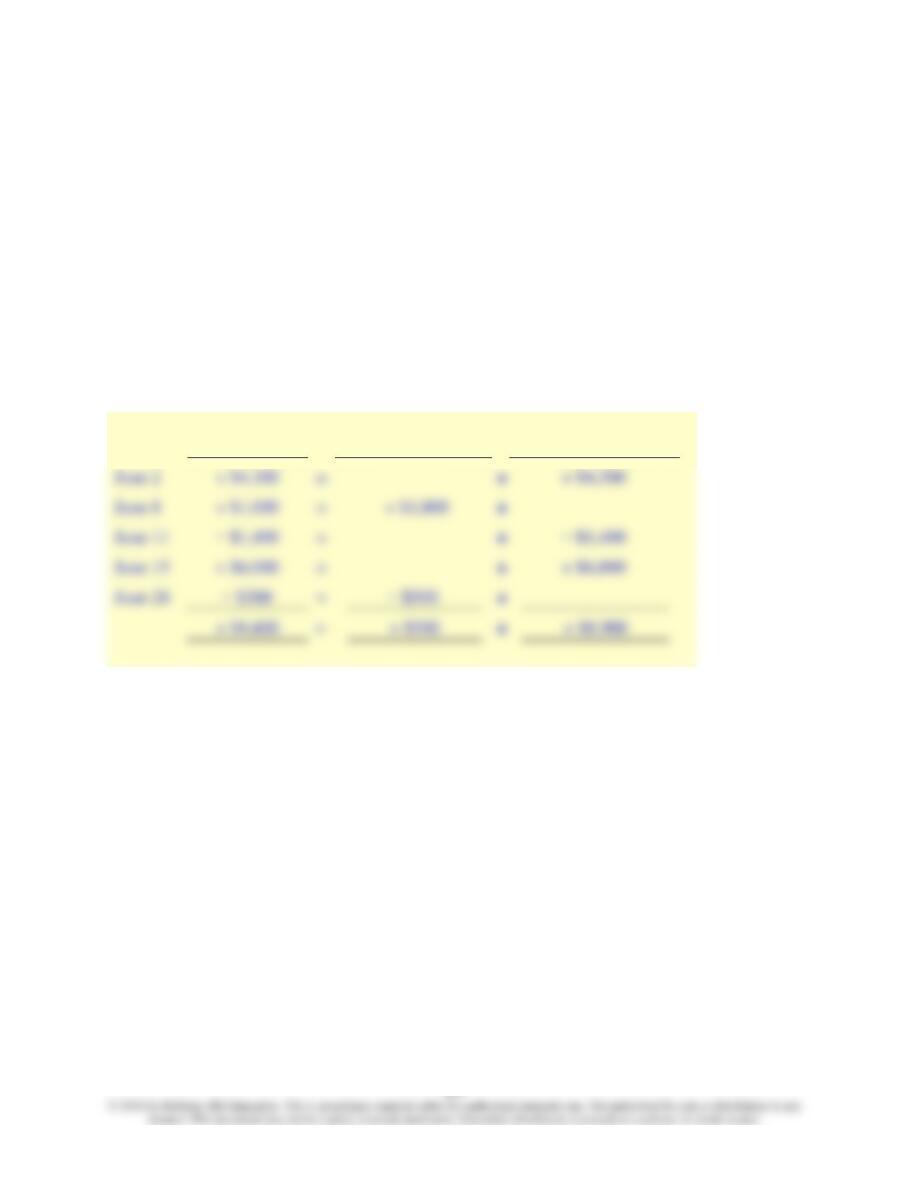
Problem #1
A company has the following transactions during June:
June 2 Provide services to customers for cash, $4,300
June 8 Purchase office supplies on account, $1,000
June 11 Pay workers’ salaries for the current period, $1,400
June 15 Issue additional shares of common stock, $6,000
June 28 Pay one-half of the amount owed for supplies purchased on June 8, $500
Required:
Indicate how each transaction affects the accounting equation.
Solution:
Assets
=
=
Liabilities
+
+
Stockholders’ Equity
Chapter 02 – The Accounting Cycle: During the Period
Problem #2
A company has the following transactions during June:
June 2 Provide services to customers for cash, $4,300
June 8 Purchase office supplies on account, $1,000
June 11 Pay workers’ salaries for the current period, $1,400
June 15 Issue additional shares of common stock, $6,000
June 28 Pay one-half of the amount owed for supplies purchased on June 8, $500
Required:
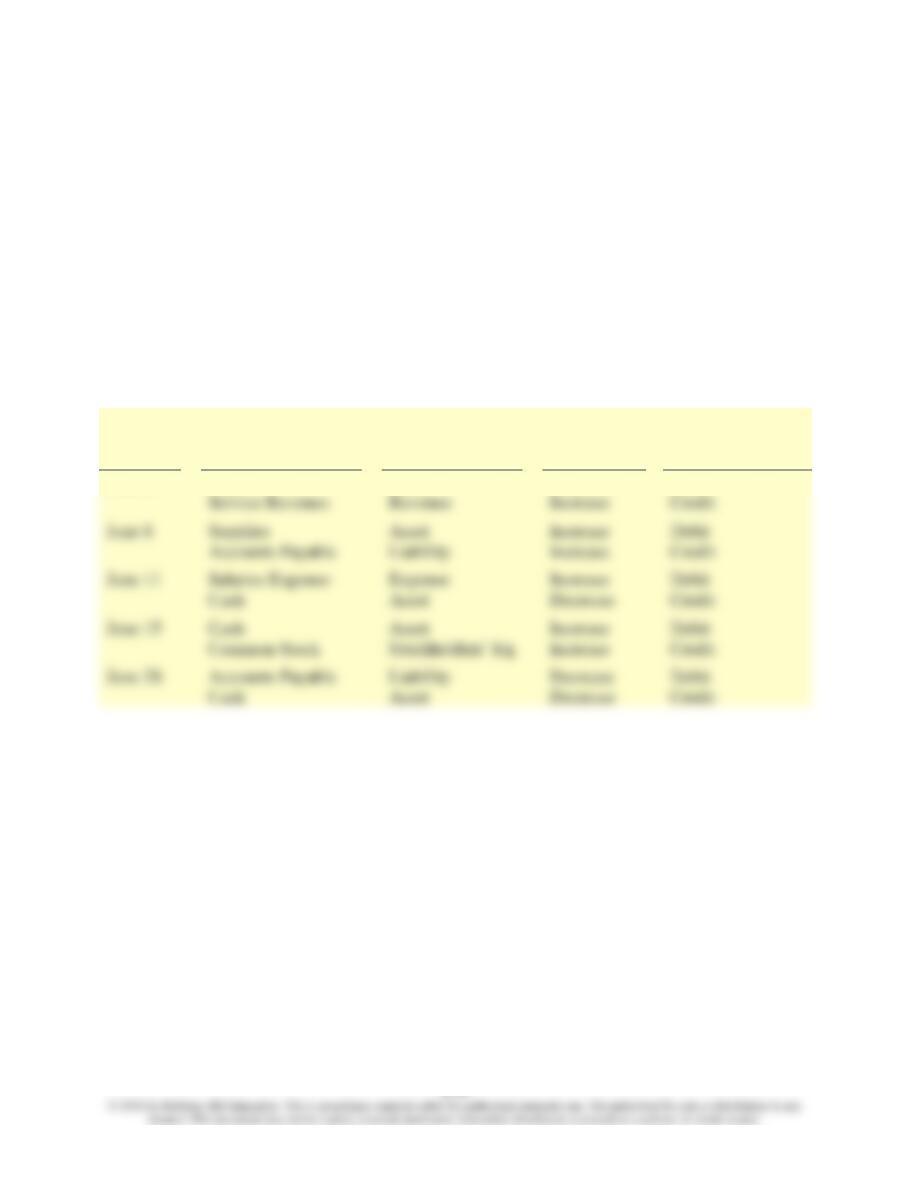
For each transaction, identify (1) the two accounts involved, (2) the type of account, (3) whether
the transaction increases or decreases the account balance, and (4) whether the increase or
decrease would be recorded with a debit or credit.
Solution:
Date
(1)
Accounts Involved
(2)
Account Type
(3)
Increase or
Decrease
(4)
Debit or Credit
June 2
Cash
Asset
Increase
Debit
June 8
Supplies
Asset
Increase
Debit
June 11
Salaries Expense
Expense
Increase
Debit
June 15
Cash
Asset
Increase
Debit
June 28
Accounts Payable
Liability
Decrease
Debit
Cash
Asset
Decrease
Credit
Chapter 02 – The Accounting Cycle: During the Period
Problem #3
A company has the following transactions during June:
June 2 Provide services to customers for cash, $4,300
June 8 Purchase office supplies on account, $1,000
June 11 Pay workers’ salaries for the current period, $1,400
June 15 Issue additional shares of common stock, $6,000
June 28 Pay one-half of the amount owed for supplies purchased on June 8, $500
Required:
Record each transaction.
Solution:
Debit
Credit
June 2
Cash
4,300
June 8
Supplies
June 11
Salaries Expense
June 15
Cash
June 28
Accounts Payable
Service Revenue
4,300
Chapter 02 – The Accounting Cycle: During the Period
Key Points by Learning Objective
LO2-1 Identify the basic steps in measuring external transactions.
External transactions are transactions between the company and separate economic entities.
Internal transactions do not include an exchange with a separate economic entity.
LO2-2 Analyze the impact of external transactions on the accounting equation.
After each transaction, the accounting equation must always remain in balance. In other words,
assets always must equal liabilities plus stockholders’ equity.
LO2-3 Assess whether the impact of external transactions results in a debit or credit to an
account balance.
For the basic accounting equation (Assets = Liabilities + Stockholders’ Equity), assets (left side)
LO2-4 Record transactions in a journal using debits and credits.
LO2-5 Post transactions to the general ledger.
LO2-6 Prepare a trial balance.
Chapter 02 – The Accounting Cycle: During the Period
Common Mistakes
Common Mistake
Common Mistake
Don’t let the account name fool you. Even though the term revenue appears in the account title
Common Mistake
Common Mistake
Common Mistake
Common Mistake
Students sometimes hear the phrase “assets are the debit accounts” and believe it indicates that
assets can only be debited. This is incorrect! Assets, or any account, can be either debited or

Chapter 02 – The Accounting Cycle: During the Period
Common Mistake
Just because the debits and credits are equal in a trial balance does not necessarily mean that all
Chapter 02 – The Accounting Cycle: During the Period
Decision Points
Question
Accounting Information
Analysis
How much profit has
Retained earnings
The balance of retained earnings
Question
Accounting Information
Analysis
How does the
Journal entries
The effects of external transactions
Chapter 02 – The Accounting Cycle: During the Period
Career Corner
Career Corner
The accuracy of account balances is essential for providing useful information to decision
makers, such as investors and creditors. That’s why the Securities and Exchange Commission
Chapter 02 – The Accounting Cycle: During the Period
Posting Transactions of Eagle Golf Academy to the Cash General Ledger Account (Learning Objective 2-5)
Illustration 2-11, page 77
Cash account from Illustration 2-12, page 78
Dec. 1
Beginning balance
Dec. 1
Issue common stock for cash
25,000
Dec. 1
Borrow by signing three-year note
10,000
Dec. 1
Purchase equipment for cash
Dec. 1
Prepay rent with cash
Dec. 12
Provide training to customers for cash
Dec. 23
Receive cash in advance from customers
Dec. 28
Pay salaries to employees
Dec. 30
Pay cash dividends
Account: Cash
Date
Description
Debit
Credit
Balance
Post