CHAPTER 2
LEARNING OBJECTIVES
1. DESCRIBE COST SYSTEMS AND THE FLOW OF
COSTS IN A JOB ORDER SYSTEM.
2. USE A JOB COST SHEET TO ASSIGN COSTS TO
WORK IN PROCESS.
3. DEMONSTRATE HOW TO DETERMINE AND USE THE
PREDETERMINED OVERHEAD RATE.
4. PREPARE ENTRIES FOR MANUFACTURING AND
SERVICE JOBS COMPLETED AND SOLD.
5. DISTINGUISH BETWEEN UNDER- AND OVERAPPLIED
MANUFACTURING OVERHEAD.
CHAPTER REVIEW
Cost Accounting Systems
1. (L.O. 1) Cost accounting involves the measuring, recording, and reporting of product costs.
From the data accumulated, both the total cost and unit cost of each product is determined.
2. A cost accounting system consists of accounts for the various manufacturing costs. These
accounts are fully integrated into the general ledger of a company. An important feature of a cost
accounting system is the use of a perpetual inventory system. Such a system provides information
immediately on the cost of a product. The two basic types of cost accounting systems are
(a) a job order cost system and (b) a process cost system.
Job Order Cost Flow
5. The flow of costs in job order cost accounting parallels the physical flow of the materials as they
are converted into finished goods. There are two major steps in the flow of costs: (a) accumulating
the manufacturing costs incurred and (b) assigning the accumulated costs to the work done.
6. A company accumulates manufacturing costs incurred by debits to Raw Materials Inventory,
Factory Labor, and Manufacturing Overhead..
7. The assignment of manufacturing costs involves entries to Work in Process Inventory,
Finished Goods Inventory, and Cost of Goods Sold.
Assigning Manufacturing Costs to Work in Process
11. (L.O. 2) The assignment of manufacturing overhead costs to work in process involves debits
to Work in Process Inventory and credits to Raw Materials Inventory, Factory Labor, and
Manufacturing Overhead.
12. A job cost sheet is a form used to record the costs chargeable to a specific job and to determine the total and unit
cost of the completed job. A separate job cost sheet is kept for each job. A subsidiary ledger consists of
individual records for each individual item (each job). The Work in Process account is referred to as a control
account because it summarizes the detailed data regarding specific jobs contained in the job cost sheets. Each
entry to Work in Process Inventory must be accompanied by a corresponding posting to one or more job cost
sheets.
Manufacturing Overhead Costs
15. (L.O. 3) Manufacturing overhead relates to production operations as a whole and therefore cannot be assigned to
specific jobs on the basis of actual costs incurred. Instead, manufacturing overhead is assigned to work in process
and to specific jobs on an estimated basis through the use of a predetermined overhead rate.
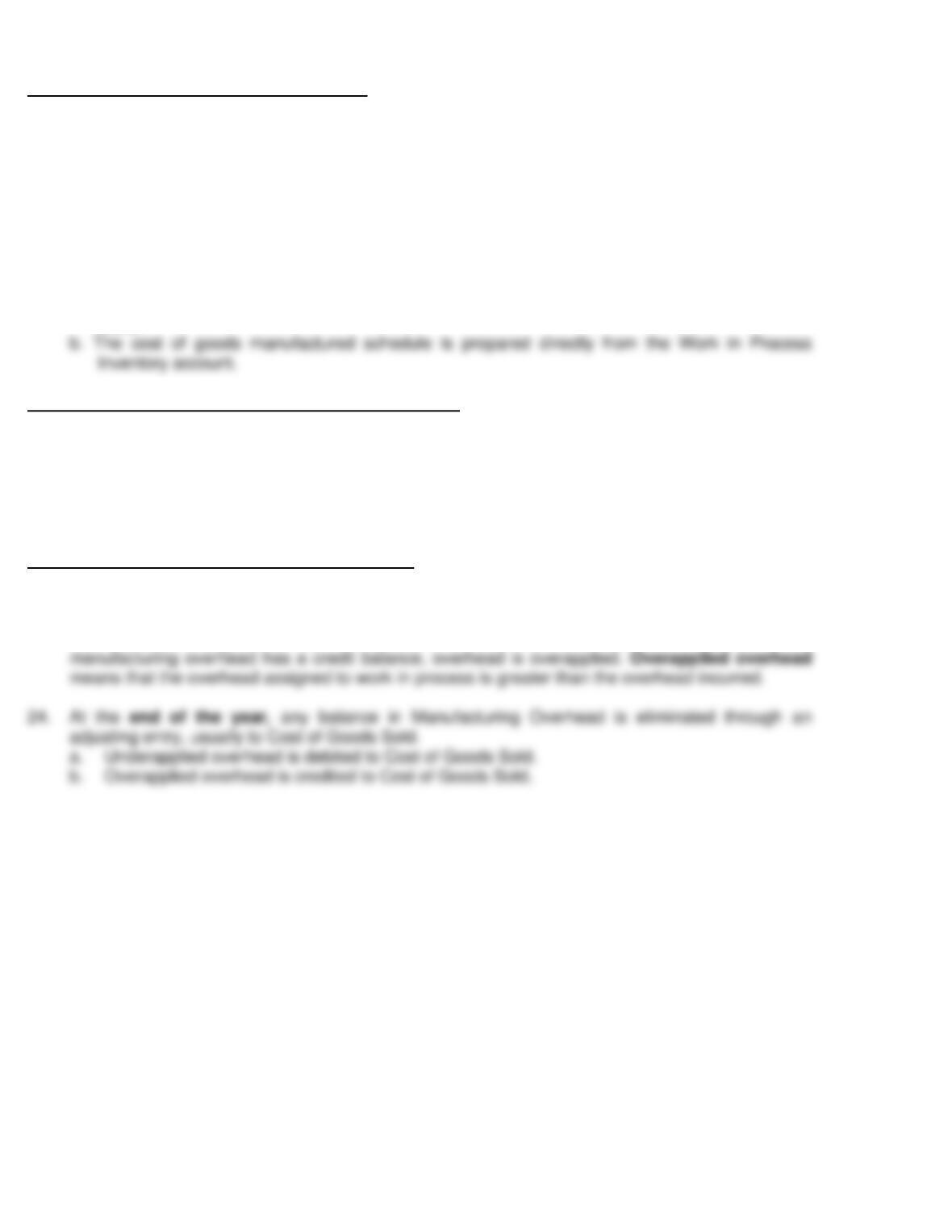
16. The predetermined overhead rate is based on the relationship between estimated annual overhead costs and
expected annual operating activity. This relationship is expressed in terms of a common activity base such as
direct labor costs, direct labor hours, or machine hours.
a. The formula for the predetermined overhead rate is:
Assigning Costs to Finished Goods
18. (L.O. 4) When a job is completed, the total cost is debited to Finished Goods Inventory and credited to Work in
Process Inventory. Finished Goods Inventory is a control account that controls individual finished goods records in
a finished goods subsidiary ledger.
Job Order Costing for Service Companies
20. While service companies do not have inventory, the techniques of job order costing are still quite
useful in many service industry environments. Many service organizations bill their customers using
cost-plus contracts, which means that the customer’s bill is the sum of the costs incurred on the job,
plus a profit amount that is calculated as a percentage of the costs incurred.
21. At the end of a period, financial statements are prepared that present aggregate data on all jobs
manufactured and sold.
a. The cost of goods manufactured schedule has one new feature: in determining total
manufacturing costs, manufacturing overhead applied is used instead of actual overhead
costs.
Advantages and Disadvantages of Job Order Costing
22. An advantage of job order costing is it is more precise in assignment of costs to projects
than process costing. One disadvantage of job order costing is that it requires a significant
amount of data entry.
Under- or Overapplied Manufacturing Overhead
23. (L.O. 5) Manufacturing overhead may be under- or overapplied. When Manufacturing Overhead
has a debit balance, overhead is said to be underapplied. Underapplied overhead means that
the overhead assigned to work in process is less than the overhead incurred. When
LECTURE OUTLINE
A. Cost Accounting Systems.
1. Cost accounting involves the measuring, recording, and reporting of
product costs. From the data accumulated, companies determine both
the total cost and the unit cost of each product.
3. There are two basic types of cost accounting systems:
a. A job order system, where the company assigns costs to each job
or to each batch of goods, and
MANAGEMENT INSIGHT
Many companies suffer from poor cost accounting and sometimes make products
they should not be selling. The managers of a diversified company thought they
were making money, but a consulting firm found that the company had seriously
underestimated costs.
What type of costs do you think the company had been underestimating?

Answer: It is most likely that the company failed to estimate and track overhead.
In a highly diversified company, overhead associated with the diesel
B. Job Order Cost Flow.
1. The flow of costs (direct materials, direct labor, and manufacturing
overhead) in job order cost accounting parallels the physical flow of the
materials as they are converted into finished goods.
2. There are two major steps in the flow of costs:
a. Accumulating the manufacturing costs incurred; these costs are
accumulated in three accounts: Raw Materials Inventory, Factory
Labor, and Manufacturing Overhead, and
b. Assigning the accumulated costs to Work in Process Inventory and
eventually to Finished Goods Inventory and Cost of Goods Sold.
3. Three entries are made to accumulate the manufacturing costs incurred.
a. When the company receives the raw materials it has purchased, it
debits the cost of the materials to Raw Materials Inventory. Raw
Materials Inventory is a control account. The subsidiary ledger consists
of individual records for each item of raw materials.
b. The cost of factory labor consists of gross earnings of factory workers,
employer payroll taxes, and fringe benefits (sick pay, pensions, and
vacation pay) incurred by the employer. Companies debit labor
costs to Factory Labor as they incur those costs. Factory labor is
assigned to work in process and manufacturing overhead at the end
of the period.
c. A company may record overhead costs periodically through adjusting
entries by debiting Manufacturing Overhead. Manufacturing Overhead
is a control account and the subsidiary ledger consists of individual
accounts for each type of cost (factory utilities, factory repairs, etc.).

C. Assigning Manufacturing Costs to Work in Process.
1. A job cost sheet is a form used to record the costs chargeable to a specific
job and to determine the total and unit costs of the completed job. The
job cost sheets constitute the subsidiary ledger for the Work in Process
Inventory account.
2. Each entry to Work in Process Inventory must be accompanied by a
corresponding posting to one or more job cost sheets.
3. Three entries are made in assigning the manufacturing costs to work in
process.
a. Materials requisition slips indicate the quantity and type of materials
withdrawn and the account to be charged. Companies charge
direct materials to Work in Process Inventory and indirect materials
to Manufacturing Overhead.
b. Companies assign factory labor costs to jobs on the basis of time
tickets prepared when the work is performed. The time ticket indicates
the hours worked, the account and job to be charged, and the total
labor cost. Companies debit the Work in Process Inventory account
for direct labor, and Manufacturing Overhead for indirect labor.
c. Companies assign manufacturing overhead to work in process and
to specific jobs on an estimated basis through the use of a prede–
termined overhead rate. Using a predetermined overhead rate enables
a cost to be determined for a job immediately.
MANAGEMENT INSIGHT
Competitors often want to know the cost of a competing product. For a price, a
company called iSuppli will disassemble sophisticated electronics and tell you
what it would cost to replicate the product. The difference between the cost of
the parts and the cost of the labor to assemble the parts isn’t all profit. There are
nonproduction costs such as research, design, marketing, patent fees, and
selling costs.
What type of costs are research, design, marketing, patent fees, and selling
costs, and how are they treated for accounting purposes?
Answer: Product costs include materials, labor, and overhead. Costs not
related to production, such as research, design, marketing,
4. The predetermined overhead rate is based on the relationship between
estimated annual overhead costs and expected annual operating activity,
expressed in terms of a common activity base.
a. The company may state the activity in terms of direct labor costs,
direct labor hours, machine hours, or any other measure that will
provide an equitable basis for applying overhead costs to jobs.
b. The predetermined overhead rate is established at the beginning of
the year.
D. Assigning Costs to Finished Goods and Cost of Goods Sold.
1. When a job is completed, the company summarizes the costs in the
applicable job cost sheet and debits Finished Goods Inventory. Finished
Goods Inventory is a control account that controls individual finished
goods records in a finished goods subsidiary ledger. Postings to the
finished goods records are made directly from completed job cost sheets.
2. Companies recognize cost of goods sold when each sale occurs. Each sale
requires an entry debiting Cash or Accounts Receivable and crediting
SERVICE COMPANY INSIGHT
Jet engines are one of the many products made by the industrial operations
division of General Electric. At prices as high as $30 million per engine GE does
its best to keep track of costs. Because of the high product costs, both the
engines themselves and the subsequent service are most likely accounted for
using job order costing. GE needs good cost records for its service jobs in order
to control its costs.
Explain why GE would use job order costing to keep track of the cost of repairing
a malfunctioning engine for a major airline.
Answer: GE operates in competitive environment. Other companies offer
competing bids to win service contracts on GE airplane engines. GE
E. Reporting Job Cost Data.
1. At the end of a period, companies prepare financial statements that
present data on all jobs manufactured and sold.
2. The cost of goods manufactured schedule is the same as for companies
F. Under- or Overapplied Manufacturing Overhead.
1. Underapplied overhead means that the overhead assigned to work in
process is less than the overhead incurred (when Manufacturing Over–
head has a debit balance).
2. Overapplied overhead means that the overhead assigned to work in
process is greater than the overhead incurred (when Manufacturing
Overhead has a credit balance).
20 MINUTE QUIZ
Circle the correct answer.
True/False
1. Under a job order system, the company assigns costs to each job, or each batch of goods,
to fill a specific customer order or replenish inventory.
True False
2. Manufacturing costs incurred in a job order system are accumulated by debits to Purchases,
Factory Labor, and Manufacturing Overhead.
True False
3. Each debit to Work in Process Inventory must be accompanied by a corresponding
posting to one or more job cost sheets.
True False
4. Manufacturing overhead costs cannot be traced directly to a specific job.
True False
5. The requisition of factory supplies to production requires a debit to the Manufacturing
Overhead account.
True False
6. Actual overhead costs are debited to the Manufacturing Overhead account.
True False
7. The entry to record the cost of goods sold includes a debit to Finished Goods Inventory.
True False
8. A debit balance in the Manufacturing Overhead Account at the end of the period indicates
that overhead has been overapplied.
True False
9. In preparing the costs of goods manufactured schedule in job order costing, manufacturing
costs include direct materials used, direct labor used, and manufacturing overhead
applied.
True False
10. A job cost sheet is a form used to record the costs chargeable to a specific job and to
determine the total and unit cost of the completed job.
True False
Multiple Choice
1. A job order cost sheet includes
a. the selling price of the job.
b. a total when a job is completed and transferred to cost of goods sold.
c. all manufacturing costs for a job.
d. all manufacturing overhead costs for the period.
2. Companies assign raw materials costs to jobs
a. By debiting Raw Materials Inventory and crediting Work in Process.
b. Based on a predetermined rate.
c. In response to verbal requests for indirect materials such as supplies.
d. Using any of the inventory costing methods (FIFO, LIFO, or average-cost).
3. In a job order cost system, debits to Work in Process Inventory originate from all of the
following except
a. applying the predetermined overhead rate.
b. assigning direct labor from time tickets.
c. assigning actual manufacturing overhead costs to jobs.
d. assigning direct materials from requisition slips.
4. The predetermined overhead rate is computed by dividing estimated
a. level of activity by estimated overhead costs.
b. level of activity by expected overhead costs.
c. overhead costs by estimated cost of jobs.
d. overhead costs by expected activity base.
5. If annual overhead costs are expected to be $1,000,000 and 200,000 total labor hours
are anticipated (80% direct, 20% indirect), the overhead rate based on direct labor hours is
a. $6.25.
b. $5.00.
c. $25.00.
d. $4.00.

ANSWERS TO QUIZ
True/False
1. True 6. True
Multiple Choice
1. c.