Problem 2-17 (20 minutes)
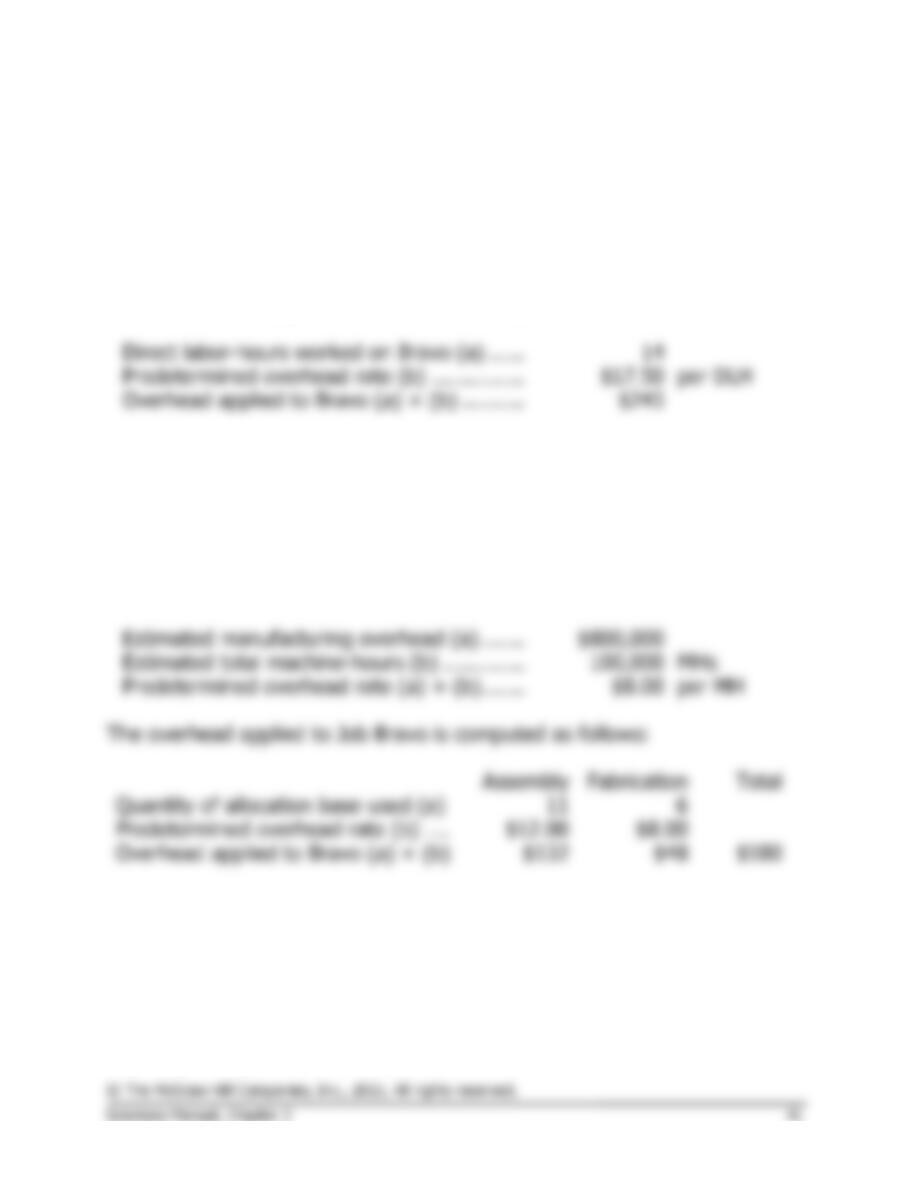
1. The predetermined plantwide overhead rate is computed as follows:
Estimated manufacturing overhead (a) …….
$1,400,000
Estimated total direct labor-hours (b) ………
80,000
DLHs
Predetermined overhead rate (a) ÷ (b) …….
$17.50
per DLH
The overhead applied to Job Bravo is computed as follows:
Direct labor-hours worked on Bravo (a) ……
Predetermined overhead rate (b) ……………
$17.50
per DLH
Overhead applied to Bravo (a) × (b) ……….
2. The predetermined overhead rate in Assembly is computed as follows:
Estimated manufacturing overhead (a) …….
$600,000
Estimated total direct labor-hours (b) ………
50,000
DLHs
Predetermined overhead rate (a) ÷ (b) …….
$12.00
per DLH
The predetermined overhead rate in Fabrication is computed as follows:
Estimated manufacturing overhead (a) …….
$800,000
Estimated total machine-hours (b) ………….
Predetermined overhead rate (a) ÷ (b) …….
per MH
Quantity of allocation base used (a)
Predetermined overhead rate (b) ….
Overhead applied to Bravo (a) × (b)
Problem 2-18 (15 minutes)
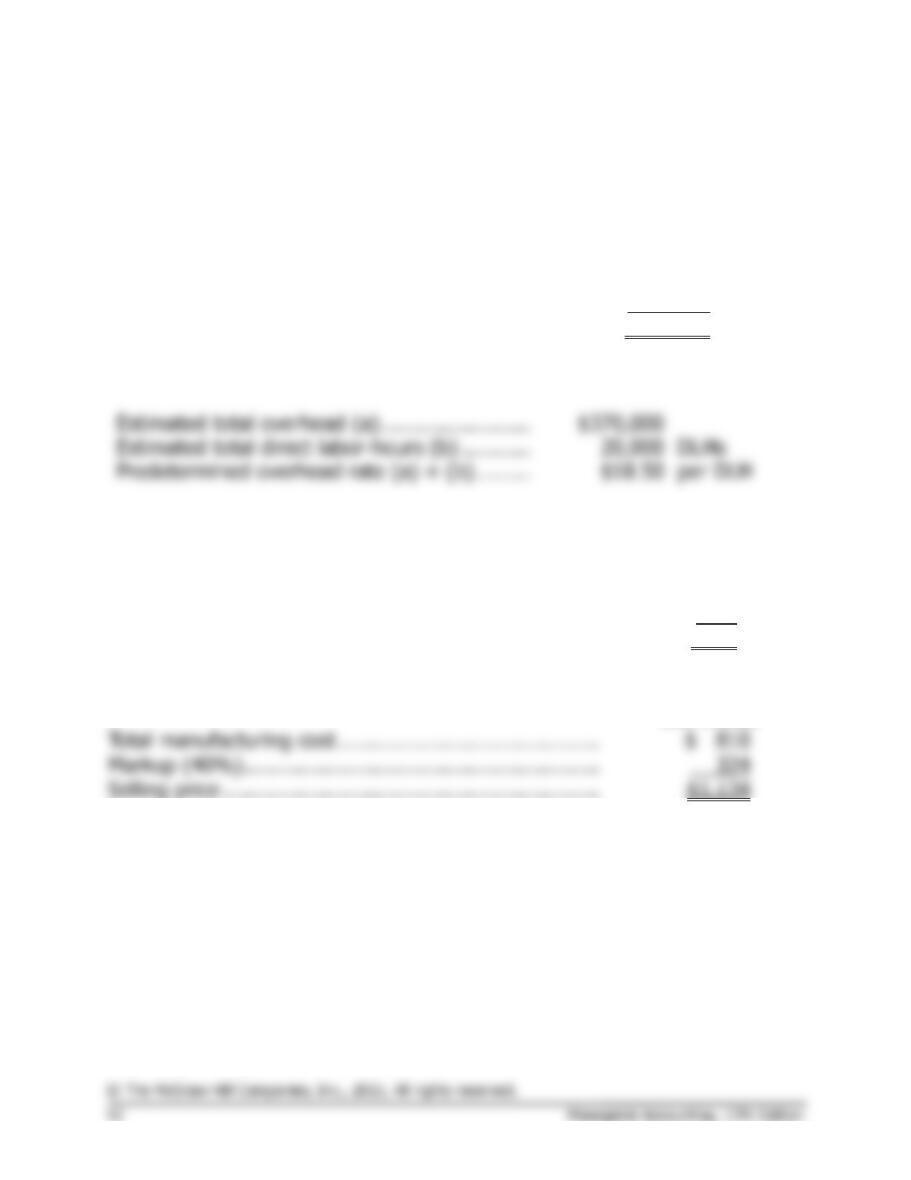
1. The estimated total overhead cost is computed as follows:
Y = $350,000 + ($1.00 per DLH)(20,000 DLHs)
Estimated fixed overhead …………………………………
$350,000
Estimated variable overhead: $1.00 per DLH ×
20,000 DLHs ……………………………………………….
20,000
Estimated total overhead cost …………………………..
$370,000
The predetermined overhead rate is computed as follows:
per DLH
2. Total manufacturing cost assigned to Mr. Wilkes:
Direct materials ……………………………………………….
$590
Direct labor …………………………………………………….
109
Overhead applied ($18.50 per DLH × 6 DLH) …………
111
Total cost assigned to Mr. Wilkes …………………………
$810
3. The price charged to Mr. Wilkes is computed as follows:
Total manufacturing cost ……………………………………
Markup (40%) …………………………………………………
Selling price …………………………..……………………….
Problem 2-19 (20 minutes)
1. Molding Department:
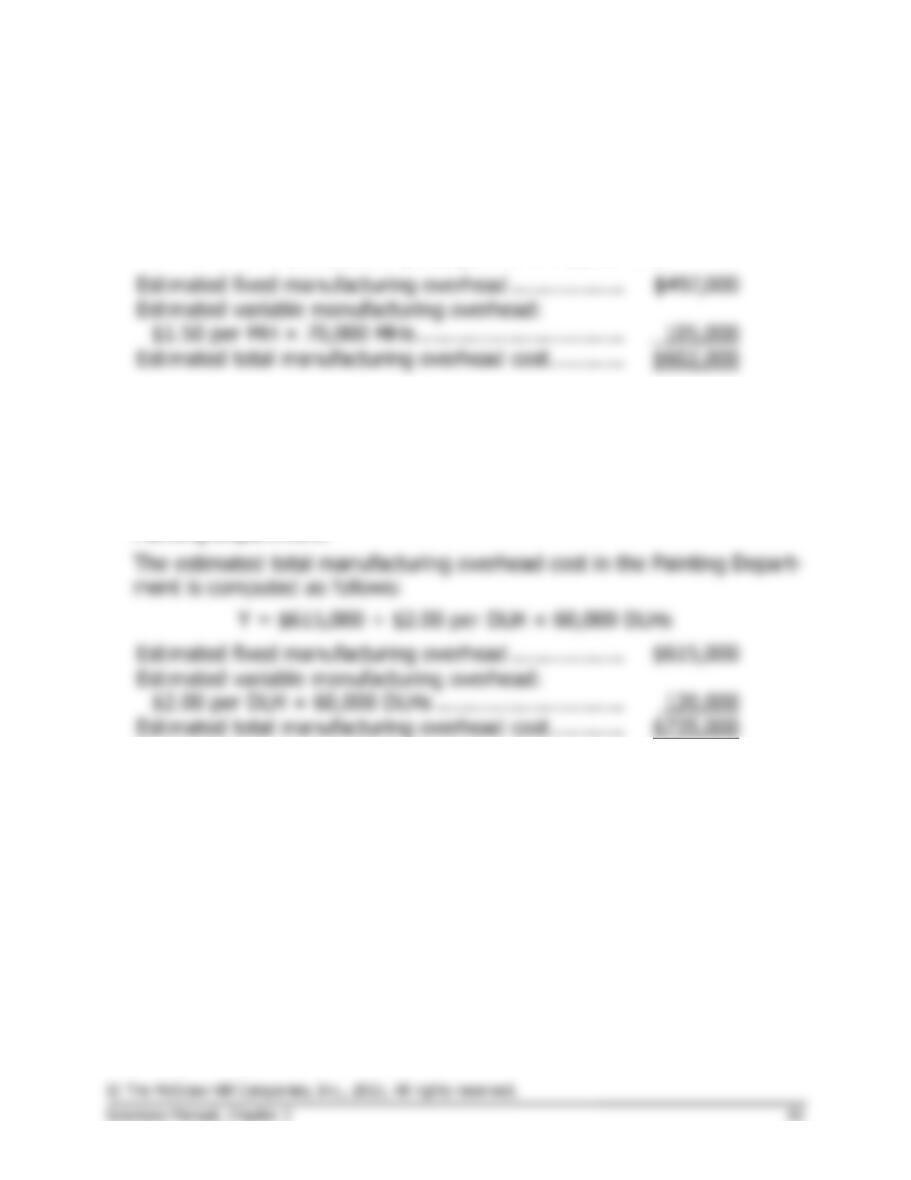
The estimated total manufacturing overhead cost in the Molding Depart-
ment is computed as follows:
Y = $497,000 + $1.50 per MH × 70,000 MHs
Estimated fixed manufacturing overhead ………………
Estimated total manufacturing overhead cost …………
$602,000
The predetermined overhead rate is computed as follows:
Estimated total manufacturing overhead (a) .
$602,000
Estimated total machine-hours (b) ……………
70,000
MHs
Predetermined overhead rate (a) ÷ (b) ……..
$8.60
per MH
Estimated fixed manufacturing overhead ………………
$615,000
Estimated total manufacturing overhead cost …………
$735,000
The predetermined overhead rate is computed as follows:
Estimated total manufacturing overhead (a) .
$735,000
Estimated total DLHs (b) ………………………..
60,000
DLHs
Predetermined overhead rate (a) ÷ (b) ……..
$12.25
per DLH
Problem 2-19 (continued)
2.
Molding Department overhead applied:
110 machine-hours × $8.60 per machine-hour
$ 946
Painting Department overhead applied:
84 direct labor-hours × $12.25 per DLH ……….
1,029
Total overhead cost ………………………………………
$1,975
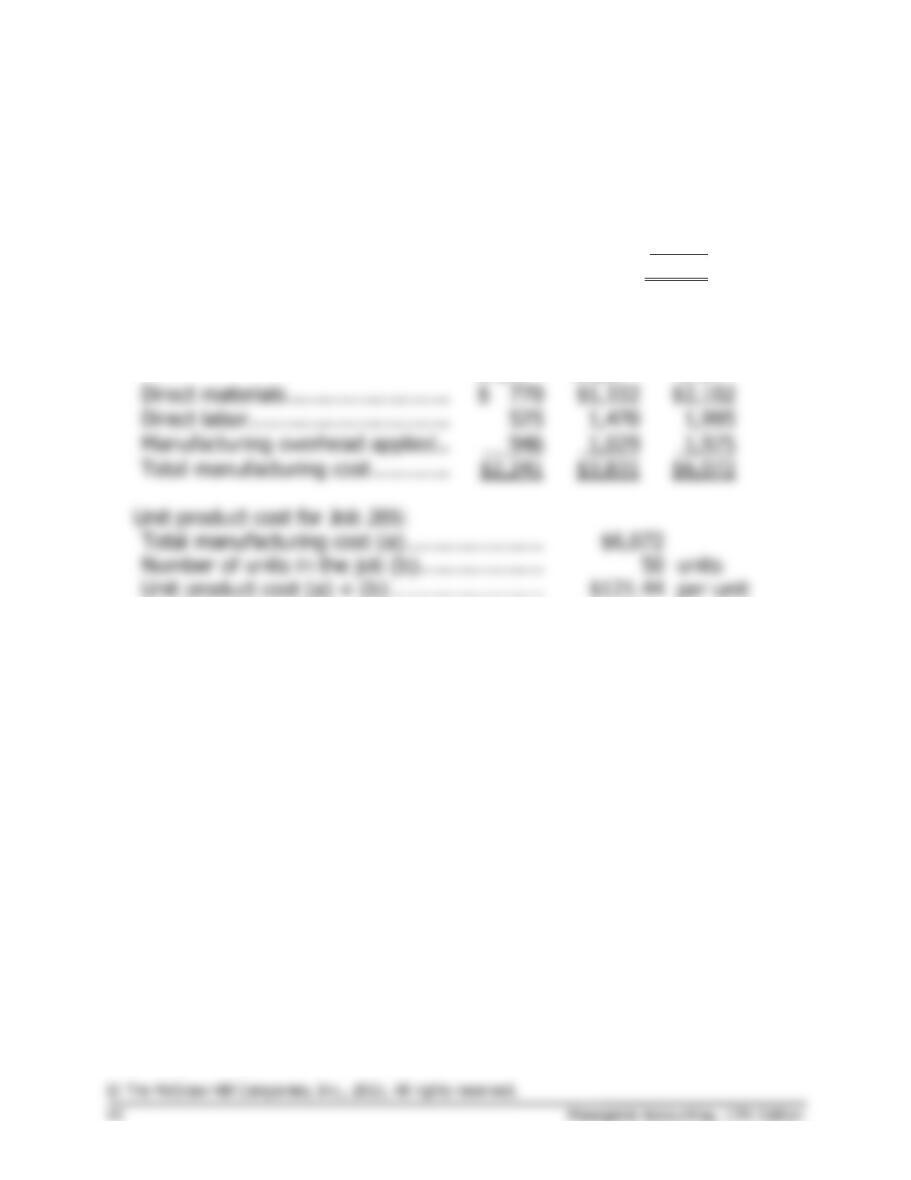
3. Total cost of Job 205:
Direct materials ……………………..
$2,102
Direct labor …………………………..
Manufacturing overhead applied ..
per unit
Molding
Painting
Problem 2-20 (45 minutes)
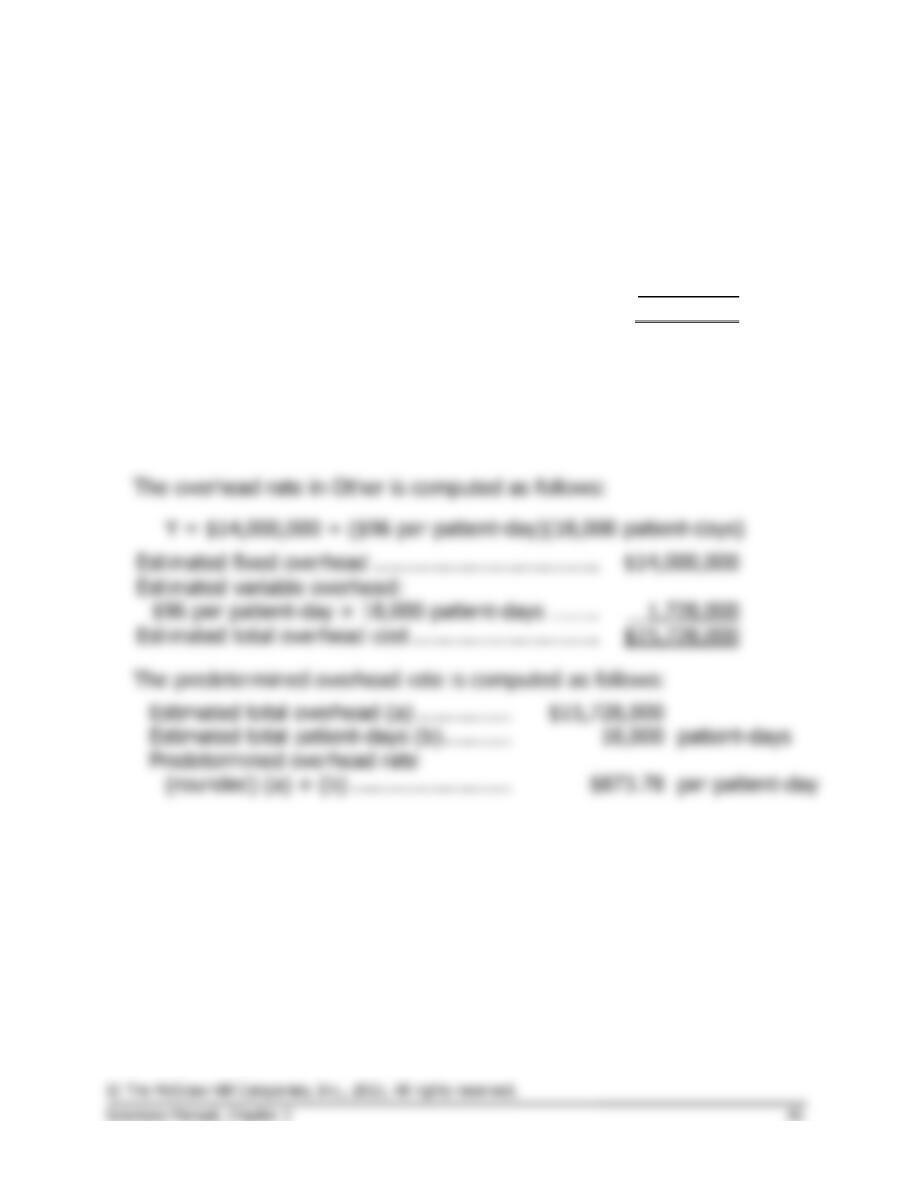
1a. The overhead rate in ICU is computed as follows:
Y = $3,200,000 + ($236 per patient-day)(2,000 patient-days)
Estimated fixed overhead ………………………………
$3,200,000
Estimated variable overhead:
$236 per patient-day × 2,000 patient-days ……..
472,000
Estimated total overhead cost ………………………..
$3,672,000
The predetermined overhead rate is computed as follows:
Estimated total overhead (a) ……………
$3,672,000
Estimated total patient-days (b) ………..
2,000
patient-days
Predetermined overhead rate (a) ÷ (b)
$1,836
per patient-day
Estimated fixed overhead ………………………………
Estimated total overhead cost …………………………
Estimated total overhead (a) ……………
Estimated total patient-days (b) ………..
patient-days
Problem 2-20 (continued)
1b.
The total cost assigned to Patient A:
Direct materials …………………………………………
$ 4,500
Direct labor ………………………………………………
25,000
ICU ($1,836 per patient-day × 0 patient-days) …
$ 0
Other ($873.78 per patient day × 14 patient-
days) (rounded to nearest dollar) ……………….
12,233
12,233
Total cost assigned to Patient A ……………………
$41,733
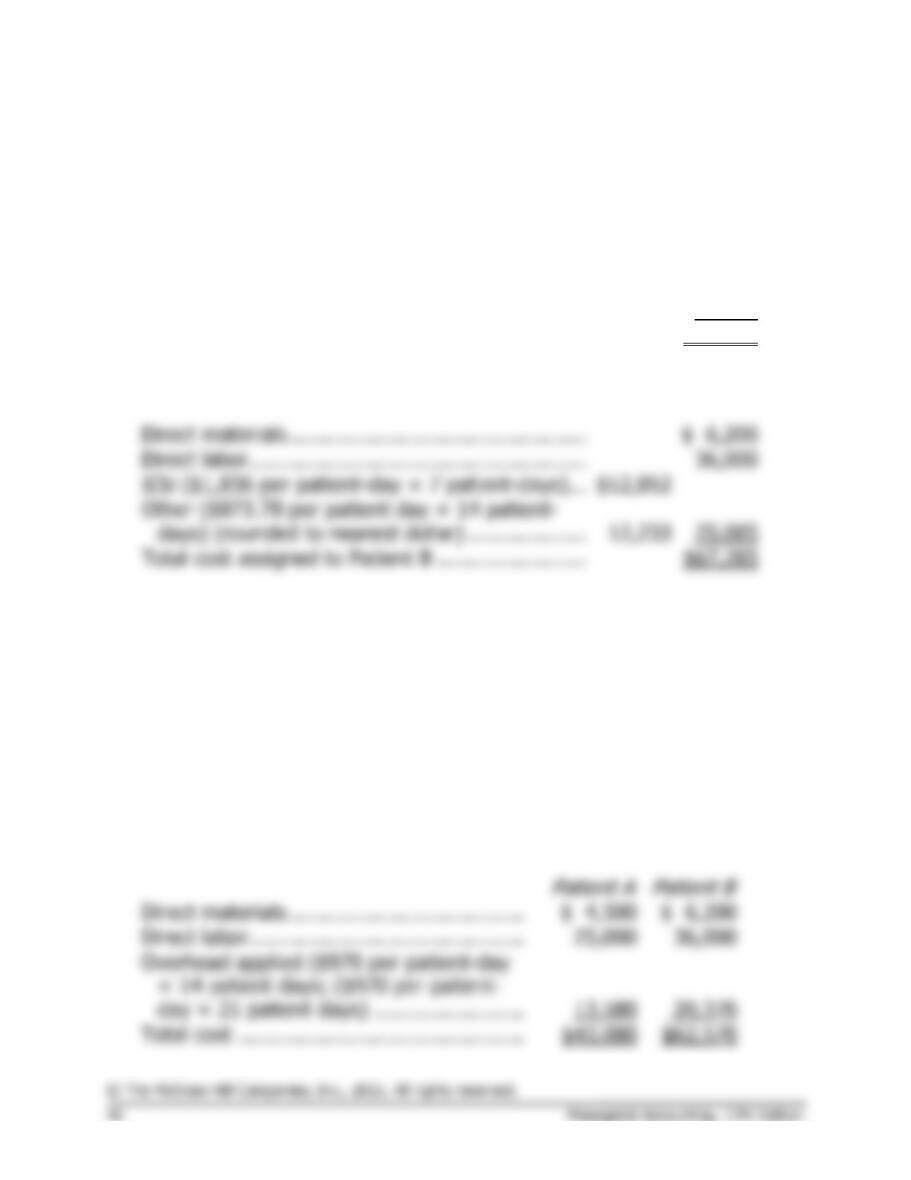
The total cost assigned to Patient B:
Direct materials …………………………………………
Direct labor ………………………………………………
36,000
ICU ($1,836 per patient-day × 7 patient-days) …
Other ($873.78 per patient day × 14 patient-
25,085
Total cost assigned to Patient B ……………………
2a. The plantwide overhead rate of $970.00 per patient-day is calculated
by combining the estimated manufacturing overhead costs computed in
requirement 1a for ICU and Other ($3,672,000 + $15,728,000 =
$19,400,000) and then dividing by the estimated total patient-days
(2,000 + 18,000 = 20,000):
Estimated total overhead (a) ……………
$19,400,000
Estimated total patient-days (b) ……….
20,000
patient-days
Predetermined overhead rate (a) ÷ (b)
$970
per patient-day
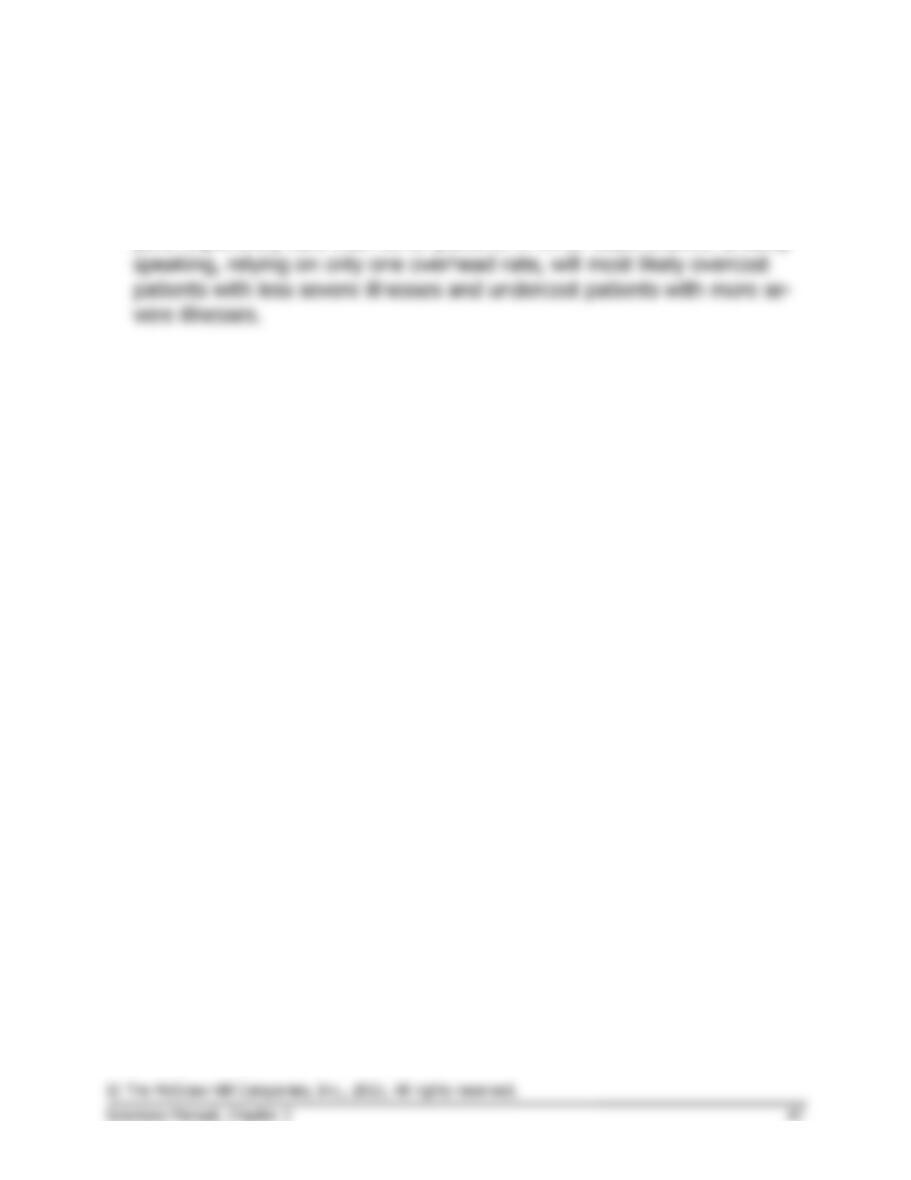
2b. The total cost assign to Patients A and B is computed as follows:
Direct materials ………………………………..
Direct labor ……………………………………..
day × 21 patient days) ……………………
Problem 2-20 (continued)
3. Relying on just one predetermined overhead rate overlooks the fact that
some departments are more intensive users of overhead resources than
others. As the name implies, patients in the ICU require more intensive
Problem 2-21 (30 minutes)
1. The plantwide predetermined overhead rate is computed as follows:
Estimated manufacturing overhead (a) …….
$600,000
Estimated total direct labor-hours (b) ………
60,000
DLHs
Predetermined overhead rate (a) ÷ (b) …….
$10
per DLH
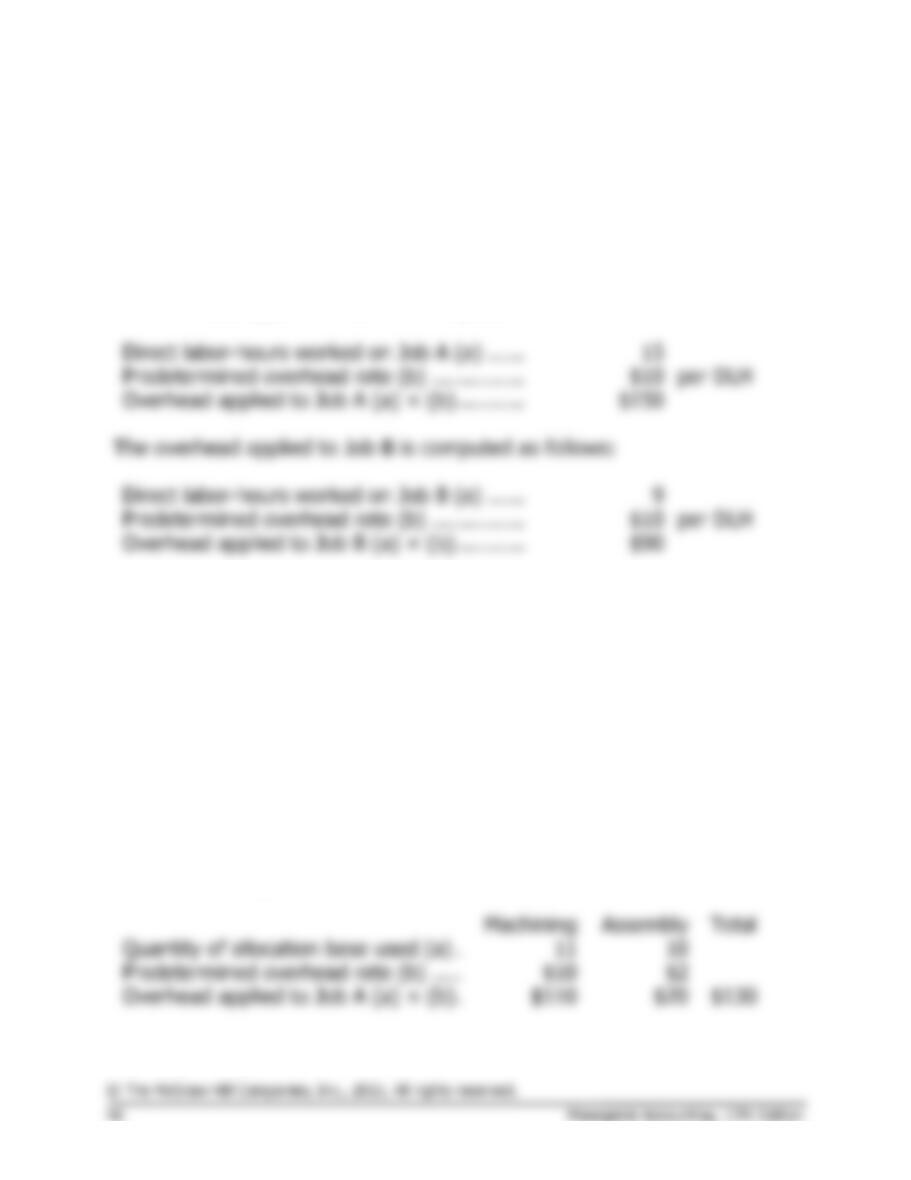
The overhead applied to Job A is computed as follows:
Direct labor-hours worked on Job A (a) ……
Predetermined overhead rate (b) ……………
per DLH
Overhead applied to Job A (a) × (b) ………..
Direct labor-hours worked on Job B (a) ……
Predetermined overhead rate (b) ……………
per DLH
Overhead applied to Job B (a) × (b) ………..
$90
2. The predetermined overhead rate in Machining is computed as follows:
Estimated manufacturing overhead (a) …….
$500,000
Estimated total machine-hours (b) ………….
50,000
MHs
Predetermined overhead rate (a) ÷ (b) …….
$10
per MH
The predetermined overhead rate in Assembly is computed as follows:
Estimated manufacturing overhead (a) …….
$100,000
Estimated total direct labor-hours (b) ………
50,000
DLHs
Predetermined overhead rate (a) ÷ (b) …….
$2
per DLH
The overhead applied to Job A is computed as follows:
Quantity of allocation base used (a) .
Predetermined overhead rate (b) …..
Overhead applied to Job A (a) × (b) .
Problem 2-21 (continued)
The overhead applied to Job B is computed as follows:
Machining
Assembly
Total
Quantity of allocation base used (a) .
12
5
Predetermined overhead rate (b) …..
$10
$2
Overhead applied to Job B (a) × (b) .
$120
$10
$130
3. The plantwide approach will overcost jobs that are intensive users of As-
sembly and minimal users of Machining. Conversely, it will undercost
products that are intensive users of Machining and minimal users of As-
sembly. These cost distortions will adversely impact the company’s pric-
ing process. Jobs that get overcosted will have selling prices that are
Case 2-22 (60 minutes)
1.
a.
Estimated total manufacturing overhead cost
Predetermined =
overhead rate Estimated total amount of the allocation base
$840,000 140% of direct
= = labor cost
$600,000 direct labor cost
$9,500 × 140% = $13,300
2.
a.
Fabricating
Department
Machining
Department
Assembly
Department
Estimated manufacturing
overhead cost (a) ………
$350,000
$400,000
$ 90,000
Estimated direct labor
cost (b)……………………
$200,000
$100,000
$300,000
Predetermined overhead
rate (a) ÷ (b) ……………
175%
400%
30%
Fabricating Department:
Machining Department:
Assembly Department:
Total applied overhead …………………
3. The bulk of the labor cost on the Koopers job is in the Assembly Depart-
ment, which incurs very little overhead cost. The department has an
overhead rate of only 30% of direct labor cost as compared to much
higher rates in the other two departments. Therefore, as shown above,
use of departmental overhead rates results in a relatively small amount
of overhead cost being charged to the job.
Use of a plantwide overhead rate in effect redistributes overhead costs
proportionately between the three departments (at 140% of direct labor
Case 2-22 (continued)
cost) and results in a large amount of overhead cost being charged to
the Koopers job, as shown in Part 1. This may explain why the company
bid too high and lost the job. Too much overhead cost was assigned to
the job for the kind of work being done on the job in the plant.
4. The company’s bid was:
Direct materials …………………………………….
$ 4,600
Direct labor ………………………………………….
9,500
Manufacturing overhead applied (see require–
ment 1b) …………………………………………..
13,300
Total manufacturing cost ………………………..
$27,400
Bidding rate …………………………………………
× 1.5
Total bid price ………………………………………
$41,100
If departmental overhead rates had been used, the bid would have
been:
Direct materials …………………………………….
$ 4,600
Direct labor ………………………………………….
9,500
Manufacturing overhead applied (see require–
Total manufacturing cost ………………………..
$22,860
Bidding rate …………………………………………
× 1.5
Total bid price ………………………………………
$34,290
Appendix 2A
Activity-Based Absorption Costing
Exercise 2A-1 (20 minutes)
1. Activity rates are computed as follows:
Activity Cost Pool
(a)
Estimated
Overhead
Cost
(b)
Expected
Activity
(a) ÷ (b)
Activity
Rate
Machine setups ……
$72,000
400
setups
$180
per setup
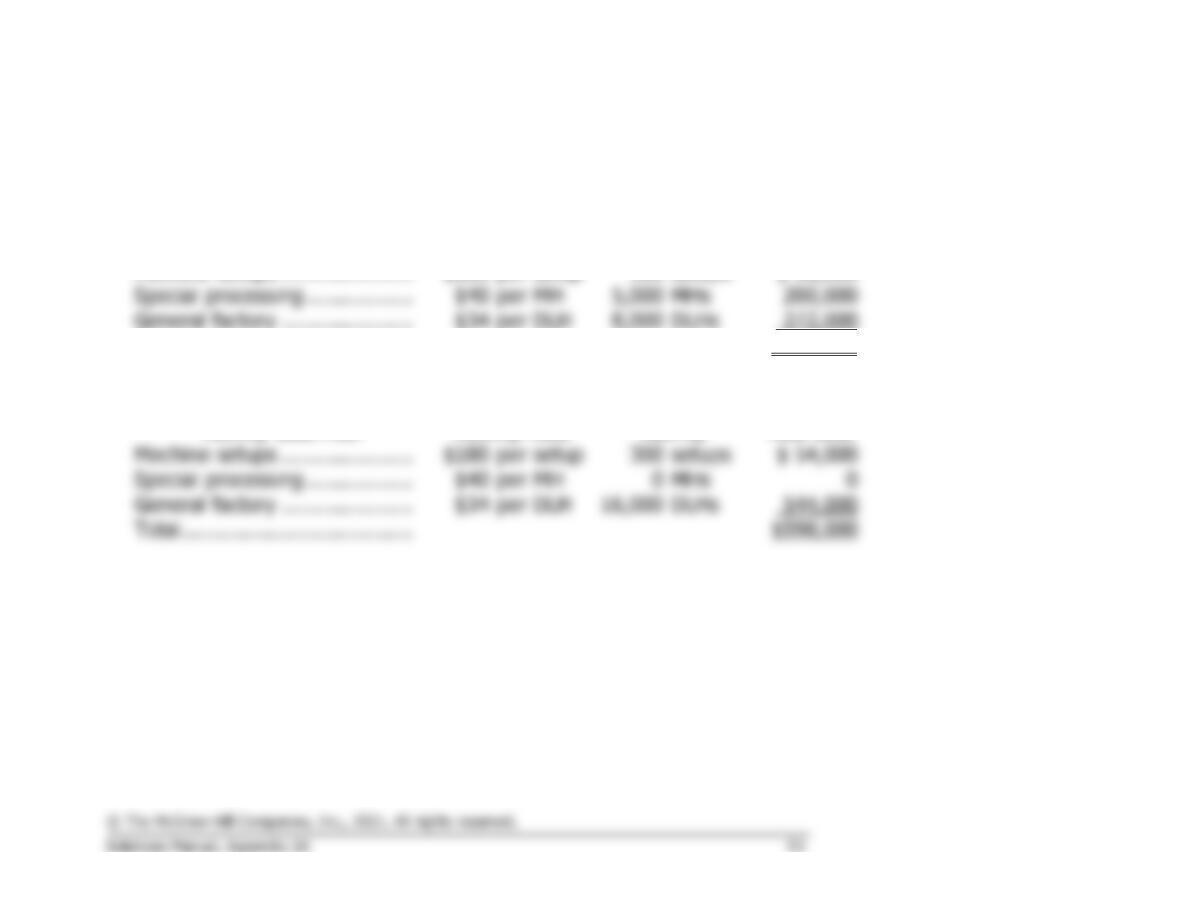
Special processing ..
MHs
per MH
General factory ……
DLHs
per DLH
Exercise 2A-1 (continued)
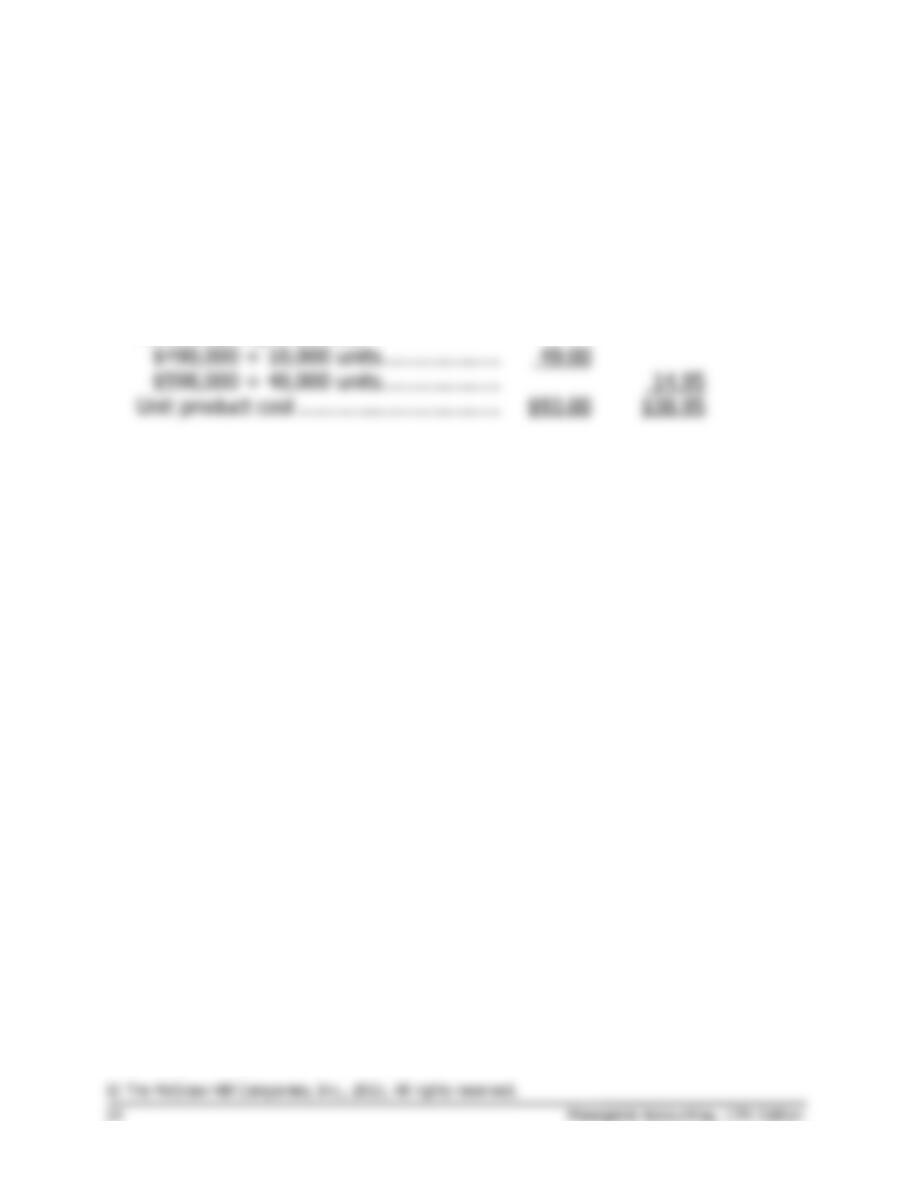
2. Overhead is assigned to the two products as follows:
Hubs:
Activity Cost Pool
(a)
Activity Rate
(b)
Activity
(a) × (b)
ABC Cost
Special processing ……………..
per MH
MHs
Total ……………………………….
$490,000
Sprockets:
Machine setups …………………
per setup
setups
General factory …………………
per DLH
DLHs
(a)
(b)
(a) × (b)
Exercise 2A-1 (continued)
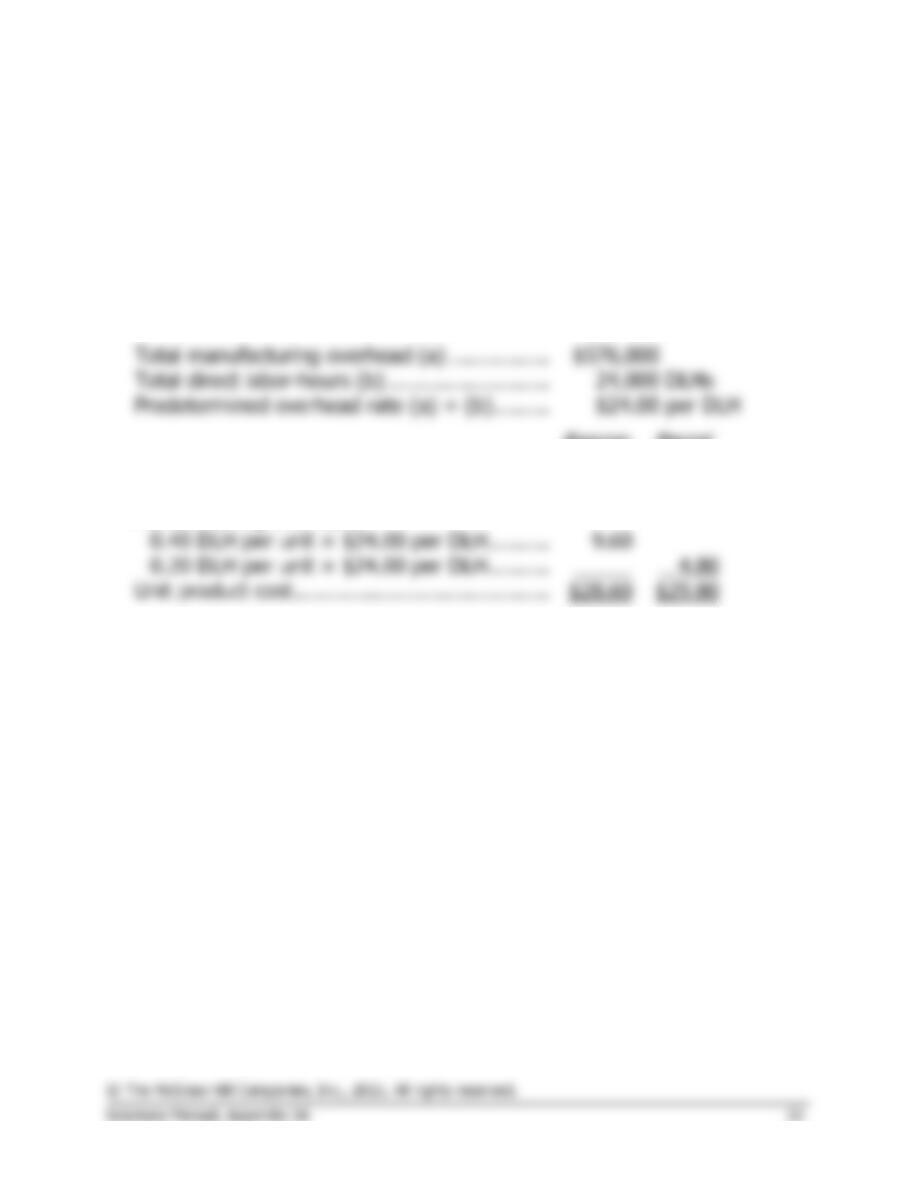
2. Each product’s unit product cost is computed as follows:
Hubs
Sprockets
Direct materials……………………………..
$32.00
$18.00
Direct labor:
$15 per DLH × 0.80 DLHs per unit ….
12.00
$15 per DLH × 0.40 DLHs per unit ….
6.00
Manufacturing overhead:
$490,000 ÷ 10,000 units……………….
$598,000 ÷ 40,000 units……………….
Unit product cost …………………………..
$93.00
Exercise 2A-2 (45 minutes)
1. The unit product costs under the company’s traditional costing system
would be computed as follows:
Rascon
Parcel
Total
Number of units produced (a) ………………….
20,000
80,000
Direct labor-hours per unit (b)………………….
0.40
0.20
Total direct labor-hours (a) × (b) ……………..
8,000
16,000
24,000
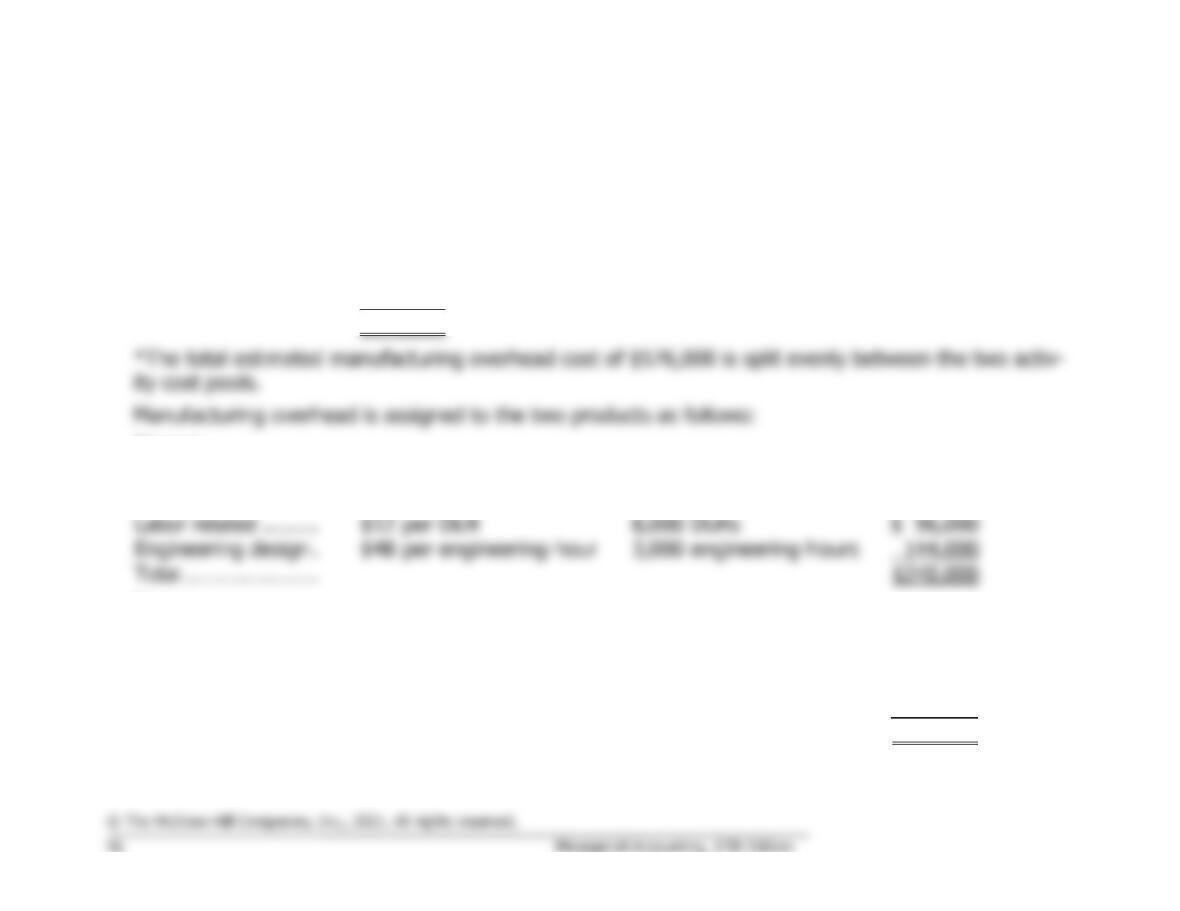
Total manufacturing overhead (a) …………….
Total direct labor-hours (b) ……………………..
DLHs
Predetermined overhead rate (a) ÷ (b) ………
per DLH
Rascon
Parcel
Direct materials …………………………………….
$13.00
$22.00
Direct labor ………………………………………….
6.00
3.00
Manufacturing overhead:
0.40 DLH per unit × $24.00 per DLH……….
9.60
0.20 DLH per unit × $24.00 per DLH……….
Unit product cost …………………………………..
$28.60
$29.80
Exercise 2A-2 (continued)
2. The unit product costs using activity-based absorption costing can be computed as follows:
Activity Cost Pool
Estimated
Overhead
Cost*
(b)
Expected Activity
(a) ÷ (b)
Activity Rate
Labor related ………..
$288,000
24,000
direct labor-hours
$12.00
per direct labor-hour
Engineering design …
$288,000
6,000
engineering-hours
$48.00
per engineering-hour
$576,000
Rascon:
Activity Cost Pool
(a)
Activity Rate
(b)
Activity
(a) × (b)
ABC Cost
Labor related ………
$12
per DLH
8,000
DLHs
Engineering design .
$48
per engineering-hour
3,000
engineering-hours
144,000
Total ………………….
$240,000
Parcel:
Activity Cost Pool
(a)
Activity Rate
(b)
Activity
(a) × (b)
ABC Cost
Labor related ………
$12
per DLH
16,000
DLHs
$192,000
Engineering design .
$48
per engineering-hour
3,000
engineering-hours
144,000
Total ………………….
$336,000
Exercise 2A-2 (continued)
The unit product costs combine direct materials, direct labor, and over-
head costs:
Rascon
Parcel
Direct materials ………………………………………
$13.00
$22.00
Direct labor ……………………………………………
6.00
3.00
Manufacturing overhead ($240,000 ÷ 20,000
units; $336,000 ÷ 80,000 units) ………………
12.00
4.20
Unit product cost …………………………………….
$31.00
$29.20
3. The unit product cost of the high-volume product, Parcel, declines under
the activity-based approach, whereas the unit product cost of the low-
volume product, Rascon, increases. This occurs because half of the
overhead is applied on the basis of engineering design hours instead of
direct labor-hours. When the overhead was applied on the basis of di-
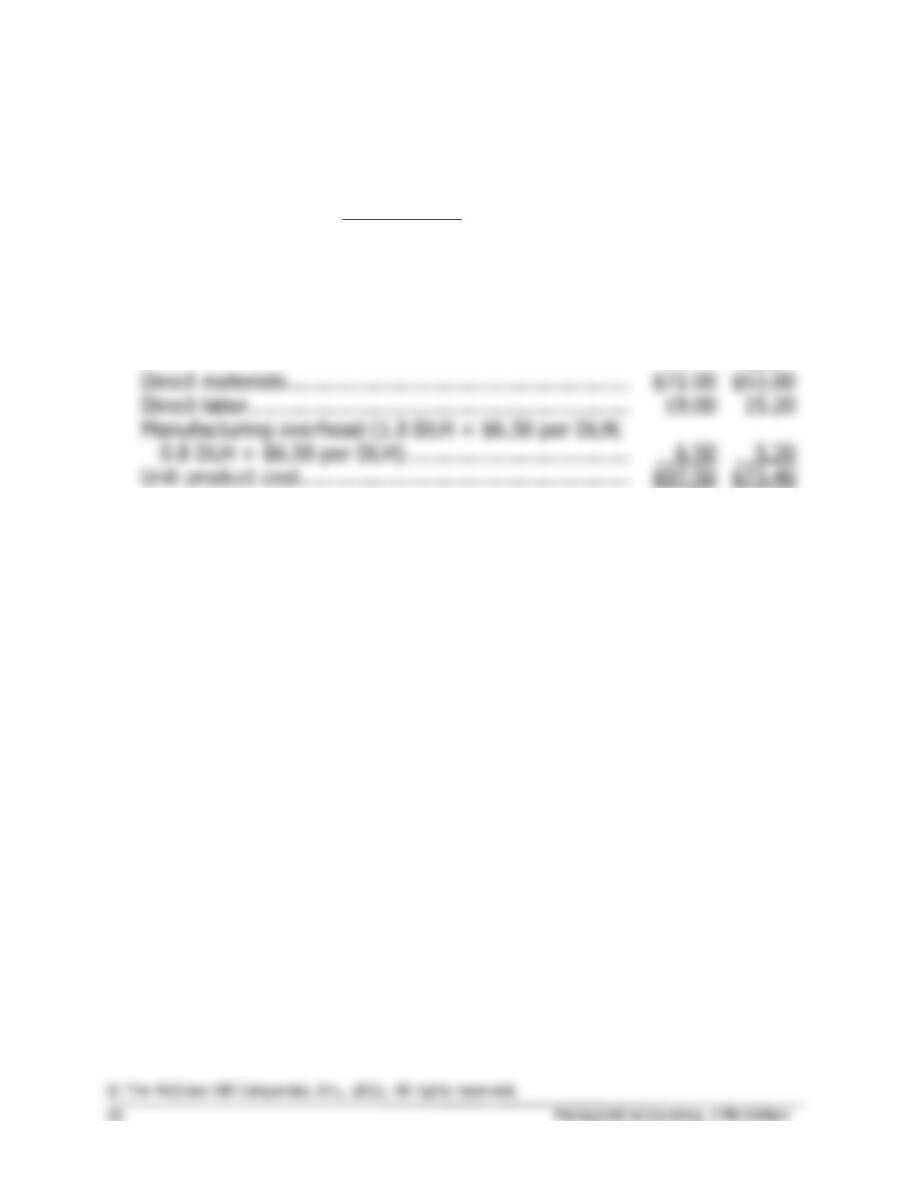
Exercise 2A-3 (45 minutes)
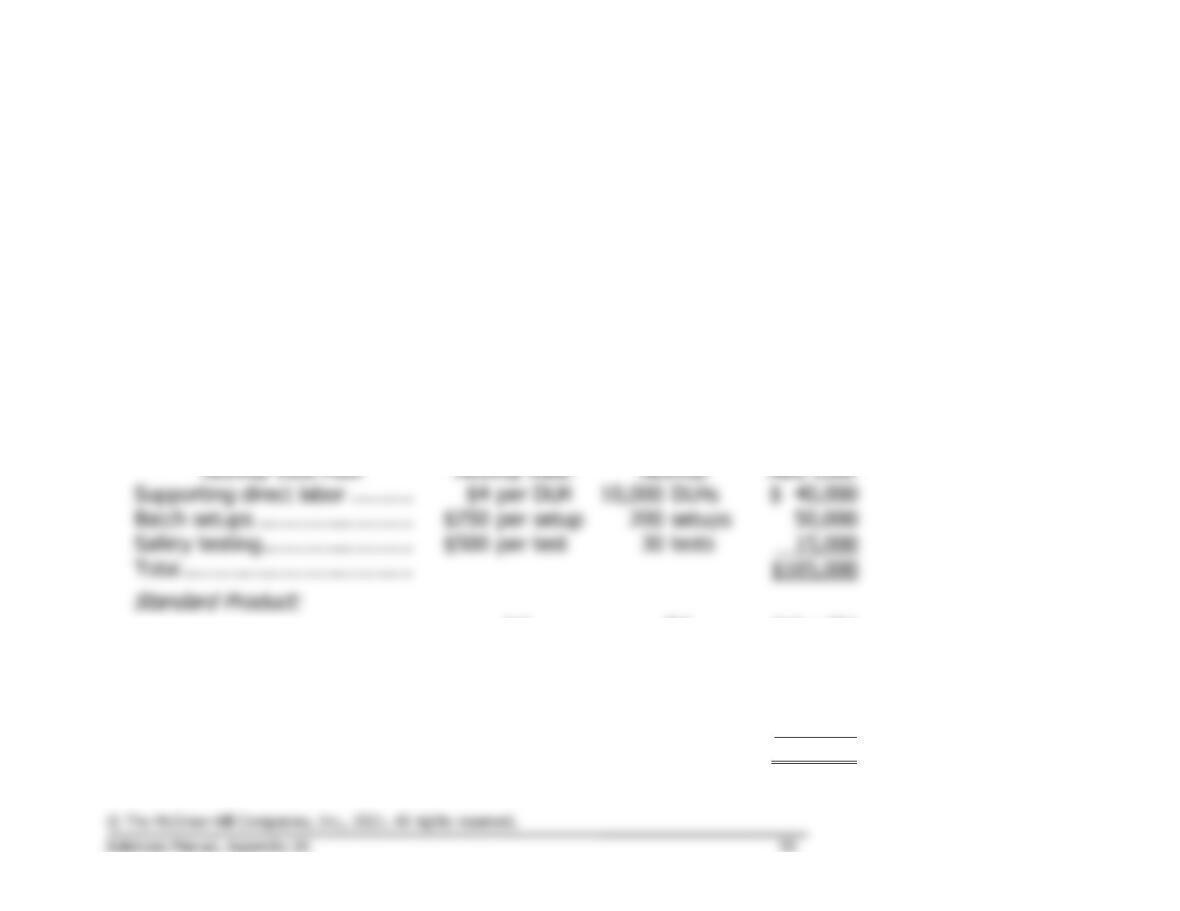
1. The predetermined overhead rate is computed as follows:
$325,000
Predetermined
= = $6.50 per DLH
overhead rate 50,000 DLHs
The unit product costs under the company’s traditional costing system
are computed as follows:
Deluxe
Stand-
Exercise 2A-3 (continued)
2. The activity rates are computed as follows:
(a)
Estimated
(b)
Overhead
Total
(a) ÷ (b)
Activity Cost Pool
Cost
Expected Activity
Activity Rate
Supporting direct labor …
$200,000
50,000
DLHs
$4
per DLH
Batch setups ……………..
$75,000
300
setups
$250
per setup
Safety testing …………….
$50,000
100
tests
$500
per test
Manufacturing overhead is assigned to the two products as follows:
Deluxe Product:
Activity Cost Pool
Supporting direct labor ……….
per DLH
DLHs
Batch setups …………………….
$250
per setup
setups
Safety testing ……………………
$500
per test
tests
15,000
Total ……………………………….
$105,000
(a)
(b)
(a) × (b)
Activity Cost Pool
(a)
Activity Rate
(b)
Activity
(a) × (b)
ABC Cost
Supporting direct labor ……….
$4
per DLH
40,000
DLHs
$160,000
Batch setups …………………….
$250
per setup
100
setups
25,000
Safety testing ……………………
$500
per test
70
tests
35,000
Total ……………………………….
$220,000
Exercise 2A-3 (continued)
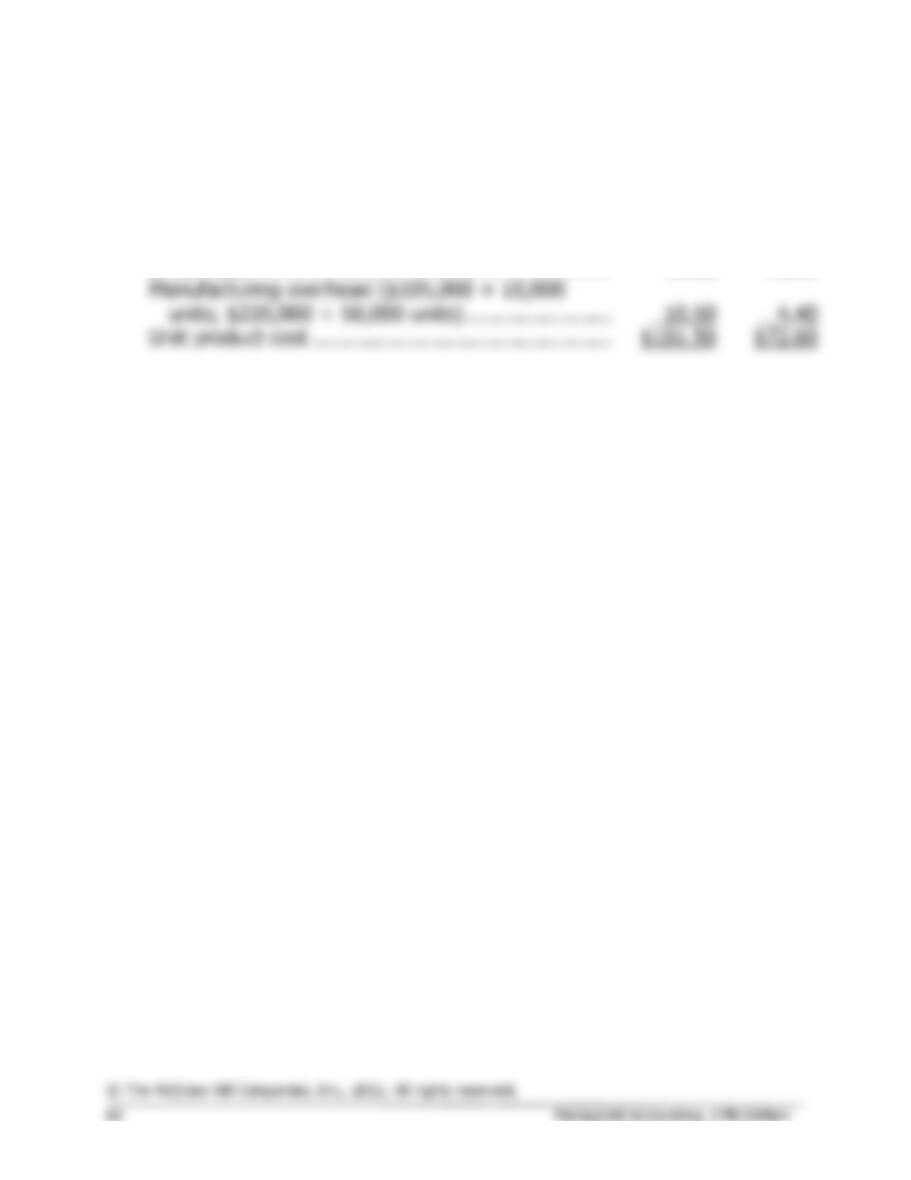
Activity-based absorption costing unit product costs are computed as
follows:
Deluxe
Standard
Direct materials …………………………………………..
$ 72.00
$53.00
Direct labor ………………………………………………..
Unit product cost …………………………………………