Chapter 2
Job-Order Costing for Manufacturing and Service Companies
QUESTIONS
1. Manufacturing costs include all costs associated with the production of goods.
Examples of manufacturing costs are: labor costs of workers directly involved with
2. Product costs are assigned to goods produced. Product costs are assigned to
3. Two common types of product costing systems are (1) job-order costing systems
and (2) process costing systems.
Job-order costing systems are generally used by companies that produce
individual products or batches of unique products. Companies that use job-order
4. A job cost sheet is a form that is used to accumulate the cost of producing a job.
5. Actual overhead is not known until the end of the accounting period. If managers
used actual overhead rates to apply overhead to jobs, they would have to wait until
Jiambalvo Managerial Accounting
2-2
6. An important characteristic of a good overhead allocation base is that it should be
strongly related to overhead cost. Assume that setup costs are classified as
7. In highly automated companies where direct labor cost is a small part of total
manufacturing costs, it is unlikely that overhead costs vary with direct labor.
8. It is necessary to apportion over- or underapplied overhead among Work in
Process Inventory, Finished Goods Inventory, and Cost of Goods Sold accounts if
9. An unexpected increase in production would typically result in overhead being
overapplied. Overhead is applied using a predetermined rate which equals
10. As companies move to computer-controlled manufacturing systems and greater use of
robotics, direct labor will likely decrease (due to decreased need for workers) and
Chapter 2 Job-Order Costing and Modern Manufacturing Practices
2-3
EXERCISES
E1. [LO 4] Managers at Company A will perceive that overhead cost allocated to jobs
increases with the amount of direct labor used. If they are evaluated on how well they
control the cost of jobs, they will try to cut back on labor, which not only reduces labor
E2. [LO 5, 7] If over- or underapplied overhead is large, we typically allocate it to Work in
Process, Finished Goods and Cost of Goods Sold based on the relative balances in
E3. [LO 4, 5] The predetermined overhead rate at Precision Custom Molds is $100 per
E4. [LO 3]
E5. [LO 1, 2]
a. Y e. N
Jiambalvo Managerial Accounting
2-4
E6. [LO 2, 4] Note that direct materials are charged to Work in Process Inventory
while indirect materials are charged to Manufacturing Overhead.
E7. [LO 2, 4] Note that direct materials are charged to Work in Process Inventory
while indirect materials are charged to Manufacturing Overhead.
E8. [LO 2, 4] Note that direct labor is charged to Work in Process Inventory while
indirect labor is charged to Manufacturing Overhead.
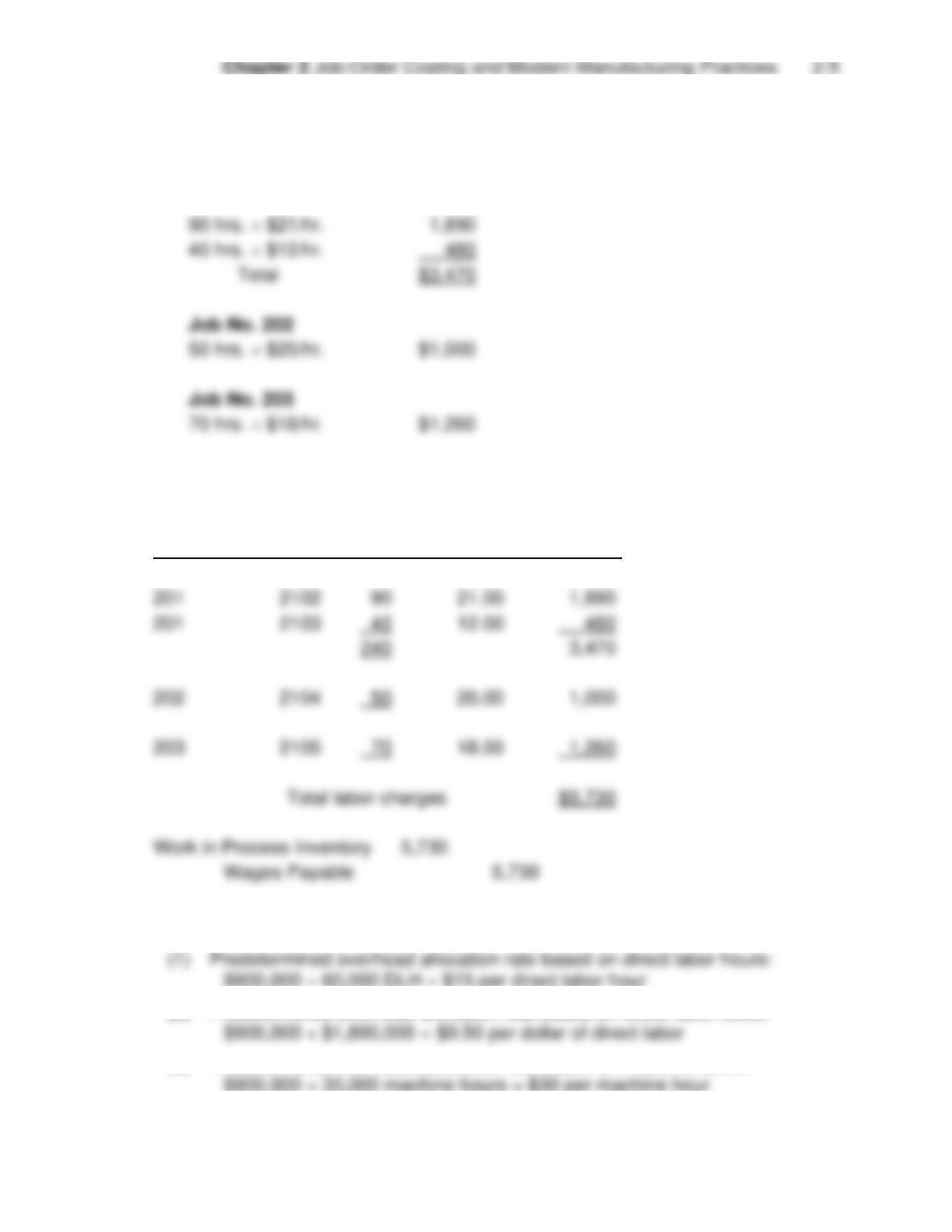
E9. [LO 2, 4]
a. Job No. 201
110 hrs. $10/hr $1,100
b. Labor Report for the month of February (by job):
Time
Job Ticket Hours Rate Cost
201 2101 110 10.00 $1,100
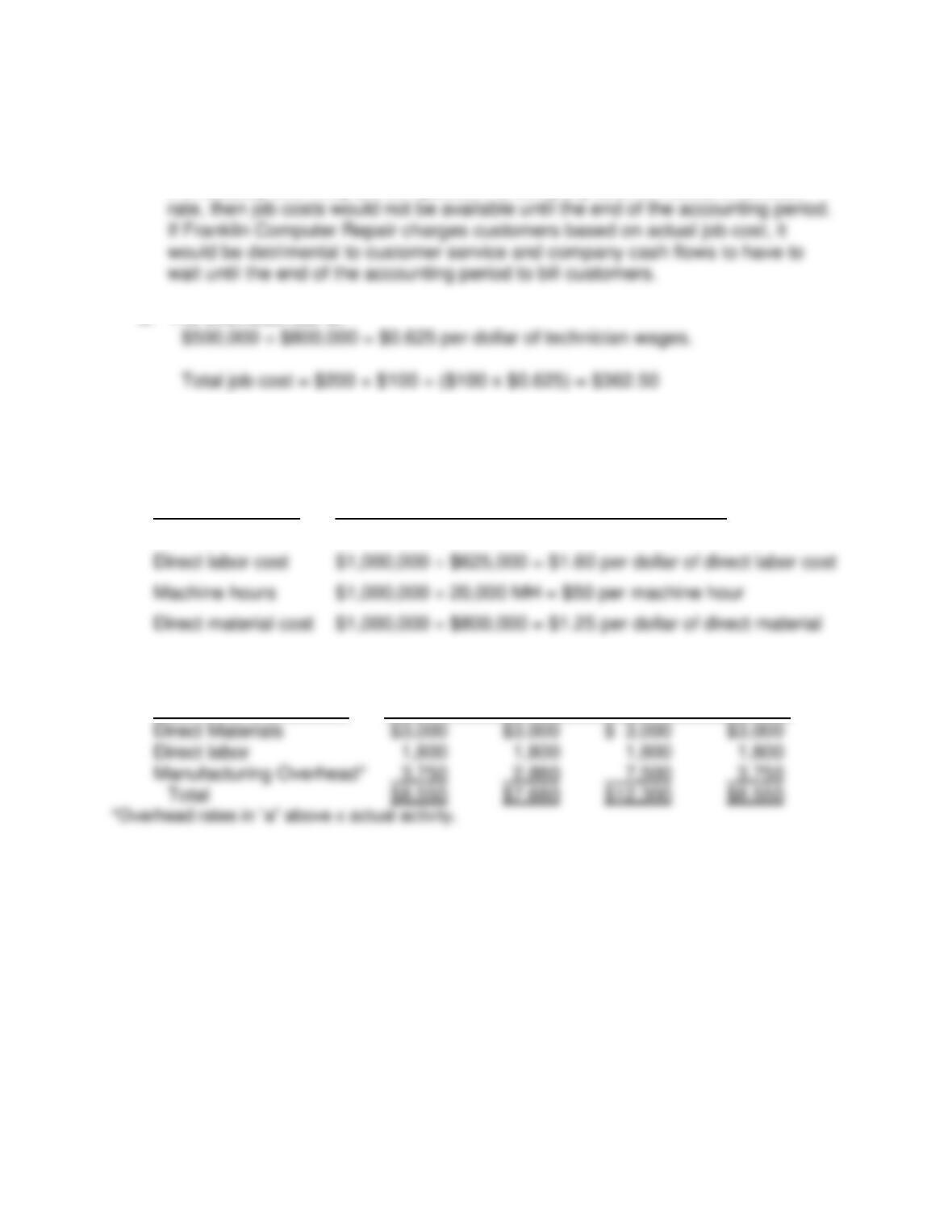
E10. [LO 5]
(2) Predetermined overhead allocation rate based on direct labor costs:
(3) Predetermined overhead allocation rate based on machine hours:
$900,000 ÷ 30,000 machine hours = $30 per machine hour
Jiambalvo Managerial Accounting
2-6
E11. [LO 4, 5, 6]
a. The use of predetermined overhead rates makes it possible to cost jobs
immediately after they are completed. If a company used an actual overhead
b. The overhead rate is:
E12. [LO 4, 5]
a. Predetermined overhead rates:
Allocation base Predetermined Overhead Rate
Direct labor hours $1,000,000 ÷ 40,000 DLH = $25 per direct labor hour
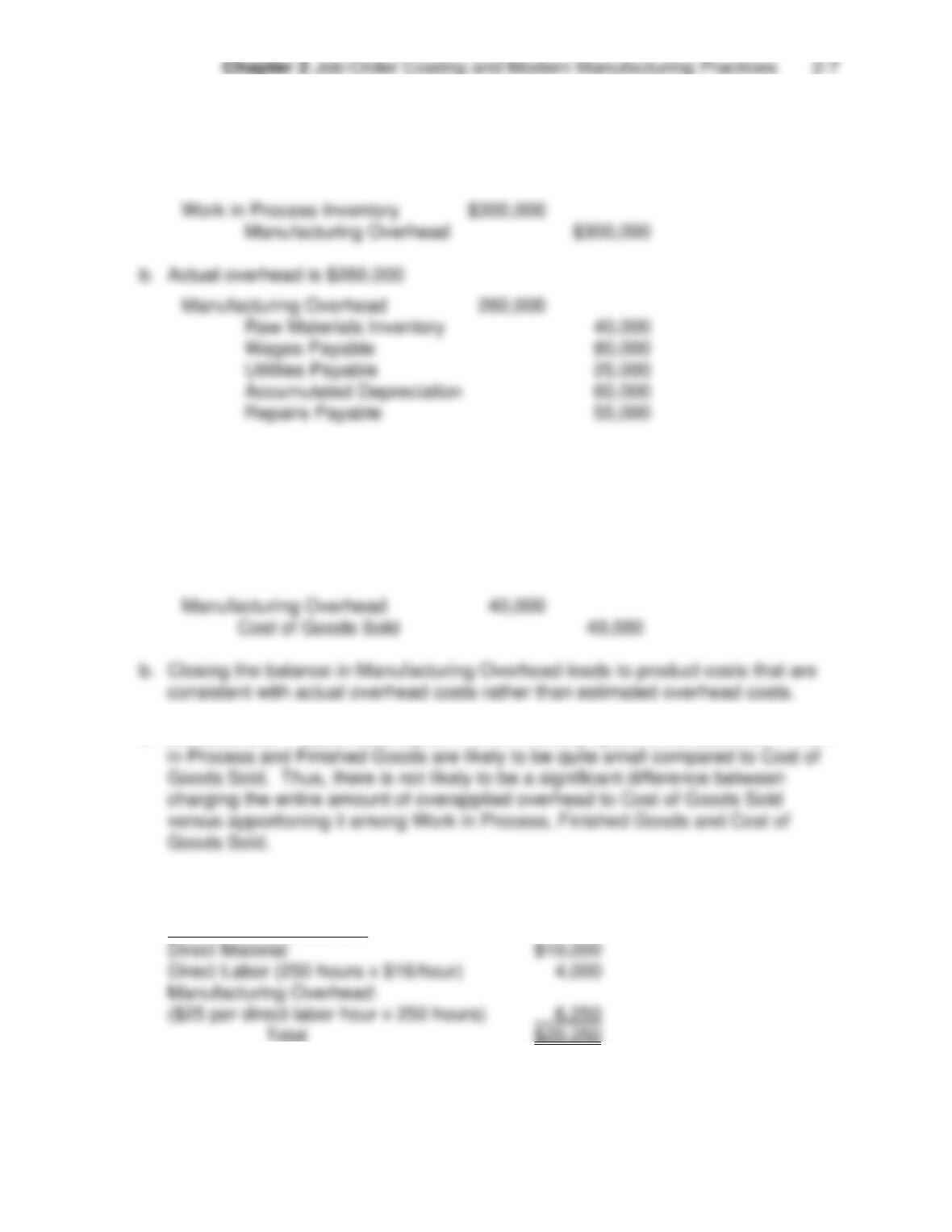
b. Cost of Job No. 253 using different allocation bases:
Cost DLH DL cost MH DM cost
E13. [LO 2, 4, 5]
a. Overhead applied is equal to $3 $100,000 of direct labor = $300,000.
E14. [LO 5, 7]
a. Overhead applied is $300,000 while actual overhead is $260,000. Thus,
Manufacturing Overhead has a $40,000 credit balance. The journal entry to close
the account to Cost of Goods Sold is:
c. Because Star Plastics uses a just-in-time inventory system, the balances in Work
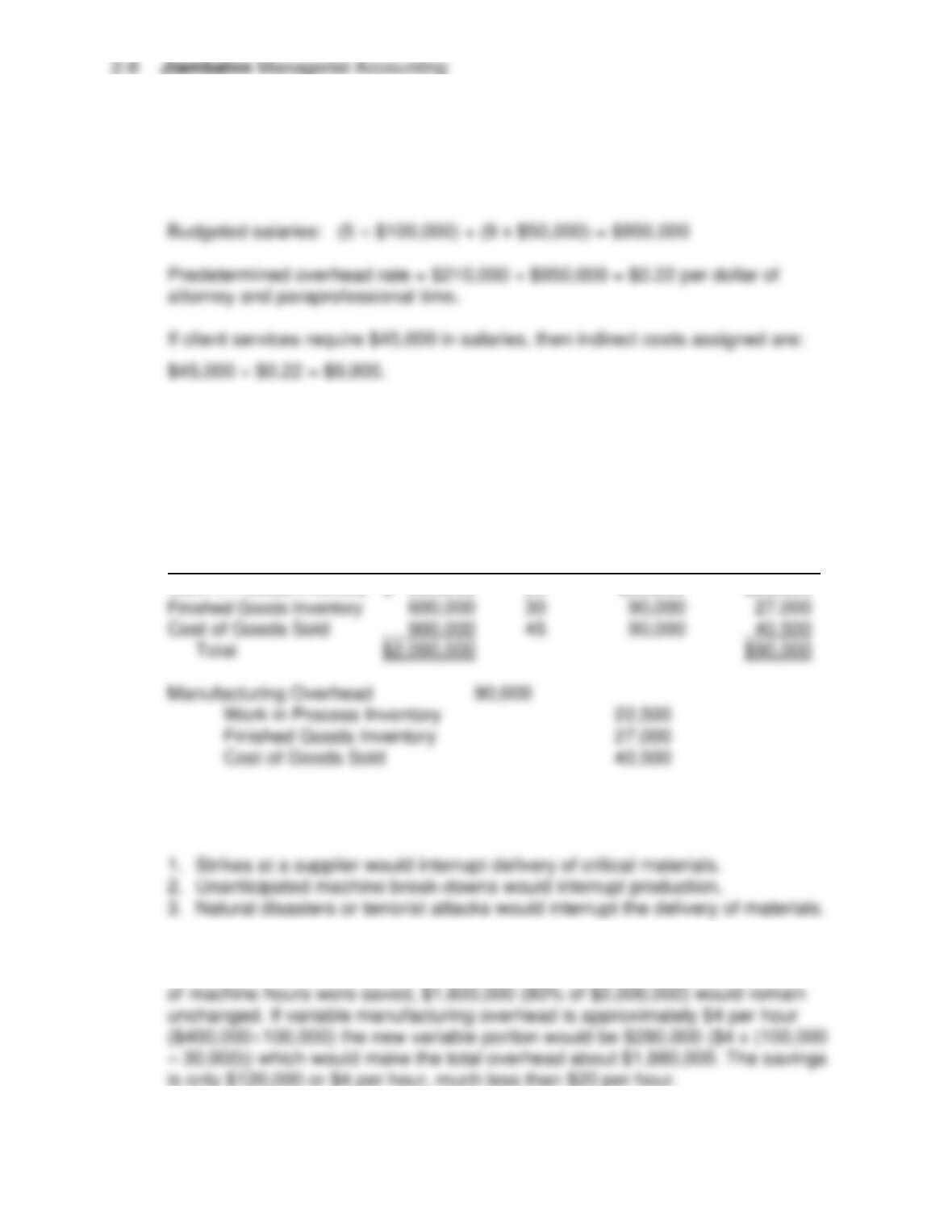
E15. [LO 4, 5]
Cost Summary: Job 325
E16. [LO 4, 5, 6]
Estimated overhead = $210,000 which is allocated based on cost of attorney and
paraprofessional time.
E17. [LO 5] Since the Manufacturing Overhead account has an ending credit balance
(before adjustment), manufacturing overhead for the period is overapplied. The
problem states that the balance is material—this suggests that we prorate the
balance among Work in Process Inventory, Finished Goods Inventory, and Cost
of Goods Sold.
% of Total
Accounts Balance Total Overapplied Adjustment
Work in Process Inventory $ 500,000 25 $90,000 $22,500
E18. [LO 7] Examples of negative events that would require a company holding
inventory are as follows:
E19. [LO 4] Estimated manufacturing overhead was $2,000,000 and eighty percent
was fixed. When the sequence of material movements was changed and 30,000
E20. Student answers will vary. See below for possible ideas.
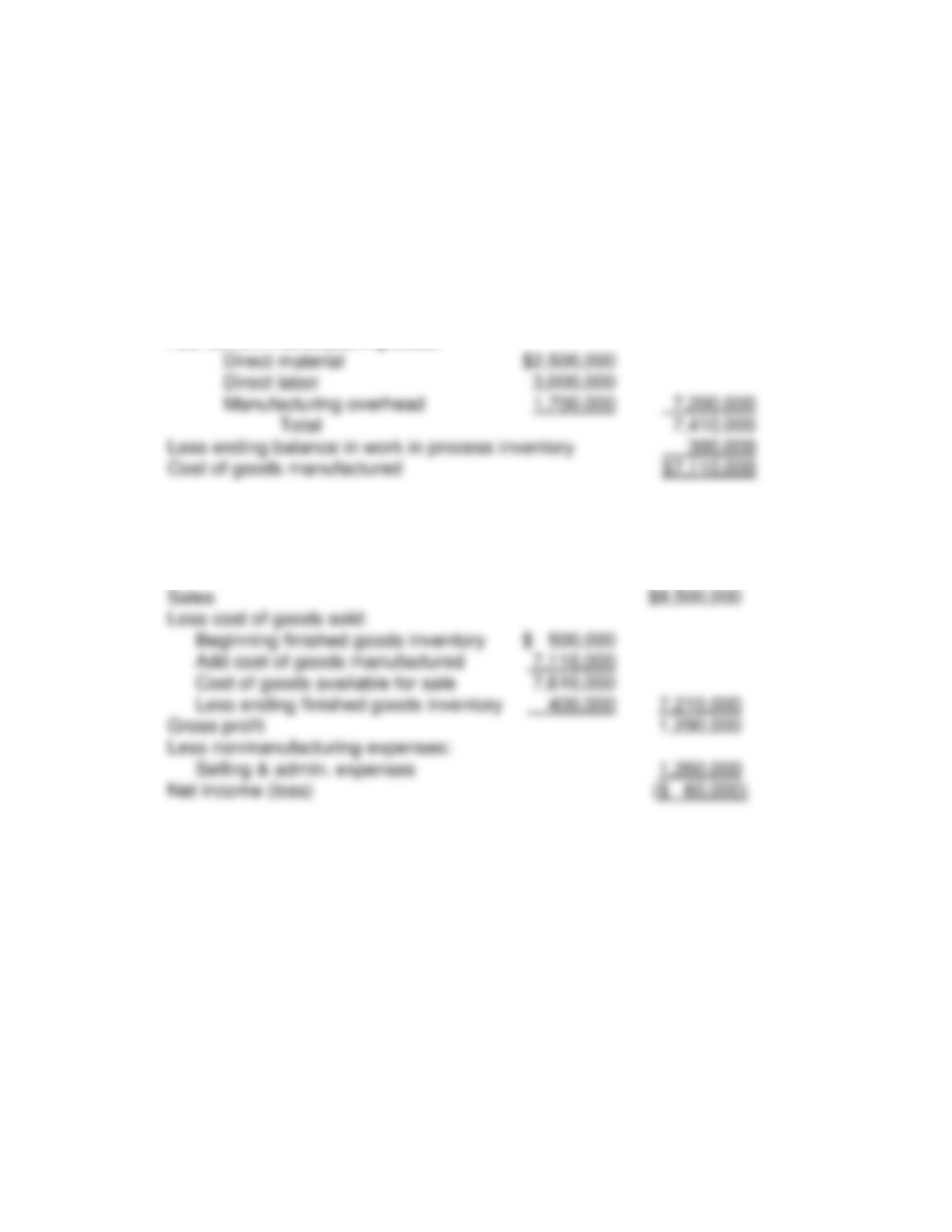
One concept is the calculation of cost of goods manufactured and cost of goods
sold. This concept is very important to someone who is an accountant for a
Jiambalvo Managerial Accounting
2-10
PROBLEMS
P1. [LO 3]
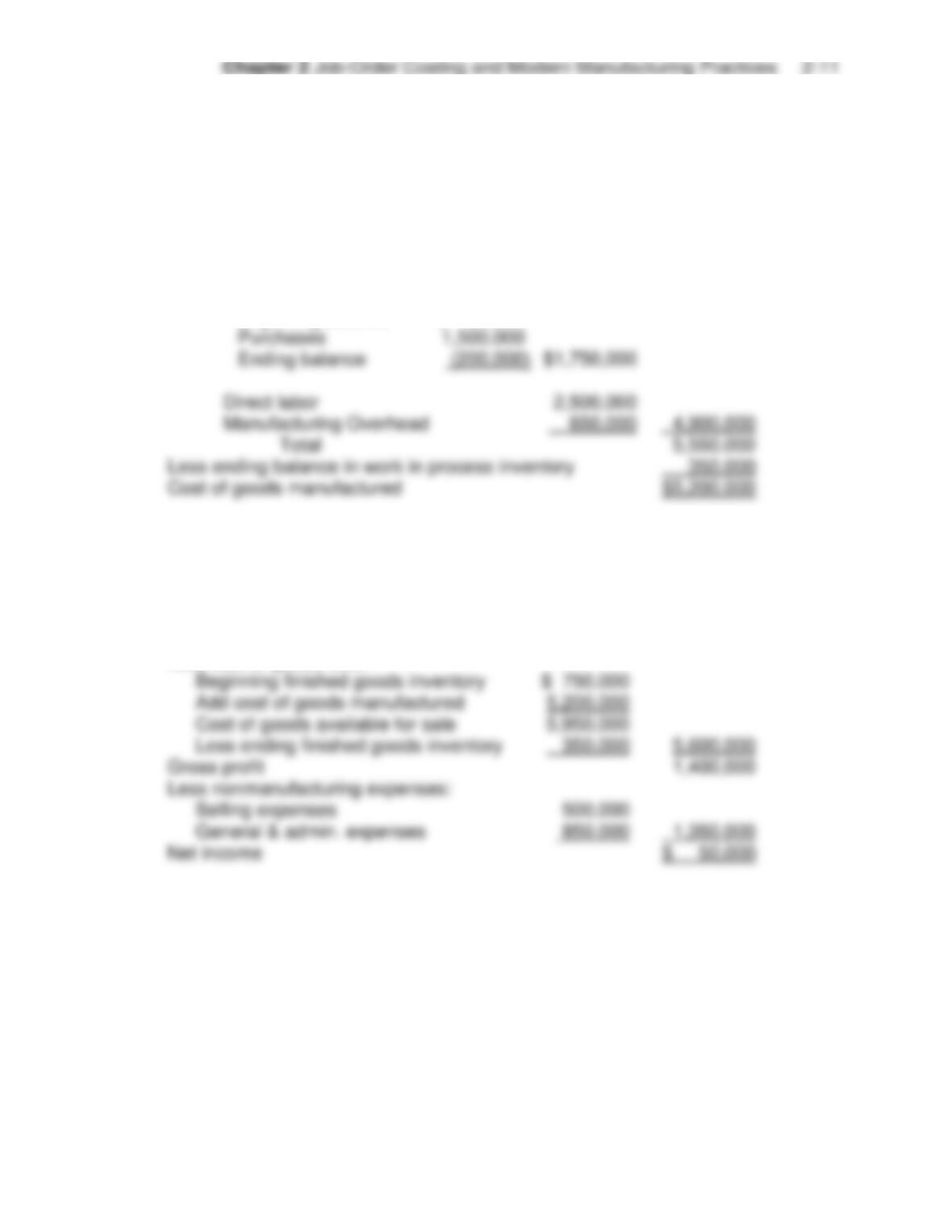
a. Satterfield’s Custom Glass
Schedule of Cost of Goods Manufactured
For the Year Ended December 31, 2017
Beginning balance in work in process inventory $ 210,000
Add current manufacturing costs:
b. Satterfield’s Custom Glass
Income Statement
For the Year Ended December 31, 2017
P2. [LO 3]
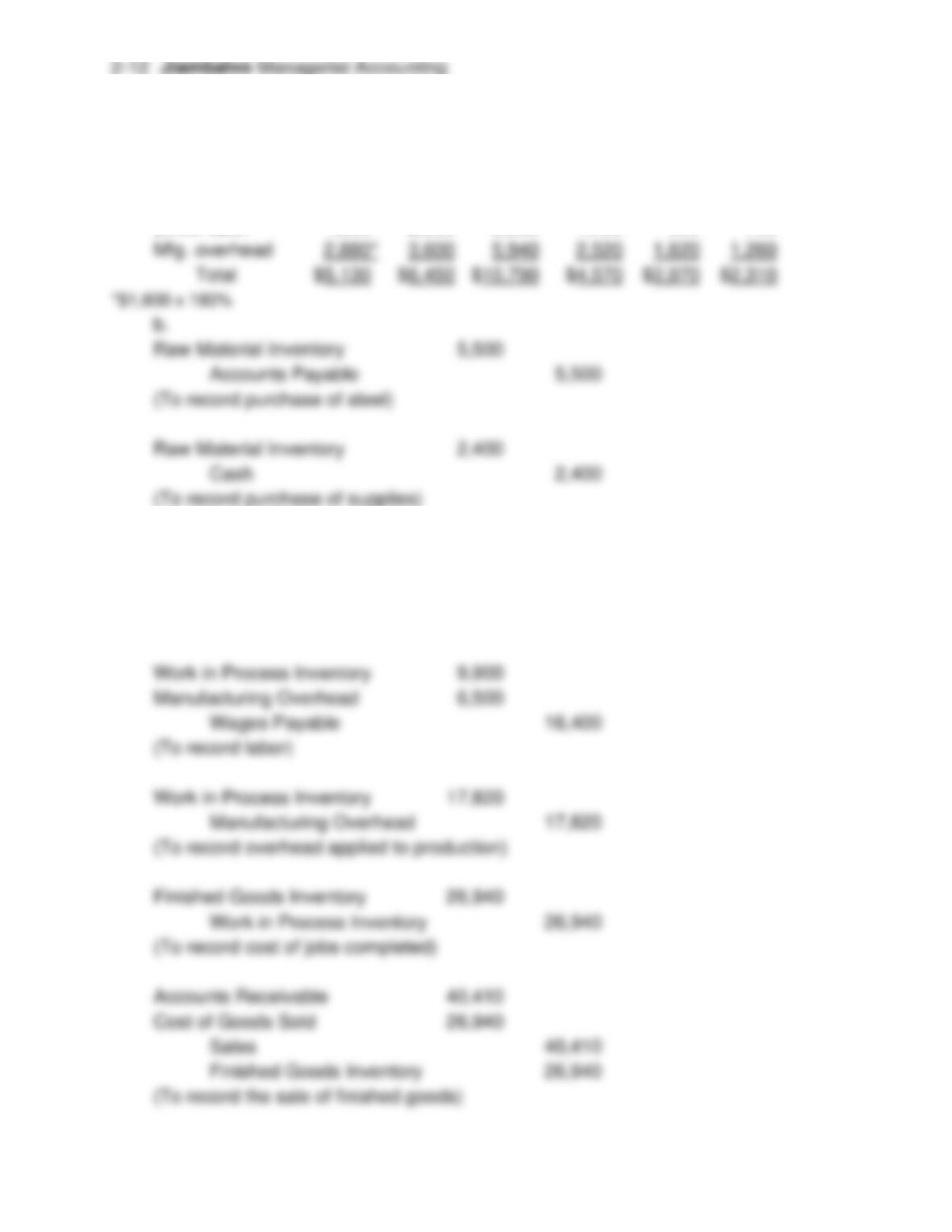
a. Terra Cotta Designs
Schedule of Cost of Goods Manufactured
For the Year Ended December 31, 2017
Beginning balance in work in process inventory $ 650,000
Add current manufacturing costs:
Direct material:
Beginning balance $ 450,000
b. Terra Cotta Designs
Income Statement
For the Year Ended December 31, 2017
Sales $7,000,000
Less cost of goods sold:
P3. [LO 4]
a. Cost of Jobs:
1005 1006 1007 1008 1009 1010
Direct materials $ 650 $ 850 $ 1,550 $ 650 $ 450 $ 350
Direct labor 1,600 2,000 3,300 1,400 900 700
Work in Process Inventory 4,500
Manufacturing Overhead 1,000
Raw Material Inventory 5,500
(To record materials used in production)
Chapter 2 Job-Order Costing and Modern Manufacturing Practices
2-13
P4. [LO 2, 3, 4]
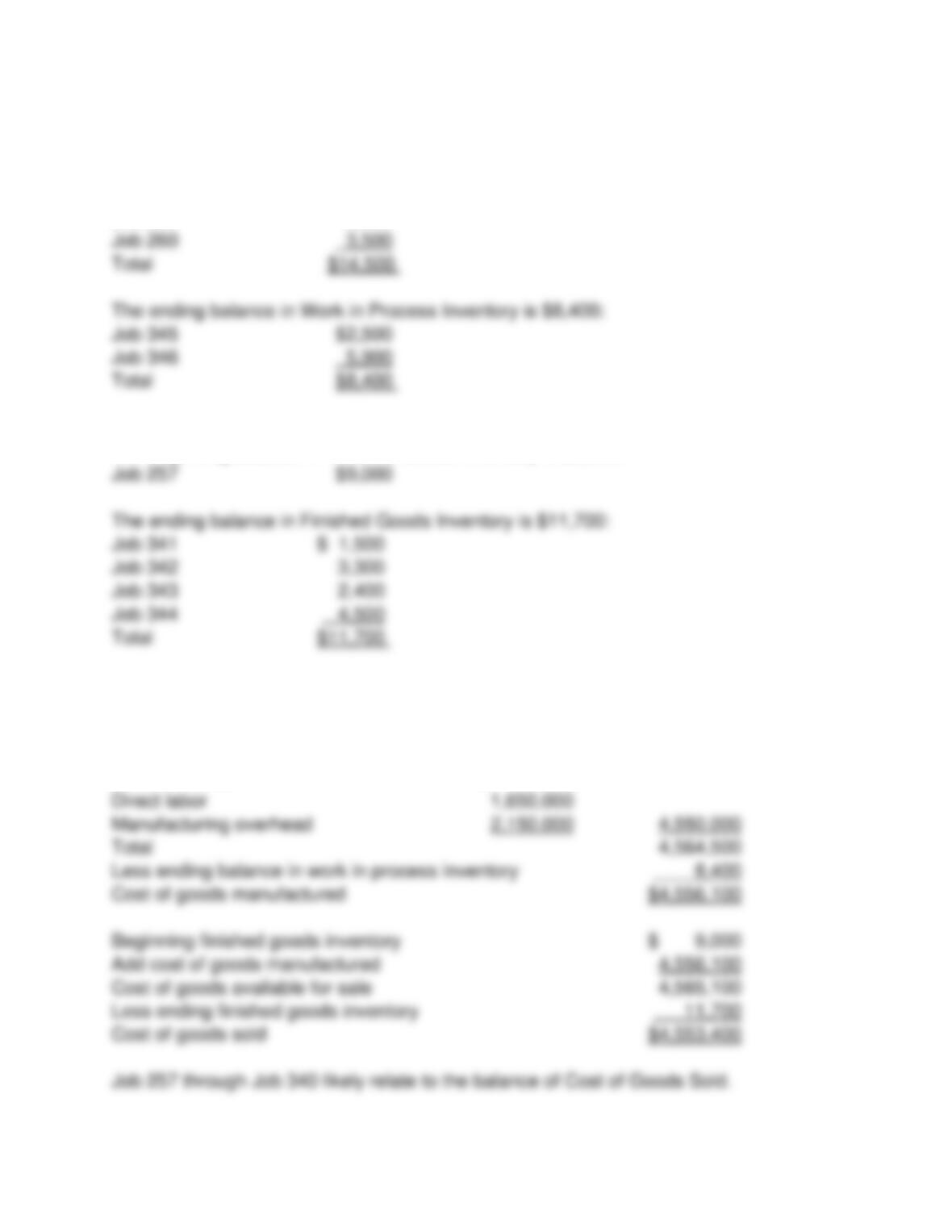
a.
The beginning balance in Work in Process is $14,500:
Job 258 $5,000
Job 259 6,000
b.
The beginning balance in Finished Goods Inventory is $9,000:
c.
Cost of goods sold is determined as follows:
Beginning balance in work in process inventory $ 14,500
Add current manufacturing costs:
Direct material $ 750,000
Jiambalvo Managerial Accounting
2-14
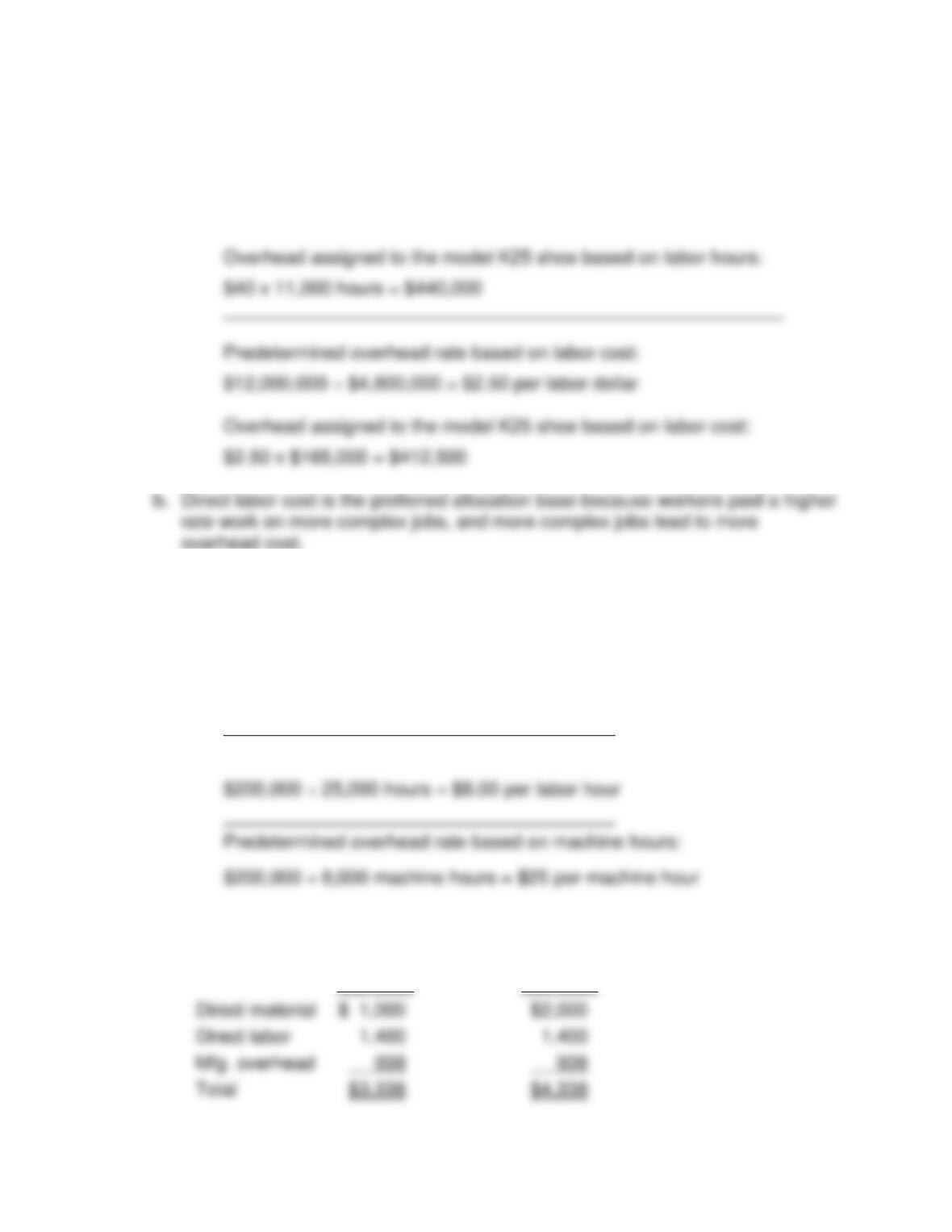
P5. [LO 4, 5]
a. Predetermined overhead rate based on labor hours:
$12,000,000 ÷ 300,000 hours = $40 per labor hour
P6. [LO 4, 5]
a. Predetermined overhead rate based on direct labor cost:
$200,000 ÷ $300,000 labor cost = $0.67 per labor dollar
Predetermined overhead rate based on direct labor hours:
b. Overhead based on labor cost
Job 9823 Job 9824