CASE 2.9
POWDER RIVER PETROLEUM INTERNATIONAL, INC.
Synopsis
Brian Fox, a Canadian with a background in the oil and gas industry, took control of Powder
River in late 2003. Fox became not only the principal stockholder of the small company but also its
CEO and CFO. Prior to Fox’s arrival, Powder River had posted large losses each year. Thanks to a
new strategy implemented by Fox, Powder River became an “overnight” success. Well, not literally.
But in 2006, only three years after Fox assumed control of the company, Powder River posted a $5.7
million net income on total revenues of $13.2 million.
In 2007, Powder River’s “bubble” burst when the company disclosed in its annual Form 10-K
filed with the SEC that there was a “catch” to the working interest sales contracts. The company had
promised to repay the Asian investors their investments in eleven years or less. More specifically,
the sales contracts obligated Powder River to repay, on an annual basis, 9 percent of the purchase
price of each working interest until the investors had fully recovered their investments. Fox had
concealed this critical feature of the sales contracts from the SEC, his fellow stockholders, and his
independent audit firm. By 2007, the company was using the proceeds from new “sales” of working
167
168 Case 2.9 Powder River Petroleum International, Inc.
Powder River Petroleum International, Inc.–Key Facts
1. In 2003, Brian Fox, a Canadian citizen with experience in the oil and gas industry, became the
principal stockholder, CEO, and CFO of Powder River, a small and unprofitable oil and gas
exploration company.
2. Fox quickly “turned around” Powder River by implementing a strategy of selling minority
3. Fox concealed a key feature of the working interest sales contracts from the SEC, his fellow
4. Even after disclosing the 9% repayment clause, Powder River continued to report the working
interest transactions as revenues in its annual financial statements filed with the SEC.
6. The results of the SEC’s investigation and a parallel investigation by the PCAOB revealed
numerous deficiencies in the annual audits of Powder River.
7. The SEC charged that the two partners who supervised the 2004-2007 Powder River audits had
8. The SEC also charged that the two partners failed to discover that Powder River did not own
10. The SEC suspended Powder River’s former audit engagement partners for five years and banned
their audit firm from servicing SEC registrants.
11. The PCAOB prohibited Powder River’s audit firm from auditing public companies, banned one
of the former audit engagement partners from being associated with a PCAOB-registered audit firm
for five years, and permanently banned the other partner from associating with such a firm.
12. In 2010, Powder River’s Chapter 11 bankruptcy petition was converted to a Chapter 7 or
Case 2.9 Powder River Petroleum International, Inc. 169
Instructional Objectives
1. To demonstrate the importance of auditors’ obtaining a thorough understanding of new, large
and/or unusual client transactions.
3. To help students identify fraud risk factors.
Suggestions for Use
This case focuses on several consecutive audits of an oil and gas exploration company. The
case is not highly technical and does not require any background in, or prior knowledge of, the oil
and gas industry. Having said that, the case does revolve around accounting and financial reporting
decisions for “working interests” in oil and gas properties; however, your students will have no
A common caveat that I offer for many of my cases is that they don’t necessarily address every
significant technical accounting, financial reporting, or auditing issue that was relevant in the given
context. That is certainly true for this case. To keep the length of the case manageable, I didn’t
attempt to address every facet of the Powder River debacle. For example, I didn’t address at length
Powder River’s restatement of its quarterly financial statements for the first three quarters of 2007—
which the company bungled, according to the SEC!! If you have an interest in addressing financial
statement restatements and/or “corrections of errors,” you might consider having your students
research this facet of the case.
Suggested Solutions to Case Questions
1. In the PCAOB’s report in which it disciplined CBN, Todd Chisholm, and Troy Nilson (see
PCAOB Release No. 105-2011-003), the agency noted that, “Chisholm and the Firm also failed to
consider, or exercise professional skepticism in evaluating, whether information obtained during the
170 Case 2.9 Powder River Petroleum International, Inc.
audit represented risk factors for fraud.” The report went on to identify the following three specific
items of information that were fraud risk factors:
Notes: Item “c” is not discussed in the case and revolves around the fact that there was conflicting
evidence regarding exactly how the “sales” to the Asian investors were consummated. Certain
“audit evidence” indicated that Fox’s business associate who was involved in arranging the working
interest sales actually purchased the working interests from Powder River and resold them to the
In addition to the three fraud risk factors specifically identified by the PCAOB, there were
clearly other fraud risk factors present during the Powder River audit engagements. The appendix,
“Examples of Fraud Risk Factors,” that follows AU Section 316 in the PCAOB’s Interim Standards
categorizes fraud risk factors into the three “angles” of the fraud triangle. Following are paraphrased
versions of selected fraud risk factors from that appendix that were particularly relevant to the
Powder River audits.
Incentives/Pressures:
—High degree of competition (the oil and gas industry is very competitive—this is especially true for
“small–time” oil and gas firms such as Powder River)
Case 2.9 Powder River Petroleum International, Inc. 171
predisposed to “following rules”
2. This question can be addressed without requiring your students to explore the sometimes tedious
accounting and financial reporting rules for oil and gas companies. In fact, the proper accounting for
the sales of the working interests and the guaranteed payments to the Asian investors was not
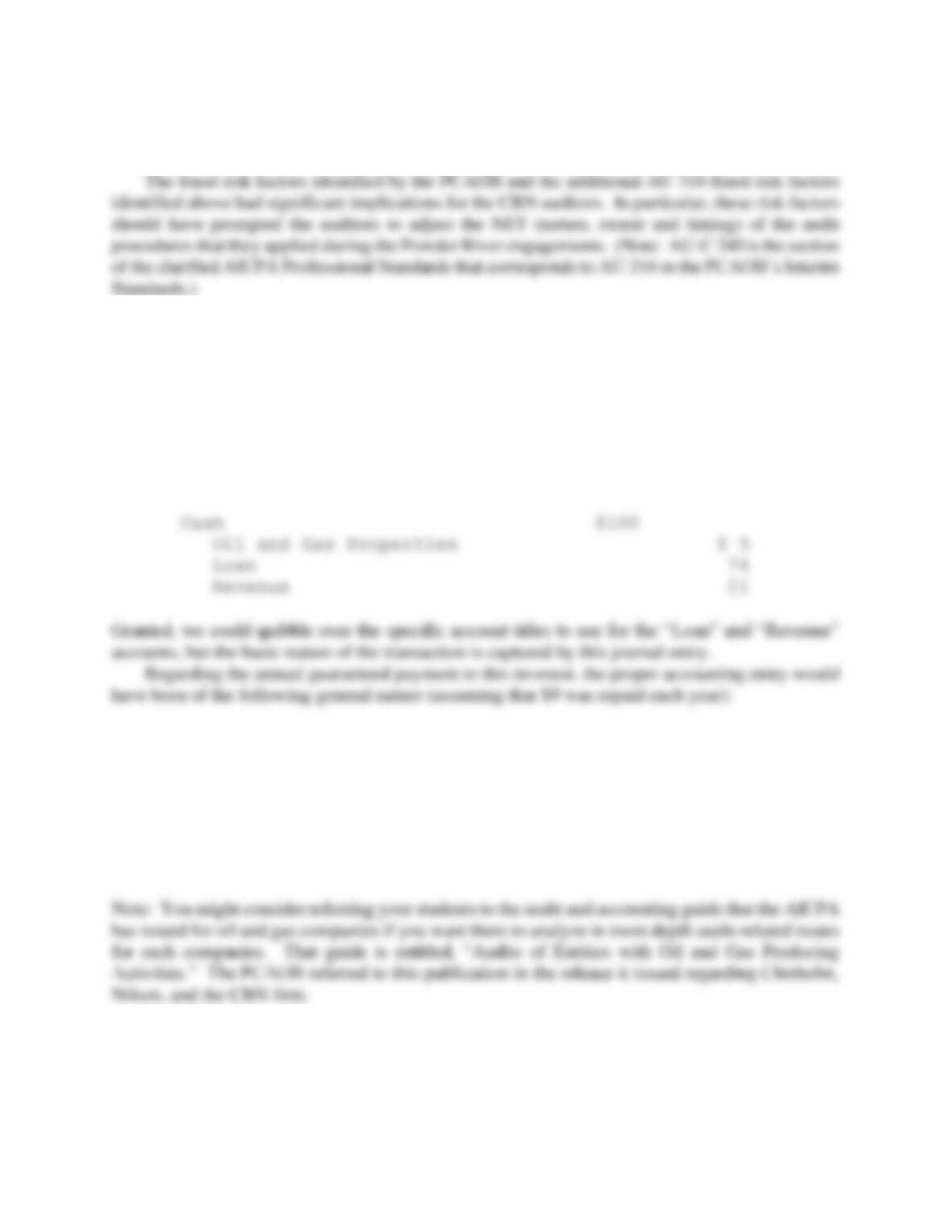
particularly challenging. Assume, for example, that Powder River “sold” a working interest to an
investor for $100 for which it was paid immediately. [Note: the impact of the sales commissions on
the transactions will be ignored.] Also, assume that the cost basis of the working interest was $5.
Finally, assume that the net present value of the guaranteed (9%) annual payments to the investors
was $74. The proper accounting entry for this transaction would have been:
Loan $5
Interest Expense 4
Cash $9
Of course, the “divvying up” of the $9 between Loan and Interest Expense would be a mathematical
exercise. Likewise, the amount debited to each account over the 11-year repayment period would
change annually.
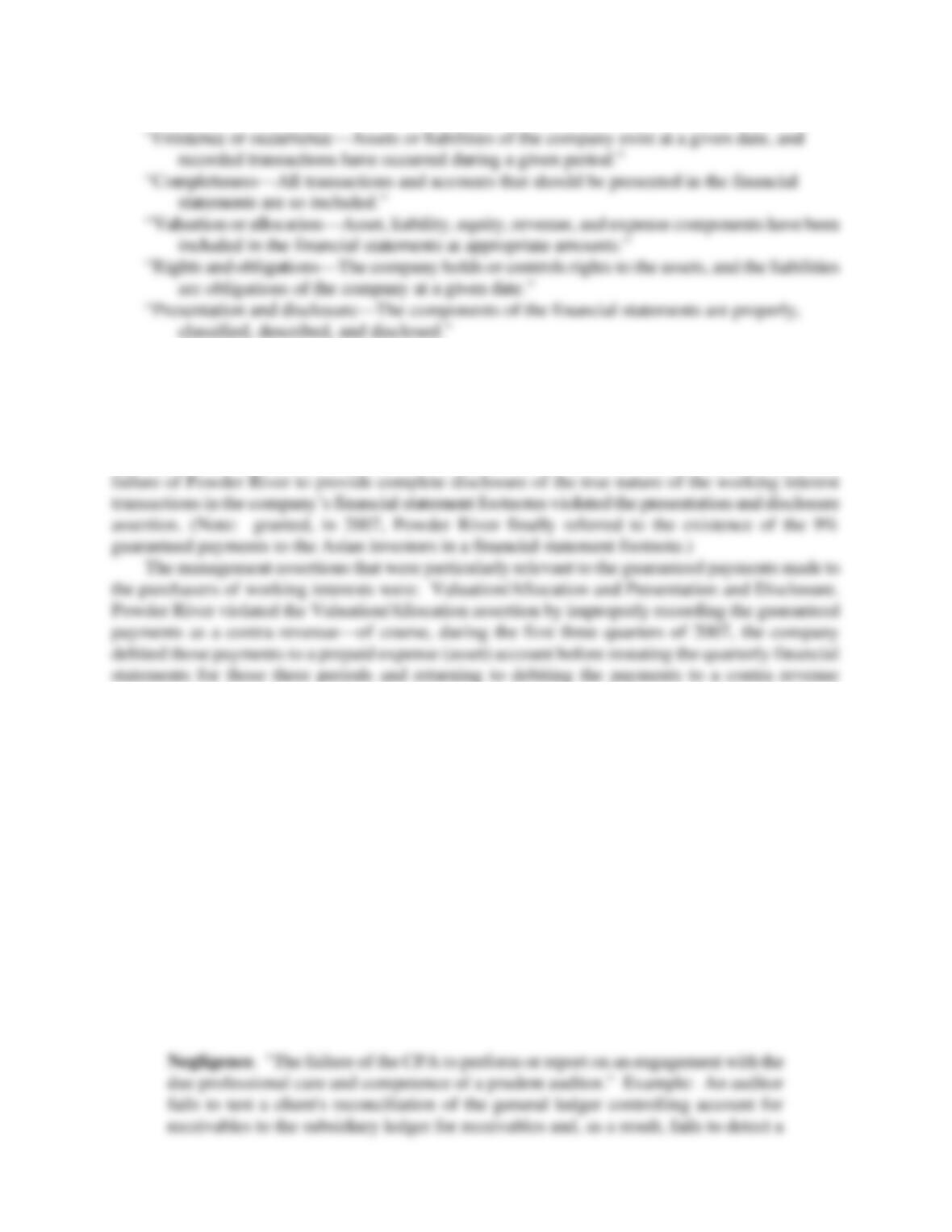
3. PCAOB Auditing Standard No. 15, “Audit Evidence,” identifies five general categories of
management assertions embedded in any given set of financial statements: existence/occurrence,
completeness, valuation/allocation, rights and obligations, and presentation and disclosure (see AS
No. 15, paragraph 11):
172 Case 2.9 Powder River Petroleum International, Inc.
The management assertions that were particularly relevant to the “sales” of working interests to
the Asian investors were: Completeness, Valuation or Allocation, and Presentation and Disclosure.
Powder River violated the completeness assertion by not recording the liabilities stemming from
those transactions. Likewise, the company failed to record the revenues resulting from those
transactions in the proper amounts and thus violated the valuation/allocation assertion. Finally, the
account. (Note: of course, this latter accounting treatment was patently wrong, as pointed out by the
SEC.) The company violated the Presentation and Disclosure assertion for the guaranteed payments
by failing to disclose them prior to 2007. As noted in a footnote to the case, Powder River also
improperly referred to the guaranteed payments as a “future commitment” rather than a current and
ongoing commitment.” (Note: Within the clarified AICPA Professional Standards, the management
assertions that underlie the audit objectives developed for specific audit engagements are discussed
in AU-C Section 315.A114. Of course, the AICPA’s assertion “list” includes 13 items that were
derived from the “original” five assertions introduced in the “old” AICPA Professional Standards.
Those “old” assertions are retained in the PCAOB’s Interim Standards.)
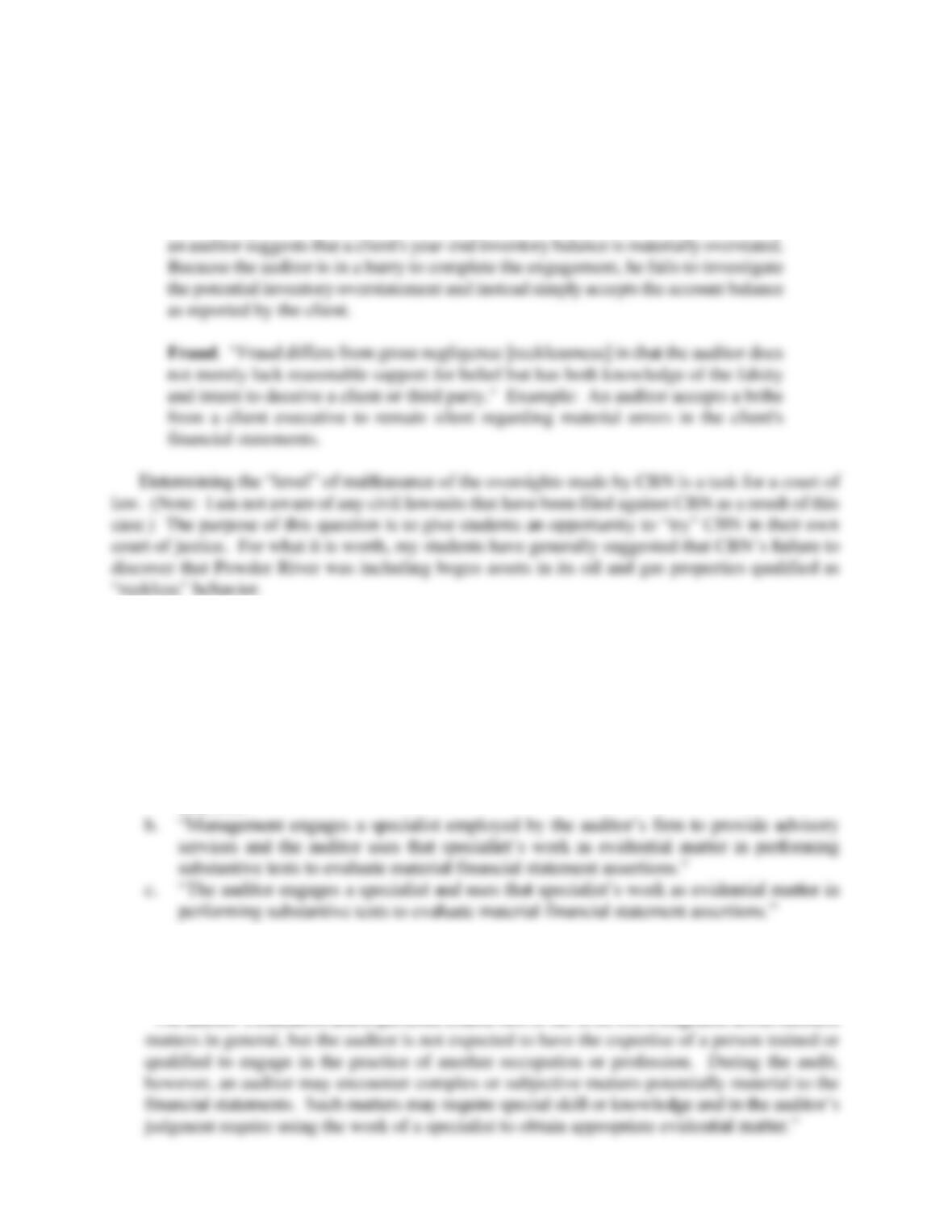
4. The definitions of negligence, recklessness, and fraud presented here are found in the following
source: D.M. Guy, C.W. Alderman, and A.J. Winters, Auditing, Fifth Edition (San Diego:
Dryden, 1999), 85-86.
Case 2.9 Powder River Petroleum International, Inc. 173
material overstatement of the general ledger controlling account.
Recklessness (a term typically used interchangeably with gross negligence and
constructive fraud). “A serious occurrence of negligence tantamount to a flagrant or
reckless departure from the standard of due care.” Example: Evidence collected by
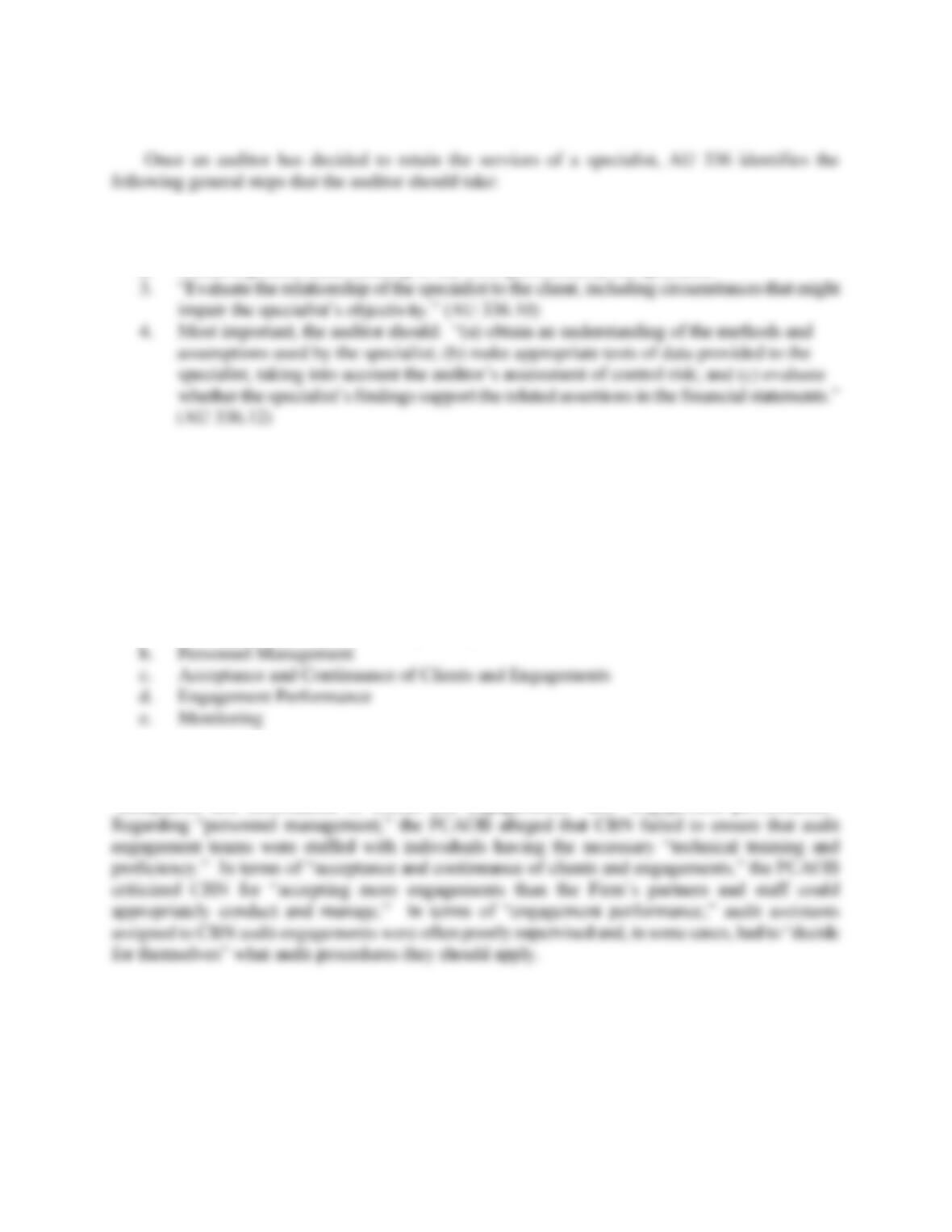
5. Paragraph .03 of AU Section 336, “Using the Work of a Specialist,” of the PCAOB’s Interim
Standards identifies the following three scenarios when auditors should consider retaining the
services of an independent expert during the course of an audit engagement. (Note: AU-C Section
620, “Using the Work of an Auditor’s Specialist,” is very similar but not identical to the PCAOB’s
version of that section, that is, AU 336.)
a. “Management engages or employs a specialist and the auditor uses that specialist’s work as
evidential matter in performing substantive tests to evaluate a material financial statement
assertion.”
The first scenario was relevant to the CBN auditors during their audits of Powder River.
Paragraph .06 of AU 336 provides the following general guidance for auditors to follow in deciding
whether the services of a specialist (of their own) should be retained in that scenario:
174 Case 2.9 Powder River Petroleum International, Inc.
1. Review the qualifications of the specialist to determine whether he or she “possesses the
necessary skill or knowledge in the particular field.” (AU 336.08)
2. Obtain a general understanding of the work performed by the specialist.
6. QC Section 20, “System of Quality Control for a CPA Firm’s Accounting and Auditing
Practice” in the PCAOB’s Interim Standards provides an overview of the nature and purpose of a
CPA firm’s quality control system. (Note: the quality control standards are somewhat different for
private company auditors. See the “QC” sections of AICPA Professional Standards, Volume 3.]
QC 20.07 identifies the following five elements of quality control for a CPA firm registered with the
PCAOB:
a. Independence, Integrity, and Objectivity
In the PCAOB’s report focusing on CBN, the agency criticized the audit firm’s quality control
system with regard to three of the quality control elements, namely, “personnel management,”
“acceptance and continuance of clients and engagements,” and “engagement performance.”