Ethical Obligations and Decision Making in Accounting, 4/e 1
Case 2-7 Milton Manufacturing Company
Milton Manufacturing Company produces a variety of textiles for distribution to wholesale
manufacturers of clothing products. The company’s primary operations are located in Long
Island City, New York, with branch factories and warehouses in several surrounding cities.
Milton Manufacturing is a closely held company, and Irv Milton is the president. He started the
business in 2005, and it grew in revenue from $500,000 to $5 million in 10 years. However, the
revenues declined to $4.5 million in 2015. Net cash flows from all activities also were declining.
The company was concerned because it planned to borrow $20 million from the credit markets in
the fourth quarter of 2016.
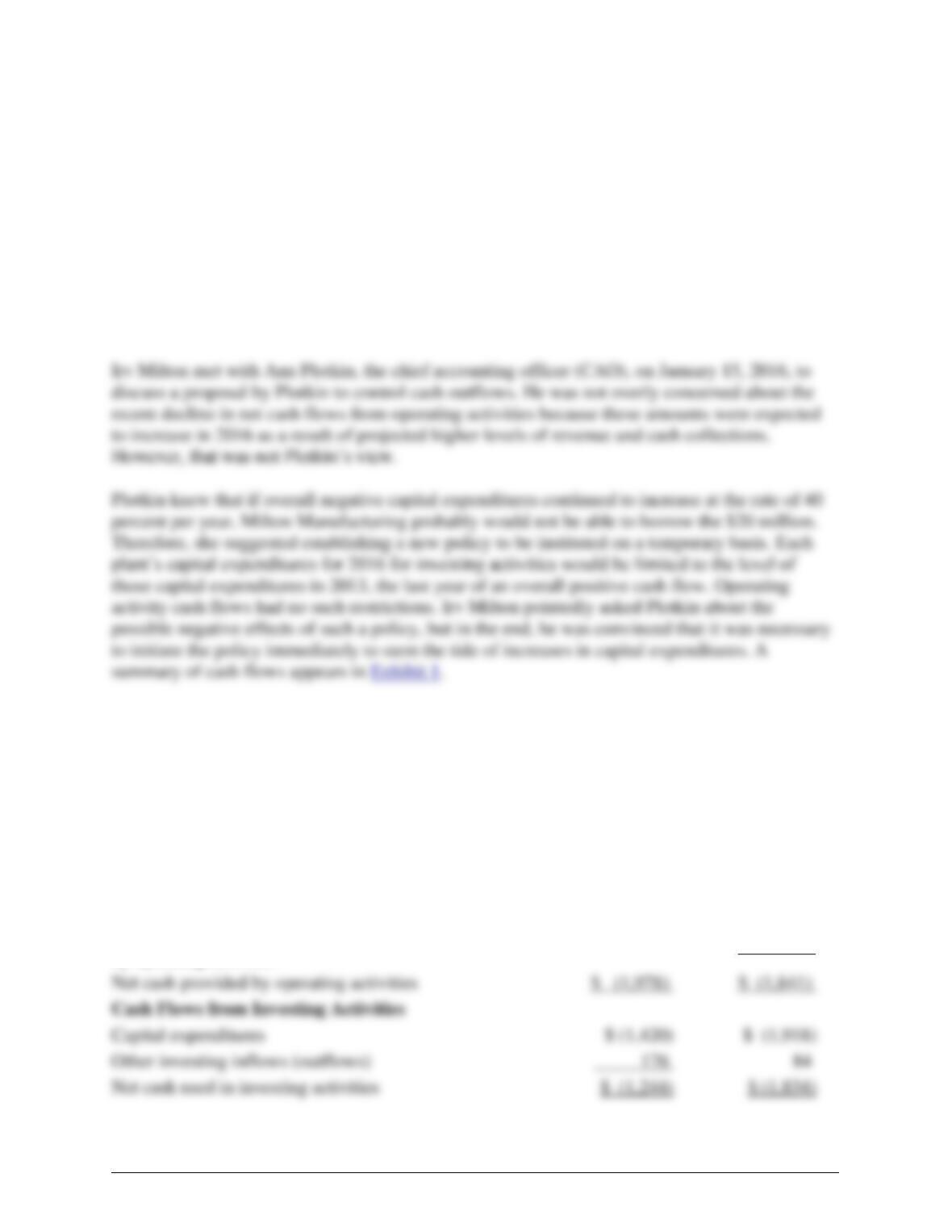
EXHIBIT 1
MILTON MANUFACTURING COMPANY
Summary of Cash Flows
For the Years Ended December 31, 2015 and 2014 (000 omitted)
December 31,
2015
December 31,
2014
Cash Flows from Operating Activities
Net income
$ 372
$ 542
Adjustments to reconcile net income to net cash provided
by operating activities
(2,350)
(2,383)
Net cash provided by operating activities
Cash Flows from Investing Activities
Capital expenditures
Other investing inflows (outflows)
Net cash used in investing activities
Ethical Obligations and Decision Making in Accounting, 4/e 2
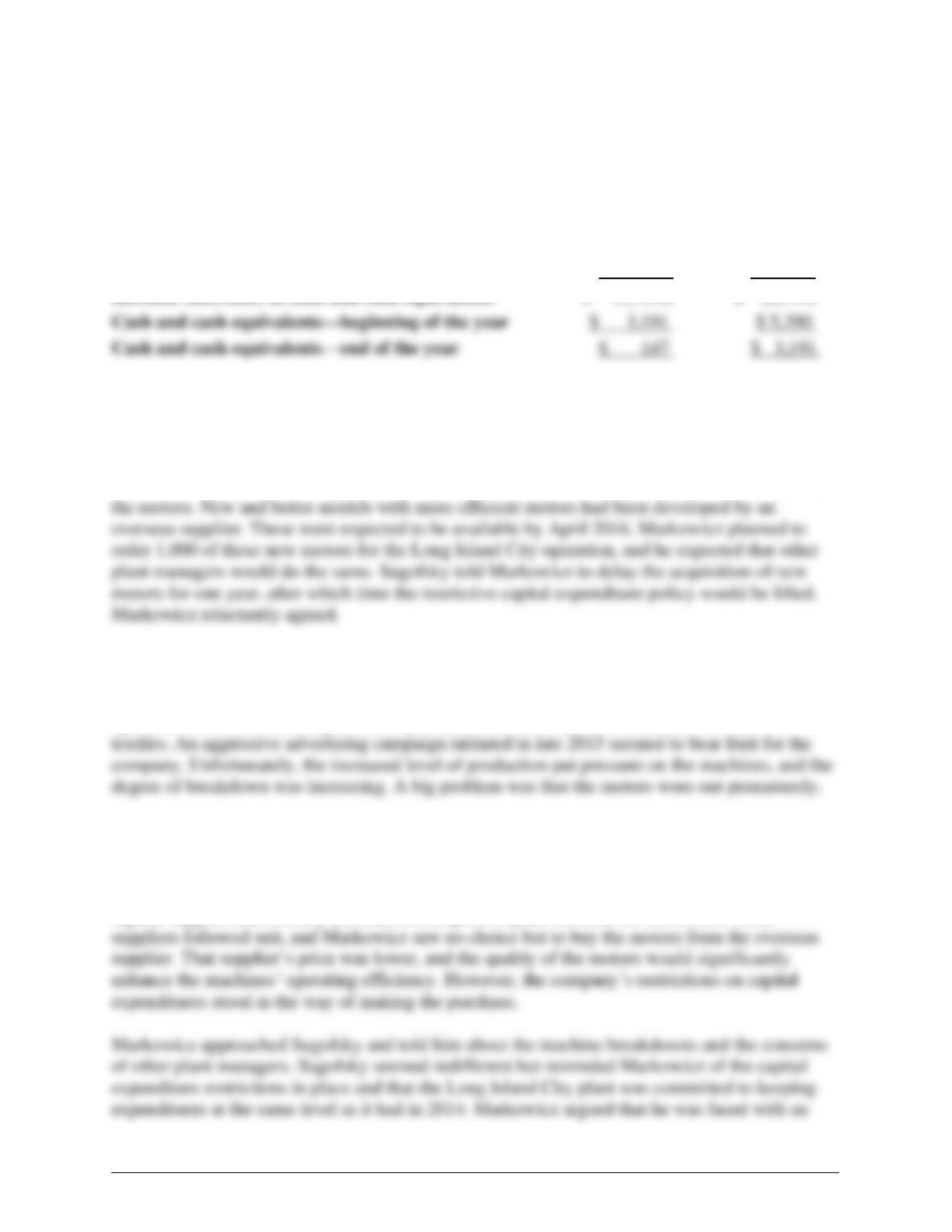
EXHIBIT 1
MILTON MANUFACTURING COMPANY
Summary of Cash Flows
For the Years Ended December 31, 2015 and 2014 (000 omitted)
Cash Flows from Financing Activities
Net cash provided (used in) financing activities
$ 168
$ 1, 476
Increase (decrease) in cash and cash equivalents
$ (3, 054)
$ (2,199)
Sammie Markowicz is the plant manager at the headquarters in Long Island City. He was
informed of the new capital expenditure policy by Ira Sugofsky, the vice president for
operations. Markowicz told Sugofsky that the new policy could negatively affect plant
operations because certain machinery and equipment, essential to the production process, had
been breaking down more frequently during the past two years. The problem was primarily with
Milton Manufacturing operated profitably during the first six months of 2016. Net cash inflows
from operating activities exceeded outflows by $1,250,000 during this time period. It was the
first time in two years that there was a positive cash flow from operating activities. Production
operations accelerated during the third quarter as a result of increased demand for Milton’s
Markowicz was concerned about the machine breakdown and increasing delays in meeting
customer demands for the shipment of the textile products. He met with the other branch plant
managers, who complained bitterly to him about not being able to spend the money to acquire
new motors. Markowicz was very sensitive to their needs. He informed them that the company’s
regular supplier had recently announced a 25 percent price increase for the motors. Other
Cash and cash equivalents—beginning of the year
Cash and cash equivalents—end of the year
$ 147
$ 3,191
Ethical Obligations and Decision Making in Accounting, 4/e 3
unusual situation and he had to act now. Sugofsky hurriedly left, but not before he said to
Markowicz, “You and I may not agree with it, but a policy is a policy.”
Markowicz reflected on his obligations to Milton Manufacturing. He was conflicted because he
viewed his primary responsibility and that of the other plant managers to ensure that the
production process operated smoothly. The last thing the workers needed right now was a
stoppage of production because of machine failure.
Markowicz made the purchase at the beginning of the fourth quarter of 2016 without informing
Sugofsky. He convinced the plant accountant to record the $1.5 million expenditure as an
operating (not capital) expenditure because he knew that the higher level of operating cash
inflows resulting from increased revenues would mask the effect of his expenditure. In fact,
Markowicz was proud that he had “saved” the company $1.5 million, and he did what was
necessary to ensure that the Long Island City plant continued to operate.
Wald reported her findings to Ann Plotkin, and together they went to see Irv Milton. After being
informed of the situation, Milton called in Sugofsky. When Wald told him about her findings,
Sugofsky’s face turned beet red. He told Wald that he had instructed Markowicz not to make the
purchase. He also inquired about the accounting since Wald had said it was wrong.
Ethical Obligations and Decision Making in Accounting, 4/e 4
Case Overview
This case deals with a company’s efforts to manage its short-term earnings and cash outflows by
restricting capital expenditures.
Top managements’ decision to restrict capital expenditures created a conflict for Sammie
Markowicz, the plant manager at the headquarters location in Long Island City. On the one hand,
Markowicz knows that the company expects him to follow company policy. On the other hand,
he is very conscious of his primary responsibility to keep the production process operating as
efficiently as possible. Markowicz was placed in a difficult position because of the capital
Some students may argue that Markowicz did the right thing; he saved the company a lot of
money; kept the production process flowing; and best served customer needs. All of this is true
but Markowicz’s ethics were situational and the problem is what if another employee/manager
decides in the future to take matters into his own hands, regardless of company policy, and make
a decision that may be in his best interests without considering all stakeholder interests. The
Questions
Ethical Obligations and Decision Making in Accounting, 4/e 5
Use the Integrated Ethical Decision-Making Process discussed in the chapter to help you assess
the following:
1. Identify the ethical and professional issues of concern to Beverly Wald as the chief
internal auditor and a CPA.
The ethical and professional issues for Beverly Wald are the recording, integrity, due
care, transparency and fair disclosure of accounting transactions and the resulting
financial statements. There could be question of whether the bank would have made the
loan if the proper accounting treatment had been reflected in the financial statements.
Markowicz convinced the plant accountant to treat the expenditure as an operating
2. Who are the stakeholders in this case and what are their interests?
The stakeholders in this case are Milton, shareholders, Wald, Plotkin, Sugofsky,
Markowicz, other plant managers, the plant accountants and other employees. Other
stakeholders include Second Bankers Hours & Trust Co., creditors, customers, the
communities where the plants are located, and the public. Milton and the shareholders
3. Identify alternative courses of action for Wald, Plotkin, and Sugofsky to present in
their meeting with Milton. How might these alternatives affect the stakeholder
interests?
Wald, Plotkin, and Sugofsky may consider the following alternatives. (1) The company
can pretend that management did not know or notice the violation of the policy. This
Ethical Obligations and Decision Making in Accounting, 4/e 6
to have worked for good, no need to take any other action, or the ends justified the means
of breaking policies. The company could counsel Markowicz to not do it again. (2) The
company could restate the financial statements. This would be supported by virtue
theory. Once the company makes the restatement, it should inform the lender. Further
(3) the company could decide to publicly punish Markowicz to temper any future
insubordination. The punishment could range from a reprimand to being fired. This
alternative would be supported by rule-utilitarianism. Rights Theory would also support
4. If you were in Milton’s place, which of the alternatives would you choose and why?
Being in Milton’s place, alternative (2) of restating the financial statements and letting
the lender know should be chosen. Further the punishment of Markowicz and Sugofsky
should be considered to set an ethical tone in the firm.
Still, the company has to examine its own behavior – unbending policies – and lack of
effective communication. Employees should feel comfortable to bring matters to their