
o Depending on the business and strategic environment of the firm, it is possible to
construct financial statements around activities related to quality, environmental
compliance, or new product development.
SUMMARY
• Exhibit 2.16 provides a summary of cost terms and definitions.
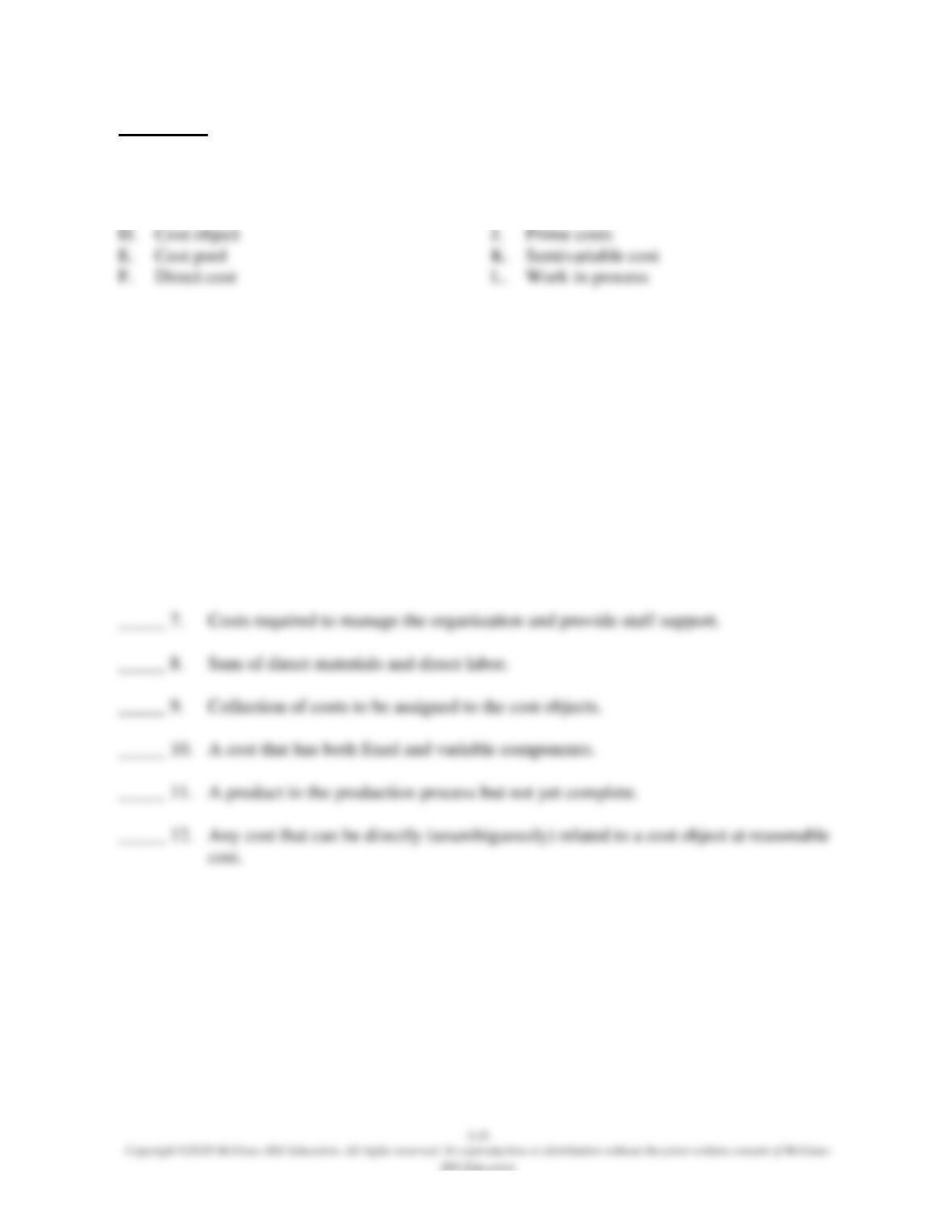
Matching
A.
Administrative costs
G.
Full absorption cost
B.
Conversion costs
H.
Indirect cost
C.
Cost allocation
I.
Opportunity cost
D.
Cost object
Prime costs
Cost pool
K.
Semivariable cost
Direct cost
Work in process
_____ 1. The foregone benefit from the best (forgone) alternative course of action.
_____ 2. Sum of direct labor and manufacturing overhead.
_____ 3. All variable and fixed manufacturing costs; used to compute a product’s inventory
value under GAAP.
_____ 4. The process of assigning indirect costs to products, services, people, business units,
etc.
_____ 5. Any cost that cannot be directly related to a cost object.
_____ 6. Any end to which a cost is assigned.
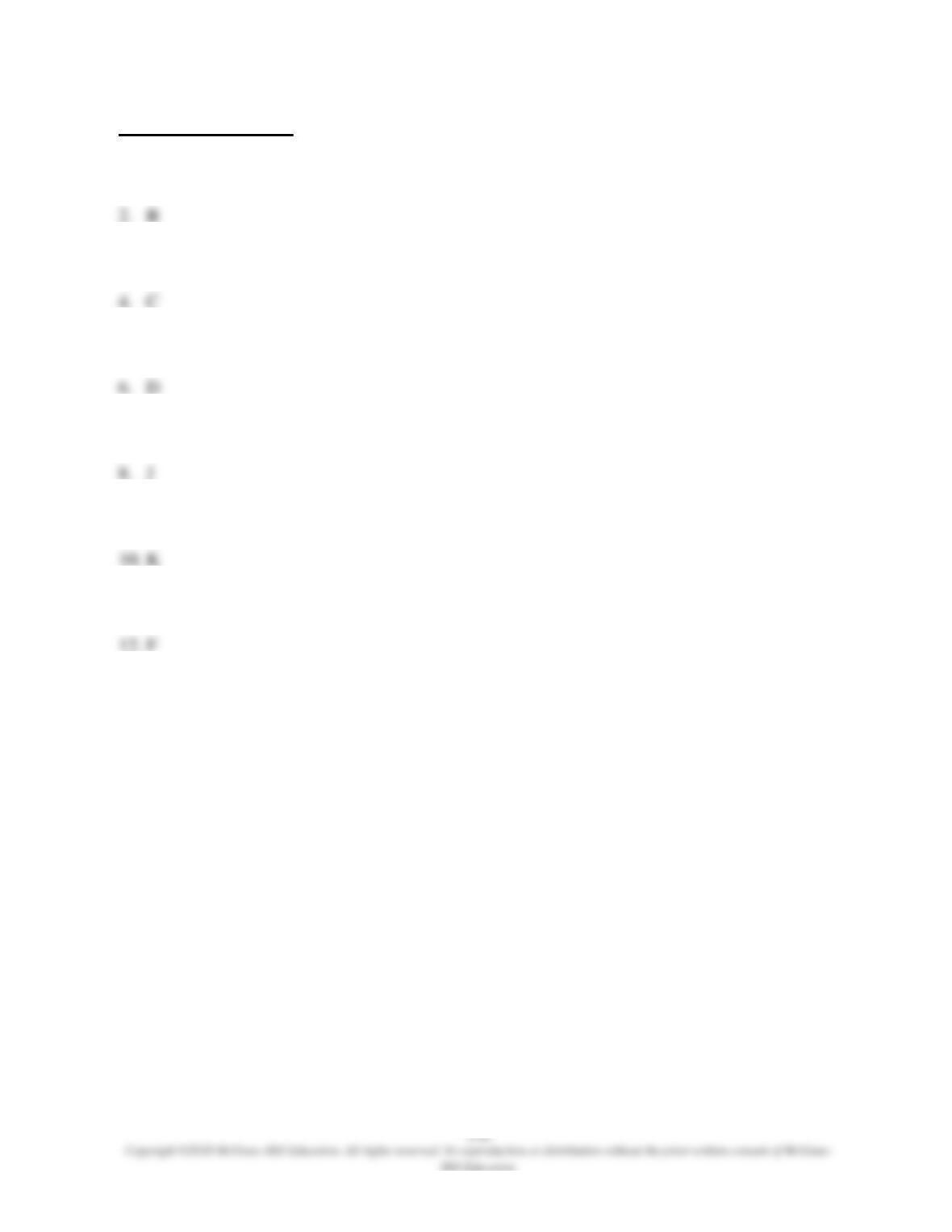
Matching Answers
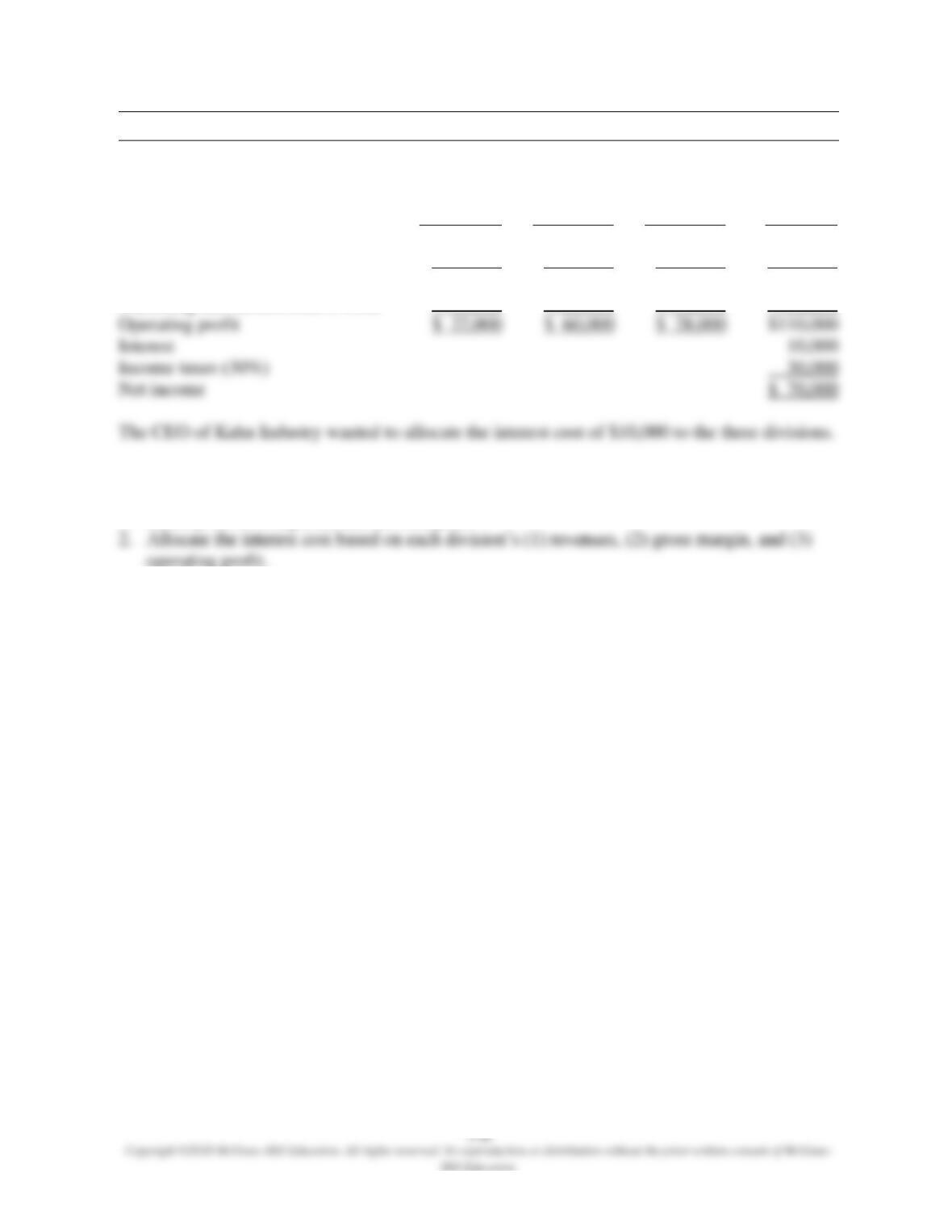
1. I
3. G
5. H
7. A
9. E
11. L
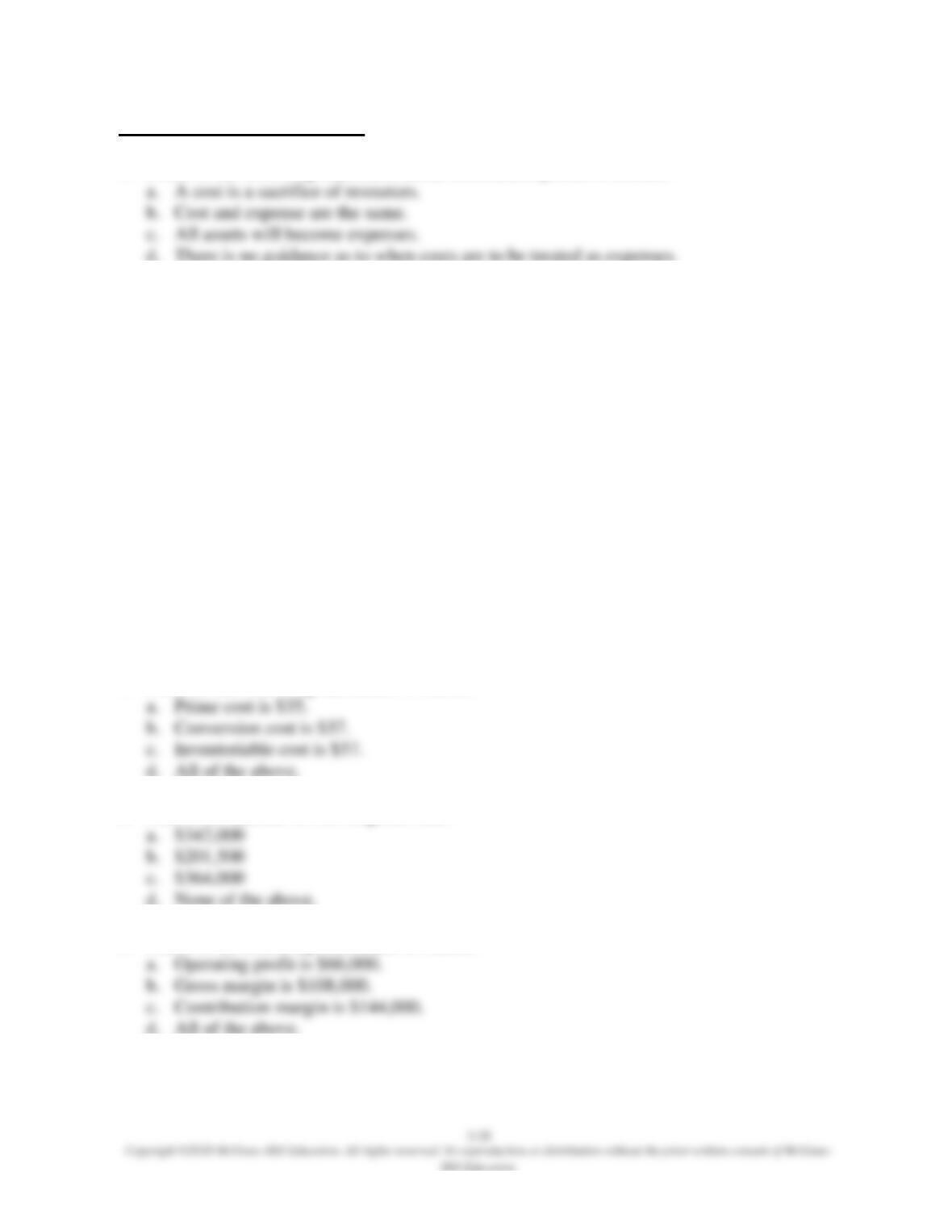
Multiple Choice Questions
1. Which of the following statements about costs and expenses is correct?
2. A cost of goods sold statement for a retail business:
a. includes transportation-in costs.
b. has a cost of goods manufactured section.
c. covers a period of time.
d. Both a and c.
3. A period cost:
a. is also known as manufacturing cost.
b. includes both marketing and administrative costs.
c. will be expensed when products are sold.
d. is part of cost of goods sold.
Use the following information to answer questions 4 through 7:
A product is sold for $75 each with unit cost of direct materials $20, direct labor $15, variable
manufacturing overhead $12, and fixed manufacturing overhead $10. The volume produced and
sold is 6,000 units. Variable and fixed marketing and administrative costs are $4 and $3,
respectively.
4. Which of the following statements is correct?
5. What is the amount of cost of goods sold?
6. Which of the following statements is correct?
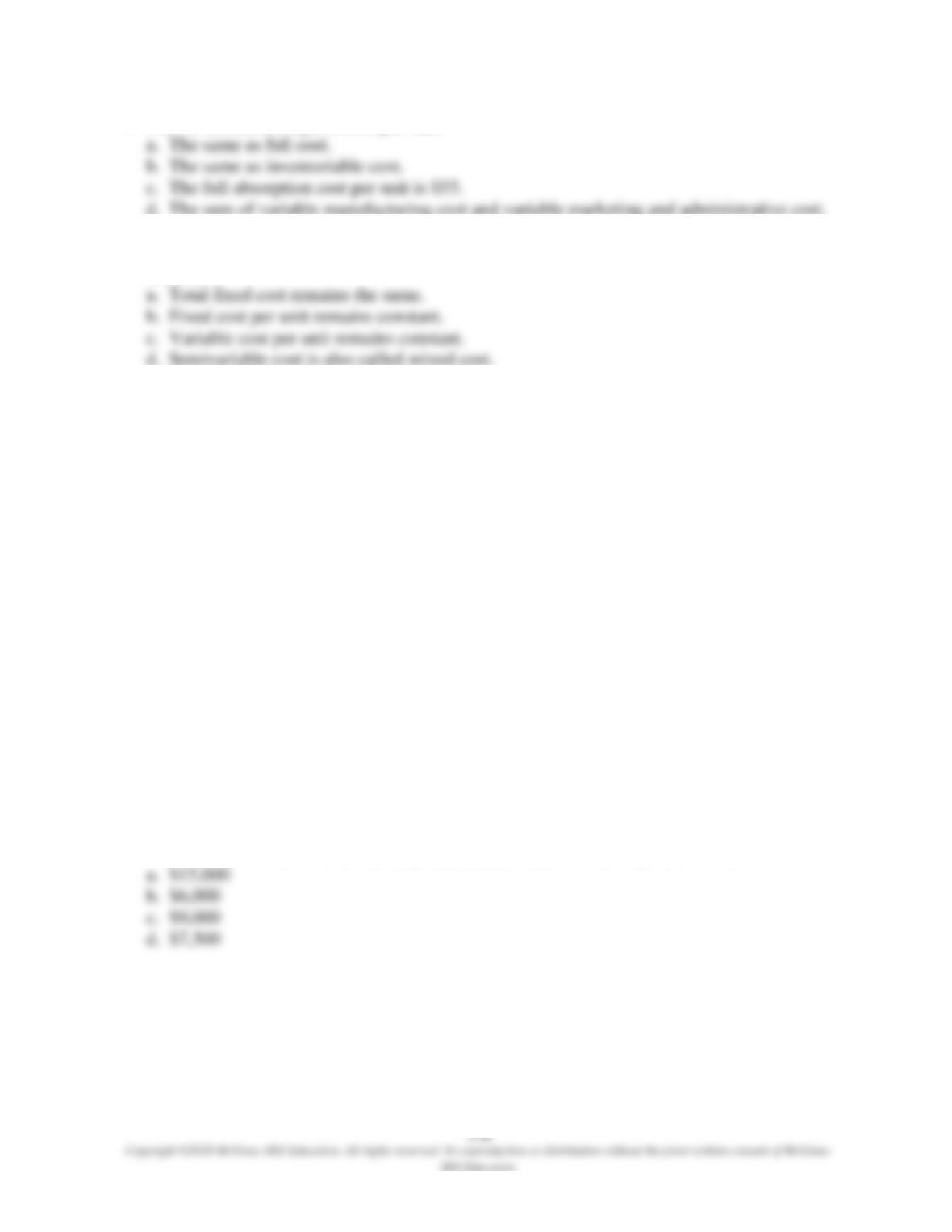
7. What is the full absorption cost per unit?
8. Which of the following statements regarding cost behavior within the relevant range is
incorrect?
9. Unit fixed cost:
a. is treated as variable cost when allocated to each unit.
b. can be used for decision making under any circumstances.
c. is misleading as the total fixed cost does not change.
d. Both a and c.
10. A value income statement:
a. is developed for managerial decision making.
b. distinguishes between value-added and nonvalue-added activities.
c. is governed by GAAP.
d. Both a and b.
11. Which of the following statements is correct?
a. A cost object is any end to which a cost is assigned.
b. A cost pool is the collection of costs to be assigned to the cost objects.
c. A cost flow diagram is a diagram illustrating the cost allocation process.
d. All of the above.
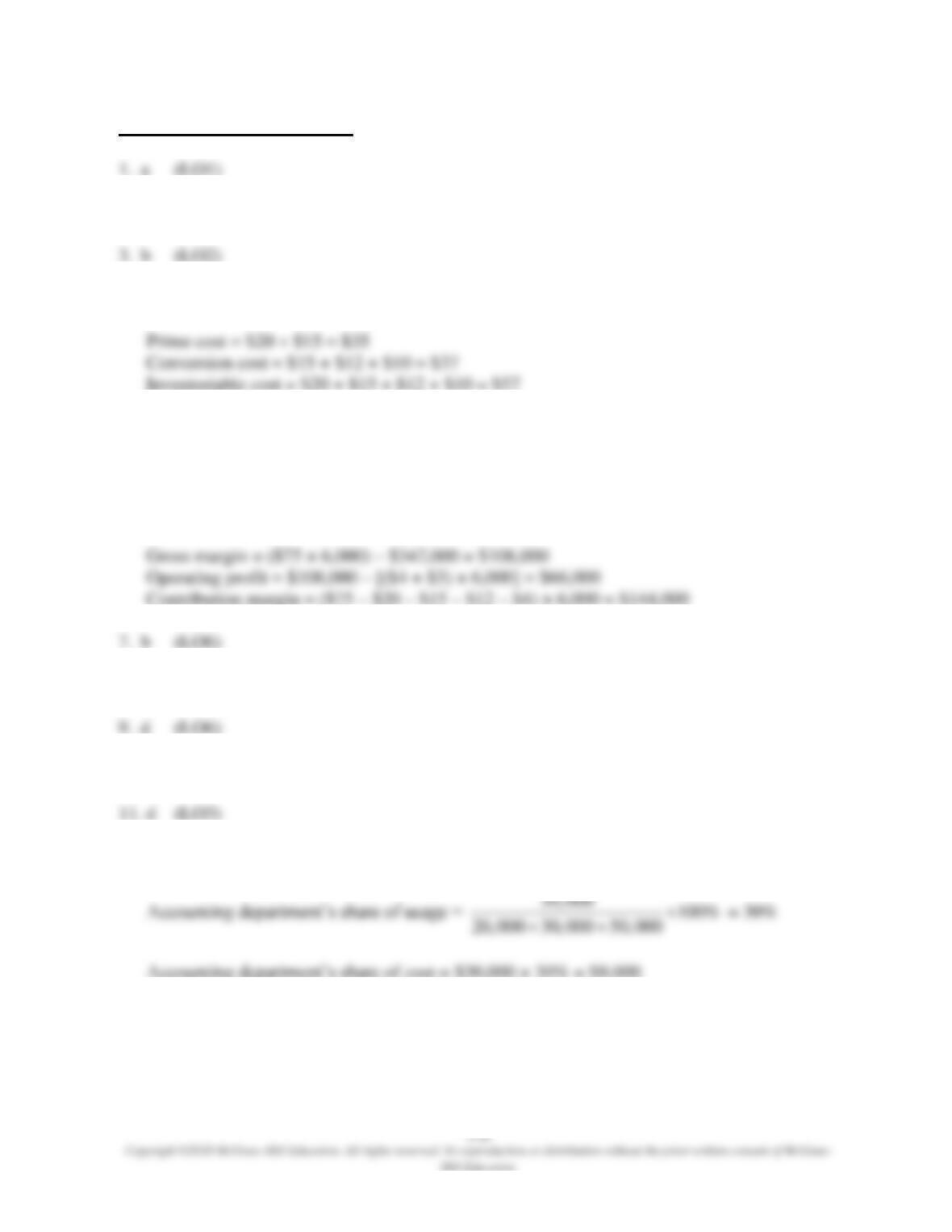
12. The annual operating expense of running a copy center is shared by the three departments
that use its service: Human resource, Accounting, and Legal. Last year, the copy center
incurred $30,000 while HR copied 20,000 pages, Accounting 30,000 pages, and Legal
50,000 pages. What was Accounting department’s share of the copy center cost?
Multiple Choice Answers
2. d (LO2)
4. d (LO4)
5. a (LO4)
$57 × 6,000 = $342,000
6. d (LO4, LO7)
8. b (LO5)
10. d (LO7)
12. c (LO3)

Demonstration Problem 1
A developer plans to buy a parcel of land and construct an office building on top of it. He
narrows his search to two possible lots in adjacent states with convenient access to highways.
The expected returns from Lots C and D are $190,000 and $210,000, respectively.
Required:
What is the opportunity cost of funds the developer uses to purchase Lot D?

Demonstration Problem 1 – Solution
The opportunity cost of funds the developer uses to purchase Lot D is the forgone return the
developer could have earned from purchasing Lot C, assuming that both investments are equal
in risk and liquidity.
Demonstration Problem 2
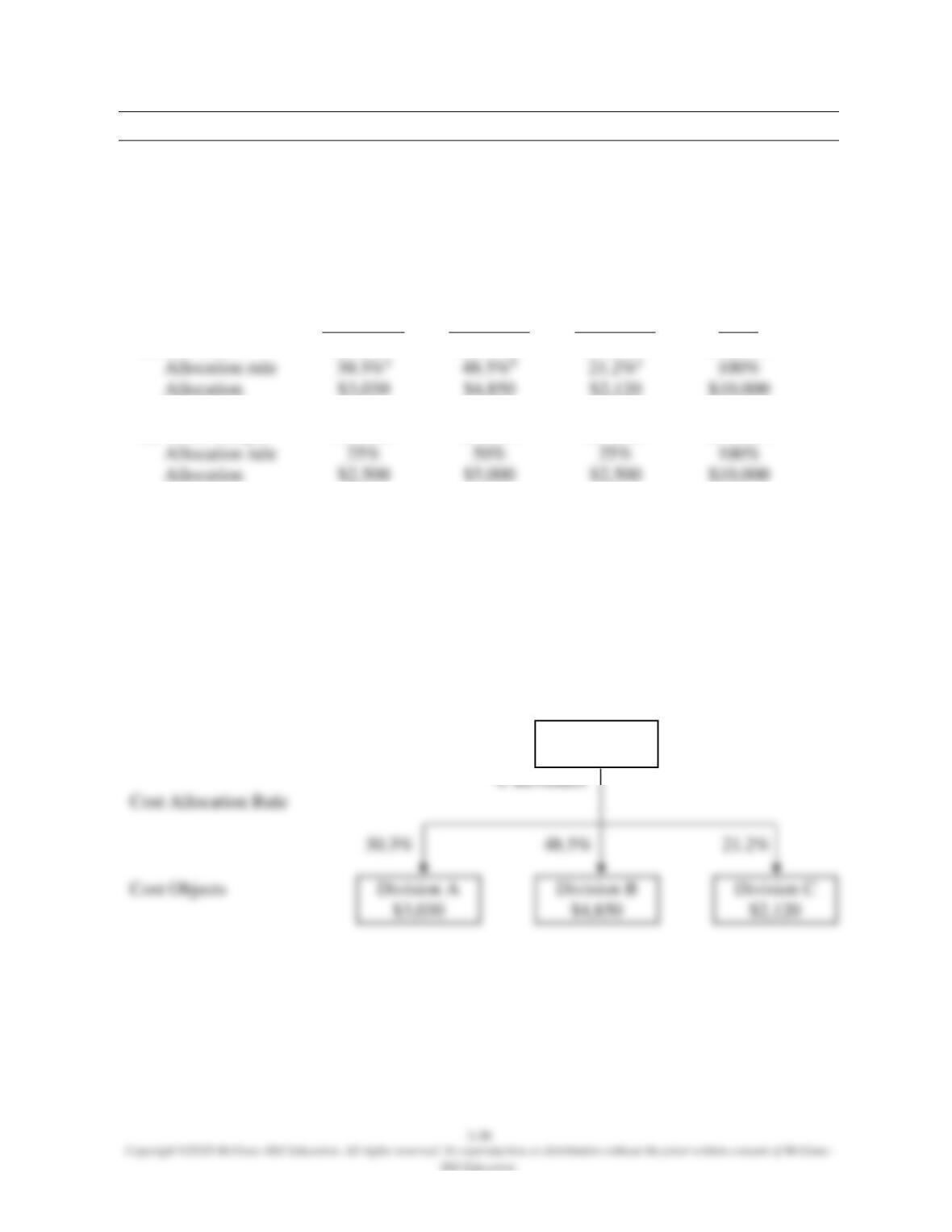
Kahn Industry, Inc. has three divisions. The following information was available for last quarter.
Division A
Division B
Division C
Company
Revenues
$200,000
$320,000
$140,000
$660,000
Cost of goods (or services) sold
160,000
240,000
100,000
500,000
Gross margin
$240,000
$ 80,000
$ 40,000
$160,000
Marketing and administrative costs
18,000
20,000
12,000
50,000
Operating profit
$ 22,000
$ 60,000
$ 28,000
$110,000
Interest
Income taxes (30%)
30,000
Net income
$ 70,000
Required:
1. Identify the cost object(s) and the cost pool.
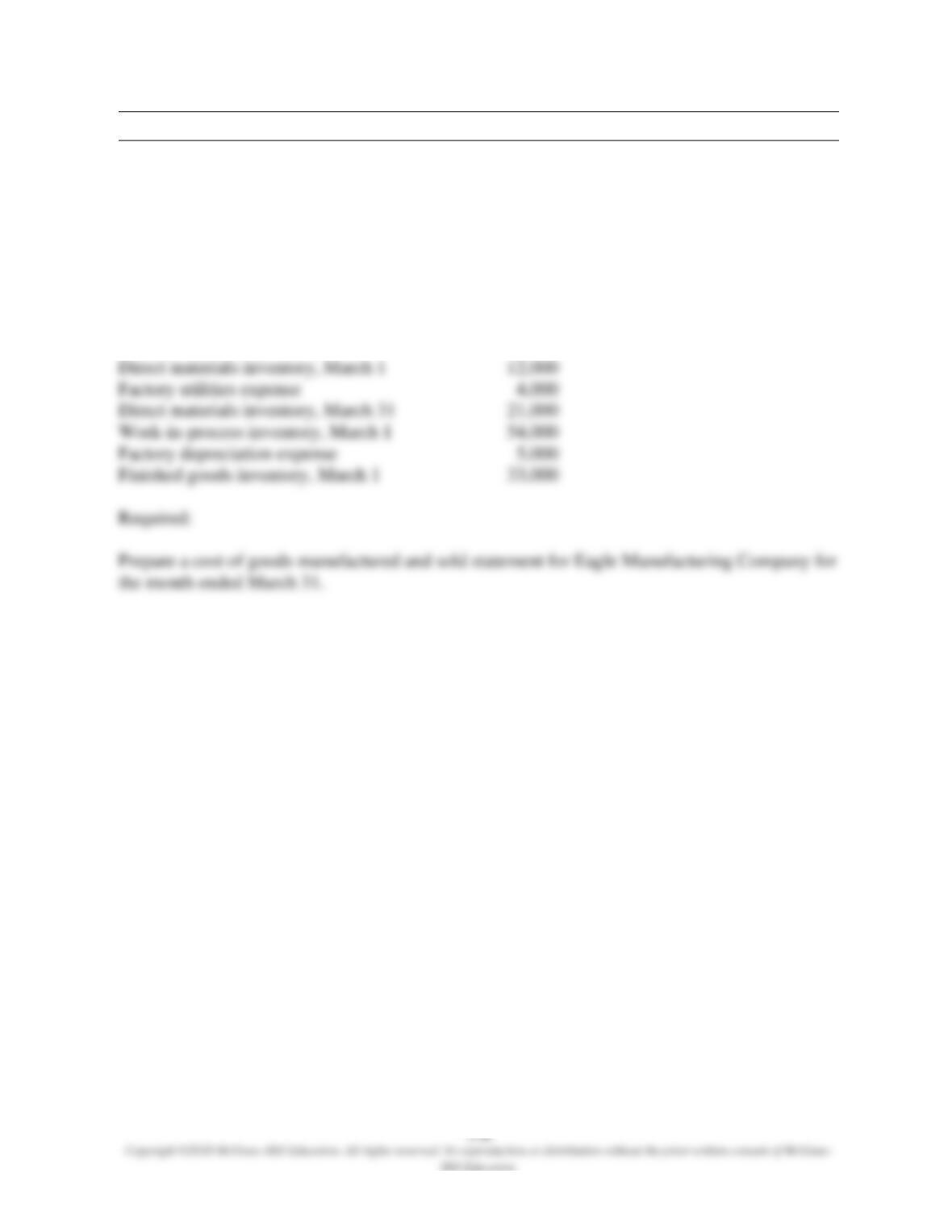
3. Draw a cost flow diagram assuming the allocation of interest cost is based on revenues.
Demonstration Problem 2 – Solution
Part 1
The cost objects are the three divisions; the cost pool is the interest cost incurred for the
company as a whole.
Part 2
Division A
Division B
Division C
Total
(1) Revenues
$200,000
$320,000
$140,000
$660,000
Allocation rule
100%
Allocation
$3,030
$4,850
$2,120
$10,000
(2) Gross margin
$40,000
$80,000
$40,000
$160,000
Allocation rule
100%
Allocation
$2,500
$5,000
$2,500
$10,000
(3) Operating profit
$22,000
$60,000
$28,000
$110,000
Allocation rule
20.0%
54.5%
25.5%
100%
Allocation
$2,000
$5,450
$2,550
$10,000
a $200,000 ÷ $660,000 = 0.303, or 30.3%.
b $320,000 ÷ $660,000 = 0.485, or 48.5%.
c $140,000 ÷ $660,000 = 0.212, or 21.2%.
Part 3
Cost Pool
Interest cost
$10,000
30.3%
48.5%
21.2%
Demonstration Problem 3
The account balances are listed below for Eagle Manufacturing Company for the month of
March.
Finished goods inventory, March 31
$29,000
Direct materials purchases
70,000
Indirect labor
21,000
Direct labor
48,000
Work-in-process inventory, March 31
73,000
Factory supervisory salaries
12,000
Direct materials inventory, March 1
12,000
Factory utilities expense
Direct materials inventory, March 31
21,000
Work-in-process inventory, March 1
54,000
Factory depreciation expense
Finished goods inventory, March 1
33,000
Demonstration Problem 3 – Solution
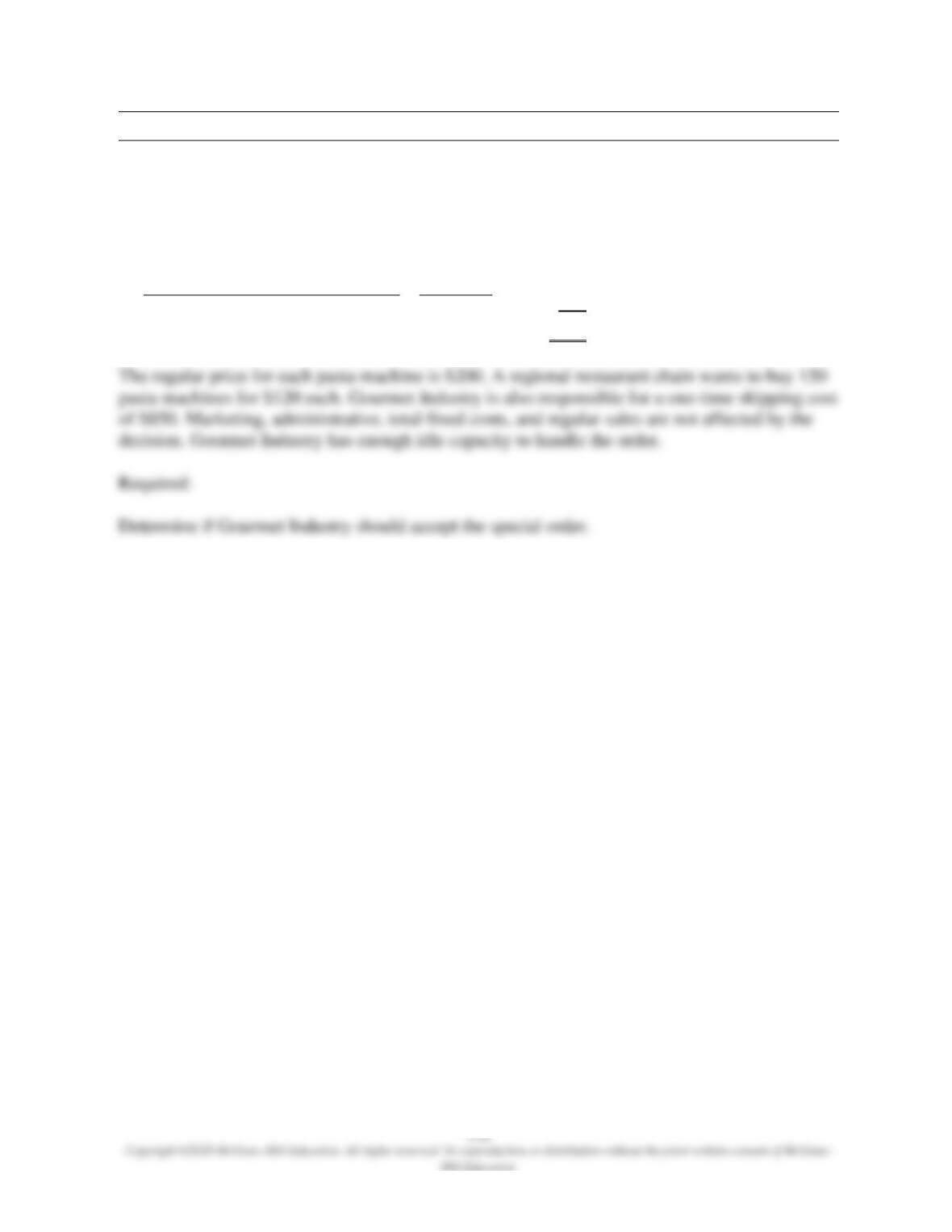
Eagle Manufacturing Company
Cost of Goods Manufactured and Sold Statement
For the month of March
Beginning work-in-process inventory
$ 54,000
Manufacturing costs during the year:
Direct materials
Beginning inventory
$12,000
Add: Purchase of direct materials
70,000
Direct materials available
$82,000
Less ending inventory
(21,000)
Direct material put into production
$61,000
Direct labor
48,000
Manufacturing overhead:
Indirect labor
$21,000
Factory supervisory salaries
12,000
Factory utilities expense
Factory depreciation expense
5,000
Total manufacturing overhead
42,000
Total manufacturing costs incurred
Total work in process during the year
Less ending work-in-process inventory
Cost of goods manufactured
Beginning finished goods inventory
Finished goods available for sale
Less ending finished goods inventory
Cost of goods sold
Demonstration Problem 4
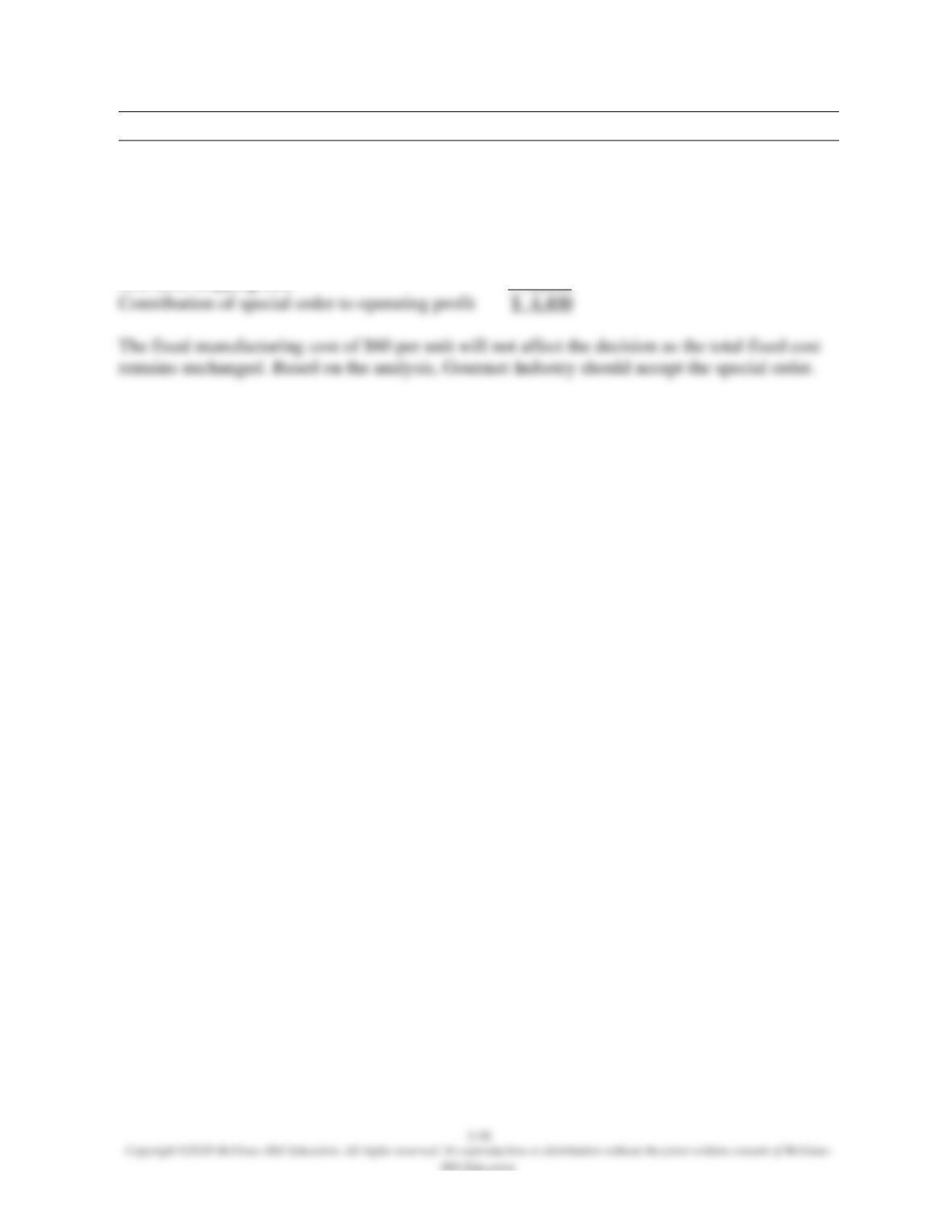
Gourmet Industry manufactures pasta machines. The accountant of the company provides the
cost structure for each pasta machine produced as follows:
Variable manufacturing cost
$ 85
Fixed manufacturing cost
(=
Fixed manufacturing cost per year $120,000
Units produced per year 2,000
=
)
60
$145
Demonstration Problem 4 – Solution
By accepting the special order, Gourmet Industry will increase its operating profit by $4,400.
Revenues from special order ($120 × 150)
$18,000
Variable manufacturing cost ($85 × 150)
(12,750)
One-time shipping cost
(850)
Contribution of special order to operating profit
$ 4,400
Demonstration Problem 5
The following information is available for each unit of the finished product produced and sold:
Sales price
$60
Variable manufacturing cost
20
Fixed manufacturing cost*
12
Variable marketing and administrative cost
6
Fixed marketing and administrative cost*
4
Demonstration Problem 5 – Solution
Full absorption cost = $20 + $12 = $32
Variable cost = $20 + $6 = $26
Full cost = ($20 + $12 + $6 + $4) = $42
Demonstration Problem 6
(Continued from Demonstration Problem 5)
The following information is available for each unit of the finished product produced and sold:
Sales price
$60
Variable manufacturing cost
20
Fixed manufacturing cost*
12
Variable marketing and administrative cost
6
Fixed marketing and administrative cost*
4
Demonstration Problem 6 – Solution
Traditional
Income Statement
Contribution Margin
Income Statement
Revenues
$360,000
Revenues
$360,000
Less: Cost of goods sold
(192,000)
Less: Variable cost
(156,000)
Gross margin
Contribution margin
Less: Marketing and administrative costs
(60,000)
Less: Fixed costs
(96,000)
Operating profit
$108,000
Operating profit
$108,000