John J. Wild, Financial Accounting: Information for Decisions, 8th Edition
2-1
CHAPTER 2
FINANCIAL STATEMENTS AND THE ACCOUNTING SYSTEM
Related Assignment Materials
Student Learning Objectives
Questions
Quick
Studies*
Exercises*
Problems*
Beyond the
Numbers
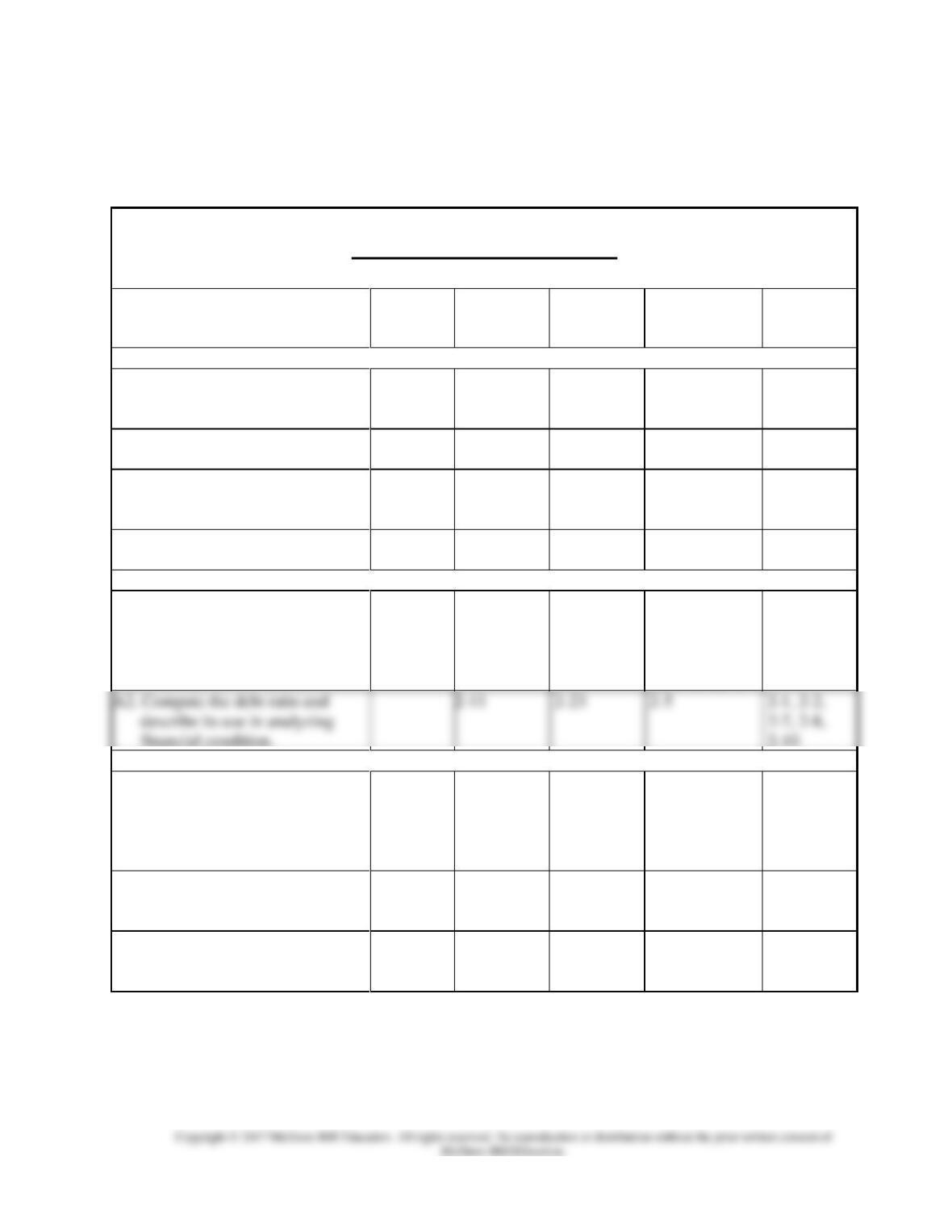
Conceptual objectives:
C1. Explain the steps in processing
transactions and the role of
source documents.
3, 6, 9
2-1
2-1
2-6
2-3, 2-4,
2-6, 2-9
C2. Describe an account and its use
in recording transactions.
1, 2, 14
2-2
2-2
2-5
2-4, 2-6
C3. Describe a ledger and a chart of
accounts.
2-3
2-3, 2-16
2-1, 2-2,
2-3, 2-4,
2-6, GL 2-4
C4. Define debits and credits and
explain double-entry accounting.
7
2-4, 2-5,
2-10
2-4
2-1, 2-2,
2-3, GL 2-4
2-6
Analytical objectives:
A1. Analyze the impact of
transactions on accounts and
financial statements.
.
2-7
2-5, 2-6,
2-9, 2-11,
2-12, 2-13,
2-15, 2-20,
2-21
2-1, 2-2,
2-3, 2-4, 2-5,
2-6, SP 2,
GL 2-1,GL 2-2,
GL 2-3, GL 2-4
2-1, 2-2,
2-4, 2-5,
2-6, 2-7,
2-8
A2. Compute the debt ratio and
describe its use in analyzing
financial condition.
2-11
2-23
2-5
2-1, 2-2,
2-7, 2-8,
2-10
Procedural objectives:
P1. Record transactions in a journal
and post entries to a ledger.
3, 4, 5
2-6
2-7, 2-11,
2-12, 2-14
2-19
2-1, 2-2,
2-3, 2-4,
SP 2,
GL 2-1,GL 2-3,
GL 2-4
P2. Prepare and explain the use of a
trial balance.
8
2-8
2-8, 2-10,
2-20, 2-21
2-1, 2-2, 2-3,
2-4, 2-6, SP 2,
GL 2-1, GL 2-4
P3. Prepare financial statements from
business transactions.
10, 11, 12,
13,15, 16,
17, 18
2-9
2-16, 2-17,
2-18, 2-19,
2-22
2-5, GL 2-1
2-4, 2-7,
2-8
*See additional information on next page that pertains to these quick studies, exercises and problems.
** SP refers to the Serial Problem
***GL refers to the General Ledger problems
John J. Wild, Financial Accounting: Information for Decisions, 8th Edition
2-2
Additional Information on Related Assignment Material
Connect
Available on the instructor’s course-specific website) repeats all numerical Quick Studies, all Exercises
and Problems Set A. Connect also provides algorithmic versions for Quick Study, Exercises and
Problems. It allows instructors to monitor, promote, and assess student learning. It can be used in
practice, homework, or exam mode.
Connect Insight
The Serial Problem for Success Systems continues in this chapter.
General Ledger
Assignable within Connect, General Ledger (GL) problems offer students the ability to see how transactions post
from the general journal all the way through the financial statements. Critical thinking and analysis components are
added to each GL problem to ensure understanding of the entire process. GL problems are auto-graded and provide
instant feedback to the student.
Excel Simulations
Synopsis of Chapter Revisions
• NEW opener—Twitter
• Simplified discussion on analyzing and recording process.
• Streamlined discussion of classified vs unclassified balance sheet.
John J. Wild, Financial Accounting: Information for Decisions, 8th Edition
2-3
Chapter Outline
Notes
I. Using Financial Statements
A. Analyzing Financial Statements. Used by internal and external users.
Evaluate company performance and financial condition.
B. Assessing Company Results. Use standards including intracompany (across
two or more periods), intercompany (competitors), industry and guidelines
or rules of thumb.
C. Using Ratios to Analyze Financial Statements. Widely used tools which
express a mathematical relation between two quantities.
D. Building Blocks of Analysis include:
1. Liquidity and efficiency – availability of resources to meet short-term
cash requirements. Includes current ratio.
II. Basis of Financial Statements
A. Identify transaction from source document which identifies and describes
transactions and events entering the accounting process.
B. Analyze transaction using the accounting equation.
G. Accounts are arranged into three basic categories based on the accounting
equation. Categories are:
1. Assets—resources owned or controlled by a company that have future
economic benefit. Examples include Cash, Accounts Receivable, Note
Receivable, Prepaid Expenses, Prepaid Insurance, Supplies, Store
Supplies, Equipment, Buildings, and Land.
2. Liabilities—claims (by creditors) against assets, which means they are
obligations to transfer assets or provide products or services to others.
Examples include Accounts Payable, Note Payable, Unearned
John J. Wild, Financial Accounting: Information for Decisions, 8th Edition
2-4
Chapter Outline
Notes
3. Equity—owner’s claim on company’s assets is called equity or owner’s
equity. Examples include Owner’s Capital, Owner’s Withdrawals
III. Analyzing and Processing Transactions
A. The general ledger or ledger (referred to as the books) is a record
containing all the accounts a company uses.
B. The chart of accounts is a list of all accounts in the ledger with their
identification numbers.
IV. Debits and Credits
A. The left side of an account is called the debit side. A debit is an entry on the
left side of an account.
B. The right side of an account is called the credit side. A credit is an entry on
the right side of an account.
C. Accounts are assigned balance sides based on their classification or type.
zero balance.
V. Double-Entry Accounting—requires that each transaction affect, and be
recorded in, at least two accounts. The total debits must equal total credits for
each transaction.
A. The assignment of balance sides (debit or credit) follows the accounting
equation.
1. Assets are on the left side of the equation; therefore, the left, or debit,
side is the normal balance for assets.
2. Liabilities and equities are on the right side; therefore, the right, or
credit, side is the normal balance for liabilities and equity.
John J. Wild, Financial Accounting: Information for Decisions, 8th Edition
2-5
Chapter Outline
Notes
B. Three important rules for recording transactions in a double-entry
accounting system are:
3. Increases to equity are credits to the equity accounts. Decreases to
1. Increases to assets are debits to the asset accounts. Decreases to assets
are credits to the asset accounts.
VI. Journalizing and Posting Transactions
A. Four steps in processing transactions are as follows:
Journalizing—The process of recording each transaction in a journal.
1. Identify transaction and source documents.
2. Analyze using the accounting equation. Apply double entry accounting
to determine account to be debited and credited.
3. Record journal entry—recorded chronologically (A journal gives us a
complete record of each transaction in one place.)
4. Posting Journal entries—transfer (or post) each entry from journal to
ledger.
a. Debits are posted as debit, and credits as credits to the accounts
identified in the journal entry.
Note: To see an illustration of analyzing, journalizing and posting of 16 basic
transactions refer to pages 64-70 of the textbook.
VII. Trial Balance
A. A trial balance is a list of accounts and their balances at a point in time.
Account balances are reported in their appropriate debit or credit columns
of the trial balance.
B. The trial balance tests for the equality of the debit and credit account
balances as required by double-entry accounting.
John J. Wild, Financial Accounting: Information for Decisions, 8th Edition
2-6
Chapter Outline
Notes
D. When a trial balance does not balance (the columns are not equal), an error
has occurred in one of the following steps:
1. Preparing the journal entries.
2. Posting the journal entries to the ledger.
E. Searching for and Correcting Errors
1. Approach to correcting errors depends on the kind of error and when it
is discovered.
2. Correcting entries may be necessary.
F. Using a Trial Balance to Prepare Financial Statements
1. Income statement reports revenues earned less expenses incurred over a
period of time.
G. Presentations Issues
1. Dollar signs are not used in journals and ledgers but are used in
financial statements and trial balance.
2. Usual practice on statements is to put dollar signs before the first and
last number in each column.
VIII. Global View—Compares U.S.GAAP to IFRS
A. Analyzing and recording transactions—all transactions in this chapter are
accounted for identically under both systems.
John J. Wild, Financial Accounting: Information for Decisions, 8th Edition
2-7
Chapter Outline
Notes
IX. Decision Analysis—Debt Ratio:
often require regular interest payments.
A. Companies finance their assets with either liabilities or equity.
B. A company that finances a relatively large portion of its assets with
liabilities has a high degree of financial leverage.(greater risk)
John J. Wild, Financial Accounting: Information for Decisions, 8th Edition
2-8
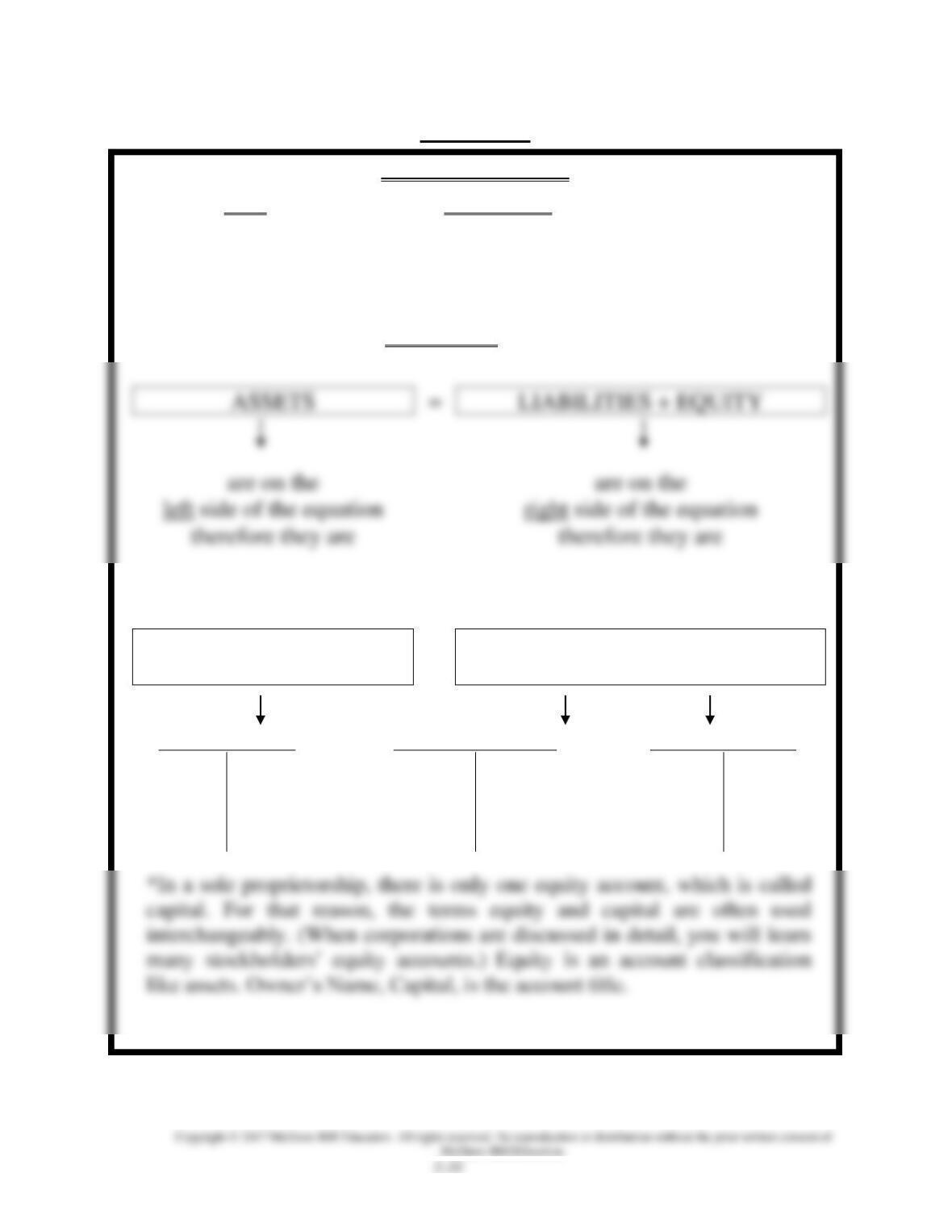
VISUAL #2-1
THREE PARTS OF AN ACCOUNT
(1) ACCOUNT TITLE
Left Side
Right Side
Rules for using accounts
Accounts are assigned balance sides (Debit or Credit).
To increase any account, use the balance side.
To decrease any account, use the side opposite the balance.

John J. Wild, Financial Accounting: Information for Decisions, 8th Edition
2-9
John J. Wild, Financial Accounting: Information for Decisions, 8th Edition
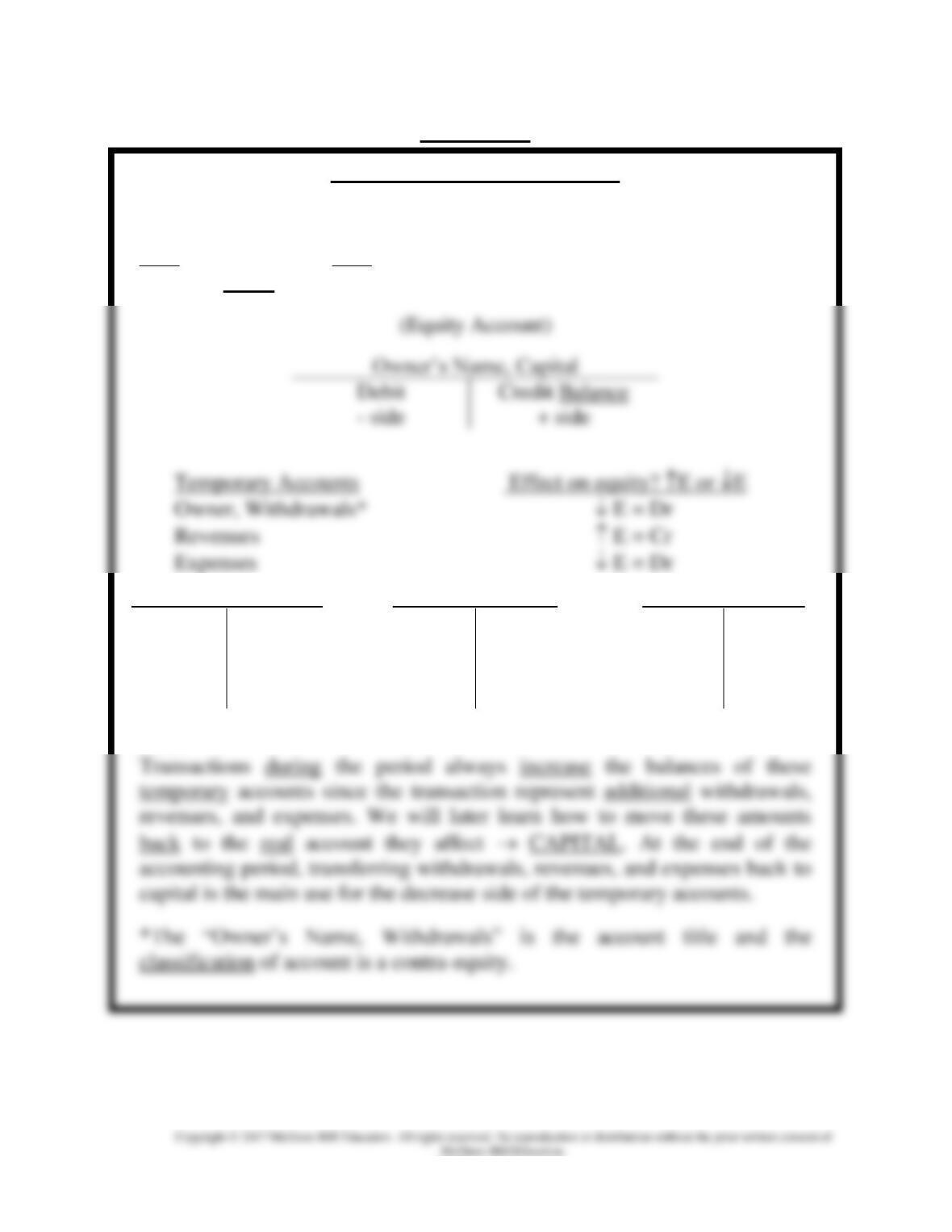
VISUAL #2-2
REAL ACCOUNTS
ALL ACCOUNTS ARE ASSIGNED BALANCE SIDES
BALANCE SIDES FOR ASSETS, LIABILITIES, AND
EQUITY ACCOUNTS ARE ASSIGNED BASED ON
SIDE OF EQUATION THEY ARE ON.
ASSIGNED LEFT SIDE
BALANCE
ASSIGNED RIGHT SIDE
BALANCE
DEBIT BALANCE
CREDIT BALANCE
All Asset Accts
All Liability Accts
All Equity Accts
Normal
Normal
Normal
Debit
Credit
Debit
Credit
Debit
Credit
Balance
Balance
Balance
+ side
– side
– side
+ side
– side
+ side

2-11
Credit Balance
John J. Wild, Financial Accounting: Information for Decisions, 8th Edition
2-12
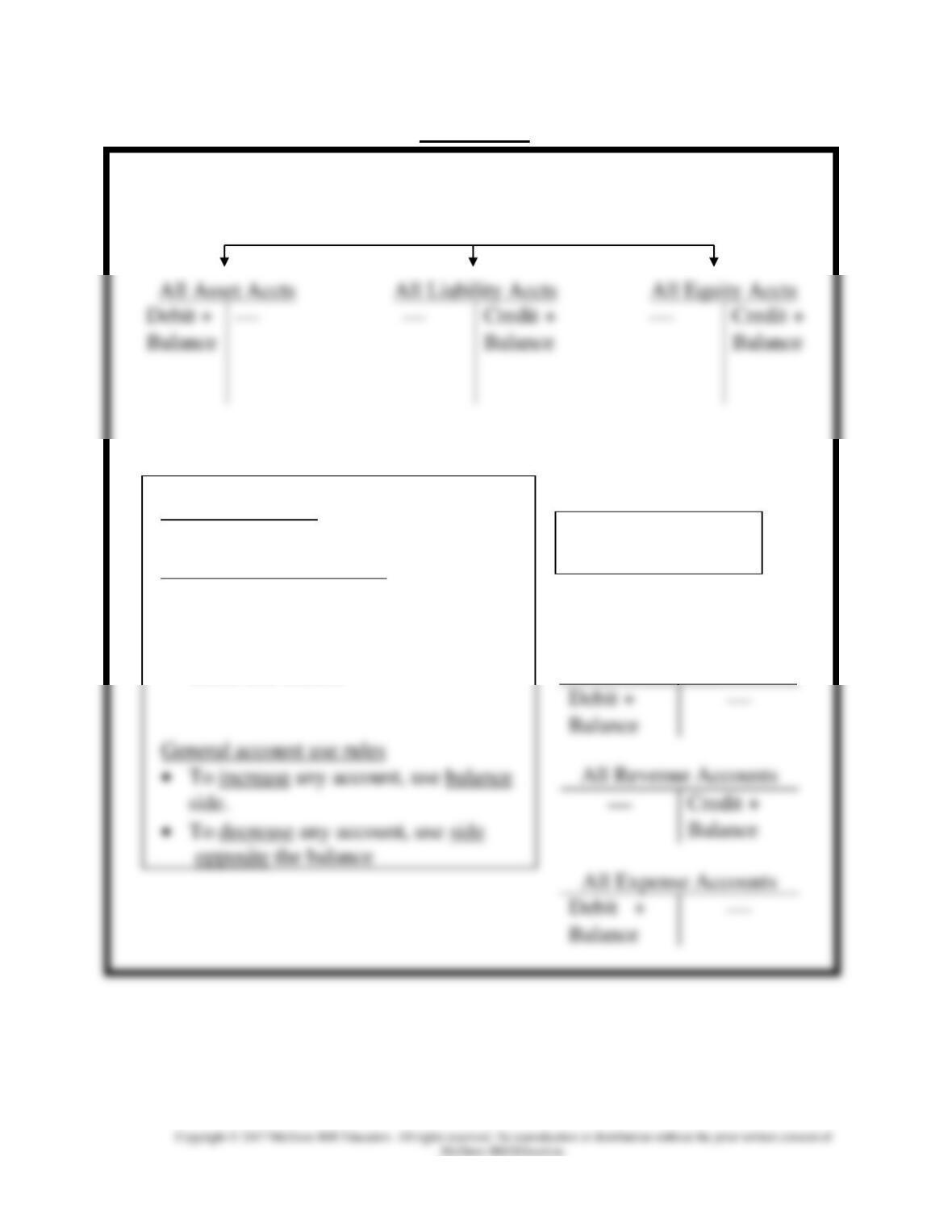
VISUAL #2-3
TEMPORARY ACCOUNTS
Temporary accounts are established to facilitate efficient accumulation of
data for statements. Temporary accounts are established for withdrawals,
each revenue, and each expense. Temporary accounts are assigned
balances based on how they affect equity.
All Withdrawal Accts
All Revenue Accts
All Expense Accts
Normal
Normal
Normal
Debit
Credit
Debit
Credit
Debit
Credit
Balance
Balance
Balance
+ side
– side
– side
+ side
+ side
– side
Note:

John J. Wild, Financial Accounting: Information for Decisions, 8th Edition
2-13
John J. Wild, Financial Accounting: Information for Decisions, 8th Edition
2-14
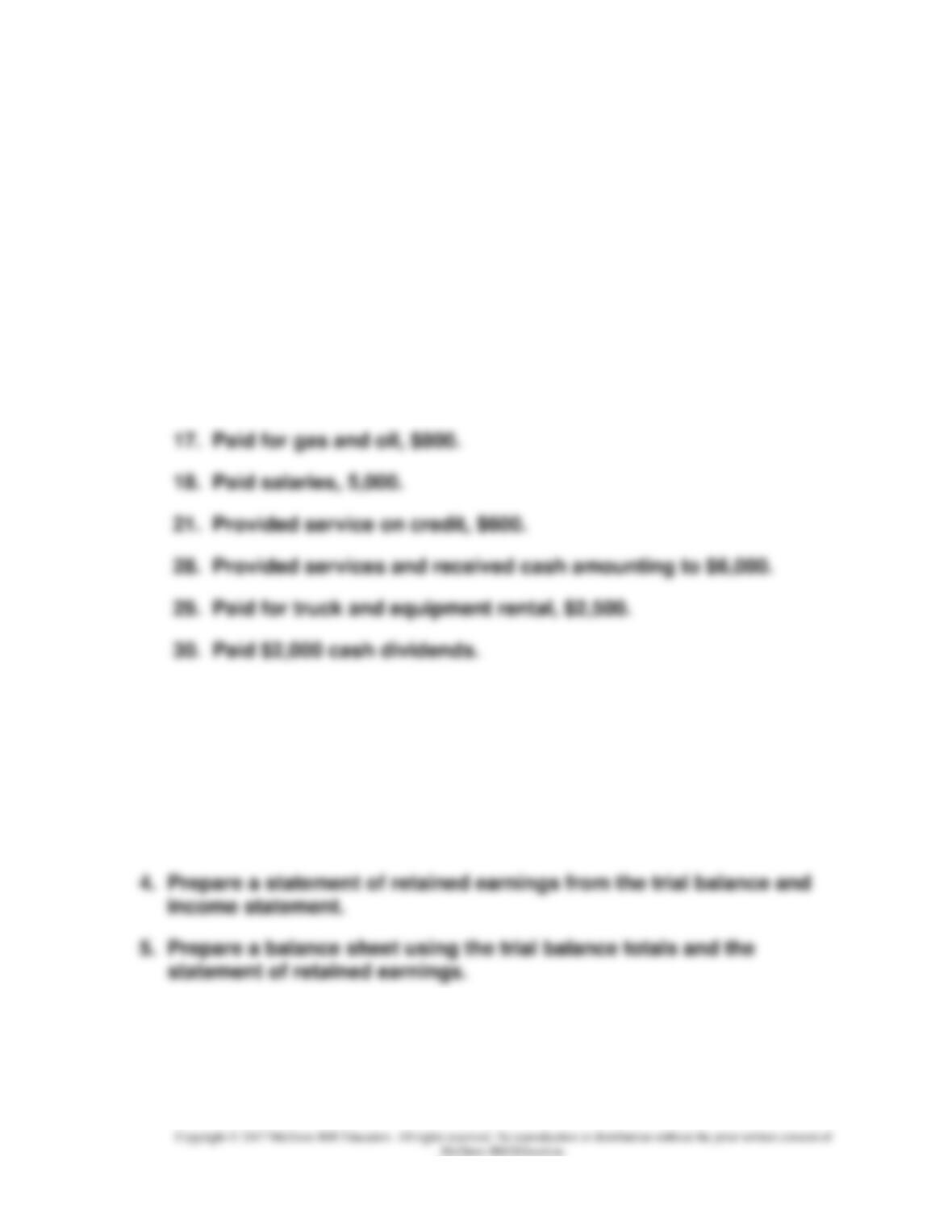
VISUAL #2-4
USING ACCOUNTS – SUMMARY
Real Accounts
Balance
Balance
RULE REVIEW
Temporary Accounts
Transaction analysis rules
• Each transaction affects at least 2
accounts.
• Each transaction must have equal
debits and credits.
All Withdrawal
Accounts
Balance
General account use rules
Balance
John J. Wild, Financial Accounting: Information for Decisions, 8th Edition
2-15
Alternate Demonstration Problem
Chapter Two
Record the following transactions of Speedy Computer Service for the
month of March 2017.
March 1. Speedy Computer Service received $3,000 cash from Bill Smith in
exchange for common stock.
15. Provided services and received cash amounting to $5,400 from
customers.
16. Purchased supplies on account, $100.
Required:
1. Record the above transactions in general journal form.
2. Prepare a trial balance after posting the entries to t-accounts (you
can make your own t-accounts).
3. Prepare an income statement from trial balance.
Explain why the company’s cash balance does not agree with net income.
John J. Wild, Financial Accounting: Information for Decisions, 8th Edition
2-16
Solution: Alternate Demonstration Problem
Chapter Two
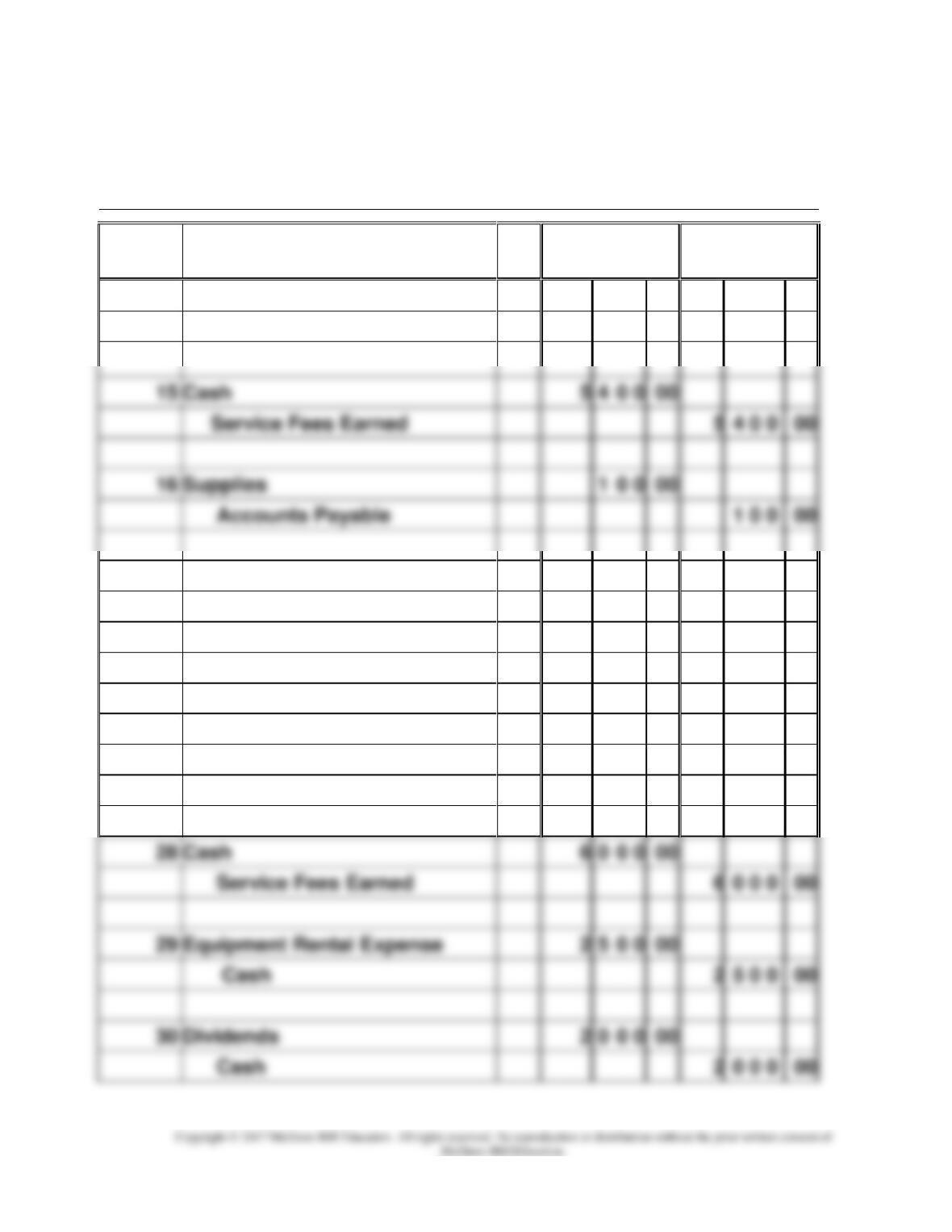
GENERAL JOURNAL
DATE
ACCOUNT TITLES AND
EXPLANATION
P.R.
DEBIT
CREDIT
March 1
Cash
3
0
0
0
00
Common Stock
3
0 0 0
00
15
Cash
5
4
0
0
00
Service Fees Earned
5
4 0 0
00
16
Supplies
1
0
0
00
Accounts Payable
1 0 0
00
17
Gas and Oil Expense
8
0
0
00
Cash
8 0 0
00
18
Salaries Expense
5
0
0
0
00
Cash
5
0 0 0
00
21
Accounts Receivable
6
0
0
00
Service Fees Earned
6 0 0
00
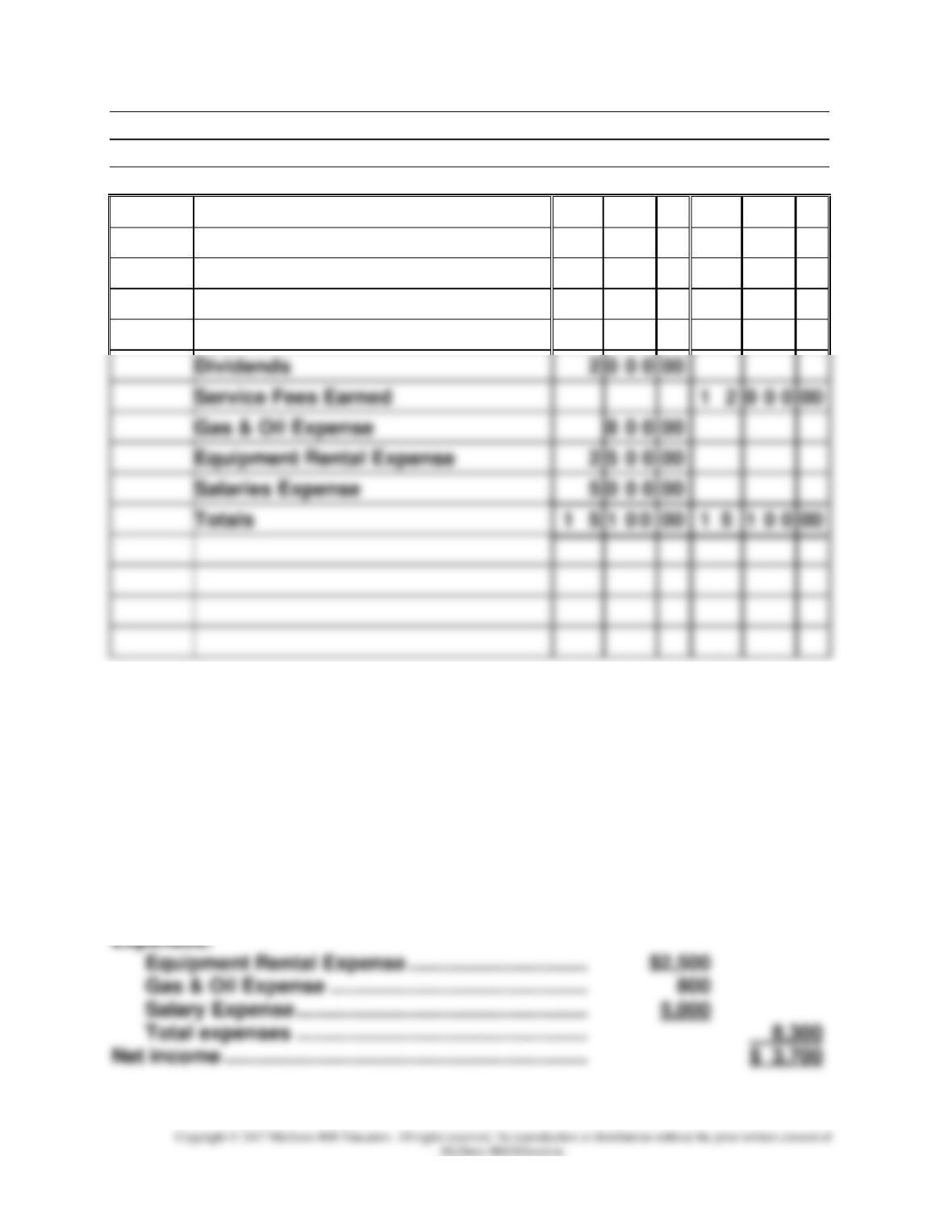
28
Cash
6
0
0
0
00
Service Fees Earned
6
0 0 0
00
29
Equipment Rental Expense
2
5
0
0
00
Cash
2
5 0 0
00
30
Dividends
2
0
0
0
00
John J. Wild, Financial Accounting: Information for Decisions, 8th Edition
2-17
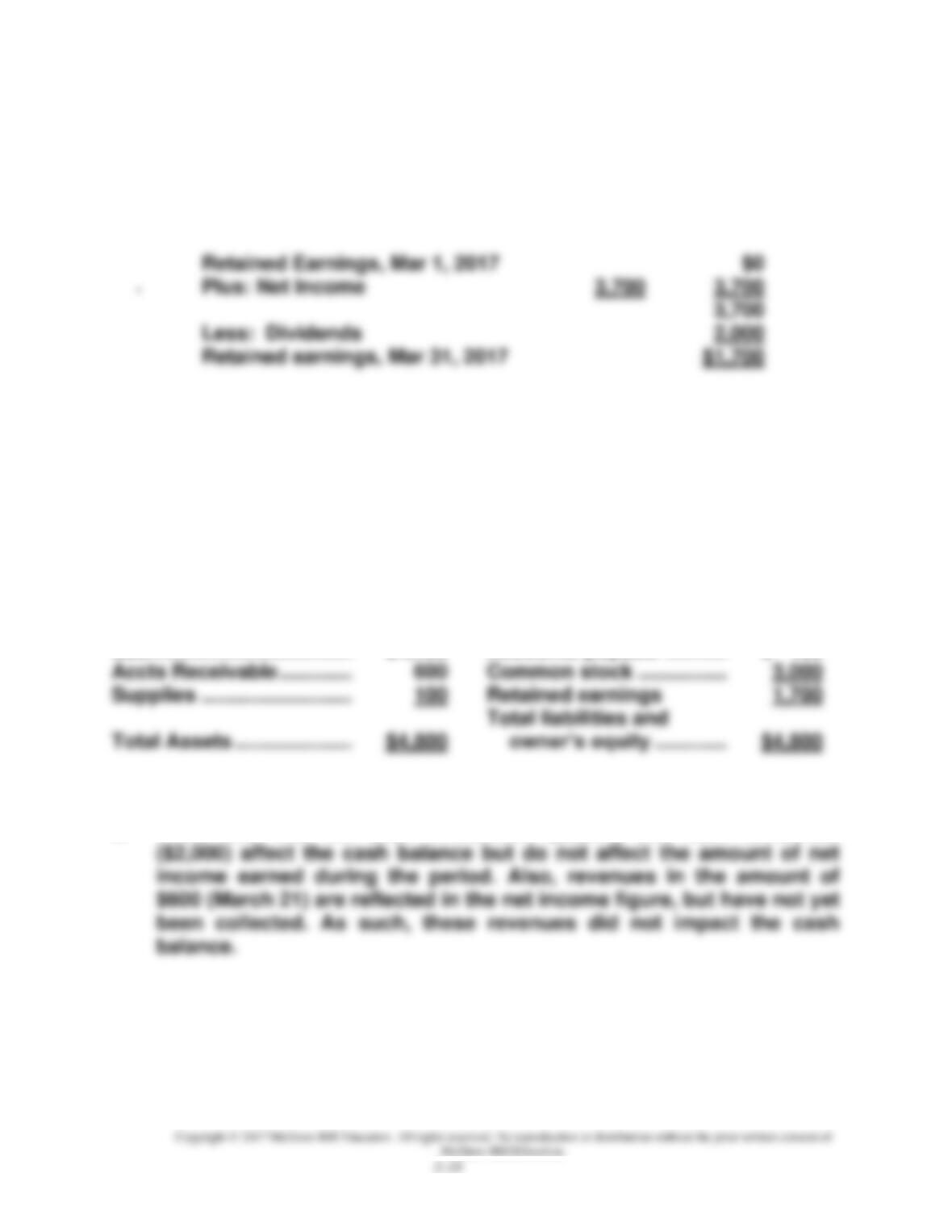
Speedy Computer Service
Trial Balance
March 31, 2017
Cash
4
1
0
0
00
Accounts Receivable
6
0
0
00
Supplies
1
0
0
00
Accounts Payable
1
0
0
00
Common Stock
3
0
0
0
00
Dividends
2
0
0
0
00
Service Fees Earned
1
2
0
0
0
00
Gas & Oil Expense
8
0
0
00
Equipment Rental Expense
2
5
0
0
00
Salaries Expense
5
0
0
0
00
Totals
1
5
1
0
0
00
1
5
1
0
0
00
3.
Speedy Computer Service
Income Statement
For the month ended March 31, 2017
Fees Earned ………………………………………………………
$12,000
Expenses:
Equipment Rental Expense …………………………..
Salary Expense …………………………………………….
Total expenses …………………………………………….
John J. Wild, Financial Accounting: Information for Decisions, 8th Edition
4.
Speedy Computer Service
Statement of Retained Earnings
For the month ended March 31, 2017
Retained Earnings, Mar 1, 2017
Retained earnings, Mar 31, 2017
5.
Speedy Computer Service
Balance Sheet
March 31, 2017
Assets
Liabilities and Owner’s Equity
Cash …………………………….
$4,100
Accounts payable ………..
$ 100
Common stock …………….
Supplies ………………………
Retained earnings
Total Assets …………………
$4,800
$4,800
6. First, note that the cash investment ($2,000) and cash dividends