Chapter 2
Cost Concepts and Behavior
Learning Objectives
1. Explain the basic concept of “cost.”
2. Explain how costs are presented in financial statements.
3. Explain the process of cost allocation.
4. Understand how material, labor, and overhead costs are added to a product at each stage of
the production process.
5. Define basic cost behaviors, including fixed, variable, semivariable, and step costs.
Chapter Overview
I. WHAT IS A COST?
• Cost versus Expenses
II. PRESENTATION OF COSTS IN FINANCIAL STATEMENTS
• Service Organizations
• Retail and Wholesale Companies
III. COST ALLOCATION
• Direct versus Indirect Costs
IV. DETAILS OF MANUFACTURING COST FLOWS
V. HOW COSTS FLOW THROUGH THE STATEMENTS
• Income Statements
• Cost of Goods Manufactured and Sold Statement
VI. COST BEHAVIOR
• Fixed versus Variable Costs
VII. COMPONENTS OF PRODUCT COSTS
• Unit Fixed Costs Can Be Misleading for Decision Making
VII. HOW TO MAKE COST INFORMATION MORE USEFUL FOR MANAGERS
Chapter Outline
• The cost accounting system records and maintains the use of economic resources by the
organization.
o The financial statements prepared by the firm for external reporting use information
from the cost accounting system.
o Cost accounting systems also provide information to help managers make better
decisions. Managers need to understand the common terms used in cost accounting.
LO 2-1 Explain the basic concept of “cost.”
WHAT IS A COST?
• Cost versus Expenses
o Cost represents a sacrifice of resources (typically cash or a line of credit). The price of
each item purchased measures the sacrifice made to acquire it.
▪ Expense is a cost charged against (i.e., deducted from) revenue in an accounting
period.
o The two major categories of costs are:
▪ Outlay cost: a past, present, or future cash outflow, such as tuition, books, and fees
paid for a college education, and
▪ Opportunity cost: the forgone benefit that could have been realized from the best
forgone alternative course of a resource, such as the time and income sacrificed to get
a college education.
▪ Managers tend to overlook or ignore opportunity costs while making decisions
because:
LO 2-2 Explain how costs are presented in financial statements.
PRESENTATION OF COSTS IN FINANCIAL STATEMENTS
• Operating profit is the excess of operating revenues over the operating costs incurred to
generate those revenues.
o Operating profit differs from net income.
o Net income is operating profit adjusted for interest, income taxes, extraordinary items,
and other adjustments required to comply with GAAP or other regulations.
o Information generated by the cost accounting system is used to help managers make
decisions that improve firm value. It is a means to an end.
Income statement
Revenue
xxx
Costs
(xx)
Operating profit
xxx
• Service Organizations
o Service organizations provide customers an intangible product, such as advice and
analyses. Labor costs and/or costs of information technology represent the most
significant cost category for service organizations.
o Exhibit 2.2 illustrates the income statement of a typical service company. Cost of
services sold includes costs of billable hours, which are the hours billed to clients plus
the cost of other items billed to clients. Costs that are not part of services billable to
clients are included in the marketing and administrative costs.
• Retail and Wholesale Companies
Income Statement
Sales revenue
xxx
Cost of goods sold
(xx)
Gross margin
xxx
Marketing and administrative costs
(xx)
Operating profit
xxx
o The cost of goods sold statement shows how the cost of goods sold was computed. The
typical format follows:
Cost of Goods Sold Statement
Beginning inventory
Cost of goods purchased
Transportation-in costs
Total costs of goods purchased
Cost of goods available for sale
Less cost of goods in ending inventory
Cost of goods sold
• Manufacturing Companies
o Manufacturing companies make the goods for sale and need to know the different costs
associated with making them.
• Direct and Indirect Manufacturing (Product) Costs
o Product costs are those costs assigned to units of production and recognized (i.e.,
expensed) when the product is sold. Product costs follow the product through inventory.
▪ Direct manufacturing costs are product costs that can be identified with units (or
batches of units) at relatively low cost, including:
▪ Direct materials are those that can be feasibly identified directly, at relatively low
cost, with the product. (For manufacturers, direct materials are purchased parts,
including transportation-in.) Direct materials are often called raw materials.
• Prime Costs and Conversion Costs
o Prime costs = Direct materials + Direct labor.
▪ Companies with relatively low manufacturing overhead tend to focus on managing
prime costs.
o Conversion costs = Direct labor + Manufacturing overhead.
▪ Conversion costs are the costs that convert direct materials into the final product.
Companies with high direct labor and/or manufacturing overhead tend to emphasize
more about conversion costs.
▪ Exhibit 2.4 summarizes the relationship between prime costs, conversion costs, and
the three elements of manufactured product costs: direct materials, direct labor, and
manufacturing overhead.
• Nonmanufacturing (Period) Costs
o Period costs (nonmanufacturing costs) are all other costs recognized for financial
reporting when incurred, including marketing and administrative costs.
• The distinction between manufacturing and nonmanufacturing costs is not always clear-cut.
Companies usually set their own guidelines and follow them consistently.
o Service companies often have costs that are mostly indirect. Managing indirect costs is
extremely important in these firms if they are to remain profitable.
LO 2-3 Explain the process of cost allocation.
COST ALLOCATION
• Cost allocation is the process of assigning indirect costs to product, services, people,
business units, etc. Cost allocation is necessary when several departments share facilities or
services.
o Cost object is any end to which a cost is assigned. Examples include a unit of product or
service, a department, or a customer.
• Cost flow diagram is a diagram or flowchart illustrating the cost allocation process.
o Fundamental approach to cost allocation:
▪ Identify the cost objects
▪ Determine the cost pools
▪ Select a cost allocation rule
o Cost flow diagrams help managers understand
o Exhibit 2.5 illustrates an example of cost flow diagram.
• Direct versus Indirect Costs
o Direct cost is any cost that can be directly (unambiguously) related to a cost object at
reasonable cost; indirect cost is any cost that cannot be directly related to a cost object.
LO 2-4 Understand how material, labor, and overhead costs are added to a
product at each stage of the production process.
DETAILS OF MANUFACTURING COST FLOWS
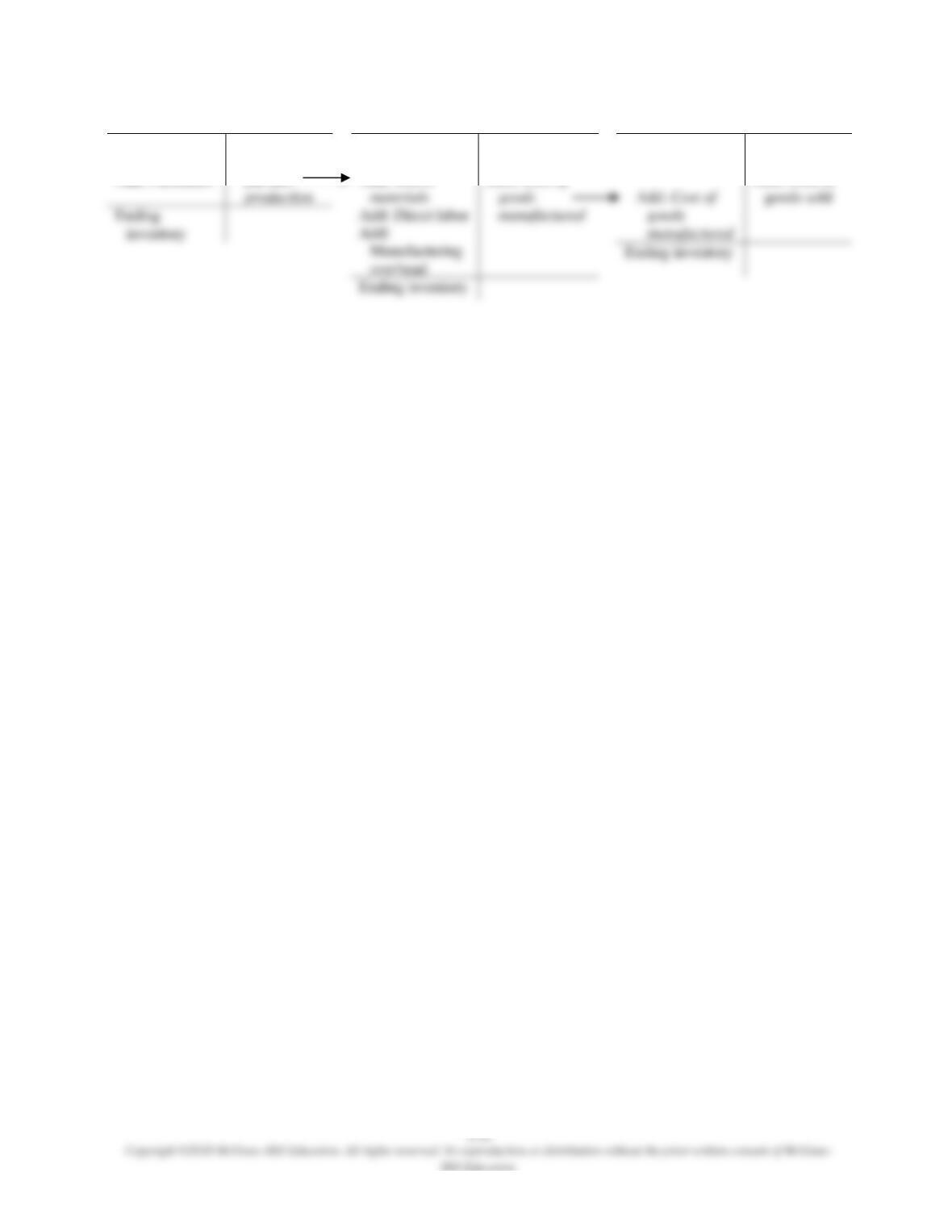
• Any production process involves three basic steps:
o Delivering direct materials to receiving area, inspecting, and then placing in direct
material inventory area (store).
o Transporting direct materials to an assembly line and undergoing the production process.
Work in process is a product in the production process but not yet complete.
o Moving the product to separate area in factory with other completed products. Finished
goods are products fully completed, but not yet sold.
Direct materials inventory
Work-in-process inventory
Finished goods inventory
Beginning
inventory
Less: Direct
materials
Ending
Beginning
inventory
Beginning
inventory
HOW COSTS FLOW THROUGH THE STATEMENTS
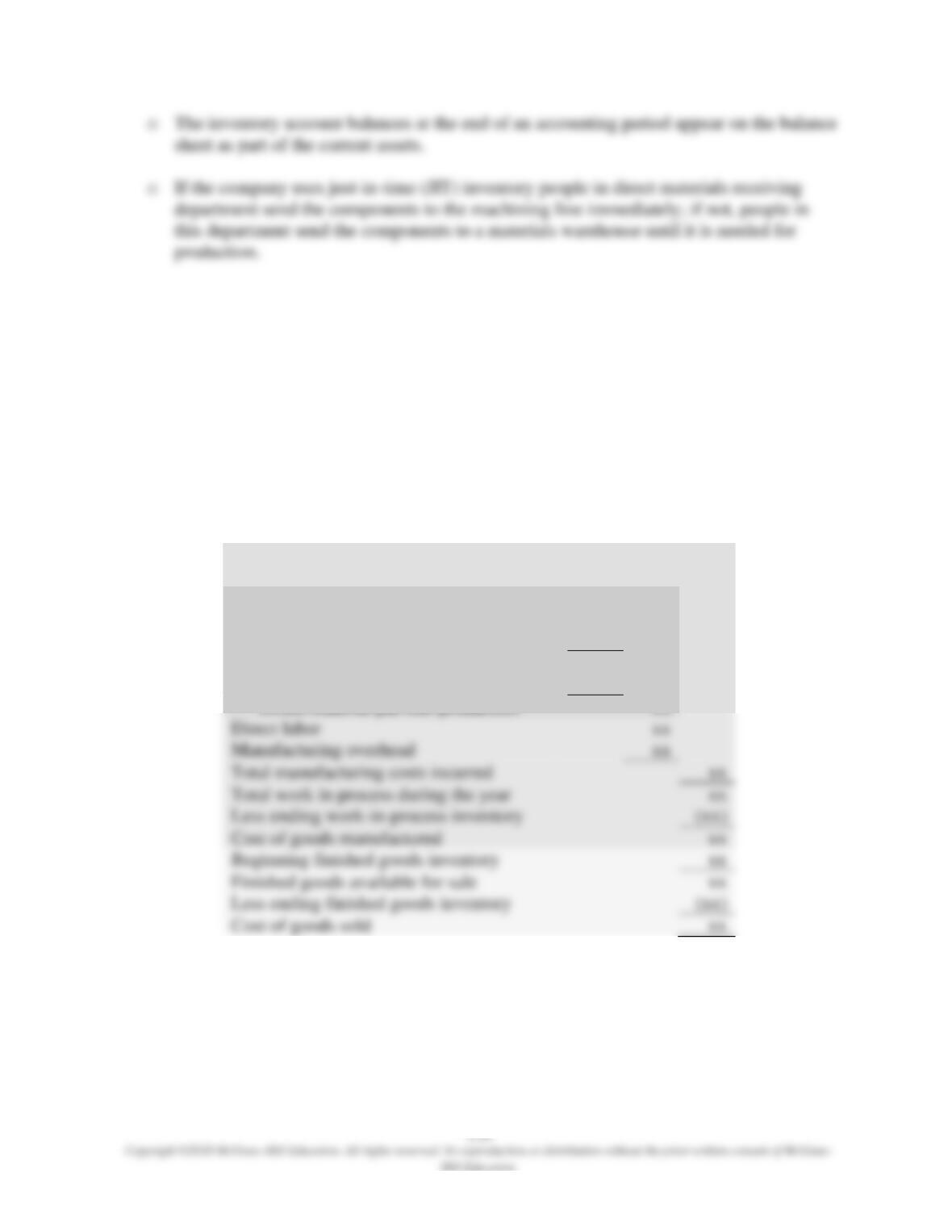
• Income Statements – Exhibit 2.7 illustrates an income statement for a manufacturing firm.
• Cost of Goods Manufactured and Sold Statement – Exhibit 2.8 illustrates a cost of goods
manufactured and sold statement for a manufacturing company.
o A typical cost of goods sold statement for a manufacturing company is more
complicated than that of a merchandising firm and has the following structure:
Cost of Goods Manufactured and Sold Statement
Beginning work-in-process inventory
xx
Manufacturing costs during the year:
Direct materials
Beginning inventory
xx
Add: Purchase of direct materials
xx
Direct materials available
xx
Less ending inventory
(xx)
Direct material put into production
xx
Direct labor
xx
Manufacturing overhead
xx
Total manufacturing costs incurred
xx
Total work in process during the year
xx
Less ending work-in-process inventory
(xx)
Cost of goods manufactured
xx
Beginning finished goods inventory
xx
Finished goods available for sale
xx
Cost of goods sold
xx
▪ The three shaded areas deal with direct materials, work-in-process, and finished
goods, respectively.
o The cost of goods manufactured and sold statement is prepared through the internal
reporting system and is for managerial use only.
o Total manufacturing costs incurred equals the sum of direct material put into production,
direct labor, and manufacturing overhead incurred during the period. Managers in
production and operations give careful attention to these costs.
o The total cost of work in process during the year (i.e., the sum of the beginning work-in–
process inventory and total manufacturing costs incurred) is a measure of the resources
that have gone into production.
o The actual formats of financial statements vary a lot in practice. For managerial
purposes, it is important that the format be tailored to what users want.
See Demonstration Problem 3
LO 2-5 Define basic cost behaviors, including fixed, variable, semivariable,
and step costs.
COST BEHAVIOR
• Fixed Versus Variable Costs
o Cost behavior deals with the way costs respond to changes in activity levels; a cost
driver is a factor that causes, or “drives,” costs.
o Fixed costs are costs that are unchanged as volume changes within the relevant range of
activity. Examples: much of manufacturing overhead, many nonmanufacturing costs.
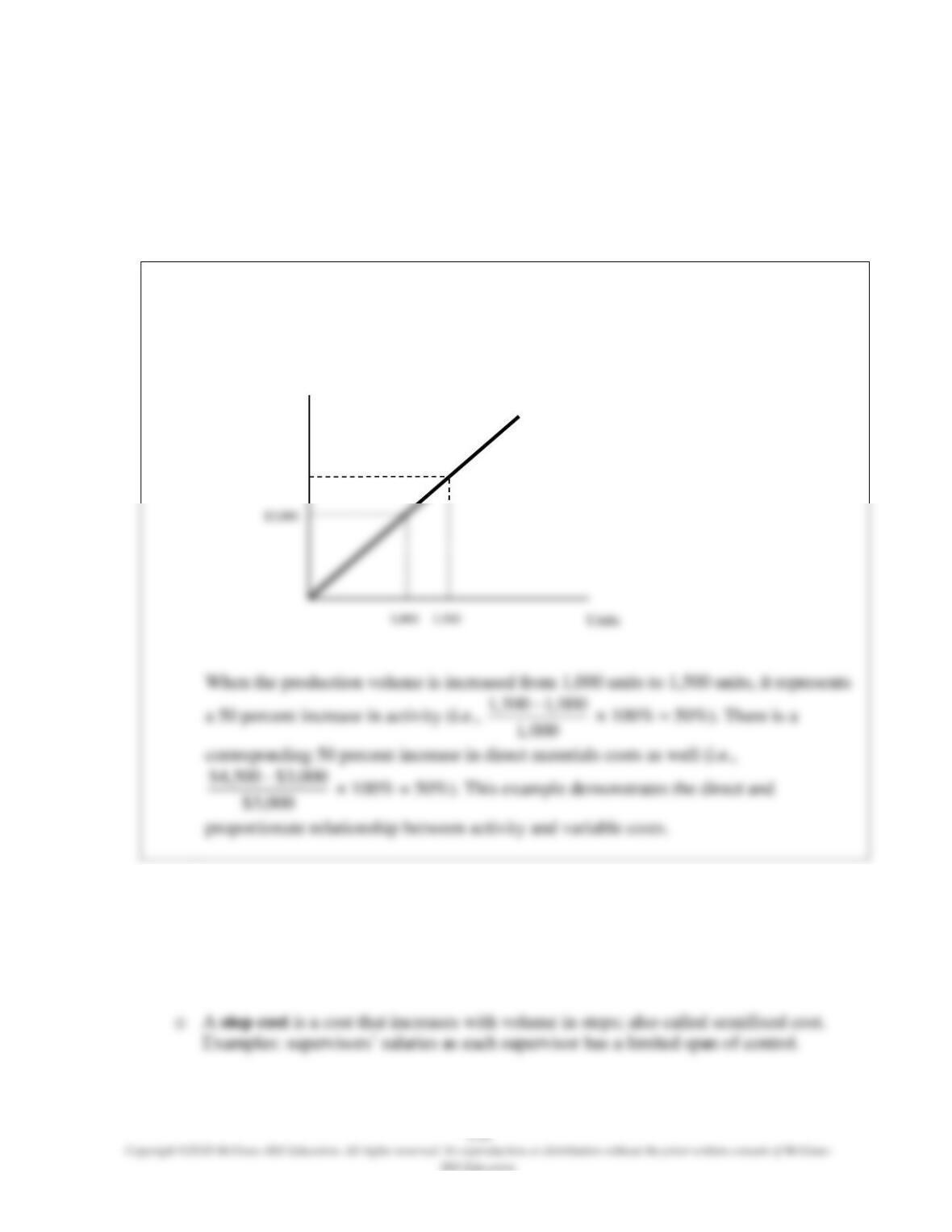
o Variable costs are costs that change in direct proportion with a change in volume
within the relevant range of activity. Examples: for manufacturing companies, direct
materials, and certain manufacturing overhead, direct labor in some cases; for
merchandising businesses, cost of the product, some marketing and administrative
costs; for service organizations, certain types of labor, supplies, copying, and
printing costs.
The following graph shows a variable cost relationship between activity (units of
production) and the resulting cost of direct materials used.
Units
$3,000
o Relevant range refers to the activity levels within which a given total fixed cost or
unit variable cost will be unchanged.
o A semivariable cost is a cost that has both fixed and variable components; also
called mixed cost. Examples: electric utility costs, phone charges.
Cost of Direct Materials
$4,500
o Four aspects of cost behavior complicate the task of classifying costs into fixed or
variable categories.
▪ Not all costs are strictly fixed or variable.
LO 2-6 Identify the components of a product’s costs.
COMPONENTS OF PRODUCT COSTS
• Some cost concepts are determined by the rules of financial accounting. Some are more
useful for managerial decision making.
o Full cost is the sum of all fixed and variable costs of manufacturing and selling a unit of
product.
o Full absorption cost is the sum of all variable and fixed manufacturing costs. Full
absorption cost is used to compute a product’s inventory value under GAAP; as such, it
excludes nonmanufacturing costs.
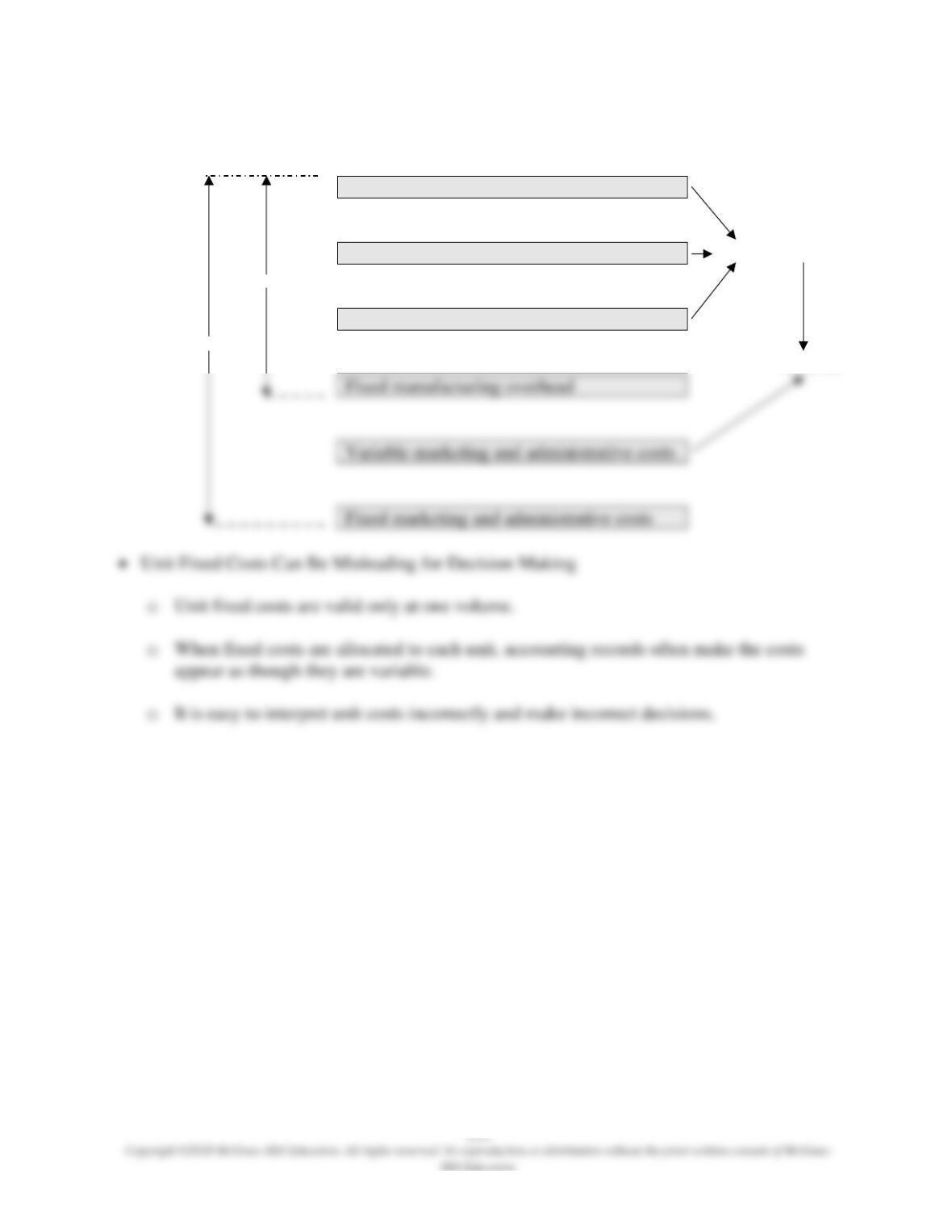
o Exhibit 2.11 illustrates the product cost components for a company.
o On a per-unit basis:
▪ Full absorption cost = Direct materials + Direct labor + Variable manufacturing
overhead + Fixed manufacturing overhead.
Full absorption cost
o The diagram below demonstrates the relationship among various product cost
components.
Direct materials
Direct labor
Variable manufacturing overhead
Fixed manufacturing overhead
Variable marketing and administrative costs
Fixed marketing and administrative costs
See Demonstration Problem 4
• Gross margin as reported in the external financial statements is the difference between
revenue and cost of goods sold, or
o Gross margin = Revenue – Cost of goods sold.
o Gross margin per unit = Sales price – Full absorption cost per unit.
o Cost of goods sold = Full absorption cost per unit × Number of units sold.
o The income statement format that emphasizes gross margin is referred to as the
traditional income statement.
Full cost
Variable manufacturing cost
Variable cost
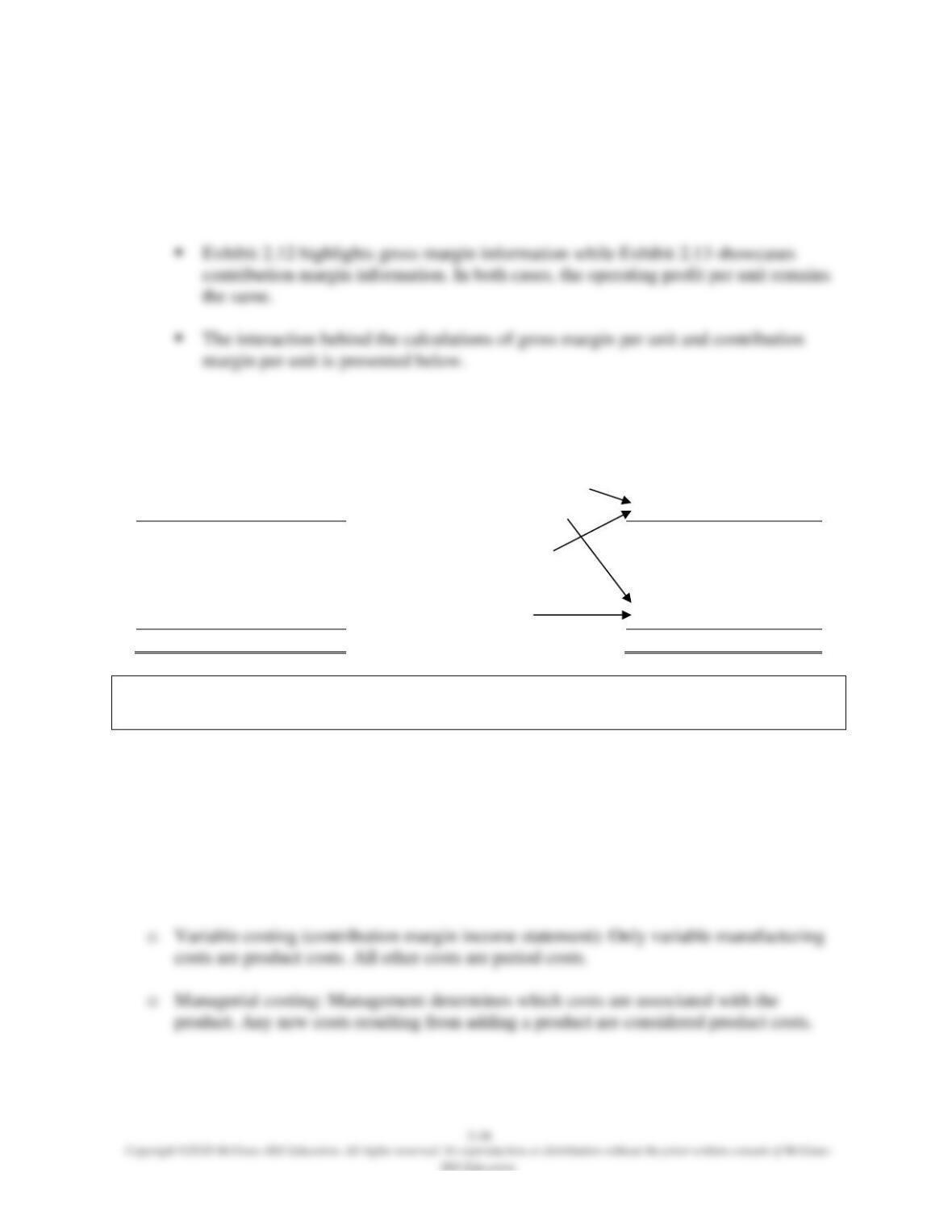
• Contribution margin per unit = Sales price – Variable costs per unit. Contribution margin
is the amount available to cover fixed costs and earn a profit.
o The income statement format that emphasizes contribution margin is referred to as the
contribution margin income statement.
Traditional
Income Statement
Components
Contribution margin
Income Statement
Sales price
Sales price
Less: Full absorption cost
= Variable manufacturing cost
+ Fixed manufacturing costs
Less: Variable cost
Gross margin
Contribution margin
Less: Marketing and
administrative costs
= Variable marketing and
administrative cost
+ Fixed marketing and
administrative cost
Less: Fixed costs
Operating profit
Operating profit
LO 2-7 Understand the distinction between financial and contribution
margin income statements.
HOW TO MAKE COST INFORMATION MORE USEFUL FOR MANAGERS
• Period costs can be determined once product costs are properly defined. Three approaches to
determining product costs are available.
o Full absorption costing (traditional income statement): As required by GAAP, all fixed
and variable manufacturing costs are product costs. All other costs are period costs.
See Demonstration Problem 5
• Gross Margin versus Contribution Margin Income Statements
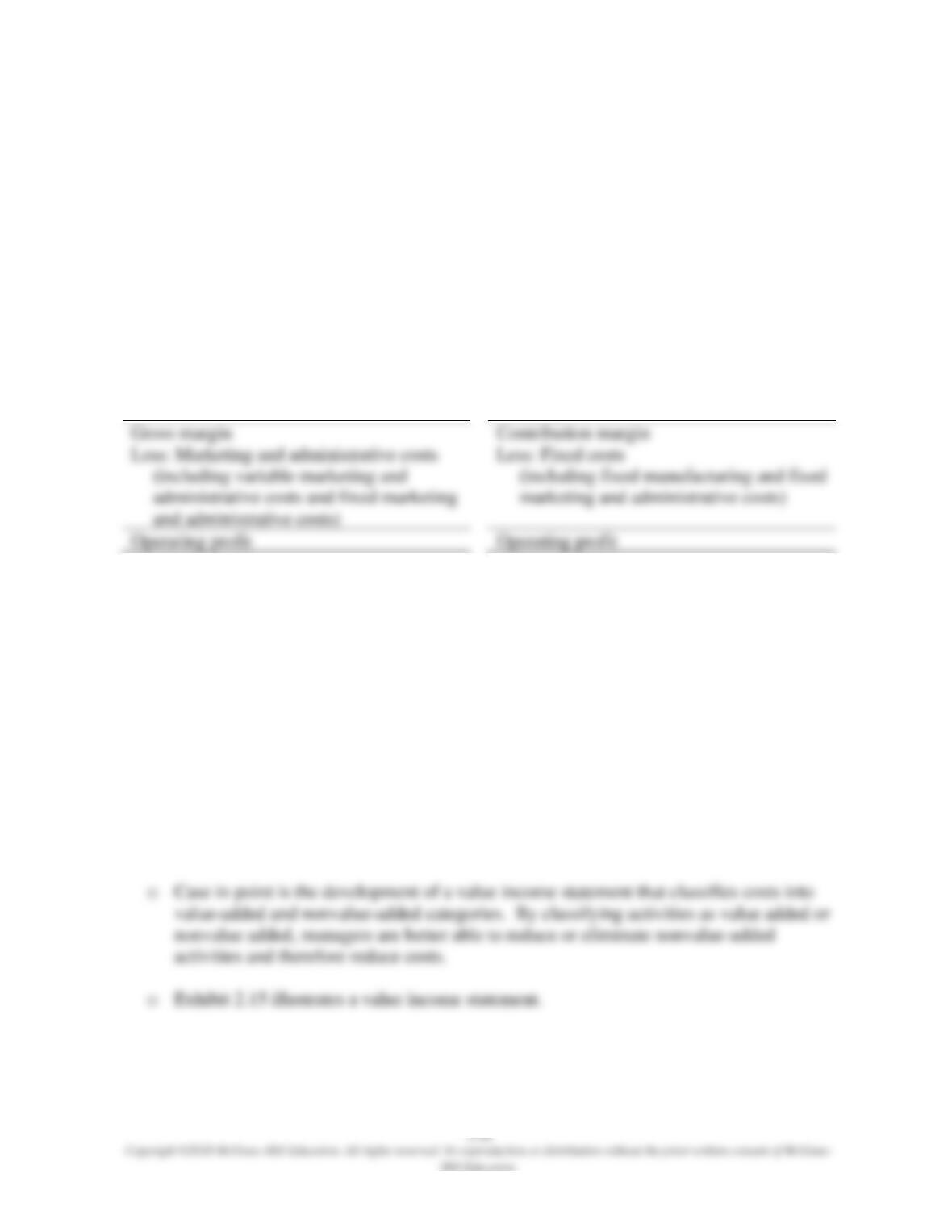
o A comparison of the first two income statement formats is shown below.
Gross Margin
Income Statement
Contribution Margin
Income Statement
Sales revenue
Sales revenue
Less: Cost of goods sold
(including variable manufacturing costs
and fixed manufacturing costs)
Less: Variable costs
(including variable manufacturing and
variable marketing and administrative
costs)
Gross margin
Contribution margin
Operating profit
Operating profit
o Exhibit 2.14 illustrates the differences between gross margin and contribution margin
income statements.
o The product costs assigned to inventory are carried in the accounts as assets. When the
goods are sold, the costs flow from inventory to the cost of goods sold account of the
income statement.
See Demonstration Problem 6
• Developing Financial Statements for Decision Making
o The cost accounting system is designed to provide managers with relevant information
for decision making. Financial statements may be developed to serve special purposes.