CHAPTER 2
A Further Look at Financial Statements
Learning Objectives
1. Identify the sections of a classified balance sheet.
2. Identify tools for analyzing financial statements and ratios for computing a company’s profitability.
3. Explain the relationship between a retained earnings statement and a statement of
stockholders’ equity.
4. Identify and compute ratios for analyzing a company’s liquidity and solvency using a
balance sheet.
5. Use the statement of cash flows to evaluate solvency.
6. Explain the meaning of generally accepted accounting principles.
7. Discuss financial reporting concepts.
Summary of Questions by Learning Objectives and Bloom’s Taxonomy
Item LO BT Item LO BT Item LO BT Item LO BT Item LO BT
Questions
1. 1 K 6. 2, 4, 5 C 10. 4, 5 K 14. 7 C 18. 7 C
Brief Exercises
1. 1 K 4. 3 K 7. 6 K 9. 7 K 11. 7 K
Do It! Review Exercises
1. 1 AP 2. 1 AP 3. 4, 5 K 4. 7 K
Exercises
1. 1 AP 4. 1 AP 7. 2 AP 10. 4 AP 12. 7 K
Problems: Set A
1. 1 AP 3. 1, 3 AP 5. 2, 4,
7. 2, 4,
8. 6, 7 E
Problems: Set B
ASSIGNMENT CHARACTERISTICS TABLE
Problem
Number
Description
Difficulty
Level
Time
Allotted (min.)
1A Prepare a classified balance sheet. Simple 10–20
2A Prepare financial statements. Moderate 20–30
8A Comment on the objectives and qualitative characteristics
of financial reporting.
Simple 10–20
1B Prepare a classified balance sheet. Simple 10–20
2B Prepare financial statements. Moderate 20–30
3B Prepare financial statements. Moderate 20–30
ANSWERS TO QUESTIONS
1. A company’s operating cycle is the average time that is required to go from cash to cash in prod-
ucing revenue.
2. Current assets are assets that a company expects to convert to cash or use up within one year of
the balance sheet date or the company’s operating cycle, whichever is longer. Current assets are
listed in the order in which they are expected to be converted into cash.
7. (a) Liquidity ratios: Working capital and current ratio.
(b) Solvency ratios: Debt to assets and free cash flow.
(c) Profitability ratio: Earnings per share.
Questions Chapter 2 (Continued)
10. (a) The increase in earnings per share is good news because it means that profitability has improved.
(b) An increase in the current ratio signals good news because the company improved its ability
11. (a) The debt to assets ratio and free cash flow indicate the company’s ability to repay the face
value of the debt at maturity and make periodic interest payments.
12. (a) Generally accepted accounting principles (GAAP) are a set of rules and practices, having
substantial support, that are recognized as a general guide for financial reporting purposes.
14. Jantz is correct. Consistency means using the same accounting principles and accounting
methods from period to period within a company. Without consistency in the application of
accounting principles, it is difficult to determine whether a company is better off, worse off, or the
same from period to period.
Questions Chapter 2 (Continued)
18. Accounting relies primarily on two measurement principles. Fair value is sometimes used when
market price information is readily available. However, in many situations reliable market price
information is not available. In these instances, accounting relies on historical cost as its basis.
SOLUTIONS TO BRIEF EXERCISES
BRIEF EXERCISE 2-1
CL Accounts payable CL Income taxes payable
BRIEF EXERCISE 2-2
MORALES COMPANY
Partial Balance Sheet
Current assets
Cash ……………………………………………………………………………… $10,400
BRIEF EXERCISE 2-3
—
BRIEF EXERCISE 2-4
ICS (a) Issued new shares of common stock
DRE (b) Paid a cash dividend
BRIEF EXERCISE 2-5
Working capital = Current assets – Current liabilities
Current assets ($102,500,000
BRIEF EXERCISE 2-6
(a) Current ratio $262, 787
$293, 625 = 0.89:1
BRIEF EXERCISE 2-7
BRIEF EXERCISE 2-8
(a) Predictive value.
BRIEF EXERCISE 2-9
(a) Relevant.
BRIEF EXERCISE 2-10
(a) 1. Predictive value.
BRIEF EXERCISE 2-11
(c)
SOLUTIONS TO DO IT! REVIEW EXERCISES
DO IT! 2-1
LONYEAR CORPORATION
Balance Sheet (partial)
December 31, 2014
Assets
Current assets
Cash …………………………………………………………. $ 13,000
Accounts receivable ………………………………….. 22,000
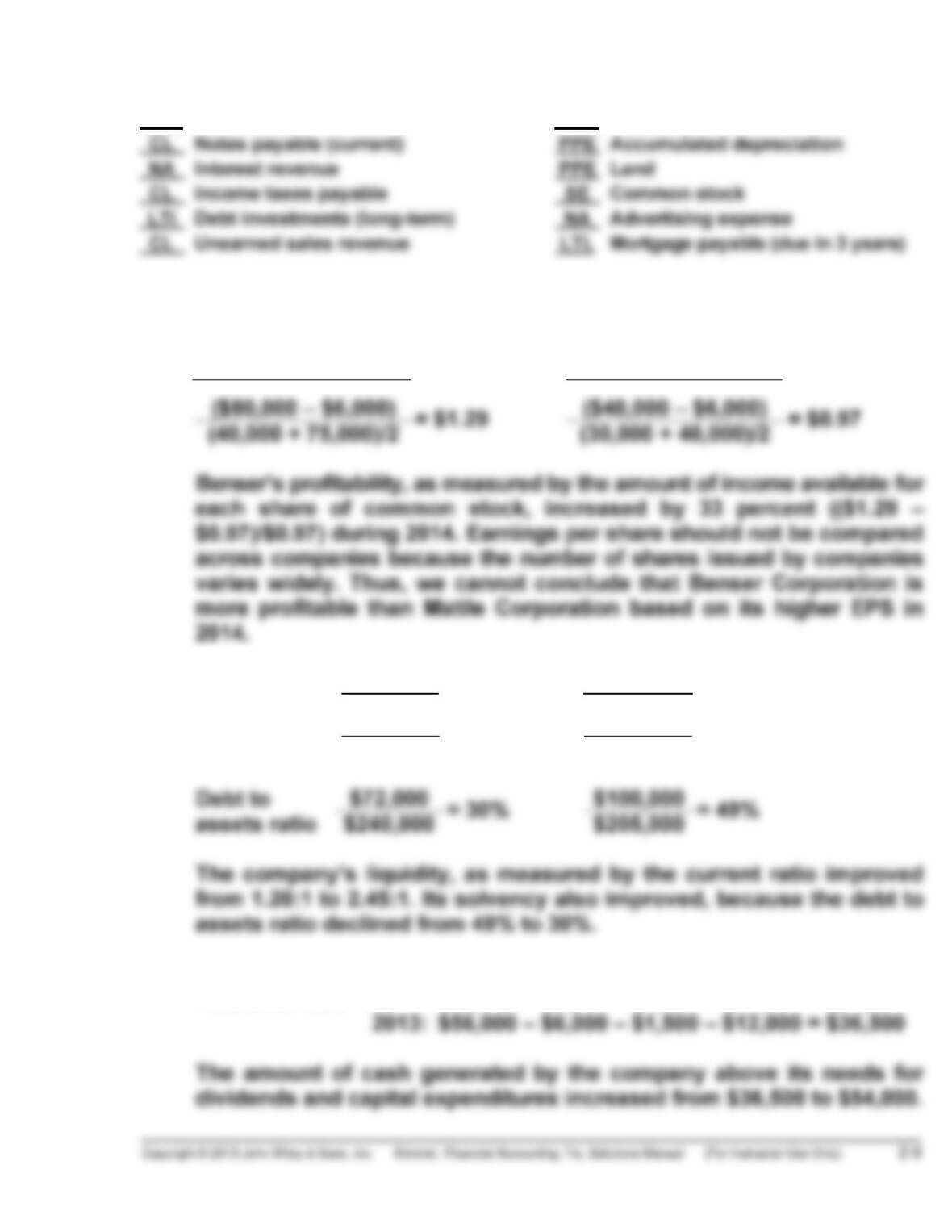
DO IT! 2-2
IA Trademarks CA Inventory
DO IT! 2-3
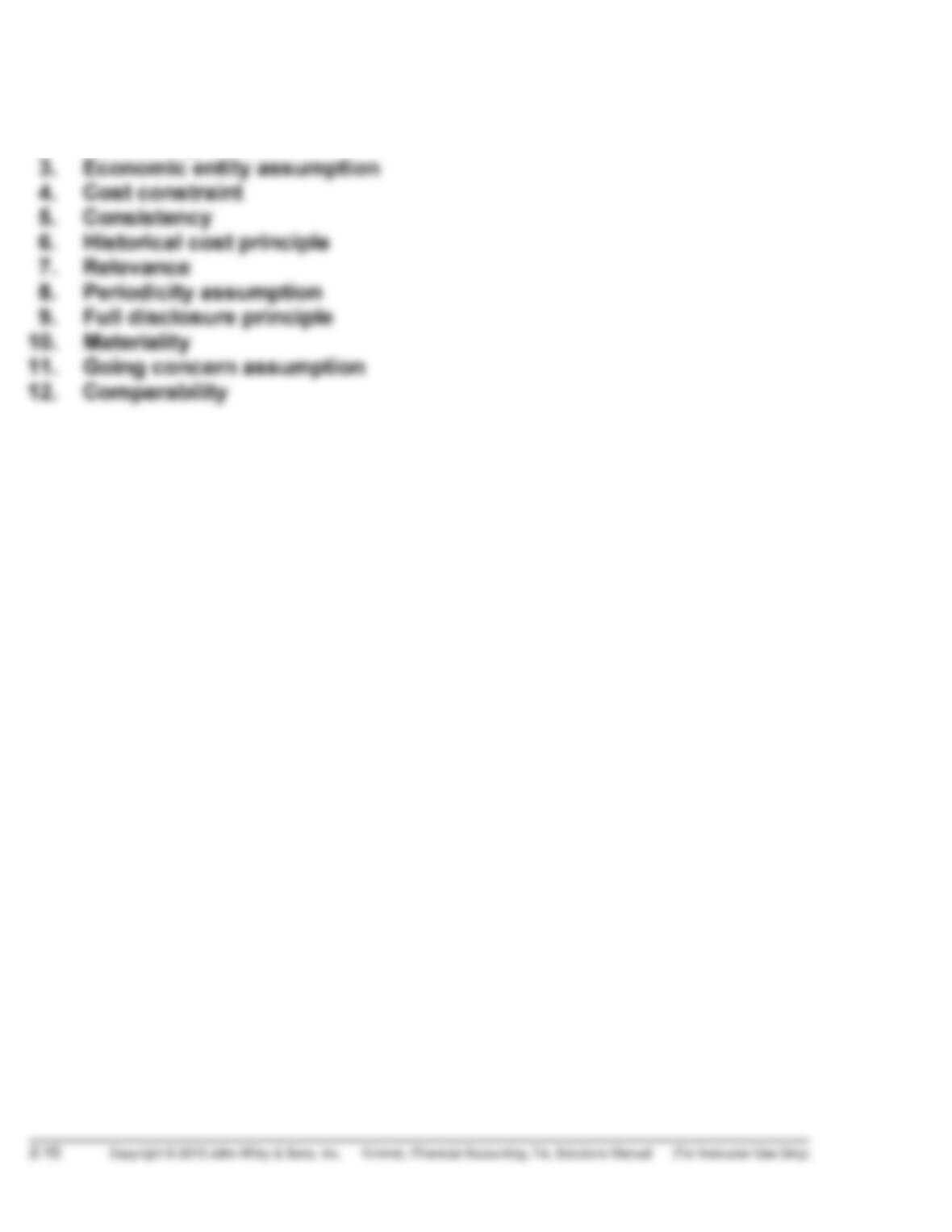
(a) 2014 2013
(b) 2014 2013
C
urrent ratio $54,000 = 2.45:1 $36,000 = 1.20:1
$22,000 $30,000
(c)
Free cash flow 2014: $90,000 – $6,000 – $3,000 – $27,000 = $54,000
DO IT! 2-4
1. Monetary unit assumption
2. Faithful representation
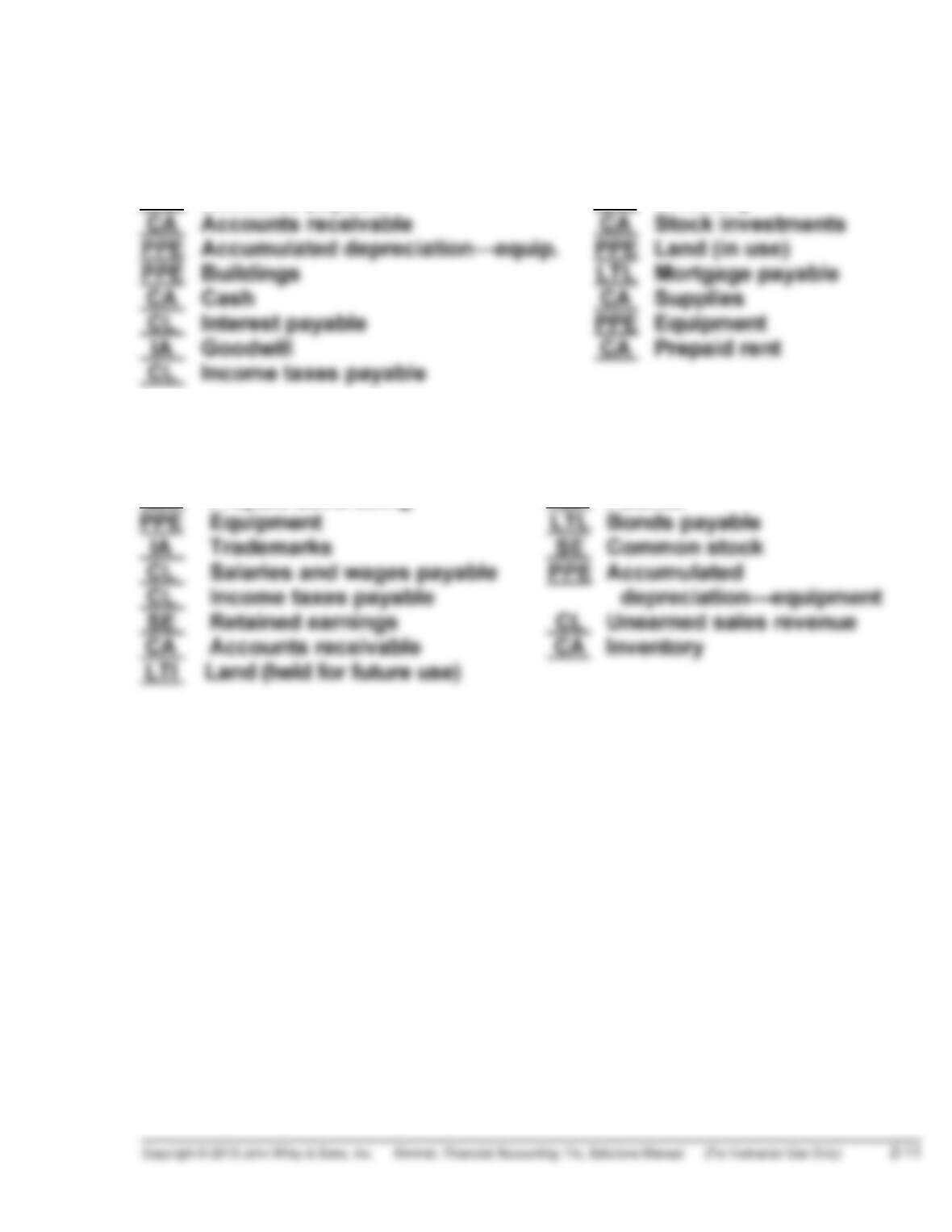
SOLUTIONS TO EXERCISES
EXERCISE 2-1
CL Accounts payable CA Inventory
EXERCISE 2-2
CA Prepaid advertising IA Patents
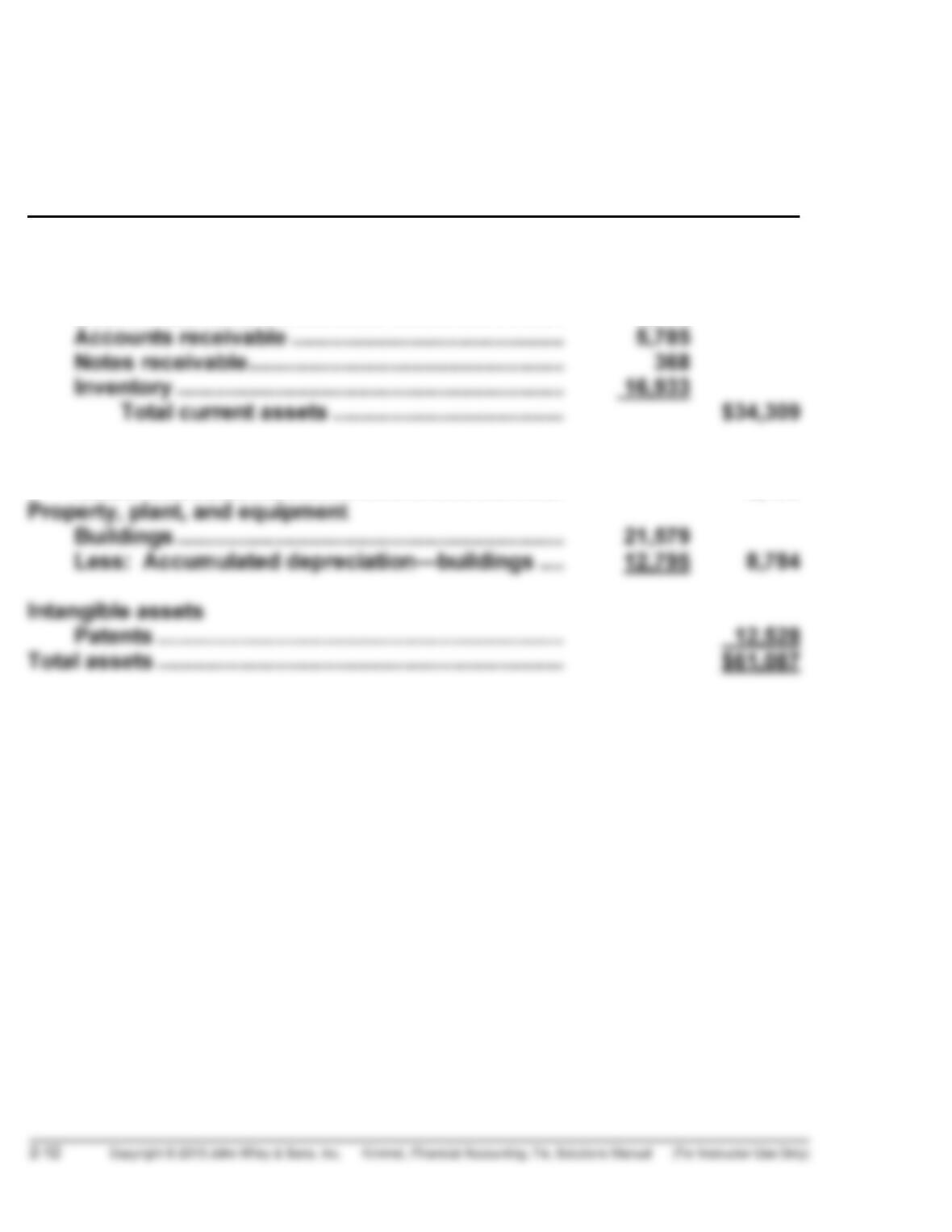
EXERCISE 2-3
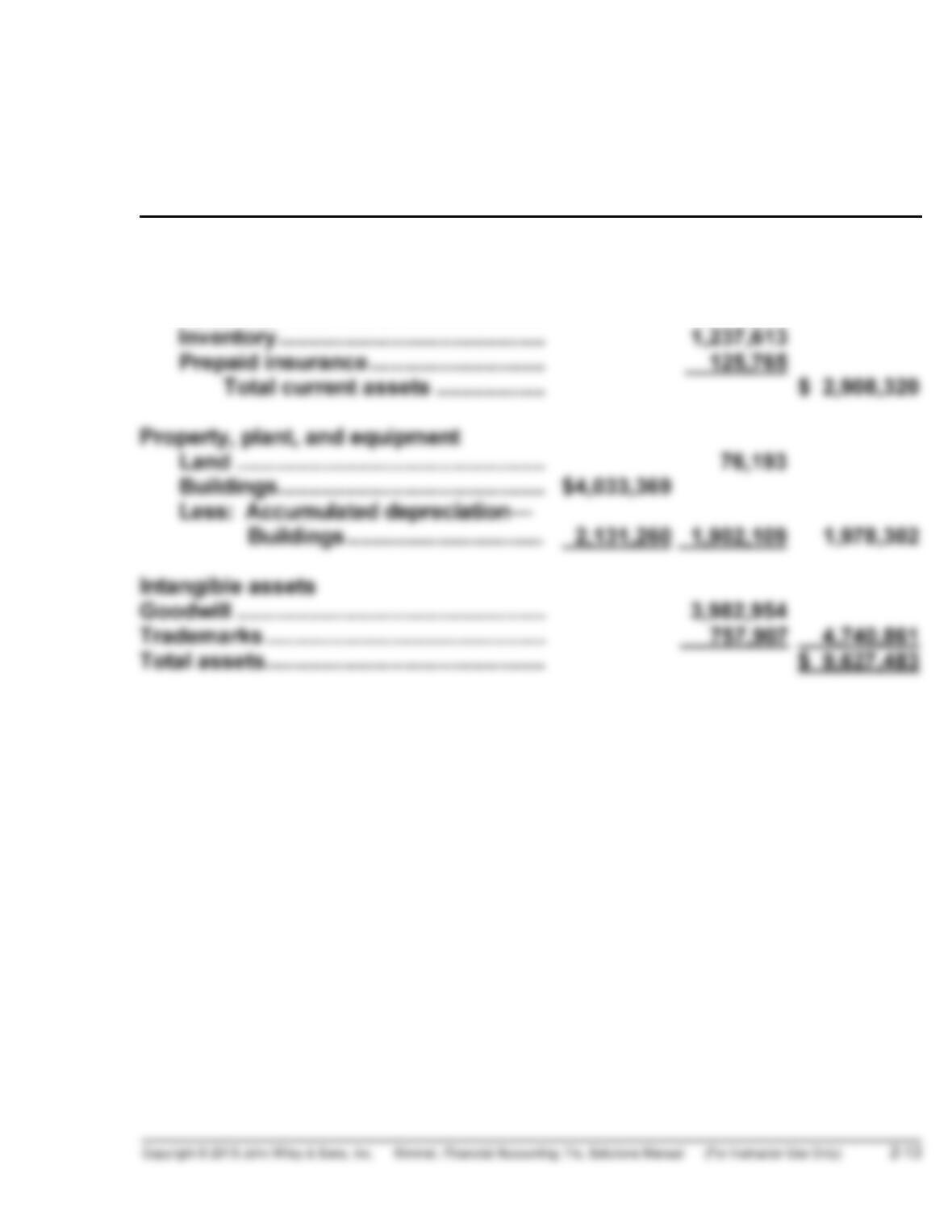
THE BOEING COMPANY
Partial Balance Sheet
December 31, 2014
(in millions)
Assets
Current assets
Cash …………………………………………………………….. $ 9,215
Debt investments ………………………………………….. 2,008
Long-term investments
Notes receivable ……………………………………………. 5,466
EXERCISE 2-4
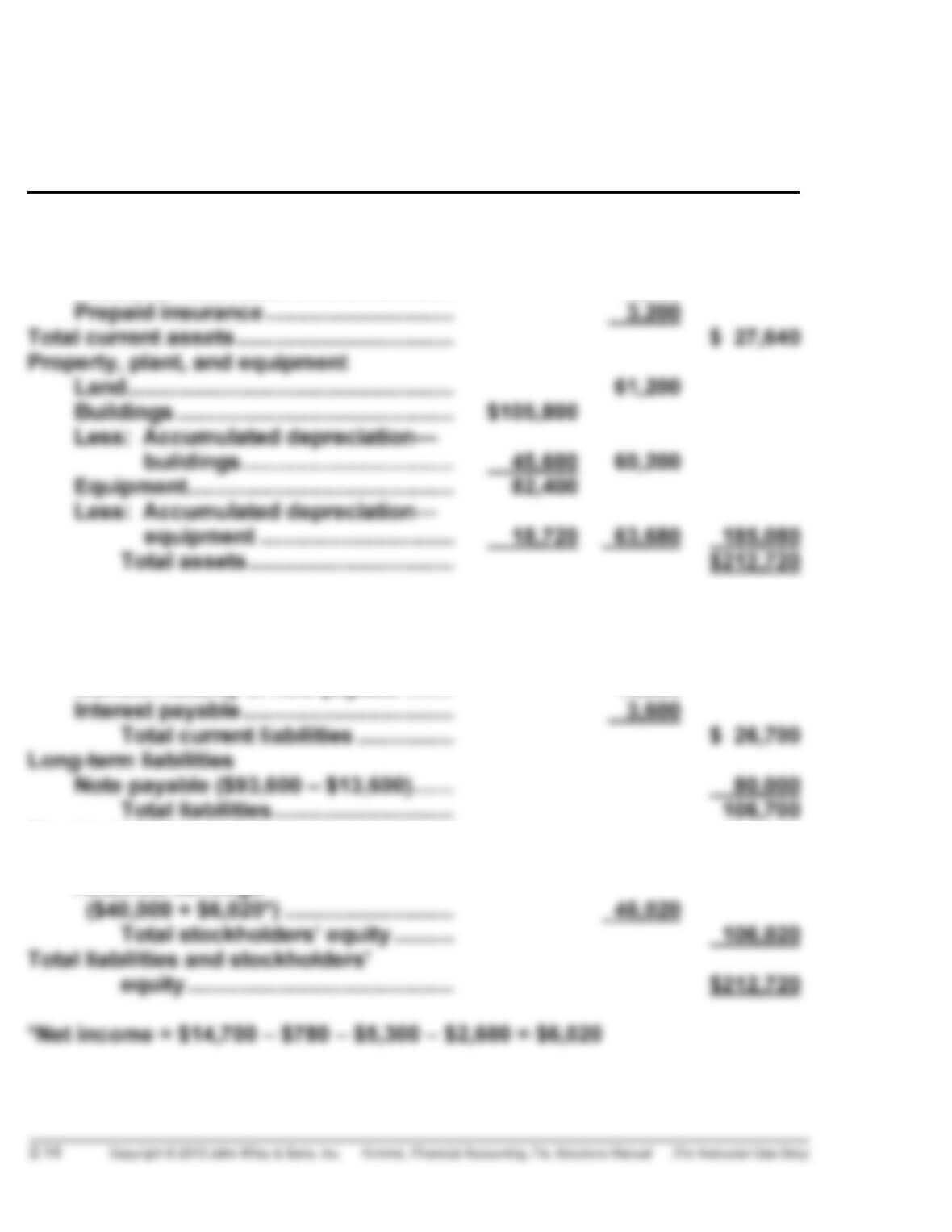
H. J. HEINZ COMPANY
Partial Balance Sheet
April 30, 2014
(in thousands)
Assets
Current assets
Cash …………………………………………… $ 373,145
Accounts receivable ……………………. 1,171,797
EXERCISE 2-5
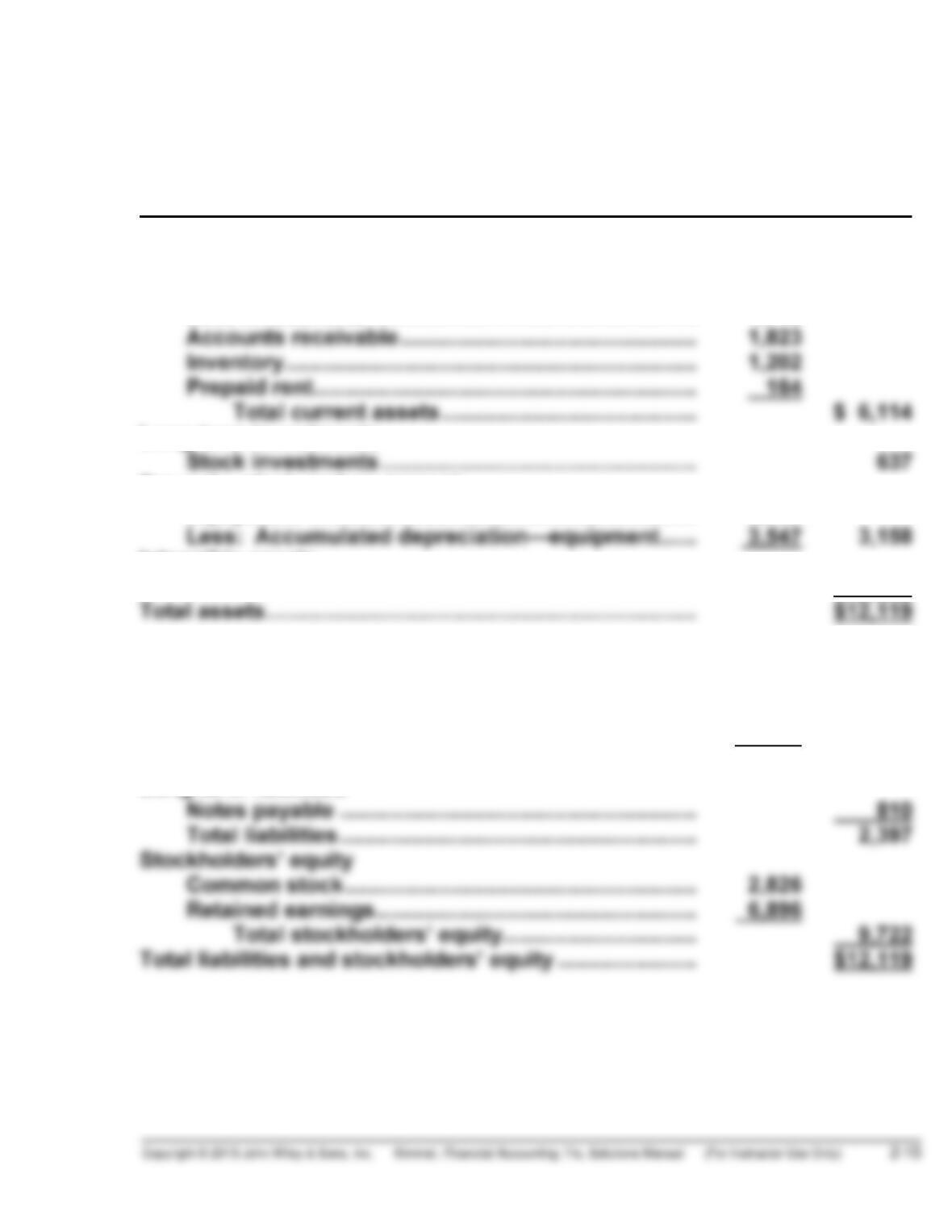
DONOVAN COMPANY
Balance Sheet
December 31, 2014
Assets
Current assets
Cash …………………………………………….. $11,840
Accounts receivable ……………………… 12,600
Liabilities and Stockholders’ Equity
Current liabilities
Accounts payable …………………………. $ 9,500
Current maturity of note payable …….. 13,600
Stockholders’ equity
Common stock ……………………………… 60,000
Retained earnings
EXERCISE 2-6
TEXAS INSTRUMENTS, INC.
Balance Sheet
December 31, 2014
(in millions)
Assets
Current assets
Cash ……………………………………………………………….. $ 1,182
Debt investments ……………………………………………… 1,743
Long-term investments
Property, plant, and equipment
Equipment ………………………………………………………. 6,705
Intangible assets
Patents …………………………………………………………….. 2,210
Liabilities and Stockholders’ Equity
Current liabilities
Accounts payable …………………………………………….. $1,459
Income taxes payable ……………………………………….. 128
Total current liabilities ……………………………….. $ 1,587
Long-term liabilities
EXERCISE 2-7
(a) Earnings per share = Net income Preferred dividends
Average common shares outstanding
—
(b) Using net income (loss) as a basis to evaluate profitability, Callaway
(c) To determine earnings per share, dividends on preferred stock are
EXERCISE 2-8
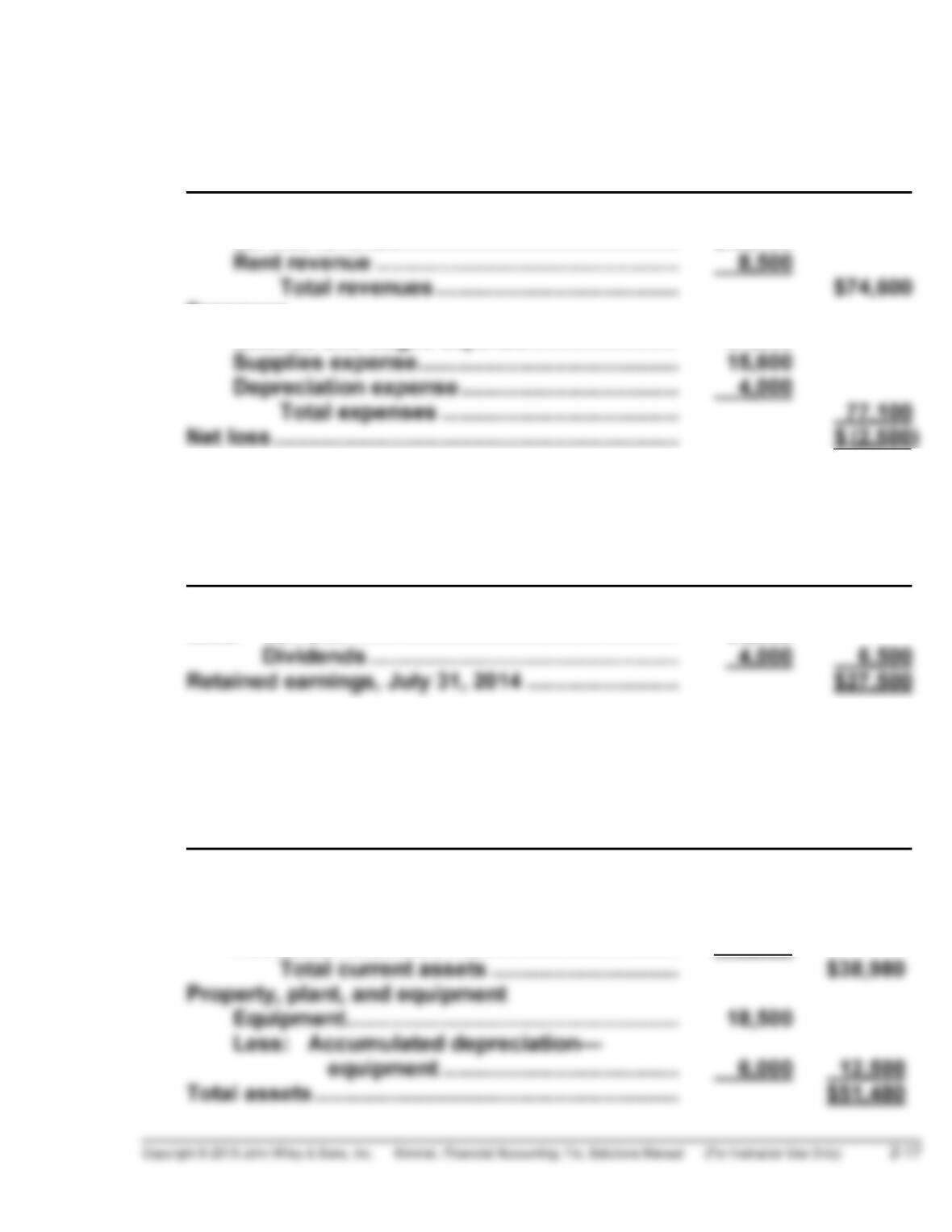
(a) BARFIELD CORPORATION
Income Statement
For the Year Ended July 31, 2014
Revenues
Service revenue………………………………………. $66,100
Expenses
Salaries and wages expense ……………………. 57,500
BARFIELD CORPORATION
Retained Earnings Statement
For the Year Ended July 31, 2014
Retained earnings, August 1, 2013 …………………. $34,000
Less: Net loss ……………………………………………… $2,500
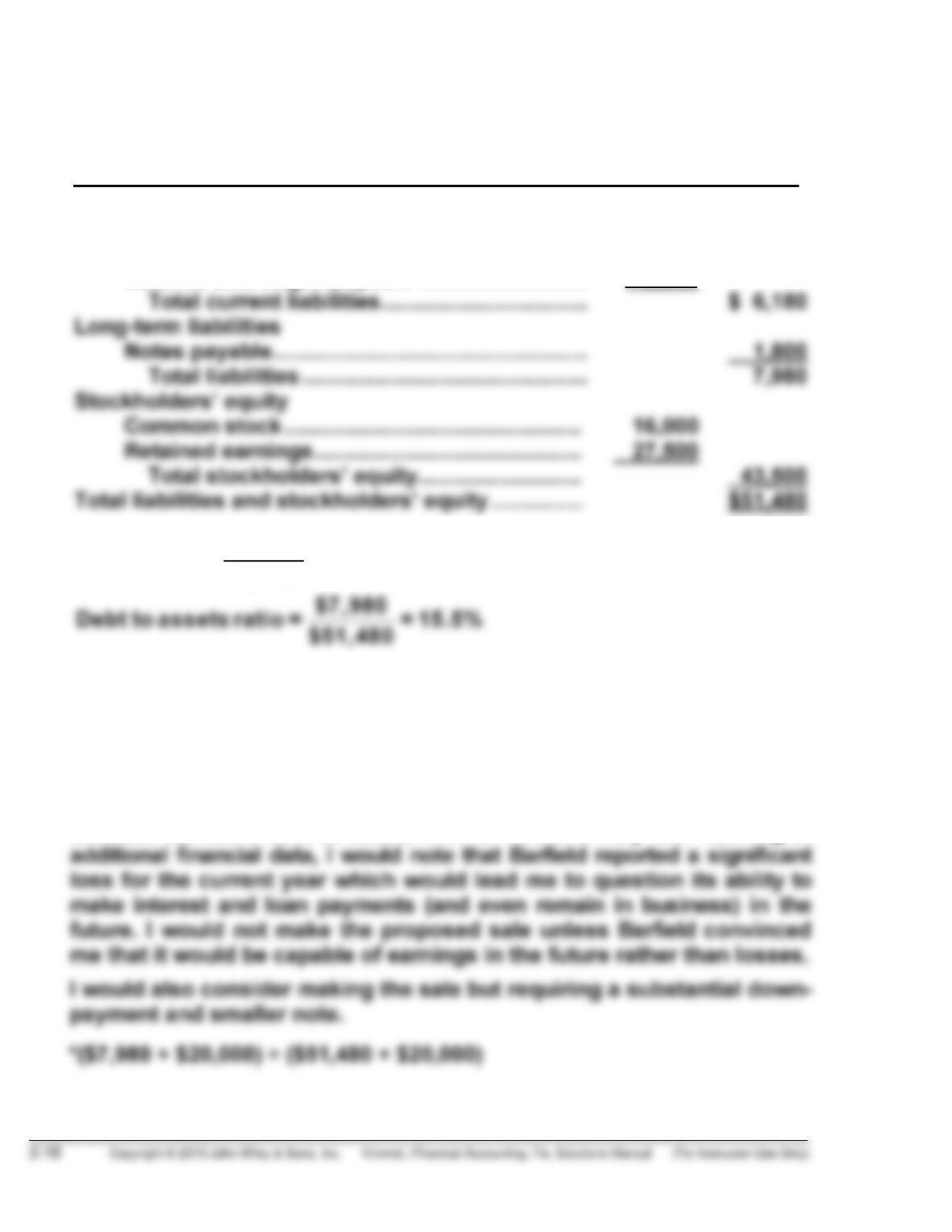
(b) BARFIELD CORPORATION
Balance Sheet
July 31, 2014
Assets
Current assets
Cash ………………………………………………………. $29,200
Accounts receivable ……………………………….. 9,780
EXERCISE 2-8 (Continued)
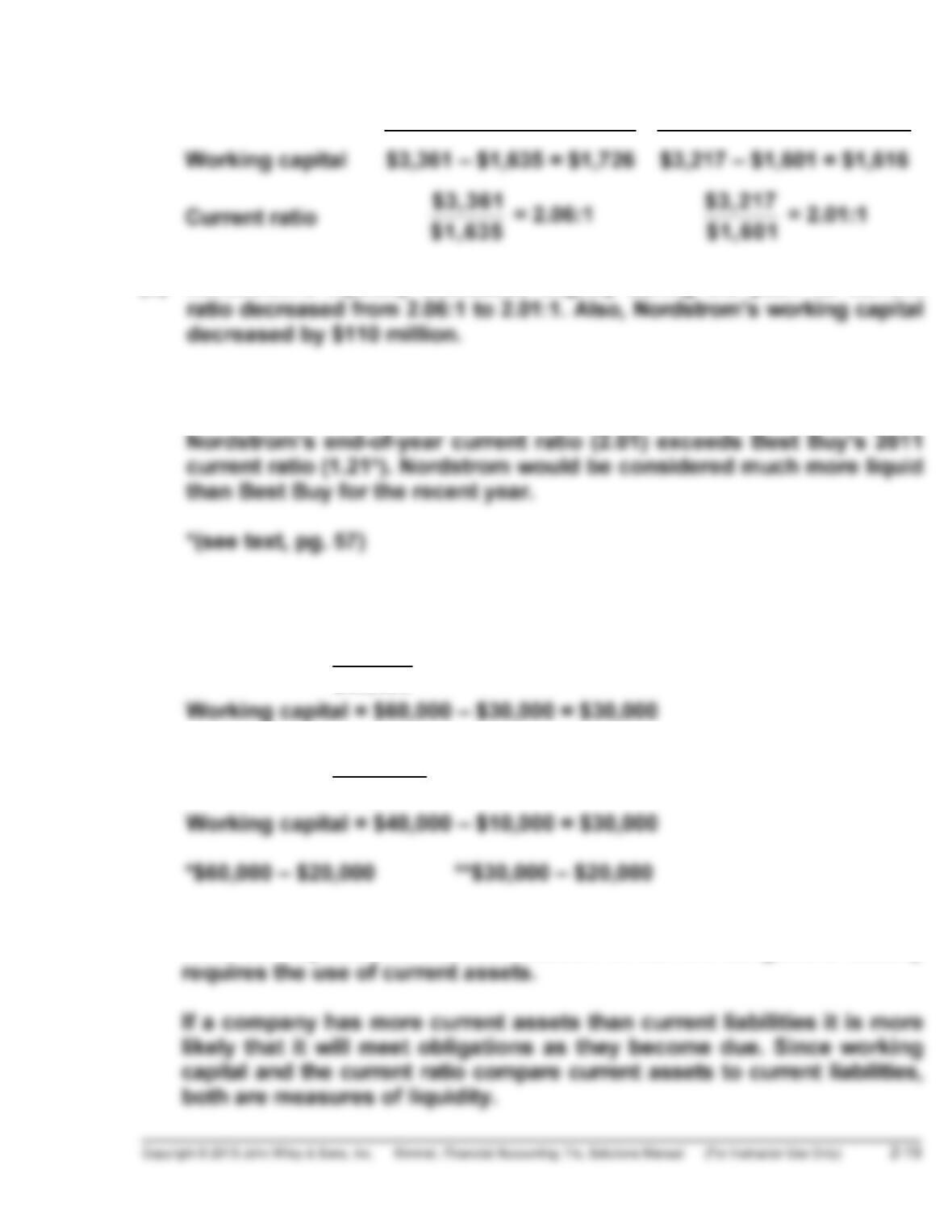
(b) BARFIELD CORPORATION
Balance Sheet (Continued)
July 31, 2014
Liabilities and Stockholders’ Equity
Current liabilities
Accounts payable ……………………………………… $ 4,100
Salaries and wages payable ………………………. 2,080
(c) Current ratio = $38, 980
$6,180 =6.3:1
(d) The current ratio would not change because equipment is not a current
asset and a 5-year note payable is a long-term liability rather than a
current liability.
The debt to assets ratio would increase from 15.5% to 39.1%*.
Looking solely at the debt to assets ratio, I would favor making the sale
because Barfield’s debt to assets ratio of 15.5% is very low. Looking at
EXERCISE 2-9
(a) Beginning of Year End of Year
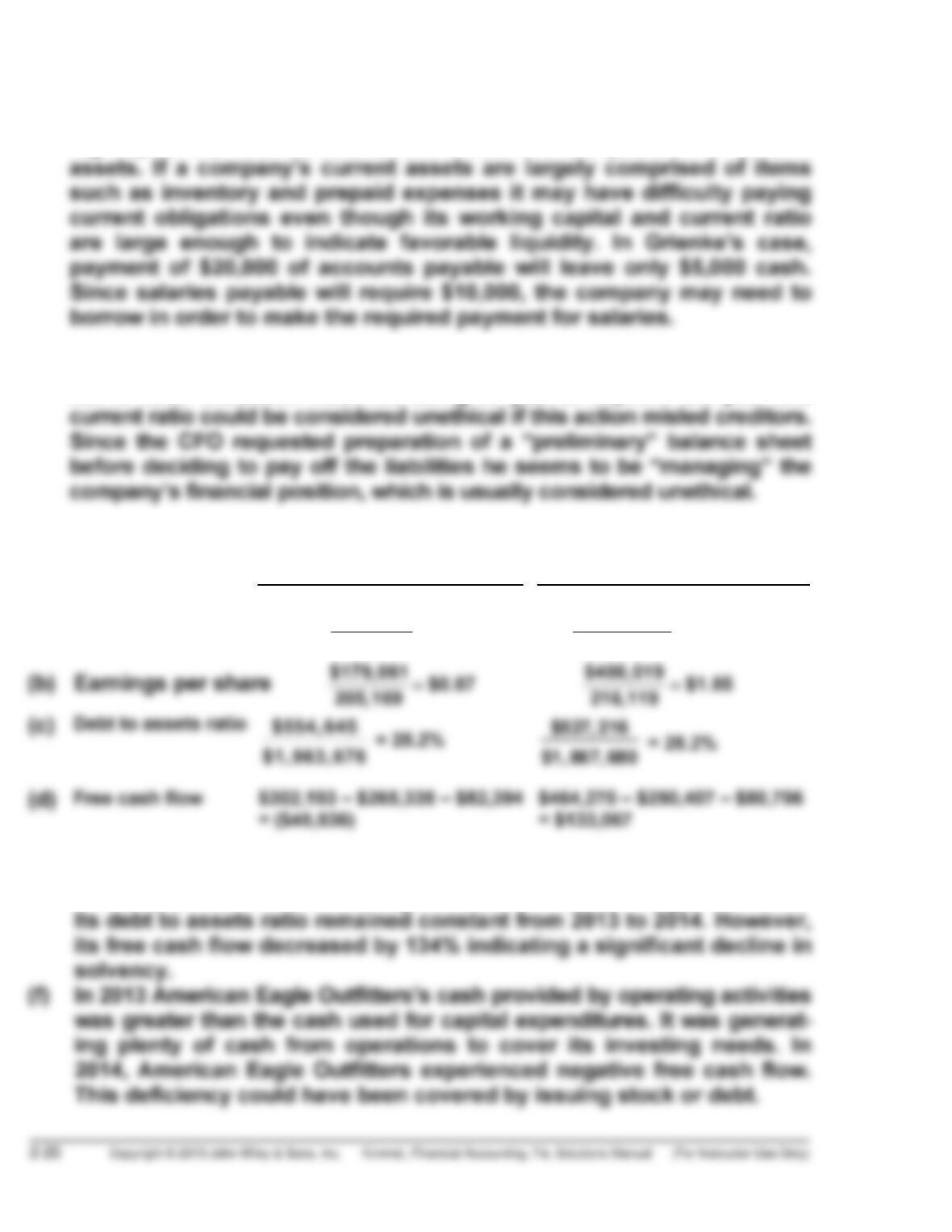
(b) Nordstrom’s liquidity decreased slightly during the year. Its current
(c) Nordstrom’s current ratio at both the beginning and the end of the
recent year exceeds Best Buy’s current ratio for 2011 (and 2010).
EXERCISE 2-10
(a) Current ratio = $60,000
$30,000 =2.0:1
(b) Current ratio = $40, 000*
$10,000** =4.0:1
(c) Liquidity measures indicate a company’s ability to pay current obliga-
tions as they become due. Satisfaction of current obligations usually
EXERCISE 2-10 (Continued)
Payment of current obligations frequently requires cash. Neither work-
ing capital nor the current ratio indicate the composition of current
(d) The CFO’s decision to use $20,000 of cash to pay off accounts payable is
not in itself unethical. However, doing so just to improve the year-end
EXERCISE 2-11
2014 2013
(a) Current ratio $925,359 $1,020,834
2.30 : 1 2.71: 1
$401,763 $376,178
==
(e) Using the debt to assets ratio and free cash flow as measures of
solvency produces deteriorating results for American Eagle Outfitters.