Chapter 2
Development and Classification
Discussion Questions
1.
a. Sources of finance. Where capital markets/shareholders are the principal source of
finance, accounting focuses on profitability, stewardship, and a fair presentation of results
and financial position. There are high levels of disclosure in published financial
b. Legal system. Accounting in code law countries tends to be highly prescriptive, detailed,
and procedural, designed to cover every possible circumstance. Accounting standards are
c. Taxation. This tends to parallel the legal system. In common law countries (where
d. Political and economic ties. Accounting technology and expertise is imported and
e. Inflation. Historical cost accounting is the basis for initially recording transactions around
f. Level of economic development. This factor defines the difficulty and types of accounting
issues that are faced in a nation. Accounting is complex where business transactions are
2. Culture underlies institutional and other arrangements in a nation that directly affect
accounting development. Individualism, power distance, and uncertainty avoidance are
likely to be the most important influences. Individualism, small power distance, and weak
uncertainty avoidance tend to be correlated with and found in common law countries with
3. This question is controversial and there is no consensus of opinion at present. However, as
noted in the answer to question 2, culture exerts a second-order effect on accounting. It
underlies institutional and other arrangements in a nation that directly affect accounting
4. Generally speaking, these patterns of accounting development are still valid today, but less so
than in 1967. The descriptions of accounting in the chapter for the respective exemplar
countries are broadly true. However, note that the Netherlands is really the only country that
can be described by the microeconomic pattern. There are also only a few countries that
follow the macroeconomic pattern. The independent discipline approach is not as ad hoc as it
5. Conservative measurements and secretive disclosures tend to be correlated. At the same time,
less emphasis on conservative measurements and transparent disclosures also tend to be
6. Classifications are a way of viewing the world. They abstract from complexity and reveal
fundamental characteristics that members of the group have in common and that distinguish
the various groups from one another. Classifications provide the basic structure for
understanding what is alike and what is different in accounting around the world. By
identifying similarities and differences, our understanding of accounting systems is improved.
Judgmental classifications rely on knowledge, intuition, and experience. Empirically derived
7. The chapter discusses three major accounting classifications. The first is the one by Mueller
(1967):
a. Macroeconomic approach, where accounting practice is designed to enhance
macroeconomic goals;
b. Microeconomic approach, where accounting develops from the principles of
microeconomics;
c. Independent discipline approach, where accounting develops from business practices
based on judgment and trial-and-error; and
d. Uniform approach, where accounting is standardized so it can be used as a tool of
administrative control by central government.
The second classification is the one based on legal systems, which closely parallels the third
classification based on practice systems. Generally speaking, the features of common law
accounting (legal system) are those described for fair presentation accounting (practice
system). The features of code law accounting (legal system) are those described for legal
compliance accounting (practice system).
Fair presentation (common law) emphasizes substance over form and is oriented toward the
8. The chapter contends that many accounting distinctions at the national level are becoming
blurred because of global capital market pressures. An increasing number of companies are
listing on multiple stock exchanges. This has pressured accounting policy makers around the
9. Our preference for classifying based on fair presentation versus legal compliance over legal
system follows from the answer to question 8. Many companies from code law countries now
10. In your authors’ opinion, the prospects for the harmonization of national systems of
accounting is low. As the chapter demonstrates, accounting satisfies the information needs of
its users and develops in response to environmental circumstances. Unless these forces
converge, there is little reason to expect accounting to converge. Also, taxation is a
fundamental influence on accounting in many countries—it is the reason accounting exists in
the first place. Unless governments are willing to relinquish their sovereignty over such
matters, national accounting systems cannot be harmonized. At the national level, accounting
systems are too entrenched.
However, the story is different at the transnational (or international) level for consolidated
financial statements. Convergence is occurring here, driven by the globalization of capital
Exercises
1. a. The dominant factor influencing accounting development in Taiwan is political and
economic ties, namely those with the United States since the 1950s. In 1949, defeated by
the Communists, Chiang Kai-shek fled to Taiwan and set up a provisional government
there. Taiwan soon began receiving substantial U.S. economic aid to prevent the further
spread of Communism. Taiwan is a dynamic capitalist economy and the United States is
the country’s largest trading partner. Taiwan is an economic power that is a leading
b. Overall, one would expect accounting to resemble U.S. accounting, emphasizing a fair
c. The above prediction is accurate according to the fifth edition of this textbook (Prentice
Hall, 2005) and Ronald Ma, ed., Financial Reporting in the Pacific Asia Region,
2. Gambia and India (both former British colonies) have common law legal systems, whereas
Belgium, Czech Republic, Mexico, Senegal (former French colony), and Taiwan have code
law legal systems. China’s legal system is not derived from code law, but more closely
3. At the time of writing, the 2008 annual report was the most recent one available. The stock
exchanges with the most foreign listed companies were London (681), New York (415),
Nasdaq (336), Singapore (312), and Mexico (248). The attraction of New York, London, and
Nasdaq for foreign companies is that these are the major capital markets in the world.
Singapore attracts many Asian companies, whereas Mexico attracts many Central and South
American companies.
The stock exchanges with the highest proportion of foreign to total listed companies were
Luxembourg (87 percent), Bermuda (69 percent), Mexico (66 percent), Singapore (41
4. Arguably the most serious obstacle to accounting harmonization in the EU is that common
and code law countries are both represented. This determines how standards are set and the
basic orientation of accounting. However, differences can be noted in every developmental
5. For the ten countries joining the EU in 2004 and the two countries joining in 2007, the level
of economic development and the fact that they lack developed capital markets (system of
6. a. The individualism scores are: China (20), the Czech Republic (58), France (71), Germany
b. Countries with high individualism scores are France, Germany, the Netherlands, United
c. According to Gray, high individualism is associated with professionalism, flexibility,
optimism, and transparency. (Note to instructors: After reading Chapters 3 and 4,
students will recognize that these characterize Dutch, U.K., and U.S. accounting, but not
7. a. The uncertainty avoidance scores are: China (30), the Czech Republic (74), France (86),
b. Countries with high uncertainty avoidance scores are the Czech Republic, France,
c. According to Gray, high uncertainty avoidance is associated with statutory control,
uniformity, conservatism, and secrecy. (Note to instructors: After reading Chapters 3 and
4, students will recognize that Gray’s prediction describes accounting well for the Czech
d. The only consistent prediction between Exercise 6 (individualism) and Exercise 7
(uncertainty avoidance) is that for the United Kingdom. Gray’s model linking culture and
accounting is valid for the United Kingdom. The model’s predictions are exactly opposite
8. The following table summarizes the use of IFRS by domestic listed companies in the 10
countries identified, according to the IAS Plus Web site at the time of writing:
Not permitted
Permitted
Required for
Some
Required for All
China
X
Czech Republic
X
France
X
Germany
X
India
X
Japan
X
Mexico
X
Netherlands
X
X
United States
X
The five countries of the European Union require their domestic listed companies to use
IFRS. This EU requirement is discussed in this chapter. China, India, Japan, Mexico, and the
United States require their domestic listed companies to use national GAAP, not IFRS. The
9. France: With banks and government as the main sources of finance, we can expect
conservative and uniform measurements. With code law legal system, the focus is on
complying with the law. The link to taxation means that measurements are also tax-oriented.
Political and economic ties with the rest of Europe suggest that French accounting may
influence and be influenced by other European countries. Low inflation indicates a low
likelihood of inflation adjustments. The levels of economic development and education
suggest sophisticated accounting.
India: With the government and stock market as the main sources of finance, we can expect a
mixed (and inconsistent) orientation—uniformity but also fair presentation. The common law
Japan: With banks as the main source of finance, we can expect conservative accounting
measurements. With the code law legal system, focus is on complying with the law. The link
likelihood of inflation adjustments. The levels of economic development and education
suggest sophisticated accounting.
United Kingdom: With the stock market as the main source of finance, we can expect fair
presentation accounting. Fair presentation accounting can also be expected because the
United States: With the stock market as the main source of finance, we can expect fair
presentation accounting. Fair presentation accounting can also be expected because the
10. The irreversible globalization of capital markets and increasing trend of multiple stock
exchange listings is causing more and more companies to adopt fair presentation accounting
for their worldwide audience. The chapter notes how accounting distinctions are becoming
blurred. Chapter 3 also notes how Germany and Chapter 4 shows how Japan have
established standard setting organizations for the purpose of adopting reporting standards for
consolidated financial statements that are in line with International Financial Reporting
Standards. Standard setters in the United States, Canada, Australia, and many other
countries are committed to converging their financial reporting with IFRS. Finally, the
European Union now requires EU-listed companies to follow IFRS in their consolidated
financial statements from 2005 on.
Thus, we believe that the two-way split proposed in the chapter (fair presentation versus
Case 2-1 Are Classifications of Accounting Outmoded?
1. The comments by Mr. Cairns are inconsistent with ideas put forth in this chapter as well as
most international accounting observers. Although it is true that classifications are
2. However, it does seem that for a select segment of the corporate world, the classifications
discussed in the chapter are less (or ir-) relevant. World class companies, multinationals with
multiple share listings around the world, are increasingly tailoring their financial reports for a
sophisticated, worldwide user group that has essentially similar demands for information. It is
the pursuit of international capital that seems to be driving this phenomenon. Thus, one
should distinguish financial reporting at the domestic level from that at the international level,
Case 2-2 Volkswagen Group
1. Germany is a code law country with legal compliance accounting. Thus, German accounting
may be characterized as tax-determined, with conservative measurements and income
2. Conservative measurements are most obvious in the different balances for capital and
reserves according to German Commercial Code (€9,811) versus IAS (€20, 918).
Conservative measurements are also illustrated by the noncapitalization of development
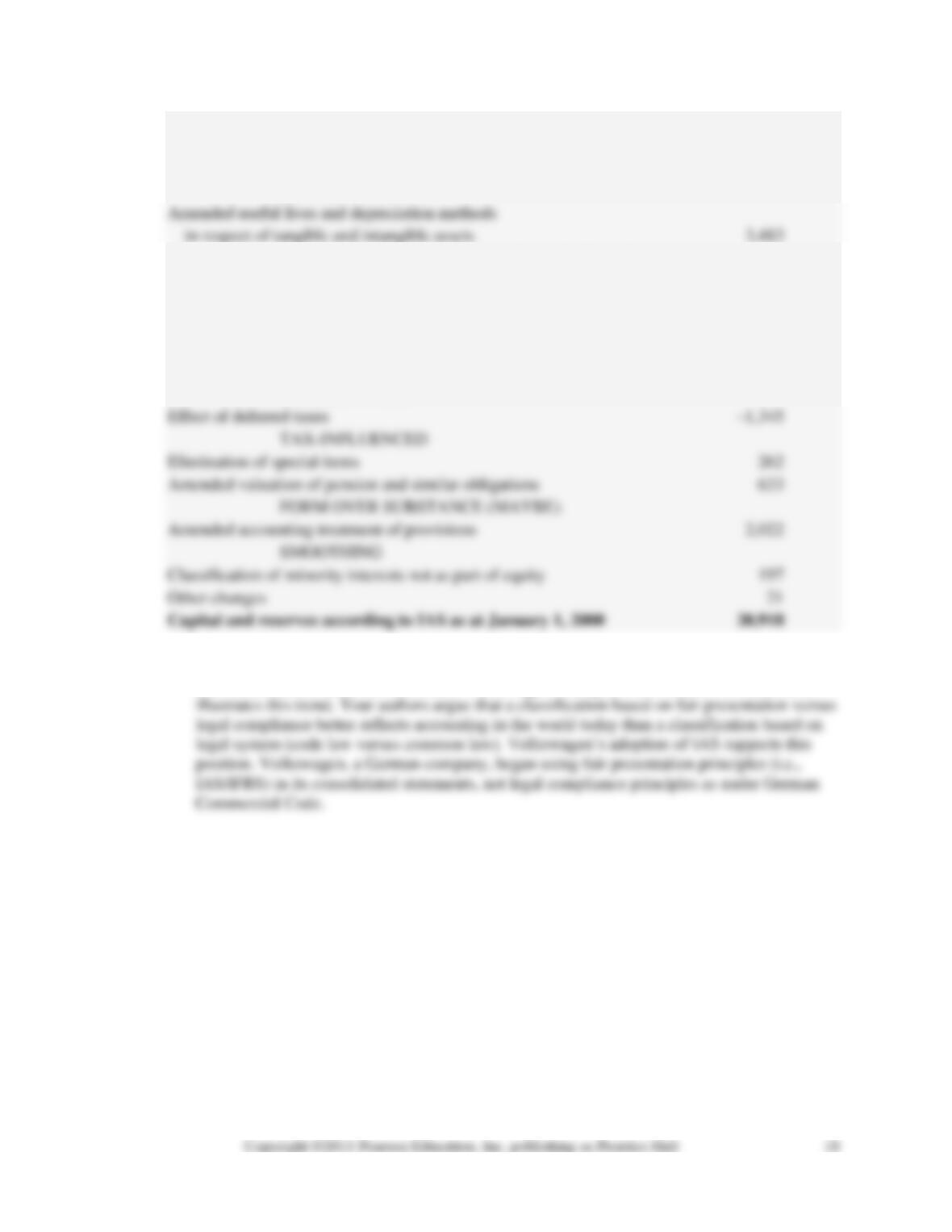
Capital and reserves according to the German Commercial
Code as at January 1 2000 9,811
Capitalization of development costs 3,982
CONSERVATISM
TAX-INFLUENCED; FORM OVER SUBSTANCE
Capitalization of overheads in inventories 653
CONSERVATISM
Different treatments of leasing contracts as lessor 1,962
FORM OVER SUBSTANCE
Differing valuation of financial instruments 897
CONSERVATISM
3. Companies from code law countries are increasingly adopting fair presentation accounting in
their consolidated financial statements. Volkswagen’s adoption of IAS (now IFRS) in 2001