33
CHAPTER 2
BASIC ACCOUNTING SYSTEMS: CASH BASIS
CLASS DISCUSSION QUESTIONS
1. The basic elements of a financial ac-
counting system include the following:
(1) a set of rules for determining what,
when, and how much should be recorded;
(2) a framework for preparing financial
statements; and (3) one or more controls
2. a. Purchase of land for cash affects
only assets.
b. Payment of a liability affects assets
and liabilities; receipt of cash for
fees earned affects assets and
stockholders’ equity.
c. Incurring an expense partially paid
in cash decreases assets increases
liabilities and decreases stockhold-
and decrease stockholders’ equity
(retained earnings) ($10,000). The
expense is an organizational ex-
pense. Likewise, a new business
might hire a new chief operating of-
ficer by agreeing to pay a nonre-
fundable, noncancellable signing
3. Out of balance. Assets are correct, but retained
earnings (utilities expense) should have been
decreased by $1,200 rather than $2,100. Thus,
retained earnings is understated by $900, and
total liabilities plus stockholders’ equity would be
less than total assets by $900.
liabilities are overstated by $7,000, and re-
tained earnings (fees earned) are understated
by $7,000; thus, the over- and understate-
ments offset each other, and the accounting
equation balances.
5. A primary control for determining the accuracy of
record keeping is the equality of the accounting
equation. The accounting equation must balance.
6. Total assets are increased by $175,000: an in-
crease in cash of $375,000 and a decrease in
come to stockholders and are not an ex-
pense.
8. a. The equality of the accounting equation
would not be affected. That is, the account-
ing equation would still balance.
b. On the income statement, total operating
expenses (salary expense) would be over-
34
9. a. The equality of the accounting equa-
tion would not be affected. That is,
the accounting equation would still
balance.
b. On the income statement, revenues
(fees earned) would be overstated
by $75,000, and net income would
activities, and thus, the net increase or
decrease in cash for the period is correct, as
is the ending cash balance.
10. a. $350,000 ($500,000 – $150,000)
b. Stockholders’ equity as of
December 31, 20Y8 …….. $400,000
Less stockholders’ equity as of
35
EXERCISES
E2–1
a. $950,000 ($357,500 + $592,500)
E2–2
Amounts in millions:
a. $47,323 ($92,033 – $44,710)
b. $6,075 increase ($3,756 + $2,319)
E2–3
Amounts in millions:
a. $1,533 ($7,837 – $6,304)
b. $112 increase ($223 – $111)
36
E2–4
(a) $193,437 ($241,272 – $47,835)
(b) $128,249 ($321,686 – $193,437)
(f) $221,656 [($214,047 + $7,609) or ($244,180 – $22,524)]
(g) $12,963 [($257,143 – $244,180) or ($20,572 – $7,609)]
E2–5
a. $825,000 ($1,200,000 – $375,000)
b. $895,000 ($825,000 + $150,000 – $80,000)
37
E2–6
a. (3) No effect
b. (3) No effect
f. (2) Decrease
g. (2) Decrease
E2–7
a. Increases assets and increases stockholders’ equity.
b. Decreases assets and decreases stockholders’ equity.
E2–8
1. Total assets decreased $140,000.
E2–9
1. (a) increase
4. (b) decrease
38
E2–10
1. (c)
2. (e)
6. (a)
7. (e)
E2–11
a. (1) Provided catering services for cash, $28,000.
(2) Purchased land for cash, $20,000.
b. $11,000 ($40,000 – $29,000)
c. $9,000 ($109,000 – $100,000)
d. $10,000 ($28,000 – $18,000)
E2–12
It would be incorrect to say the business incurred a net loss of $8,000. The excess
of the dividends over the net income for the period is a decrease in the amount of
retained earnings in the corporation.
39
E2–13
Company Sierra
Stockholders’ equity at end of year ($770,000 – $294,000) …..…………… $ 476,000
Deduct stockholders’ equity at beginning of year
($490,000 – $175,000) ………………………………………………………………… (315,000)
Net income (increase in stockholders’ equity) …………….……………… $ 161,000
Company Tango
Company Yankee
Increase in stockholders’ equity (as determined for Sierra) ……………… $ 161,000
Deduct issuance of additional common stock ………………..……………….. (75,000)
Net income ……………………………………………………………………………….. $ 86,000
Company Zulu
40
E2–14
In each case, solve for a single unknown, using the following equation:
Stockholders’ Equity (beginning) + Issuance of Common Stock – Dividends +
Revenues – Expenses = Stockholders’ Equity (ending)
Krypton: Stockholders’ equity at end of year ($350,000 – $110,000) … $ 240,000
Deduct stockholders’ equity at beginning of year
($250,000 – $130,000) ……………………………………………………………. (120,000)
Increase in stockholders’ equity ……………………………………… $ 120,000
Add dividends ………………………………………..………………………. 16,000
$ 136,000
Deduct additional issuance of common stock ………………….. (50,000)
Increase due to net income …………………………….……………….. $ 86,000
Add expenses ………………………………………………………………… 64,000
Revenue …………………………………………….……………………….. (b) $ 150,000
Radium: Stockholders’ equity at end of year ($248,000 – $136,000) … $ 112,000
Add decrease due to net loss ($112,000 – $128,000) ……….… 16,000
$ 128,000
Add dividends ………………………………………..………………………. 60,000
41
E2–15
Amounts in millions:
a. $(9,186) = $18,412 – $27,598
E2–16
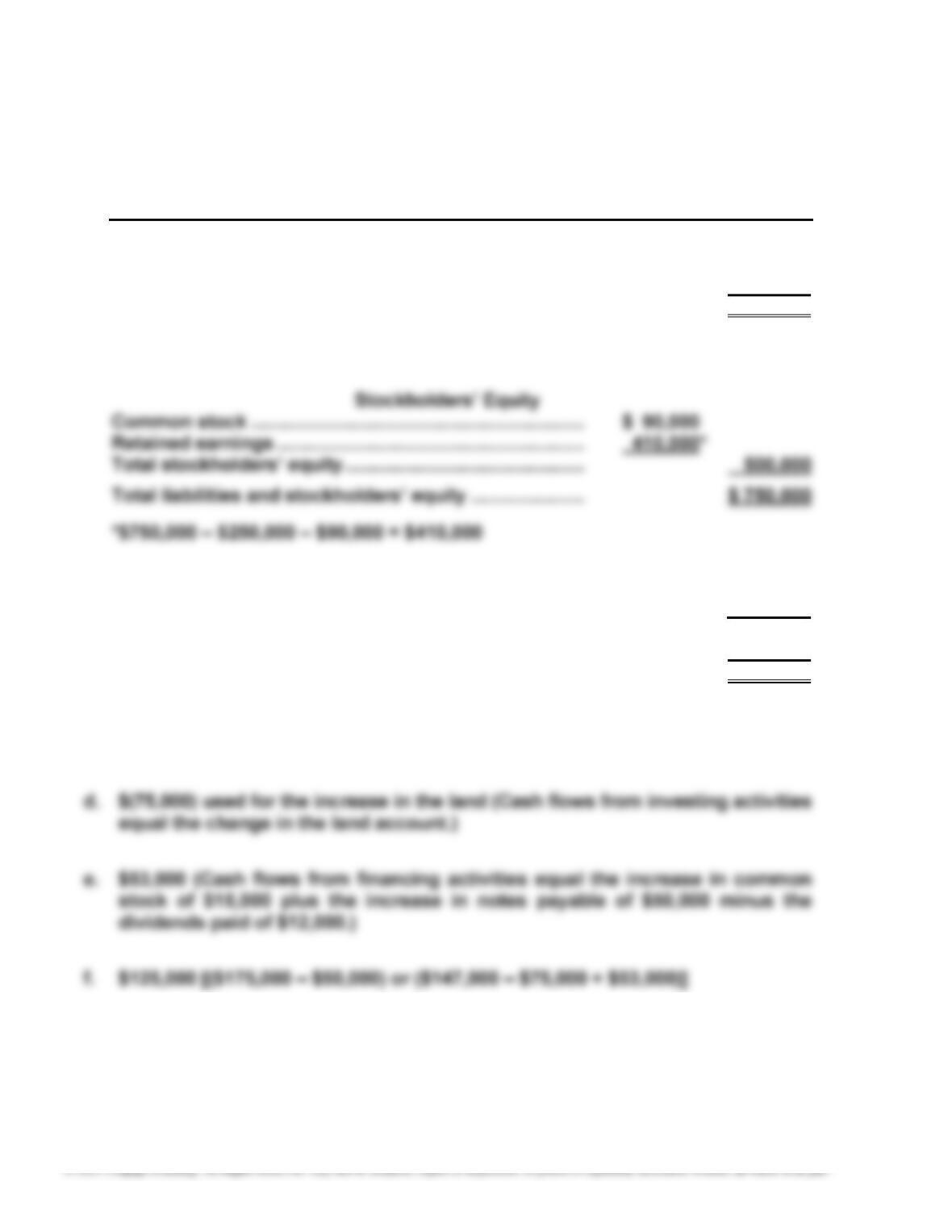
a. ABBY’S INTERIORS
Balance Sheet
October 31, 20Y6
Assets
Cash ………………………………………………………………………. $ 50,000
Land ………………………………………………………………………. 500,000
Total assets ………………………………………….………………… $550,000
Liabilities
Notes payable ………………………………………………………… $200,000
42
E2–16, Concluded
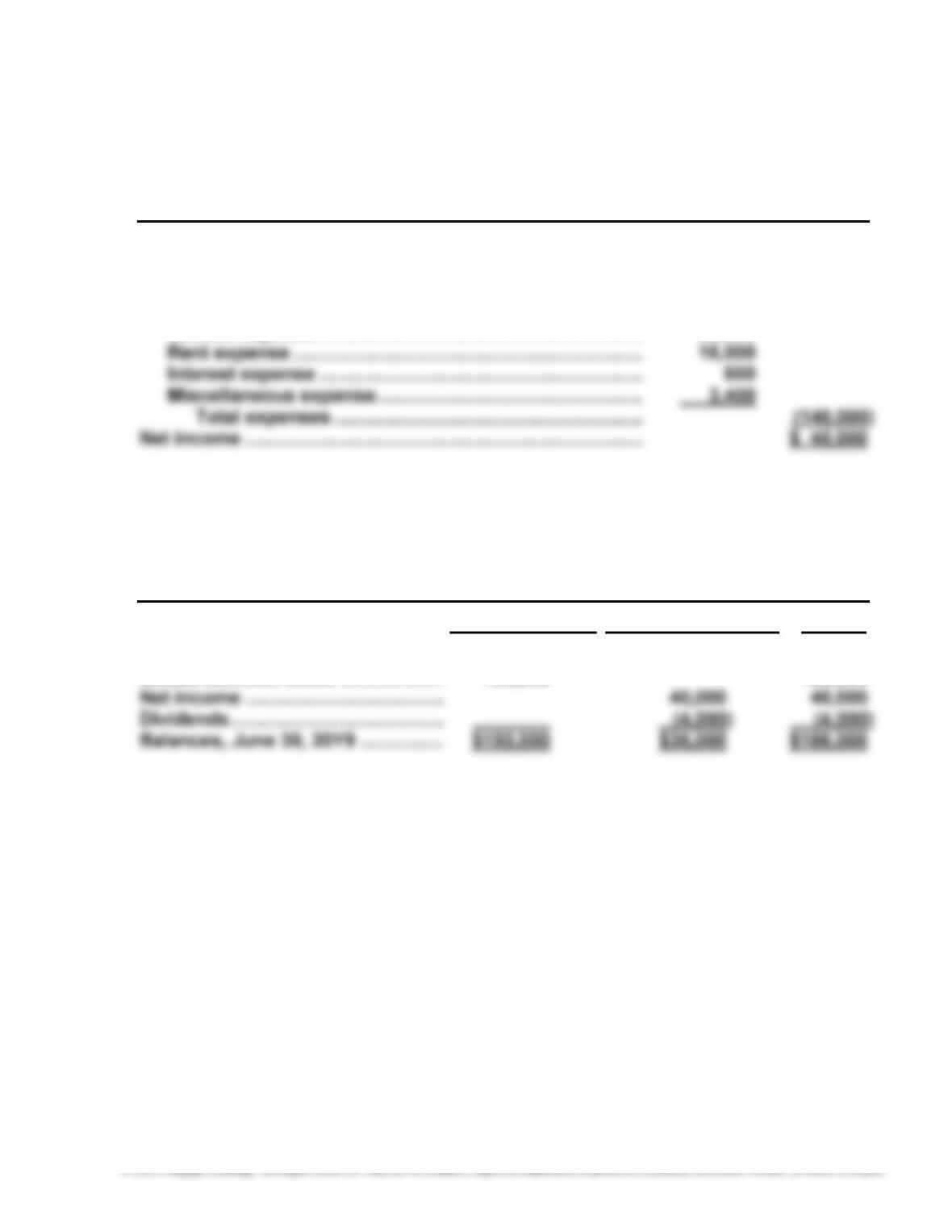
ABBY’S INTERIORS
Balance Sheet
November 30, 20Y6
Assets
Cash ……………………………………………………………………… $ 175,000
Land ………………………………………………………………………. 575,000
Total assets ………………………………………….……………….. $ 750,000
Liabilities
Notes payable ………………………………………………………… $ 250,000
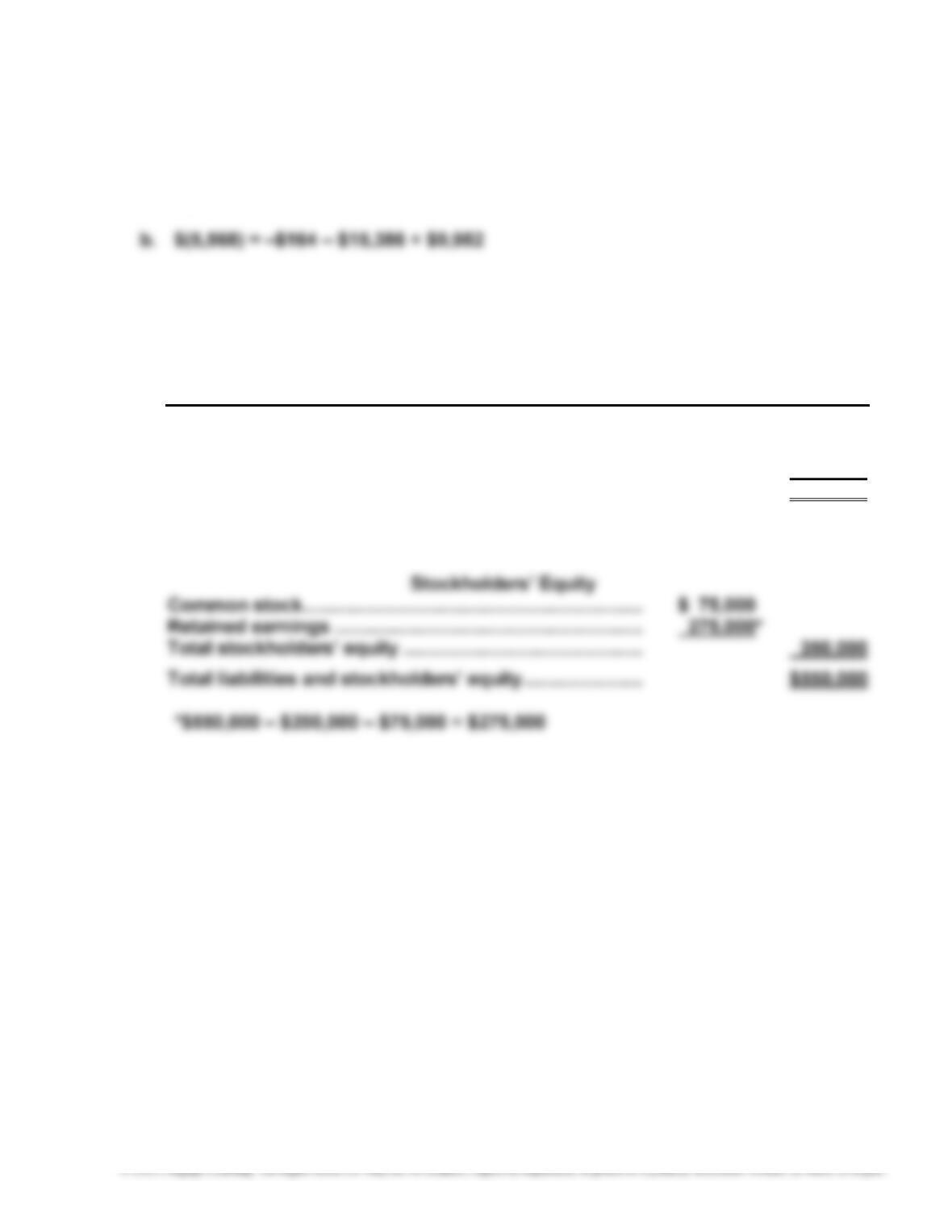
b. Retained earnings, November 30, 20Y6 …………………..…………………. $ 410,000
Less retained earnings, October 31, 20Y6 ………………………………….. (275,000)
Increase in retained earnings …………………………..………………………… $ 135,000
Add dividends ………………………………………………………………………….. 12,000
Net income ……………………………………………………………………………….. $ 147,000
c. Net cash flows from operating activities = $147,000 (The same as net income using
the cash basis.)
43
E2–17
WEST COAST DREAMS REALTY INC.
Income Statement
For the Month Ended June 30, 20Y9
Revenues:
Sales commissions ……………………………………..…………. $180,000
Expenses:
Salaries expense ……………………………………………………. $100,000
E2–18
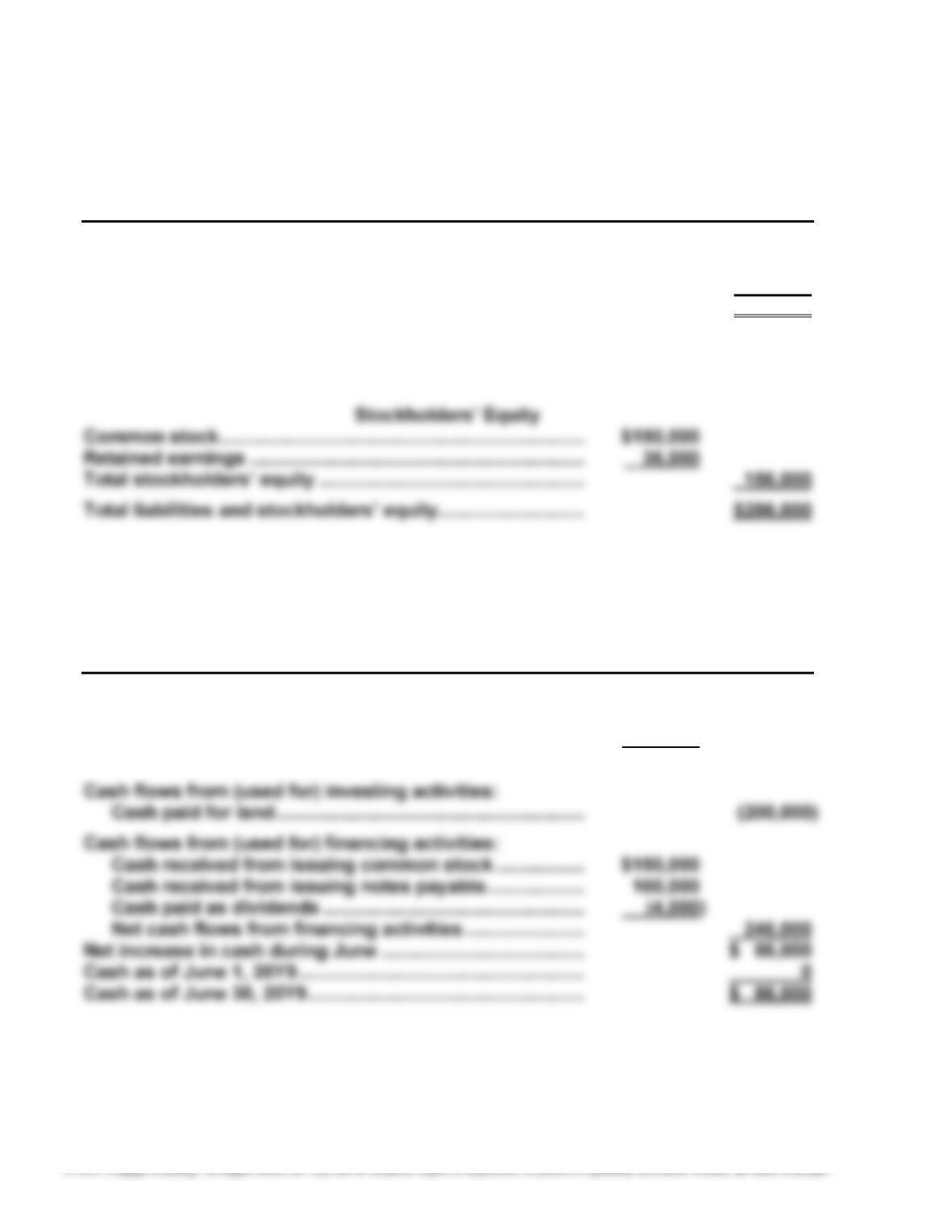
WEST COAST DREAMS REALTY INC.
Statement of Stockholders’ Equity
For the Month Ended June 30, 20Y9
Common Stock Retained Earnings Total
Balances, June 1, 20Y9 ……………… $ 0 $ 0 $ 0
44
E2–19
WEST COAST DREAMS REALTY INC.
Balance Sheet
June 30, 20Y9
Assets
Cash ………………………………………………….……………………….. $ 86,000
Land ………………………………………………….……………………….. 200,000
Total assets ………………………………………………………………… $286,000
Liabilities
Notes payable ………………………………………….…………………. $100,000
E2–20
WEST COAST DREAMS REALTY INC.
Statement of Cash Flows
For the Month Ended June 30, 20Y9
Cash flows from (used for) operating activities:
Cash received from operating activities ………………….. $ 180,000
Cash paid for operating activities ……………………………. (140,000)
Net cash flows from operating activities ………………….. $ 40,000
45
E2–21
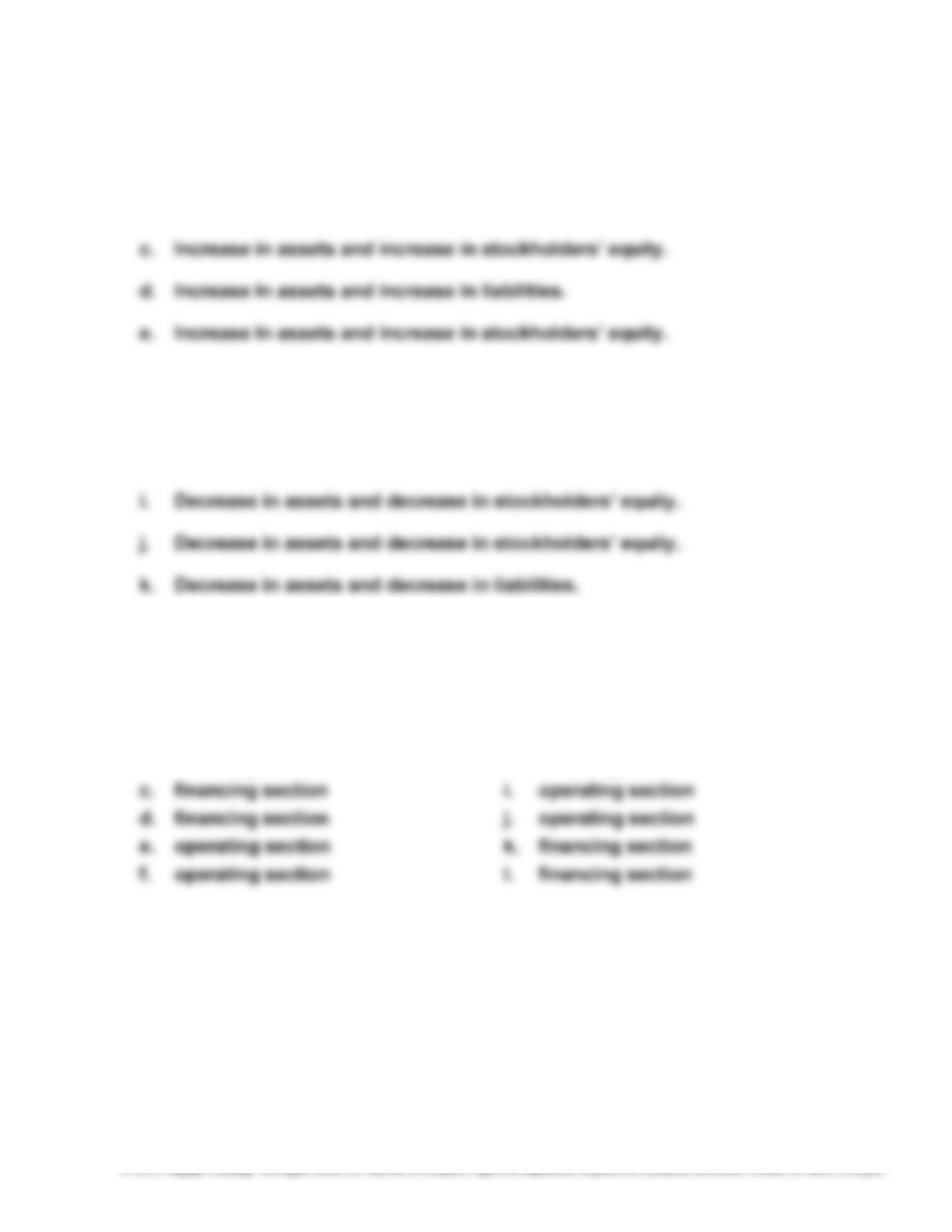
a. Decrease in assets and decrease in stockholders’ equity.
b. Increase in assets and decrease in assets.
f. Decrease in assets and decrease in stockholders’ equity.
g. Decrease in assets and decrease in stockholders’ equity.
h. Increase in assets, decrease in assets, and increase in stockholders’ equity.
l. Decrease in assets and decrease in stockholders’ equity.
E2–22
a. operating section
b. investing section
g. operating section
h. investing section
46
P2–1
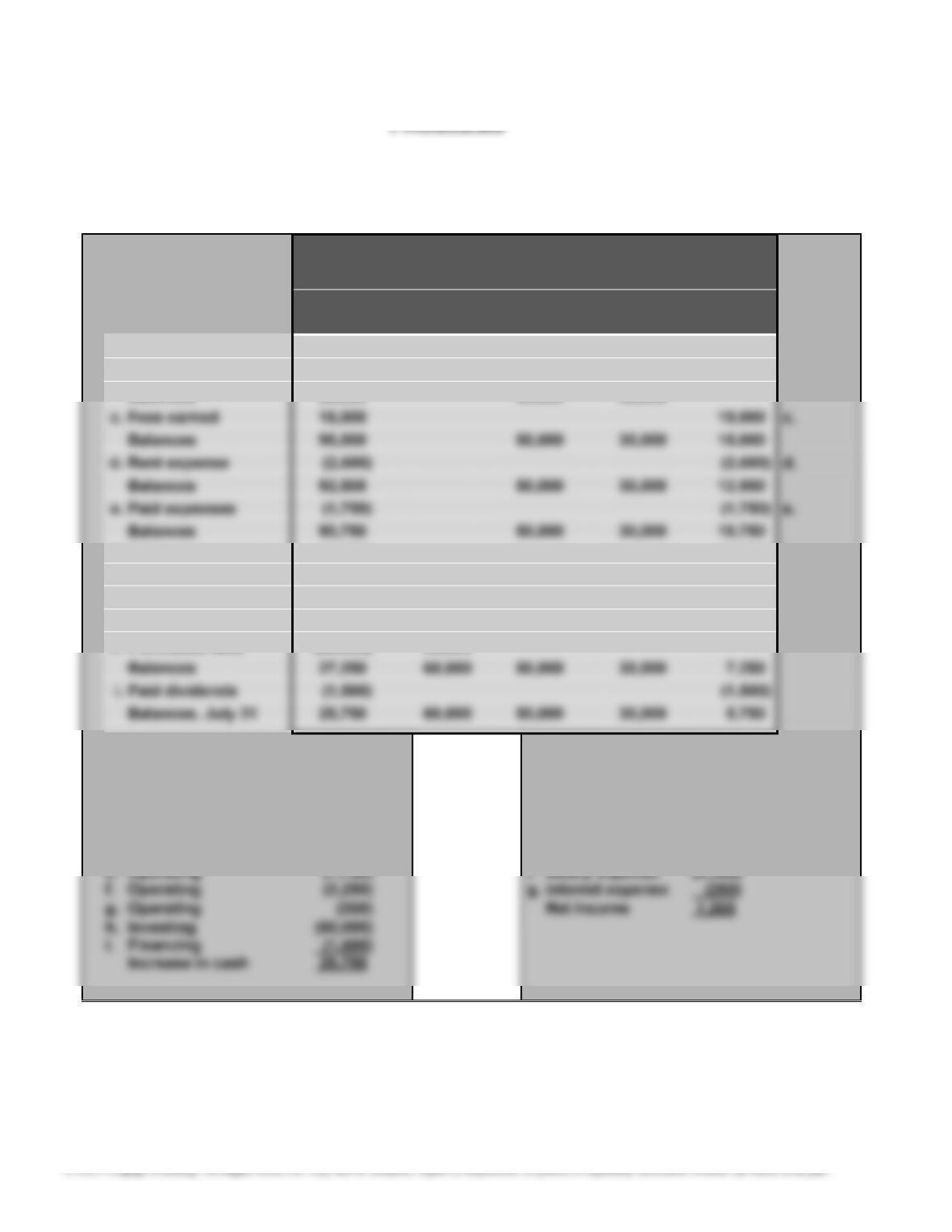
1.
Balance Sheet
Assets =Liabilities +Stockholders’ Equity
Notes Common Retained
Transaction Cash +Land =Payable +Stock + Earnings
a. Issued common stock 30,000 30,000
b. Issued note payable 50,000 50,000
f. Paid salary expense (3,250) (3,250) f.
Balances 87,500 50,000 30,000 7,500
g. Paid interest expense (250) (250) g.
Balances 87,250 50,000 30,000 7,250
Statement of Cash Flows Income Statement
a. Financin
g
30,000 c. Fees earned 15,000
b. Financing 50,000 d. Rent expense (2,500)
c. Operatin
g
15,000 e.
A
uto expense
(
1,250
)
d. Operatin
g
(
2,500
)
e. Misc. expense
(
500
)
g
(
)
(
)
(
)
g
(
)
2. Stockholders’ equity is the right of stockholders to the assets of the business.
These rights are increased by stockholders’ investments and revenues and
decreased by dividends and expenses.
47
P2–1, Continued
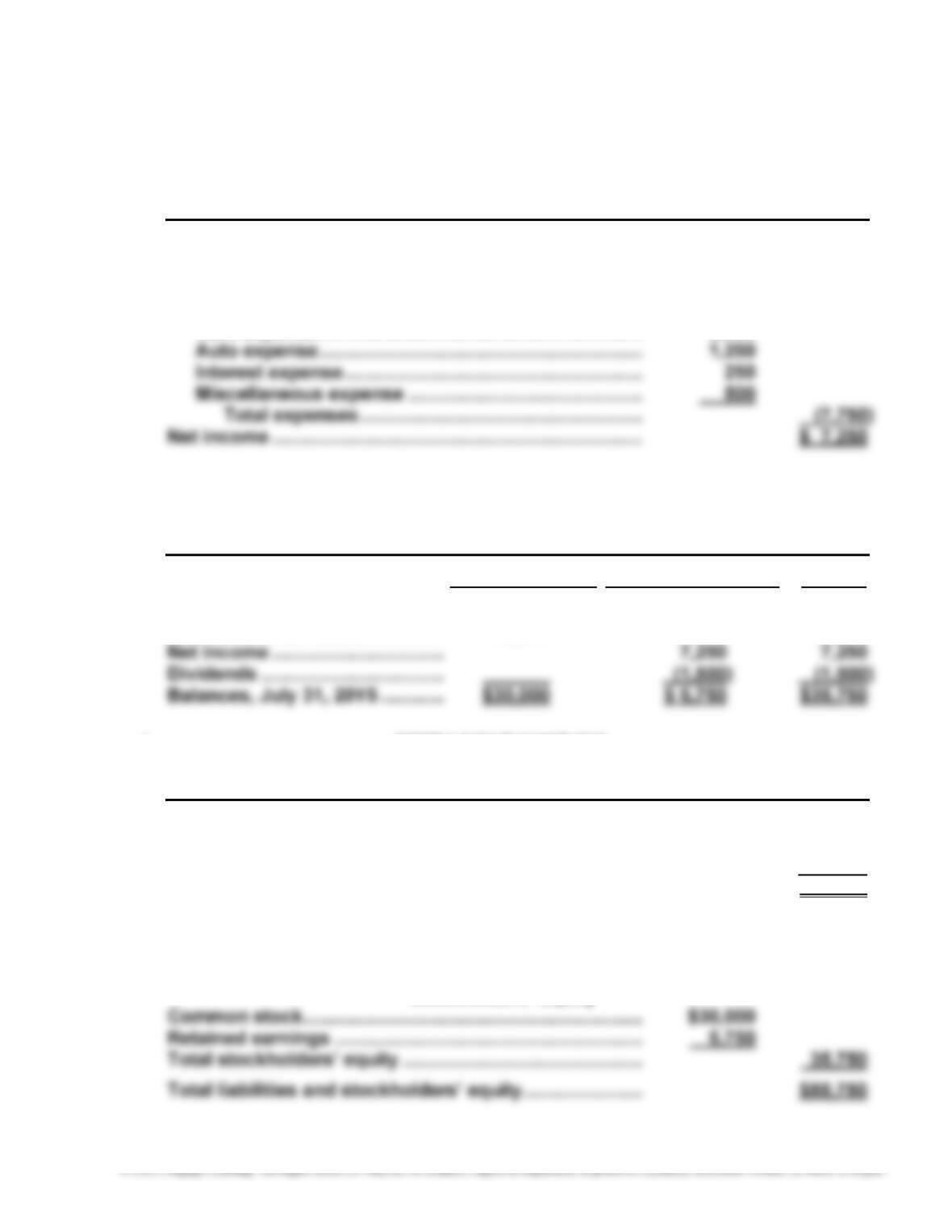
3. SMITH INSURANCE INC.
Income Statement
For the Month Ended July 31, 20Y5
Revenues:
Fees earned ………………………………………………………. $ 15,000
Expenses:
Salary expense ………………………………………………….. $3,250
SMITH INSURANCE INC.
Statement of Stockholders’ Equity
For the Month Ended July 31, 20Y5
Common Stock Retained Earnings Total
Balances, July 1, 20Y5 ………….. $ 0 $ 0 $ 0
Issued common stock …………… 30,000 30,000
4. SMITH INSURANCE INC.
Balance Sheet
July 31, 20Y5
Assets
Cash ………………………………………………………………………. $25,750
Land ………………………………………………………………………. 60,000
Total assets ……………………………………………………………. $85,750
Liabilities
Notes payable ………………………………………………………… $50,000
48
P2–1, Concluded
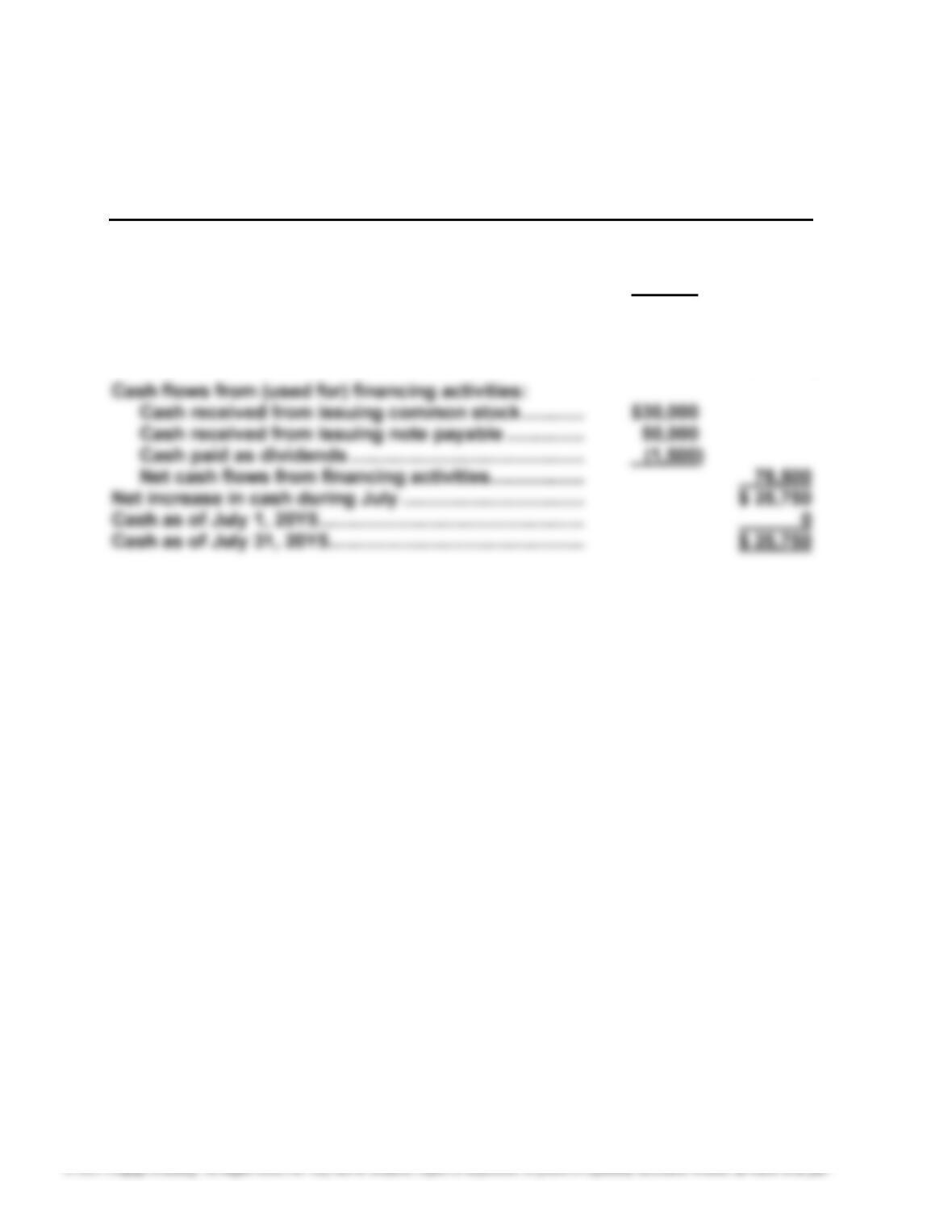
5. SMITH INSURANCE INC.
Statement of Cash Flows
For the Month Ended July 31, 20Y5
Cash flows from (used for) operating activities:
Cash received from operating activities ……………… $15,000
Cash paid for operating activities …………………….... (7,750)
Net cash flows from operating activities …………….. $ 7,250
Cash flows from (used for) investing activities:
Cash paid for land ……………………………………………… (60,000)
49
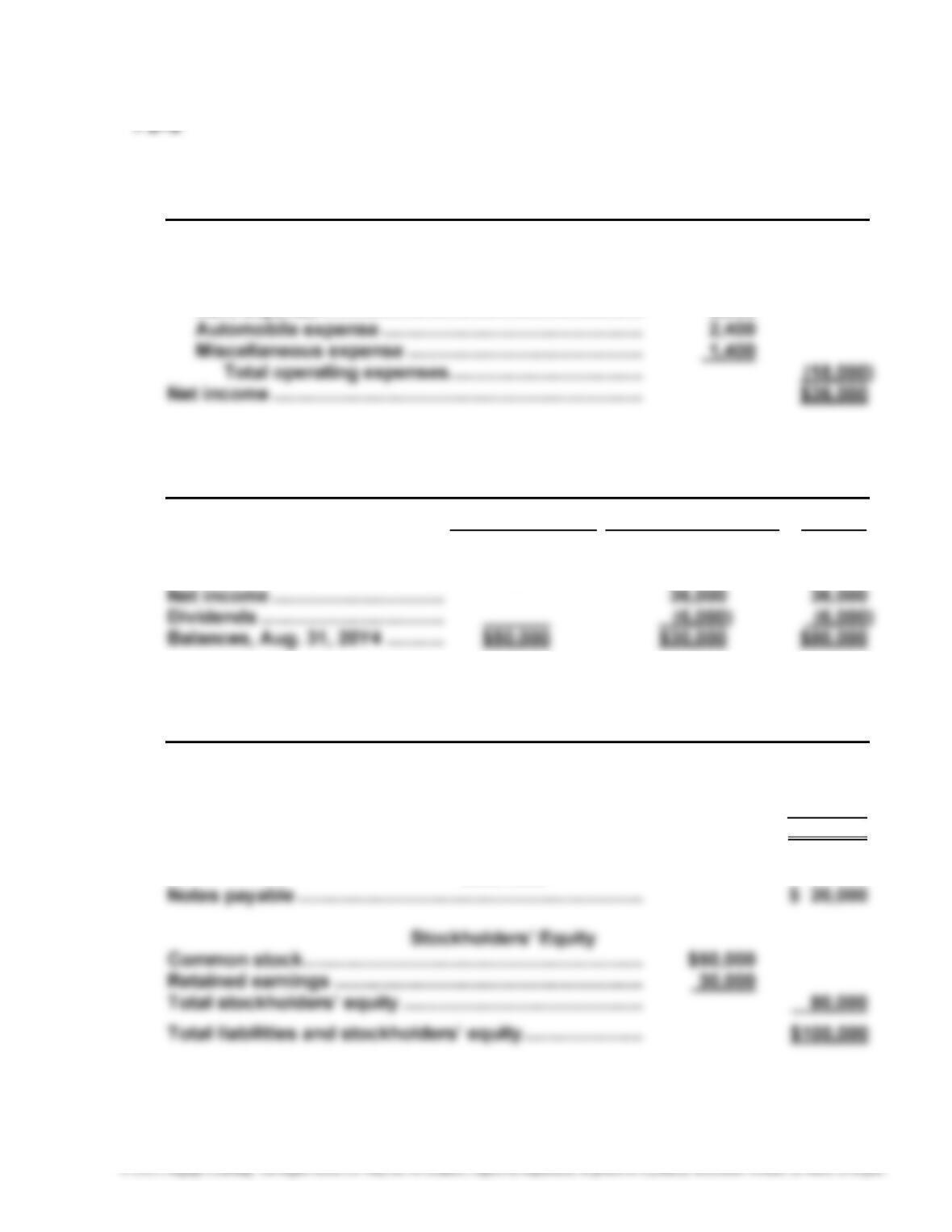
1. RESTART TECHNOLOGY SERVICES
Income Statement
For the Month Ended August 31, 20Y4
Fees earned ……………………………………………………………. $54,000
Operating expenses:
Salaries expense ……………………………………………….. $9,200
2. RESTART TECHNOLOGY SERVICES
Statement of Stockholders’ Equity
For the Month Ended August 31, 20Y4
Common Stock Retained Earnings Total
Balances, Aug. 1, 20Y4 …………. $ 0 $ 0 $ 0
Issued common stock …………… 50,000 50,000
3. RESTART TECHNOLOGY SERVICES
Balance Sheet
August 31, 20Y4
Assets
Cash ………………………………………………………………………. $ 20,000
Land ………………………………………………………………………. 80,000
Total assets ………………………………………….………………… $ 100,000
Liabilities