2
Cost Concepts and Behavior
Solutions to Review Questions
2-1.
Cost is a more general term that refers to a sacrifice of resources and may be either an
opportunity cost or an outlay cost. An expense is an outlay cost charged against sales
revenue in a particular accounting period and usually pertains only to external financial
reports.
2-2.
2-3.
2-4.
Common examples include the value forgone because of lost sales by producing low
2-5.
Yes. The costs associated with goods sold in a period are not expected to result in
future benefits. They provided sales revenue for the period in which the goods were
sold; therefore, they are expensed for financial accounting purposes.
2-6.
The costs associated with goods sold are a product cost for a manufacturing firm. They
are the costs associated with the product and recorded in an inventory account until the
product is sold.
2-7.
Both accounts represent the cost of the goods acquired from an outside supplier, which
2-8.
Direct materials:
Materials in their raw or unconverted form, which become an integral
part of the finished product are considered direct materials. In some
cases, materials are so immaterial in amount that they are considered
part of overhead.
Direct labor:
Costs associated with labor engaged in manufacturing activities.
Sometimes this is considered as the labor that is actually responsible for
converting the materials into finished product. Assembly workers,
cutters, finishers and similar “hands on” personnel are classified as
direct labor.
Manufacturing
overhead:
All other costs directly related to product manufacture. These costs
include the indirect labor and materials, costs related to the facilities and
equipment required to carry out manufacturing operations, supervisory
costs, and all other support activities.
2-9.
2-10.
Contribution margin is likely to be more important, because it reflects better how profits
will change with decisions.
2-11.
2-12.
Total variable costs change in direct proportion to a change in volume (within the
relevant range of activity). Total fixed costs do not change as volume changes (within
the relevant range of activity).
2-13.
A value income statement typically uses a contribution margin framework, because the
2-14.
A value income statement is useful to managers, because it provides information that is
useful for them in identifying and eliminating non value-added activities.
Solutions to Critical Analysis and Discussion Questions
2-15.
The statement is not true. Materials can be direct or indirect. Indirect materials include
items such as lubricating oil, gloves, paper supplies, and so on. Similarly, indirect labor
includes plant supervision, maintenance workers, and others not directly associated
with the production of the product.
2-16.
No. Statements such as this almost always refer to the full cost per unit, which includes
2-17.
Marketing and administrative costs are treated as period costs and expensed for
financial accounting purposes in both manufacturing and merchandising organizations.
However, for decision making or assessing product profitability, marketing and
administrative costs that can be reasonably associated with the product (product-
specific advertising, for example) are just as important as the manufacturing costs.
2-18.
There is no “correct” answer to this allocation problem. Common allocation procedures
2-19.
The costs will not change. Your allocation in 2-18 was not “incorrect,” because the
purpose of the allocation is not to determine incremental costs.
2-20.
2-21.
Answers will vary. The major cost categories include servers (mostly fixed), personnel
(mostly fixed), and legal costs (mostly fixed). There are only small variable costs for
2-22.
2-23.
Answers will vary. Common suggestions are number of students in each program,
usage (cafeteria: meals; library: study rooms reserved; or career placement: interviews,
for example), assuming usage is measured, or revenue (tuition dollars).
2-24.
No, R&D costs are relevant for many decisions. For example, should a program of
research be continued? Was a previous R&D project profitable? Should we change our
process of approving R&D projects? R&D costs are expensed (currently) for financial
reporting, but for managerial decision-making the accounting treatment is not relevant.
2-25.
This question can create a good discussion of the different roles of financial and
managerial accounting. An important issue is identifying the activities that are non
Solutions to Exercises
2-26. (15 min.) Basic Concepts.
a.
False. The statement refers to an expense. For example, R&D costs are incurred
in expectation of future benefits.
b.
False. Variable costs can be direct (direct materials) or indirect (lubricating oil for
machines that produce multiple products.)
c.
True. Each unit of a product has the same amount of direct material (same cost
per unit), but producing more units requires more material (and more cost).
2-27. (15 min.) Basic Concepts.
Cost Item
Fixed (F)
Variable (V)
Period (P)
Product (M)
a.
Depreciation on buildings for administrative staff offices
F
P
b.
Cafeteria costs for the factory
F
M
c.
Overtime pay for assembly workers
V
M
d.
Transportation-in costs on materials purchased
V
M
e.
Salaries of top executives in the company
F
P
Sales commissions for sales personnel
V
P
g.
Assembly line workers’ wages
V
M
h.
Controller’s office rental
F
P
Administrative support for sales supervisors
F
P
j.
Energy to run machines producing units of output in the
2-28. (10 min.) Basic Concepts.
a.
Assembly line worker’s salary.
B
b.
Direct materials used in production process.
P
c.
Property taxes on the factory.
C
d.
Lubricating oil for plant machines.
C
e.
Transportation-in costs on materials purchased
P
2-29. (15 min.) Basic Concepts.
Concept
Definition
9
Period cost ……………
Cost that can more easily be attributed to
time intervals.
2
Indirect cost …………..
Cost that cannot be directly related to a
cost object.
Fixed cost ……………..
Cost that does not vary with the volume of
activity.
8
Opportunity cost …….
Lost benefit from the best forgone
alternative.
Outlay cost ……………
Past, present, or near-future cash flow.
6
Direct cost …………….
Cost that can be directly related to a cost
5
Expense ……………….
Cost charged against revenue in a
Cost ……………………..
Sacrifice of resources.
Variable cost …………
Cost that varies with the volume of activity.
4
Full absorption cost ..
Cost used to compute inventory value
according to GAAP.
11
Product cost ………….
Cost that is part of inventory.
2-30. (15 min.) Basic Concepts: Multiple Choice.
a.
(3)
Variable cost per unit: $26 (= $12 + $9 + $2 + $3)
b.
(4)
Variable production cost per unit: $23 (= $12 + $9 + $2)
c.
(2)
Full cost per unit: $34 (= [$26 + ($190,000 ÷ 23,750 units)]
d.
(1)
Full absorption cost per unit: $29 (= [$23 + ($142,500 ÷ 23,750 units)]
e.
(2)
Prime cost per unit: $21 (= $12 + $9)
(2)
Conversion cost per unit: $17 (= [$9 + $2 + ($142,500 ÷ 23,750 units)]
g.
(2)
2-31. (15 min.) Basic Concepts: Multiple Choice.
a.
(4)
Variable cost per unit: $18 (= $8 + $4 + $1 + $5)
b.
(2)
Variable production cost per unit: $13 (= $8 + $4 + $1)
c.
(4)
Full cost per unit: $23 (= [$18 + ($1,125,000 ÷ 225,000 units)]
d.
(3)
Full absorption cost per unit: $16 (= [$13 + ($675,000 ÷ 225,000 units)]
e.
(2)
Prime cost per unit: $12 (= $8 + $4)
(1)
Conversion cost per unit: $8 (= [$4 + $1 + ($675,000 ÷ 225,000 units)]
g.
(1)
Contribution margin per unit: $9 (= $27 – variable cost per unit of $18)
h.
(2)
Gross margin per unit: $11 (= $27 – full absorption cost of $16)
2-32. (15 min.) Basic Concepts.
Cost Item
Fixed (F)
Variable (V)
Period (P)
Product (M)
a.
Power to operate factory equipment …………………………..
V
M
b.
Chief financial officer’s salary …………………………………….
F
P
c.
Commissions paid to sales personnel …………………………
V
P
d.
Office supplies for the human resources manager ………..
F
P
e.
Depreciation on pollution control equipment in the plant ..
F
M
2-33. (15 min.) Basic Concepts.
a.
Variable production cost per unit: ($360 + $60 + $15 + $30) …………
$465
b.
Variable cost per unit: ($465 + $45) …………………………………………..
$510
c.
Full cost per unit: [$510 + ($225,000 ÷ 1,500 units)] …………………….
$660
d.
Full absorption cost per unit: [$465 + ($135,000 ÷ 1,500)] …………….
$555
e.
Prime cost per unit. (materials + labor + outsource) …………………….
$435
f.
Conversion cost per unit: (labor + overhead + outsource) …………….
$540
g.
Contribution margin per unit: ($900 – $510)………………………………
$390
h.
Gross margin per unit: ($900 – full absorption cost of $555)…………
$345
2-34. (15 min.) Basic Concepts: Intercontinental, Inc.
a.
Prime cost per unit: (materials + labor) ………………………………………
$40
Contribution margin per unit: ($100 – $72) ……………………………….
Gross margin per unit: ($100 – full absorption cost of $74)…………..
$26
Conversion cost per unit: (labor + overhead) ………………………………
$50
Variable cost per unit: ($60 + $12) …………………………………………….
f.
Full absorption cost per unit: [$60 + ($4,200,000 ÷ 300,000)] ………..
$74
g.
Variable production cost per unit: ($16 + $24 + $20) ……………………
$60
h.
Full cost per unit. [$72 + ($5,400,000 ÷ 300,000 units)] ………………..
$90
i.
Suppose the number of units increase to 400,000 units per month,
which is within the relevant range. Which parts of (a) through (h) will
change? For each amount that will change, give the new amount
for a volume of 400,000 units.
c. Gross margin = $100.00 – $70.50 = $29.50
d. Conversion costs = $16 + $20 + ($4,200,000 ÷ 400,000) = $46.50
f. Full absorption cost = $60 + ($4,200,000 ÷ 400,000) = $70.50
h. Full cost = $72 + ($5,400,000 ÷ 400,000) = $85.50
c, d, f
and h
will
change,
as
follows
2-35. (15 min.) Cost Allocation—Ethical Issues
This problem is based on the experience of the authors’ research at several companies.
a. Answers will vary as there are several defensible bases on which to allocate the
product development costs. As an example, many government-purchasing contracts
are based on the cost of the product or service. In this case, using expected sales
(units or revenue) leads to a potential circularity. Price depends on cost, which
depends on sales, which depends on price.
2-36. (15 min.) Cost Allocation—Ethical Issues
This problem is based on the experience of the authors’ research at several companies.
b. You should explain to Star that you cannot agree with the allocation basis, especially
given the reason for selecting the basis. If this fails to persuade Star, you should
disclose to Star’s boss your disagreement with the analysis and the relation between
Star and the vendor.
2-37. (30 min.) Prepare Statements for a Manufacturing Company: Tappan
Parts.
Tappan Parts
Cost of Goods Sold Statement
For the Year Ended December 31
Beginning work in process inventory
$1,354,000
Manufacturing costs:
Direct materials:
Beginning inventory
$962,000
Purchases
1,118,000
(a)*
Materials available
$2,080,000
Less ending inventory
884,000
Direct materials used
$1,196,000
Other manufacturing costs
310,000
**
Total manufacturing costs
1,506,000
(c)
Total costs of work in process
Less ending work in process
1,430,000
Cost of goods manufactured
(b)
Beginning finished goods inventory
Finished goods available for sale
Ending finished goods inventory
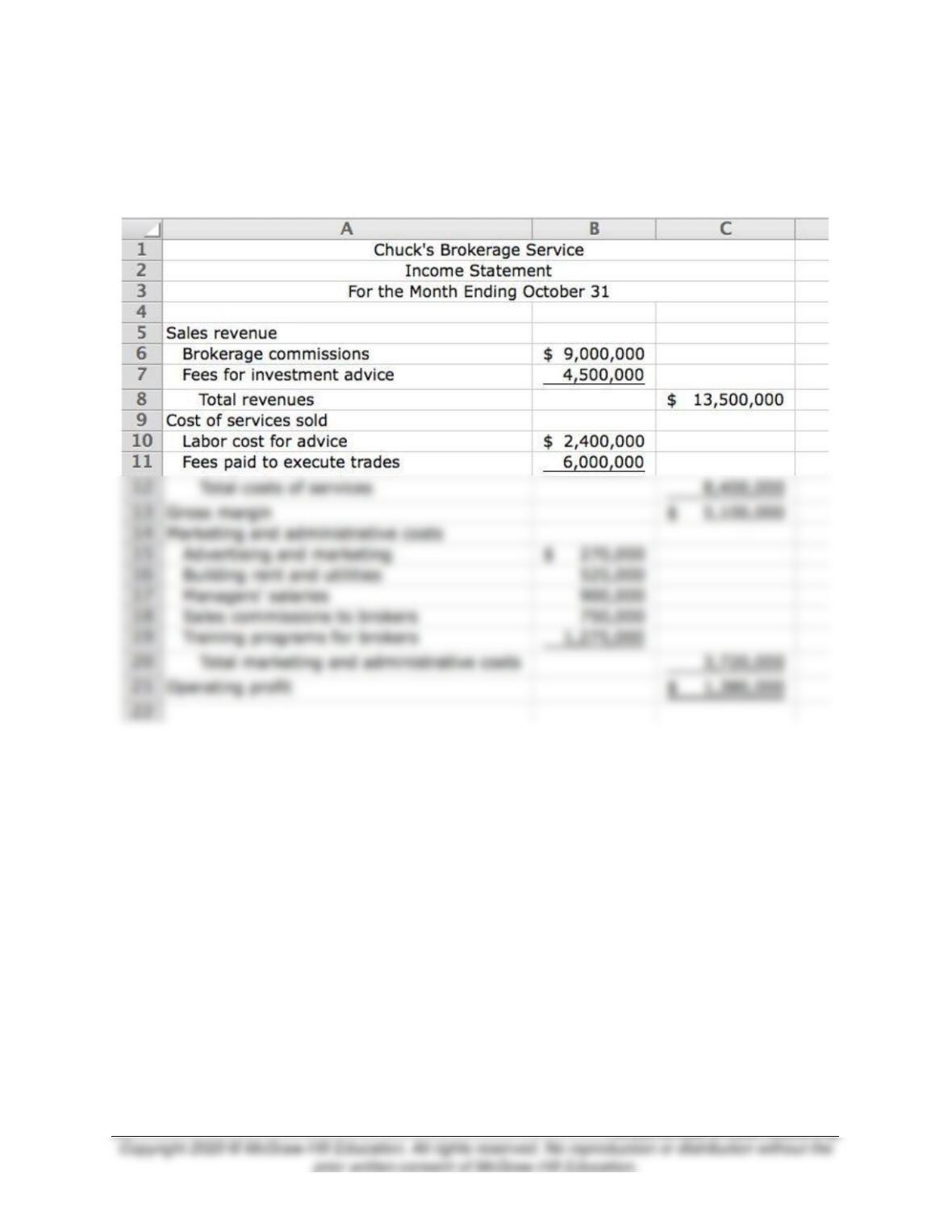
2-38. (10 min.) Prepare Statements for a Service Company: Chuck’s Brokerage
Service.
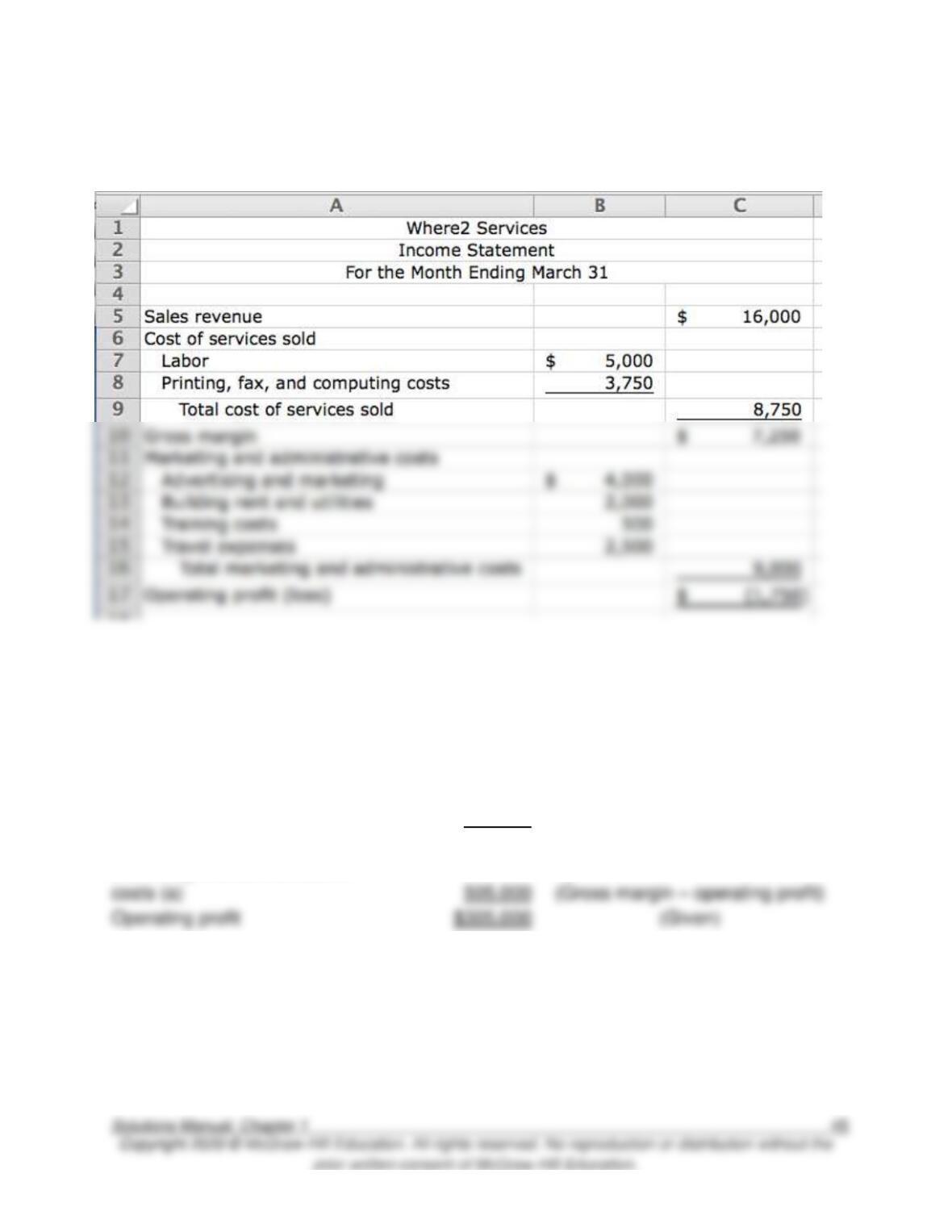
2-39. Prepare Statements for a Service Company: Where2 Services.
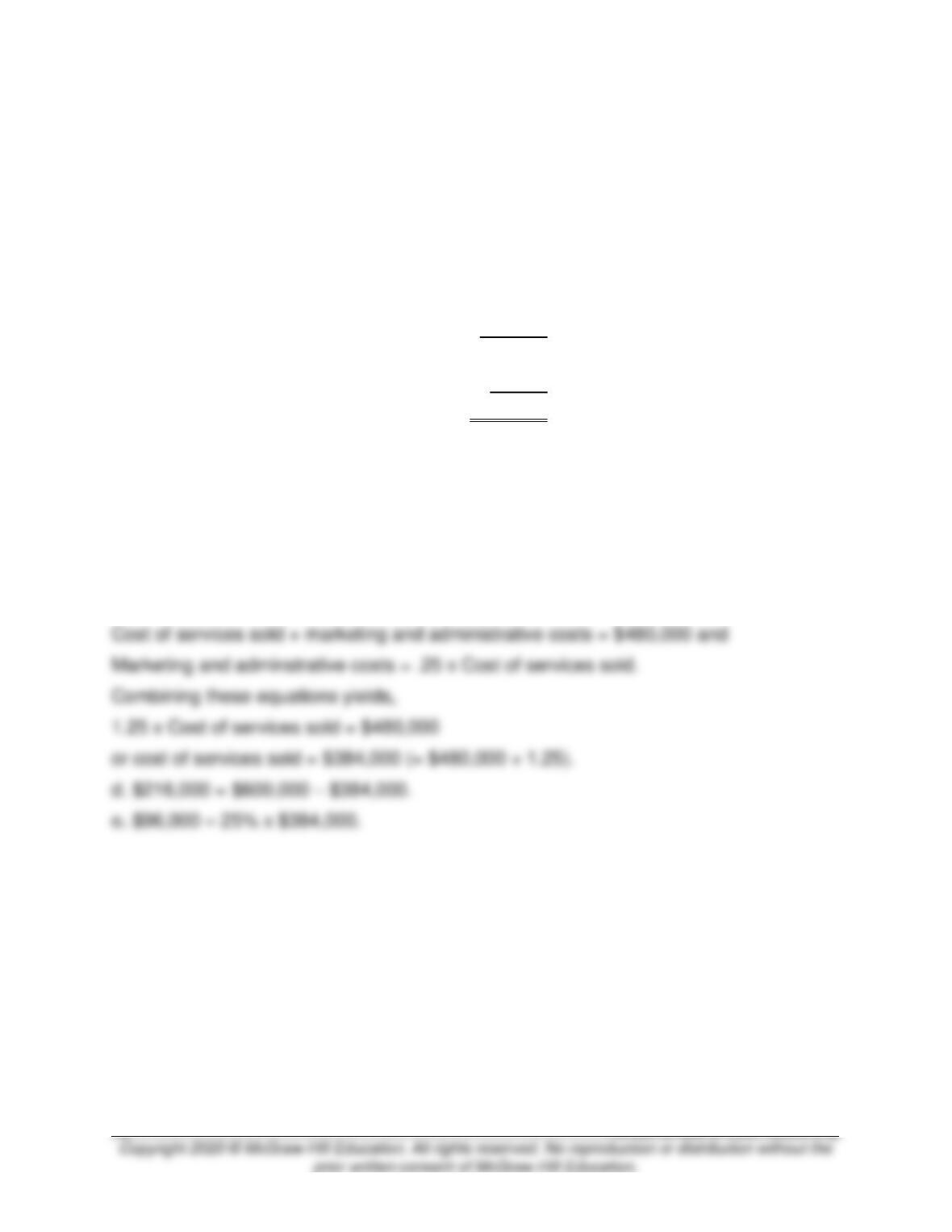
2-40. (10 min.) Prepare Statements for a Service Company: Remington
Advisors
Sales revenue
$1,700,000
(Given)
Cost of services sold (b)
890,000
(Sales revenue – gross margin)
Gross margin
$810,000
(Given)
Marketing and administrative
2-41. (20 min.) Prepare Statements for a Service Company: Lead! Inc.
You can solve this in the order shown below.
Lead!, Inc.
Income Statement
For the Month Ended April 30
Sales revenue
$600,000
a
Cost of services sold
384,000
c
Gross margin
$216,000
d
Marketing and administrative costs
96,000
e
Operating profit ($600,000 x 20%)
$120,000
b
a. Given
b. $120,000 = 20% x $600,000.
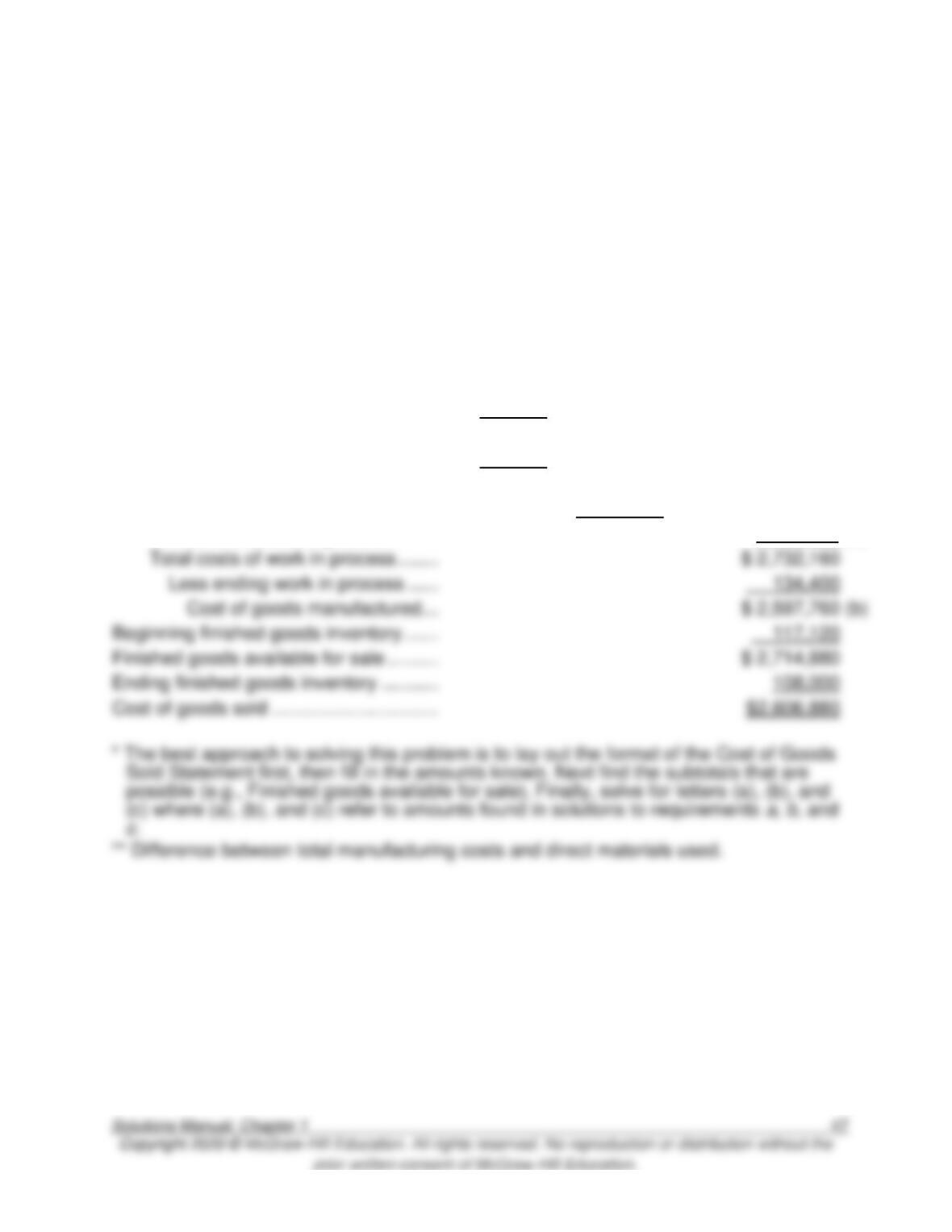
c. To find the cost of services sold plus marketing and administrative costs, start with
the operating profit (b). Then cost of services plus marketing and administrative costs is
$480,000 (= $600,000 – $120,000). But, marketing and administrative costs equal 25%
of cost of services sold, so,
2-42. (30 min.) Prepare Statements for a Manufacturing Company: Crabtree
Machining Company.
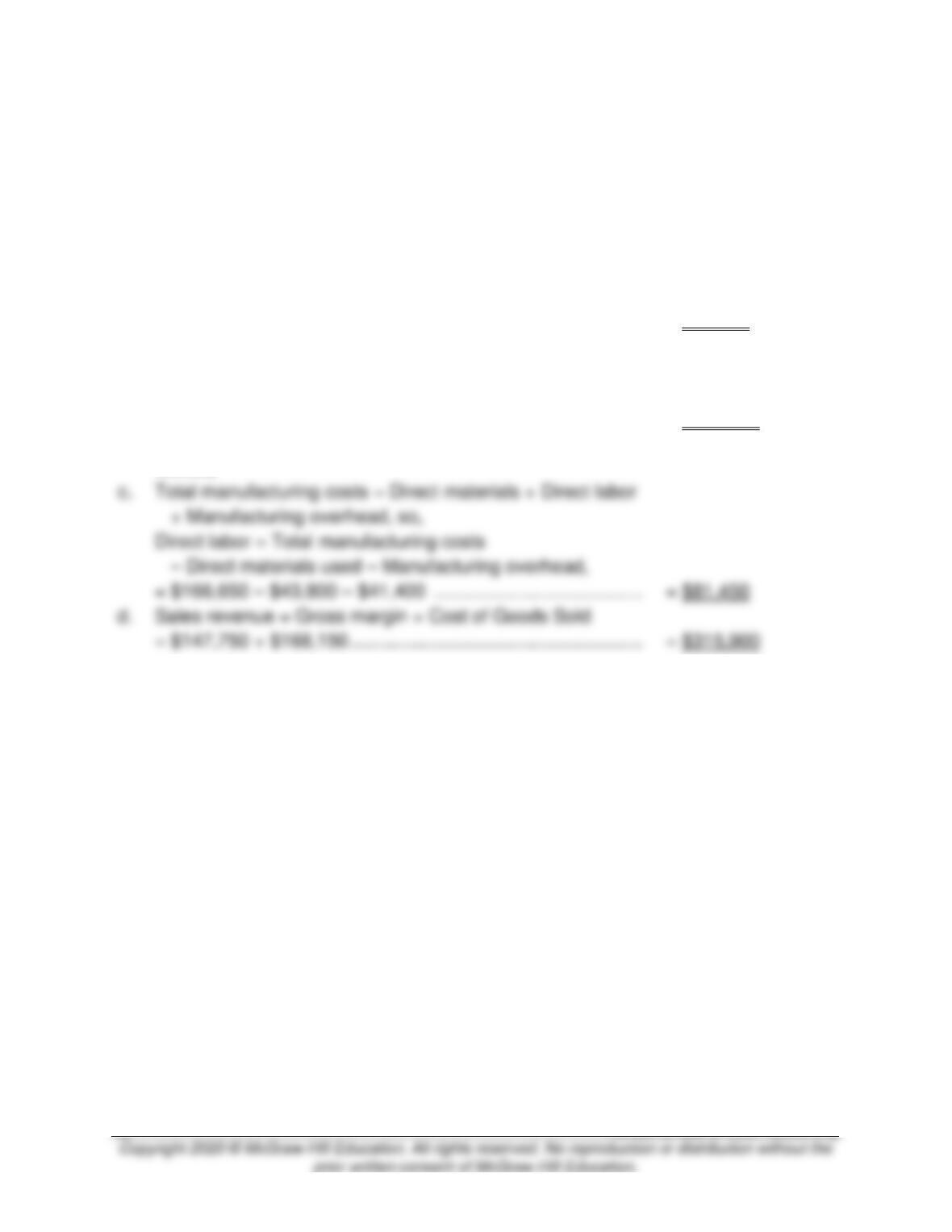
Crabtree Machining Company
Cost of Goods Sold Statement
For the Year Ended December 31
Beginning work-in-process inventory ….
$ 139,200
Manufacturing costs:
Direct materials:
Beginning inventory …………………..
$115,200
Purchases ………………………………..
717,600
Materials available ………………….
$832,800
Less ending inventory ………………..
141,600
Direct materials used ………………
$ 691,200
(a)*
Other manufacturing costs ………….
1,901,760
**
Total manufacturing costs ……….
2,592,960
(c)
Total costs of work in process ……..
Less ending work in process ……
(b)
Beginning finished goods inventory …….
Finished goods available for sale ……….
Ending finished goods inventory ………..
2-43. (15 min.) Basic Concepts: Monroe Fabricators
a.
From the basic inventory equation,
Beginning Inventory + Transferred in
= Transferred out + Ending Inventory, so
Ending Materials Inventory, December 31,
= Beginning balance + Transferred in – Transferred out
= $7,800 + $48,300 − $43,800 ………………………………………
= $12,300
b.
Total manufacturing costs = Cost of goods manufactured
– Beginning work-in-process + Ending work-in-process
= $163,350 – $8,100 + $11,400 …………………………………….
(also can be found solving for Transferred in to Finished
Direct labor = Total manufacturing costs
= $166,650
2-44. (15 min.) Basic Concepts: Talmidge Co.
a.
From the basic inventory equation,
Beginning work-in-process inventory + Total manufacturing
cost
= Cost of goods manufactured + Ending work-in-process
inventory, so
Ending work-in-process inventory, March 31,
= Beginning balance + Total manufacturing cost – Cost of
goods manufactured
= $10,000 + $254,000 – $260,000 …………………………………
= $4,000
2-45. (15 min.) Prepare Statements for a Merchandising Company: Angie’s
Apparel.
Angie’s Apparel
Income Statement
For the Month Ended July 31
Sales revenue
$570,000
Cost of goods sold (see statement below)
388,500
Gross margin
$181,500
Marketing and administrative costs
($42,000 + $27,000 + $9,000 + $16,500) …………………………………………
94,500
Operating profit ……………………………………………………………………………
$87,000
Angie’s Apparel
Cost of Goods Sold Statement
For the Month Ended July 31
Merchandise inventory, July 1
Merchandise purchases
Total cost of goods purchased
Cost of goods available for sale
Merchandise inventory, July 31
2-46. (15 min.) Prepare Statements for a Merchandising Company: University
Electronics.
University Electronics
Income Statement
Sales revenue
Cost of goods sold (see statement below)
Gross margin
University Electronics
Cost of Goods Sold Statement
For the Year Ended February 28
Merchandise inventory, March 1
$ 185,000
Merchandise purchases
$2,750,000
Transportation-in
105,000
Total cost of goods purchased
2,855,000
Cost of goods available for sale
$3,040,000
Merchandise inventory, February 28
210,000
Cost of goods sold ………………………………………………………
$2,830,000
2-47. (10 min.) Cost Behavior for Forecasting: Dayton, Inc.
The variable costs will be 20 percent higher because there will be an increase of 36,000
– 30,000 = 6,000 units (20% = 6,000 ÷ 30,000).
Variable costs:
Direct materials used ($510,000 × 1.2) …………………………...
$ 612,000
Direct labor ($1,120,000 × 1.2) ………………………………………
1,344,000
Indirect materials and supplies ($120,000 × 1.2) ………………
144,000
Power to run plant equipment ($140,000 × 1.2) ………………..
168,000
Total variable costs …………………………..………………………….
$2,268,000
Fixed costs:
Supervisory salaries ……………………………………………………..
$ 470,000
Plant utilities (other than power to run plant equipment) …….
120,000
Depreciation on plant and equipment …………………………..…
Property taxes on building …………………………………………….
Total fixed costs …………………………………………………………..
756,000
units).