Chapter 2
Investing and Financing Decisions and
the Accounting System
ANSWERS TO QUESTIONS
1. The primary objective of financial reporting for external users is to provide
financial information about the reporting entity that is useful to existing and
2. (a) An asset is a probable future economic benefit owned or controlled by the
entity as a result of past transactions.
(b) A current asset is an asset that will be used or turned into cash within one
year; inventory is always considered a current asset regardless of how
3. (a) The separate entity assumption requires that business transactions are
separate from the transactions of the owners. For example, the purchase
of a truck by the owner for personal use is not recorded as an asset of the
business.
4. Accounting assumptions are necessary because they reflect the scope of
5. An account is a standardized format used by organizations to accumulate the
6. The fundamental accounting model is provided by the equation:
Assets = Liabilities + Stockholders’ Equity
7. A business transaction is (a) an exchange of resources (assets) and obligations
(debts) between a business and one or more outside parties, and (b) certain
8. Debit is the left side of a T-account and credit is the right side of a T-account. A
9. Transaction analysis is the process of studying a transaction to determine its
economic effect on the entity in terms of the accounting equation:
10. The equalities in accounting are:
(b) Debits = Credits
11. The journal entry is a method for expressing the effects of a transaction on
accounts in a debits-equal-credits format. The title of the account(s) to be
12. The T-account is a tool for summarizing transaction effects for each account,
13. The current ratio is computed as current assets divided by current liabilities. It
measures a company’s liquidity — the ability of the company to pay its short-term
14. Investing activities on the statement of cash flows include the buying and selling
of productive assets and investments. Financing activities include borrowing and

MULTIPLE CHOICE
1. d
6. c
3. a
8. d
4. a
9. b
5. d
10. a
Financial Accounting, 10/e 2-5
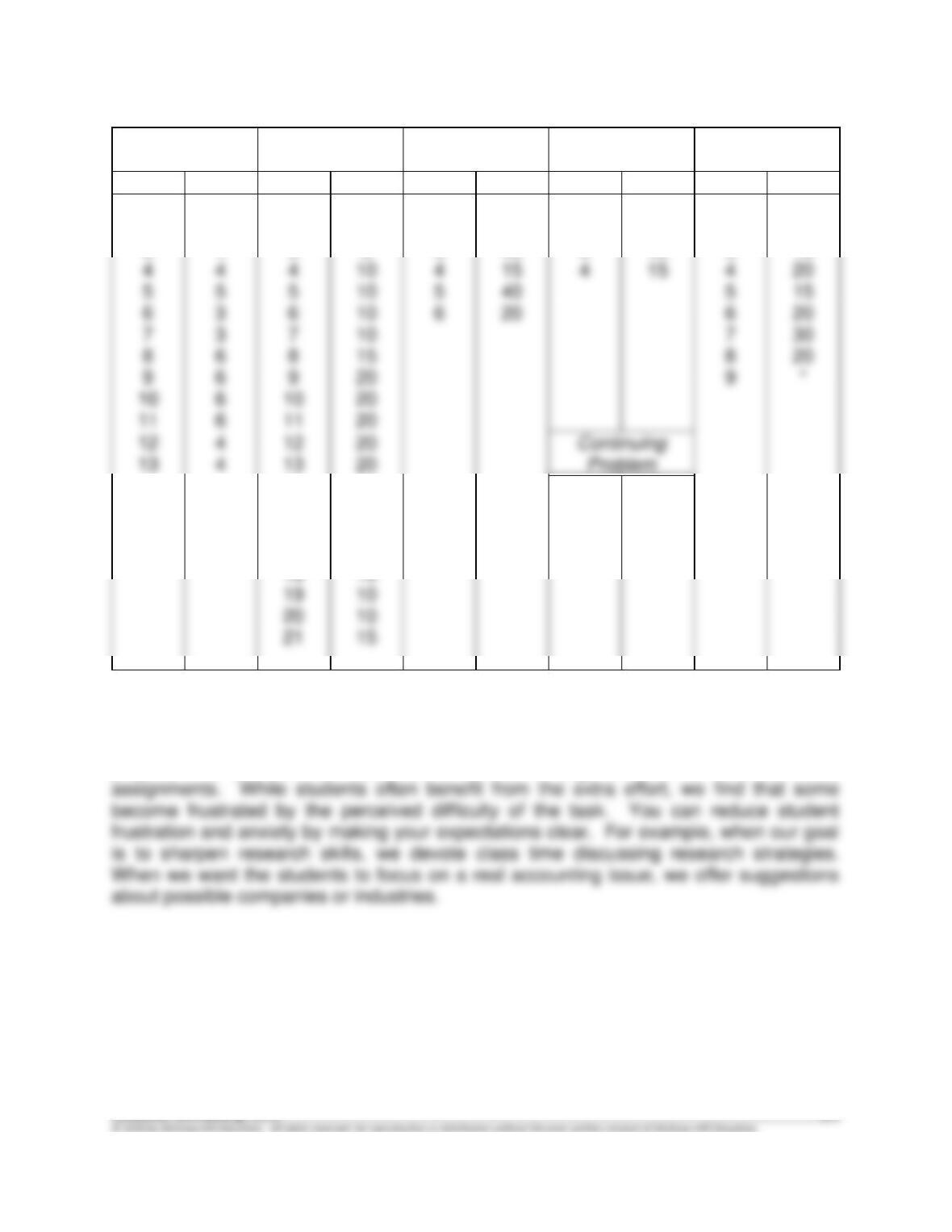
(Time in minutes)
Mini-exercises
Exercises
Problems
Alternate
Problems
Cases and
Projects
No.
Time
No.
Time
No.
Time
No.
Time
No.
Time
1
3
1
8
1
20
1
20
1
15
2
3
2
15
2
25
2
25
2
15
3
4
3
8
3
40
3
40
3
15
4
4
4
10
4
15
4
15
4
20
5
5
5
10
5
40
5
15
6
3
6
10
6
20
6
20
7
3
7
10
7
30
8
6
8
15
8
20
9
6
9
20
9
10
6
10
20
11
6
11
20
12
4
12
20
13
4
13
20
14
30
1
40
15
20
16
20
17
10
18
10
19
10
20
10
* Due to the nature of these cases and projects, it is very difficult to estimate the
amount of time students will need to complete the assignment. As with any open-ended
project, it is possible for students to devote a large amount of time to these
MINI-EXERCISES
M2–1.
F
(1) Going concern assumption
H
(2) Historical cost
G
(3) Credits
A
(4) Assets
(5) Account
M2–2.
D
(1) Journal entry
C
(2) A = L + SE, and Debits = Credits
A
(4) Liabilities
M2–3.
(1) N
M2–4.
CL
(1) Accounts Payable
CA
(2) Accounts Receivable
NCA
(3) Buildings
CA
(4) Cash
(5) Common Stock
NCA
(6) Land
CA
(7) Merchandise Inventory
CL
(8) Income Taxes Payable
NCL
CA
CA
CA
CL
CL
M2–5.
Assets
=
Liabilities
+
Stockholders’ Equity
a.
Cash
+30,000
Notes payable
+30,000
b.
Cash
–10,000
Equipment
+2,000
–2,000
M2–6.
Debit
Credit
Assets
Increase
Decrease
Liabilities
Decrease
Increase
Decrease
Increase
M2–7.
Increase
Decrease
Assets
Debit
Credit
Liabilities
Credit
Debit
Credit
Debit
M2–8.
a.
Cash (+A) ………………………………………………………………….
30,000
Notes payable (+L) ……………………………………………….
30,000
b.
Notes receivable (+A) ………………………………………………….
c.
Cash (+A) ………………………………………………………………….
d.
Equipment (+A) ………………………………………………………….
Notes payable (+L) ……………………………………………….
Dividends payable (+L) …………………………………………
Financial Accounting, 10/e 2-9
M2–9.
Cash
Notes Receivable
Equipment
Beg.
900
Beg.
1,000
Beg.
15,100
(a)
30,000
10,000
(b)
(b)
10,000
(d)
15,000
(c)
500
5,000
(d)
16,400
11,000
30,100
Dividends Payable
3,000
Beg.
Beg.
30,000
(a)
2,000
(e)
10,000
(d)
43,000
2,000
Beg.
3,000
Beg.
10,000
Beg.
490
(c)
(e)
2,000
8,000
M2–10.
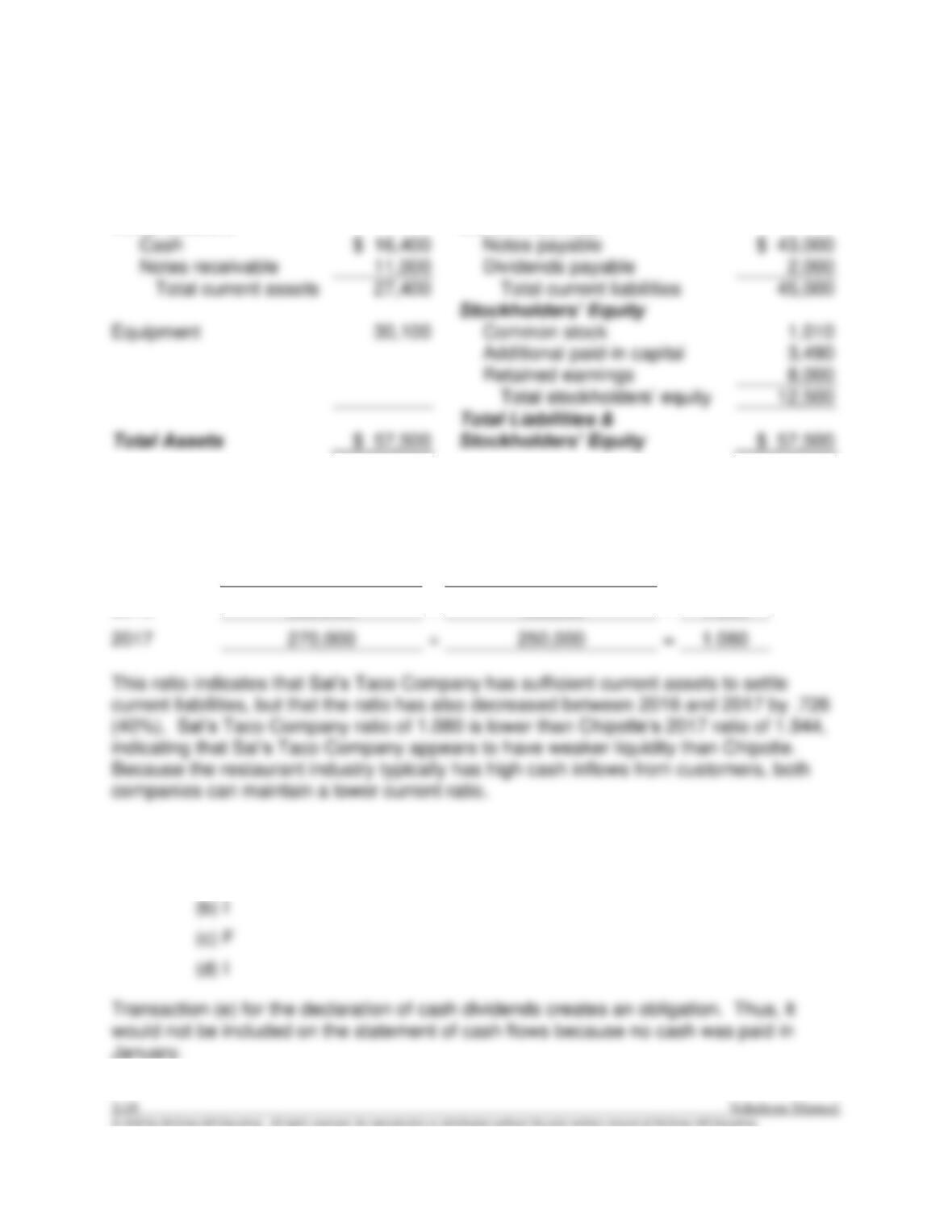
JonesSpa Corporation
Trial Balance
January 31
Debit
Credit
Cash
16,400
Notes receivable
11,000
Equipment
30,100
Notes payable
43,000
Dividends payable
Common stock
Additional paid-in capital
Retained earnings
M2–11.
JonesSpa Corporation
Balance Sheet
At January 31
Assets
Liabilities
Current assets:
Current liabilities:
Total current liabilities
Equipment
Total Assets
M2–12.
Current Ratio =
Current Assets
÷
Current Liabilities
2016
280,000
÷
155,000
=
1.806
2017
÷
=
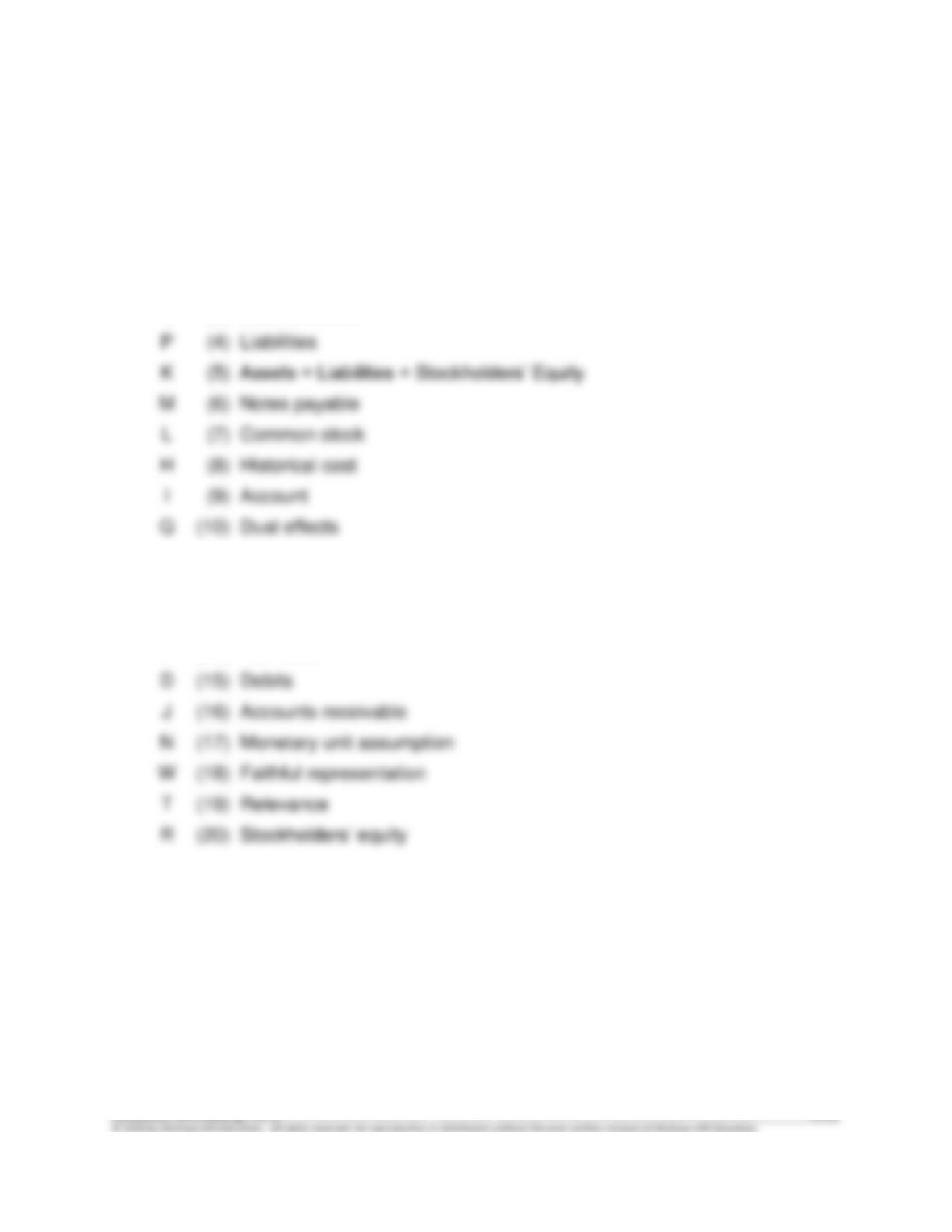
M2–13.
(a) F
Financial Accounting, 10/e 2-11
EXERCISES
E2–1.
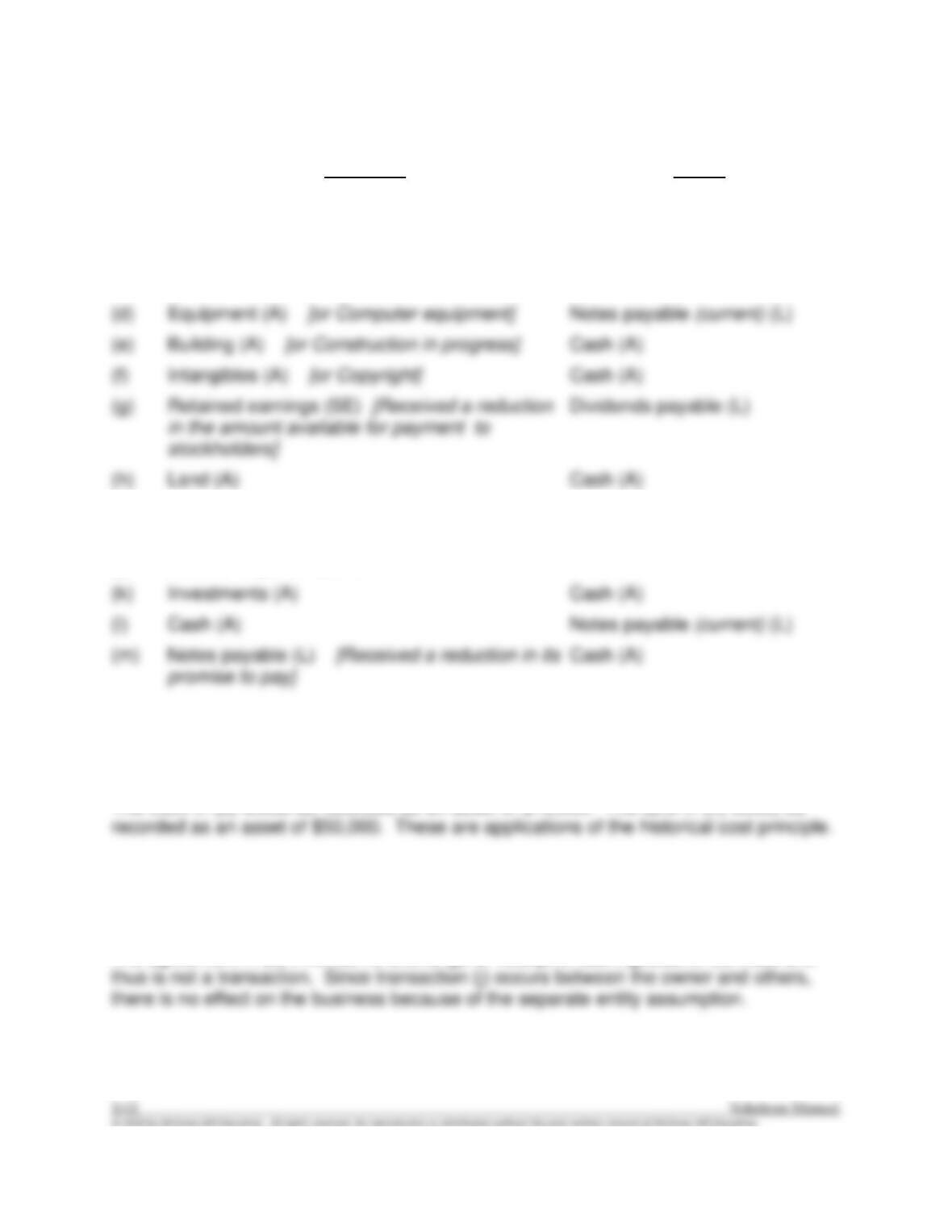
E
(1) Transaction
F
(2) Going concern assumption
B
(3) Balance sheet
P
(4) Liabilities
M
(6) Notes payable
L
(7) Common stock
H
(8) Historical cost
(9) Account
Q
(10) Dual effects
O
(11) Retained earnings
A
(12) Current assets
C
(13) Separate entity assumption
X
(14) Par value
D
(15) Debits
(16) Accounts receivable
N
(17) Monetary unit assumption
(18) Faithful representation
T
(19) Relevance
R
E2–2.
Req. 1
Received
Given
(a)
Cash (A)
Common stock and Additional
paid-in capital (SE)
(b)
Equipment (A) [or Delivery truck]
Cash (A)
(c)
No exchange transaction
—
(d)
Equipment (A) [or Computer equipment]
Notes payable (current) (L)
(e)
Cash (A)
(h)
Land (A)
Cash (A)
(i)
Intangibles (A) [or Patents]
Cash (A) and Notes payable
(current) (L)
(j)
No exchange transaction
—
(k)
Investments (A)
Cash (A)
(l)
Cash (A)
Notes payable (current) (L)
(m)
Notes payable (L) [Received a reduction in its
promise to pay]
Cash (A)
Req. 2
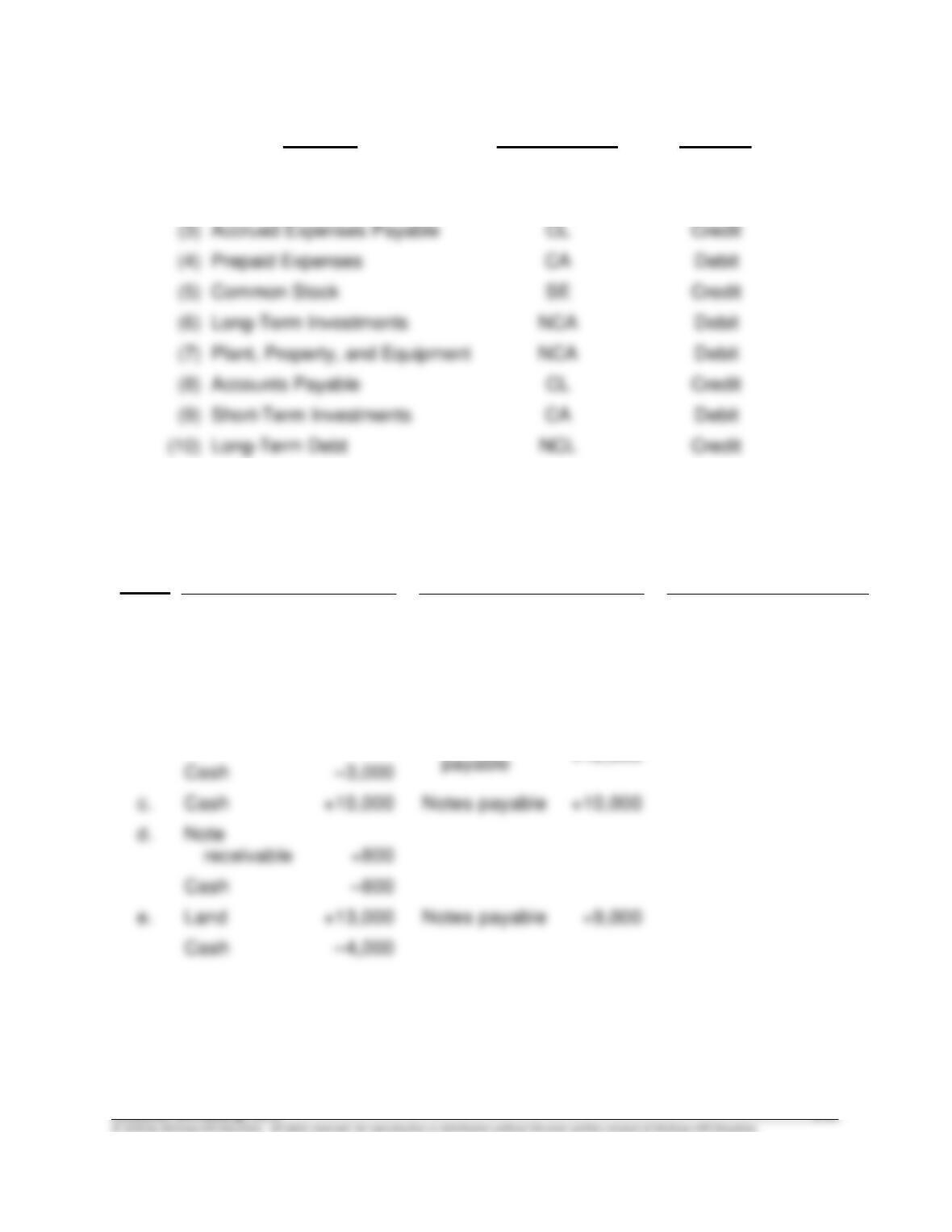
The truck in (b) would be recorded as an asset of $18,000. The land in (h) would be
Req. 3
The agreement in (c) involves no exchange or receipt of cash, goods, or services and
Financial Accounting, 10/e 2-13
E2–3.
Account
Balance Sheet
Classification
Debit or Credit
Balance
(1) Accounts Receivable
CA
Debit
(2) Retained Earnings
SE
Credit
(3) Accrued Expenses Payable
Credit
(4) Prepaid Expenses
CA
Debit
(5) Common Stock
SE
Credit
(6) Long-Term Investments
Debit
(7) Plant, Property, and Equipment
Debit
(8) Accounts Payable
Credit
(9) Short-Term Investments
CA
Debit
Credit
E2–4.
Event
Assets
=
Liabilities
+
Stockholders’ Equity
a.
Cash
+40,000
Common
stock
Additional
paid-in
capital
+1,000
+39,000
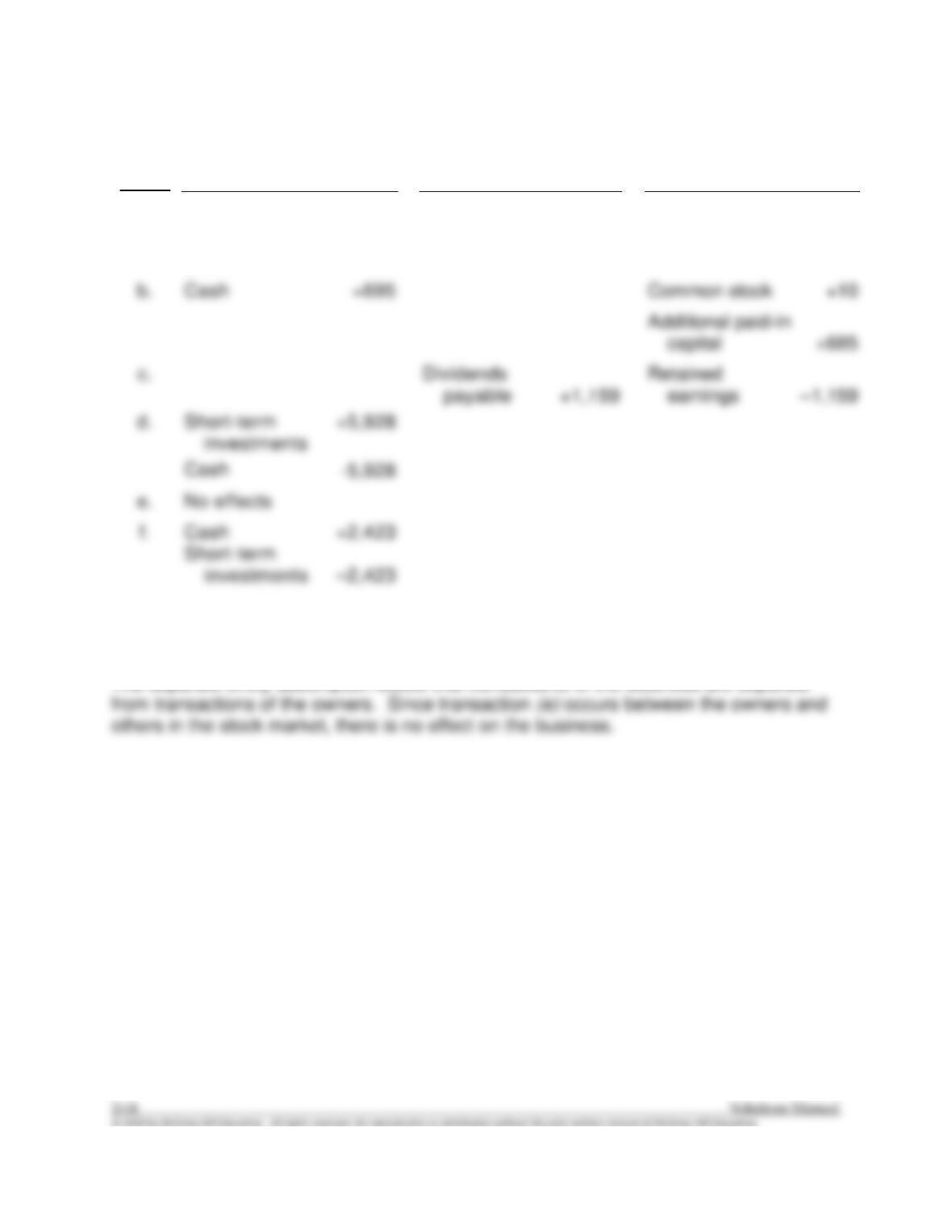
b.
Notes payable
Equipment
+15,000
Accounts
E2–5.
Req. 1 (dollars in millions)
Event
Assets
=
Liabilities
+
Stockholders’ Equity
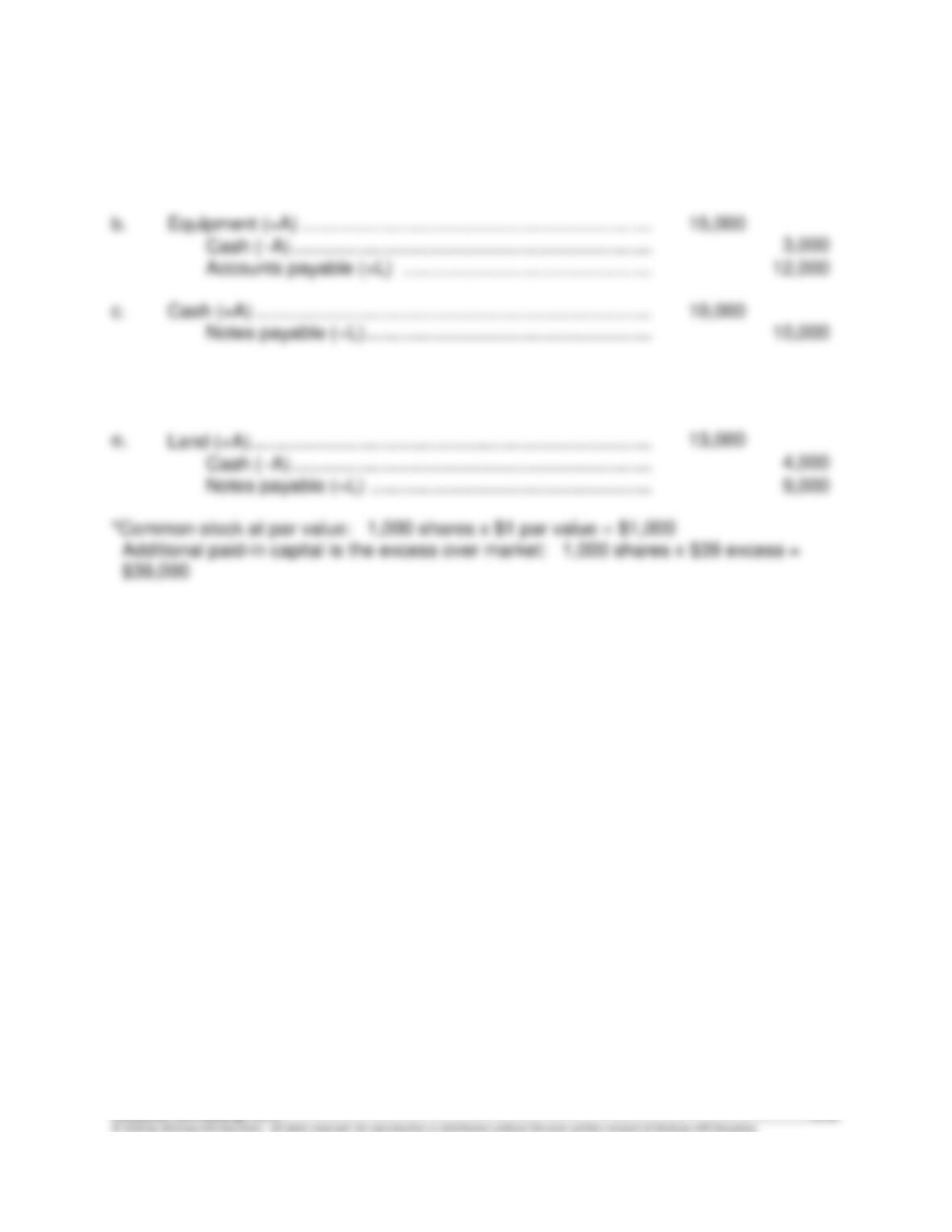
a.
Buildings
Equipment
Cash
+303
+1,202
– 432
Notes payable
(long–term)
+1,073
b.
Cash
+695
Common stock
Req. 2
The separate entity assumption states that transactions of the business are separate
Financial Accounting, 10/e 2-15
E2–6.
a.
Cash (+A) ………………………………………………………………….
40,000
Common stock (+SE)* …………………………………………..
Additional paid-in capital (+SE) …………………………
1,000
39,000
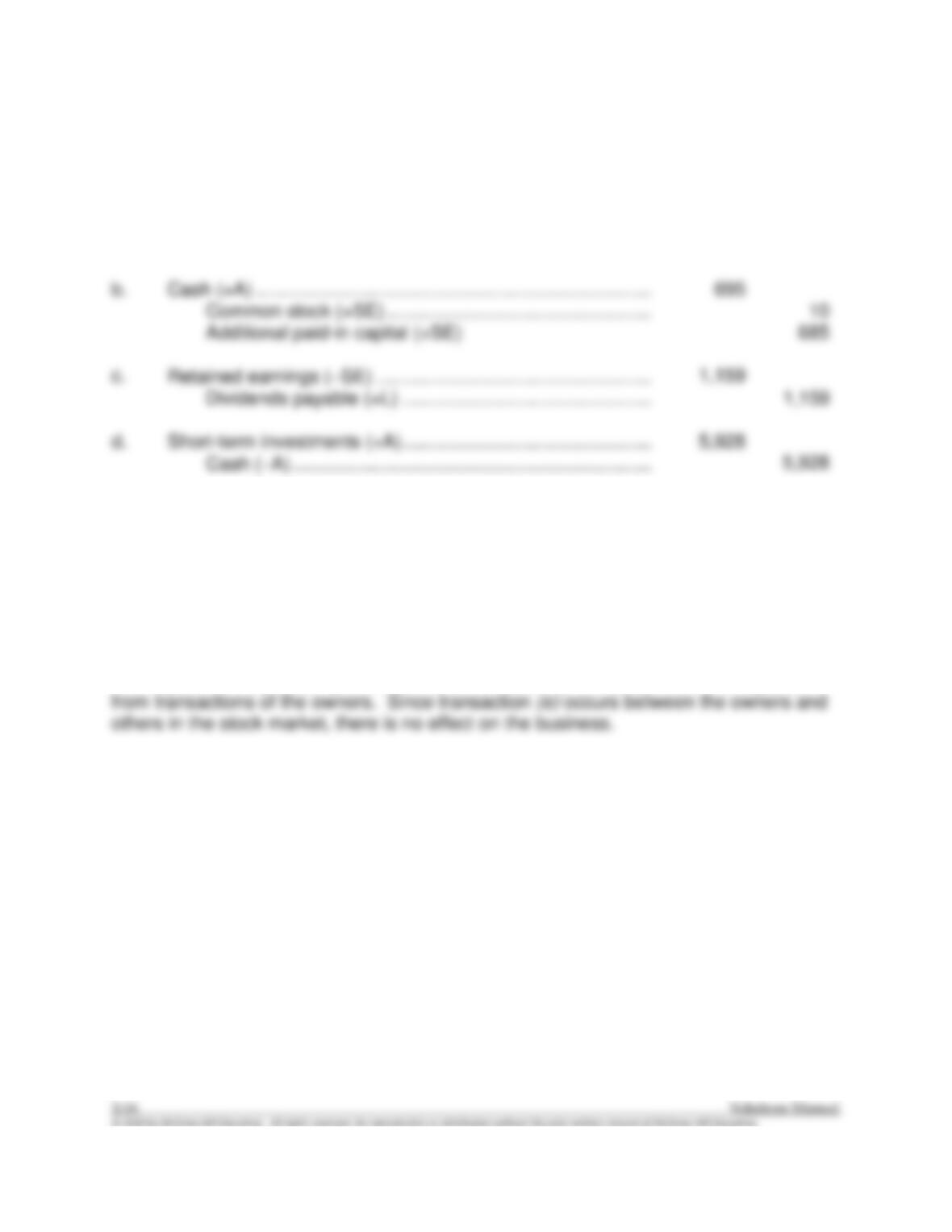
b.
Equipment (+A) ………………………………………………………….
15,000
c.
Cash (+A) ………………………………………………………………….
10,000
d.
Notes receivable (+A) …………………………………………………
Cash (−A) …………………………………………………………..
800
800
E2–7.
Req. 1 (dollars in millions)
a.
Buildings (+A) …………………………………………………………….
303
Equipment (+A) …………………………………………………………
1,202
Cash (−A) ……………………………………………………………
432
Notes payable (+L) ………………………………………………
1,073
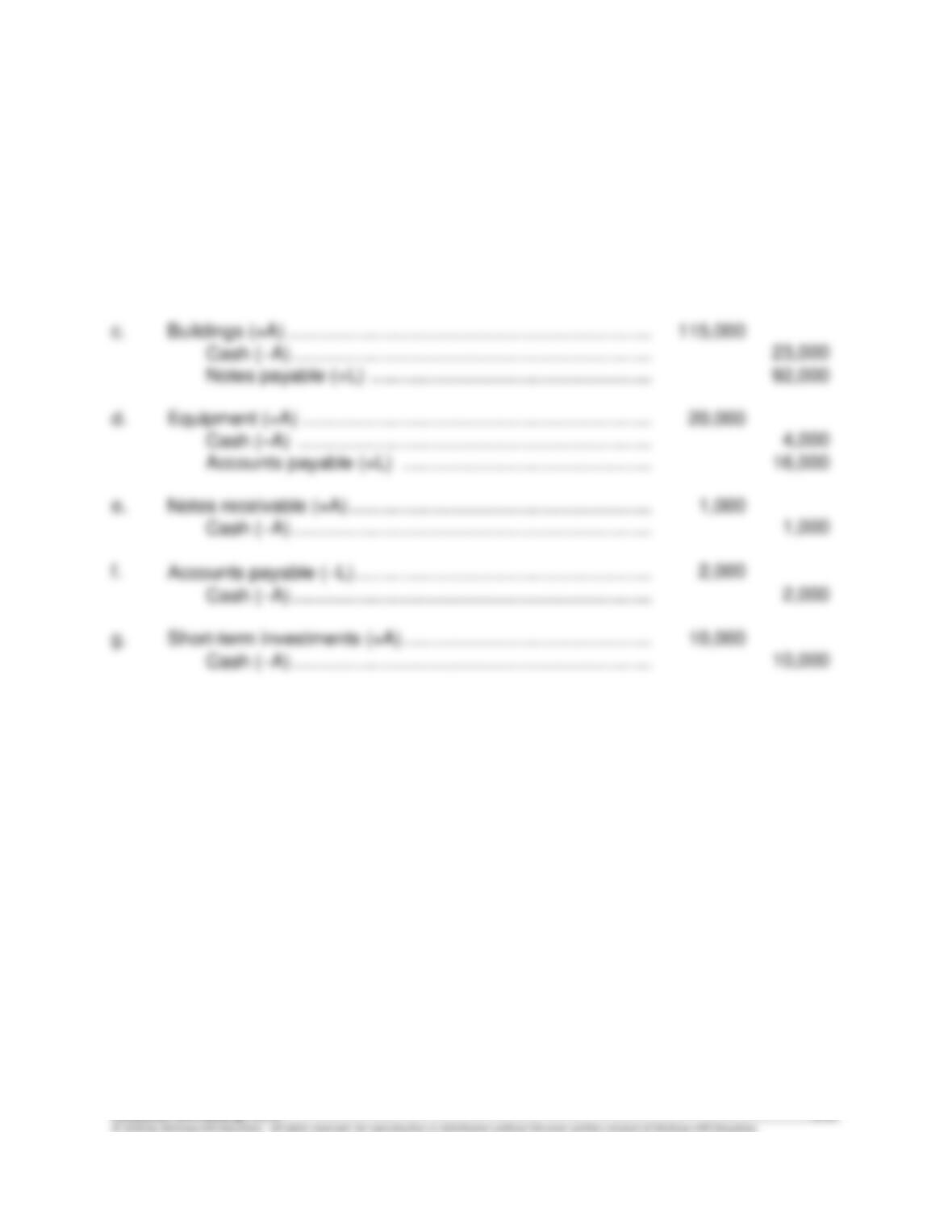
b.
Cash (+A) ………………………………………………………………….
695
Additional paid-in capital (+SE)
Dividends payable (+L) …………………………………………
d.
Short-term investments (+A) …………………………………………
Cash (−A) ……………………………………………………………
e. No journal entry required.
f.
Cash (+A) ………………………………………………………………….
2,423
Short-term investments (−A) ………………………………….
2,423
Req. 2
The separate entity assumption states that transactions of the business are separate
Financial Accounting, 10/e 2-17
E2–8.
Req. 1
a.
Cash (+A) …………………………………………………………………
30,000
Notes payable (+L) ……………………………………………..
30,000
b.
Cash (+A) (500 shares x $30 market value per share) ……..
15,000
Common stock (+SE) (500 shares x $0.10 par value) ..
Additional paid-in capital (+SE) (difference) ……………..
50
14,950
c.
Buildings (+A) …………………………………………………………….
d.
Equipment (+A) ………………………………………………………….
20,000
Accounts payable (+L) …………………………………………
16,000
e.
Notes receivable (+A) ………………………………………………….
g.
Short-term investments (+A) …………………………………………
10,000
E2–9.
Req. 1
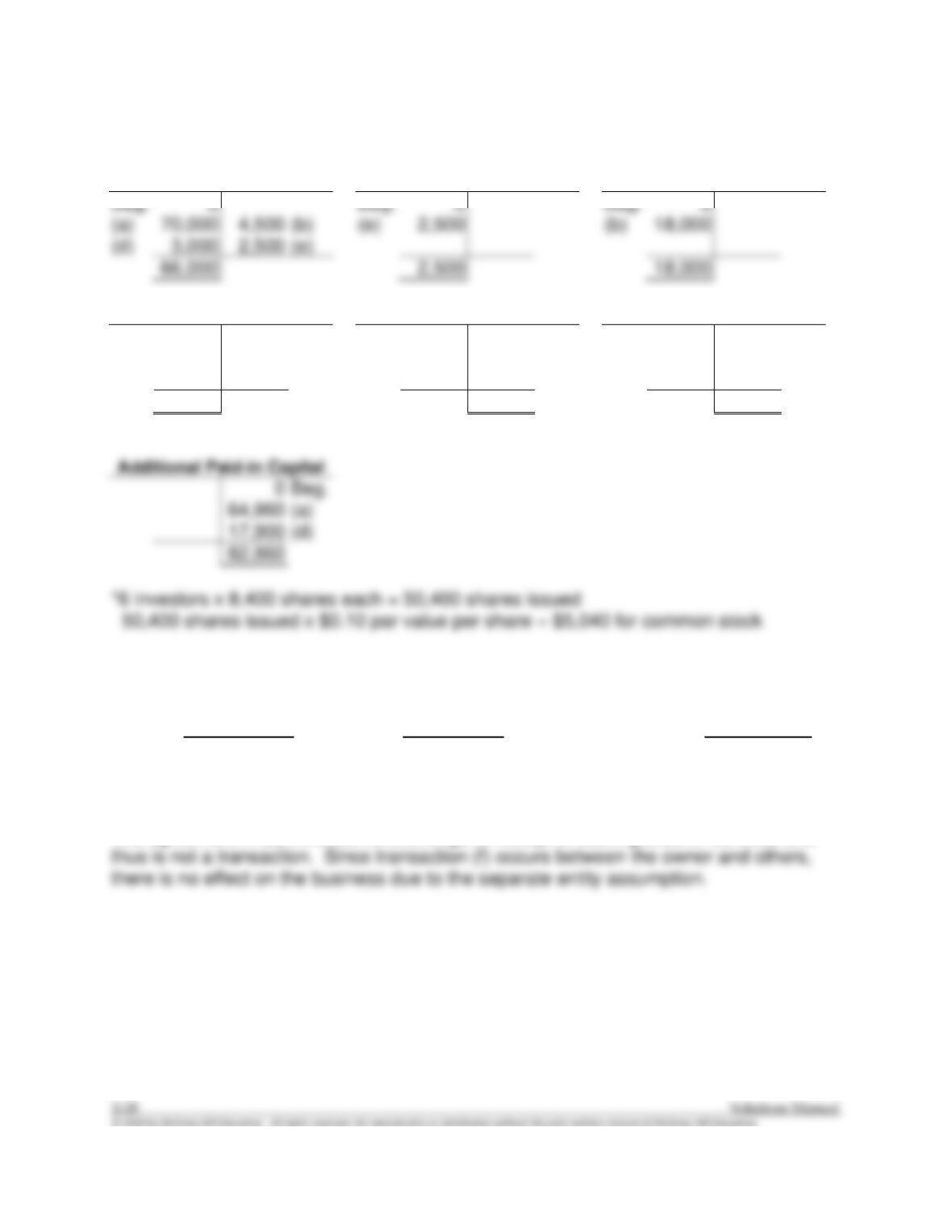
Cash
Notes Receivable
Equipment
Beg.
0
Beg.
0
Beg.
0
(a)
70,000
(b)
(e)
2,500
(b)
18,000
(d)
(e)
66,000
2,500
18,000
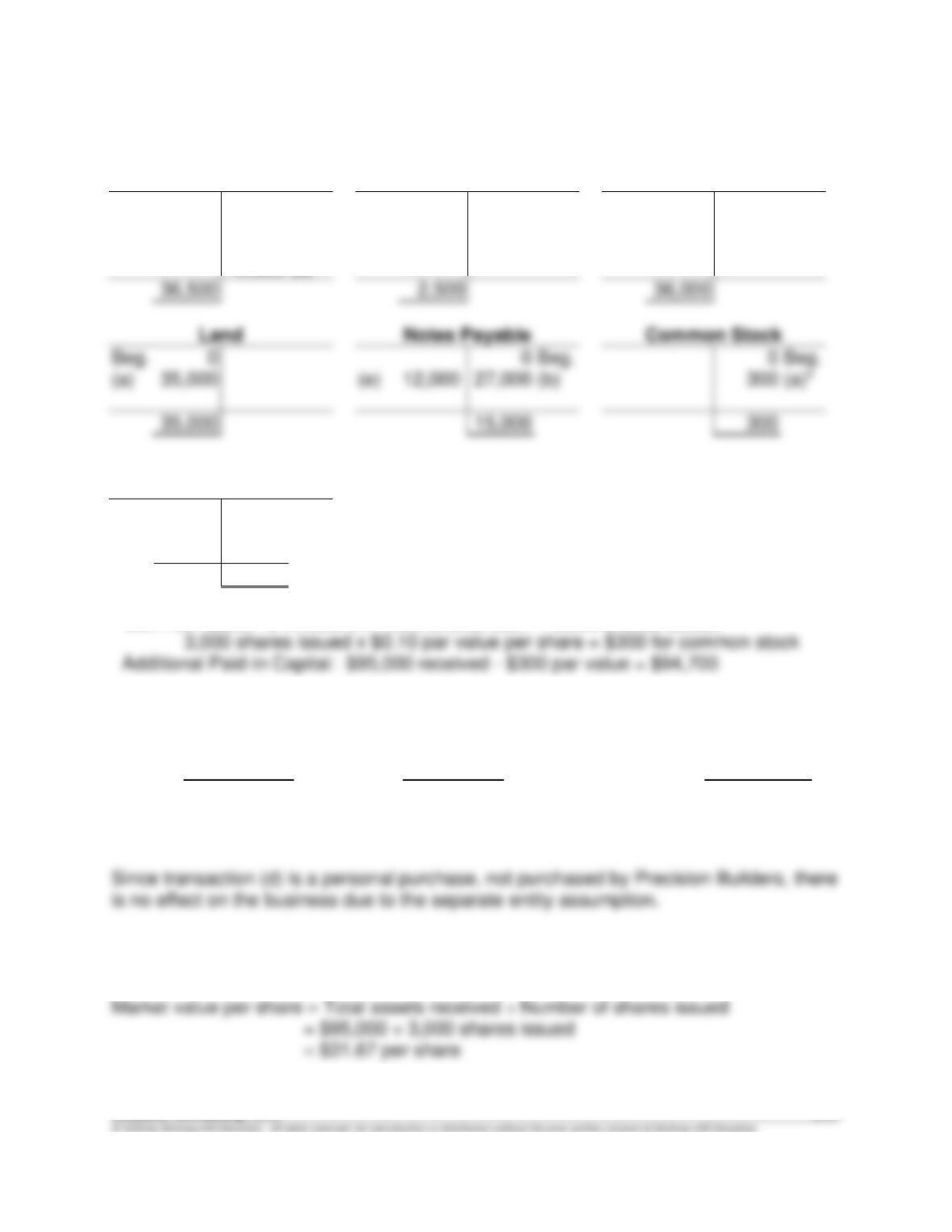
Land
Notes Payable
Common Stock
Beg.
0
0
Beg.
0
Beg.
(d)
15,000
13,500
(b)
5,040
(a)*
100
(d)
15,000
13,500
5,140
0
Beg.
64,960
(a)
17,900
(d)
82,860
Req. 2
Assets $ 101,500 = Liabilities $ 13,500 + Stockholders’ Equity $ 88,000
Req. 3
The agreement in (c) involves no exchange or receipt of cash, goods, or services and
Financial Accounting, 10/e 2-19
E2–10.
Req. 1
Cash
Notes Receivable
Equipment
Beg.
0
Beg.
0
Beg.
0
(a)
60,000
9,000
(b)
(c)
2,500
(b)
36,000
2,500
(c)
12,000
(e)
2,500
36,000
Land
Beg.
0
0
Beg.
0
Beg.
(a)
35,000
(e)
12,000
27,000
(b)
(a)*
35,000
Additional Paid-in Capital
0
Beg.
94,700
(a)*
94,700
* Common Stock: 3 investors x 1,000 shares each = 3,000 shares issued
Req. 2
Assets $ 110,000 = Liabilities $ 15,000 + Stockholders’ Equity $ 95,000
Req. 3
Req. 4
E2–11.
Req. 1
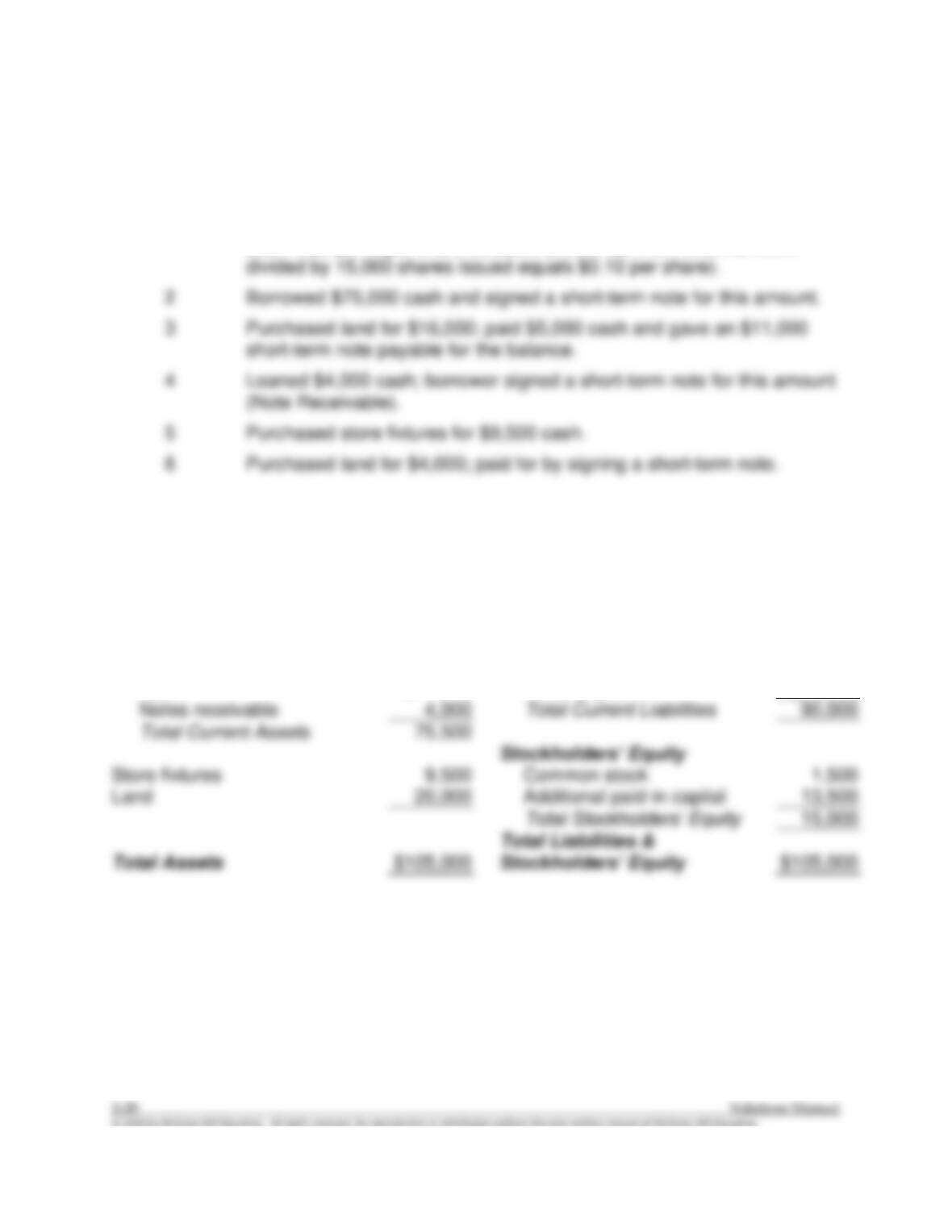
Transaction
Brief Explanation
1
Purchased land for $16,000; paid $5,000 cash and gave an $11,000
Loaned $4,000 cash; borrower signed a short-term note for this amount
Issued common stock to shareholders for $15,000 cash. (FastTrack
Sports Inc. is a corporation because it issues stock. Par value of the
stock was $0.10 per share because $1,500 common stock amount
Req. 2
FastTrack Sports Inc.
Balance Sheet
At January 7
Assets
Liabilities
Current Assets
Current Liabilities
Cash
$71,500
Notes payable
$90,000
Notes receivable
Land
Additional paid-in capital
Total Assets