Financial and Managerial Accounting, 9th Edition
2-1
CHAPTER 2
ACCOUNTING FOR BUSINESS TRANSACTIONS
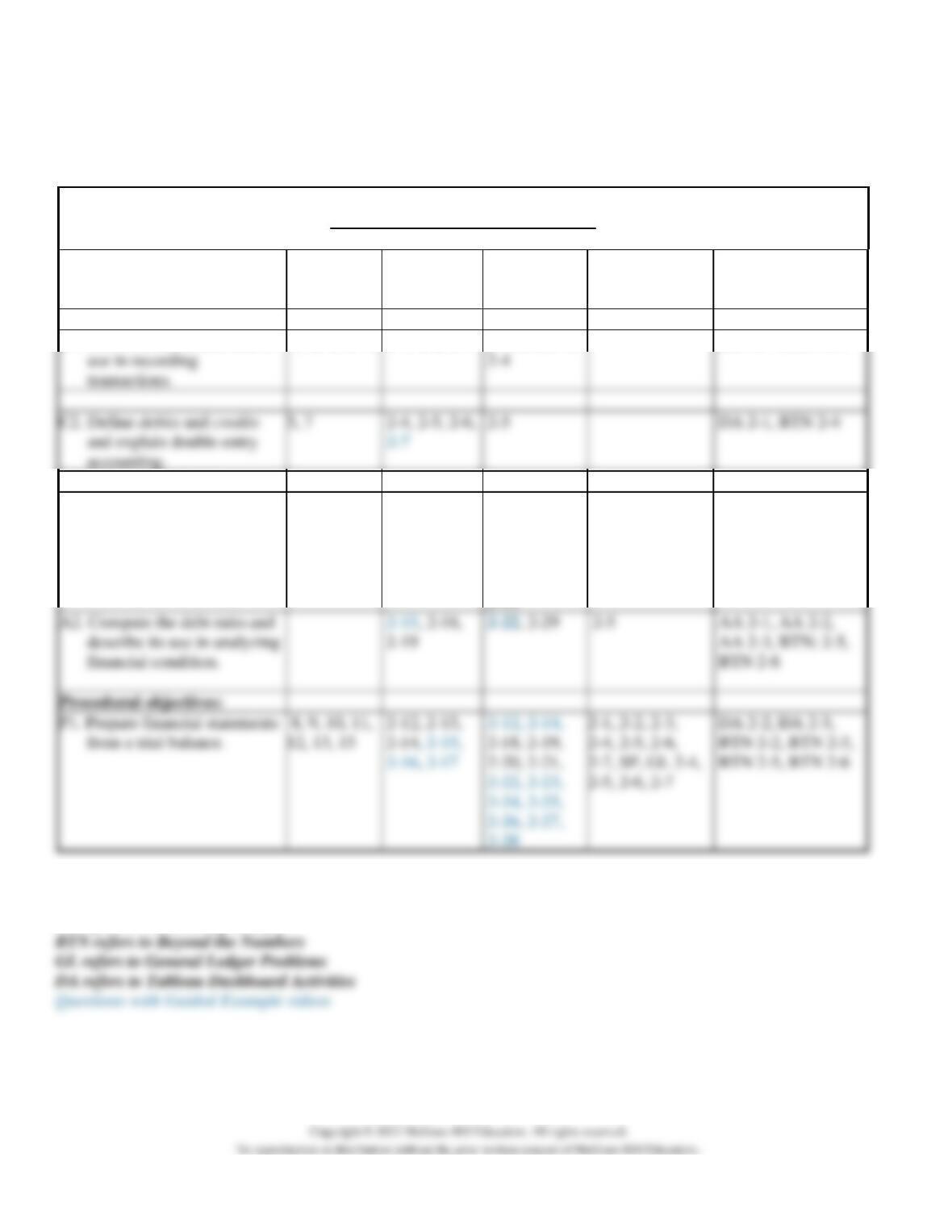
Related Assignment Materials
Student Learning Objectives
Questions
Quick
Studies*
Exercises*
Problems*
AA, BTN, DA
Conceptual objectives:
C2. Define debits and credits
5, 7
2-4, 2-5, 2-6,
2-5
DA 2-1, BTN 2-4
C1. Describe an account and its
1, 2, 3, 4, 14
2-1, 2-2, 2-3
2-1, 2-2, 2-3,
BTN 2-1, BTN 2-4
Analytical objectives:
A1. Analyze and record
transactions and their impact
on financial statements.
.
6
2-8, 2-9, 2-10
2-11
2-6, 2-7, 2-8,
2-9, 2-10,
2-11, 2-13,
2-15, 2-16,
2-17, 2-18,
2-19
2-1, 2-2, 2-3,
2-4, 2-6, SP,
GL: 2-2, 2-3, 2-4,
2-6, 2-7, 2-8
AA 2-1, AA 2-2,
BTN 2-4
2-19
AA 2-3, BTN: 2-5,
BTN 2-6
Procedural objectives:
2-20, 2-21,
2-7, SP, GL 2-4,
BTN 2-5, BTN 2-6
*See additional information on next page that pertains to these quick studies, exercises, and problems.
SP refers to the Serial Problem
AA refers to Accounting Analysis
Asset Accounts
3:43
1:37
1:40
1:34
C2
Define debits and credits and explain double-entry accounting.
Financial and Managerial Accounting, 9th Edition
Additional Information on Related Assignment Material
See Chapter 1 of the Instructor’s Resource Manual for more information on materials for this text available
in Connect.
Connect
Available on the instructor’s course-specific website, Connect:
• All numerical Quick Studies, all Exercises and Problems Set A. Connect also provides algorithmic
Hints/Guided Examples
Please note that the Guided Examples are labeled as “Hints” in Connect assignments. The animated
PowerPoints without the video and audio functions for the Guided Examples are also available in the Connect
Need-to-Know Videos
LO
Need–to-Know
Title
Time
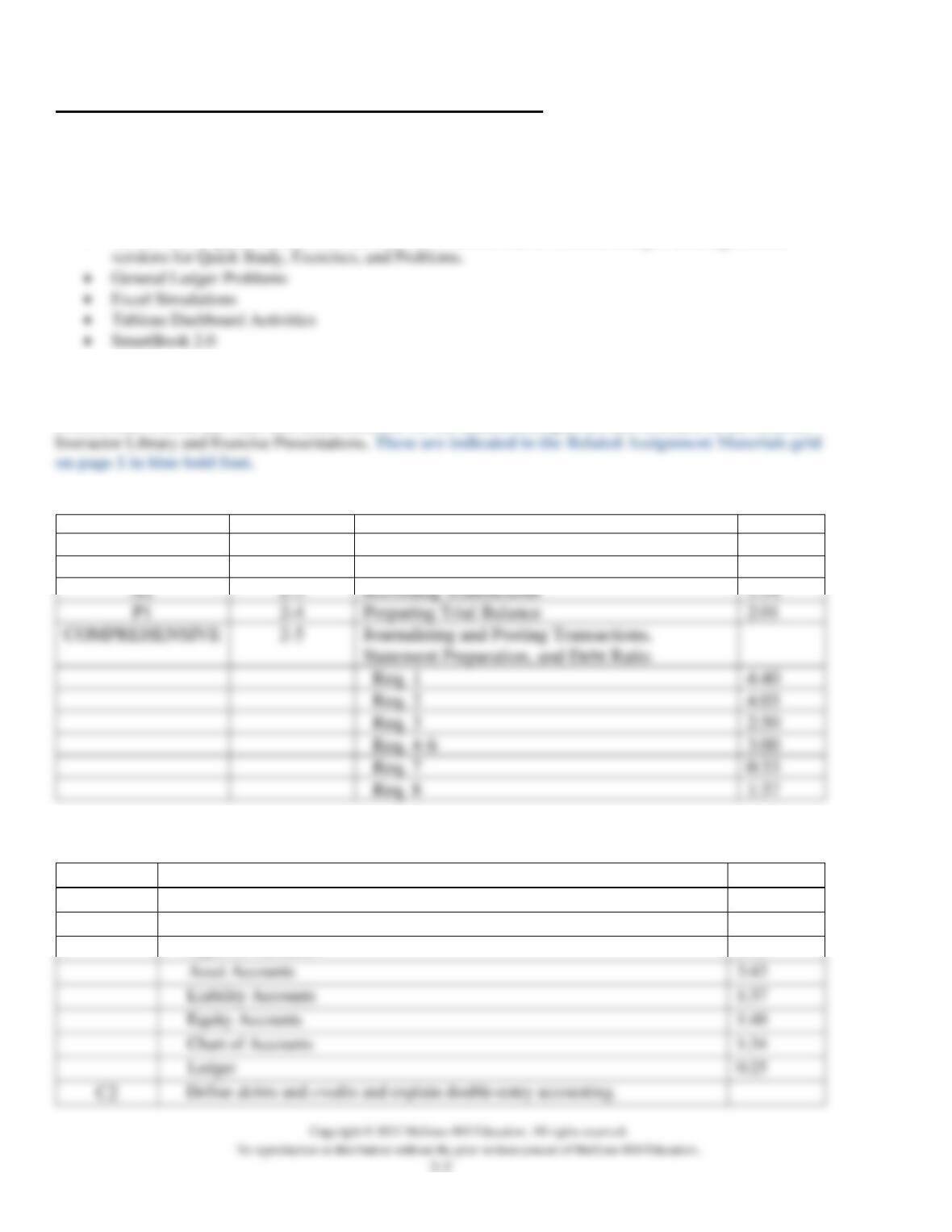
C1
2-1
Classifying Accounts
1:34
C2
2-2
Normal Account Balance
2:54
2-3
Recording Transactions
1:54
2-4
Preparing Trial Balance
2:01
Statement Preparation, and Debt Ratio
Req. 1
4:40
Req. 2
4:03
Req. 3
2:50
Req. 4-6
3:00
Req. 7
0:33
Req. 8
1:37
Concept Overview Videos
Each video is paired with a Knowledge Check question.
LO
Title
Time
C1
Describe an account and its use in recording transactions.
Source Documents
1:17
Types of Accounts
0:45
Financial and Managerial Accounting, 9th Edition
2-3
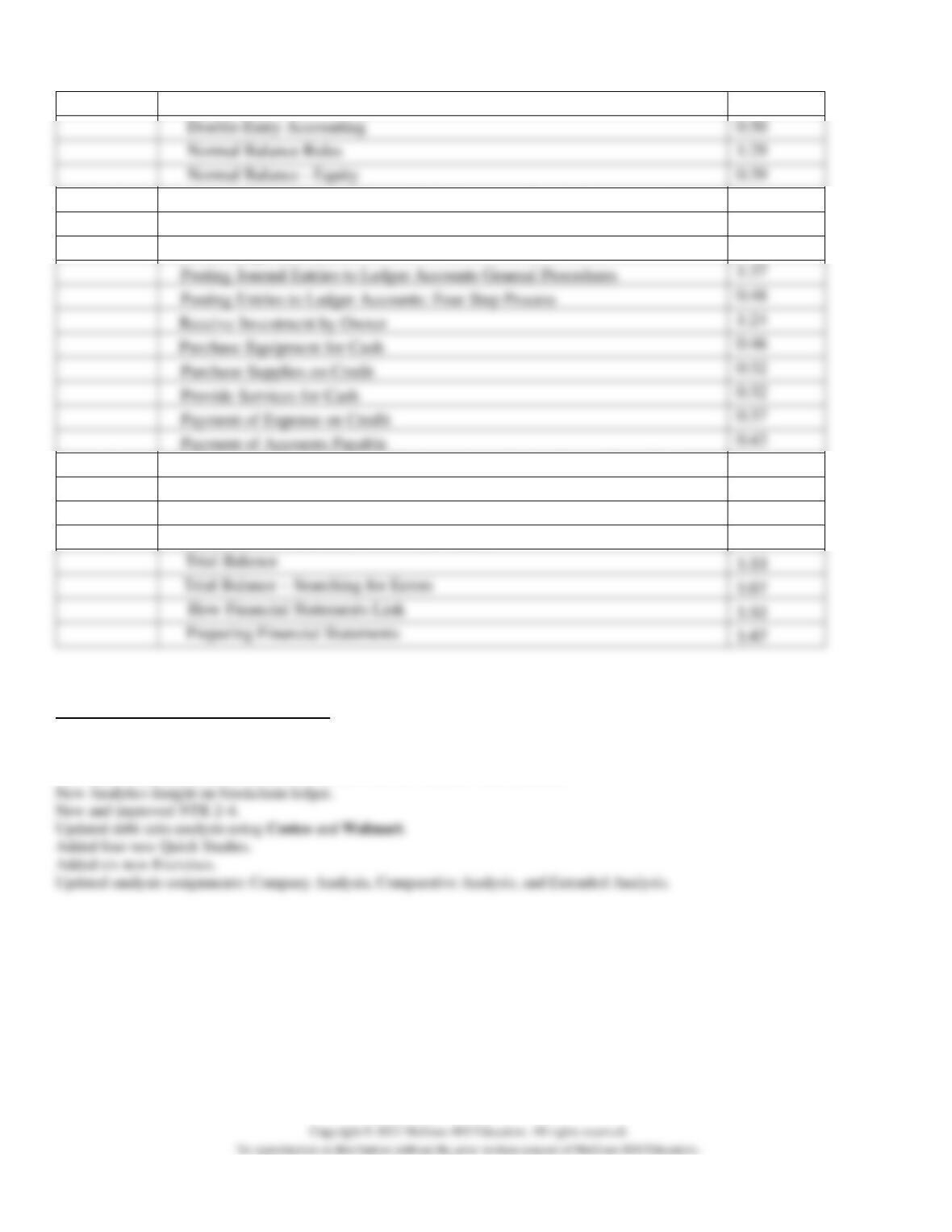
T-accounts
0:48
Double-Entry Accounting
0:50
Normal Balance Rules
1:29
Normal Balance – Equity
0:39
A1
Analyze and record transactions and their impact on financial statements.
Accounting Process
0:21
Journalizing Transactions
1:30
1:37
0:48
1:24
0:46
0:32
0:32
0:37
0:43
A2
Compute the debt ratio and describe its use in analyzing financial condition.
Financial Statement Data
1:18
Debt Ratio
1:13
P1
Prepare financial statements from a trial balance.
Trial Balance
Trial Balance – Searching for Errors
How Financial Statements Link
Synopsis of Chapter Revisions
NEW opener—Stitch Fix and entrepreneurial assignment.
Streamlined learning objectives.
New and enhanced Exhibit 2.1 shows the relation between balance sheet accounts.
Financial and Managerial Accounting, 9th Edition
Chapter Outline
I. Basis of Financial Statements
A. The process to go from transactions and events to financial statements includes the following:
1. Identify each transaction and event from source documents.
B. Source Documents—identify and describe transactions and events entering the accounting system.
1. Assets—resources owned or controlled by a company that have future economic benefit. Examples
include Cash, Accounts Receivable, Note Receivable, Prepaid Expenses, Prepaid Insurance,
2. Liabilities—claims by creditors against assets, which means they are obligations to transfer assets
or provide products or services to others. Examples include Accounts Payable, Note Payable,
Unearned Revenues, and Accrued Liabilities.
3. Equity—an owner’s claim on a company’s assets is called equity, stockholders’ equity or
shareholders’ equity. Examples include Common Stock, Dividends (decreases equity),
Revenues from providing goods or services; i.e., Sales, Fees Earned, (increases equity), and
III. Double-Entry Accounting
Double-entry accounting demands the accounting equation remain in balance. This means that for each
transaction (1) at least two accounts are involved with at least one debit and one credit and (2) total
amount debited must equal the total amount credited.
A. Debits and Credits
1. A T-account represents a ledger account and is used to understand the effects of one or more
account.
Financial and Managerial Accounting, 9th Edition
2-5
3. The right side of an account is called the credit side. A credit is an entry on the right side of an
account.
4. Accounts are assigned balance sides based on their classification or type.
B. Double-Entry System—requires that each transaction affect, and be recorded in, at least two
accounts. The total debits must equal the total credits for each transaction.
1. The assignment of balance sides (debit or credit) follows the accounting equation.
a. Assets are on the left side of the equation; therefore, the left, or debit, side is the normal
balance for assets.
IV. Analyzing and Processing Transactions
A. Journalizing and Posting Transactions
Four steps in processing transactions are as follows:
1. Identify transactions and source documents.
3. Record journal entry—recorded chronologically. A journal gives us a complete record of each
transaction in one place.
a. A General Journal is the most flexible type of journal because it can be used to record any
4. Post entry to ledger—process of transferring entries from the journal to the ledger.
a. Debits are posted as debit, and credits as credits to the accounts identified in the journal
entry.
Financial and Managerial Accounting, 9th Edition
2-6
V. Trial Balance
A. A trial balance is a list of all ledger accounts and their balances (either debit or credit) at a point
in time. Account balances are reported in their appropriate debit or credit columns of the trial
balance.
D. Searching for Errors: when a trial balance does not balance, an error has occurred and must be
corrected. Follow these steps:
1. Verify that the trial balance columns are correctly added.
Note: Any errors must be located and corrected before preparing the financial statements.
Financial statements prepared from the trial balance are actually unadjusted
statements. The purpose, content and format for each statement was presented in
Chapter 1. The next chapter will address adjustments.
E. Presentation Issues
1. Dollar signs are not used in journals and ledgers but do appear in financial statements and
VI. Decision Analysis—Debt Ratio
A. Companies finance their assets with either liabilities or equity.
B. A company that finances a relatively large portion of its assets with liabilities has a high degree
Financial and Managerial Accounting, 9th Edition
2-7
Chapter 2 Alternate Demonstration Problem
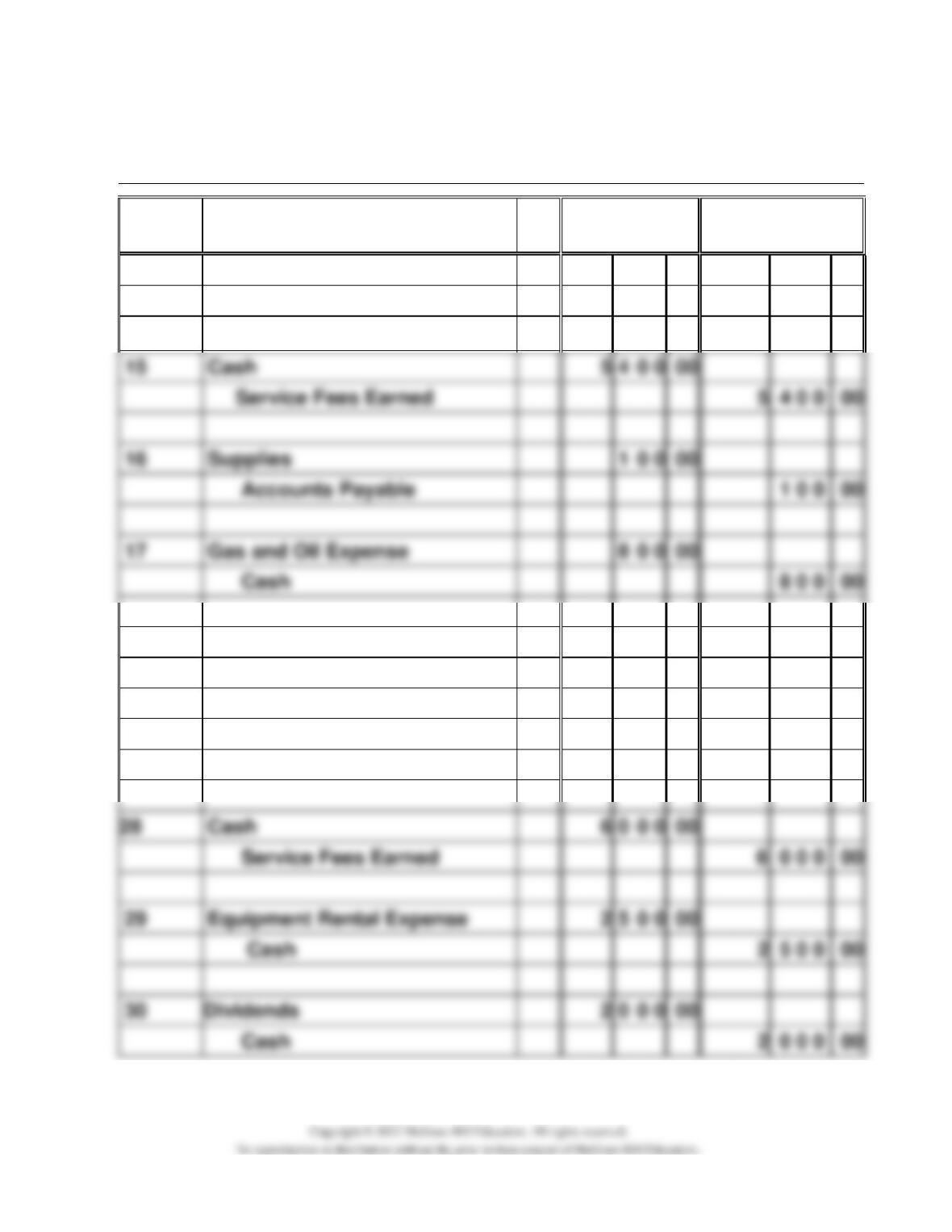
Record the following transactions of Speedy Computer Service, owned by Bill
Smith, for the month of March 2021.
Mar 1. Bill Smith invested $3,000 cash in exchange for common stock to start
the business.
15. Bill provided services and received cash amounting to $5,400 from
customers.
Required:
1. Record the above transactions in general journal form.
2. Prepare a trial balance after posting the entries to T-accounts (you can
make your own T-accounts).
Financial and Managerial Accounting, 9th Edition
2-8
Chapter 2 Solution: Alternate Demonstration Problem
GENERAL JOURNAL
DATE
ACCOUNT TITLES AND
EXPLANATION
PR
DEBIT
CREDIT
March 1
Cash
3
0
0
0
00
Common Stock
3
0 0 0
00
15
Cash
5
4
0
0
00
Service Fees Earned
5
4 0 0
00
16
Supplies
1
0
0
00
Accounts Payable
1 0 0
00
17
Gas and Oil Expense
8
0
0
00
Cash
8 0 0
00
18
Salaries Expense
5
0
0
0
00
Cash
5
0 0 0
00
21
Accounts Receivable
6
0
0
00
Service Fees Earned
6 0 0
00
Cash
6
0
0
0
00
Service Fees Earned
6
0 0 0
00
Cash
2
5 0 0
00
30
2
0
0
0
00
Cash
2
0 0 0
00
Financial and Managerial Accounting, 9th Edition
2-9
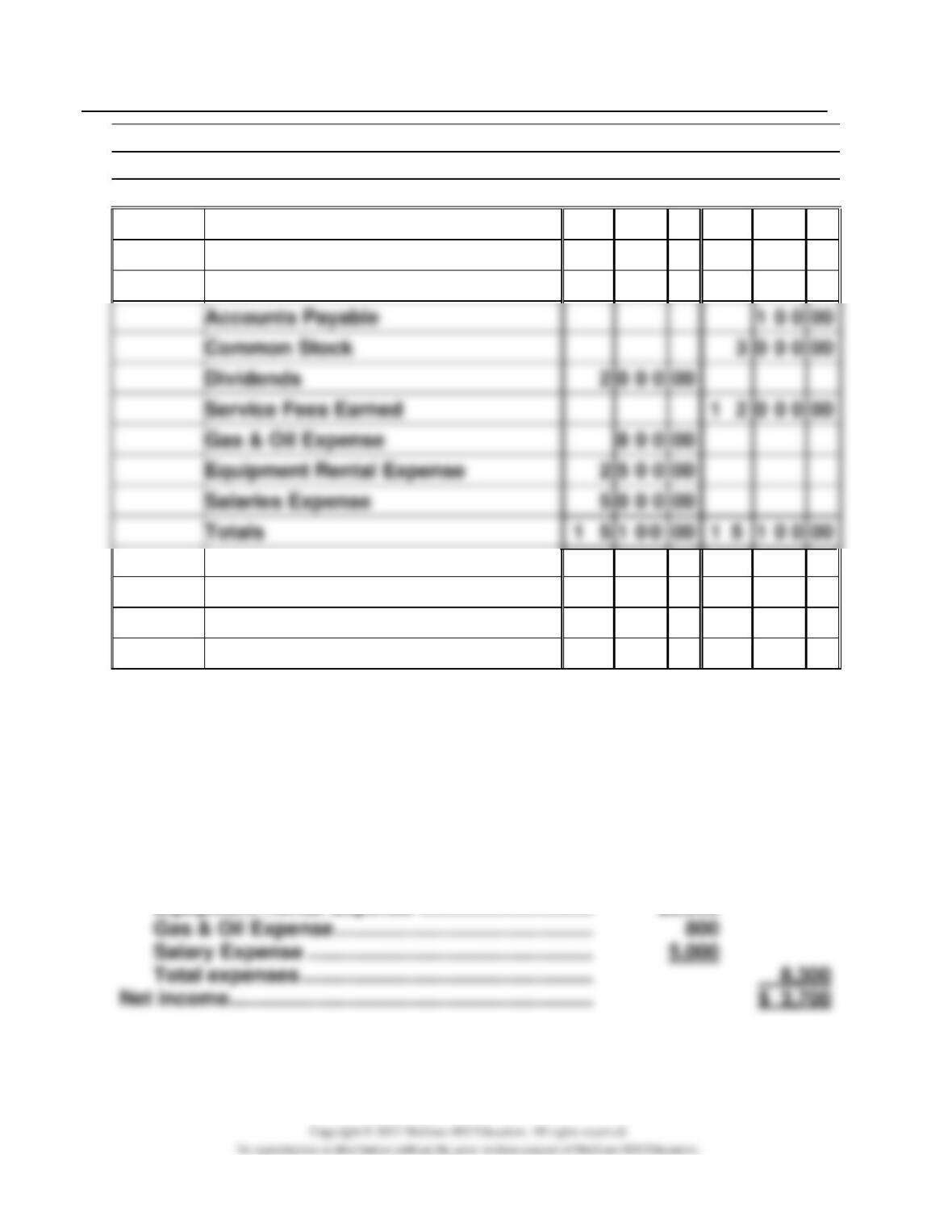
Speedy Computer Service
Trial Balance
March 31, 2022
Cash
4
1
0
0
00
Accounts Receivable
6
0
0
00
Supplies
1
0
0
00
Accounts Payable
1
0
0
00
Common Stock
0
0
0
00
Dividends
2
0
0
0
00
Gas & Oil Expense
8
0
0
00
Equipment Rental Expense
2
5
0
0
00
Salaries Expense
5
0
0
0
00
Totals
1
5
1
0
0
00
1
5
1
0
0
00
3.
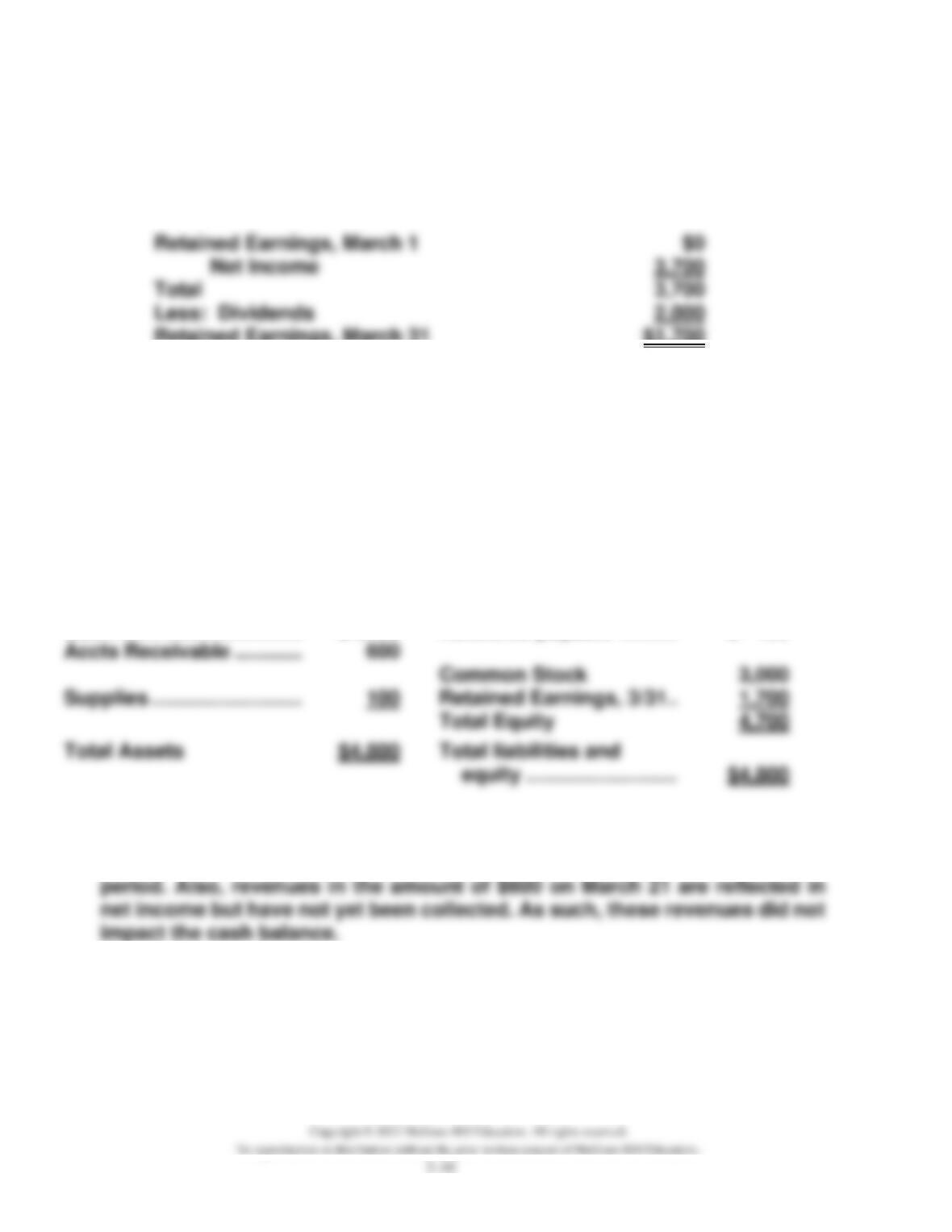
Speedy Computer Service
Income Statement
For the month ended March 31, 2022
Fees Earned ………………………………………………………
$12,000
Expenses:
Equipment Rental Expense ………………………….
$2,500
Salary Expense ……………………………………………
Total expenses …………………………………………….
Financial and Managerial Accounting, 9th Edition
4.
Speedy Computer Service
Statement of Retained Earnings
For the month ended March 31, 2022
Retained Earnings, March 1
Total
Retained Earnings, March 31
$1,700
5.
Speedy Computer Service
Balance Sheet
March 31, 2022
Assets
Liabilities and Owner’s Equity
Cash …………………………...
$4,100
Accounts payable ……….
$ 100
Accts Receivable …………
Common Stock
Supplies ………………………
Retained Earnings, 3/31..
6. First, note that Common Stock of $3,000 and Dividends of $2,000 affect the
cash balance but do not affect the amount of net income earned during the